Seven Nurses Quit Because of the Chief Surgeon—Then Jenna Entered His Operating Room
The whiteboard in the break room at Ridgemont General had seven names crossed out in red marker.
Nobody talked about it. Nobody erased it. The names just sat there, day after day, like a warning nobody had the guts to say out loud.
Jenna Briard saw it her first morning. She read it once, pulled her sleeves down over her wrists out of a habit older than her nursing badge, and went to find the charge desk.
She had driven four hours from the last place she’d worked.
And four hours before that from the place before it.
She collected quiet hospitals the way some people collected distance from things they were no longer willing to look at directly.
Ridgemont was the smallest of the three.
It sat in a midsized Ontario city that smelled like lake water in summer and diesel in winter, and its trauma floor had a reputation that preceded it by about fifteen minutes in any nursing circle that had ever had the misfortune of needing to fill a vacancy there.
The reason for that reputation arrived on the floor at 7:43 in the morning.
White coat pressed. Stethoscope draped with the casual precision of a man who had decided long ago that everything in his line of sight belonged to him.
Dr. Preston Alt moved through Ridgemont General the way glaciers moved through valleys.
Slowly. Completely. And with a tendency to grind down everything soft in his path without registering that anything had been lost.
He was sixty-one. Silver-haired. The kind of man who had photographs on his office wall of himself shaking hands with people whose names he routinely dropped in conversation.
His surgical outcomes were exceptional.
His conduct was not.
He spotted Jenna at the supply cart within two minutes of arriving on the floor.
The way men like him spotted anything new and therefore not yet categorized.
“Number eight,” he said. Not to her. To the resident standing behind him. The way a man announces an interesting feature of a landscape he is passing through. “Let’s see how long this one manages.”
The resident laughed.
The obedient laugh of someone who had learned that laughing along cost less than staying straight-faced.
A few of the other staff found something important to look at on their clipboards.
Jenna counted a stack of IV bags she did not need to count and said nothing.
She had been called worse by men who outranked Preston Alt in every category that mattered, and she had outlasted all of them in the only field where it counted.
She filed the comment under information and went back to work.
—
The morning passed the way mornings passed in a hospital that ran on hierarchy instead of decency.
Alt corrected her documentation in front of a patient’s daughter, loudly enough that the hallway heard, though her documentation had been correct.
He told a third-year resident that competent nurses did not ask twice, glancing at Jenna as he said it, though she had asked nothing.
He passed her supply cart three times without acknowledging she was a person standing beside it, which she found privately the least offensive thing he had done before noon.
She understood by lunch why seven women had walked out before her.
It was not any single moment.
It was the accumulation of them. The careful daily reduction. The way a man could make you feel like furniture by treating you like furniture consistently enough and with enough authority that the people around him started to wonder if maybe he was right.
She had a letter in the pocket of her scrubs.
She had written it before starting every new position for the past three years and carried it through the first few weeks like a contingency plan, taking it out sometimes, putting it back, trying to decide if she was keeping it as an escape route or as a reminder of why she had not taken one yet.
Gillian Shaw found her in the medication room around two in the afternoon.
Restocking a tray with the kind of quiet, systematic precision that came from either extensive training or an extreme desire not to be spoken to.
Gillian was the only nurse on the floor who had survived Alt longer than four months, which she wore not as a badge of honor, but as evidence of a stubbornness she had long since stopped pretending was a virtue.
“You’re going to blow a blood vessel holding your jaw like that,” Gillian said, settling against the counter with a coffee she had been nursing since morning.
Jenna glanced up briefly. “I’m fine.”
“You are about the least fine person I have met this calendar year,” Gillian said pleasantly. “Which is saying something because I work with Alt. The rigid shoulders. The sleeves in a thirty-degree stock room. The look you get every time he opens his mouth, like you’re deciding whether to respond or just let the moment pass. You’re letting a lot of moments pass.”
“That’s generally the plan,” Jenna said.
Gillian studied her the way long-experienced nurses studied things they were not sure about but had not yet given up on.
Then she offered a short nod. The nod of a woman extending a provisional trust.
“Fair enough. Welcome to Ridgemont. The coffee is terrible and Alt makes grand rounds feel like a performance review for a job you didn’t apply for. But the patients are worth it. Mostly.”
She paused.
“Watch your back tonight. He’s been in a mood since the board meeting last week. Something about an accreditation timeline.”
Jenna filed that too and went back to work.
—
Late afternoon brought her to room nine.
A seventy-eight-year-old retired sergeant named Cecil Maguire had been admitted two days earlier with a hip fracture that had turned out to be more complicated than the initial film suggested.
Cecil had done three tours before the army decided it could manage without him.
And he talked about those years constantly. Without self-pity and without nostalgia. Just with the particular clarity of someone who had processed his own history thoroughly enough to discuss it like weather.
Most of the floor staff had developed a pattern of nodding at the doorway and moving on.
Jenna sat.
“You’re the first one today who actually came in,” Cecil said when she checked his chart. “The others stick their heads in, make sure I haven’t fallen out of bed, and disappear. You sat down.”
“I’m less busy than I look,” Jenna said.
“No,” Cecil said, watching her hands move through vitals with a focus that was not quite clinical and not quite personal. “No, you’re not. You’re somebody who has learned how to look less busy than they are. I knew fellows like that. Usually, they were the ones you wanted in the seat next to you when things went sideways.”
Jenna said nothing, but she also did not stand to leave.
And Cecil seemed to understand that as sufficient.
He told her about a patrol outside Kandahar in 2007. About a medic who had kept a man alive with a piece of field dressing and what Cecil referred to diplomatically as an improvised device that had no business working as well as it did.
He talked about it with the same calm precision he might have used to describe a plumbing repair.
And Jenna listened without consulting the clock once.
—
She was heading back to the floor when the trauma pager went off.
It was not the ordinary sound.
Or rather, it was the ordinary sound, but something underneath it made Jenna stop walking entirely for half a second before she started moving again in a different direction and at a different speed.
“Incoming,” the radio at the desk said. “Federal coordination. Single patient. Male. Blast and penetrating trauma. ETA six minutes. Military liaison has been notified. No additional information is being released at this time.”
Jenna felt something settle into her spine.
An old, cold, precise settling. The kind that happened when the part of her she had spent three years painting over with routine and paperwork and polite silence recognized the shape of something it had dealt with before.
She moved.
—
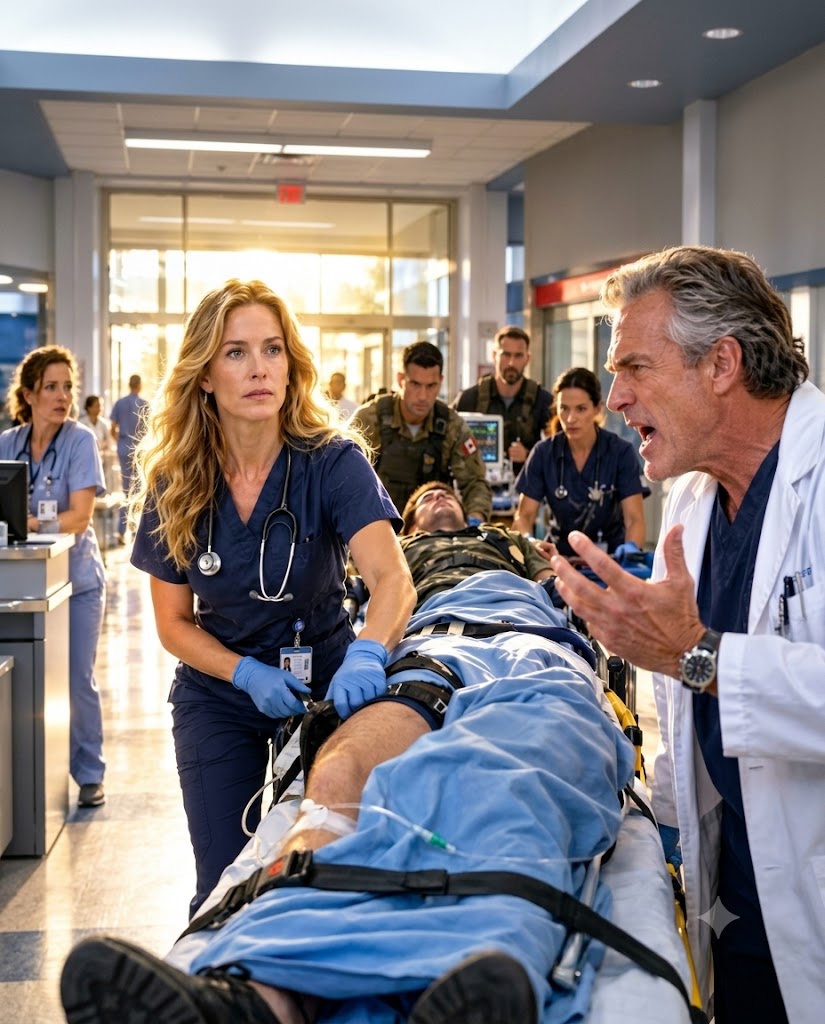
The vehicles came in through the ambulance bay at precisely seventeen minutes to five.
Two dark SUVs with no markings and four people who moved the way that particular category of professional always moved.
Heads tracking. Eyes reading exits and angles. Posture relaxed only to someone who was not paying attention.
They had a gurney between them.
And the man on it was young. Maybe twenty-four. Dressed in civvies that had been cut away at the thigh and the torso to expose wounds that were each by themselves serious, but which together were adding up to something.
The body was beginning to run out of capacity to negotiate with.
Alt arrived at a controlled jog, coat open, voice already carrying the authority of a man composing his surgical plan aloud as he walked.
“Get him to bay three. Someone page anesthesia. Prepare for exploratory laparotomy. We’re dealing with an abdominal penetration and we move him now.”
Jenna looked at the patient’s face.
At his skin color. The specific gray of someone whose circulatory system was diverting resources toward the center and away from everything else.
At his breathing. Fast and shallow. The body’s last form of honest communication before it stopped communicating at all.
At the wound.
Alt was not looking at a smaller puncture high on the inner left thigh, where the fabric of his trousers was soaked in a pattern that had a rhythm to it.
“Arterial,” she said.
The word was not loud. It did not need to be.
Alt turned. The look on his face was the look of a man who had not expected to be interrupted and was recalculating how to handle the source of the interruption.
“Excuse me, nurse?”
“He’s losing from the leg, not the abdomen,” Jenna said, already moving. “The abdominal wound is serious, but it’s not what kills him in the next two minutes. This is.”
She had the tourniquet from the emergency kit on his thigh before Alt finished forming his response.
Her hands working with a precision that came from a place in her body entirely below conscious decision-making.
High and tight above the wound. Firm and even. Checked twice.
She noted the time aloud so that whoever took over would have it.
The bleeding slowed. Then stopped.
The change in the patient’s color was visible within seconds. Some of the gray pulling back. His pulse at the throat steadying fractionally from the frantic flutter of a system in free fall toward something that still had a chance.
One of the men who had arrived with the SUVs stepped forward.
He was broad through the shoulders and still in the way of a man who had been trained to be still even when his body wanted to do something else entirely.
He watched Jenna’s hands for a long moment before he looked at her face.
“Where did you learn that?” he said quietly.
Jenna did not answer.
She was already calling out vitals. Already reaching for a secondary pressure dressing. Already running the kind of internal calculation she had told herself three years ago she would never have to run again.
“Get him to bay three,” she said to the resident standing frozen at the supply cart now. “And bring that tourniquet time with you because it matters more than you think.”
They moved him.
The broad-shouldered man walked alongside the gurney, matching pace with Jenna, watching her with the particular attention of someone recognizing a language they had not expected to hear in this context.
He said his name was Rook. The way some people said a name that was not quite a name and expected you to understand that the distinction was important.
“That’s Patch,” he said, nodding at the gurney. “He’s mine to bring home. You just gave him a better shot at that than anyone else in this building would have.”
“He’s not home yet,” Jenna said.
“No,” Rook agreed. “But he’s closer.”
She walked with Patch to the bay doors and handed him to the surgical team, calling out the tourniquet application time twice to make sure it registered, then stood in the hallway with her scrubs soaked and her hands finally beginning the delayed tremor that adrenaline always produced once it had nowhere urgent to go.
Gillian appeared at her shoulder with a clean set of scrubs and an expression of controlled astonishment.
“Okay,” she said. “I have watched a lot of trauma responses in this building, and I have never seen anything that looked like that. You moved like you already knew where you were going before you got there.”
“I’ve restocked a lot of trauma carts,” Jenna said.
Gillian looked at her for a long moment.
“Sure,” she said. “Absolutely. That’s what that was.”
—
Alt found her at the nurse’s station forty minutes later.
He had changed his coat. His composure was back in place, or close enough to it, though something in his eyes had shifted in the way of a man who had just been embarrassed in front of federal personnel and was deciding how to make sure that did not happen again.
“My office,” he said. “Now.”
The office was small, decorated with commendations and photographs that told the story of a man who had spent twenty years accumulating evidence of his own importance.
He closed the door behind her and stood behind his desk without offering her a chair, which she had expected.
“What you did in that bay was unauthorized,” he said. “You made a clinical determination without physician oversight. I want to be very clear with you about the liability that creates.”
“I stopped an arterial bleed that would have killed him before he reached the table,” Jenna said. “The situation required it.”
“What you did,” Alt said, his voice dropping into the register men used when they wanted to sound reasonable while delivering a threat, “was reveal training this hospital has no record of. I don’t like things I have no record of on my floor, nurse Briard. And I don’t like being made to look uncertain in front of a federal escort on what is ultimately my floor.”
Jenna looked at him steadily.
“What was the alternative?” she asked. “Let him die in the bay while I waited for authorization?”
Alt’s expression did not change, but the air in the room changed slightly. The way it changed when a conversation became something other than what it had announced itself as.
“Seven nurses left this hospital before you arrived,” he said. “I wonder what your threshold is.”
Jenna thought of the letter in her pocket, soft at the folds, and felt something shift in her relationship to it.
Not the urge to use it.
Something closer to the opposite.
“I never planned to be the eighth,” she said, and left his office before he could reclaim the last word.
—
She found Patch’s chart near the recovery bay entrance two hours later, going through it the way she went through everything. Systematically. And in full.
She was nearly finished when she noticed the fragments stapled to the back of the second admission page.
A scanned sheet that did not belong to Patch.
Different patient. Different date.
The surgeon of record, still legible, was Preston Alt.
The outcome field, only partially obscured by a smear of black marker that had not quite completed its job, read: deceased.
She did not touch it.
She memorized the page layout, the shape of the smear, the font of the surgeon field, and put the chart back exactly as she had found it.
Her hands were steady.
Her pulse was not.
She almost said something to Gillian three times before she left the hospital that night.
Each time, the old instinct stopped her. The reflex that said information was a liability until you understood the perimeter of who might be listening.
She drove home in silence and did not sleep.
And in the morning, she asked Gillian one question before either of them had finished their first coffee.
“Has a patient ever died on Alt’s table and had the record handled strangely afterward? Missing pages. Redactions. Anything that felt wrong.”
Gillian put her cup down.
“Where is this coming from?”
“I found something in a chart yesterday,” Jenna said. “A fragment that didn’t belong there. Different patient. Alt as surgeon of record. The outcome field said deceased, and somebody had worked hard to make sure nothing else on the page was readable.”
Gillian was quiet for a long time.
“There was a patient,” she said finally. “Fifteen months ago. Military came in on a similar channel to yesterday. No full record distributed to floor staff. Alt operated. He died. There was an internal review that lasted nine days and then disappeared from the conversation so completely it was like it had never happened. Two nurses who kept asking about it were gone within a month. I told myself they burned out. Now I’m not sure what to tell myself.”
“Do you remember a name?” Jenna said.
“Nadeau,” Gillian said. “I only heard it once. Corporal Eve Nadeau. French Canadian kid. Early twenties. The family never got a straight answer about what happened. I heard that secondhand from someone in administration who should not have been talking, and then never heard it again.”
Jenna sat with that.
With the name. With the weight of a family somewhere who had waited fifteen months for an answer to a question a torn page and a smear of black marker had been designed to make unanswerable.
“I’m not going anywhere,” she said.
Gillian studied her for a moment, then leaned forward and refilled Jenna’s cup without being asked, which was in its own way an answer.
“Good,” she said. “Because I’m tired of watching this place go through nurses the way Alt goes through residents and calling it a high standard.”
—
Rook found her in the visitors’ corridor outside the recovery wing that afternoon, moving with the unhurried ease of a man who was always approximately where he had meant to be.
“Patch is stable,” he said. “You should know that he’s going to be home for his daughter’s birthday next month because of what you did yesterday.”
Jenna nodded.
She was glad.
She was also thinking about Corporal Nadeau and what it meant that his name had surfaced in the same building where a different young soldier was going to make it home.
Rook seemed to read something in her silence that she had not intended to broadcast.
“You found something,” he said.
She told him about the torn page. About Nadeau. About the two nurses who had stopped asking questions and then stopped showing up.
She told him in the particular compact form of someone who had learned to communicate necessity without decoration.
Rook listened without interrupting.
When she finished, he was quiet for a few seconds.
“I know that name,” he said. “Everyone in the community knows that name. He went in for a wound that should not have killed him. The official story was complications. Nobody with his background believed that, but the hospital made sure there was nothing left to look at. I’ve been trying to locate the record for eight months.”
He paused.
“If it’s here, it’s because somebody was careless in the middle of making it disappear. That tends to happen when the person doing the erasing starts to panic.”
“What would make Alt panic right now?” Jenna said.
“Accreditation review,” Gillian said, appearing behind them with a chart she did not need. “Site visit coming in under two weeks. Full chart audit. The kind that goes back years if the reviewers are thorough.”
Rook absorbed that.
“He’s cleaning house before the inspection,” he said. “Which means if there’s a physical record still in that building, it’s running out of time.”
“So are we,” Jenna said.
—
They did not plan it out loud.
Exactly.
They did not need to.
Jenna understood the shape of what needed to happen the way she understood most things that needed doing. From the inside out. Without a map. With only the training her body had been carrying for years, waiting for her to stop pretending it wasn’t there.
Gillian met her at the service entrance near the loading dock at half past ten that night.
Dressed for a shift she was not scheduled to work. Holding a badge reader borrowed from a contact she declined to name.
“Last opportunity to reconsider,” Gillian said.
“I reconsidered the moment I read the word deceased on a page somebody tried to destroy,” Jenna said. “This is just the rest of it.”
Gillian exhaled.
“Right then. Records archive is two floors down, west wing, past imaging. There’s a camera at the main entrance, but the maintenance corridor along the back wall has a gap in coverage. Don’t ask me how I know that. Just duck at the second junction because there’s a pipe that does not care about anyone’s forehead.”
They moved through the quiet building in the careful, unhurried way of people with a reason to be somewhere and the training not to show it.
Past the glow of monitors in rooms where patients slept.
Past the nurse’s station where a single staff member sat with her back turned, absorbed in documentation that had nothing to do with either of them.
Rook was three floors above them in the recovery wing, watching a hallway feed on a secured device, positioned to move if either of them needed to know something before they knew it themselves.
The records room smelled like compressed time. Filing systems and low light and the particular staleness of things stored long enough to be forgotten.
Jenna found the section for archived surgical cases from fifteen months prior within four minutes.
And found the space where the Nadeau file should have been within thirty seconds of that.
The space held a single index card.
On it, in handwriting she recognized from the surgical notes she had reviewed the previous day, were four words.
*Removed. Authorization: P. Alt.*
He had not just buried the record.
He had begun destroying it.
And the timing of that destruction tracked almost exactly with the appearance of the fragment she had found in Patch’s chart.
A piece of a file dislodged in the rush of a man trying to make evidence vanish before an inspection he had known about for weeks.
She almost missed the second folder.
It was wedged sideways behind an adjacent file. The way things got wedged when someone was moving quickly and not thinking about the detail of what they were leaving behind.
She pulled it free.
*Corporal Eve Nadeau. Admitted with blast fragment injury. Survivable prognosis. Surgical repair performed by Dr. Preston Alt.*
And in the body of the surgical notes, something that made her close her eyes for two full seconds before she kept reading.
An anesthetic dosage recorded in one hand, then crossed out and rewritten in a different pen. A different hand.
Shifting the record from surgeon error to equipment malfunction.
Someone had altered the official notes after the fact.
Someone had helped a man cover up a mistake that had cost a twenty-three-year-old his life.
And then helped him bury the person who would have proved it.
Her radio crackled. Gillian’s voice, barely above a breath.
“Someone in the east corridor. Moving toward you. Go now.”
She photographed eight pages in under forty seconds.
Flash off.
Hands that had stopped shaking three years of practice ago.
Not stopping now either.
She slid the folder back into its exact position and eased the door shut behind her in the same motion, stepping into the maintenance corridor a second before she heard Alt’s footsteps pass within arm’s reach of where she had been standing.
She did not breathe until they reached the stairwell.
Gillian’s hands were trembling.
Jenna’s were not.
“Tell me it was worth it,” Gillian whispered.
Jenna held up the phone.
“He altered the surgical notes after Nadeau died. Different pen. Different hand. He didn’t just fail to report it. He falsified the record with help, then spent fifteen months making sure nobody could prove it.”
Gillian stared at the screen.
“That’s not a tragedy anymore,” she said. “That’s a crime. A deliberate one. Sustained over more than a year. That’s the kind of thing that ends careers and opens investigations.”
Jenna sent the photographs to Rook before she left the building.
His response came back in eleven minutes.
*My contact at the office that handles service member deaths in civilian facilities is reviewing them now. Expect someone by morning.*
—
The federal investigator who arrived at eight the next morning was a woman named Agent Colleen Wyatt.
Who introduced herself with the particular economy of someone for whom introduction was largely a formality, and who looked at Jenna across the small conference table in the administrative wing with the attentiveness of a person reading a great deal more than the words being spoken.
“Your personnel file describes you as a civilian nurse with no prior service record,” Wyatt said. “The tourniquet application in that trauma bay. The records access. The way you’re sitting in this chair right now. That’s not civilian training, Miss Briard.”
Jenna sat with that for a moment.
She thought about Cecil, three floors above them. About the way he had told her once that silence had mass. That it gathered weight the longer it sat.
“I served,” she said. “Army medic, attached to a special operations unit for four years. My call sign was Spectre. I separated after losing someone I couldn’t save, and I spent three years telling myself that becoming invisible was the same as recovering. It wasn’t. It was just smaller.”
Wyatt nodded with the brief respect of a professional receiving a fact she had expected.
“Those are not a nurse’s hands,” she said. “That’s something else. And what you found in that records room is exactly what two previous investigations were missing.”
She paused.
“Thank you for not walking away.”
—
Alt was in the building when the second federal vehicle arrived.
The floor heard it the way hospital floors heard everything. Sideways and in fragments. Rumor and half-sentence and the electricity of a building sensing that something much larger than its ordinary routine was pressing against its walls.
He found Jenna at the nurse’s station.
His composure was visibly fraying. The pressed-coat certainty worn down to something more desperate underneath.
“Whatever you’ve done,” he said, “whatever calls are being made this morning, this traces to you. I want you to understand that you have broken protocols, trespassed in restricted areas, and violated this hospital’s operational integrity.”
“I didn’t alter a dead soldier’s surgical notes to hide the fact that I killed him,” Jenna said.
Her voice carried clearly across the trauma floor into the sudden silence of a hallway that had stopped pretending not to listen.
“That was you. The error is in your handwriting, and the correction is in someone else’s. I have the photographs.”
Alt’s face went through several things very quickly.
Ending somewhere past afraid and into the particular territory of a man realizing that the architecture he had built to protect himself had been dismantled from inside a room he thought was locked.
“You have no idea,” he started.
“I know exactly what I saw,” Jenna said. “And so do the people in that conference room with your personnel file open in front of them.”
Behind her, Rook appeared in the hallway.
Unhurried. Moving with the quiet certainty of a man who had received confirmation that the sequence of events was now beyond anyone’s ability to interrupt.
“They would like to speak with you, Dr. Alt,” he said.
Alt went.
He went the way men like him went when the authority they had spent decades accumulating finally stopped working. Badly. Loudly. And without accepting for one more moment than was absolutely necessary that any of it was real.
—
Gillian appeared at Jenna’s side once he was gone.
Coffee in hand. Expression balanced somewhere between relief and the sheepishness of a woman recalibrating a friendship in real time.
“I would like to formally register a complaint,” she said. “That you let me describe you as a lookout for the past two days while apparently being someone entirely different from what your personnel file suggests.”
“I was always exactly what I said I was,” Jenna said. “I just didn’t say all of it.”
Gillian considered that.
“For what it’s worth,” she said, “you are the best thing that has happened to this floor in four years. Also, I want it noted for the record that I identified you as unusual on day one. You told me my shoulders were wrong.”
“They were wrong,” Jenna said.
“They were the shoulders of someone who had decided to take up less space than they were entitled to,” Gillian said. “That’s always the first sign.”
—
She visited Cecil before the end of the shift.
Finding him sitting up in bed with the television off, watching the window with the particular alertness of old soldiers who had never entirely stopped keeping watch.
He took one look at her and said, “Lighter.”
She sat on the edge of his bed.
“I think I’ve been carrying something for a long time by convincing myself I was protecting people from it,” she said. “Mostly I was just protecting myself from having to feel the full weight of it.”
Cecil was quiet for a moment.
“I know that particular strategy,” he said. “Used it myself for a decade after I came home. The problem with it is that the weight doesn’t go anywhere. It just redistributes itself into everything else and calls it your personality.”
He patted her hand.
“Whatever you did today, whatever it cost, it costs less than the version where you stayed invisible another three years and let whatever you found stay buried.”
“That’s what I’m starting to believe,” Jenna said.
—
The investigation that followed moved quickly.
Alt’s privileges were suspended before the end of the week, and within ten days the federal review had expanded to cover his full tenure at Ridgemont General.
Every case where an outcome had been quietly reclassified.
Every record that had gone missing without adequate explanation.
Two of those cases resolved into findings serious enough that the provincial medical licensing body opened its own parallel inquiry.
The hospital administrator, a careful man named Gerald Apprentice who had held his position for nine years by being very good at not seeing things he could not afford to see, resigned the following Monday.
Citing personal reasons.
Which was the institutional phrase for a man who had finally calculated the difference between the reputation he had been protecting and the thing underneath it that made it worth protecting.
—
Patch went home seventeen days after his surgery.
Walking with a cane he had been told he would not need by Christmas.
He sent Jenna a message through Rook that said, “Only Nadeau’s family finally got answers yesterday. Whatever that was worth to you, it was worth more than you know.”
She read it twice and saved it somewhere that was not her phone.
—
The floor changed slowly.
The way institutional cultures change. Not overnight and not with a single announcement, but one conversation at a time.
Staff members who had spent years learning to absorb Alt’s particular version of management without complaint began to speak differently in break rooms and handoff meetings.
A slow unlocking of things that had been sealed shut by the specific fear of a man who had confused his position with his worth.
Gillian kept a running list on the inside of the medication room door.
Half joke. Entirely serious. A record of small injustices finally being named.
“You started this,” she told Jenna one evening, restocking a crash cart with the methodical efficiency that Jenna had come to understand was Gillian’s default mode for processing large emotions.
“Seven nurses left before I walked through that door,” Jenna said.
“And not one of them came back to see it through,” Gillian said. “You’re the difference. Not because you had the training, though that helped. Because you were willing to be seen. That’s the harder thing. Being seen when you have spent years making sure you were not.”
—
Jenna thought about that on the drive home.
About the specific courage it took to stop shrinking. And what it had cost her. And what it would cost her going forward.
About Corporal Eve Nadeau. Twenty-three years old and survivable. Whose family had waited fifteen months for an honest accounting of what had happened to him in a building that had been very good at protecting itself from that kind of honesty.
She thought about hiding.
About the way she had told herself that invisibility was a form of safety, and had not noticed for three years that it was also a form of harm to herself and to every situation she walked through without bringing the full weight of what she knew.
The resignation letter was still in her coat pocket when she got home.
She took it out. Unfolded it one last time. Read it the way she had read it a hundred times in parking lots and break rooms and quiet moments in hallways where nobody was watching.
Then she put it in the recycling and went to bed for the first time in three weeks without dreaming about someone she could not save.
—
She slept until morning.
And in the morning, she drove back to Ridgemont General and walked through the front entrance without pulling her sleeves down.
Without curving her shoulders inward.
Without folding herself into the smallest shape she could manage.
The floor was already busy.
Gillian was at the charge desk, coffee going cold at her elbow, looking up when Jenna came through the doors.
“You look different,” Gillian said.
Jenna thought about Cecil saying *lighter*.
About Rook saying *whatever you say, Spectre* in a tone that had been patient and certain and waiting for exactly this.
“I’m the same person I always was,” she said. “I just stopped hiding the parts that mattered.”
Gillian looked at her for a long moment.
Then picked up her coffee and passed it across the desk without being asked.
“Good,” she said. “This floor needs more of those parts. It has needed them for a long time.”
—
The whiteboard in the break room still had seven names crossed out in red marker.
But underneath them, in handwriting that was not Alt’s and not anyone else’s who had ever been afraid to sign their name to something true, someone had written an eighth word.
*Enough.*
And for the first time in four years, nobody in that building pretended not to see it.









