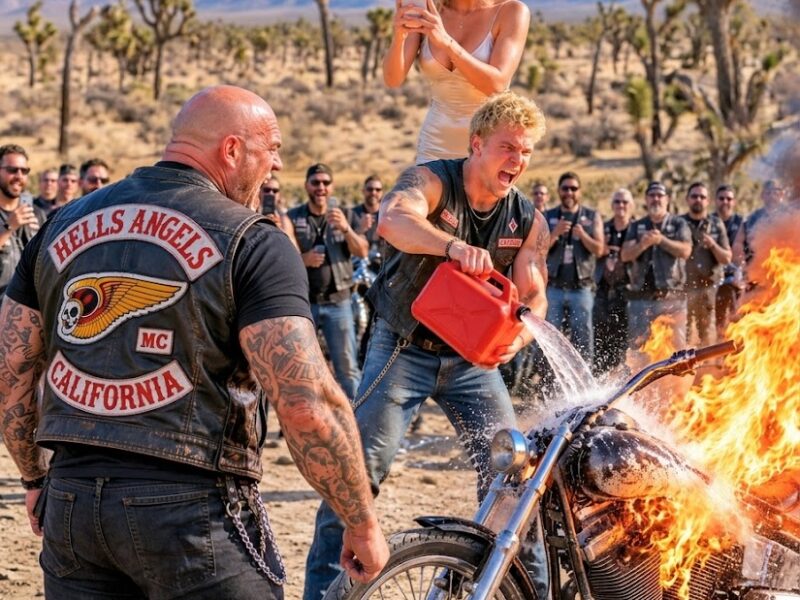
Rich brats burned an old biker’s Harley for fun. Seconds later, they learned exactly who they messed with.
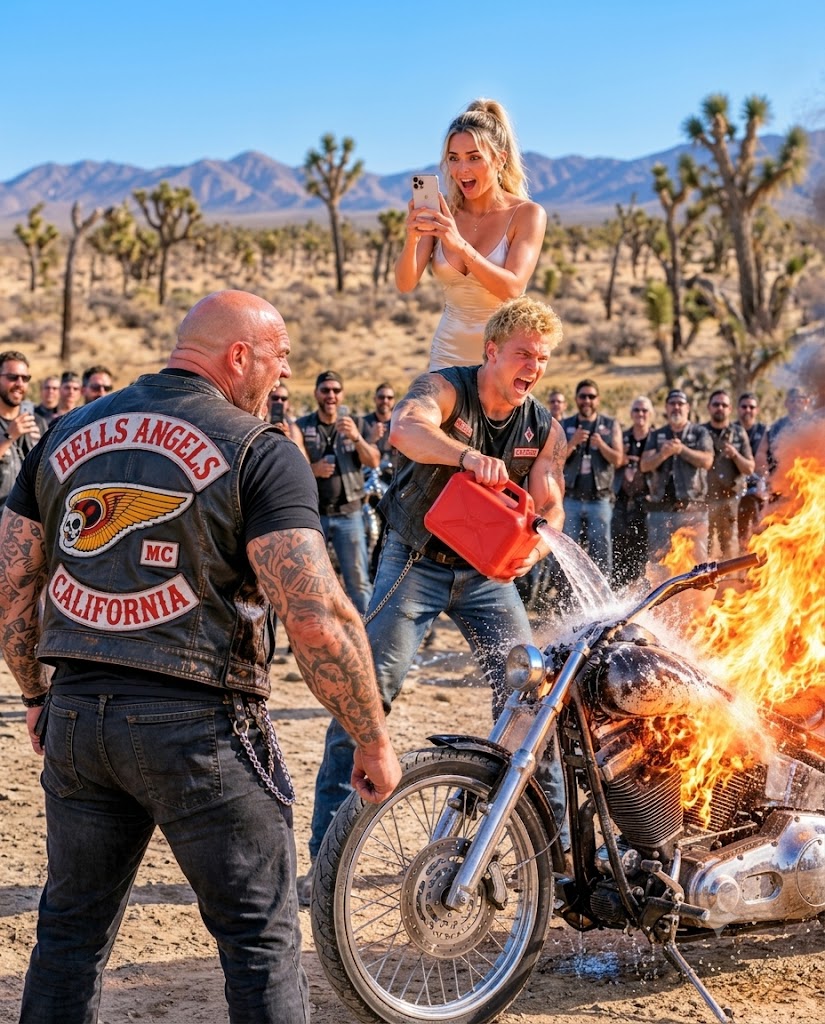
A boot drove into the side of a parked motorcycle.
Metal screamed against gravel as 800 pounds of steel tipped and crashed down hard.
Chrome cracked. Gas sloshed and leaked into the dirt.
Three kids laughed, one of them holding a phone up, filming the whole thing.
The bike’s front wheel spun slow in the air, going nowhere.
Then a low growl cut through the laughing.
A one-eyed shepherd planted his body over the fallen machine and bared his teeth.
And across the lot, an old man set down his coffee cup and stood up from the diner steps.
His name was Silas Rafferty. And those boys had no idea what that faded patch on his back meant.
What they did in the next 10 minutes would bring 40 riders down from three states.
What kind of man had those boys just crossed?
Stay with me on this one.
Let me take you back about 20 minutes to before any of it happened.
The diner sat alone off the highway, maybe 15 miles south of Flagstaff, where the pines start thinning out and the red dirt takes over.
It was called Rosie’s. Nothing special. A gravel lot, a buzzing sign, a counter with eight stools, and a smell of bacon that never really left the walls.
The kind of place long-haul drivers stop at because it’s the only thing for miles.
Silas Rafferty had been stopping there for close to 30 years.
He rode in a little after 8 that morning. You’d have heard him before you saw him.
That low, heavy rumble of an old Shovelhead engine, the kind they don’t build anymore.
He eased the bike into the lot, cut the motor, and for a second he just sat there in the quiet, both boots on the ground, letting the ride settle out of his bones.
Silas was 68 years old. Big hands, gray beard down to his chest, shoulders that still filled out a leather cut, even if the rest of him had gone lean.
His face was all lines and sun. He’d earned every one of them.
The bike he rode was a 1978 Harley Shovelhead, and it was not a showpiece.
It was something better than that. He’d built most of it with his own hands.
The tank especially. That tank meant more to him than anything else on the machine.
And here’s why.
Two years back, he buried his wife. Maggie. Forty-one years married.
After the funeral, he couldn’t sit still in that empty house. Couldn’t stand the silence of it.
So he went out to the garage and he started working.
Stripped that old tank down to bare metal. Hammered out the dents, sanded it, primed it, painted it himself. Three coats by hand.
Deep candy red with a thin gold line Maggie used to love.
He put her initials on the underside where nobody would ever see them. M.R.
Just for him to know they were there.
That tank was how he’d gotten through the worst year of his life. You understand that?
And you understand everything that comes next.
Riding in the sidecar beside him was Diesel, a shepherd mix, gray around the muzzle, blind in one eye from a fight he’d had long before Silas found him half dead by a gas station.
Diesel went everywhere Silas went, wore little goggles when they rode fast.
People at the diner knew him by name. He was the only family Silas had left that still breathed.
Silas climbed off, stretched his back, and lifted the dog down.
Diesel trotted a slow circle and settled in a patch of morning sun by the steps.
Rosie’s regular waitress, a woman named Dawn, who’d worked that counter 20 years, saw him through the window and already had the black coffee pouring.
That was the whole plan for the day.
Coffee, quiet, maybe a slice of pie, then ride on toward Sedona to see an old friend.
That’s when the truck pulled in.
It was a brand-new pickup, lifted high, chrome everywhere, the kind that costs more than most people make in a year and has never once hauled anything heavier than a surfboard.
It came in too fast, spraying gravel, music pounding loud enough to rattle the diner windows.
Three young men spilled out of it. Maybe 20, 21 years old.
Clean shoes, nice watches, the careless kind of loud that comes from never once being told no.
They came from the gated hills up above the valley where the new money built houses with gates and views.
You could tell just by the way they moved.
Like the whole world was a thing somebody else cleaned up for them.
The one who ran the show was named Tyler. Tall, grinning, a phone always in his hand.
His two buddies were Brett and Cody, and they laughed at everything Tyler said before he even finished saying it.
They clocked the old biker and the one-eyed dog right away, and something in them lit up.
You know the type. A quiet old man alone is a target to a certain kind of kid.
They see age and they see weakness. They see gray in a beard and they figure there’s nothing left behind it.
“Yo, look at this,” Tyler said loud, pointing at the Shovelhead. “Grandpa’s got a hog.”
His friend snickered.
Silas said nothing. He sipped his coffee on the steps and looked out at the highway like he hadn’t heard a word.
Diesel lifted his head and watched the boys with his one good eye.
“That thing even run?” Tyler called over. “Smells like it’s leaking. You sure you didn’t just push it here?”
More laughing.
Dawn came to the door with a worried look.
Silas gave her a small shake of the head. Let it go.
He’d dealt with mouthy kids his whole life. Words were just words.
He wasn’t going to let three brats ruin a good cup of coffee.
But here’s the thing about boys who have never been told no.
Silence doesn’t calm them down. It eggs them on.
When the old man didn’t flinch, didn’t snap back, didn’t do anything but sit there, it didn’t make them bored.
It made them bolder.
They wanted a reaction. They were going to keep pushing until they got one.
And that’s exactly what happened next.
Tyler walked over to the bike.
Slow, grinning, playing to the phone his buddy Cody had already lifted up to record.
He circled the Shovelhead like he owned it, running one finger along the handlebar.
“My dad’s got a garage full of real bikes,” Tyler said. “Italian stuff. This is just junk some old man glued together.”
“Leave it alone, son,” Silas said.
First words he’d spoken. His voice was low and even. Not angry, just flat and certain.
The way a man sounds when he means a thing all the way down.
That was the reaction they’d been fishing for.
And it was a mistake, because now Tyler had an audience and a dare all at once.
“Or what?” Tyler said, turning to the camera, grinning wide. “What’s the old man going to do?”
He put his boot against the seat and he shoved.
The bike rocked on its kickstand.
Silas was on his feet now. Coffee forgotten.
“Don’t.”
Tyler shoved again. Harder. Both hands this time, throwing his weight into it, laughing the whole way.
For one second, the Shovelhead hung at the balance point.
Then gravity took it.
Eight hundred pounds of steel and chrome went over and slammed into the gravel.
The tank. That tank. The one he’d sanded and painted by hand through the worst year of his life.
It hit a rock jutting up from the dirt.
You could hear it. A dull crunch, and then the hiss of gas running out into the ground, carrying a thin streak of candy red paint with it.
The boys went wild. Howling, high-fiving, Cody swinging the phone around to catch it all.
“Oh my God, it’s down. It’s down,” Brett was shouting.
Tyler stood over the fallen machine with both arms raised like he’d won something.
And that’s when Diesel moved.
The old dog crossed that lot faster than a creature his age should move.
He didn’t bark. He didn’t lunge at the boys.
He did something that stopped all three of them cold.
He walked straight to the downed bike, planted his body across the cracked tank, over the spilled gas and the gold initials nobody could see, and he stood there guarding it.
A low, steady growl rolling out of his chest, his one good eye fixed on Tyler, lips pulled back off his teeth.
The laughing died.
“Call off your dog, old man,” Tyler said.
The grin was still there, but something underneath it had gone uncertain.
Silas walked over slow and crouched by his bike.
He put one hand flat on the dented tank, almost gentle, and he looked at the long crack in the paint where the rock had caught it.
For a long moment, he didn’t say anything at all.
Didn’t yell, didn’t curse. The quiet coming off him was somehow worse than shouting would have been.
“You know what this is?” Silas said finally, still looking at the tank, not at the boys. “This paint. My wife’s name is under here.”
He touched the gold line with two fingers.
“Took me a year to get it right. A year.”
“It’s a bike, man,” Tyler said, but his voice had lost some of its air. “Relax. You can buy another one. What’s it even worth? Like a couple grand.”
Silas stood up.
He was not a huge man anymore, but there was something in the way he rose off the ground that made all three of those boys take half a step back without meaning to.
“It’s not for sale,” he said. “And it’s not yours to break.”
Dawn had come out onto the steps now, phone in her hand.
“I’m calling the sheriff,” she said. “I got cameras on this lot, you little punks. The whole thing’s recorded.”
That sobered the boys fast.
Cody lowered the phone. Brett started edging toward the truck.
“We didn’t do anything,” Tyler said, backing up, hands spreading wide. “It fell. He parked it wrong. That’s on him.”
Silas didn’t argue.
He just reached into the inside pocket of his cut, pulled out an old flip phone, the cheap kind, and he dialed one number from memory.
He turned away from the boys to do it. Said just a few words, too low for anyone to hear.
Then he closed the phone, slid it back in his pocket, and went to his dog.
“Easy, Diesel,” he murmured. “Easy now. I got it.”
He got a grip on the handlebars and with a grunt that cost him, heaved the Shovelhead back up onto its stand.
Gas was still weeping out of the cracked seam.
He looked at it a moment, then he just let it be.
He walked back to the diner steps, eased himself down, and picked up his coffee again.
Took a sip. It had gone cold.
He drank it anyway.
And just like that, it seemed to be over.
The boys stood by their truck, unsure what to do with themselves.
The old man wasn’t fighting. Wasn’t chasing.
He was just sitting there drinking cold coffee like a tired old-timer who’d given up.
Tyler’s grin crept back a little.
“Yeah, that’s what I thought,” he said, though nobody had challenged him.
Dawn went back inside. Diesel came and lay down at Silas’s feet, still watching.
The morning sun was warm on the gravel. A truck passed on the highway and faded off.
Quiet settled back over Rosie’s like nothing had happened at all.
The boys figured they’d won.
An old man, a broken bike, a scared dog, and no fight.
They climbed halfway into their truck, already laughing about the video, already arguing over who’d post it first.
They had no idea what that one phone call had set loose.
It started as a feeling before it was a sound.
A low vibration you could feel in the gravel under your boots before your ears caught up to it.
Then it became a rumble on the far edge of the highway, way off to the north, growing.
Not one engine. Many. A whole lot of them rolling in together.
That deep thunder of big twins running in formation.
The sound bouncing off the hills until it filled the whole valley.
Tyler froze with one foot in the truck.
“The hell is that?”
They came over the rise all at once.
A line of headlights in the morning sun, two and three abreast, stretching back down the road farther than you could see the end of it.
Leather and chrome and faded colors.
Riders old and young, big men on big machines, and they did not slow down or spread out.
They came straight for Rosie’s lot like a river finding its channel.
Forty motorcycles poured off the highway and into that gravel lot, one after another after another, until the whole place shook with the sound.
And then all at once went silent as 40 engines cut at nearly the same moment.
The quiet that dropped after was heavier than the noise had been.
These were not boys from the gated hills.
These were working men. Welders and roofers and long-haul drivers and a couple of guys who’d done hard time and a couple more who’d done two tours overseas.
On the back of every cut was the same patch. The same colors Silas wore faded on his own back.
The Desert Saints. A chapter that went back 50 years with roots in three states.
And Silas Rafferty’s name at the very top of its history.
Because here is the thing those boys were about to learn.
The quiet old man they’d been shoving around, the one drinking cold coffee on the steps, was not just some rider.
Silas “Doc” Rafferty was the founding road captain of that whole chapter. The man who’d started it.
The one whose name the younger guys said with their voices lowered.
When that call went out that somebody had put Doc’s bike down in the dirt, it didn’t matter what anybody was doing.
They dropped it and they rode.
This was no longer three kids laughing at an old man.
This had become something with 50 years of history and 40 men behind it.
And Tyler and Brett and Cody understood that in their bones before they understood it in their heads.
The nature of the whole thing had changed.
It wasn’t a prank anymore. It wasn’t even about a bike anymore.
They were three soft kids standing in the middle of a brotherhood they had just spit on.
And there was nowhere to run.
A big man with a white braid, the current road captain, a fellow called Griff, swung off his bike and walked to Silas first.
Didn’t even look at the boys.
“Doc,” he said, and he put a hand on Silas’s shoulder. “You all right?”
“I’m all right,” Silas said.
Griff looked at the Shovelhead, at the crack in the tank, the gas in the dirt, the gold line split in two.
His jaw tightened.
He’d known what that bike meant. Half the men in that lot had known Maggie, had stood at her funeral, had watched Silas rebuild that tank with his own hands because it was the only thing keeping him upright.
Griff turned around slow and looked at the three boys for the first time.
Now, if you’re still with me this far, and I hope you are, do me one favor.
Tap that subscribe button and let me know you’re riding along.
These are the stories we tell here, and I want you here for all of them.
All right, back to that lot, because this is where it really turns.
Griff didn’t yell. He didn’t have to.
Forty men were already forming a loose half circle.
Not rushing, not touching anybody, just closing the open space of that lot until there was only one way out, and it ran right past all of them.
The boys pressed back against their truck.
“Which one of you did it?” Griff said.
Not a question. A verdict.
Nobody spoke.
Then Cody, the follower, cracked.
He pointed at Tyler.
“He did. It was him. He pushed it. I was just filming, I swear.”
Tyler shot him a look of pure betrayal.
But his hands were shaking now.
“Look,” he said, and his voice came out high and fast. “Look, this is a misunderstanding. Okay? My dad—my dad’s going to—you don’t know who my dad is. He’ll have every one of you arrested. He knows the sheriff. He knows everybody. You touch me and you’re all finished.”
And right on cue, like the universe wanted to prove his point, a second vehicle came tearing into the lot.
A black Range Rover, spotless, cutting between the parked bikes without any care for the men standing next to them.
It skidded to a stop and a man got out.
Mid-40s, expensive sunglasses, a polo shirt, the kind of tan that comes off a golf course.
He slammed the door and came striding across the gravel like he already owned it and everyone standing on it.
This was Preston Vance. Tyler’s father.
Real estate. Half the new development up in those hills had his name on it.
And he walked in exactly the way his son had walked in two hours earlier.
Because that is where the son had learned it.
“Tyler,” he barked. “I got your text. What is this?”
He swept his sunglasses off and glared around at the 40 bikers like they were a mess somebody had left on his property.
“All right, listen up, all of you. I don’t know what you people think is happening here, but I’ve got the sheriff on speed dial and a lawyer who will bury every single one of you. You’re on camera. You’re trespassing. You’re threatening a minor—”
“He’s 21,” Dawn said from the steps. “And it’s my lot. And my cameras caught your boy wrecking that man’s motorcycle for a laugh.”
Preston waved her off without even looking.
He’d decided how this was going to go on the drive down.
He was going to throw money and names around until these grease-stained men scattered.
The way everything scattered when he raised his voice.
He reached into his jacket and pulled out a checkbook.
Actually a checkbook.
And held it up like a weapon.
“Here’s how this ends,” he announced to the whole lot.
“I write a number. A generous number. For the bike, for the inconvenience, for everybody’s wasted morning. And then all of you get on your little toys and ride off, and we forget this ever happened.”
“What’s the damage, old man? Five grand? Ten? Name it. I’ve got better things to do today than stand in a parking lot with a bunch of—”
He gestured vaguely at the cuts, the beards, the leather.
“—with people like you.”
Silas hadn’t moved from the steps this whole time.
Now, finally, he stood up.
He came down the two steps into the gravel, slow, Diesel rising to pad along beside him.
He walked across that lot, through the crowd of his own men, who parted to let him through without a word.
And he stopped in front of Preston Vance.
And Preston, mid-sentence, waving his checkbook, looked at the old man’s face.
Really looked at it. For the first time.
At the gray beard and the lines and the pale, tired eyes.
And something happened to Preston Vance’s face that nobody in that lot would ever forget.
The color drained right out of it.
The checkbook lowered.
His mouth opened and no sound came out.
He took a step back. And then another.
Staring at Silas like he’d seen a ghost walk up out of the ground.
“No,” Preston said quietly. “No, that’s—you’re—”
Because Preston Vance knew that face.
He’d known it his whole childhood from a framed photograph that sat on his father’s dresser until the day the old man died.
A photograph of two young bikers standing shoulder to shoulder beside a highway, grinning, dust on their boots.
One of them was Preston’s father, Walter Vance.
Wally. A Desert Saint back before the money, back when the family had nothing but a rented house and a motorcycle in the drive.
And the other man in that photograph, the one with his arm around Wally Vance’s shoulders, was Silas Rafferty.
“Your—Doc,” Preston whispered. “You’re Doc Rafferty.”
Silas looked at him a long moment.
“I knew a Wally Vance,” he said slowly. “Rode with him 25 years. You’ve got his jaw.”
Preston’s legs nearly went out from under him.
He put a hand on the hood of his own Range Rover to stay up.
Here is what Preston Vance had spent 30 years trying to forget.
His father, Wally, was the best man he ever knew and the poorest.
Wally rode with the Saints his whole life.
And when Wally was dying, slow and hard in a county hospital with no money and no insurance, it was these men, this club, Silas most of all, who were there every single day.
It was Silas Rafferty who sat by that bed at the end.
It was Silas who carried the casket.
It was Silas who pressed an envelope of cash into the hand of a scared 19-year-old Preston and said, “Your daddy was my brother. You’re never alone. You call me anything, ever.”
And Preston had taken that money.
And then Preston had spent the rest of his life running as far from where he came from as he could get.
New name for himself. Gated hills.
Taught his own son that people in leather, people who worked with their hands, people like his own dead father, were trash to be scattered with a checkbook.
He’d buried Wally Vance twice. Once in the ground and once in his own shame.
And now his son had put Doc Rafferty’s motorcycle in the dirt and laughed about it.
His son had done to the best man his grandfather ever knew the ugliest thing a person could do.
And filmed it. And called his father to come throw money at it.
Preston turned and looked at Tyler.
And Tyler, for the first time in his spoiled life, saw real fear on his father’s face.
And it terrified him more than the 40 bikers had.
“Dad,” Tyler said. “Dad, who is he? Just pay him and let’s go.”
Preston crossed the gravel and did something no one expected.
He grabbed his son by the collar. Not gently.
And dragged him forward until the boy was standing right in front of Silas.
“Look at him,” Preston said, his voice shaking. “You look at this man. Do you have any idea what you did?”
“It’s a motorcycle. Dad, who cares? You can buy him 10 of them.”
“You can’t buy this,” Preston said. “There is not enough money in the world to buy this. This man—”
He stopped. His eyes were wet now, and his voice broke on it.
“This man sat with your grandfather when he died. When we had nothing, when I had nothing, these men paid for the funeral. I couldn’t. And I let you grow up thinking you were better than them. That’s on me. God help me. That’s on me.”
The whole lot had gone silent.
Forty men stood and watched a rich man come apart in the gravel in front of them.
Tyler’s face had changed. The smirk was gone.
Something young and lost had come up underneath it.
He looked at the old man he’d been shoving around, and then at the bike lying cracked on its stand.
And you could see it finally landing on him. Who it was. What it meant.
“I didn’t know,” Tyler said. His voice had gone small. “Grandpa—you never told me about Grandpa. You never told me anything.”
“No,” Preston said. “I didn’t.”
Silas raised one hand, and the quiet in the lot deepened.
He looked at Tyler. Not with hate.
With something worse for a boy like that. With disappointment. The plain and patient kind.
“I’m not going to have my brothers here touch you,” he said. “That’s not what your granddad would have wanted, and it’s not who we are, whatever that father of yours taught you to think. But you’re going to make this right. Not with his money. With your own two hands.”
“You’re going to come to my shop, and you’re going to learn how to pull a dent and mix a paint and lay it down clean. You’re going to fix this tank yourself. However long it takes. And while you’re doing it, I’m going to tell you about your grandfather. Because somebody ought to. And it looks like nobody has.”
Tyler stared at him.
And then this kid, this loud, soft, careless kid who’d never been told no in his life, started to cry right there in the gravel in front of 40 bikers.
He nodded.
“Okay,” he said. “Okay. Yes, sir.”
A patrol car finally rolled into the lot, light bar flashing, called in by Dawn an hour before.
A young deputy stepped out, took one look at the crowd, and then spotted the old man in the middle of it.
His whole posture changed.
“Mr. Rafferty,” he said, and he actually took his hat off. “Didn’t know it was your call, sir. You want to press this? We’ve got it all on camera. Those three are looking at destruction of property.”
“Easy,” Silas said.
He looked at Tyler a long moment. Then at Preston.
“No charges,” he said. “We’re handling it. Family thing, deputy.”
The deputy blinked, nodded, and put his hat back on.
“Yes, sir. You need anything, you got my number.”
And he left.
Because even the law out there knew whose name that was.
They got the Shovelhead loaded into the back of a club member’s truck, careful as pallbearers.
A dozen hands easing it up the ramp.
Preston stood off to the side the whole time, not knowing what to do with his hands.
A man whose whole map of the world had just been redrawn in front of him.
Before Silas left, Preston came to him.
He didn’t bring the checkbook this time. He brought nothing but himself.
“I’m sorry,” Preston said. “For him. For me. For all of it. I should have told him where he came from.”
“Yeah,” Silas said. “You should have.”
He wasn’t cruel about it. He just didn’t lie to make a man feel better.
“Send the boy Saturday. Seven in the morning. Tell him to wear clothes he doesn’t mind ruining.”
“I’ll bring him myself,” Preston said.
“Good,” Silas said. “You could stand to learn to pull a dent, too.”
And for the first time maybe in 30 years, Preston Vance laughed.
A short, wet, surprised sound.
And wiped his eyes, and nodded.
Tyler came every Saturday that fall.
Seven in the morning, every week, and he did not miss one.
The first few mornings he was useless, the way soft hands always are.
And Silas worked him anyway. Slow and patient, the way you break a young horse.
Pull the dent. Feel the metal.
Sand it till your arm’s dead. Then sand it more.
Mix the paint. Lay it down thin. Wait. Do it again.
And while they worked, Silas talked.
He told that boy about Wally Vance.
About a young man who had nothing and gave everything.
About the time Wally rode 400 miles through a storm to sit with a brother in the hospital.
About how Wally laughed, how he sang off-key.
How he’d give the coat off his back to a stranger and the shirt under it, too.
By the end of the first month, Tyler knew his grandfather better than his own father had let him know him in 21 years.
It took them until almost Christmas to finish the tank.
The last coat went on, and the thin gold line, Tyler’s own hand on the brush now, steady at last.
They let it cure.
Silas turned it over and showed the boy the initials underneath. M.R.
And told him about Maggie.
And this time it was the old man’s eyes that filled.
Tyler didn’t say anything.
He just put his hand on the old man’s shoulder, the way men do when there are no words.
And they stood there a while in the cold garage.
They mounted that tank back on the Shovelhead on a bright December morning.
It gleamed. It was honest to God better than before.
Silas lifted Diesel into the sidecar and buckled the old dog’s goggles on.
He threw a leg over the bike, that familiar weight settling under him, and he fired it up.
That low, heavy rumble filled the garage and rolled out into the cold, blue morning.
He looked back at Tyler, standing there in a greasy shirt with calluses on his hands he hadn’t had in the fall.
A different boy than the one who’d shoved a bike into the dirt for a laugh.
“Your granddad would have liked you,” Silas said. “The man you’re turning into. Not the one you were.”
Tyler nodded and couldn’t speak.
Silas eased the Shovelhead out into the light.
Diesel’s ears up in the wind, the candy red tank catching the sun, with a name underneath it that the world would never see, but two men now knew was there.
He rode out onto the highway, slow, and opened it up.
And that sound faded off into the hills the way it had come.
A man and his dog and a machine built twice by hand, carrying the people they’d loved along with them.
The way the best of us always do.
And nobody who stood in that gravel lot that morning ever forgot what they learned there.
That the quietest man in the room is sometimes the one you should fear losing the respect of most.
And that you never, ever know who you’re really standing in front of until it’s too late to take it back.
—
The weeks that followed Tyler’s first Saturday at the shop were not easy ones.
He showed up that first morning in a three-hundred-dollar hoodie and brand-new work boots that had never seen a day of labor.
Silas took one look at him and pointed to a pile of shop rags.
“Start there. Wipe down every tool on that wall. Then do it again.”
Tyler blinked. “Again?”
“They’ll still be dirty the second time. That’s the point.”
And so the boy who had never been told no learned what it meant to be told to do something twice.
The second Saturday, Silas handed him a dent puller and a battered fender from a wrecked Softail.
“Practice. You’re going to make it worse before you make it better. That’s fine. That’s how you learn.”
Tyler worked for three hours. The fender looked like it had been attacked by a raccoon.
Silas looked at it, nodded once, and said, “Do it again.”
The third Saturday, Tyler didn’t complain. He just took the tools and went to work.
Silas watched him from the corner of his eye and said nothing.
But Diesel, lying on his bed by the woodstove, thumped his tail once against the floor.
That was as close to approval as anyone got in that shop.
By the fourth week, Tyler had stopped checking his phone every five minutes.
By the fifth, he’d stopped wearing the expensive watch.
By the sixth, he showed up in clothes that actually looked like they’d been worked in, and his hands had the first raw redness of calluses forming.
“You’re getting there,” Silas said.
It was the first compliment he’d given, and Tyler felt it land somewhere deep in his chest.
Preston came with him most Saturdays, at first just to drop him off.
Then to stay and watch. Then, eventually, to pick up a sanding block himself.
He was clumsy. He was slow. He was embarrassed.
But he kept coming.
One Saturday in October, with the aspens turning gold on the hills, Preston stood beside Silas while Tyler worked on the tank, his tongue between his teeth in concentration.
“I spent thirty years running from this,” Preston said quietly. “From all of it. From him.”
Silas didn’t look at him. He watched the boy work.
“Running’s a young man’s game,” he said. “Sooner or later you get tired. Question is whether you got anything left to come back to.”
Preston was quiet for a long time.
“I don’t know if I do,” he said.
Silas finally turned and looked at him.
“Your boy’s in there sanding a tank your father would have given his right arm to see. You’re standing in my shop, not running from it. Looks to me like you got something.”
Preston’s jaw tightened. He nodded, just once, and went back to watching his son.
The tank took them until almost Christmas.
Layer by layer, coat by coat, the candy red came back to life.
And when Tyler laid down that thin gold line with his own hand, steady at last, Silas stood behind him and didn’t say a word.
When it was done, he turned the tank over and showed the boy the initials.
M.R.
“Margaret Rose,” Silas said. “Maggie. Forty-one years.”
Tyler traced the letters with one finger, gentle.
“She must have been something,” he said.
“She was,” Silas said. “She was everything.”
And for the first time, Tyler saw the old man’s eyes go wet.
He didn’t say anything. He just put a hand on Silas’s shoulder, the way you do when there are no words.
They stood there a while in the cold garage, the two of them and the old dog by the stove.
And something passed between them that neither one would ever be able to explain.
The morning they mounted the tank back on the Shovelhead, it was 28 degrees and the sky was a hard, clean blue.
Tyler held the tank while Silas bolted it down.
When the last bolt was tight, they both stepped back and looked at it.
It gleamed. It was better than before.
Not because the paint was better. Because of what it had survived.
Silas lifted Diesel into the sidecar and buckled the old dog’s goggles on.
He threw a leg over the bike and fired it up.
That low, heavy rumble filled the garage and rolled out into the cold morning.
He looked back at Tyler, standing there in a greasy shirt with calluses on his hands and something different in his eyes.
“Your granddad would have liked you,” Silas said. “The man you’re turning into. Not the one you were.”
Tyler nodded. He couldn’t speak.
Silas eased the Shovelhead out into the light.
Diesel’s ears up in the wind. The candy red tank catching the sun.
And underneath it, a name the world would never see.
He rode out onto the highway, slow, and opened it up.
The sound faded off into the hills the way it had come.
A man and his dog and a machine built twice by hand.
Carrying the people they’d loved along with them.
The way the best of us always do.
And back in the lot, the gravel had long since swallowed the last drops of spilled gas.
But the story stayed.
It stayed in the way Dawn looked at the steps every morning when she opened the diner.
It stayed in the way the deputy kept Silas’s number in his phone, just in case.
It stayed in the way Tyler walked into his father’s office that January and said, “I’m not going to college. I want to learn a trade.”
It stayed in the way Preston didn’t argue.
It stayed in the way the Desert Saints rode through Flagstaff every year on the anniversary of Wally Vance’s death, and every year, a black Range Rover followed at the back of the pack.
And it stayed in the way Silas Rafferty, 68 years old, kept riding.
Every morning. Every chance he got.
With a one-eyed dog in the sidecar and a candy red tank full of memory.
Because some things you carry. And some things carry you.
And the quietest man in the room is sometimes the one who’s been carrying the most.
You never know who you’re standing in front of.
Until it’s too late to take it back.









