
Restaurant managers filmed a hungry Black man begging for scraps. They laughed. They mocked him. Then they heard four words: “Meet your owner.”
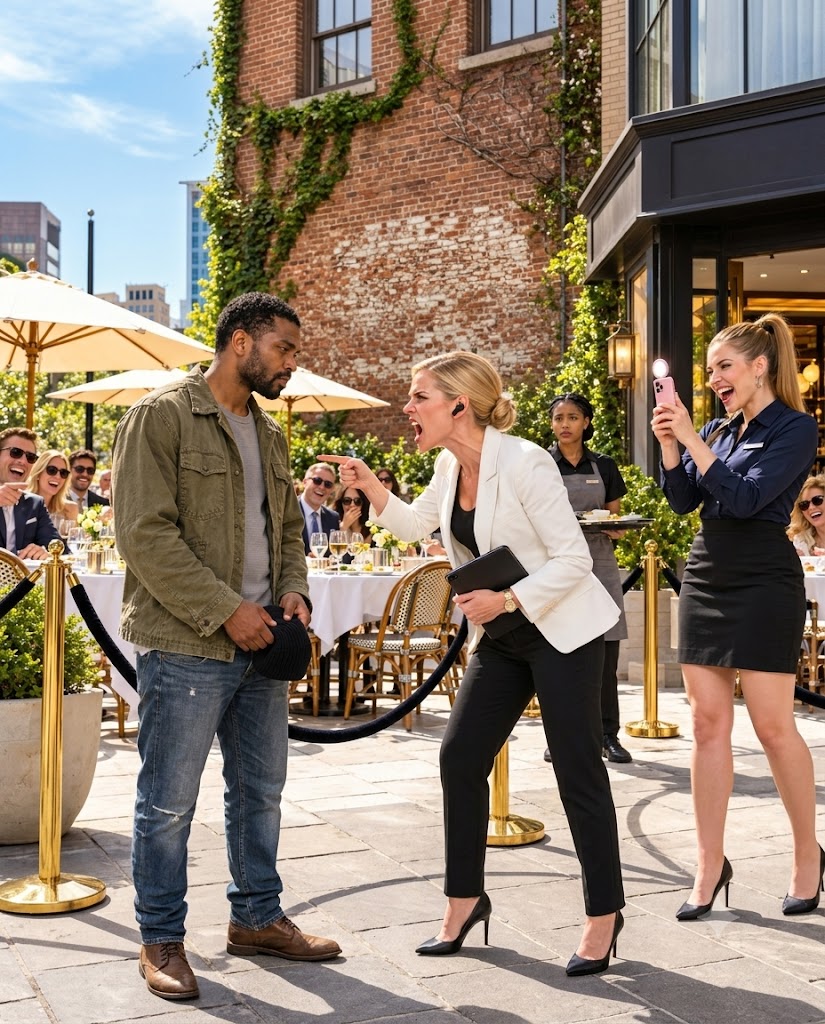
The evening rush had finally died down at Booker’s Kitchen, that upscale soul-food restaurant on Auburn Avenue where people paid sixty dollars a plate for the experience of eating food their grandmothers used to make for free. The patio lights twinkled like tiny lies, and the hostess stand gleamed under the soft glow of Edison bulbs that cost more than most people’s monthly electric bills.
A man in a weathered jacket stood at the edge of the patio, his posture careful, his eyes scanning the tables like he was doing math he already knew the answer to. He wasn’t asking for a table. He was asking for whatever the kitchen threw out at three o’clock, the scraps that nobody wanted, the ends of bread and the bottom of the pot.
The general manager, Brenda Kesler, had been filming him for thirty seconds before she even spoke. Her phone was angled just right, catching the patio lights and his tired face in the same frame. She had a feeling this one would get clicks.
“Sir, the patio is for guests,” she said, her voice carrying that particular tone managers use when they’ve already decided you’re a problem.
“Yes, ma’am. I’m not asking for a table.”
“Then what are you asking for?”
“Whatever the kitchen throws out at 3. Scraps. I’ll eat them out back. Nobody has to see me.”
Brenda laughed, and it wasn’t a kind laugh. It was the kind of laugh that gets shared on social media with captions like “can you believe this” and “the audacity.” She turned her phone slightly, making sure the restaurant’s logo was visible in the background.
“This is not a soup line. People pay $60 a plate for an experience. You’re standing in the experience.”
The man nodded slowly, like he’d heard this before, like he’d heard every version of this before. He started to turn away, but then Brenda’s coworker, a young woman named Kayn, chimed in from behind the host stand.
“Hold on. Say scraps again. That was so good.”
The man stopped. He looked at Kayn, then at Brenda’s phone, then at the patio full of people who were pretending not to watch. His jaw tightened, but his voice stayed calm.
“Ma’am, I’d rather you didn’t film me.”
“Public patio, babe. Wave for Kayn after hours.”
That was when Todd, the security guard, appeared at Brenda’s elbow. He was a large man with a soft voice and eyes that had seen too much and judged too little. Brenda didn’t even look at him.
“Todd, patio now, please. Thank you for your time.”
The man walked away without another word. He didn’t argue. He didn’t beg. He just walked, his shoulders straight, his head high, like a man who had learned a long time ago that dignity was the only thing nobody could take from him.
Brenda stopped filming and immediately started editing. She added captions, a catchy sound, and posted it before the man had even reached the end of the block. Within an hour, it had three thousand views. By morning, it would have nine hundred comments, most of them laughing, some of them cruel, a few of them asking questions nobody at Booker’s Kitchen wanted to answer.
—
The next morning, Emani showed up to work at five o’clock, same as always. She was a buser, had been for three years, and she had never once been late. She baked biscuits in her own kitchen before dawn, using her grandmother’s recipe, and she brought them to work in a worn canvas bag that she kept under the counter.
At 1:15, she took her break in the alley behind the restaurant. It was the only place employees could go without being seen by customers, and Emani liked it because it was quiet. She sat on an overturned milk crate and ate her lunch, watching the clouds move across the sky.
That was when she saw him. The man from the video. He was walking down the alley, his hands in his pockets, his eyes on the ground. He looked tired in a way that sleep couldn’t fix.
Emani didn’t think. She just acted. She pulled out one of her biscuits, wrapped in wax paper, and held it out to him.
“That’s yours. And I’m giving it to you. Take it before I change my mind.”
The man stopped. He looked at the biscuit, then at her, then back at the biscuit. His eyes were wet, but he didn’t cry. He just took it, carefully, like it was made of glass.
“Both,” he said, his voice barely above a whisper.
“I ate at 5.”
“Who made this?”
“Me. 5:00 a.m. My grandmother’s recipe.”
The man took a bite, and for a moment, his face changed. It was like watching a storm break, like seeing the sun come out after days of rain. He closed his eyes and chewed slowly, savoring every crumb.
“Thank you, Emani.”
She hadn’t told him her name. She blinked, confused, but before she could ask, he was gone, walking back down the alley with the second biscuit tucked into his jacket pocket.
—
Twenty minutes later, Emani was called into Brenda’s office. The general manager was standing behind her desk, arms crossed, her face a mask of professional disappointment.
“I gave a man my lunch,” Emani said, before Brenda could speak. “We paid security to walk him off my patio. Twenty minutes later, you invite him back to my door.”
“I bake those at 5 this morning on my own stove. This is my break.”
“Your break happens on my property.”
“You’re firing me for two biscuits.”
“I’m firing you for liability. He slips on that step, he owns the building. And now every hungry man downtown knows where the back door is. That’s not our brand.”
Emani stared at her. She wanted to argue, wanted to explain that the man hadn’t asked for anything, that she had offered, that kindness wasn’t a liability. But she knew it wouldn’t matter. Brenda had already made up her mind.
“Ma’am, she was on her break. I came back to return this to her.”
Todd’s voice came from the doorway. He was holding a name tag, the one Emani had left on the counter when she’d been called in.
“Todd, back door. Name tag. Walk of shame part two.”
Emani took the name tag. She looked at it for a moment, then at Brenda, then at Todd. She didn’t say anything. She just walked out, her head high, her shoulders straight, just like the man in the alley.
“You got to take seven. I’m sorry. That’s on me.”
Todd’s voice followed her down the hallway, but she didn’t turn around. She just kept walking, out the back door, into the alley, where the milk crate was still sitting and the sky was still gray.
—
The video went viral by Thursday. It had been shared forty thousand times, liked two hundred thousand times, and commented on by people who had never set foot in Auburn Avenue. The comments were brutal.
“Who does this guy think he is?”
“$60 a plate and he wants scraps?”
“The audacity is unreal.”
But there were other comments, too. Comments from people who had been hungry, who had asked for scraps, who had been filmed and mocked and humiliated. Comments from people who knew what it felt like to be invisible.
Emani didn’t see the video until Friday. She was sitting in her mother’s kitchen, eating Sunday supper on a Thursday because her mother said time didn’t matter when family was involved. The biscuits were on the table, the same recipe, the same warmth.
“You’re the girl from the video,” her mother said, not looking up from her plate.
“I’m a buser. Three years, never late once.”
“We just can’t take on that kind of attention.”
Emani didn’t respond. She just ate her biscuit and thought about the man in the alley, about the way he had said her name, about the way he had looked at her like she was the only person in the world who had ever seen him.
—
Walter Price had been working for the Booker family for twenty-two years. He had started as a driver, then become a scheduler, then a fixer, and now he was the man who made problems disappear. He was the one who called Brenda on Friday morning and told her that Mr. Booker’s office wanted the guest book out for the anniversary.
“Of course. It’s safe in storage, sir. Every page.”
Walter didn’t believe her. He had been doing this too long to believe anyone who answered that fast. But he didn’t say anything. He just made a note and hung up.
—
Calvin Booker had been avoiding Auburn Avenue for eight months. He had been avoiding it for six years, really, ever since he had left for college and never looked back. His father had run a counter there, a little place called Booker’s Kitchen, where people paid what they could and nobody went hungry.
But Calvin had wanted more. He had wanted board meetings and flights and quarterly reports. He had wanted to be someone, to build something, to prove that he was more than just the son of a man who gave away food for free.
And he had succeeded. He had built an empire, a chain of restaurants that made millions, a brand that people paid sixty dollars a plate for. He had everything he had ever wanted.
Except he didn’t. Because his father had died eight months ago, and Calvin hadn’t been there. He had been in a board meeting, closing a deal, making money. And when he had finally flown home, it was too late.
His father had left him the book. The old guest book from the host stand, the one where people wrote their names and paid what they could and promised to pay it forward. Calvin had put it in storage. He hadn’t been able to look at it.
But now, he was looking at a video. A video of a man asking for scraps, a video of a manager laughing, a video of a buser who had given away her lunch.
And he was angry. Not at Brenda, not at Kayn, not even at the man in the video. He was angry at himself.
—
Brenda Kesler had been general manager for two years. She had increased profits by eleven percent, had streamlined operations, had turned Booker’s Kitchen into a brand. She had done everything corporate had asked her to do.
And now, she was standing in the dining room, watching the owner of the restaurant walk through the front door. He was wearing a three-piece suit, and he looked like he had just stepped out of a boardroom.
“Miss Kesler. Walter Price, Mr. Booker’s office. He’d like his father’s book out for the anniversary.”
Brenda smiled. She had been expecting this. She had prepared for this. She had the book in storage, safe, every page.
“Of course. It’s safe in storage, sir. Every page.”
“You believe her?”
Calvin looked at Walter, who shrugged.
“I believe she answered fast.”
—
Emani was at the five points kiosk when she saw him again. He was standing by the bus shelter, wearing the same weathered jacket, looking like he had nowhere to be and nowhere to go.
“You’re the reason she’s gone.”
“I know. So, what do you want with her?”
“She paid for my lunch. I want to pay her back.”
“With what?”
“Work. Whatever she needs carried.”
Emani didn’t know what to say. She had been fired, had lost her job, had lost her name tag. But she still had her recipe, and she still had her mother, and she still had a folding table in the closet.
“Five points. By the bus shelters. She’s selling biscuits starting tomorrow, 6:00 a.m.”
The man nodded. He didn’t smile, didn’t thank her, didn’t say anything. He just turned and walked away, his hands in his pockets, his eyes on the ground.
—
The next morning, Emani set up her folding table at the five points kiosk. She had baked double the biscuits, had brought honey and butter, had painted a sign that said “Emani’s” in gold letters. She didn’t have a glass counter, didn’t have a real restaurant, but she had a table and a recipe and a reason to get up in the morning.
The man showed up at 6:00 a.m. He was wearing an apron, and he was carrying a box of stools.
“I’m not here to eat. I’m here to work it off.”
“Work off what?”
“Tuesday.”
Emani stared at him. She wanted to ask questions, wanted to know who he was, wanted to understand why he kept showing up. But she didn’t. She just handed him a biscuit and pointed to the corner.
“Take the stools to the cart at the corner, please.”
—
The days passed. Emani sold biscuits, and the man carried stools, and slowly, people started to notice. The line got longer, the biscuits got warmer, and the man got quieter. He didn’t talk much, didn’t smile, didn’t explain. He just worked.
And then, one day, Brenda showed up.
“We’re closed. I’m not buying.”
“I want the book you took out of my dumpster.”
“You told me to throw it away. And you threw it away. Then you climbed in after it. Kaye has it on video. That’s theft.”
“That book was never yours, Mrs. Kesler. The owner can have it. I’ll put it in his hands myself.”
“The owner doesn’t come down here, sweetheart. Then I’ll go up there. You have till Friday. After that, it’s the police.”
Brenda walked away, and Emani watched her go. She didn’t know what to say, didn’t know what to do. She just stood there, holding a biscuit, watching the woman who had fired her walk away.
“What does she want?”
“Long story. I’m too tired. Mama says you’re coming to Sunday supper 6 o’clock. I’ll show you then.”
—
Sunday supper at Emani’s house was a sacred thing. Her mother, Gloria, had been setting the table for thirty years, and she had never once missed a Sunday. The table was always set for six, even though there were only four of them, because Gloria believed in leaving a plate for the ones still on their way.
The man showed up at 6:00, exactly on time. He was wearing a clean shirt and carrying a bouquet of carnations from the bus station.
“You looking for me? I’m in 88 paid in quarters.”
“I’m looking for why she drove downtown on a Saturday.”
“People drive downtown for less.”
“Brenda doesn’t. Brenda sends Todd.”
Gloria came out of the kitchen, wiping her hands on her apron. She looked at the man, then at Emani, then back at the man.
“Well, look who’s in the book.”
“What you going to do with that?”
“Nothing tonight.”
—
Dinner was quiet. The food was good, the biscuits were warm, and the man ate like he hadn’t eaten in years. When he was done, he pushed his plate away and looked at Gloria.
“Ray says grace.”
“Ma’am, I’m not.”
“Guess says grace. That’s the rule in this house.”
The man bowed his head. His voice was soft, barely above a whisper.
“Lord, bless this food and keep a plate for the ones still on their way.”
“Amen. That’s an old one.”
—
After dinner, the man pulled out the book. It was old, worn, the pages yellowed with age. He opened it to a page and pointed to a name.
“R. Booker, 1979.”
Gloria looked at the page, then at the man, then at Emani.
“I was there when he wrote it. You could go back up those stairs tonight, son.”
“Friday. She walks into that room first. Call Brenda tonight. Tell her Mr. Booker knows about the book. No police. He’ll handle it himself Friday.”
“She’ll think you’re on her side.”
—
Friday morning, the dining room was full. The staff had been called in for an all-staff meeting, and Brenda was standing at the front, a smile on her face.
“Owner’s first visit like ever. Regional announces my promotion today. Get my face when they say it.”
The door opened, and Emani walked in. She was wearing her apron, the one Brenda had told her to throw away, and she was carrying the book.
“And there’s our thief. Good morning, Miss Kesler.”
“Todd, take the book from her, please. Gently.”
“I was invited. I’ll put it in Mr. Booker’s hands, not yours.”
Brenda’s smile faltered. She looked at Todd, who shrugged, then at the man standing behind Emani.
“Miss Kesler, meet the owner of this restaurant. Mr. Calvin Booker.”
The room went silent. Brenda’s face went pale. She looked at the man, really looked at him, and for the first time, she saw him. Not the man in the video, not the man asking for scraps, but the man who had been standing in front of her all along.
“Sir, if I had known it was you—”
“You’d have fed me. That’s the problem.”
Calvin walked to the front of the room. He opened the book, turned to a page, and read aloud.
“Brenda Kesler, waitress at the Peach Truit Diner. Behind on rent, three weeks of suppers, forgiven. She’ll pay it forward. RB 2009.”
He looked up at Brenda.
“He fed you three weeks. You threw him in the dumpster.”
—
The room was silent. Brenda’s hands were shaking. She looked at Kayn, who was staring at the floor, then at Todd, who was standing by the door.
“Miss Kesler, Miss Dunn, leave your keys on the stand. You’re done here. And the roses Regional sent you for that video. I want those back.”
“I made this place 11%.”
“He made it 47 years. I’ll be out front.”
—
Calvin walked outside, and Emani followed him. They stood on the sidewalk, watching the morning traffic, not saying anything.
“You let me pay for your lunch.”
“Yes.”
“I counted rent money on a sidewalk in front of you. I told you about the glass gold letters. You could buy that whole block.”
“I could.”
“Every morning I saved you the warm ones. I thought you had nothing. I tried to tell you. Then Brenda pulled up. I knew on Sunday. Ray Ray 8 months. Sunday supper. I waited 4 days for you to say it.”
“I didn’t know how to stop being Ray. I said I’d put it in his hands. I never said anything about forgiving him.”
Emani looked at him. Her eyes were wet, but she didn’t cry. She just stood there, waiting.
“That dough didn’t lie to you.”
“Nobody lied to me. Everybody just left things out.”
—
Calvin looked at the restaurant. It was his now, really his, not just in name but in every way that mattered. He had the power to change it, to make it what his father had always wanted it to be.
“22 years on the 49. People got on in church hats, hospital gowns. One man in a Santa suit in July. I never once asked to see a bank statement before I let him sit down. He was hungry. That part was true. He told me his name was Ray. Is it?”
“Middle name. Andre looked it up. His daddy called him Ray.”
“And his daddy’s been gone eight months. So he gave you the only name nobody’s called him since.”
—
Emani looked at the restaurant, then at Calvin, then at the sky.
“Mama would have sent me if I didn’t come. That first day, I came to see if anything of his was left in here. There’s room by the front door, a glass counter, your biscuits, your name.”
“Three things.”
“Go ahead.”
“The sign, it goes back to Booker’s Kitchen.”
“Done.”
“The book goes back on this stand. Front door. Anybody hungry walks in the front. Nobody eats by the dumpster again.”
“Done.”
“And my mother eats here on Sundays and never writes her name in anything.”
“Done.”
“So, what do I do? You call me Ray or Calvin?”
“I’ve got a table at five places at 6:00 a.m. Somebody has to carry the stools. And that’s somebody’s name.”
“Whoever shows up on time.”
—
The sun was rising over Auburn Avenue, casting long shadows across the sidewalk. Emani and Calvin stood there, two people who had been brought together by a video, a biscuit, and a book.
“I can walk, Walter.”
“Yes, ma’am. I’m walking anyway.”
“Is it true about the book?”
“It’s true. Come on. Front door. Came to supper, paid in full.”
“You only came once.”
“Then I’m behind. Sunday. Mama’s table. 6:00. Don’t bring carnations from the bus station.”
“Let him bring carnations. 5.99. He got robbed. Fair.”
—
The anniversary party was held on a Sunday, exactly ten days after the video had gone viral. The restaurant was packed, the tables were full, and the front door was open. A glass counter stood by the entrance, filled with biscuits and honey, and a sign above it read “Emani’s” in gold letters.
Calvin stood by the door, wearing an apron, greeting every guest who walked in. He didn’t call himself Mr. Booker anymore. He just called himself Ray.
And every Sunday, at 6:00, he sat at his mother’s table, eating biscuits and listening to stories about his father. He never missed a Sunday again.
The book was back on the stand, where it belonged. And on the first page, in his father’s handwriting, were the words that had started it all.
“Whoever comes hungry, feed them. Whoever comes tired, rest them. Whoever comes lonely, love them. This is Booker’s Kitchen. This is home.”
And at the bottom of the page, in fresh ink, Calvin had written his own words.
“Paid in full. R. Booker, 2024.”
—
The video was taken down. Brenda and Kayn were let go, and the roses were returned. Regional sent a letter of apology, and the profits went up, not by eleven percent, but by forty-seven.
Emani got her glass counter and her gold letters. She got her name painted on the window and her biscuits on the menu. She got a place at the table, every Sunday, for the rest of her life.
And Calvin got something he hadn’t known he was looking for. He got a family, a home, a reason to get up in the morning. He got a name that nobody had called him since he was a boy.
He got to be Ray again.
—
The line at Emani’s started forming at 5:30 every morning. People came from all over the city, from all walks of life, to buy biscuits and honey and to hear the story of the man who had asked for scraps and ended up owning the restaurant.
But the best customers were the ones who couldn’t pay. The ones who came with empty pockets and hungry eyes, the ones who had been told no so many times they had stopped asking.
Emani never turned them away. She just handed them a biscuit and said the same thing her grandmother had said to her.
“Pay when you can. If you can’t, pay it forward.”
And they did. Every single one of them. They paid it forward in ways that couldn’t be measured, in kindness and generosity and love. They paid it forward in biscuits and honey and Sunday suppers.
They paid it forward in the way that mattered most.
They paid it forward in being seen.
—
The old host stand was still there, by the front door, with the book on it. People wrote their names in it, just like they had in 1979. They wrote their stories, their struggles, their hopes. They wrote about being hungry and being fed, about being lost and being found.
And on the last page, in Emani’s handwriting, were the words that summed it all up.
“Nobody eats by the dumpster again.”
It wasn’t just a promise. It was a covenant. It was a commitment to seeing people, to feeding people, to loving people. It was a commitment to being the kind of place where everyone was welcome, where everyone was valued, where everyone was home.
And that was the real experience. That was what people paid for. Not the sixty-dollar plates or the Edison bulbs or the patio lights that twinkled like tiny lies.
It was the truth. It was the love. It was the biscuits.
It was home.
—
Calvin stood by the front door, watching the sun rise over Auburn Avenue. He was wearing his apron, and he was holding a biscuit, and he was smiling.
“Ray,” Emani said, coming up behind him. “You’re burning the biscuits.”
“I know. I’m learning.”
“You’ve been learning for six months.”
“I’m a slow learner.”
Emani laughed. She took the biscuit from his hand and replaced it with a fresh one.
“Eat,” she said. “You’re hungry.”
Calvin looked at the biscuit, then at Emani, then at the restaurant. He thought about his father, about the book, about the video that had changed everything.
“I am,” he said. “I’ve been hungry for a long time.”
“Then eat. You’re home now.”
And he did. He ate the biscuit, and he stood by the front door, and he welcomed everyone who walked in. He didn’t ask for their bank statements, didn’t check their credentials, didn’t care where they came from or what they had done.
He just fed them. He just loved them. He just welcomed them home.
Because that was what his father had done. That was what Emani had done. That was what Booker’s Kitchen had always been about.
It was about seeing people. It was about feeding people. It was about loving people.
And it was about biscuits.
Always about biscuits.
—
The anniversary party was over, but the story was just beginning. The video was gone, but the lesson remained. The managers were fired, but the kindness remained.
And every Sunday, at 6:00, the table was set for six. Gloria, Emani, Calvin, Walter, Todd, and the ones still on their way.
They came from all over, the hungry and the tired and the lonely. They came with empty pockets and full hearts. They came because they had heard the story, because they had seen the video, because they had read the book.
They came because they were hungry. And they left because they were full.
Full of biscuits. Full of love. Full of home.
And on the front door, in gold letters, was the name that said it all.
Emani’s.
People figured out the rest.
—
The End.









