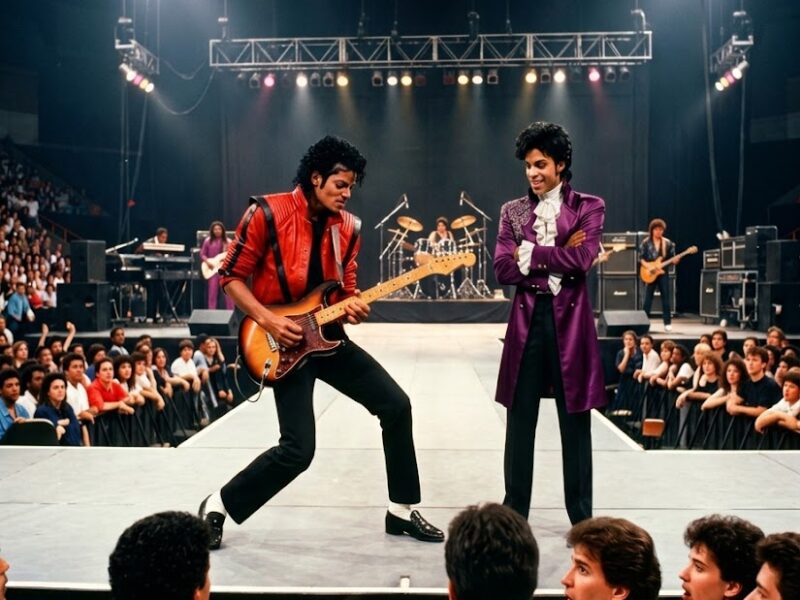
Prince DARED Michael Jackson To Play a Guitar LIVE — What Michael Did Next Shocked 20,000 People
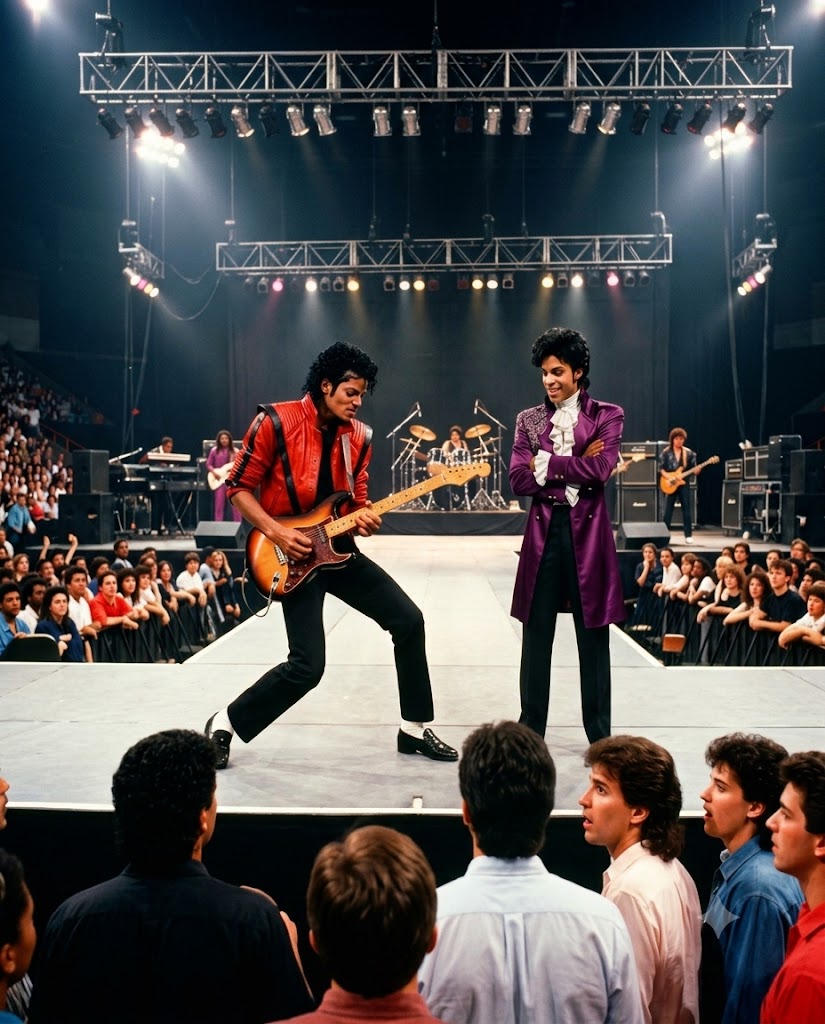
August 1988, a dressing room backstage at a charity gala in Los Angeles.
Prince sat on a folding chair, purple guitar strap draped over the back of it, talking to a music journalist who’d been granted fifteen minutes before the show.
The conversation had drifted the way it always did with Prince — from music theory to ego to who in the business actually deserved the credit they got.
The interviewer asked about Michael.
What did Prince think of him as a musician, not as a performer, but as an actual player of instruments?
Prince’s answer was careful, almost gentle at first.
“Michael’s the best entertainer alive. Nobody’s arguing that. The way he moves, the way he commands a stage, nobody’s ever done that better. Maybe nobody ever will.”
But the interviewer sensed there was more.
Prince considered his words.
“But entertaining and musicianship, those are two different things. I write my own songs. I play twenty-seven instruments on my own records. Guitar, bass, drums, keys, all of it. Michael’s got the best ears in the business, don’t get me wrong, but has anybody ever actually seen him play anything? Has he ever picked up a guitar in front of people and shown you what he can do with it? That’s a different kind of gift than the one he’s got. And I don’t think it’s the one he’s got.”
The interview published with a headline that traveled fast.
Prince: Michael’s a performer, not a musician.
The kind of quote that sells magazines and starts wars.
September 1988, Michael’s home studio at Hayvenhurst.
His engineer showed him the article, hesitant, already bracing for a reaction.
Michael read it silently twice, then set the page down on the console, careful the way he handled everything.
“Prince is one of the most talented people I’ve ever met,” Michael said quietly. “He’s not wrong that people don’t see me play. He’s just wrong about why.”
His engineer waited.
“I’ve been playing guitar since I was a kid,” Michael said. “Nobody ever let me show it. Not the label, not my father, not anybody. They had a role for me, and the role wasn’t guitarist. The role was frontman. So I learned to keep it private. Played it at home, in hotel rooms, on the bus, never in front of a camera.”
He picked the article back up, read the quote one more time.
“He thinks nobody’s ever seen it because it doesn’t exist,” Michael said. “That’s not the same thing as it not existing.”
“You upset?” his engineer asked.
Michael’s face did something small and quiet, something that looked almost like the beginning of a plan.
“No. I think it’s about time somebody found out.”
What his team didn’t know yet was that Michael wasn’t planning a rebuttal in the press.
He wasn’t planning an interview, a statement, a carefully worded response through his publicist.
He was planning something else entirely.
Something that would take two months of private, secret work in a room nobody but two people were allowed into.
The AIDS Project Los Angeles benefit concert was scheduled for late October 1988.
A single night, a lineup that read like a fantasy draft nobody expected to actually happen, and the kind of ticket that sold out in under two hours the moment it went on sale.
Madison Square Garden on loan for one special East Coast stop of a broader charity tour.
Prince was headlining.
Michael was performing a shortened set before him — a favor to the organizers, a chance to do something for a cause that mattered deeply to both of them, even if their public rivalry, half real and half manufactured by a press that loved pitting the two biggest stars in the world against each other, had been simmering for years.
Prince arrived at soundcheck that afternoon in a mood everyone around him recognized.
Sharp, focused, a little combative — the way he always got before a big show.
He ran through three songs with his band, adjusting tones, snapping at a monitor engineer who couldn’t get his in-ears balanced right.
The usual perfectionism that made him both brilliant and occasionally exhausting to work with.
Michael arrived a few hours later, quiet, almost invisible compared to Prince’s earlier energy.
He walked the stage once alone, running his hand along the edge of it the way he always did before a big show, feeling out the space.
Then he disappeared into his dressing room and didn’t come out again until it was time.
Nobody backstage knew what Michael had brought with him in a black case that his security team carried in and set carefully against the wall of his dressing room, untouched for the rest of the afternoon.
The show started at eight o’clock.
Madison Square Garden was packed to the rafters — twenty thousand people who’d paid good money and waited months for this exact night.
The energy in the building was the kind that makes the walls themselves feel like they’re humming.
Michael opened his short set with three songs off *Bad*.
The crowd screaming through every one of them.
The choreography as sharp and precise as anything he’d ever done.
He moved across that stage like gravity had made a special exception just for him.
Every step landing exactly where it needed to.
Every spin timed to the beat like he’d rehearsed it a thousand times, because he had.
By the third song, the whole arena was on its feet and staying there.
Prince watched from the wings, arms crossed, nodding along, genuinely impressed the way anybody with an ear for performance would be.
But there was something underneath the nod.
Something that had been sitting in him since that interview two months earlier.
Something he hadn’t quite let go of.
When Michael finished his set and the applause was still roaring through the building, Prince walked out onto the stage before the crew could even finish resetting for his own performance.
Unplanned.
Not in the schedule.
The producers backstage exchanged panicked glances, nobody sure what was about to happen.
Michael, still catching his breath, sweat visible under the stage lights, turned to see Prince walking toward him with a microphone in hand.
The crowd’s noise shifted — confused at first, then electric, sensing something unplanned was unfolding in real time.
“Ladies and gentlemen,” Prince said into the mic, that easy, confident half-smile on his face. “I think we’ve got a little unfinished business up here.”
Michael’s expression stayed calm, though something behind his eyes sharpened.
“A couple months back,” Prince continued, “I said some things in an interview about my friend Michael here. Said he’s the best entertainer alive, and I meant that. Still mean it. But I also said something about how nobody’s ever really seen him play an instrument. Said maybe that’s just not his gift.”
The arena went quiet.
The way a room goes quiet when it senses it’s about to witness something that wasn’t in the program.
“Is that true?” Prince said, turning to Michael now. “You’ve never picked up a guitar in front of anybody.”
Michael’s voice when it came was soft but steady, carrying easy through the microphone he’d kept in hand.
“That’s true.”
“So here’s what I’m thinking,” Prince said, that competitive glint entering his eyes now, the one that everybody who’d worked with him would have recognized instantly. “Right here, right now, in front of all these people, I dare you to prove me wrong.”
The crowd erupted into a wave of noise, murmurs and gasps rolling through the seats.
Michael stood there a second, the weight of twenty thousand eyes on him, Prince standing a few feet away with that easy, challenging smile.
“You want me to play guitar?” Michael said.
“Right now.”
“Right now,” Prince confirmed. “In front of everybody. No band, no track, no safety net. Just you and a guitar and whatever you’ve got.”
Michael looked out at the crowd.
Twenty thousand faces, half of them still screaming his name from the set he’d just finished, none of them having any idea what they were about to see.
He looked back at Prince, and something in his expression settled.
The way water settles after you drop a stone in it.
“Bring me the guitar in my dressing room,” Michael said quietly to a stagehand standing nearby. “Black case, left wall.”
The stagehand took off running.
Prince’s smile flickered just slightly.
A small crack of surprise passing across his face.
He hadn’t expected an immediate yes.
He’d expected hesitation, maybe a graceful deflection, maybe Michael laughing it off and turning it into a bit — the kind of thing that plays well on camera without any real risk attached to it.
Instead, Michael was standing there, calm, waiting.
“You’ve got something back there,” Prince said, half to himself, half into the mic.
The crowd picking up on the shift in his energy immediately.
“I’ve had it a long time,” Michael said.
The stagehand returned less than a minute later, carrying the black case carefully across the stage.
He set it down and opened it in front of Michael.
Inside, resting in dark velvet, was a guitar nobody in that arena had ever seen him hold in public.
A vintage instrument worn at the edges from years of private use.
Strings slightly darkened from hands that had clearly played it more than anybody knew.
Michael lifted it out, slung the strap over his shoulder with a practiced motion, and settled it against his body.
The way you settle something that’s an extension of yourself, not something you’re borrowing for a stunt.
Prince’s eyebrows went up slightly, watching the way Michael held it.
That wasn’t the posture of somebody who’d picked up a guitar three times in his life.
“What are you going to play?” Prince asked, still holding the mic, though his voice had lost some of its earlier bravado.
Michael thought about it for a second.
“You said I don’t have anything to show. So I’m not going to play something safe.”
He turned to the sound engineer standing at the side of the stage.
“Cut everything. No backing track, no click, nothing. Just me.”
The engineer looked to the producer, who nodded, though visibly nervous about handing this much dead air to an unplanned, unrehearsed moment on live broadcast television.
Because cameras from the charity’s national simulcast were rolling, and there was no going back now.
The lights dimmed.
Not the full production lighting Michael had just performed under.
Not the lasers and the smoke and the choreographed color changes.
Just a single spotlight, tight and warm, settling over him, standing there alone with an old guitar and twenty thousand people holding their breath.
Prince stepped back toward the wings, close enough to watch, far enough to give Michael the whole stage.
The competitive smile was gone now, replaced with something more like genuine curiosity.
Maybe even the first flicker of concern that he might have just walked into something bigger than he’d planned.
Michael closed his eyes for a moment, adjusted his grip on the neck, and then without a word, without any introduction, he began to play.
The first notes were simple.
A slow, aching blues progression in a minor key.
Nothing flashy, nothing built for show.
Just a handful of notes laid down with a patience nobody in that arena expected from a man they’d just watched execute the sharpest, most precise choreography in the business less than twenty minutes earlier.
His fingers moved slow across the fretboard.
Deliberate.
Careful.
Not fast, not showing off.
Just present.
Like he was having a conversation with the instrument rather than performing a trick for an audience.
B.B. King, watching from a private box that evening as a special guest of the charity’s board, later said he’d noticed something in the very first phrase that told him this wasn’t a stunt.
“He wasn’t playing to impress anybody,” King would say in an interview years later. “He was playing because he had something to say, and this was how he’d learned to say it.”
Prince stood in the wings, arms no longer crossed, watching with an intensity his own band members said they’d rarely seen from him during another artist’s performance.
He leaned forward slightly, studying Michael’s hands.
The way you study something you didn’t expect to be studying.
Thirty seconds in, Michael bent a note.
Held it.
Let it waver.
That slight vibrato shaking the pitch just enough to make it sound almost like a voice cracking.
The note hung in the air over Madison Square Garden, and the whole building went dead silent.
Twenty thousand people who’d come expecting spectacle, instead getting something that felt entirely unguarded.
He released the bend slowly, let it settle back to its original pitch, and moved into the next phrase.
A minute in, Michael’s playing shifted into something more rhythmic.
Still slow, still deliberate, but with a groove underneath it now.
The kind of feel that made a few people in the crowd start swaying without deciding to.
He wasn’t playing anything anybody recognized.
No cover, no familiar riff borrowed from a record everybody already knew.
This was something original.
Something that sounded like it had been written in private, in a room with nobody watching, over years of quiet practice that nobody had ever been allowed to witness.
Prince’s expression had changed completely by now.
The smirk from earlier — the easy confidence of a man who thought he already knew the answer to the question he was asking — had given way to something closer to genuine astonishment.
He turned to one of his own band members standing near him in the wings.
“Did you know he could do this?”
The band member shook his head slowly, eyes still fixed on the stage.
“Nobody knew.”
Ninety seconds in, Michael did something that made the whole arena lean forward at once.
He hit a run of notes — fast, a cascading pattern that climbed up the neck of the guitar with a precision that would have taken most players years to build the muscle memory for — then dropped back down into a low, growling bend that made the amplifier hum with feedback.
Controlled.
Intentional.
Adding weight to the note rather than distorting it into noise.
B.B. King, in his private box, sat forward, gripping the armrest.
“That’s not beginner’s luck,” he said quietly to the person beside him. “That’s years.”
Two minutes into the solo, Michael opened his eyes for the first time since he’d started playing.
He looked out at the crowd, then found Prince standing in the wings.
Their eyes met.
Prince didn’t say anything.
Didn’t need to.
His expression said everything that needed saying.
Michael closed his eyes again and kept going.
The intensity building now, the tempo picking up slightly, each phrase answering the one before it.
A musical conversation happening entirely within himself.
Question and response.
Tension and release.
The same architecture that built every great blues solo anybody had ever heard.
Except this one was coming from a man the entire music industry had spent decades insisting only knew how to dance and sing.
Three minutes in, he built toward something bigger.
His right hand moved faster now, picking with a speed that made several musicians backstage — people who’d played with legends their whole careers — exchange stunned glances with each other.
This wasn’t showmanship.
There was no theatrical flourish attached to it.
No spin, no drop to his knees, none of the visual tricks Michael had built an empire on.
Just his hands moving across strings, his whole body still except for the small, controlled motion required to make the instrument speak.
Prince stepped forward slightly, close enough now that some of the front rows could see both men in the same frame.
Michael center stage under his single spotlight.
Prince just at the edge of it, watching like a student who’d suddenly found himself in the wrong classroom.
At three and a half minutes, Michael hit the climax of the piece.
A sustained bend, pushed a full step up the neck, held with a vibrato so wide and so controlled it sounded almost vocal.
Like the guitar itself was crying.
He held it five seconds.
Ten seconds.
The crowd, already dead silent, seemed to hold its breath along with the note.
Fifteen seconds.
Somewhere in the arena, somebody let out an audible gasp.
Twenty seconds, and the note was still ringing, still bending, still alive under his fingers.
A physical feat that anybody who understood the guitar knew required not just finger strength, but years of calluses built up through repetition nobody had ever seen him do.
Then slowly — so slowly it felt almost unbearable — Michael let the bend release.
Let the note descend back to its original pitch.
Let it ring out on the open string and fade naturally into silence.
He lowered the guitar, bowed his head slightly, stood there motionless, sweat visible on his face despite having played for less than four minutes.
The arena remained frozen.
Three seconds.
Four.
Five.
Then it broke.
The applause that came wasn’t the screaming, chaotic roar of a typical Michael Jackson show.
It was something else entirely.
Something deeper.
The sound of twenty thousand people who just watched somebody they thought they fully understood reveal an entire dimension of themselves nobody had ever known existed.
Prince walked across the stage toward him.
Slow.
His usual swagger completely absent.
He reached Michael and stopped a few feet away, just looking at him for a long moment, something working behind his eyes.
“How long?” Prince asked, his voice carrying through the microphone still clipped to his jacket. “How long have you been able to do that?”
Michael looked up, a small, tired smile crossing his face.
“Since I was a teenager. Used to sneak into the studio after everybody left. Taught myself out of books, off records, just trying to figure out what my hands could do when nobody was telling me what I was supposed to be.”
“Nobody ever heard this,” Prince said, still processing.
“Nobody was ever allowed to,” Michael said. “The label had a plan for me. The plan didn’t include this. So I kept it for myself.”
Prince stood there another moment, and then he did something the crowd hadn’t expected either.
He reached up, unstrapped his own guitar — the signature instrument he’d played through his entire set that night — and held it out toward Michael.
“Play something with me,” Prince said. “Right now. Whatever you want.”
Michael looked at the guitar, then at Prince.
Something passing between them that the whole arena could feel even without understanding exactly what it meant.
“I don’t need your guitar,” Michael said, the smile widening slightly. “I’ve got mine.”
Prince laughed.
A real laugh, the tension of the whole evening finally breaking.
He slung his own guitar back over his shoulder instead.
“All right then,” Prince said. “Let’s see what happens when two people who’ve spent their whole lives being underestimated get on the same stage.”
The band, still standing ready from Michael’s earlier set, looked to their conductor for direction.
Prince waved them in.
Quiet — just bass and a soft hi-hat, nothing more, giving both guitars room to breathe.
Michael counted it in with a nod, and the two of them began to play together.
Trading phrases the way musicians do when they’re genuinely listening to each other rather than performing at each other.
Michael would lay down a slow, bending phrase, and Prince would answer with something sharper, more angular — his own signature style, weaving in and around what Michael had just offered.
Where Michael’s playing was patient, almost meditative, Prince was electric, full of sudden turns and unexpected runs.
The two styles shouldn’t have worked together.
Born from completely different traditions, completely different relationships to the instrument.
But somehow, up on that stage, they did.
Three minutes into their duet, something remarkable happened.
Michael, who’d spent his whole solo playing with his eyes closed, opened them and looked directly at Prince.
Prince looked back.
And without either of them saying a word, they landed on the same note at exactly the same moment, bending it together in perfect unison.
Two guitars crying the same cry.
One from a childhood in Gary, Indiana, built around discipline and expectation.
The other from a childhood in Minneapolis, built around difference and isolation.
Same pain.
Different histories.
Same language underneath it all.
The crowd was on its feet now.
Not screaming.
Standing.
The particular kind of standing ovation that happens when a room understands it’s witnessing something rare.
Something that wasn’t planned.
Something that could never be perfectly recreated even if they tried.
They brought the piece to a close together, both men landing on the final chord at the same instant, letting it ring out and fade into the enormous silence of Madison Square Garden holding its breath one more time.
Then the applause came.
And this time it didn’t stop for a long time.
Prince took the microphone first, still catching his breath, sweat on his forehead, something genuinely humbled in his expression.
“Ladies and gentlemen,” he said, “I came out here tonight thinking I knew exactly who Michael Jackson was. Thought I had him figured out. Best dancer alive. Best entertainer alive. No argument there. But I just found out there’s a whole side of this man that the world’s never gotten to see. And I think that’s on all of us — for assuming we already knew everything there was to know about somebody just because we’d watched them perform a thousand times.”
He turned to Michael.
“I owe you an apology. What I said in that interview about you not really being a musician — that was wrong. Dead wrong.”
The crowd roared its approval.
Michael took the microphone gently from Prince’s hand.
His voice when it came was soft, carrying the particular weight of somebody who’d been holding something in for a very long time.
“You didn’t know because I never let anybody know,” Michael said. “That’s not your fault. I built a whole career around giving people exactly what they expected from me. Perfect choreography, perfect vocals, the show they paid for. And somewhere along the way, I think I convinced myself that showing this part of who I am — the part that just sits alone with a guitar and works through something nobody else can see — that it wasn’t what people wanted from me. That it would confuse the image.”
He paused, looking out at the crowd.
“Tonight, I found out I was wrong about that, too.”
Prince put a hand on Michael’s shoulder.
Genuine warmth in the gesture now.
All trace of the earlier competitive edge completely gone.
“Where’d that piece come from?” Prince asked. “What you played before I came out? That wasn’t just technical skill. That was something real underneath it.”
Michael considered the question.
“I wrote that after my father used to make us rehearse until our fingers bled. Literally bled, sometimes, back when we were kids in Gary. I used to go somewhere quiet after those sessions and just play something that was mine. Something nobody was grading, nobody was judging, nobody was going to tell me I did it wrong. That solo tonight — that’s basically twenty years of those quiet moments all folded into four minutes.”
The arena had gone completely still again, listening to every word.
“Pain doesn’t need permission to be real,” Michael continued. “It doesn’t matter if you got it from cotton fields or from a rehearsal room in Indiana. It’s still pain. I think tonight I finally let myself show that instead of hiding it behind everything else I built.”
B.B. King, watching from his private box, stood up slowly and began to applaud.
The rest of the arena following his lead, the ovation rolling through Madison Square Garden in waves.
Backstage an hour later, after the rest of Prince’s set had wrapped and the crowd had finally started filing out into the New York night, still buzzing about what they’d witnessed, Michael sat in his dressing room with the guitar resting across his lap, running his thumb absently along the strings.
Prince knocked, then let himself in without waiting for an answer — the way you do with somebody you feel like you actually know now.
“Got a minute?” Prince asked.
“For you, always,” Michael said, echoing something he’d probably heard Dolly Parton say once at another event, though he didn’t mention that.
Prince sat down across from him, still visibly working through what had happened.
“I need to ask you something, and I need you to be honest with me.”
“Go ahead.”
“Why tonight? You could have just laughed it off. Made a joke out of the whole thing. Instead, you sent somebody running for a guitar you’d apparently been hiding for years. Why risk that in front of twenty thousand people with no rehearsal?”
Michael thought about the question seriously before answering.
“Because you weren’t wrong that nobody’s ever seen it. You were just wrong about why. And I think some part of me had been waiting a long time for somebody to finally ask the question in a way I couldn’t avoid answering. You gave me an excuse I’ve been needing for years.”
Prince sat with that for a moment.
“You know, I’ve spent my whole career trying to prove I could do everything myself. Play every instrument, write every part, produce every track. Some of that’s genuine love for the craft. But if I’m being honest, some of it’s fear, too. Fear that if I don’t do it all myself, somebody’s going to say I’m not really the one behind the music.”
“That’s a heavy thing to carry,” Michael said.
“So is what you just told me about your father,” Prince said. “About rehearsing till your fingers bled. That’s not nothing, Michael.”
Michael was quiet for a moment.
“No, it’s not.”
“You should play more,” Prince said. “In front of people. Not because you owe anybody proof of anything — because it looked like it meant something to you up there. Looked like the first time in a long time you weren’t performing for anybody but yourself.”
Michael smiled.
Small but genuine.
“Maybe I will.”
That night at Madison Square Garden never got officially released as an album or single, though a handful of grainy audience recordings and a partial broadcast clip circulated for years among collectors who understood exactly what they had.
But everybody who was in that building carried the memory of it the rest of their lives, telling the story to anybody who’d listen about the night Prince dared Michael Jackson to prove he was a real musician — and Michael answered with four minutes that nobody in that arena, least of all Prince himself, ever forgot.
Years later, when reporters asked Prince about that evening, he never dressed the story up bigger than it already was, never tried to reclaim the narrative or spin it in his own favor.
“That’s one of the only times in my life I’ve been completely wrong about somebody and glad to be wrong,” Prince said in a 1996 interview. “I thought I knew exactly what Michael was capable of because I’d watched him perform a thousand times on television, same as everybody else. Turns out there was a whole side of him none of us ever got to see because he never let us. And when he finally did, it wasn’t because he wanted applause. It was because I pushed him into a corner, and instead of running from it, he turned around and showed me something real.”
The story of that night spread through the music industry fast, even without a properly mixed and released recording to prove it.
Musicians who weren’t even there started talking about it within days, hearing it secondhand from crew members, from other performers who’d been backstage, from anybody lucky enough to have witnessed it in person or caught the partial simulcast broadcast.
Eddie Van Halen, who’d been watching the charity broadcast at home that night, brought it up in an interview years later.
“I’ve been playing guitar my whole life,” Van Halen said. “I know what real playing sounds like versus somebody who just knows a few licks well enough to fool an audience for thirty seconds. What Michael did that night wasn’t a trick. That bend he held for twenty seconds — I tried that myself once in the studio just to see if I could match it. Took me three takes to even get close. And my hands have been doing this since I was a kid. He’d apparently been doing it in secret his whole career. That’s not luck. That’s obsession in the best possible sense of the word.”
A session guitarist who’d occasionally worked with Michael’s band — though never on anything involving actual guitar parts for Michael himself — gave an interview decades later where she recalled hearing whispers about his private playing long before that night at the Garden.
“There were rumors,” she said. “People who worked closely with him would occasionally mention hearing something coming from a closed studio room late at night. Something that didn’t sound like anybody else was in there. Nobody ever confirmed it, though. Michael was so protective of that part of himself. I think he genuinely believed if people knew he could do that, it would somehow take away from what he’d already built. Took Prince basically daring him in front of twenty thousand people to finally let it out.”
Michael referenced that evening a handful of times over the years.
Always careful, always thoughtful, the way he tended to talk about the things that mattered to him most.
In a 1993 sit-down interview, a journalist asked him about moments in his career that had changed how he saw himself rather than just how the public saw him.
“There was a night in 1988,” Michael said, “at a charity show with Prince. He said something in an interview that I could have easily dismissed or gotten angry about. Instead, I let it push me into doing something I’d kept private my whole life. I played guitar — really played it — in front of an audience for the first time ever.”
“What did that experience teach you?” the journalist asked.
Michael thought about the question for a long moment before answering.
“That the parts of yourself you’re most afraid to show people are usually the parts that matter most,” he said. “I spent so many years giving the world exactly what I thought it wanted from me. The dancing, the vocals, the whole package, perfectly assembled. And somewhere in there, I convinced myself that anything outside that package was a liability. Something that might confuse people or make them question the image. That night taught me the opposite was true. The most honest thing I ever gave an audience wasn’t the choreography. It was four minutes of a private part of myself I’d kept hidden for twenty years.”
Prince, for his part, brought up the story periodically over the decades, always with the same genuine respect, the same careful acknowledgement of what had actually happened rather than what people wanted the story to become.
In a 2004 interview, a reporter asked him directly about that night, hoping he’d share something the public hadn’t heard before.
“I don’t tell that story to make myself look bad,” Prince said. “Though I probably should, since I basically walked out there thinking I already had the whole thing figured out. I tell it because it changed how I thought about talent. About assumption. About how much we think we know about somebody just because we’ve watched them on television our whole lives. Michael taught me something about humility that night, and I don’t think either of us walked off that stage the same person who walked onto it.”
The reporter asked if he’d kept in touch with Michael in the years that followed.
“We talked here and there,” Prince said. “Different lives, different circles. But every time we did talk, one of us would bring up that night. He asked me once if I still had that guitar I’d offered him on stage. Told me he kept his own from that night somewhere safe. Said it reminded him what happens when you finally let people see the parts of you that you’ve been protecting.”
Over the years, that particular evening became something of a quiet legend among people who followed both Michael’s and Prince’s careers closely.
Music historians occasionally referenced it in retrospectives, always noting the same thing — that in an industry built almost entirely on image, on carefully controlled narratives about who an artist was and what they were capable of, one of the most powerful moments either man ever produced happened when one of them stripped away the entire image in front of thousands of people and simply let the truth speak for itself.
“What made that night significant,” one music writer noted in a piece looking back at both careers years later, “wasn’t the size of the crowd or the fame of the two men on stage. It was the willingness of both of them to be wrong in public. Prince could have quietly retracted his comment in a later interview. Let the controversy fade the way most controversies do. Instead, he brought it directly to Michael in front of the exact audience that had read the original quote and gave him a chance to answer it however he wanted. And Michael — a man whose entire public identity was built around control, precision, and the careful management of every single detail people saw of him — chose in that moment to let something completely unrehearsed and unguarded happen instead.”
Some who study the culture of celebrity and public image also took note of that evening, pointing to it as a rare example of two of the most famous people on the planet allowing genuine uncertainty to play out live, without a script, without a plan for how it would end.
“You can trace almost every iconic moment in pop culture back to some degree of control,” one cultural historian said in a documentary that touched briefly on the incident. “Everything’s managed. Everything’s rehearsed. Everything’s designed to land a certain way. What happened on that stage in 1988 is one of the only examples from that era of two massive stars genuinely not knowing what was about to happen and choosing to let it happen anyway, in front of the whole world.”
For Prince, that night became something he referenced whenever he talked about the danger of assuming you fully know somebody based only on what they’ve chosen to show you.
“People think because you’ve watched somebody perform a thousand times, you understand the full scope of who they are,” he said in a later interview. “I fell into that trap with Michael. Assumed because I’d never seen him with a guitar in his hands that meant it wasn’t a part of who he was. Turns out I was looking at maybe ten percent of the picture. That’s a lesson worth remembering with anybody, not just other musicians.”
For Michael, the memory seemed to linger even longer, surfacing in interviews and conversations with people close to him at unexpected moments, always tied to the same handful of details.
The guitar.
The single spotlight.
The way the whole arena had gone completely silent during that twenty-second bend, and how that silence had felt like the safest he’d ever felt performing anything in his entire life.
A close collaborator of Michael’s, speaking years later, recalled a conversation they’d had about that night.
“He told me once that of everything he’d ever done on a stage — every stadium, every record-breaking show, every performance the world still talks about — that four minutes at Madison Square Garden was the one that felt most like him. Not the character he’d built. Not the persona. Just him. He said it was terrifying, and it was also the closest he ever felt to free.”
There’s something particular about a moment like that one.
Something that happens when two people who’ve spent their entire careers being watched, being judged, being turned into symbols bigger than themselves suddenly find themselves in a situation neither of them planned for — and instead of retreating to the safety of the rehearsed and the expected, they choose to let something real happen in front of thousands of strangers.
Prince dared Michael Jackson to play guitar that night.
Not because he was trying to embarrass him, and not really because he thought he’d win the point he was trying to make.
He dared him because somewhere underneath the competitive edge, he genuinely wanted to know the truth.
And when Michael accepted that dare — when he stood there under a single spotlight and let twenty thousand strangers hear something he’d kept hidden for twenty years — he gave everyone in that room something far more valuable than a perfectly executed performance.
He gave them proof that the people we think we know best are often carrying entire worlds we’ve never been allowed to see.
That’s the story that got told and retold in the years that followed.
Not because it involved two of the biggest names in music history, though certainly that helped it spread.
But because it reminded everybody who heard it of something simple and true — that no matter how thoroughly the world thinks it knows you, there’s almost always a part of yourself you’ve kept quiet, waiting for the right moment, or maybe just the right dare, to finally let it out.
That’s what happened on an October night in 1988 at Madison Square Garden.
Not a rivalry.
Not a feud, no matter what the headlines said the next morning.
Just one dare, one guitar, and four minutes that proved nobody — not even the biggest star in the world — is ever exactly who you think they are.
The night Prince dared Michael Jackson to prove he could really play.
And minutes later, twenty thousand people watched the whole story of who Michael Jackson actually was quietly rewrite itself in front of them.









