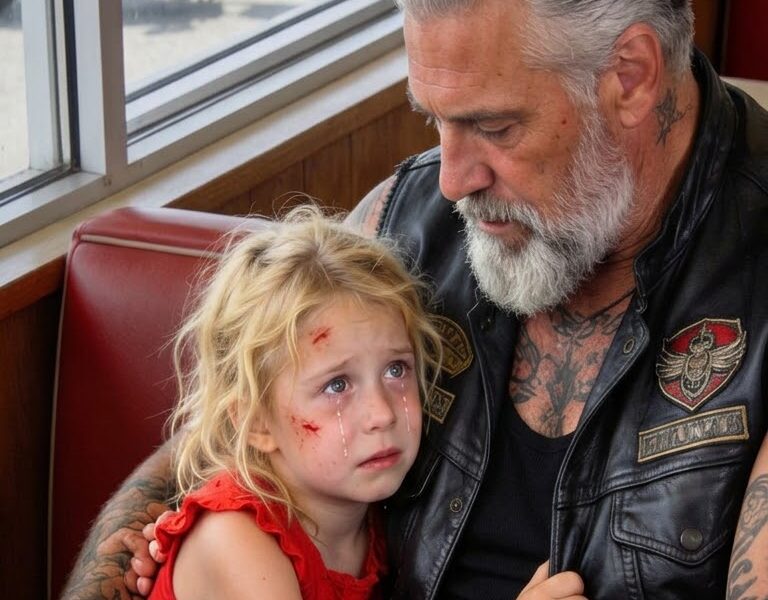
“Pretend You’re My Dad,” a Soaked 7-Year-Old Begged a Biker—He Said Yes, Then 30 Riders Appeared
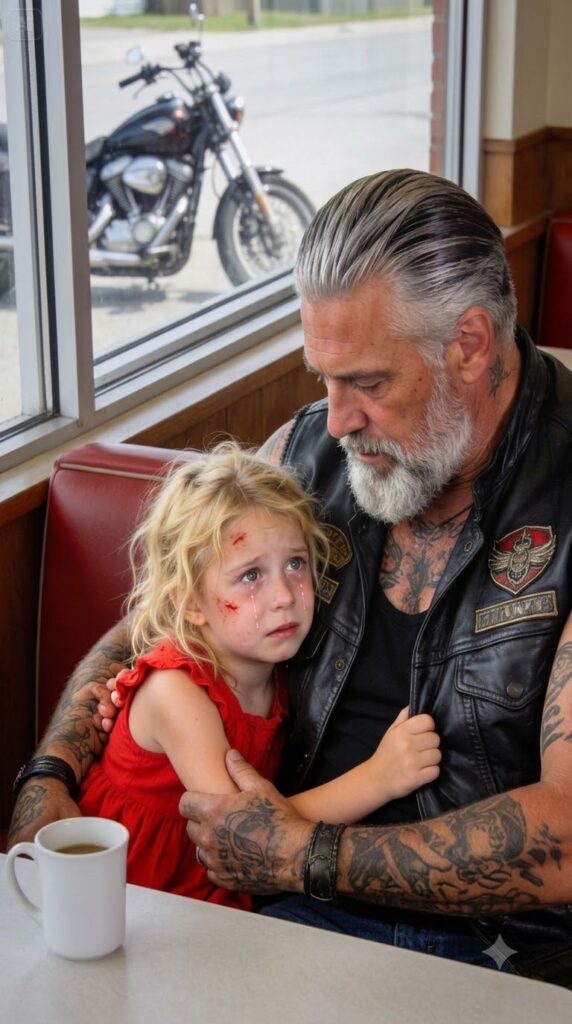
The rain came down on Highway 50 like the sky itself was trying to wash something clean.
Frank Donovan rode through it the way a man rides when he has nowhere left to go and nothing left to lose.
His Harley engine growled beneath him steady and low, the only sound in the world that still made sense.
Fifty-two years old, six-foot-three, two hundred and twenty pounds of muscle, scar tissue, and grief carved into the shape of a man.
He had been riding for three days, maybe four.
Time had a way of bleeding together when you stopped sleeping in beds and started sleeping in motel parking lots with your boots on.
The leather cut on his back carried the patch of the Iron Saints Motorcycle Club and below that, smaller, the rocker that read Sergeant at Arms.
Twenty-three years he had worn that patch.
Before that, eight years in the Marine Corps, two tours in places he did not talk about, and one wife who had been the only thing that ever made him feel like a real person instead of a weapon someone had forgotten to put away.
Margaret.
Eight months in the ground.
Pancreatic cancer.
From diagnosis to funeral in eleven weeks.
He had held her hand the whole time and she had told him the night before she died that she wanted him to keep living.
She had used those exact words.
Keep living, Frank.
Don’t just survive.
Live.
He had been doing a real bad job of honoring that promise.
The neon sign of Rosie’s Diner cut through the rain like a lighthouse.
Half the letters were dead.
The R and the I and one of the S still buzzed weakly.
Frank slowed the Harley and pulled under the overhang, killed the engine, and sat there for a long moment listening to the rain hammer the metal roof.
His hands ached from the cold.
His back ached from the road.
Everything ached really, and not just from the riding.
He pushed open the diner door and the bell above it chimed once, soft and apologetic.
Like even the bell knew it was too late at night for company.
Four people inside.
Frank cataloged them the way he always did.
Old habit.
The waitress behind the counter, mid-fifties, gray showing at the roots of dyed brown hair.
Eyes that had seen things and stopped flinching about them.
An old couple in the corner booth working through a stack of pancakes in the kind of silence that only forty years of marriage could produce.
And a trucker by the window.
Big man, maybe sixty, staring at his phone like it owed him money.
Frank took the back booth.
Always the back.
Where you could see the door and both exits and nobody could come up behind you.
The waitress brought coffee without being asked.
Her name tag said Helen.
“Rough night to be on the road,” she said.
“Only kind worth riding.”
She almost smiled.
“My husband used to say that. Marine Corps, 1976 to ’84.”
“2000 to 2008,” Frank said.
“Semper Fi.”
“Oorah,” she said, and meant it.
Then she went back to the counter and left him alone.
The coffee was hot and bitter and exactly what he needed.
He wrapped both hands around the cup and stared out at the rain and thought about Margaret and the cancer and the way her hand had felt in his when she stopped breathing.
He thought about how a man could ride ten thousand miles and still not get any further from the thing inside him.
The bell above the door chimed again.
Frank looked up out of pure reflex and the world tilted.
A little girl stood in the doorway.
She could not have been more than seven years old.
She wore a pink jacket that had been pink once but was now mostly mud and water.
Her blond hair hung in wet ropes around a face that was too pale, too thin, too aware.
There was a scrape on her left cheek.
Her sneakers squeaked on the linoleum and left small puddles wherever she stepped.
She stood there dripping and looked around the diner the same way Frank had, calculating, cataloging.
A child should not know how to do that.
A child should never have learned.
Her eyes locked onto his.
Helen noticed her.
“My sweetheart, where’s your—”
But the girl was already moving.
Not toward the counter, not toward the door, straight toward Frank’s booth, sneakers squeaking, leaving a trail of rainwater behind her like a comet’s tail.
The trucker looked up.
The old couple stopped eating.
Helen froze with the coffee pot in her hand.
Frank sat very still and watched this small drowned creature walk up to the most dangerous-looking man in the room without a single moment of hesitation.
She stopped at his table, her chin barely cleared the edge.
“Mister,” her voice came out small and shaking, “I need help.”
Frank did not move, did not blink.
He studied her the way he studied everything that did not add up, and a lot did not add up about her.
The bruises on her wrists, faint but there.
The dirt under her fingernails, the way she held herself like every muscle was already braced for impact.
“Where are your parents, kid?”
She flinched.
Actually flinched like he had raised a hand to her instead of asking a simple question.
“My mom,” she whispered.
Her voice cracked.
“My mom is gone.”
The bell above the door chimed for the third time that night.
The girl’s entire body went rigid.
The color drained from her face so fast Frank thought she might pass out right there at his table.
And then she did something he never saw coming.
She climbed into the booth, slid right in beside him, pressed herself against his side, small body shaking so hard he could feel it through his leather cut.
“Please,” she whispered.
The word was meant only for him.
“Please, mister. I know you’re scary. I know everyone’s scared of you, but I need you to pretend, just for a little bit.”
“Pretend what?”
She looked up at him with tears running down her face mixing with rainwater.
Her eyes were old.
God, her eyes were old.
“Pretend you’re my dad.”
Frank Donovan had been many things in his fifty-two years.
A son, a Marine, a husband, a killer when the country asked him to be, a criminal when the country stopped asking and the Brotherhood started.
But in all those years and all those lives, no one had ever looked at him the way this little girl was looking at him now.
Like he was the only door left unlocked in a burning house.
He felt something shift inside his chest, something that had been sleeping for eight months.
The man who walked through the door looked exactly like every predator Frank had ever met.
Mid-forties, expensive suit, gray pinstripe tailored.
The kind of suit that cost more than a working man made in a month.
He shook the rain from a black umbrella with the precise practiced motions of someone who had done it ten thousand times.
His smile was wooden and white and entirely wrong.
His eyes swept the diner.
Trucker, old couple, Helen, and then they found the girl.
The smile widened.
“Lily.”
His voice was smooth and cultured, the kind of voice you heard reading audiobooks or pitching financial products on television.
“There you are, sweetheart. Daddy has been so worried.”
The girl Lily gripped Frank’s leather cut so hard her knuckles went white.
Something old and familiar ignited in Frank’s chest.
He had spent a lot of years being the thing people crossed the street to avoid.
He had broken bones and faces and a few hearts and at least once a man’s neck, and he had told himself the whole time that it was for the brotherhood, for the cause, for the patch.
But this, this was different.
This was a little girl who had looked at the most dangerous man in the room and seen safety, and now the actual dangerous man had walked through the door.
Frank slid his arm around Lily’s shoulders and pulled her close.
When he looked up at the man in the gray suit, his eyes carried the same flat promise they had carried in Fallujah and Ramadi, in every barroom from Reno to Fresno.
“She’s with me,” Frank said.
His voice came out quiet, the voice of a man who had said worse things before doing worse things.
The man in the suit’s smile did not waver, but something behind it shifted.
“I am sorry, there must be some confusion. This is my daughter. She wandered off during our trip. I have been looking everywhere for her.”
“That’s right.”
Frank took a slow sip of his coffee, set the cup down with deliberate care.
“Funny, because she just called me dad.”
“She is confused. The storm frightened her. You know how children are.”
“No,” Frank said, “I don’t. Why don’t you tell me?”
The temperature in the diner dropped ten degrees.
The trucker by the window had set his phone down.
The old couple in the corner had stopped pretending to eat.
Helen had her hand on something under the counter, and Frank would have bet his Harley it was either a baseball bat or a twelve-gauge.
The man in the suit took one step closer, still smiling.
The smile had become a thing of teeth.
“Sir, I appreciate your concern, but this is a family matter. Lily, come here right now.”
Lily whimpered.
Actually whimpered, pressed herself harder into Frank’s side.
That was when Frank saw it, the detail that confirmed everything.
The man had called her Lily, used her name like he knew it.
But when she had climbed into the booth, when she had grabbed his cut and begged him to help, she had never told Frank her name.
Which meant this man knew things he should not know about a child he claimed was his.
Frank’s free hand moved to his belt, not to a weapon, not yet.
Just rested there casual where his knife lived in a leather sheath under his cut.
Old habits.
“Here is what I think,” Frank said, and his voice carried that peculiar quiet that always came right before violence.
“I think you need to walk back through that door. Get in whatever car you drove here in and disappear.”
“Or what?”
The smile cracked just enough to show teeth.
“You will assault me in front of witnesses over a confused little girl.”
“No,” Frank said.
He smiled back.
It was not a nice smile.
“I’ll make you wish I had just assaulted you.”
Lily’s small voice cut through the tension like a wire.
“He took me.”
The words tumbled out in a terrified rush.
“Three days ago. From my house. My mom tried to stop him and he hurt her and there was so much blood and I ran and I have been hiding and he has been looking for me and please, mister, please.”
“Sweetheart,” the man said, his voice turning syrupy with practiced concern.
“You are having one of your episodes again. Remember what the doctor said about making up stories.”
Frank looked down at Lily, really looked, saw the truth written in every shaking muscle, every terrified breath, every tear that rolled down her dirty face.
Then he looked back at the man in the gray suit.
“She’s not making anything up.”
The mask slipped just for a second.
Long enough for Frank to see what lived underneath.
Something cold, something that looked at children and saw inventory.
“This does not concern you, biker,” the man said.
“Walk away while you still can.”
“That a threat?”
“That is a promise. You have no idea who you are dealing with.”
“Iron Saints,” Frank said.
He said it loud enough for the whole diner to hear.
Said it the way a man announced he was holding aces.
“That is who I am. That is what this patch means. And that little girl just became my problem. So here is your choice. You walk out of here on your own two feet or you crawl out on whatever I leave you with.”
The trucker stood up.
He did not say a word, just stood up all six and a half feet of him and stepped over to flank Frank’s left side.
Then the old man in the corner pushed himself out of his booth.
Had to be seventy if he was a day.
Career, Frank guessed from the way he moved, from the look in his eyes that said he had seen evil before and wasn’t impressed by this version of it.
The old man came over and stood on Frank’s right.
Three men.
Three generations.
Three complete strangers who had never spoken a word to each other, all standing between a little girl and the thing that wanted her back.
The man in the suit looked at each of them.
Calculated.
Weighed.
Yawned.
Frank could see him doing the math and he could see the moment the math came out wrong.
“This is not over,” the man said quietly.
“You have no idea what you have just done.”
“Sure I do,” Frank said.
“I just adopted a kid.”
The man turned and walked out.
He did not run.
He did not hurry.
He walked with the calm of someone for whom this was a postponement, not a defeat.
The bell chimed as the door closed behind him.
Nobody moved.
Frank counted to thirty.
Watched through the rain-streaked window as headlights came on in the parking lot.
A black SUV.
Of course it was a black SUV.
The vehicle sat there for a long moment, engine running, wipers slapping.
Then it pulled out and disappeared into the storm.
“Damn,” Frank said quietly.
The trucker sat back down.
So did the old man.
Both of them trying to convince themselves it was over.
Frank knew better.
It was not over.
It was just starting.
He looked down at Lily still pressed against his side, still shaking.
“You got a name besides Lily?”
“Lily Hartman.”
Her voice was so small.
“I’m seven. I’ll be eight in October.”
“Okay, Lily Hartman. I’m Frank. Some people call me Reaper.”
“Why?”
“Because I send the wrong people to meet him.”
She looked up at him.
“Are you going to send the bad man?”
Frank crouched down so they were eye to eye.
The booth made it awkward, but he managed.
“I’m going to keep you safe. That is what matters right now. You understand?”
She nodded.
Then she threw her thin arms around his neck and held on like he was the only solid thing in a liquid world.
Helen appeared with a fresh pot of coffee and a stack of clean dish towels.
“Bathroom is in the back. Get her dried off. I will make her something hot to eat.”
“Thank you.”
“Don’t thank me yet.”
Helen’s voice was low.
“That man is coming back, and he is not coming alone.”
Frank knew she was right.
In the bathroom, Lily stood shivering under the fluorescent light while Frank ran warm water over a clean towel and handed it to her.
She wiped her face, her arms, tried to get the rain and mud and fear off her skin like fear was a thing you could wash away.
“Where is your mom, Lily? Really?”
Fresh tears started.
“He killed her. I know he did. She was on the phone yelling at someone about papers, about evidence, about something bad she found at work. And then he came in the back door, and she told me to run upstairs and hide. And I heard her yell, and then there was a sound like a firecracker, and I heard her fall, and I could not move. And then I ran out the window and I have been running for three days and—”
Frank kept his voice even.
Steady.
The voice he used to use with new recruits in their first firefight.
“Okay. You did good. You ran. You survived. That is what your mom wanted.”
“But I left her.”
“And she is proud of you for it. Trust me on that.”
Lily looked up at him with those two old eyes.
“Why are you helping me? Everyone says bikers are bad.”
Frank thought about that.
About twenty-three years wearing a patch that made mothers pull their children closer on sidewalks.
About the violence and the brotherhood and the long road of it all.
“Maybe I am bad,” he said finally.
“But that does not mean I let things like this happen. Not when I can stop them.”
“My mom used to say there are no bad people, just bad choices.”
“Your mom sounds smart.”
“She was.”
The door of the bathroom slammed open hard enough to crack against the wall.
The trucker filled the doorway.
Sweat on his forehead despite the cold.
“He’s back. Two more SUVs, six guys getting out. And these ones are not wearing suits. They are wearing tactical gear.”
Frank’s blood went cold.
Not from fear, from recognition.
This was not a kidnapping anymore.
This was a cleanup operation.
The kind of people who showed up when an asset went off the reservation and a problem needed to be made permanent.
He pulled his phone from his pocket, dialed a number he knew by heart.
The phone rang twice.
A gravel voice answered.
“Reaper, where the hell have you been?”
“Bear, I need the brothers, all of them, now.”
“You in trouble?”
Frank looked down at Lily.
At her small hands clutching that ruined pink jacket.
At the way she was watching him like he was the answer to a question she had been carrying for three days.
“Yeah,” he said, “but not the kind you think. I have got a kid here, seven years old. People want to take her. People who do not stop.”
A pause on the other end.
Just long enough for a brother to set down whatever he was holding.
“Where?”
“Rosie’s Diner, Highway 50, middle of nowhere, Nevada.”
“How many of them?”
“Six, maybe more on the way.”
“We are ninety minutes out if we ride hard, maybe seventy-five.”
“Don’t know if I have got seventy-five, Bear.”
“Then make some noise, brother. Let them know they picked the wrong man to mess with.”
The line went dead.
Frank pocketed the phone and looked at the trucker.
“What’s your name?”
“Dale.”
“Dale, you got a rig out there. Sleeper cab, forty-foot trailer.”
“Why?”
“Can you drive in this weather?”
“Driven in worse.”
“Good. When this goes sideways, you get her in that cab and you drive. Don’t stop. Don’t slow down. Don’t pick up your phone.”
Dale looked at Lily, looked at Frank.
“Six guys, what about you?”
Frank’s smile was all teeth and no warmth.
“I’ll buy you time.”
“Against six?”
“They’re about to learn why they call me Reaper.”
Back in the diner, the air had gone from tense to suffocating.
The old couple was already gone.
Smart.
Helen had moved from hand on something under the counter to actually holding the something, which turned out to be a Mossberg pump-action shotgun she kept openly on top of the bar now.
Through the rain-streaked windows, Frank could see them.
Six men climbing out of two black SUVs.
All wearing similar black tactical jackets over body armor.
Moving with the kind of practiced precision that screamed military training.
Not the loud, sloppy kind.
The other kind.
The kind that came from working in shadows.
Cleaners.
The kind of people who did not leave witnesses.
“Lily,” Frank crouched down one more time.
“I need you to listen to me carefully. When I say go, you run to Dale. You get in his truck. You do not look back. You do not wait for me. Promise.”
“But you said you would stay.”
“I said I would keep you safe. That is what I am doing right now, baby. Go with Dale. I will find you.”
He hugged her, felt her thin arms around his neck.
Then he peeled her off and pushed her toward Dale and the trucker’s big hand closed gently around her shoulder.
The bell above the door chimed.
All six men walked in together.
Spread out professionally, blocking exits, controlling space.
The one in front was older than the man in the gray suit had been.
Silver hair, suit underneath the tactical jacket, eyes that did not waste motion.
“Gentlemen, ladies,” his eyes found Lily, “and children. My name is Mr. Harrison. I am here to collect something that belongs to my employer.”
“She is not a something,” Frank said, and she does not belong to anybody.
“You misunderstand. The girl is material to an ongoing federal investigation. Very sensitive, very classified. We are simply here to—”
“Cut the act,” Frank said.
He stood up slowly, positioned himself between Lily and the men.
“I know what you are. I know what you do. And you are not taking her.”
Harrison’s smile thinned.
“You are making a mistake.”
“Made plenty of those. One more is not going to hurt.”
“You are outgunned, outmanned. You are one biker and a trucker and a waitress with a shotgun against six trained professionals.”
“Six?”
Frank laughed.
The sound was cold.
“You brought six men to take a seven-year-old girl. That tells me everything I need to know about how scared your boss is.”
One of the men reached inside his jacket.
Frank moved.
Not toward the gun, toward the table.
He grabbed the coffee pot Helen had left on his table thirty minutes ago.
The glass was still hot.
Two hundred degrees of dark roast.
He hurled it straight into the face of the nearest tactical operator.
Boiling coffee, breaking glass, screaming.
Then he flipped the table.
“Go!”
Lily ran.
Dale grabbed her hand and they bolted for the back exit.
The Mossberg roared from behind the counter.
Helen had decided she was tired of watching.
The first round took a man’s center mass and dropped him to one knee.
Body armor stopped the pellets, but not the shock.
Frank grabbed the man closest to him, a big, bald operator with a tattoo on his neck.
Used his momentum, slammed him face-first into the counter, hard enough to crack laminate and teeth in the same motion.
Spun, caught another one with an elbow to the throat, heard the wet, awful crunch of a windpipe giving way, but there were too many.
He had known there would be.
Someone hit him from behind, baton or rifle stock to the kidneys, and Frank went down to one knee.
Tasted blood, felt hands grabbing him.
Then he heard the most beautiful sound in the world, thunder.
Not from the sky, from engines.
Fifteen Harley-Davidsons came screaming into the parking lot at the same time, headlights cutting through the rain like searchlights through a prison yard.
Brothers were dismounting before the bikes finished rolling.
Frank could see Bear in the lead, six and a half feet of muscle and fury wearing a sergeant patch.
Behind him came Snake and Razor and Prophet and Tiny, who was anything but, and ten more brothers Frank had bled with for two decades.
They came through the door like the wrath of God arriving late, but ready to make up for it.
What followed was short.
It was brutal.
It was in its own, ugly way, beautiful.
Frank had bought Lily three minutes.
His brothers gave her the rest of her life.
When it was over, four of the six men were unconscious on the diner floor.
One had a leg bent in a direction legs were not supposed to bend.
And Mr. Harrison was on his knees in a puddle of his own blood with Bear’s Bowie knife pressed against the soft flesh under his jaw.
“Talk,” Bear growled, “and talk fast.”
Frank pulled himself up off the linoleum, spit blood, his ribs hurt, his head hurt, everything hurt.
But he was alive.
“Where’s the girl?” he called.
“Safe,” Dale’s voice from the doorway.
“Got her in the cab, locked it up like Fort Knox. She is okay.”
Frank nodded, walked over to Mr. Harrison on his knees, looked down at the man who had brought five killers to a roadside diner to collect a child.
“You heard the man,” Frank said, “Talk.”
And talk Harrison did.
Because when you are on your knees in your own blood with an Iron Saints knife at your throat and your team unconscious or dying around you, you talk.
He told them about Lily’s mother, about Sarah Hartman, auditor for the United States Department of the Treasury, about the files she had found buried in the financial records of three federal foster care contractors, about money moving in patterns that did not match services rendered, about children disappearing from the system and reappearing in places children should never appear.
He told them about the network that protected it, names that made Bear’s eyes narrow, a federal judge in Las Vegas, a senator, a businessman in Denver who ran charitable foundations that were not actually charitable.
He told them how high it went and how dirty it got and how nobody had ever come close to bringing it down because the people protecting it were the same people supposed to be investigating them.
He told them everything.
And with every word the cold thing in Frank Donovan’s chest grew colder.
Because this was no longer about one little girl in a wet pink jacket.
This was about burning down an empire.
“Bear,” Frank said quietly, “make some calls.”
“Who to?”
“Everybody.”
Two hours later, Lily sat in Dale’s truck cab wrapped in three blankets while fifteen bikers stood outside in the rain planning a war.
Frank climbed up to the passenger door and tapped on the window.
She unlocked it immediately.
“Hey, kid.”
“Did you kill them?”
Straight to the point.
Frank liked that about her.
“No, but I scared them real good. And the ones who came back, we took care of them.”
“Good.”
Her small hands gripped the blanket.
“Are more coming?”
“Probably, but not for a while. We’ve got time.”
“Time for what?”
Frank looked at her for a long moment.
Really looked.
Seven years old.
Orphan, she thought.
Caught in something so big it could swallow grown men whole.
Terrified, but also brave.
Smart.
A survivor in a way that grown men he had served with had not been survivors.
“Time to finish what your mom started,” he said.
“How?”
“That’s the part where we get to be loud.”
She thought about that.
Then she said something he was not ready for.
“Am I family now?”
The question hit him harder than Harrison’s men had hit him.
He felt it land somewhere deep.
Somewhere Margaret used to live, somewhere that had been empty for eight months.
“Yeah, kid,” he said quietly, “I guess you are.”
Lily smiled, the first real smile he had seen from her.
Small, but real.
“Okay, Dad.”
And just like that, the pretending started turning into something else.
Outside the rain kept falling.
The Iron Saints stood in a loose circle around their bikes smoking, talking low.
Bear caught Frank’s eye through the windshield and gave him a nod that said everything brothers ever needed to say to each other.
We are here.
We are not leaving.
Whatever comes next, we come, too.
Frank climbed down from the cab, pulled his cut tighter against the cold, walked over to where Bear stood with Snake and Prophet.
“Tell me what we know,” Frank said.
Bear pulled out a phone, tapped through some messages.
“Harrison spilled most of it. We have got names, locations, the whole org chart of what looks like a trafficking operation running through three Western states. He says the mother, Sarah Hartman, has the original evidence. The files she copied off Treasury servers before she ran. He says she is dead. He says he thinks she is dead. He pulled the trigger, saw the body, helped clean the scene.”
Frank looked at him.
“But?”
“But he never confirmed the death certificate, never saw her at a morgue. And that little girl in the truck has been running for three days, which means somebody up the food chain still thinks the mother might be alive, too. Otherwise, they would not be sending six cleaners after one little girl.”
Frank let that sit.
“You think Sarah Hartman is alive?”
“I think it is a possibility worth sweating.”
“How do we find out?”
Snake, who had been quiet, finally spoke.
“If she is alive, she is hiding. And if she is hiding, she is hiding because she knows they are watching her. Her phone, her credit cards, her sister, her friends, her mother, everyone who might know where she would go. So, she would not contact any of them. Not directly. But—”
Snake held up a phone.
Harrison’s phone.
“She might contact him if she thought he was the only way to reach her daughter.”
Frank stared at the phone, at what Snake was suggesting.
“You want to use her dead kidnapper’s phone to flush her out.”
“I want to send a message that only the mother of that little girl would understand, and I want to see what comes back.”
Frank looked at the truck, at the small face pressed against the passenger window watching him through the rain.
“Do it,” he said.
Bear nodded.
Snake started typing.
And somewhere out in the desert, fifty miles from a diner in the middle of nowhere, a phone in the pocket of a woman who was supposed to be dead was about to start vibrating.
Frank Donovan, who had ridden into Nevada with nothing left to lose, climbed back into the warmth of the diner to wait for whatever came next.
The rain kept falling.
The Iron Saints kept their watch.
And inside Dale’s truck cab, a little girl named Lily Hartman closed her eyes for the first time in three days and let herself believe just a little that maybe the world was not entirely full of monsters.
Maybe some of the monsters were on her side now.
The phone in Snake’s hand buzzed at 4:17 in the morning.
Frank had not slept.
None of them had.
The Iron Saints had spread themselves across Rosie’s Diner in shifts.
Brothers on the roof, brothers at the corners of the parking lot, brothers in the booth opposite Frank drinking coffee and watching the rain finally taper off into a gray pre-dawn drizzle.
Helen had stayed open all night.
She had refused to take money for the food.
She had refused to take money for the shotgun shells, either, which she had used three of and seemed to consider a fair trade for the entertainment.
Lily had finally fallen asleep in Dale’s cab with her head in his lap and his road atlas as a pillow.
Dale himself had not moved in four hours, sitting up perfectly straight in the driver’s seat, one hand resting near the gearshift, the other resting on the seat between him and the sleeping child like a guardrail.
Frank had checked on them twice.
The second time, Dale had said quietly, “She had a nightmare. Said the word mom just once, then she went back to sleep.”
Frank had not said anything.
He had just put his hand on Dale’s shoulder for a second, then walked away because his throat was too tight to speak.
When the phone buzzed, Snake brought it over.
“It is from a burner, has to be her.”
The message was three words.
“Where is she?”
Frank stared at the screen for a long moment, then he typed back slowly with thick fingers that were not used to texting.
“She is safe with Iron Saints MC Rosie’s Diner Highway 50. Come now. Bring everything.”
He hesitated, then added one more line because whoever was reading this on the other end was not going to come to a parking lot full of bikers on the word of a stranger using her dead kidnapper’s phone.
“She asked me to pretend. I said yes.”
He sent it.
For seven minutes nothing happened.
Snake held the phone.
Bear stood beside Frank.
The rain dripped off the diner’s overhang in slow irregular plinks.
Then the phone buzzed again.
“1 hour alone.”
Bear shook his head.
“We are not letting you stand alone in a parking lot.”
“She has to think I am alone or she will not come.”
“Then we hide, but we are here.”
Frank texted back: “Alone in the open. Brothers in cover. They protect her, too.”
A long pause, then: “Okay.”
Forty-seven minutes later, a beat-up tan sedan that had probably been white once pulled into the lot.
It rolled slow, headlights off, like an animal approaching a watering hole that might be a trap.
The driver’s door opened.
The woman who stepped out looked like she had been shot three days ago and had been moving on coffee and willpower ever since.
Sarah Hartman, mid-thirties, blonde like her daughter, pale in a way that had nothing to do with being inside too much.
There was a lump under her jacket on her left side that Frank made for a heavy bandage.
She moved with the careful, conserved movements of someone managing serious pain.
He walked out to meet her with his hands open and visible.
“Frank Donovan.”
“Where is she?”
“Inside the truck, sleeping.”
“I want to see her.”
“You will. But first you tell me how you survived. Because Harrison told me he watched you die.”
Sarah’s jaw tightened.
“He saw what I needed him to see. I was wearing my husband’s old vest. Kevlar from when he was a Las Vegas cop. He died eight years ago in a traffic stop. I had it in the back of my closet. When the calls started getting strange at work, when people I did not know started showing up at my building, I started wearing it under my clothes.”
Her voice cracked.
“Every day for two months, I felt crazy. Like I was overreacting. Then he came through my back door, and I was glad I was crazy.”
“He shot you in the chest?”
“Twice. Knocked me down. Knocked the wind out. I lay there. I made my eyes go empty. I did not breathe until he was gone. He kicked me once to be sure. I have a broken rib from it, and the vest cracked one of the plates, and I have bruises on my chest you would not believe. But I did not move. And I heard Lily go out the upstairs window, and I waited until I heard his car drive away. And then I crawled out my own back door, and I have been hiding for three days.”
“Why not go to the police?”
“Because Harrison is not the only one. Because I worked at Treasury for eleven years, and I know how money moves and who it moves to. The people I would have to trust to protect me are the same people I would be reporting on. The local field office has at least one mole. I do not know who. I know they exist because three weeks ago I sent an anonymous tip up the chain and the next morning there were two men sitting in a black sedan across the street from my house.”
Frank watched her while she spoke.
Watched the steadiness in her eyes.
The exhaustion underneath it.
The thing that was keeping her upright was not adrenaline.
It was the seven-year-old in the truck cab fifty feet away.
“You let her think you were dead,” he said.
“Yes, for three days.”
“That is a hard thing for a kid.”
Sarah’s face crumpled for one second and then rebuilt itself.
“Mr. Donovan, if they had known I was alive, they would have hunted me with everything they have. And they would have known they could break me with her. They would have taken her and they would have hurt her and they would have put it on a phone and sent it to me and they would have gotten everything they wanted. The only way to keep her alive was to make them believe they did not need her to get to me. The only way to do that was to be dead.”
She paused.
“I am going to spend the rest of my life making that up to her. If I get a rest of my life.”
Frank nodded slowly.
“Come on, let’s go give her her mother back.”
The reunion was the kind of thing a man should not be allowed to watch.
Lily had come awake when Frank knocked on the cab.
She had seen Sarah through the windshield and gone perfectly still.
The way a deer goes still right before it bolts.
Sarah had stayed back, hands raised, letting Lily come to her.
“Mom.”
“Baby.”
“Mom.”
“It is me, Lily. It is really me.”
Lily came out of the cab in a stumble and a run that became a collision and Sarah caught her with arms that must have felt like they were on fire from the wound.
And neither of them cared and Lily was sobbing into Sarah’s neck saying, “You were dead. You were dead. I saw you. I saw you.”
And Sarah was saying, “I am sorry, baby, I had to. I had to. I had to.”
Over and over.
Frank turned away.
He looked at Bear who was looking at the sky like maybe there was something interesting up there.
He looked at Dale who was wiping his eyes with a grease-stained handkerchief and pretending he was not.
He looked at Helen who was just watching and who looked like a woman who had seen a lot of bad things and was glad to be seeing a good one.
Eventually, Sarah pulled herself together enough to talk.
She pulled a small flash drive from a money belt under her shirt and held it up.
“Everything is here. Six months of work. Every transaction. Every name. Video from a meeting I bugged. Bank records. Two contractors and a federal judge and a sitting senator. It is enough to bring down most of the people who tried to kill me.”
“We need to get this somewhere,” Frank said.
“Public. Fast.”
“There is an agent, Victoria Moss, out of the San Francisco field office. I have been watching her career. She’s been quietly investigating one of the contractors for almost a year independent of the rest of her office. If anyone in the bureau is clean, it is her. But I cannot just walk into a federal building.”
“Then we don’t walk into a federal building. We bring her to us.”
Bear pulled out his phone.
“I will get the warehouse ready.”
“What warehouse?”
“Old meat packing plant south of here. The club uses it for storage. Defensible. Off the books. Not on any registry that connects to me or the brothers.”
Sarah nodded.
“How long until we can be there?”
“Forty minutes.”
She looked at Lily still wrapped around her waist.
“Okay.”
It took them forty-three minutes.
They moved in a loose convoy.
Dale’s truck in the middle.
Bikes in front and behind.
Frank rode beside the truck the whole way, glancing into the cab every few miles to make sure Lily was still there, still real, still breathing.
The warehouse sat at the end of a dirt road surrounded by scrub brush, concrete and corrugated metal.
The kind of building that looked from the outside like nothing worth fighting for.
Inside, Bear had been busy on his phone.
By the time they arrived, brothers were already setting up perimeter positions.
A second wave of bikes was coming in from the Reno chapter.
Word had moved through the Iron Saints faster than the storm.
Sarah called Agent Moss from a burner phone Bear handed her.
The conversation was brief and Frank only heard one side of it.
When Sarah hung up, she said, “She is on a plane in two hours. She wants to drive, but she wants it in person and she wants to talk to me before she takes it anywhere.”
“Two hours is a long time to sit still,” Frank said.
“I know.”
It took forty minutes for the next problem to find them.
Snake came jogging across the warehouse floor with a phone in his hand.
“Bear, we got a problem. State police just got a call, anonymous tip, welfare check on this address, suspicious activity at an abandoned warehouse, possible trafficking.”
“How long do we have?”
“Maybe ten minutes. They got somebody on the inside.”
Frank swore.
If state police rolled up and found them, even with Sarah Hartman vouching, the protocol was going to be to take Lily into protective custody, foster care, the system, the same system Sarah had been investigating.
Lily would disappear into the gears of a bureaucracy with a hole in it big enough to lose a child through and they would never see her again.
Bear was already running scenarios.
“We move her. Dale’s truck, take her and Sarah to a secondary location until Moss arrives. They will see the truck leaving. They will follow. Then we hide her in plain sight.”
Snake, of all people, came up with it.
“Birthday party.”
Bear looked at him.
“What?”
“Cops show up to a warehouse full of bikers, they expect drugs or guns. They are not expecting cake. We turn this into a kids birthday party. Dale is the dad, Lily is the daughter. We are all uncles. Helen and Sarah are wholesome family friends.”
“Helen is at the diner.”
“Helen is right behind us in her car because she said she was not going to miss the rest of this for anything. I checked.”
Frank turned.
Helen was in fact behind them, parking a beat-up Subaru next to a Harley, getting out with a stack of takeaway boxes and the Mossberg slung casually over her shoulder like a purse.
“Get the shotgun out of sight,” Bear called to her.
“We are throwing a birthday party in eight minutes.”
“For who?” Helen called back.
“Lily. She is eight.”
“She told me she was seven.”
“She is eight today.”
Helen, who was a woman who understood emergencies, did not ask another question.
She walked back to her car, came back without the shotgun, and produced from one of her boxes a slightly stale cinnamon roll with a candle stuck in it.
Five minutes later, Lily was sitting on a wooden crate with a candle burning in front of her and frosting on her cheek.
Dale was wearing a borrowed leather cut over his flannel that did not really fit him.
Twelve bikers were standing in a rough semicircle pretending to sing happy birthday in the worst harmony Frank had ever heard.
Sarah stood beside her daughter with a hand on her shoulder, smiling the kind of smile a woman smiles when she has not slept in seventy-two hours and is also possibly bleeding internally.
Three state police cruisers rolled into the lot.
The lead officer was a woman in her early forties with sharp eyes and a steady right hand resting near her sidearm.
She got out slowly, looked at the bikes, looked at the warehouse, looked at the birthday cake.
“We got a call about suspicious activity at this location. Multiple vehicles, possible trafficking situation. Care to explain what is going on?”
Frank stepped forward, hands open.
“Officer, just throwing my buddy’s daughter a birthday party. Eighth birthday at a warehouse. Family business, storage. We use it for parties sometimes, cheaper than renting a hall.”
The officer’s eyes went to Lily.
Lily was watching the officer with the wide frozen look of a child who has spent three days running and now did not know if running was the right answer or the wrong one.
Frank watched the moment hang.
Watched the officer’s training kick in, looking for signs of coercion, looking for fear pointed in the wrong direction.
The officer crouched down so she was closer to Lily’s eye level.
“Hi, sweetheart. My name is Officer Rios. Are you okay?”
This was the moment Frank could not breathe.
Lily looked at Officer Rios.
Then she looked at her mother.
Then at Frank.
And what Frank saw in her face was the calculation of a child who had learned the hard way that the people in uniforms were not always the safe people and the people on the bikes were not always the bad ones.
“Yes, ma’am, it is my birthday. It is a nice party.”
“Are these men your family?”
“They are my dad’s friends. He works with them.”
“And your mom?”
Lily looked at Sarah.
Sarah was holding herself together by a thread.
“My mom just got back from a long trip. That is why we are having the party today.”
Officer Rios studied her.
Looked at Sarah’s pale face and saw the bandage outline under the jacket.
Looked at the blanket Lily was clutching in one hand, even with frosting in the other.
Looked at twelve men with patches and old scars, none of whom were looking at the kid with anything other than something like protectiveness.
Her radio crackled.
Domestic call two counties over, urgent.
She straightened up, looked at Frank.
“Mr. Donovan, I am going to say something to you and I want you to listen carefully. I do not believe a single word of what I just heard. Not one. But I have a domestic with a weapon four counties from where I am supposed to be and I have a feeling that whatever is going on here is bigger than my pay grade. So, I am going to leave. And I am going to send a quiet email to a friend of mine in San Francisco who works for the Bureau and used to be my partner when I was in the city. Her name is Moss. You may have heard of her.”
Frank looked at her.
“You know Victoria Moss?”
“She married my brother. So, I am going to make a call instead of an arrest. Do not make me regret it.”
She got back in her cruiser.
The other two cruisers followed.
The dust settled.
Frank let himself breathe.
“That is going to be a story we tell for years,” Snake said.
It was forty minutes after Officer Rios left that the first explosion hit the warehouse.
There had been no warning.
None.
One of the brothers on the south side, Reno chapter member named Cope, had been doing a slow walk of the perimeter when the wall beside him bowed inward and then ruptured.
Forty pounds of breaching charge, professionally placed.
He never knew what hit him.
Frank was inside with Lily and Sarah when it happened.
The sound was like the world ending.
He went down on instinct, dragging Lily under and feeling Sarah hit the concrete on the other side of the child.
Dust and concrete and metal rained from the ceiling.
Somewhere across the warehouse, brothers were already firing.
This was not state police.
This was not six men in suits.
This was a small army.
“Bear,” the voice on the radio.
“South wall is open. We have got at least twenty-five hostiles moving in. Cope is down. Repeat, Cope is down.”
Frank’s hands shook for one second.
Then he turned them into fists.
“Sarah, listen to me. Take Lily. There is a maintenance tunnel under the office in the northeast corner. Bear showed you when we got here. It comes out at an old pump station. There are two brothers waiting at the other end with a vehicle. You go. You do not stop. You do not look back.”
“Frank, you—”
“I have to buy time for Moss. She lands in twenty minutes. I have to keep this fight here.”
Lily was looking at him with eyes that knew exactly what he was saying.
“You promised,” she whispered.
“I promised I would keep you safe. That is what I am doing right now, baby. Go with your mom. I will find you.”
He hugged her, felt her thin arms around his neck.
Then he peeled her off and pushed both of them toward the office and Sarah half carried Lily across the warehouse floor while bullets started chewing into the metal walls around them.
Frank picked up a rifle off a dead operator who had made it twenty feet inside the south wall and then run into Prophet, and he went to work.
The fight that followed was the worst Frank had been in since the second tour.
They had numbers.
They had equipment.
They had night vision and breaching charges and the kind of training that came from contractors who used to wear flags.
The Iron Saints had a building they knew, rage they had been carrying since Cope went down, and the unshakeable fact that there was a child in a tunnel under their feet who was not going to get caught.
It was enough.
Barely.
Frank was in the rafters above the main floor picking targets when he saw a flicker of movement near the office.
One man, black tactical, working alone, heading for the tunnel access.
He had eyes on the way out.
Frank dropped from the rafters into a stack of pallets, rolled to absorb the impact, came up moving.
He got across the floor in twelve seconds.
The man was at the office door.
Frank tackled him from behind, took him down hard, drove a knife under the back of his vest plate before either of them really registered the contact.
The man went limp.
Frank rolled him over.
The face was nobody he knew.
But the radio in the man’s ear was still talking.
Frank pulled the earpiece out and put it in his own ear.
A voice was speaking, calm, cultured, giving orders.
“Find the woman. Find the girl. The biker is irrelevant. Eliminate everyone in the building. We finish this in twenty minutes or this becomes a federal incident. Repeat. Twenty minutes. Get me eyes on the tunnel.”
Frank knew that voice.
Not from anywhere personal.
Not from a friend or an enemy.
From a press conference six months ago.
From a federal podium with a federal seal behind it.
From a man who had been on television talking about organized crime initiatives and the bureau’s commitment to inter-agency cooperation and how no one was above the law.
The voice on the radio belonged to Deputy Director Thomas Carlyle, head of the organized crime division of the FBI.
Frank stood up slowly in the middle of a warehouse that was being torn to pieces around him.
And he understood with the cold certainty of a man who had been lied to by governments before that this was never going to be solved by handing a flash drive to anyone wearing a badge.
The earpiece kept talking.
“I want the girl alive. Repeat. The girl alive, the mother dead. We need her dead before any of this comes out. Make it look like the bikers did it.”
Frank found Bear ten seconds later in a smoke-filled hallway.
Both of them were bleeding from cuts they had not noticed.
Bear was reloading.
Frank grabbed his shoulder.
“It is Carlyle, Deputy Director Carlyle. He is the one running this. He is in the building.”
Bear stopped reloading.
“Deputy Director of the FBI.”
“Yes, he is here. He is somewhere on this property in a vehicle running command. I just heard him on attack channel telling them to kill Sarah and grab Lily. He is twenty feet from a flash drive that ends his career and his freedom and the freedom of half the people he protects. He is not going to leave. He has to see this done.”
Bear’s face went still in the way it went still right before it got loud.
“Go finish it,” Bear said.
“I will hold the line.”
“I will be back.”
“I know you will.”
Frank turned.
He had taken three steps when he heard Bear grunt behind him.
He turned back.
Bear was on one knee.
There was a hole in his cut.
Then another.
Then another.
Bear was looking down at his own chest with an expression of mild surprise.
A figure in tactical gear stood at the end of the hallway.
The figure was raising the rifle for a fourth shot.
Frank shot him in the face.
He did not remember picking up his pistol.
He did not remember aiming.
He just remembered the man at the end of the hall going down and Bear on his knees and the world going a kind of red Frank had not felt in years.
He got to Bear in three strides.
“You stupid, stupid—”
“Three of them were yours,” Bear rasped.
“Caught them in the back of the cut. Did not even feel the first one.”
“I am getting you out.”
“You are going to find Carlyle.”
“Bear—”
“That man wanted to take a kid, Reaper. You go finish it. You go finish it for me. I will be here when you get back.”
Frank pressed both hands against the worst of the holes.
Felt warm wetness pumping under his palms.
“Promise me you will be here.”
“I promise. Now go.”
Frank went.
He found Carlyle in a black command vehicle parked in the tree line behind the warehouse.
Three operators were guarding it.
Frank took the first one with a knife and the second one with the first one’s pistol and the third one with his bare hands when the pistol clicked empty.
None of it took longer than nine seconds.
He was aware distantly that he was bleeding from places he had not been bleeding from a minute ago.
He yanked the door of the command vehicle open.
Thomas Carlyle was sitting at a small built-in console, headset on, in a tactical jacket over what Frank could see was an expensive button-down shirt.
Fifty-something, silver at the temples, the face from the press conferences.
He looked up when the door opened and Frank saw the moment Carlyle understood that the man at his door was not one of his men.
Carlyle’s hand went for a sidearm in a shoulder holster.
Frank shot him in the shoulder through the shirt, through the jacket, into the meat.
Not enough to kill, more than enough to stop.
Carlyle screamed.
The sidearm clattered onto the floor of the vehicle.
Frank climbed in, closed the door behind him, sat down across from a federal deputy director who had been ordering the death of a child fifteen minutes earlier.
“Hello, sir,” Frank said.
“I think we need to have a conversation.”
Carlyle was breathing hard, pressing his good hand against the wound, doing math.
Frank could see him doing it.
“You have no idea what you have just done.”
“Heard that one before.”
“I am the second most senior official in the—”
“I know what you are. You think this changes anything? The evidence, the flash drive? None of it sticks, not to me. I have buried better cases than this on Tuesday afternoons. I have men. I have lawyers. I have judges. I have them.”
“You have about six minutes,” Frank said.
“Federal agents are on their way, the good ones. And the chief problem you have got, Mr. Carlyle, is that I am not the police. I do not have to read you any rights. I do not have to take you alive. I do not have to do anything except sit here and decide whether you are worth the bullet.”
Carlyle stopped talking.
He stared at Frank and in that moment finally something in the man broke.
Not the man, the mask.
Underneath was a face Frank had seen on a hundred bad men over the years.
The face of someone who had built a whole life on the assumption that he could not lose and was discovering very late that the assumption had been wrong.
“What do you want?”
“I want you alive so a federal prosecutor can put you in a federal prison for a federal long time.”
“Then what is the gun for?”
“Insurance.”
A horn sounded outside.
Three short blasts, then sirens.
Real ones.
Federal ones.
A black SUV that did not belong to Carlyle’s people came roaring up the dirt road followed by a second, followed by a third, followed by a tactical van and an ambulance and what looked like every federal vehicle in three counties.
Frank kept the gun on Carlyle.
The door of the command vehicle was yanked open.
A woman stood there.
Mid-forties.
Dark hair pulled back.
Federal windbreaker over a vest.
She had her sidearm drawn but pointed at the ground.
Her eyes went from Frank to Carlyle to the shoulder wound to the gun in Frank’s hand.
“Mr. Donovan, Agent Moss. Put the gun down, please.”
“Are you going to arrest him?”
“Yes, for all of it. For all of it. Plus the conspiracy to murder a federal witness, plus tonight’s attack, plus everything Carlyle’s pet judges have not been able to bury. We have been building this case on him for two years, Mr. Donovan. You did not break it tonight. You closed it.”
Frank looked at her, tried to read her.
She let him read her.
There was a tired honesty in her face that Frank did not see often.
He lowered the pistol.
“My brother is in there,” he said.
“Bear, he is bleeding out.”
“Medics are already with him. He is going.”
“How is he?”
“I do not know yet, but he is going and so are you. You are bleeding from at least three places I can see and probably more I cannot.”
Frank had not noticed.
He looked down.
His left side was wet.
His pant leg was wet.
He felt suddenly very, very tired.
Moss’s hand was on his elbow.
“Come on, Mr. Donovan. There is a little girl who needs to know that you kept your promise. Let us go tell her.”
Frank stood up.
His legs almost did not.
Moss steadied him.
Behind them two federal agents were already pulling Carlyle out of the command vehicle and Carlyle was trying to talk and Moss was very pointedly not listening.
Frank let her walk him out of the trees and back toward the warehouse where the gunfire had stopped and where dawn was starting to come up gray and watery over the Nevada desert and where somewhere underground in a tunnel that came out at an old pump station a seven-year-old girl was waiting to find out whether the man she had asked to pretend was still alive.
He was.
For now, he was.
Bear did not die.
That was the first miracle of the morning and Frank held onto it in the back of the ambulance the way a man holds onto a rope over a cliff.
Bear was in the second ambulance two minutes ahead of Frank’s and the medic in Frank’s rig was on the radio with the medic in Bear’s rig and the medic in Bear’s rig kept saying he is hanging on.
He is hanging on.
Vitals are crap, but he is hanging on.
Frank lay on the gurney and stared at the ceiling and tried to do the breathing exercises the corpsman had taught him in 1998.
In, hold, out.
In, hold, out.
The PA working on his side told him to stop talking about Bear and let her do her job.
He stopped talking.
Lily was waiting for him at Carson Medical Center.
He did not know that until they wheeled him into the emergency department.
He was on enough painkiller by then that the world had taken on a blurred underwater quality.
But he heard a small voice say “Dad.”
And he turned his head and there she was standing next to her mother, both of them in clean clothes.
Some federal agent had probably bought them at a Walmart at four in the morning.
Lily’s hair was brushed.
Sarah had bandages showing under a fresh shirt.
They both looked like people who had been crying for a while and stopped, not because the tears ran out, but because there was no time.
“Hey, kid. You promised. I came back.”
“You are bleeding.”
“Just a little.”
“That is a lot.”
Sarah’s hand on Lily’s shoulder.
Sarah’s other hand finding Frank’s, cold from the saline drip.
“Thank you,” Sarah said.
She did not say it like a polite thing.
She said it like a thing she would say every day for the rest of her life and never feel like it was enough.
“Where is Bear?”
“Surgery. They will know in a couple of hours.”
Frank closed his eyes for a second.
Opened them.
Lily was still there.
“I’m going to need to sleep for a little bit, kid. Will you be here when I wake up?”
“Yes. Promise.”
“Promise.”
They wheeled him into a curtained bay.
He did not remember falling asleep.
He remembered Sarah saying “I will not leave her.”
And a nurse saying “Mr. Donovan, you are very lucky.”
And then a long, dark, dreamless place that was not death, but was something nearby.
He woke up nine hours later.
Lily was asleep in a chair beside his bed with her head on Sarah’s shoulder.
Sarah was awake.
Sarah had not slept.
Sarah did not look like she planned to.
Bear had survived surgery.
That was the second miracle.
They told Frank in a low voice and he closed his eyes and did the breathing exercises again and when he opened his eyes a tear had escaped down his temple and Sarah pretended not to see it.
Three of his brothers had not survived.
Cope from the south wall, a Reno chapter member named Hammer who had been on the roof, and a brother Frank had known for nineteen years named Tiny who had gone down in the second wave and had not gotten back up.
Frank received the names from Snake who came in around noon with his face set in the particular hard stillness of a man who had been crying alone in his truck on the way over.
They held each other for a minute.
Neither of them spoke.
There was nothing to say that would help.
Agent Moss came in around three.
She brought paperwork.
“We need to talk about what happens next.”
The next two weeks were a blur of statements, rooms with cameras, lawyers, more statements, hospital food, federal protection details, and Lily’s small hand finding his every time he started to drift.
Carlyle had been booked, charged, and processed.
Twelve other arrests had gone down nationwide at the same time.
The footage of federal judge Marcus Hendricks being walked out of his Las Vegas mansion in handcuffs at four in the morning had played on every news network in the country.
A senator had resigned.
Two corporate executives had been arrested.
A chief of police in a small Nevada town had eaten his service weapon in his garage before federal agents got to him.
The story was the biggest corruption case in the western United States in twenty years.
And then on the fourteenth day Moss came to Frank’s room with a face Frank did not like.
“Hendricks made bail.”
Frank stared at her.
“How?”
“Five million dollars cash posted by a law firm in the Cayman Islands representing an offshore trust we cannot trace fast enough. He is wearing an ankle monitor. He cannot leave the state, but he is out.”
“He will run.”
“We are watching.”
“Watching is not stopping.”
“We know, Mr. Donovan.”
Frank closed his eyes, opened them.
“How many of the others?”
“Six made bail. Four more will likely make bail in the next forty-eight hours.”
“So, they walk.”
“Many of them, yes, for now. The trials will take years. Some convictions will hold. Some will not. The structure of the network is broken. The leadership is exposed, and the trafficking pipeline is shut down. But, if you are asking me whether every man who ordered the death of Sarah Hartman is going to spend the rest of his life behind bars, the answer is probably not.”
Frank looked at her for a long time.
“Then we have got a problem. Because they have all got long memories, and Sarah is the only witness against most of them.”
“That brings me to the second thing.”
The second thing was witness protection.
Permanent.
New names, new city, new everything for Sarah and Lily.
“The people who tried to kill them tonight have resources we cannot fully account for,” Moss said.
“They have offshore money. They have connections in security firms. Some of those security firms have access to government databases we are still trying to lock down. Sarah and Lily cannot go back to their old life. They cannot keep their names. They will be hunted for as long as they are findable.”
“Where would you send them?”
“That is the part I cannot tell you.”
Frank stared at her.
“You are taking them away.”
“I am offering them protection.”
“And me.”
Moss looked at him long.
Honestly.
“You are not their family, Mr. Donovan. Not legally. The program is for them, not you.”
There it was.
The thing Frank had felt coming since the morning at the warehouse, and had been pretending not to feel.
“Sarah asked me,” Frank said quietly.
“She asked me to come.”
“I know, she told me. And it is not impossible. It is rare. It would require a court to recognize a custodial relationship that does not currently exist. It would require Sarah’s full sworn endorsement. It would require you giving up your motorcycle club affiliation and any other connection to your previous life. Permanently. New name, new record. You would not see your brothers again. Not for years, maybe not ever.”
Frank let that sit.
“What about Bear?”
“Mr. Donovan, your brother just took three bullets to keep that little girl alive. Whatever you decide, he will respect it. I have already met him. He told me to tell you, and I quote, that if you do not go with that kid, he will personally come to whatever witness protection you put him in and finish what the bullets started.”
Frank made a sound that was almost a laugh.
That night he sat with Bear.
Bear was awake now, off the worst of the sedation, looking like a man who had been hit by a truck three times.
Frank sat in the chair by the bed and did not say much for a while.
Eventually, Bear spoke.
“You love her.”
“Sarah?”
“No, the kid.”
Frank thought about it.
About three days that had felt like three years.
About a child who had walked up to the most dangerous-looking man in the diner and asked him to be the safest one.
About the way her hand felt when she put it in his.
“Yeah, I do.”
“Then go.”
“Bear, I have known you twenty-three years, Reaper. I have known you sober and drunk and bleeding and angry and married and widowed. And I have not seen you have a reason to wake up in the morning since Margaret. That kid is a reason. You go be a reason back to her.”
“I am going to lose all of you.”
“You are not going to lose us. You are going to be without us for a while. There is a difference. Iron Saints does not end at a chapter or boundary. It does not end at a state line. It does not end because some federal piece of paper says you are a different person now. You are my brother. You will be my brother when we are both seventy. We will figure out how. We always have.”
Frank could not look at him.
“I’m sorry about the others.”
“So am I. They were good men. They were the best of us and they died doing the right thing. That is what we all signed up for, brother. Every one of us, the day we put on the patch.”
Frank reached out and put his hand on Bear’s.
Bear’s hand was warm and dry and squeezed back weakly, but it squeezed.
“Go,” Bear said again.
Frank went.
He had fifteen minutes to say goodbye to a life he had lived for twenty-three years.
He stood in the hospital parking lot at sunset and made the calls.
To Snake, to Prophet, to Razor and the chapter president he had not seen in eight months.
He told them what was happening.
He did not give them details because Moss had said no details, but he told them the shape of it.
He told them he was leaving.
He told them why.
Every one of them, every single one, said the same thing in different words.
Go.
Be a father.
Come back when you can.
We are not going anywhere.
His Harley was in the parking lot of an impound yard outside Reno.
The bike he had ridden for eleven years.
Seventy-two thousand miles.
Every mile a story.
Federal protocol said the bike got auctioned and the money went into an escrow account under his new name.
He could not keep it.
They could not let him keep it.
The bike was a fingerprint as identifiable as his face.
He went to see it one last time.
He stood in the impound lot in the orange evening light and ran his hand over the leather seat, the chrome, the patches in the saddlebag he had carried across nineteen states.
He felt stupid.
He did it anyway.
“Thanks for the ride,” he said quietly.
Then he walked away and did not look back.
The transfer happened at three in the morning.
Two unmarked SUVs, federal escort, Frank in one vehicle, Sarah and Lily in the other.
Moss had compromised on that point because Lily had refused to be separated from Frank after she heard the word goodbye and decided she did not believe in it anymore.
They drove for nine hours.
Frank slept for some of it.
He dreamed about Margaret.
Margaret was sitting on a porch he did not recognize drinking coffee.
She looked up at him and smiled and said, “Keep living, Frank. Don’t just survive.”
He woke up when they crossed the state line.
He did not know which state line.
They were not telling him until they got there.
They got there at dusk.
The town was small and clean and ringed by tall green trees that did not look like Nevada.
The air smelled like rain and pine.
Moss met them at a federal safe house on the edge of the town and walked them through the new identities.
Frank Donovan was now Frank Mercer.
Sarah Hartman was now Sarah Mercer.
Lily Hartman was now Lily Mercer.
Frank stared at the documents for a long time.
Sarah took his hand under the table.
Lily had fallen asleep in his lap, which was a thing she did now regularly, like it was the most natural thing in the world.
“Why Mercer?” Frank asked.
“Common enough not to be memorable, uncommon enough not to overlap with anyone in the area.”
“And where is the area?”
“Oregon. Small town outside of Portland. I will tell you the name when we get to the apartment.”
The apartment was on the second floor of a converted Victorian house.
Two bedrooms, a small kitchen, a balcony that looked out over a maple tree just starting to turn red.
The realtor, who was not actually a realtor but a federal handler, walked them through it and left.
It was very quiet.
Frank stood in the middle of the living room with his hands in his pockets and did not know what to do.
Lily knew what to do.
Lily walked into the smaller bedroom, put her stuffed bear on the pillow, came back out and said, “That is my room. Are you and Mom going to share the other one or do we need a couch person?”
Sarah turned bright red.
Frank cleared his throat.
“Couch is fine,” he said.
“We will figure that out, baby,” Sarah said at the same time.
Lily looked between them, said, “Okay,” in a voice that suggested she had her own opinions on the timing of things, and was choosing to let the adults have theirs.
She went back into her room.
Sarah laughed.
It was the first time Frank had heard her laugh.
“She’s been planning that conversation for two weeks,” Sarah said.
“She is seven.”
“She is seven going on forty, you have noticed.”
“I have noticed.”
There was a pause, then Sarah said more quietly, “I do not know what we are. I do not know what to call this. I do not know what is real and what is just because we survived something terrible together. And I do not need to figure it out tonight or this week or this year. But I know I do not want to do this alone. And I know she does not want to do this without you. And I am asking you, please, stay.”
“I am staying.”
“Just be Frank for a while. We can be a family without putting a name on it. Okay?”
“Okay.”
The legal process took six months.
The petition for adoption, the home study, the court hearings, the judge who looked at Frank’s old record and asked hard questions and listened to Sarah’s answers, and to Lily’s answers, and to Frank’s answers, and to a sealed federal letter from Agent Victoria Moss that nobody else got to read.
Six months of careful, deliberate paperwork in a county courthouse in Oregon while Frank Mercer worked at a body shop fixing trucks for thirty-five dollars an hour, and Sarah Mercer worked from home as a freelance bookkeeper for small businesses, and Lily Mercer started second grade at an elementary school where her teacher said she was the bravest kid in the class.
In the months between the diner and the courthouse, Frank learned things he had not expected to learn.
He learned that a seven-year-old could tell when an adult was tired by the way he held a coffee cup, and could decide on her own to bring him a glass of water without being asked.
He learned that Sarah cried in the shower on Sundays, and never anywhere else, and that the right thing to do was to leave a clean towel on the bathroom counter, and pretend he had not noticed.
He learned that small towns were quieter than he remembered, and that quiet was not the same as boring, and that there was a particular kind of peace that came from fixing the brake line on the delivery van, and knowing that the van would get a baker to her shop on time the next morning.
He learned that he could go a whole day without thinking about his patch, and another whole day without thinking about Margaret, and that this did not mean he had stopped loving either one.
It just meant the load had shifted, like a pack on a long march, and he was carrying it differently now.
In November, six months after the night at the diner, they stood in front of a judge in Portland.
Frank wore a suit.
The suit felt like a costume.
Lily sat between him and Sarah on a wooden bench in a small courtroom, swinging her legs because they did not reach the floor.
The judge was a woman in her sixties with glasses on a chain around her neck.
She read the paperwork slowly.
She looked at Frank.
“Mr. Mercer, you understand what you are asking the court to do?”
“Yes, Your Honor.”
“You have a sealed federal letter in this file that is informing certain decisions I am making today. You are asking this court to grant you full parental rights to a child you have known for less than a year under circumstances that I am told but cannot fully evaluate. Can you tell me why?”
Frank stood up.
He had practiced this.
The practice had not helped.
“Your Honor, I lost my wife eight months before I met Lily. I rode out into the desert to figure out whether I was going to come back. I had not made up my mind yet. And then a little girl walked up to me in a diner and asked me to pretend to be her father. I said yes because she needed me to. I have been her father every day since. Not because of biology, because she let me be. I am asking the court to make it official because she has earned a father who is officially hers. And because I have earned a daughter by being one to her. We are not pretending anymore, Your Honor. We have not been pretending for a long time.”
The judge looked at him for a long moment over her glasses.
Then she looked at Lily.
“Young lady, do you understand what is happening here?”
“Yes, ma’am.”
“Tell me in your own words.”
“Frank wants to be my real dad on paper. He has been my real dad for a long time. The paper is just so other people know. So nobody can ever say he is not.”
“Is that what you want?”
“More than anything.”
The judge looked at Sarah.
“Mrs. Mercer, does Mr. Mercer have your endorsement?”
“He has my full and complete endorsement, Your Honor.”
“On the record?”
“On the record.”
The judge took off her glasses, held them in her hand, looked at Frank one more time.
“Mr. Mercer, sometimes the law catches up to what is already true. This is one of those days. The court grants the petition. Congratulations. You are a father.”
Lily screamed.
Actually screamed in the courtroom.
The bailiff jumped.
Sarah burst into tears.
Frank did not remember sitting down, but he was sitting.
Lily was in his lap.
Her arms were around his neck.
The judge was smiling.
Outside the November sun was thin and pale, and Frank stood on the courthouse steps with his daughter on one hip and his wife holding his free hand.
Because that is what Sarah had quietly become around the third month.
He looked up at the sky.
He thought about Margaret.
He thought she would have liked Lily.
He thought she would have liked Sarah.
He thought she had probably had a hand in this somewhere, the way she always used to gently steer him toward the thing that was good for him without him noticing.
Keep living, Frank.
He was.
Finally, he was.
That night in the small apartment in the small town in Oregon, Lily asked him to read her a bedtime story.
He picked a book about a dragon and a princess.
Halfway through, she stopped him.
“Dad?”
“Yeah, baby.”
“Do you ever miss it? The motorcycle, your brothers, the road?”
Frank closed the book, thought about it honestly, because she deserved an honest answer.
She always did.
“Sometimes I miss the road. I miss my brothers a lot. There is a part of me that will always be the man who rode that bike.”
“Are you sad about it?”
“Some days, but not most days.”
“Why?”
“Because before I met you, I was riding because I did not know what else to do. I was running because there was nothing in front of me. The road was the only thing that made sense, and only because it was empty. Now there is something in front of me. There is you. There is your mom. There is a town and a life that I get to wake up to. The road was good when I had nothing to ride toward. It would feel different now because I have got something to ride toward and it is right here.”
Lily considered this for a long moment.
Then she said, “I’m glad I asked you to pretend that night.”
“Me, too, kid.”
“Even though it was scary. Especially because it was scary. The best things usually are.”
She yawned, curled up tighter against the bear which she still slept with even though she had told her teacher she did not.
Frank turned out the lamp.
In the doorway, on his way out, he looked back at her.
The shape of her under the blanket, seven years old, almost eight, asleep.
His phone buzzed in his pocket.
Bear.
It was always Bear who texted late.
“Heard you became a legal dad today. About damn time. Send me a picture of her sometime. Tell her Uncle Bear says happy birthday a few weeks early. Iron Saints forever. Mercer’s a good name. I always liked it.”
Frank stood in the dark hallway and read the message three times.
He typed back slowly.
“Thank you, brother, for all of it. I will see you again. I do not know when, but I will.”
Bear’s reply came twenty seconds later.
“I know. I will be here.”
Frank put the phone away, walked back into the kitchen.
Sarah was sitting at the small table with two cups of coffee.
She slid one toward him.
“She asleep?”
“Out cold.”
“How are you?”
Frank thought about it.
About fifty-two years.
About Margaret.
About a Marine Corps barracks in 1993.
About a parking lot in Nevada with a Harley he would never see again.
About a little girl in a wet pink jacket who had walked up to the most dangerous-looking man in a diner and seen something he had not known was there.
“I am okay,” he said.
It was the first time in eight months it had been true.
He sat down across from his wife in the small kitchen of their second-floor apartment in a small town outside Portland, Oregon, and they drank their coffee, and outside the window, the maple tree in the yard had finished turning red.
And somewhere in a hospital in Nevada, an old biker named Bear was healing slower than he wanted to, but healing all the same.
And somewhere in a federal prison, Thomas Carlyle was sitting in a cell waiting for a trial he was going to lose.
And somewhere in a state pen, the man who had brought Mr. Harrison to the diner was learning that the inside of a corrections facility was a much harder place for a man like him than he had expected.
And somewhere a federal judge named Hendricks was on the run because he had skipped bail and federal marshals were closing in on him in a beach town in Mexico.
And somewhere in a small bedroom down the hall, a seven-year-old girl named Lily Mercer was sleeping the deep, unbothered sleep of a child who knew with absolute certainty that the man she had asked to be her father was in the next room and was going to be in the next room tomorrow.
And the day after, and the day after that, for as many days as he had left to give her.
Frank Mercer, who had been Frank Donovan, who had been Reaper, who had been a Marine and a husband and a brother and a widower, lifted his coffee and looked at the woman across the table from him and thought for the first time in his entire life that he understood what his old wife had meant.
Keep living.
Don’t just survive.
He was going to.
For all the years he had left.
For her.
For both of them.
For the family a stranger had asked him to pretend to be one stormy night in Nevada.
And for the family they had become when the pretending wore through and what was underneath turned out to be the realest thing he had ever known.
Outside the wind moved through the maple.
Inside the coffee was hot.
Down the hall a small girl breathed softly in her sleep.
It was enough.
It was finally enough.









