Poor Girl Helps An Elderly Man Being Mocked, Not Knowing His Son Is A Billionaire CEO
**Part 1**
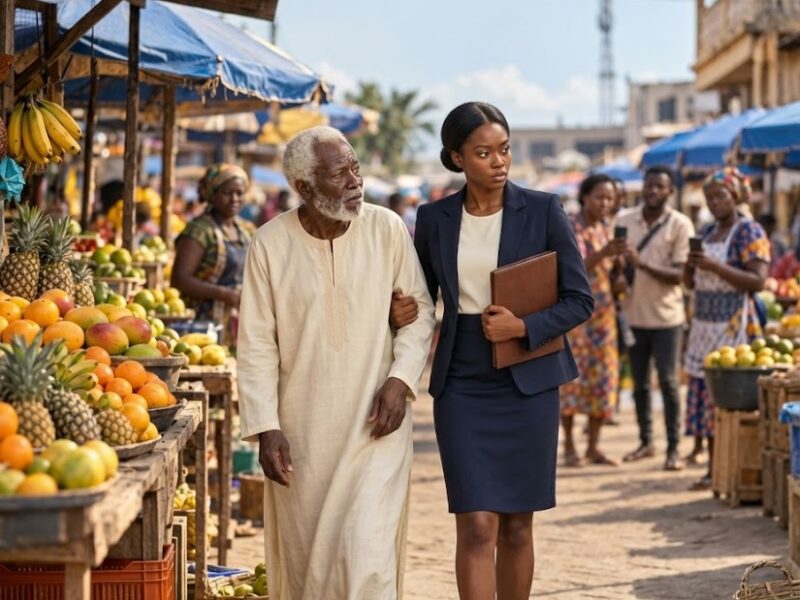
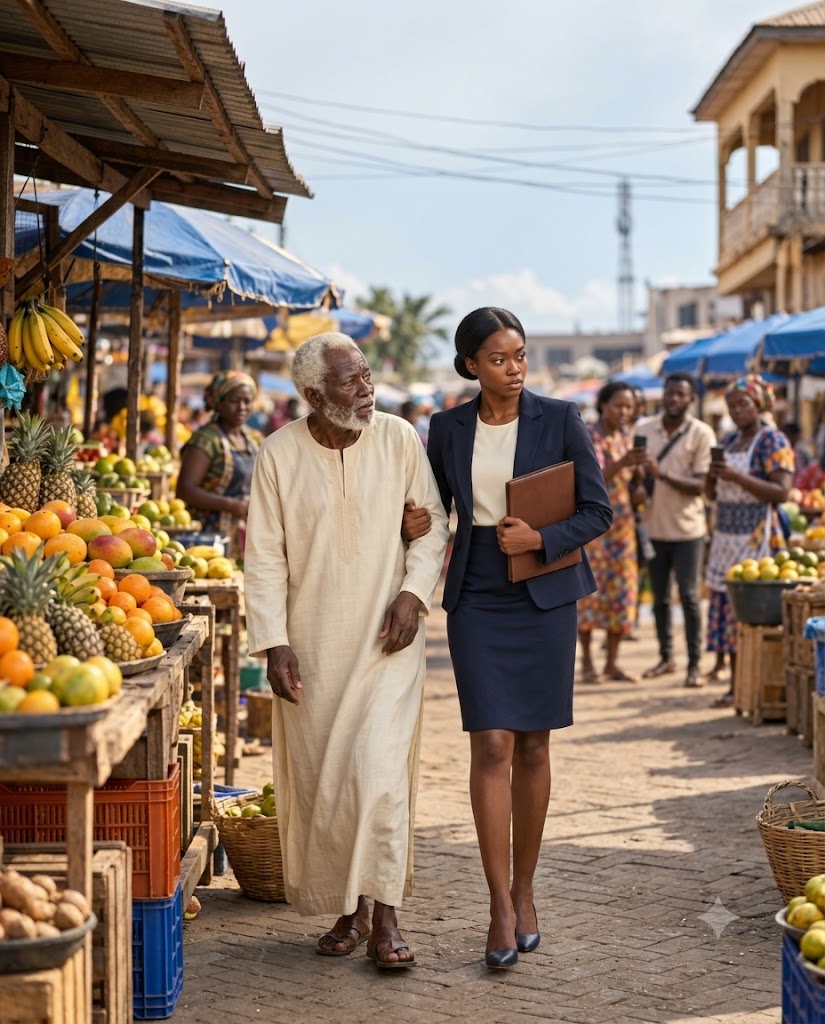
The old man stood in the middle of the produce aisle at the Midtown Farmers Market, his hands trembling as he patted the empty pocket of his worn brown jacket for the tenth time that morning.
The vendor, a heavyset woman with a voice that carried three stalls down, had already drawn a small crowd with her shouting.
“Old man, either you pay or you drop my fruits,” she said, her arms crossed so tight her elbows looked like they might snap. “I have no time for stories.”
“Please, my daughter,” the old man whispered, his accent thick with a West African rhythm that had softened after decades in the States. “Someone took my wallet. My grandson will send money soon.”
“Grandson,” the vendor spat, rolling her eyes toward the onlookers. “Every beggar on Market Street has a rich grandson. Go and sit somewhere.”
A young woman in a faded denim jacket stepped forward from the crowd, her grocery bag hanging limp at her side. She had been watching from the moment the old man’s hands began to shake.
“Auntie, please lower your voice,” she said, her tone soft but firm. “He is somebody’s father.”
The vendor turned on her like a hawk spotting prey. “Then you pay for him since your mouth is so sweet.”
The young woman didn’t flinch. She reached into her pocket and pulled out a crumpled wad of bills.
“How much is it?”
“Forty dollars,” the vendor said, testing her. “Not one penny less.”
The young woman counted out two twenties and placed them in the vendor’s palm. She didn’t blink.
“Here is forty. And next time respect gray hair. That is how we were raised.”
The vendor snatched the money and shoved a paper bag of mangoes toward the old man. “Take your fruits and go, old man.”
He reached for the bag, then turned to the young woman with eyes that glistened like rain on a windowpane.
“God bless you, my child. What is your name?”
She hesitated, then smiled. “Akosua.”
“Akosua,” he repeated, as if memorizing a prayer. “I am Nana. You have a good heart, Akosua. If only my grandson could find a woman like you. He works too much.”
“Hey Nana,” she laughed, shaking her head. “We have just met and you are already arranging marriage.”
At my age, one does not waste time,” he said, and for the first time that morning, he laughed too. “My daughter, take this.”
He pulled a hundred-dollar bill from the inside lining of his jacket—the pocket he had checked three times but somehow missed.
“Please take a taxi home. Don’t wait in this sun.”
“No, no,” Akosua said, pushing his hand back. “That looks like your last money. Keep it.”
“I have a job interview at ten,” she added, glancing at her watch. “I will take the next bus.”
“Don’t worry,” Nana insisted. “Then at least leave me your number. An old man needs good people around him.”
She borrowed a pen from the vendor’s counter and scribbled her number on the back of a receipt.
“I have written it on this receipt. Call me anytime, Nana.”
“Go well, my child. May that interview be yours.”
“Amen. Take care of yourself, Nana.”
She walked away, her grocery bag still empty, her wallet forty dollars lighter, and her heart somehow fuller than it had been in years.
The old man watched her until she disappeared into the crowd, then pulled out a phone that cost more than the vendor’s entire stall.
“Nana, where have you been?” A sharp voice crackled through the speaker. “We searched the whole house.”
“I only wanted fresh mangoes, coffee, and a little air.”
“Without the driver? Without your phone?”
“What? Something did happen. Thieves took my wallet and a stranger saved me.”
“Which stranger?”
“A young woman. She paid for my fruits and gave me money for a taxi.”
There was a long pause on the other end. “People don’t give money to strangers for nothing, Nana.”
“She did. She was rushing to an interview.”
Another pause. “Kofi, that is the kind of wife you need.”
“Not again.”
“You know, I cannot build a life while Amma is still missing.”
The old man’s grip tightened on the phone. “Amma has been missing for fifteen years, my son.”
“Our car left the Cape Coast Road. Amma reached the clinic and sent help back. Then she vanished.”
“Before that journey, I promised I would find her if she was ever lost.”
“Promises to ghosts can keep a living man lonely.”
“Then I will stay lonely until I find her.”
The line went dead.
Nana slipped the phone back into his pocket and picked up his bag of mangoes.
The vendor was watching him now, her eyes narrowed with suspicion.
“You know that boy?” she asked.
“I know many people,” Nana said quietly. “Most of them don’t know me.”
He walked toward the black sedan that had been waiting at the curb for the past twenty minutes, its engine humming like a patient beast.
The driver stepped out and opened the rear door. “Sir, your grandson called again.”
“I know.”
“He said the investors from Lagos delayed again.”
“Of course they did.”
“He asked whether your succession plan is stable.”
Nana paused with one foot inside the car. “Let me guess. They still think an unmarried CEO means uncertain leadership.”
“They want continuity. The board wants a settled household and a clear long-term commitment.”
“Our numbers are strong. That should be stability enough.”
“They are judging appearances, not our numbers.”
Nana settled into the leather seat. “Still, one commitment could calm them.”
“Uncle, I will marry when I choose and only the woman I choose.”
The voice came from the front passenger seat. Kofi Asante turned around, his jaw set, his eyes tired.
“Your grandfather built this company from one small shop. Do not lose it over a childhood promise.”
Nana raised me after my parents died. I will protect his company, but not with a fake smile.”
“Then decide before the board meets in three months.”
“Their legal counsel can keep any marriage confidential.”
Kofi stared out the window at the farmers market, at the vendors packing up their stalls, at the woman who had just paid for a stranger’s mangoes.
“Three months,” he repeated. “Fine.”
Akosua’s apartment was on the fourth floor of a building that had seen better decades.
The elevator had been broken since March, and the stairwell smelled like someone had cooked fish and forgotten to open a window.
She climbed the stairs slowly, her interview clothes still crisp, her hope still intact.
“So you are back,” her mother said the moment she walked through the door. “Where is the money? Where is the job?”
“I missed the interview, Ma. I stopped to help an old man at the market.”
“You helped a stranger while your own has no food. I will find another job. I always do.”
“Chalie, stop the sermon. Nobody asked you to become a saint.”
Her brother Yao lounged on the couch, his eyes bloodshot, his hands never far from his phone.
“And who asked you to bet away everything this family owns?”
“Don’t talk to your brother like that. He is carrying a heavy debt.”
“His debt, Ma, not mine. Why must I always pay?”
“Because I have found a solution.”
Akosua’s blood ran cold. “What solution?”
“Mr. Bouchard wants to marry you.”
“The landlord? The man who looks at me like goods on a shelf?”
“He owns three buildings. He will clear Yao’s debt on the wedding day.”
“So you are selling me to pay for Yao’s gambling.”
“I am saving this family.”
“You will marry him whether you like it or not.”
Akosua’s phone buzzed in her pocket. She pulled it out, grateful for any distraction.
“Hello?”
“Akosua, it is Nana from the market. Did I wake you?”
“No, Nana. I am just sitting outside. Did you reach home safely?”
“I did. But your voice sounds heavy tonight. Come and visit me.”
“Tonight? Nana, it is already late.”
“Late is when a young woman sits outside her own house in the dark.”
“You notice too much, Nana.”
“Sometimes I remember running beside water. Then the picture disappears.”
“What?”
“An old man hears many things in a voice. My driver will fetch you. I am sending the address now.”
“Okay, Nana. I will come.”
The address led to a gated estate in the hills, where the houses were spaced so far apart that the lawns had their own zip codes.
Akosua stood at the iron gate, her mouth slightly open.
“Nana, this is your house. I thought the driver brought me to the wrong gate.”
“It is only a house, my daughter. The people inside matter more.”
“But you stood at the market begging for forty dollars of fruit.”
“And you were the only one who saw a man, not a beggar.”
“Who else lives here, Nana?”
“My grandson. He is still at the office as usual. How was your interview?”
“I missed it. It was at Asante Holdings, my dream company.”
“Life has its own ways. Stay here tonight. The guest room is ready.”
“I cannot impose on you, Nana.”
“You are not imposing. You are resting. Go and sleep.”
The guest room had sheets that smelled like lavender and a window that looked out over the valley.
Akosua lay awake for hours, listening to the silence, wondering how a man who couldn’t afford mangoes lived in a house with a fountain in the driveway.
In the morning, she found out.
“Good morning, Nana. Who is our guest?”
The voice came from the doorway. Akosua turned and felt the floor shift beneath her.
“This is Akosua, the young woman from the market.”
“Good morning, sir.”
“Wait. You are Kofi Asante?”
“I am. And you are the lady who paid for my grandfather’s mangoes.”
“She missed her interview at your company because she stopped for me.”
“Is that true?”
“Yes, sir. But I did not come here to ask for anything.”
“What did you study?”
“Marketing at the University of Cape Coast. I did my national service at a brand agency.”
“Our marketing team needs sharp eyes. Report to the fourth floor tomorrow at eight.”
“Just like that?”
“Not just like that. You will prove yourself like everyone else.”
The first week was a blur of coffee runs and spreadsheet revisions.
The second week, Kofi called her into his office and slid a report across the desk.
“Your report says our water brand is talking to the wrong people. Explain.”
“We advertise to rich estates, but our real buyers are market women and bus drivers.”
“And your changes?”
“Smaller sachets, radio adverts, and prize boards at the bus stations.”
“Sales in Kumasi went up eighteen percent in ten days.”
“The ten-day radio and prize board pilot worked. Packaging changes can wait for the full rollout.”
“Most people don’t listen. Keep going, Miss Mensah.”
“Thank you, sir.”
“And at the office, we keep things professional. Always.”
“Of course, sir. I prefer it that way.”
Nana watched from the doorway of the home office, a cup of coffee in his hand and a smile he couldn’t hide.
“Akosua, I have been thinking. You should marry Kofi.”
“Nana, we barely speak outside work. He still calls me Miss Mensah.”
“I am not asking for love tomorrow. I am asking whether an honest arrangement could help you both.”
“Help each other how?”
“He needs a wife. You need a home. Maybe God put you both at that market.”
“Tell me first, where is your family?”
“I have no family, Nana. My parents died when I was small. I live alone.”
“I am sorry, my daughter. Then let this house be your family.”
“I would need my own room, my own work, and the right to leave without owing him anything.”
“Safe from what?”
“People at home keep demanding money. I need time to stand without their hands around my future.”
“I understand. Think overnight. If you still agree tomorrow, Kofi must hear every condition from you.”
Kofi listened without interrupting.
“Nana says you need a wife and I need a home,” Akosua said, her hands folded in her lap. “But I have conditions.”
“I am listening.”
“Board counsel receives the certificate. Staff and the public receive no photos, no announcement, no office ring.”
“Understood.”
“And at home?”
“At home, we have separate rooms. Your salary and property remain yours. After one year, either of us may leave.”
“If I find Amma sooner, I will tell you before any decision.”
“And you accepted my conditions.”
“I keep my work, my choices, and my right to leave.”
“You are everything to me,” Nana said from the corner. “I just don’t want you to get hurt.”
“Then do not worry, Mr. Asante. I entered this with open eyes, not romantic promises.”
“Your room is the last door on the left. Mine is on the right.”
“Good. That is simple.”
“The driver will take you to work every morning.”
“No, thank you. I will take the bus like always.”
“Board counsel knows you are my wife. What if someone connected to them sees you there?”
“Nobody at the station knows who your wife is. I will pay my own way.”
“Most women would ask for a car, an allowance, something.”
“I am not most women. Good night, Kofi.”
The marriage certificate was signed in a lawyer’s office on a Tuesday afternoon.
There were no flowers, no rings, no tears.
Just two signatures and a handshake that lasted a second too long.
Nana cried anyway, dabbing his eyes with a handkerchief that had seen better days.
“You finally did something right,” he told Kofi.
“I did something practical.”
“Practical is how love starts.”
Akosua moved into the penthouse that weekend.
She unpacked her one suitcase in the room on the left, hung her three work outfits in the closet, and placed a framed photo of her parents on the nightstand.
She didn’t know their names. She didn’t know where the photo had come from. But it was hers, and that was enough.
Three weeks later, her phone rang at midnight.
“Akosua, it’s Yao. Don’t hang up. I am in serious trouble.”
“How much this time?”
“Fifty thousand dollars.”
“What?”
“The loan men gave me one week.”
“Where would I find that kind of money?”
“Don’t lie. Ma’s friend saw you entering that tower in Airport City.”
“You people followed me.”
“Ma only wants what is fair. You eat in a tower while we starve. Ma says you married money and forgot your family.”
“You never treated me like family. You treated me like a bill. I am not paying.”
“Then don’t blame me for what happens next.”
The line went dead.
Akosua sat in the dark for a long time, her heart pounding against her ribs like a trapped bird.
The next morning, her mother called.
“My daughter, you came. You came. Sit. Sit. I made coffee the way you like it.”
“You said you wanted to apologize, Ma. So, apologize.”
“I was too hard on you. Take one sip, then we talk like family.”
Akosua lifted the cup to her lips.
The room began to spin.
“Ma, what did you put in this? My head is spinning.”
“I only wanted you calm. Stop fighting what is good for this family.”
“What?”
“I gave Peace money already. Yao’s debt is cleared.”
“Ma, you sold me.”
“I sold nothing. Mr. Bouchard and I called it a bride price.”
“But we did this without your consent.”
“I am married, Mr. Bouchard. You cannot touch me.”
“Married to whom? Nobody has ever seen this husband.”
“Step away from my wife. Now.”
Kofi stood in the doorway, his suit jacket open, his eyes blazing.
“Your wife?”
“I paid for this girl. She is a person, not an item in your store. Touch her and you go straight to the police.”
“Madame Peace, you told me she had no husband.”
“Akosua, can you stand? Hold my arm. We are leaving.”
“You lied to me. I told Nana I had no family. We will talk later. Right now, you are coming home.”
The car ride was silent except for the sound of Akosua’s shallow breathing.
Kofi kept his eyes on the road, but his hand never left hers.
“Drink some water. The clinic nurse examined you before we came home. Your tests were clear.”
“Thank you. Are you angry that I lied about my family?”
“I understand why you lied. Nobody wants to show that kind of wound.”
“I thought you would send me away.”
“Nobody is sending you anywhere. Mr. Bouchard will never come near you again.”
“Why are you being so kind to me?”
“Because you deserve kindness. Your brother warned me and your location led me there.”
“Thank you, Kofi. For coming for me.”
For a moment, she saw water again. A stream, trees, and a boy ahead of her.
“The Osu family has a charity gala tomorrow night. Come with me.”
“People will ask why I am with you. You said nobody should know.”
“You are right. I will go alone. Rest now.”
The gala was held at the Grand Meridian Hotel, where chandeliers hung like frozen rain and the champagne never stopped flowing.
Kofi stood at the edge of the ballroom, a glass of sparkling water in his hand, when the Osu family took the stage.
“Friends, fifteen years ago, we lost our daughter on the Cape Coast Road. Tonight, God has returned her.”
The room erupted in applause.
“A DNA test has confirmed it. Meet our Amma.”
A woman stepped forward, her hair swept into an elegant updo, her gown a cascade of gold.
“Thank you all. I grew up in a children’s home. I did not know who I was.”
“Amma, is it really you?” Kofi whispered.
“Kofi. Kofi Asante. They told me you never stopped looking for me.”
“Do you remember me at all?”
“Pieces. Faces. My memory is broken, Kofi. Please be patient with me. You are my best friend. That much I feel. Even if I cannot remember.”
“I will be. Welcome home, Amma.”
The weeks that followed were a blur of dinner parties and foundation events.
Amma moved into the Osu estate, her every whim indulged, her every request granted.
“This photo was taken at Kakum the week before the accident. Do you remember that day, Kofi?”
“I was nine. I can hardly remember what I ate yesterday.”
“You made me promise something beside that stream.”
“Then tell me. I want to remember it with you.”
“You said if you ever get lost, I must look for you first. You used to hate crowded places.”
“Then I am glad you found me. Now shall we go for lunch?”
People change, Kofi. Fifteen years in a children’s home changes anybody.”
Akosua watched from the penthouse window as Kofi’s car pulled away for the third night in a row.
She had stopped waiting up for him. She had stopped pretending it didn’t hurt.
“Nana, I came to say goodbye. I am leaving the penthouse.”
“Leaving because of that girl from the gala.”
“Kofi comes home late every night. Now the papers say he is always in Labon. He is confused, my daughter. The past is loud in his ears.”
“He is not confused. He found the woman he waited for. I will not stand in the way.”
“Do you love him?”
“I do, Nana. That is why I must go before it breaks me.”
“At least take some money to start again.”
“No, Nana. I resigned from Asante Holdings and found work at a printing press in Osu.”
“My grandson is a fool and you are a queen.”
“Please give him this letter. I signed separation instructions, but his lawyer has not filed anything.”
Kofi found the letter on his desk three days later.
He read it twice, folded it carefully, and placed it in the drawer with the receipt Akosua had written her number on.
He didn’t call.
He didn’t file.
He didn’t know what he was waiting for.
The foundation board meeting was scheduled for ten, but Amma arrived at eleven.
“Amma, the foundation board is waiting. You promised to visit the children’s ward today.”
“Mommy, not today. I have a headache and my hair appointment is at two.”
“This is the fifth time you have canceled.”
“I lost fifteen years. Mommy, let me enjoy my life a little.”
“Kofi, please talk to her. She listens to you.”
“Amma, you grew up in a children’s home. I thought that ward would matter to you.”
“Kofi, please don’t you start, too.”
“The Amma I knew gave her lunch to other children.”
“The Amma you knew was nine. Grow up, Kofi.”
Kofi stood in the hallway, his phone pressed to his ear.
“Musu, ask your family lawyers to verify the DNA test through an independent laboratory.”
“I will authorize it tonight.”
“What did you find now?”
“The authorized independent review found that her sample number belongs to another patient file.”
“Who signed the report?”
“Dr. Ansa signed it. The hospital compliance team found he removed the original file.”
“Is there any link between Dr. Ansa and her?”
“The investigators found four meetings and a thirty-thousand-dollar transfer before the result.”
“Call him. He can talk to me or to the medical council.”
“The Osu lawyers interviewed him with hospital counsel. He gave a recorded statement an hour ago.”
“What did he say?”
“She paid him to swap the sample. The result was forged. She is not Amma.”
Kofi stood in the Osu living room, the folder in his hand, his voice steady.
“Uncle, Auntie, I am sorry. The DNA result was forged.”
“Forged? Kofi, what are you saying?”
“Dr. Ansa has confessed. She paid him. This woman is not your daughter.”
“He is lying. Why would I fake something like that?”
“His statement and the authorized audit are in this folder. Every meeting, every transfer, for all those shopping bags.”
“Daddy, please tell him I am your daughter.”
“We lost our child once. Tonight, we have lost her again. Leave my house and never use my daughter’s name again.”
“Your lawyers reported the fraud. The police are coming to question her.”
“You will all regret this.”
“Nana, I was never in love with that woman. I was in love with a memory.”
“And the real woman walked out of your house with one small bag.”
“Akosua cared for you when she had nothing. I was too blind to see her.”
“What is that paper in your hand?”
“With the Osu family’s permission, their lawyers checked clinics along the Cape Coast Road. Wneba Clinic recorded an unknown girl about nine with a head injury after our crash. She reached the clinic, described our car, and collapsed after sending workers back.”
“Who took the child home?”
“A woman named Peace Mensah later became her guardian.”
“Nana, Akosua could be Amma.”
“Then do not turn hope into truth too soon. Find Akosua and confirm it properly.”
The police arrived at the Osu estate within the hour.
But Selena was already gone.
“The police say Selena fled before they reached Labon. I must find Akosua before Selena does.”
Kofi’s phone buzzed with a text from an unknown number.
“Mr. Asante, if you want your wife back, send two million dollars to this number.”
“Who is this? Where is Akosua?”
“No police or you will never see her again.”
“Listen to me. If anyone touches her, you will regret it.”
“You have two hours, Mr. Asante. The clock is running.”
“Nana, call now. Call now. Tell her to trace this number and call the police.”
The warehouse smelled like rust and old rain.
Akosua sat on a wooden chair, her wrists bound with zip ties, her eyes adjusting to the dim light.
“You sent a clinic register photo and promised answers in public. Yao’s men brought me here instead.”
Selena stepped out of the shadows, her gold gown replaced by jeans and a black hoodie.
“I found Peace’s name in that register before I approached the Osus. She was easy to find.”
“Then you knew the DNA was false before you entered their home.”
“I paid Peace and your brother to hold you. The ransom funds my escape while I erase the clinic trail.”
“What are you talking about?”
“Kofi will chase money instead of records. By sunrise, every remaining page linking you to Amma will be gone.”
“You are insane.”
“I am not your mother. I met you at Wneba Clinic fifteen years ago.”
“What?”
“The clinic notified welfare officers. Months later, they placed you with me as a temporary guardian. I moved districts, ignored their follow-ups, and told everyone your parents were dead. Yao is my only child.”
“So that is why nothing I did was ever enough. You were never mine to love.”
Police sirens wailed in the distance.
“Police traced Yao’s call. Nobody move.”
“Selena, it is over. It is over.”
“Officers, secure the room. Everyone, keep your hands visible.”
“Akosua, tell them to leave me. I raised you.”
“You raised me to pay your bills. Ma, goodbye.”
“Akosua, I am here. An officer will untie you safely.”
“I am so sorry you came.”
“I will always come. Always.”
Kofi knelt beside her, his hands shaking as he cut the zip ties.
“Open it. Whatever it says, I am right here.”
She unfolded the paper the officer had handed her.
“Probability of parentage: 99.9%.”
“It is real. You are Amma Osu, the girl I searched for my whole life.”
“I don’t remember them. I don’t remember anything before that clinic.”
“Mama, you don’t have to remember, my darling. You only had to come home.”
“For fifteen years, I set a plate for you every Christmas.”
“Come here, Kofi.”
“The stream is clearer now. I remember falling, then running toward clinic lights. And I remember a boy promising he would find me.”
“At Kakum, you made me promise. It just took me too long.”
The Osu estate was filled with flowers and photographers and the kind of champagne that cost more than Akosua’s entire apartment building.
“Tonight we welcome our only daughter, Amma Osu, and name her our family’s designated heir.”
Akosua stood at the podium, her hands steady on the lectern.
“I am an Osu by birth, but I grew up as Akosua, and I will stay her.”
Kofi found her in the garden an hour later, away from the cameras and the questions.
“I once promised to find Amma. I never understood that she was already beside me.”
“I don’t love you because you are an Osu. I love you because you are Akosua.”
“You helped my grandfather with your last forty dollars. You loved me while I was blind.”
“I never filed your separation instructions. I will if you want freedom. But I am asking you to choose me again.”
“Yes, Kofi. This time I choose you freely.”
“Finally, my grandson has opened his eyes.”
“Kofi, our family accepts the knocking and your gifts. Today we bless the marriage you both chose.”
“With my whole life, sir. Nana, thank you for finding me.”
“No, my child, you found me first at the market.”
“May I have this dance, Mrs. Asante?”
“You may. And this time, everybody can know.”
The mangoes sat in a bowl on the kitchen counter, ripening in the afternoon sun.
Nana had bought them that morning from the same vendor, who had recognized him and apologized three times.
He had accepted the apology and paid full price.
Akosua walked into the kitchen and picked one up, turning it over in her palm.
“You know,” she said, “I never actually got to eat the mangoes I paid for that day.”
Nana smiled. “Then I owe you forty dollars and a bag of fruit.”
“You owe me nothing, Nana.”
“I owe you everything, my child.”
She sat beside him at the table, and they ate mangoes in silence, the juice running down their chins, the sun warming the room.
Kofi found them there an hour later, both asleep, the bowl empty, the receipt with Akosua’s number still tucked in his grandfather’s pocket.
He pulled a blanket over them and stood by the window, watching the city stretch toward the horizon.
Fifteen years he had searched for a ghost.
Fifteen years he had walked past the answer.
And now, in the quiet of a kitchen that smelled like mangoes and lavender, he finally understood.
Some promises take a lifetime to keep.
And some are kept by simply paying attention.
He reached into his pocket and pulled out the receipt, now worn soft from months of folding and unfolding.
He placed it on the counter beside the empty bowl, a small monument to the day everything changed.
Outside, the sun began to set, painting the sky in shades of gold and pink.
Inside, his family slept, and for the first time in fifteen years, Kofi Asante allowed himself to believe that he was home.
**Hinged Sentence:** *Some promises take a lifetime to keep, and some are kept by simply paying attention.*
The phone rang at seven the next morning.
Kofi answered on the first ring. “Asante.”
“Mr. Asante, this is Detective Adu from the Accra Police. Selena Mensah is in custody. She is cooperating with investigators.”
“What does she want?”
“A reduced sentence. She is offering to testify about the clinic records.”
“Then let her talk.”
“She also said something you should know. The original file from Wneba Clinic was not destroyed. She hid it in a storage unit in Tema.”
“Why should I believe her?”
“Because she knows it is the only thing she has left to bargain with.”
Kofi was quiet for a moment. “Send me the address.”
The storage unit was the size of a closet and smelled like mothballs.
Inside, a single cardboard box sat on a metal shelf.
Kofi opened it carefully, as if it might contain something alive.
Inside were three folders, a child’s bracelet, and a photograph.
The photograph showed a little girl with braids, standing beside a stream, smiling at the camera.
On the back, in faded ink, someone had written a name.
*Amma Osu, age 9.*
Kofi held the photograph for a long time.
Then he placed it back in the box, closed the lid, and carried it to the car.
Akosua was sitting on the balcony when he got home.
She had a cup of tea in her hands and a blanket wrapped around her shoulders.
“You found something,” she said, without turning around.
“How did you know?”
“You have that look. Like you are carrying something heavy.”
He sat beside her and placed the box on the table between them.
“I found the original clinic file. And a photograph.”
She opened the box slowly, her hands trembling.
When she saw the bracelet, she stopped breathing.
“I remember this,” she whispered. “It was blue. My mother gave it to me.”
“Akosua.”
“I remember her. I remember her hands. She used to braid my hair.”
“You don’t have to remember everything at once.”
“I know. But this helps.”
She picked up the photograph and stared at the little girl by the stream.
“That was the week before the accident,” Kofi said. “The Kakum trip.”
“I was happy.”
“You were.”
“I want to be happy again.”
“You will be.”
She leaned against him, and for the first time, he didn’t pull away.
“Nana said something to me once,” she said. “He said an old man hears many things in a voice.”
“What did he hear in mine?”
“He heard a woman who was tired of being strong.”
Kofi closed his eyes. “I heard the same thing.”
They sat there as the sun rose, the photograph between them, the past finally finding its place in the present.
Two months later, the Asante Foundation opened a new clinic in Wneba.
It was named the Amma Osu Center for Children, and it had a wall of photographs, each one showing a child who had been lost and found.
Akosua stood at the entrance, cutting the ribbon with a pair of oversized scissors.
Nana watched from the front row, tears streaming down his face.
“Your mother would be proud,” he said when she came to sit beside him.
“You are my family now, Nana.”
“I always was, my child.”
Kofi stepped up to the podium, his notes forgotten in his pocket.
“Fifteen years ago, I lost my best friend,” he said. “Last year, I found her again. But the truth is, she was never really lost. She was just waiting for me to open my eyes.”
The crowd applauded, but Akosua only had eyes for him.
“Some promises take a lifetime to keep,” he said, looking directly at her. “And some are kept by simply paying attention.”
She smiled, and the sun broke through the clouds.
**Part 2**
The clinic in Wneba had been open for six months when the first letter arrived.
It was addressed to Akosua in handwriting she didn’t recognize, postmarked from a small town in the Eastern Region.
She opened it at the kitchen table, her coffee growing cold beside her.
*Dear Akosua,*
*My name is Esi. I was your mother’s best friend. I have been looking for you since the accident.*
Akosua read the letter three times before she could breathe again.
“Kofi,” she called, her voice cracking. “Kofi, come here.”
He found her in the kitchen, the letter trembling in her hands.
“What is it?”
“Someone knew my mother. Someone is still alive who knew her.”
Kofi sat beside her and read the letter.
*I was supposed to meet your mother at the clinic that day. I was running late. By the time I arrived, she had already sent help back to the car and was holding you in her arms.*
*She was bleeding. She had hit her head on the dashboard. But she wouldn’t let go of you.*
*When the ambulance came, she made me promise to find you if anything happened to her.*
*I tried. I tried for fifteen years.*
*I am old now, and sick, and I don’t have much time left. But I had to see you one more time.*
*Please come. I am at the Holy Cross Hospital in Koforidua.*
*I have something to give you.*
*Esi*
“Do you want to go?” Kofi asked.
“I have to.”
“I will drive you.”
The hospital was small and clean, with white walls and a garden full of hibiscus.
Esi was in the last room on the left, her bed surrounded by machines that beeped in steady rhythm.
She was tiny, her skin like crumpled paper, her eyes bright with recognition when Akosua walked in.
“You look like her,” Esi whispered. “You look exactly like her.”
Akosua sat beside the bed and took the old woman’s hand.
“You knew my mother.”
“I loved your mother. She was my sister in everything but blood.”
“What was her name?”
“Her name was Adwoa. Adwoa Osu. She was the kindest woman I ever knew.”
“Tell me about her.”
Esi smiled, and for a moment, she looked young again.
“She used to sing while she cooked. She hated shoes. She laughed with her whole body.”
“She sounds wonderful.”
“She was. And she loved you more than anything in this world.”
Esi reached under her pillow and pulled out a small velvet pouch.
“Take this. It belonged to your mother. She asked me to keep it for you.”
Akosua opened the pouch and poured its contents into her palm.
A ring. Simple gold, with a small diamond that caught the light.
“She wore it every day,” Esi said. “Your father gave it to her on their wedding day.”
“My father.”
“He died when you were two. A car accident. She never remarried.”
“I don’t remember him.”
“You were too young. But she used to tell you stories about him every night. She wanted you to know him.”
Akosua slipped the ring onto her finger. It fit perfectly.
“Thank you,” she whispered. “Thank you for finding me.”
“I should have found you sooner. I am sorry.”
“You found me now.”
Esi closed her eyes, exhausted.
“Your mother would be so proud of you. Look at what you have built.”
“I built it because of her.”
“No. You built it because of you. Because you are strong. Because you are kind. Because you are Adwoa’s daughter.”
Akosua stayed until Esi fell asleep.
Then she walked out of the hospital and into the garden, where Kofi was waiting.
“I have a ring,” she said, holding up her hand.
“It’s beautiful.”
“It was my mother’s.”
She started to cry, and Kofi pulled her into his arms.
“I have a name now,” she said. “My mother’s name was Adwoa. She sang while she cooked. She hated shoes.”
“She sounds like you.”
“I don’t remember her. But I feel her.”
“That’s enough. That’s more than enough.”
They drove home in silence, the ring warm on Akosua’s finger.
Nana was waiting on the porch when they arrived, a cup of tea in his hands.
“You found her,” he said.
“I found her.”
“Then you are complete.”
“No,” Akosua said, sitting beside him. “I am just beginning.”
The next year brought changes no one could have predicted.
The Asante Foundation expanded to three more clinics across the country, each one focused on reuniting families separated by tragedy.
Akosua became the face of the foundation, her story told in newspapers and on television.
She never mentioned Selena or Yao or the warehouse.
She only spoke of hope.
Kofi stepped down as CEO and appointed a new board, one that didn’t care whether he was married or not.
He spent his days with Akosua, building something that had nothing to do with profits and everything to do with purpose.
Nana lived to see his ninety-fifth birthday, surrounded by grandchildren and great-grandchildren who called him Papa.
He died in his sleep two weeks later, a smile on his face.
Akosua found a letter in his desk drawer, addressed to her in his careful handwriting.
*My child,*
*I knew from the moment you paid for my mangoes that you were special. I didn’t know how special until I saw you stand up to the world and refuse to let it break you.*
*You gave an old man a reason to believe in tomorrow.*
*Now it is your turn to give that reason to someone else.*
*Love fiercely. Live fully. And never forget that you were found because you were never truly lost.*
*Your Nana*
She folded the letter and placed it in the velvet pouch with her mother’s ring.
Then she walked out into the garden, where the mango tree Nana had planted was finally bearing fruit.
Kofi was there, holding two glasses of lemonade.
“To Nana,” he said, raising his glass.
“To Nana,” she echoed.
They drank in silence, watching the sun set over the city.
“I have something to tell you,” she said.
“What is it?”
She took his hand and placed it on her stomach.
“I’m pregnant.”
Kofi’s eyes widened, then filled with tears.
“We’re going to have a baby.”
“We are.”
“We’re going to be parents.”
“We are.”
He pulled her close, and they stood there under the mango tree, the past finally behind them, the future stretching out before them like a road they had always been meant to travel.
**Hinged Sentence:** *Love fiercely. Live fully. And never forget that you were found because you were never truly lost.*
The baby was born on a Tuesday morning, in the same hospital where Akosua had taken Esi to say goodbye.
She weighed seven pounds and three ounces, and she had her grandmother’s eyes.
They named her Adwoa, after the woman who sang while she cooked and hated shoes.
Nana would have cried.
Akosua held her daughter in the quiet of the hospital room, Kofi asleep in the chair beside her.
“You are going to know everything about where you come from,” she whispered. “And you are going to be so loved.”
Adwoa opened her eyes and looked up at her mother.
And Akosua could have sworn she saw the stream from her dreams, and the boy standing on the other side, waiting.
“Welcome to the world, little one,” she said. “We have been waiting for you.”
The mango tree in the garden bloomed every year after that, bearing fruit that Akosua would pick with her own hands.
She would sit on the porch with Adwoa and tell her stories about Nana and the market, about forty dollars and a receipt, about a promise that took fifteen years to keep.
And every time she finished, she would add the same words.
“Some promises take a lifetime to keep. And some are kept by simply paying attention.”
Adwoa would nod, not fully understanding, but knowing that whatever her mother said was true.
And across the city, in a small office at the foundation, a wall of photographs kept growing.
Each one showed a child who had been lost and found.
Each one was a promise kept.
**THE END**









