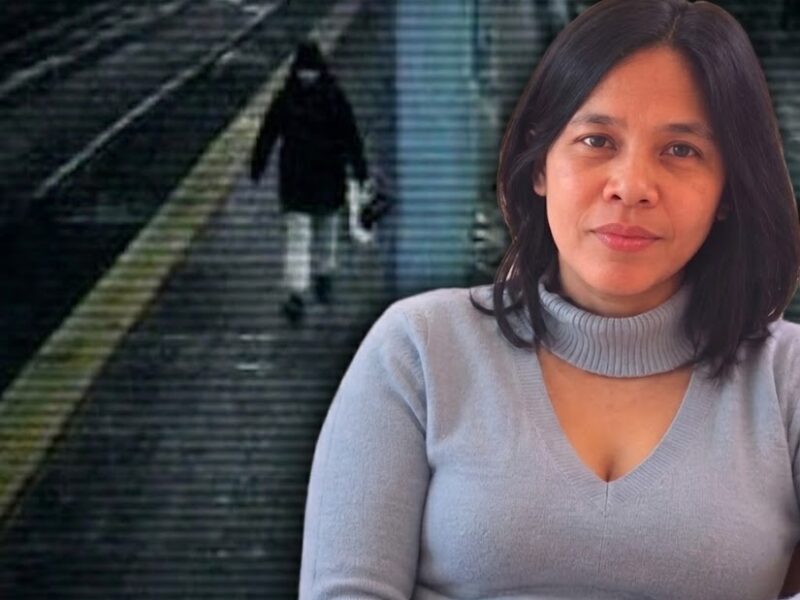
Police Were Left Stunned When They Found Her Naked in That Pose

**Part 1**
The phone rang at 11:01 p.m., and the voice on the other end was barely a voice at all.
It was wind and terror and a woman screaming for help, and then it was nothing.
Eight minutes later, the phone rang again.
This time there were only sounds—wet, broken, animal sounds—and then the line went dead for good.
The police would later say the hardest part was the snow.
It swallowed footprints, muffled screams, and made the whole city look like a photograph of itself.
In a city of a million people, one woman had become invisible.
That night the temperature dropped to five degrees Fahrenheit, and the streets were empty, and somewhere near a church a blue bag and a hard hat waited in the dark.
The hard hat would speak first.
It would tell them who he was.
But that night, nobody was listening to a hard hat.
They were listening to a phone that kept ringing and ringing and ringing.
Her name was Arceli Lawagan, and she was forty-one years old.
She had been in Canada for four years, and she had been away from her children for much longer than that.
She was a mother of five, and she had left the Philippines with a promise: she would come back for them.
She had worked two years as a nanny in Hong Kong before that, saving every dollar she could, and then she had moved to Calgary to study accounting and work two jobs.
She was quiet, reserved, the kind of woman who kept to herself until she found a church and a circle of friends who called her Cell.
She cooked, she crocheted, she dreamed of owning her own accounting business.
She did not plan on spending the rest of her life working two jobs.
She had a plan to slowly build a different life for herself and her family.
On January 17, 2008, around 10:00 p.m., she finished her shift at a printing company in downtown Calgary.
She was about six and a half miles from home, and the ground was covered in snow, and the next morning she had to get up early again.
It was the end of a normal workday: leaving, reaching the station, taking the train, walking the last part of the way.
She worked as a scanning operator, and that night she finished earlier than usual.
Cameras would record the exact moment she left.
Later, investigators would return to those images over and over, trying to determine at what point in her usual route everything changed.
But Arceli never made it home.
About an hour and a half later, two worrying calls came into 911, one right after the other.
They were from a friend named Melor and her roommate Cristine.
Both reported the same thing: Arceli had been attacked.
Just moments before, Arceli had called Melor.
She was screaming for help and told him she was being beaten and assaulted.
Her voice was difficult to hear.
She was crying and it seemed the phone was not close to her.
Then the call suddenly cut off.
Later, court documents would show two calls from Arceli to her friend at 11:01 and 11:09.
During the first one, she was still able to report that she had been attacked.
In the second, only unintelligible sounds could be heard.
Eight minutes had passed between them.
Melor did not know exactly where Arceli was, so he got in his car and went out to look for her.
On the way, he contacted Cristine and then called 911 himself shortly after his first call.
The problem was that neither he nor Cristine could tell the police where the attack had occurred.
They only knew that their friend was in grave danger.
Arceli hadn’t managed to tell them the name of any street or any house she might have been near.
The operator sent two patrol officers to the city center, where they met with Cristine.
Meanwhile, the police tried calling Arceli and locating her phone.
Cristine got into the police car and showed the officers where Arceli worked.
For the next few hours, they searched the surroundings thoroughly.
They checked parks, parked cars, alleys, and dumpsters.
But Arceli was nowhere to be found.
Her phone kept ringing, but no one answered.
On the cameras near her work, she was still alone and following her usual route.
On her friend’s phone, a plea for help could already be heard.
Between those two moments lay a part of the journey that the police were just beginning to reconstruct.
Around 2 a.m., more than a dozen police officers were already participating in the search.
The temperature kept dropping, and with it, the concern grew.
If Arceli was injured and unable to call for help, the cold made the situation even more dangerous.
Some of the police officers headed to the printing company.
There, they confirmed that Arceli had finished her shift and had left around 10 p.m.
Security cameras had also recorded it.
In the footage, she was wearing a large, warm coat, a dark hat, and several bags.
Arceli left the building alone.
No other pedestrians were visible nearby, and according to the recordings, no cars passed by her either.
The search continued throughout the night, and around 5 a.m., a missing person case turned into a homicide investigation.
Far from the places the police had checked up until then, someone heading to work spotted a body near the Grace Baptist Church.
Authorities suspected almost immediately that they had found Arceli.
However, the woman had been beaten so brutally that it was necessary to use her fingerprints to officially identify her.
Arceli’s pants were pulled down and tangled around one of her ankles, while her coat was still on.
The subsequent autopsy confirmed the worst suspicions.
The woman had been assaulted before she died, and the cause of death was severe blunt force trauma to the head.
The attack was extremely brutal.
The blows to her head were so strong that the skin separated from her skull.
She had bruises on her abdomen and her eyes were completely swollen shut.
Her nose, jaw, cheekbones, and the bones in her throat area were fractured.
According to the medical examiner, the head injuries were so severe that her brain simply stopped functioning.
After suffering those wounds, Arceli could only have survived for a few minutes.
At the crime scene, investigators carefully collected everything that could have any significance for the investigation.
Among the items found was Arceli’s phone.
It appeared to have been deliberately destroyed.
Nearby, there were also several empty bottles, a construction hard hat, and a large blue bag.
However, the bags Arceli had left work with were not there.
Her purse was also missing.
For her loved ones, there was another especially painful circumstance.
Arceli was a deeply religious person, and her body had been found right next to a church.
One of the police officers who worked the crime scene was also Catholic.
He later recalled kneeling beside Arceli’s body, praying for her, and vowing to find the person who had done that.
In his own words, he had never done anything like that before that case, nor did he ever do it again.
This case affected him in a way completely different from the others.
The police spoke with Cristine and Melor again.
“Who could have been waiting for Arceli after work?” they asked.
“Had she had any conflict with anyone?”
“Did she know the person who had attacked her?”
But according to Cristine, outside of the church community, Arceli practically had no social life.
She spent most of her free time talking to her children and her husband, who remained in the Philippines.
She hardly ever went anywhere else besides the stores, and after work, she never stayed to meet anyone.
Work, church, and conversations with her family.
That is how her friends described Arceli’s life.
From what they said, there didn’t seem to be anyone who could have a motive to target her.
Meanwhile, she was still trying to get her life established.
A few days before she died, Arceli had been searching online for a used car and planned to go see it over the weekend.
For a woman who relied on public transport every day after finishing night shifts, it was a very specific change she was already preparing for.
Before the family began arranging the transfer of Arceli’s body to the Philippines, where her husband and children were waiting for her, a memorial service was held in Calgary.
More than four hundred people came to say goodbye to her, and the church was completely full.
The place where the body was found gave investigators an important clue.
Arceli was only five minutes away from her home.
That meant that she had managed to catch the train that night and had completed almost her entire usual route.
All that remained was to follow that route in reverse, from Franklin station to the train she had arrived on, and then to the stop downtown where she had boarded the train.
Camera footage confirmed that on January 17, Arceli had followed her usual route.
At 10:09, Arceli was walking along the platform.
There were few people around, and she did not stop to talk to anyone during the trip.
At the end of the platform, Arceli sat in a shelter to shield herself from the wind, where there were a few other people.
The image quality was poor, and the snow and bad weather only worsened the visibility.
That is why the detectives could not determine exactly who was near Arceli.
The people who were in the shelter next to her did not board the same train.
The investigators continued reviewing the recordings.
Around 10:30, Arceli arrived at Franklin station, the stop closest to her home.
Upon getting off the train car, she walked quickly toward the exit.
At first, they did not notice anything strange in the footage.
The station was almost empty, and the few passengers were rushing home to escape the cold.
But then the investigators’ attention focused on a young man in a yellow jacket.
He was walking behind Arceli, gradually picking up his pace.
At one point, the man even leaned to the side to dodge another passenger in front as if trying to see her better.
They discovered he had traveled on the same train, so the police began reviewing footage from previous stations.
In those images, they were trying to find him before he crossed paths with Arceli.
Around 10 p.m., one of the cameras captured him walking back and forth on the platform, talking briefly with someone, and then just standing there.
When a young woman walked in his direction, the man pulled his hood over his face, turned around, and followed her with his gaze as she passed him.
Other recordings led investigators to suspect that he might be following women at random.
Considering what had happened to Arceli, this person immediately became an extremely important piece of the investigation.
At the station before Franklin, the man suddenly stepped out of the train car.
For a while, he walked along the platform without an obvious purpose.
He spoke briefly with someone and then hurried back to get on the same train again.
When Arceli reached the escalators at Franklin station, the man in the yellow jacket was already catching up to her.
The closer she was to the exit, the faster he advanced.
At the top of the escalators, there was barely a step left between them.
But what caught the investigators’ attention the most was what he was carrying: a hard hat and a large blue bag.
The police had found identical items near Arceli’s body.
Up until that moment, the recordings only showed an unknown person in winter clothing.
Now, the investigators had something they could show to people outside the station.
The hard hat pointed to a profession, and the stickers on it could help find him among other workers.
One of the detectives recognized the characteristic hard hat used by steel structure workers and noticed the prominent stickers and logos.
The police went to a local office for workers in that sector.
They showed the manager the security camera footage, and after seeing it, he provided a name.
Christopher Watcheston.
The twenty-one-year-old man became the prime suspect.
When the detectives arrived at his home, they almost immediately saw the well-known yellow jacket placed on a chair.
There was blood on one of its sleeves, but the yellow jacket was just the beginning of the search.
Inside the home, they found Arceli’s purse.
Inside it were still her documents and credit cards.
A DNA sample was taken from Christopher.
The results confirmed a link to the attack.
His DNA was found on Arceli’s body, and her blood was on his jacket.
Christopher Watcheston was arrested and charged with the assault and murder of Arceli.
He pleaded not guilty to the charges and later testified personally in his own defense.
The case was heard by Judge Christine Ewig without a jury.
One of the key issues was how the murder should be legally classified.
Under Canadian criminal law, if a sexual assault or unlawful confinement is accompanied by a murder, it can be classified as first-degree murder.
If the necessary link between those acts cannot be proven, it is considered second-degree murder.
In both cases, the sentence involved life imprisonment, but the period before parole eligibility was considerably different.
For first-degree murder, that possibility did not exist for twenty-five years.
For second-degree murder, that period could be between ten and twenty-five years.
The defense maintained that the exact sequence of events that night remained insufficiently clear.
The lawyers argued that there could have been a pause between the sexual assault and the fatal beating, and therefore they believed there was reasonable doubt as to whether the crime should be classified as first-degree murder.
The prosecution’s position was completely different.
Prosecutors argued that the sexual assault and the murder were part of the same continuous attack.
In their opinion, it was unlikely that after assaulting Arceli, she would have voluntarily remained near her attacker.
For that reason, the prosecution insisted it should be treated as first-degree murder.
At the same time, Christopher no longer denied committing the attack.
He admitted that he had assaulted and brutally beaten Arceli, but maintained that he had no intention of killing her.
According to his version, that night he had drunk between twelve and twenty-four cans of beer and a small bottle of Southern Comfort, and had also consumed salvia.
Christopher claimed he was disoriented and having hallucinations.
According to him, at one point he believed Arceli was his mother, who had been murdered previously.
He even allegedly called out to her.
When Arceli turned around, Christopher said he didn’t know what to say.
Then the attack began.
Christopher said that Arceli was terrified and begged him not to hurt her.
She told him she had a husband and children, but that didn’t stop him.
Describing the sexual assault, Christopher claimed he was supposedly observing his own actions as if he were watching the scene from the outside.
Afterwards, according to his version, he regained consciousness and told Arceli to flee.
Despite the attack, Arceli tried to call for help.
She managed to briefly call Melor.
It was that very desperate call after which the search began during the night, but she could not escape.
Christopher grabbed her again and then began kicking her in the head.
He was wearing steel-toed work boots.
In court, he declared that he supposedly did it to cause her amnesia and prevent her from recognizing him.
According to his words, he had no intention of killing her.
The prosecution received this version with extreme skepticism.
According to the prosecutors, Christopher simply changed his explanations depending on what was convenient for him at the time.
They considered his account of hallucinations, mental confusion, and lack of intent to kill an attempt to reduce his own responsibility.
A narcotics expert also testified at the trial.
The specialist drew attention to the timelines that Christopher himself had mentioned.
Based on the time he claimed to have consumed salvia, the substance’s effects should have worn off before the attack on Arceli.
His story about the hallucinations began to contradict the timeline he had described himself.
Christopher’s lawyers, on the other hand, focused on his past, described his life as difficult and unstable, and stated that those very experiences had gradually led him to alcohol and drugs.
The defense insisted that at the time of the crime, Christopher was in an extremely unstable psychological state.
According to his lawyers, Christopher had practically fallen through the cracks of all the systems meant to help a troubled teenager.
They emphasized that calling his youth simply difficult would have been a significant understatement of what he had lived through.
The death of his mother held an especially important place in this story.
She was murdered in the city of Regina.
The defense maintained that after that, Christopher’s life began to fall apart completely.
Despite the defense’s attempts to have the crime reclassified as second-degree murder, the judge did not agree with the lawyers’ arguments.
On April 13, 2010, Christopher was found guilty of first-degree murder.
The judge concluded that Arceli had remained under her attacker’s control from the sexual assault until the murder.
His version that they were two separate episodes did not convince the court.
He was sentenced to life in prison.
He will not be eligible to apply for parole until he has served at least twenty-five years in prison.
They’ve endured more than two years of anguish, but this family is determined to make it through another date, no matter how tough it gets.
“We forever with this pain from the rest of our life,” one of them said.
Today, a verdict for the man who killed their sister.
Oswald is Arceli’s only brother.
He flew in from Toronto to find some sense of closure; finding forgiveness for the man who killed his big sister is proving a lot tougher.
“I don’t think so. I don’t think so,” he said.
“Because what we’ve been through, I just can’t imagine that someone will experience again what we, you know, we have.”
“It’s still hard, but we’re just human; we have to forgive.”
Marlin Hory is one of Arceli’s sisters.
She sat in court every day during the trial.
She kept her family updated but never spoke publicly.
Even now, she has a hard time thinking about what she learned during the trial.
“It’s hard to accept the way she was killed,” she said.
The whole family holds on to the good memories, but the grief is still there.
“I miss my sister. It’s not easy. Every single day you have to try to be normal.”
The children remained in the Philippines with her father.
The family wants to bring them to Canada but says immigration officials haven’t approved anything yet.
“We try to finish whatever my sister wanted to do,” Marlin said.
“Well, I still believe Canada is one of the best places to live. So, that hope is still intact.”
At the time of the sentencing, Christopher was twenty-four years old.
In court, he read a brief apology.
He said he didn’t know if he could ever free himself from the pain that would remain forever in his soul.
That same year, Christopher appealed the conviction and sentence, but in October, he withdrew the appeal.
The life sentence remained in effect.
For the detectives who investigated Arceli’s murder, this story didn’t end with the trial either.
They said they still remembered her even years later.
It was one of those cases that stay in your memory for a long time.
The patrol officer, who had prayed next to Arceli’s body, returned mentally to the events of that night quite often.
On almost every shift, he drove past the same church, and each time he remembered that snowy night when they found her.
Over time, Arceli’s sister shared that her children had grown up and were doing well in life.
Professionally, they followed in their father’s footsteps and became engineers.
However, the family never managed to fulfill the dream for which Arceli had left the Philippines.
Her children didn’t have the opportunity to move to Canada as she had planned.
After her death, her sister tried to take over the family’s immigration sponsorship, but the application was rejected.
Her loved ones lost Arceli and with her the chance to complete the path she had started so they could one day live together in Canada.
After Arceli’s death, a charitable fund was created to help her family.
The money came from the residents of Calgary, and some of those donations continued to be sent to her family in their home country.
Arceli’s sister, Marlin, said after the sentencing that she wanted her to be remembered, above all, as a good mother.
For her loved ones, that was more important than any detail of the judicial process.
Her five children had lost the person who, for years, had worked far away from them so that one day that distance would disappear.
In the camera footage, Arceli wears a warm coat, a hat, and the bags from her workday.
She walks through the station she had used many times before.
Her life was not supposed to end on that short stretch of the path.
Future conversations with her children were still waiting for her, her own business, and the car she planned to see over the weekend.
These were the everyday plans of a woman who had worked hard and was slowly getting closer to the life she wanted.
That night, Arceli managed to call for help.
Afterwards, her friends, the police, and the entire city tried to understand what had happened to her.
The investigators identified the attacker and proved his guilt.
But in the Philippines, there was a family for whom the most important thing was something else.
Mom would never call again.
Her name was Arceli Lawagan.
She was forty-one years old.
She was working for the day when she could live with her children again.
**Part 2**
The bicycle was the first thing they noticed.
It lay on its side near the Grand Canal, a Falcon Storm mountain bike with flat handlebars and green elements on the frame, abandoned like a sentence without a period.
Two women running along the bank saw it at almost the same moment they heard a sound like a woman crying.
At first they thought a cyclist had fallen.
They went to check if she needed help.
Instead, they found a young woman on the ground and a man over her, holding her pinned to the earth.
Around the victim’s neck hung a small chain with the name Ashling.
Upon seeing the witnesses, the man turned toward them and, through gritted teeth, ordered them to leave.
According to one of the witnesses, Ashling was fighting desperately to escape, twisting and moving her whole body to break free, but by then she was no longer making a sound.
The women were not carrying phones, and there was no one nearby who could help them immediately.
So they shouted at the attacker that they would call the police and ran to the nearest house to seek help.
Shortly after, emergency services arrived at the scene.
Ashling lay motionless.
The man who had attacked her was already gone.
Paramedics tried to save Ashling, but she died at the scene.
It was later determined that she had been strangled and stabbed eleven times in the neck.
The cause of death was blood loss.
Next to her body were her keys.
The circumstances indicated that Ashling had tried to use them to defend herself against her attacker.
Experts concluded that she had put up extremely strong resistance and that until the very last moment, she did everything possible to free herself and save her life.
The two women who witnessed the attack were able to describe the man in as much detail as the circumstances allowed.
What they remembered most was his clothing: a dark blue padded bomber jacket with a distinctive stitch pattern on the back.
Another important clue was the bicycle abandoned near the scene of the attack.
Investigators suspected it belonged to the attacker.
The police seized it and asked the public to provide any information related to it.
Investigators were not only interested in knowing who had used the bike on the day of the murder, but also where it had been seen in the days prior, who it belonged to, and if it had been stolen.
After the public appeal, people who had been near the Grand Canal around that time began to come forward.
However, at first, none of the reports received provided investigators with a concrete breakthrough.
Data from her Fitbit helped to reconstruct the last minutes of Ashling’s life more accurately.
The device recorded the start of her workout at 2:51 in the afternoon.
About half an hour later, the movement pattern changed suddenly and became chaotic.
And at 3:31 in the afternoon, the Fitbit stopped recording Ashling’s heartbeat.
In this way, investigators obtained a much narrower window of time in which the attack took place.
At that time, police believed they were looking for a single man and that the attack had most likely been random, as no connection had been found between Ashling and her killer.
At the same time, the intensity of her resistance provided investigators with another possible lead.
Since Ashling had fought back actively and, given the circumstances, had likely used her keys against the attacker, it was possible he had cuts, scratches, or bruises on his body.
The description provided by the two witnesses led detectives to a man who was already known in the area for violent crimes.
Only a few hours had passed since they found Ashling when the police detained a forty-year-old man and began questioning him.
However, this line of investigation quickly fell apart.
After being investigated, the man was released without any charges being filed against him.
He had no connection to the murder of Ashling Murphy, but by then his name and photographs had already been spread across social media.
The man began receiving death threats despite being innocent.
Because of this, after being released, he had to be moved to a safe location.
The case of Ashling Murphy gained huge repercussions almost immediately.
Her murder was being talked about all over Ireland.
The news appeared on major television channels and social media was filled with posts, not only within the country but also abroad.
People were trying to help the investigation, sharing information, and at the same time actively debating the circumstances of the tragedy.
However, part of those conversations focused on the fact that Ashling had gone out alone for a run in a fairly isolated place.
Activist Laura Bates drew attention to the dangerous underlying meaning of this type of reasoning.
In her opinion, by emphasizing that the victim was simply running or just walking home, society unintentionally creates the impression that the tragedy would have been less terrible if the person had been doing something else at that moment.
According to her, such a reaction often stems from pain and indignation, but what the victim was doing before the attack should not matter.
Barely forty-eight hours had passed since the murder and numerous commemorative events were already being held throughout the country.
Thousands of people attended them, and well-known politicians joined in as well.
Meanwhile, at Durrow National School, they were trying to come to terms with what happened.
The school principal shared how difficult it was to accept that just a day earlier, Ashling had been in front of her class teaching the children.
And the next day, the students arrived at school with tears in their eyes, but their teacher was no longer there.
On January 14, near the Irish Parliament building in Dublin, about a hundred people first gathered.
By 4 in the afternoon, there were already nearly a thousand.
The then-Taoiseach, Micheál Martin, and future head of government Leo Varadkar also joined the tribute to Ashling.
Varadkar said that Ashling’s murder had united the country in solidarity and repudiation of what happened.
In parallel, the investigation moved forward, although police revealed very few details.
On January 17, authorities merely reported that there had been significant progress.
Behind those words hid, among other things, a disturbing lead that the public was still unaware of.
At 10:44 at night, investigators received an email from a person claiming to be responsible for Ashling’s murder and asking for forgiveness for what happened.
Detectives managed to determine where the message had been sent from and subsequently locate the account owner.
The man explained that he had mental health problems and abused alcohol.
According to him, after heavy intoxication, he sometimes barely remembered his own actions.
However, while sober, the man could not explain why he had sent such an email and insisted he had no connection to Ashling’s death.
At first, this lead seemed promising to investigators, but subsequent checks completely ruled the man out as a suspect.
Once again, the investigation needed a breakthrough, and it didn’t take long to arrive.
Police attention turned to another man who, two days after the murder, went to a hospital located a considerable distance from the crime scene.
The thirty-one-year-old patient had serious cuts, bruises, and scratches on his face.
By then, practically the whole country already knew of Ashling’s death, and police had specifically reported that the attacker could have been injured due to the victim’s active resistance.
That is why the nurses decided to contact the police.
The man could not convincingly explain the origin of his wounds and spoke very little at first.
When the detectives arrived at the hospital, his condition and the type of injuries also aroused their suspicions.
Authorities verified his details and subsequently seized and searched two vehicles, in addition to carrying out searches at two residences.
One was more than an hour away in Dublin, while the other was just about eight minutes from the place where Ashling had been murdered.
During the first conversation at the hospital, the thirty-one-year-old man claimed that he himself had been the victim of an attack.
According to his version, a stranger had attacked him while wearing a blue protective mask.
In the middle of the pandemic, that characteristic offered little to investigators, as a huge number of people were wearing masks at that time.
Furthermore, the man claimed that he barely remembered anything because everything had happened too fast.
The detectives were not convinced by that explanation.
They showed him a photograph of Ashling.
The man replied that he had never seen her before, not even on the news.
He explained that he watched the news, but that he didn’t know enough English to understand its content.
The investigators felt he was not telling the whole truth.
They ended the conversation and left him to reflect on what he had said, but later they returned to question him again and this time the man’s version had changed.
Now he claimed that the man who had supposedly attacked him had also attacked Ashling, because they were all on the same path.
According to this new version, he had tried to save the young woman and not harm her.
And then the story changed for the third time.
The man suddenly declared that he himself had killed Ashling.
The detectives immediately informed him of his rights and told him he was not obligated to continue speaking.
However, the man did not stop; he began to describe the attack and explained that he had never seen Ashling before.
According to him, he was carrying a knife that he used against the chain.
When Ashling walked past him, he cut her and then inflicted wounds on her neck.
The man said that she panicked and that then he panicked as well.
Afterward, he began to cry and asked the detectives if he would receive ten years in prison.
During the conversation, the man also pointed to his abdomen.
He had three puncture wounds there.
Investigators suspected that those injuries could have been caused by Ashling’s keys when she was desperately trying to defend herself.
But his words alone were not enough to establish his involvement.
They took a DNA sample from him and compared it with the biological material found under Ashling’s fingernails.
The result confirmed the detectives’ suspicions.
The DNA matched.
While investigators continued to reconstruct the full picture of what happened near the Grand Canal, on January 18, hundreds of people gathered to say goodbye to Ashling Murphy.
Ashling’s funeral was not only attended by her family, friends, and local residents.
Among those present were the then Taoiseach, Micheál Martin, President Michael D. Higgins along with his wife Sabina, as well as Minister for Justice Helen McEntee.
At 11 in the morning, schools across the country held a minute of silence in memory of the young teacher.
One of the most painful moments was the farewell from her young students.
As the funeral procession passed them, the children lined up along the road holding photographs of their twenty-three-year-old teacher.
For Ryan, that day meant saying goodbye to the person with whom he had planned his entire future.
On behalf of both families, he delivered a long speech.
Ryan called Ashling the greatest love of his life and said he would forever cherish the memory of the five years they spent together.
He hoped that one day they could meet again and continue those plans they had built together.
In his farewell, Ryan said this was just a “see you later,” but not a goodbye forever, because Ashling would continue to live in the hearts and memories of those who loved her.
But that same day, another major turn in the case occurred.
While hundreds of people said goodbye to Ashling, the police announced that the man they had been monitoring during his hospital stay had been officially arrested and charged with the murder of Ashling Murphy.
Eventually, the name of the accused was officially made public: Jozef Puska.
He worked as a builder and moved to Ireland from Slovakia in 2015.
Puska lived in Tullamore together with his wife and their five children.
That same night, after the charges were filed, he appeared before the Tullamore District Court.
Outside the courthouse, a large number of journalists and local residents gathered.
Meanwhile, the police continued to reconstruct Puska’s movements during the hours leading up to the murder, and the information obtained indicated that Ashling might not have been anywhere near the first woman he targeted that day.
Anne Marie Kelly first saw Puska when he was riding a bicycle.
She stepped aside to let him pass, but the man went by very slowly and, as she recounted, looked at her in a way that gave her a strong sense of unease.
Later, Anne Marie saw him again near the canal.
This time, Puska was no longer on his bike, but was walking behind her, leading the bicycle beside him.
The woman felt he was watching her and quickened her pace.
Shortly after, she saw a man approach in a van and quickly headed toward him.
After that, Puska hurried away.
The investigation established that he had also followed three other women that same day.
Part of his movements were captured by surveillance cameras, and after that, he crossed her path.
According to investigators, this behavior indicated that Puska had been deliberately looking for an opportunity to cause serious harm to someone or even kill.
At the same time, up until that point, Puska was practically a stranger to the police.
He had never previously come to their attention for any reason.
Despite the confession he had made in the hospital, Puska pleaded not guilty.
He claimed he did not remember admitting his involvement in the murder.
Instead, he returned to his previous version of events.
Supposedly, an unknown man had attacked him and then attacked Ashling, while Puska had only tried to save her.
While he remained in custody, the investigation continued.
On June 13, 2023, five other people appeared before the Tullamore District Court.
The day before, they had been arrested in Dublin in connection with the Ashling Murphy case.
Marek Puska, Lubomir Puska, and Lucia Istokova were charged with withholding information.
Jozefina Grundzova and Viera Gachova were charged with actions intended to impede the apprehension or prosecution of the alleged offender.
The trial against Jozef Puska began on October 17, 2023.
By then, the prosecution had several categories of evidence: CCTV footage, DNA analysis results, eyewitness testimony, and finally his own confession made at the hospital.
However, the defense continued to insist on a different version of events.
According to this version, Puska’s injuries had been sustained during an attack by an unknown man.
Supposedly, that same stranger had then murdered Ashling and fled, while Puska had remained there solely because he was trying to help her.
That was also the explanation the defense gave for what the two women who ran to the scene of the attack had seen.
According to this version, they had not witnessed Puska hurting Ashling, but rather supposedly trying to stop her bleeding.
The prosecution rejected the defense’s version in the strongest possible terms.
Puska’s claims that he had supposedly tried to help Ashling were described as a disgusting lie.
The prosecution emphasized that in this story there were no two victims and no good Samaritan who had arrived by chance at the crime scene.
The only victim was Ashling.
After thirteen days of hearings and testimonies from more than sixty witnesses, the case went to the jury.
They had to decide if Puska’s story about an unknown man who supposedly attacked him first, then murdered Ashling, and disappeared without a trace, was credible.
On November 9, 2023, it took the jury just about two hours.
Their verdict was unanimous.
Jozef Puska was guilty of the murder of Ashling Murphy.
When the decision was announced, Puska sat in silence in the courtroom, covering his face with his hands.
His story about a mysterious attacker did not convince the jury.
After the verdict, Mr. Justice Tony Hunt also spoke without mincing words.
Addressing the jury, he said that evil was present in that room and that the day of reckoning would come for Puska.
The judge agreed with the jury’s decision and noted he was glad they did not take longer than necessary to consider what he called Puska’s nonsense.
At the same time, Mr. Justice Tony Hunt made it clear that this was not a criticism of the defendant’s lawyers.
As he explained, the material the defense had to work with was extremely weak.
The crime against Ashling itself was described by the judge as something so horrific that the details could literally cause physical distress.
Taking into account everything the jurors had to go through during the trial, he exempted them from the obligation of serving on juries for the next twenty years.
As they left the courtroom, those present broke into applause.
November 17, 2023, was the day of the sentencing.
Mr. Justice Tony Hunt told Puska that in this case there could only be one punishment and that he fully deserved it.
For the murder of Ashling Murphy, Jozef Puska received a mandatory life sentence.
During the hearing, Ryan addressed Ashling’s killer.
He spoke about the future that had been stolen from them.
Now he could never marry the woman he loved and would have to somehow continue his life without her.
Ryan also spoke about Puska’s behavior during the trial, his smiles, and the lack of any sign of remorse.
For Ryan, that was further proof of the kind of person they were dealing with.
Concluding his statement, he called Puska the embodiment of pure evil and wished that on the day he died, he would be in hell before God even knew he was dead.
Throughout that time, Puska avoided eye contact with those testifying in court.
He wouldn’t even look at the judge.
Mr. Justice Tony Hunt noted that if the law allowed him to impose a sentence that completely excluded the possibility of release, he would consider that option in this case.
The judge also emphasized that any future decision regarding a possible release for Puska could not be analyzed apart from his behavior after the crime.
The reason why he killed Ashling remained unknown.
Puska showed neither remorse nor compassion, and throughout the process, he continued to lie about what happened.
According to the judge, all of this would have to be taken into account if the possibility of his release were ever to be considered.
Shortly after the sentencing, Puska was moved to a high-security cell in another prison and placed under twenty-four-hour surveillance.
According to sources, he had allegedly attempted to take his own life during the trial.
It was also reported that other inmates had threatened to retaliate against him after his entry into the prison.
Despite the unanimous jury verdict, the evidence presented in court, and the life sentence, Jozef Puska’s family continues to consider him innocent.
After the trial ended, it became especially clear how much Ashling meant to the people around her.
Her death shocked not only a small local community but practically all of Ireland.
In the wake of this case, conversations grew stronger regarding personal safety, education, and the need to continue fighting against violence toward women and girls.
The tragedy united thousands of people who together expressed their support for Ashling’s family and demanded change.
Every murder leaves behind many more victims than might appear at first glance.
Families, friends, coworkers, and entire communities suffer, but some cases take on such a large social and emotional dimension that their impact goes far beyond where they occurred.
They remain in the collective memory and force society to ask itself difficult questions.
This happened after the murder of Sarah Everard in the UK, and after the cases of Ashling Murphy in Ireland and Jill Meagher in Australia.
And the same happened after the murder of Ashling Murphy, but behind the national debates, the tributes, and the high-profile court case, there remained a family for whom this story will never be just a well-known criminal case.
Ryan confessed that one of the most painful thoughts for him is knowing that he will now have to remember Ashling for longer than he actually knew her.
Her sister Amy spoke of a different pain.
Understanding that at the most terrible moment, there was no family member with Ashling who could have saved her.
Ashling did so much for others, but when she needed help the most, her family could not be by her side.
For Amy, as an older sister, it was especially difficult to accept that she could not protect Ashling while she was alive.
Now, in her own words, the only thing she can do is protect her memory.
And the life of the Murphy family was forever divided between a before and an after.
But even after Ashling’s death, her place within the family remained intact.









