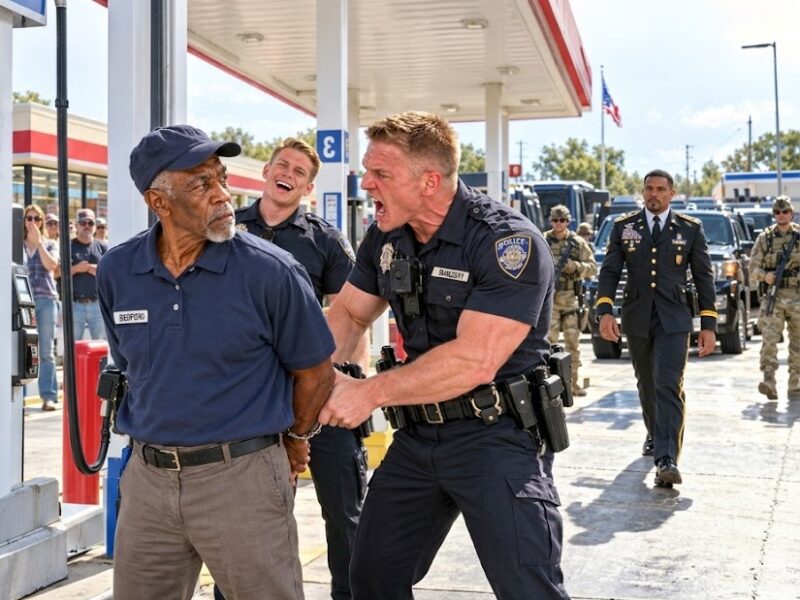
Police Handcuffed an Elderly Black Man at a Gas Station Without Hearing His Side—Then They Learned He Had Raised a Delta Force Commander
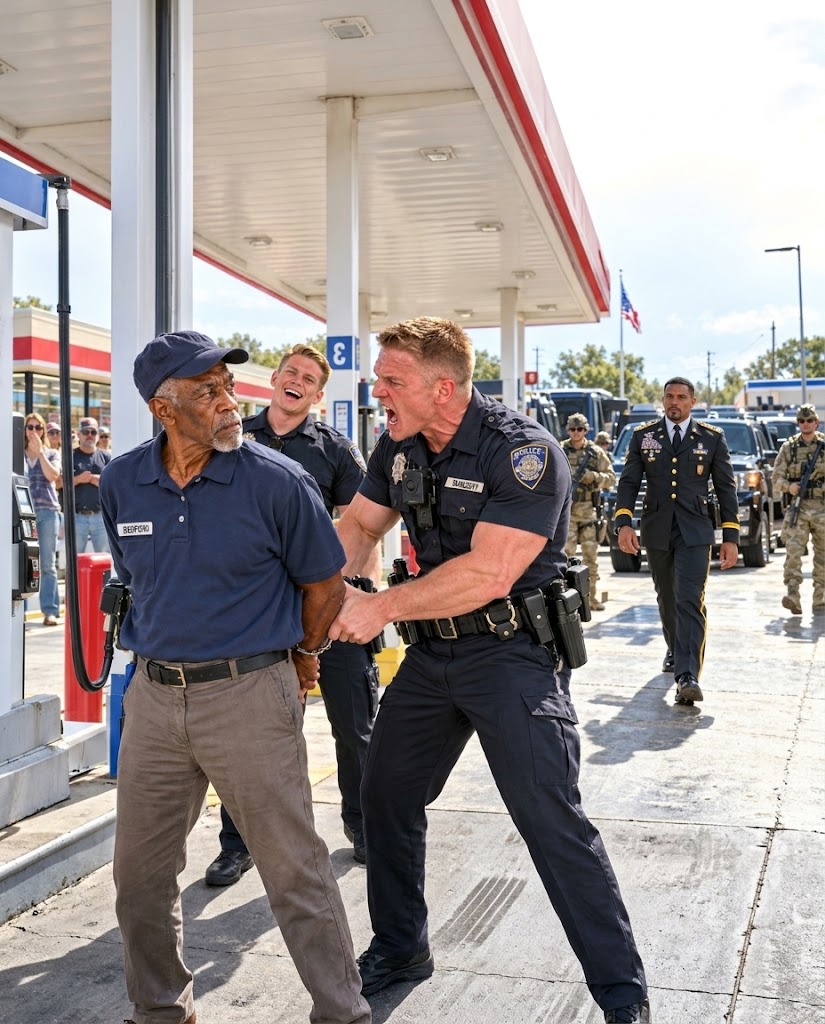
The sun came up white over Pel Hollow at a quarter past seven, and the concrete apron of the Kettlewood Fuel Stop was already hot enough to soften shoe soles. Bedford Abernathy had worked that apron for twenty-two years, and he knew which pump handle stuck, which hose bled a thin bead when the pressure dropped, and that Highway 19 ran heaviest between eight and ten when gravel trucks rolled south toward the river and shift crews rolled north toward Fort Macy. That morning he had come in early—not for overtime, but for the opposite.
“Orville,” he said at six, standing in the office doorway with his cap in his hands, “I need to be out of here by two.”
Orville Chastain looked up from the ledger. “Two?”
“My boy’s coming home tonight. Bringing his wife. Bringing the babies.” Bedford’s voice stayed level, but something underneath it had started to shake. “First time in four years.”
Chastain capped his pen. “Then be gone by two.”
So Bedford worked. He washed the windshield of every car that stopped. He checked the oil for a woman who asked and for two men who did not. He wiped down the nozzles between customers because nobody else did, and because a greasy handle was a small insult he refused to hand to anybody. Inside the glass, Hazelene Snowden ran the register and watched him through the smudges.
“You keep checking that clock, Bedford.”
“I’m not checking anything.”
“You’ve looked up eleven times since you clocked in.” She slid a coffee across the counter when he came in for change. “What are you cooking?”
“Smothered chicken, rice, greens.” He said each one slowly, like a man reading a list he had already memorized. “The oldest doesn’t like greens. I’m making them anyway.”
“And the little one?”
“Cornbread.” He smiled, and it made his whole face look twenty years younger. “That child would eat cornbread in his sleep.”
Hazelene laughed, then stopped laughing, because Bedford had taken his wallet out and was counting. He counted the way a man counts when the number has to come out right. Two tens, a five, three ones, a quarter. He turned the bills over twice like they might become more. He pressed them flat against the counter with the side of his thumb and counted them again.
“Short?” she asked.
“It’ll do.”
“Bedford.”
“It’ll do, Hazelene.”
She knew exactly why it wouldn’t. She had watched the reason happen eleven times since spring. The reason drove a steel-gray pickup with a lift kit and a county decal he had no right to display on a personal vehicle. The reason came in off Highway 19 somewhere between eight and nine, filled the tank to the neck, and drove off without putting a hand in his pocket. The first time, Bedford had run after the truck with the receipt in his fist. The second time, he had written it down. By the sixth time, the drawer was short enough that Chastain’s register software flagged it, and Bedford had stood in that back office with his cap in his hands and said he would cover it. He covered it every time after that out of his own pay—half a day’s wages, give or take, depending on how deep the tank ran. Hazelene had asked him once whose truck it was.
“Doesn’t matter.”
“Bedford.”
“I’ve lived in this town sixty years, Hazelene. You put a police officer’s name on a piece of paper here, you find out real quick what that paper is worth.”
But that morning, the money in his wallet was chicken and rice and cornbread. That morning, the money was a table with five people at it. At 8:14, the steel-gray pickup came off the highway and swung wide across two lanes of apron, cutting in front of a minivan that had been waiting. The driver did not look at the minivan. He never did. He stopped at pump three, let the window down, and did not get out.
“Fill it.”
Bedford set down his rag. “Morning, Officer Dunlevy.”
“I said fill it.”
Bedford filled it. The pump ticked upward—twenty, thirty-five, fifty. He watched the numbers climb the way a man watches a fever climb. Behind him, a second car pulled into line, then a third, then a gravel hauler with Dale Overmire Trucking stenciled on the door eased in behind them all and sighed to a stop. The pump clicked off at sixty-two dollars and change. Bedford hung up the nozzle. He capped the tank. He walked to the island, tore the receipt off the printer, and did something he had not done in fourteen months. He walked around to the front of the truck. He stood in the middle of the apron in the white blaze of the morning, directly in the path of the steel-gray grille, and held the slip of paper up where the windshield could not pretend it wasn’t there.
“Sir,” he said, “your tank is full. Sixty-two dollars.”
Inside the glass, Hazelene’s hand went still on the register keys. In the line behind him, a woman turned her radio down. Through the windshield, Clint Dunlevy’s jaw set. His eyes went past Bedford to the cars lined up behind him, one at a time, counting them. Then they came back. The engine died. The door swung open. Clint Dunlevy stepped down onto the concrete and let the door hang open behind him. He was thirty-four years old, built thick through the shoulders, and he wore the uniform on a day he was not scheduled to work. He took his time. He adjusted his belt. He looked at the receipt in Bedford’s hand the way a man looks at something a dog has brought into the house. Then he raised his voice so that the whole apron could hear it.
“Is somebody going to explain to me,” he said, “why there is an old Black man standing in front of my truck waving paper at me?”
Nobody answered. That was the point. He turned a slow half circle, taking in the line of cars, including every single person in the joke.
“Twenty-two years pumping gas,” he said. “Twenty-two years. And today is the day he decides he’s in charge of something.”
Bedford did not lower his arm. “Sir, your tank is full. Sixty-two dollars.”
Dunlevy repeated the word and let it rot in his mouth. “Sir. You hear that? He’s being polite. He’s being so polite while he blocks a police vehicle with his body.”
“It’s a personal vehicle, officer.”
The apron went quiet in a different way. Dunlevy’s jaw worked once. He stepped closer, close enough that Bedford could smell the coffee on him, and he dropped his voice to something private and foul.
“You don’t correct me. Not ever. Not in public and not with that mouth.”
“I’m not correcting you. I’m asking you to pay.”
“Asking?” Dunlevy laughed, then turned and gave the laugh to the line of cars so nobody behind him could pretend they were not part of it. “You people always ask. You ask for the money. You ask for the forms. You ask for somebody to come fix what you broke yourself.”
In the gravel hauler, Dale Overmire rolled his window down. Sixty years old, forearms like cable, and he put his elbow out and watched and said nothing yet. Dunlevy pointed at the slip of paper without touching it.
“Read it.”
Bedford did not move.
“I said read it out loud. You’re standing there holding it like it’s a warrant. So let’s hear you read it.” He tilted his head. “Officer, can you read?” He said it brightly, almost kindly, the way you would ask a child. “That’s a real question. Twenty-two years at a pump. I’d be surprised if anybody ever sat you down and taught you. So go on. Prove me wrong.”
Bedford’s jaw tightened. His thumb pressed a crease into the paper and let it go.
“Twenty-two years,” he said, “and I have never asked you for one thing that wasn’t printed on a slip. Don’t you talk to me about years.”
Bedford Abernathy lifted the receipt. He held it steady. He read it slowly and all the way through. Kettlewood Fuel Stop, Highway 19, pump three. Unleaded, 15.9 gallons, sixty-two dollars and eleven cents total due. His voice did not shake. “Thank you for your business,” he finished. “That’s what it says at the bottom. Fifteen point nine gallons.”
“Congratulations,” Dunlevy said. “Sixty-two eleven. I heard you. Then pay it.”
Somebody in the second car made a small sound. It might have been a laugh. Dunlevy’s head snapped toward it.
“Something funny?”
The window went up.
“That’s what I thought.”
Behind the glass, Hazelene Snowden had come out from behind the register. She stood with one palm flat against the door, not pushing it open, not letting it go. Bedford saw her there. He gave the smallest shake of his head, and she stayed exactly where she was. Dunlevy caught the whole exchange.
“Oh, he’s got backup.” He raised his chin toward the window. “Sweetheart, I’d think real hard about which side of that glass you want to be standing on this morning.”
Hazelene did not move. She also did not open the door.
“Smart,” Dunlevy said. “Smarter than him.” He turned back, and now the performance was over, because the performance had failed, and what was left in his face was the thing underneath it. “You want to know what you just did? I have driven onto this lot every week for over a year. Every week that tank gets filled and nobody says a word, because everybody here understands how a town works. And today, a seventy-two-year-old pump jockey decides to make a speech about it in front of eleven people.”
“Fourteen months,” Bedford said.
“What?”
“It’s been fourteen months. Not over a year. Fourteen months.” He said it without heat, the way a man reads back a figure he has carried a long time. “I know because I’ve paid for every one of them.”
The silence that came down then had weight to it.
“Say that again.”
“The drawer comes up short at the end of the shift.” Bedford’s hand was steady on the paper. “Mr. Chastain’s system catches it. So I put the money back in out of my check every time.”
“You’re lying.”
“No, sir.”
“You are standing in front of a police officer in front of this entire lot, and you are calling him a thief.”
“I’m asking you to pay sixty-two dollars.”
Dunlevy’s hand came to rest on his belt. Not on anything—just resting there where everyone could see it rest.
“Do you have any idea,” he said softly, “what I can do to your whole life this morning?”
“I need to be home by four, officer.” Bedford’s throat moved. “My son’s coming. So please just pay it.”
For one full second, nothing happened. Then Dunlevy’s eyes went to the receipt still hanging in the air between them—still steady, still extended, still refusing to come down—and he reached for it. He did not take the receipt from Bedford’s fingers. He took the nozzle instead. It was still hanging on the island behind the old man, and Dunlevy walked past him to get it, bumping his shoulder on the way through. He lifted the handle off the hook, carried it back around the front of the truck, and squeezed the trigger. Gasoline came out in a thin, bright arc and laid itself down on the concrete in a line two feet long, stopping an inch from the toes of Bedford’s shoes. Somebody in the line shouted. A door opened and shut again. The smell came up off the hot slab immediately, sharp enough to sting.
“Whoops,” Dunlevy said.
Bedford looked down at the spill. He had cleaned that apron every morning for twenty-two years. He knew what a gallon of unleaded did to concrete in July, and he knew that the stain would still be there in October, and he knew that every single person in that line was watching him look at it.
“Officer, there’s a vapor hazard with the pumps running. There’s a spill—”
“On your lot,” Dunlevy said. “On your shift.” He let the nozzle drop. It hit the concrete flat, bounced once, and skidded against Bedford’s ankle. The metal was hot from the sun—hot enough that the old man flinched. “Pick it up.”
Bedford bent and picked it up and hung it back on the hook, and his hands were not entirely steady now.
“Now clean it.”
“I’ll get the absorbent from inside.”
“You’ve got a rag.”
Bedford went still. The rag was in his back pocket. It was the blue cotton square he used on windshields, washed and folded every night in his own kitchen sink, and he carried it the way some men carry a pocketknife. Hazelene had seen him iron it once. She had never let him forget it.
“That’s a glass rag,” Bedford said quietly. “It won’t lift fuel. You need the granular.”
“Did I ask you for a lesson?” Dunlevy’s voice cracked across the apron like a thrown plate. “I am standing in a hazardous spill on a public lot, and the employee responsible is arguing with me. Get down there and clean it up. Now.”
The old man did not move for a count of three. Then Bedford Abernathy reached back, took the folded blue rag out of his pocket, shook it open, and lowered himself onto the concrete. His knees did not want to do it. One of them had been rebuilt in a county hospital in 1998 and had never worked right since. He went down the way old men go down—one hand on the fender well of a truck he had just filled for free, then the other hand flat on the burning slab—and then he wiped. Behind him, fourteen feet of silence. A minivan, a sedan, a gravel hauler with its engine idling and its driver’s hands locked on the wheel.
“Get the edge there,” Dunlevy said. “You missed the edge.”
Bedford wiped the edge.
“This is what I mean,” Dunlevy told the line of cars, loud, conversational, almost friendly. “This is the job right here. Nobody’s holding him down. He’s doing exactly what he was hired to do. And twenty minutes ago, he thought he was running a bank.”
Inside the glass, Hazelene Snowden turned her face away and pressed the back of her wrist against her mouth. Out on the shoulder of Highway 19, Dale Overmire put his hauler in gear, rolled it fifty feet off the lot, parked it on the gravel, and killed the engine. He did not drive away. He got out, stood beside his own front tire in the full sun, and watched. In the minivan at the head of the line, a woman had her phone pressed against the windshield. Her hands shook so badly the picture would come out useless, and she held it up anyway. In the back seat, a boy of nine had stopped asking what was happening, because his mother had told him twice to hush, and the third time she had not trusted her voice. Dunlevy saw the phone. He smiled at it.
“Go ahead, sweetheart,” he called. “Film the cleanup. That’s a work order being carried out.”
The phone stayed up. The minivan did not move. When the stain was a dull gray smear and the rag was black and soaked through, Bedford put his palm on the fender well again and started the long work of getting up. His wallet slid out of his back pocket on the way. It hit the concrete and fell open, and a photograph came halfway out of the plastic sleeve—the photograph gone soft at the corners from being handled, the way paper goes soft only after years of being taken out and put back. Dunlevy’s boot came down on the edge of it. Not hard. Just enough. He looked down at it for a second, and whatever he saw there was not worth his attention, because he slid the wallet across the concrete with the side of his foot and sent it skating under the truck.
“Keep your business off my lot,” he said.
“That’s my son.”
“I don’t care.”
Bedford got onto his feet. He was breathing through his mouth. There was fuel on his trouser knees and gray grit on both palms, and the blue rag hung ruined in his fist, and he was still somehow standing straight.
“Sixty-two dollars,” he said. “Please.”
Dunlevy stared at him with something close to wonder. “You really don’t quit.”
“No, sir.”
And behind them both, the door of the Kettlewood Fuel Stop banged open hard enough to rattle the glass. Hazelene Snowden came out into the light with a hardbound notebook in her hand.
“Get back inside,” Dunlevy said.
Hazelene Snowden did not get back inside. She came across the apron in her flat work shoes with the notebook held against her chest like a hymnal.
“Officer, I keep the drawer.”
“I know what you keep.”
“Then you know what’s in here.” She did not open it. She just held it. “Every short. Every date. Every gallon.”
For the first time that morning, something in Clint Dunlevy’s face moved in a direction he did not choose. He turned his head toward the cruiser parked at the edge of the lot and raised his voice.
“Kilgore.”
The passenger door opened. Sawyer Kilgore was twenty-six, pink from the sun, two years on the job, and he came across the concrete at a pace that suggested he had been hoping very hard not to be called.
“Lot’s closed,” Dunlevy said. “We’ve got a fuel spill and a theft investigation. Clear it. Plant, clear it.”
Kilgore cleared it. He walked the line with his hand up and his eyes down, and one by one the cars backed out onto Highway 19 and left. The minivan went last. The woman in the driver’s seat said something to Kilgore through her window that made the back of his neck go red, and then she drove away too, and her phone went with her. Dunlevy took out his own phone and dialed the number printed on the sign above the pumps. Orville Chastain picked up on the third ring.
“Mr. Chastain? Officer Dunlevy, Pel Hollow PD.” He said it pleasantly, and he said it loud enough for everyone on that apron to hear every word. “I’m standing on your lot with an active spill, a hazard violation, and an employee I’ve got reason to believe has been siphoning product for over a year.” He paused. “No, sir, you don’t need to come down. I’d just like you to understand what kind of morning this could turn into. Fire marshal, weights and measures, permit review—” A pause. “Or it could turn into nothing at all. That’s generally up to the owner.” He listened for a moment. “That’s what I thought,” he said, and hung up. Then he turned to Hazelene. “How long have you worked here?”
“Nine years.”
“Nine years.” He looked at the notebook against her chest. “Hourly or salary?”
She said nothing.
“Hourly,” he said. “Of course. So what you’ve got, Miss Snowden, is nine years of goodwill and a shift schedule that somebody writes every Sunday night. And what you’re about to do is hand a police officer a book you keep in your own handwriting with no witness, no date stamp, and no way on this earth to prove when a single line of it was written.”
“I know what I wrote.”
“You know what you wrote.” He nodded slowly. “And when this gets looked at—and it will get looked at—what everybody is going to see is a Black cashier and a Black pump attendant who got caught short in the drawer and invented a story about a cop.”
Out on the gravel, Dale Overmire started walking back toward the lot. Kilgore met him at the property line.
“Sir, you need to stay off.”
“I’m a witness.”
“Sir—”
“I’ve been hauling out of this stop for eleven years. That man has washed my windshield in the rain.” Overmire’s voice carried. “I’m a witness.”
“Then you can give a statement at the station,” Dunlevy called over without turning around. “Right now you’re obstructing. Walk.”
Overmire looked past him at Bedford. Bedford shook his head just once. Overmire stood there a moment longer. Then he walked back to his truck, sat down in the cab with the door hanging open and his boots on the step, and did not leave. Kilgore came back across the apron and stopped a few feet short of his partner. His hand moved to the square of black plastic clipped above his badge.
“Plant, my camera’s running.”
“Then shut it off.”
Kilgore’s hand stayed where it was.
“I said shut it off. That’s a policy violation.”
The young man’s voice came out thin. “Not during an active stop. It’s an automatic write-up.”
Dunlevy looked at him for a long moment. Then he laughed, and the laugh had no bottom in it.
“Fine,” he said. “Let it run. Record every second. In six months, you’ll be thanking me for teaching you what this job really is.”
Kilgore took his hand down. The small red light stayed on. So now there was nobody. The lot was empty. The pumps were dark. The owner had been handled by telephone. The cashier had been handed her own schedule as a threat. And the only other witness had been pushed off onto the gravel.
“Nobody’s coming, old man,” Dunlevy said. “Look around. Look real good.”
Bedford looked. Then he looked back at him. “I see you,” he said.
And Bedford Abernathy stood alone in the middle of two hundred feet of hot concrete with gasoline drying on the knees of his trousers.
“Officer,” he said. “May I have your badge number?”
Dunlevy’s hand came up and lay flat across the nameplate on his chest. “Say that again.”
“Your badge number. That’s all I’m asking for.”
“I don’t believe you can read it from there.”
“Then take your hand down.”
Hazelene stepped forward. “Bedford, it’s almost noon. You’ve got people coming tonight. Let’s just—”
“That’s enough out of you,” Dunlevy snapped.
And Bedford Abernathy turned and looked at the woman who had stood up for him, and he reached out and took the hardbound notebook out of her hands. He opened it. He held it up so the sun fell across the page.
“Fourteen months,” he said. “It’s all in here, and I’m sending it to your department this afternoon.”
Clint Dunlevy crossed the distance in two steps and tore the notebook out of the old man’s hands. He did not look at it. He folded it shut, lifted the flap of his breast pocket, and pushed it down inside against his chest. Then he buttoned the flap.
“Shut your lying mouth,” he said. “Blaming me to cover the fuel you steal. I have never taken a single drop.” He tapped the pocket. “Fourteen months of shortages in that drawer. Fourteen months. And the only man with keys to the island is you.” He spread his hands wide, playing to a lot that had nobody left in it. “You wrote your own confession, and you handed it to me.”
“That’s Hazelene’s handwriting.”
“Then she’ll answer for it, too.”
Hazelene made a sound. Kilgore stepped sideways to put himself between her and the pumps. He did not look at either of them.
“Turn around,” Dunlevy said.
Bedford did not turn around. “Officer, I’ll come down to the station. You don’t have to do this here.”
“Turn around.”
“I’ll walk to the car myself. Please—”
“Still running your mouth.” Dunlevy’s voice dropped flat and almost bored. “You’re resisting an officer.”
He took Bedford by the wrist. The old man’s arm came up behind his back in a motion that had nothing to do with resistance and everything to do with physics, and his shoulder reached the end of what it could do, and then it went past that. Bedford made no sound at all. Dunlevy walked him forward four steps and put him face-first against the steel column of pump three. The metal had been standing in direct sun since seven in the morning. It was hot enough to raise a welt.
“Black male, seventy-two, theft,” he said to nobody, to the record, to the air. “Cuff him, Kilgore. Tight. He’s a slick one.”
Kilgore did not move.
“Kilgore.”
“Clint, he’s seventy-two.”
“Cuff him.”
And Sawyer Kilgore, twenty-six years old, two years on the job, with a red light burning above his badge, took the handcuffs off his own belt and put them on Bedford Abernathy’s wrists. He left them loose. Dunlevy saw that. He reached over his partner’s hands and ratcheted each cuff down three clicks, and the steel bit into the thin old skin above the bone and stopped. Hazelene Snowden started to cry—not loudly. She did not look away once.
“Walk,” Dunlevy said.
He could have put him in the cruiser right there. The cruiser was parked forty feet away at the edge of the island, close enough to reach in six seconds. He did not walk him to the cruiser. He turned Bedford by the elbow and walked him the long way—the whole length of the apron, past all four pumps, past the air hose, past the ice chest with the faded decal the old man had scrubbed a thousand times. He walked him slow. He walked him in a straight line down the middle of the concrete in the white blaze where Highway 19 could see. Cars slowed on the road. A pickup honked. Somebody shouted something out a window that got lost in the wind. Out on the gravel, Dale Overmire stood up out of his cab with his phone in his hand and his jaw locked and his eyes wet, and he filmed the whole thing from a hundred feet away and did not stop.
“Officer,” Bedford said, “my son gets in at six.”
“Then he can come visit you.”
“He’s been gone four years.” A breath. “Four years. And he let his daddy pump gas.”
Dunlevy did not turn around. “Tells you everything.”
At the far end of the lot, behind the air pump, there was a low concrete curb and a green dumpster with flies working the lid. Dunlevy put his hand on the back of Bedford’s neck and sat him down on the curb beside it.
“Sit there,” he said. “Where you belong.”
The old man sat. Hazelene came out of the store with a cold bottle of water and got within ten feet of him.
“He’s been in that sun forty minutes.”
“Back inside.”
“He is seventy-two years old, and you have put him on the ground beside a dumpster.”
“Miss Snowden.” Dunlevy did not raise his voice at all. “If that bottle crosses this line, I will charge you with interfering, and you will spend tonight in a cell instead of him.”
She stood there with the plastic sweating in her fist. Then she set it down on the concrete, well out of his reach, and walked back. His arms were locked behind him. His shoulders were up around his ears because there was no other way for them to be. His knees were gray with concrete dust and dark with fuel. The folded blue rag had fallen somewhere on the apron behind him, and he could see it from where he sat—a small blue square a hundred feet away. And he looked at it for a while. Then he turned his face up into the sun and worked out the arithmetic. Booking took three hours if nobody dragged it. Arraignment was the next morning at the earliest. Chicken, rice, greens, cornbread. The boy who would not eat greens. The baby who would. Four years. Four years, and the table would be set and the chairs would be out and the door would open at six on a house with nobody in it. Bedford Abernathy lowered his head, and for the first time all morning, closed his eyes.
Dunlevy keyed his shoulder mic. “Dispatch, this is Dunlevy. I need a supervisor out to the Kettlewood stop on 19. I’ve got a theft in custody and I want this documented properly.”
The radio crackled an acknowledgement. And underneath it, rising off the highway, came a sound that did not belong to Pel Hollow on a Tuesday morning. Engines—heavy ones, more than one—and then threading through them the rise and fall of a siren. Kilgore turned his head toward the road first.
“Clint,” he said.
They came off Highway 19 in a line. A military police escort first, light bar turning, siren dropping to a growl as it slowed. Behind it, a black government SUV. Behind that, a second escort, and behind that, a tan command vehicle with a plate that was not a civilian plate. They did not pull up to the pumps. They came across the apron and stopped in a staggered line down the middle of the lot, and the doors opened. A man got out of the SUV. He was forty-one years old. He wore a plain gray polo and jeans and desert boots that had been resoled twice. His wife came out the far side with a child on her hip and a girl holding her other hand, and she was still saying something about ice cream when she stopped talking, because the man in the gray polo had gone completely still. He was looking at the far end of the lot. At the air pump. At the green dumpster. At the seventy-two-year-old man sitting on a concrete curb in a Kettlewood uniform with his hands locked behind his back.
“Dad.”
Nobody heard it. It did not have enough air behind it. Then he ran. He crossed two hundred feet of concrete at a dead sprint, and he went down on both knees on the curb beside his father, and he got one arm around the old man’s back and one hand under his elbow and lifted him upright off that curb like he weighed nothing at all.
“Dad. Dad, look at me.”
“Ridley.” Bedford’s voice came out wrecked. “Baby, what are you doing here?”
“They let us go early. I was coming to get you.” His hands were moving over his father’s shoulders, his wrists, the skin above the steel. “I wanted to surprise you.”
“Your knees. You’ll tear your—”
Ridley Abernathy’s hands stopped at the cuffs. He went very quiet.
“Who did this?”
Bedford did not answer, so his son stood up. He turned around and he looked across that apron at the man in uniform, and he did not shout. He did not take a single step forward. He stood in front of his father with his hands open at his sides, and he asked for two things.
“Your name and your badge number.”
Clint Dunlevy laughed. “Oh, we’re doing this. Name and badge number. You want to be real careful, son.” He came toward him unhurried, thumbs hooked in his belt. “I don’t know who you think you are. I don’t know what kind of job buys a man a car like that, but right now you are interfering with an arrest, and I can seat you on that curb right next to him.”
“Then seat me.”
“Say that again.”
“I said, then seat me.” Ridley’s voice never rose. “But you’re going to give me your name and your badge number first.”
Dunlevy’s hand came off his belt, and a door opened on the tan command vehicle. Colonel Merritt Pennington was fifty-six years old. He was the garrison commander at Fort Macy. He had ridden out with the convoy that morning and had not expected to leave the vehicle. He stepped down onto the concrete. He took off his cover and held it against his thigh. He had seen the curb. He had seen the dumpster. He had seen the flies. When he spoke, his voice came out rough, and it broke in the middle, and he did not try to hide that it broke.
“Officer, the man you just put in handcuffs beside a trash container is Bedford Abernathy. He has pumped gas on this lot for twenty-two years.” He pointed. “And the man standing in front of him is his son. Lieutenant Colonel Ridley Abernathy, United States Army. He commands a Delta Force squadron, and he has spent the last four years in places I am not permitted to name in front of these pumps.”
The lot stopped breathing. That old man raised him alone on what you can earn at sixty-two dollars a tank. Behind the colonel, four soldiers had come out of the escort vehicles. Nobody gave an order. They formed a loose line facing the far end of the lot, and one after another they came to attention and held it. Not for the colonel. For the man on the curb. Bedford saw them. He tried to straighten his back and could not, because his hands were still locked behind him. Hazelene Snowden’s hands came up over her face, and she started across the concrete at a run in her flat work shoes, crying so hard she could not see where she was going. Out on the gravel, Dale Overmire took his cap off and held it against his chest and stood there like a man at a graveside. On Highway 19, traffic in both directions had slowed to a crawl and then simply stopped. Drivers looked out at a line of military vehicles and a seventy-two-year-old man in handcuffs, and nobody started moving again. Coral Lee Abernathy turned both children around and pressed their faces into her shoulder, and Sawyer Kilgore let go of his partner’s arm, took three full steps backward, and put his hand flat over the camera on his chest as though he could cover what it had already recorded. Clint Dunlevy did not move. His face had gone the color of the concrete. His mouth opened once and produced nothing. And then slowly, without any instruction from the part of him that was still thinking, his right hand drifted up and pressed flat against the buttoned pocket on his chest—against the notebook inside it. Ridley saw the hand. So did Colonel Pennington. And at that exact moment, a county car with a chief’s star on the door turned off Highway 19 and came onto the lot.
Chief Virgil Hardaway had been fifty-nine years old for eleven days, and he had never once in his career walked onto a scene that looked like this one. He took in the convoy. He took in the colonel with his cover in his hand. He took in the four soldiers standing at attention and the empty pumps and the woman in the Kettlewood polo sobbing with her arms around an old man’s shoulders. Then he saw the handcuffs.
“Take them off,” he said. “Right now.”
Kilgore got there first. His hands shook so badly it took him three tries to find the keyhole. And when the steel came away, there were two raw bands printed into the skin of Bedford’s wrists, white at the edges and purple in the middle. Ridley Abernathy caught his father’s forearms and held them. Then he pulled the sleeves down over the marks.
“It’s all right, Dad,” he said. “Nobody has to look at that.”
Hardaway turned to Dunlevy. “Officer, empty your pockets on the hood of that cruiser.”
“Chief, this man has been stealing—”
“Empty your pockets.”
Dunlevy’s hand went to his chest, and then it stopped, because there was nowhere left to take it. He unbuttoned the flap. He pulled out the hardbound notebook and laid it on the hood. And the sound it made was very small. Hardaway opened it in front of everyone. It was not a diary. It was a ledger. Date, pump, gallons, dollar amount, a plate number written out in full in the same careful hand—fifty-one times. And at the bottom of each page, a second column in a different and older handwriting, with a single word repeated down the length of it. Covered. Covered. Covered. Covered.
“That’s my pay,” Bedford said quietly. “That’s where it went.”
Hardaway read for a long time without speaking. “Officer Kilgore.”
“Sir.”
“Is your body camera running?”
Kilgore’s throat worked. “Yes, sir. It’s been running the whole time.”
“He told me to shut it off. And did you?”
“No, sir.”
“Say the rest of it.”
The young man looked at the concrete, and then he made himself look at the old man instead. “I’ve been riding with him since March,” he said. “I’ve watched him fill that truck eight times. I never once saw him pay. I knew, and I didn’t report it. And this morning, I put those cuffs on an innocent man because he told me to.” He unclipped the camera and put it on the hood beside the notebook.
Orville Chastain’s truck came through the entrance too fast and stopped crooked. He got out with a laptop under his arm and his shirt buttoned wrong.
“The register locks,” he said, breathing hard. “Fourteen months. Every short, every shift, every time that drawer came up light.” He set it down and opened it with shaking hands. “And the canopy camera runs on a ninety-day loop, chief. But I’ve got off-site backup, and it caught every pull-up he ever made.”
Hardaway looked at the laptop. He looked at the ledger. He looked at the camera. Then he looked at the pump island, where a gray smear of gasoline was still drying on the concrete, and at the blue rag lying beside it.
“Officer Dunlevy,” he said. “Badge. Chief. Badge. Weapon on the hood.”
For one terrible moment, Clint Dunlevy did not move, and every soldier on that lot shifted their weight at the same time, and he felt it. He unpinned the badge. He set the weapon down. Hardaway picked up the handcuffs that Kilgore had left on the cruiser’s hood—the same cuffs, still warm, still carrying the marks of the sun—and he turned them over once in his hand.
“Clint Dunlevy,” he said, “you are under arrest for unlawful arrest under color of law, for theft of fuel in excess of four thousand dollars, and for filing a false report. You will be walked to that car in front of these people, because that is what you just did to him.”
The cuffs closed. Nobody cheered. Forty-some people stood on that lot and along that highway, and not one of them made a sound. Dunlevy turned his head once as they passed the island.
“Bedford. Bedford, tell them. Tell them I never—”
Bedford Abernathy did not look up. “Sixty-two dollars,” he said. “That is all I ever asked you for.”
They watched a man be walked the long way across the concrete—past all four pumps, in the white blaze, exactly as far as he had walked Bedford Abernathy. Hazelene Snowden picked the water bottle up off the slab where she had been forced to leave it. She crossed the ten feet nobody had let her cross, twisted the cap off, and put it into Bedford’s hands.
“Drink it,” she said. “Please. Just drink it.”
He drank. Half of it ran down his chin, and neither of them cared. Colonel Pennington watched that and said one thing to the chief—low, though it carried anyway.
“Forty minutes in that sun, and not one of us was here.”
Bedford did not watch him go. He had gotten down on one knee beside the steel-gray pickup and was reaching underneath it with his sore arm. His wallet came out gritty and scuffed. He opened it, straightened the soft old photograph with his thumb, and pressed it back down into its plastic sleeve—and only then did his hands finally start to shake. Ridley crouched beside him and looked at the picture. It was a boy of nine in a church suit, standing in front of this same lot, in front of this same sign, holding a windshield rag.
“You kept it in there the whole time,” Ridley said.
“Where else would I keep it?”
Orville Chastain came across the apron, then, carrying something small and crumpled that he had picked up off the concrete. He held it out to Bedford. It was the receipt. Sixty-two dollars and eleven cents. Still unsigned.
Clint Dunlevy was terminated from the Pel Hollow Police Department eleven days later. The criminal case took longer. Unlawful arrest under color of law. Theft of fuel totaling four thousand one hundred sixteen dollars across fourteen months. Filing a false report. The ledger went in as evidence, and so did the body camera footage, and so did fifty-one plate captures pulled off a canopy camera backup that he had never once thought about in all the mornings he spent under it. He pleaded out in the spring. He served time. He will never again hold a peace officer certification in that state, because the board revoked it permanently and published the reason. The prosecutor’s closing exhibit was not the convoy and not the colonel. It was a still frame from a body camera: a hardbound notebook being buttoned into a police officer’s breast pocket by his own hand.
Sawyer Kilgore was suspended without pay. He did not appeal it. He testified at every hearing he was called to. And when the defense attorney asked him why he had not shut his camera off, he said that he had almost done it, and that he thought about almost doing it every day. He is still on the job. He rides alone now. Nobody in Pel Hollow has quite decided what to make of him, and he has stopped expecting them to.
Bedford Abernathy settled with the city. He did not spend the money on himself. Three weeks after the settlement, he walked into a council chamber in a pressed shirt and was seated on the civilian oversight board. And at his first meeting, he put forward one page of plain language that is now county policy. They call it the Kettlewood Rule. Any municipal or law enforcement vehicle fueling at a private station signs for it. Printed name, badge or unit number, odometer, signature. Station keeps the top copy. The county reconciles monthly and publishes the total. It is not a dramatic law. It has no name attached to a tragedy. It is just a signature line on a slip of paper in the exact place where there had not been one. And in the first year, it closed a hole that eleven stations across that county had been eating out of their own payroll for years.
Orville Chastain made Bedford the morning manager. He also did something that embarrassed the old man badly. He framed the notebook. It hangs beside the register in the Kettlewood Fuel Stop to this day, open to a page where the word covered runs down the margin in a tired hand. And underneath the frame, there is a small brass plate that reads, “He paid for it so nobody else would have to.” Hazelene Snowden works the register under it five days a week and has made at least four grown men cry by explaining what it is.
And that night—the actual night, the one the whole morning had been pointed at—Bedford Abernathy got home at a quarter to four. He cooked smothered chicken, rice, greens the oldest would not touch, a pan of cornbread for a four-year-old who ate two pieces before anyone sat down and then fell asleep face-first against his grandfather’s arm halfway through the meal. Five chairs at that table. Nobody empty. At some point, Ridley noticed his father eating left-handed and reached over and pushed the sleeve up and looked for a long moment at the two fading bands on his wrist.
“Dad.”
“It’s nothing.”
“It isn’t nothing.”
Bedford Abernathy put his fork down. He looked at his son—forty-one years old, sitting at a kitchen table in the same house where he had read him the Bible every night of his childhood on a pump attendant’s wages.
“You came,” he said. “You got out of that truck and you came across that whole lot for me.”
“Of course I did.”
“Then it’s nothing.” The old man picked his fork back up. “Eat your greens.”
Coral Lee asked how long he had been covering the shortages.
“Long enough.”
“Dad.”
“Fourteen months.” He passed the cornbread down the table. “And I’d have done fifteen before I put that man’s name on a complaint form in this town.”
Ridley set his fork down and did not pick it up again for a while. The video Dale Overmire filmed from a hundred feet away has been watched more times than anyone in Pel Hollow can account for. The frame people stop on is never the handcuffs. It is a forty-one-year-old man in a gray polo running across two hundred feet of hot concrete toward a seventy-two-year-old man on a curb—past four soldiers who had not yet been told who either of them was.
So here is the question worth arguing about. If Bedford Abernathy’s son had been an hour later—if that convoy had stayed on the highway and kept going—would any of it have mattered? Would the camera have been enough? Would Kilgore have spoken? Would anybody have believed a cashier’s handwriting? Say what you think. Share this with someone who has had to swallow something just to keep a job. Because there are men and women covering somebody else’s tab in this country right now, and the only thing that ever stops it is being seen.
The story is over, but one thing keeps sticking with me, and it isn’t the convoy or the handcuffs. It’s the word written down the margin of that notebook—fifty-one times, in a steady hand. Covered. Not stolen. Covered. Every month, out of his own check, he quietly made the number come out right so nobody else would have to explain a shortfall. Fourteen months of a man paying for another man’s gasoline and telling nobody. So here’s what I’m taking from this one. Every workplace has somebody doing that—covering a soft gap that nobody upstairs ever learns about, because the person has more pride than the job has pay. And it works so well that the problem stays invisible for years, and the person solving it just gets quieter and poorer while everybody upstairs keeps living the numbers as if they’re fine. The thing that finally stopped it was a signature line on a slip of paper in the exact place where there hadn’t been one. So what are you covering right now that nobody knows about? Who is carrying this kind of debt in silence, and what would it take for someone to finally see them?









