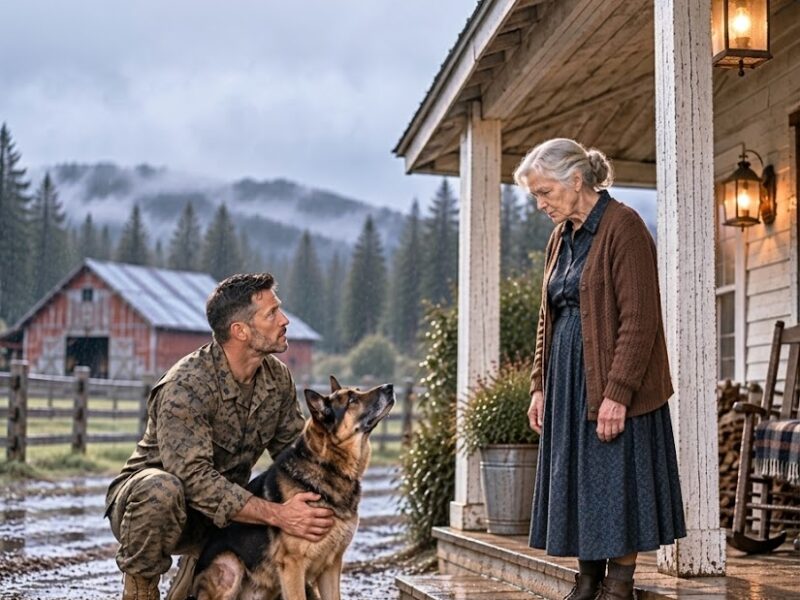
“Please Save Him,” the Marine Begged an Elderly Woman—Then His Injured K9 Recognized Her
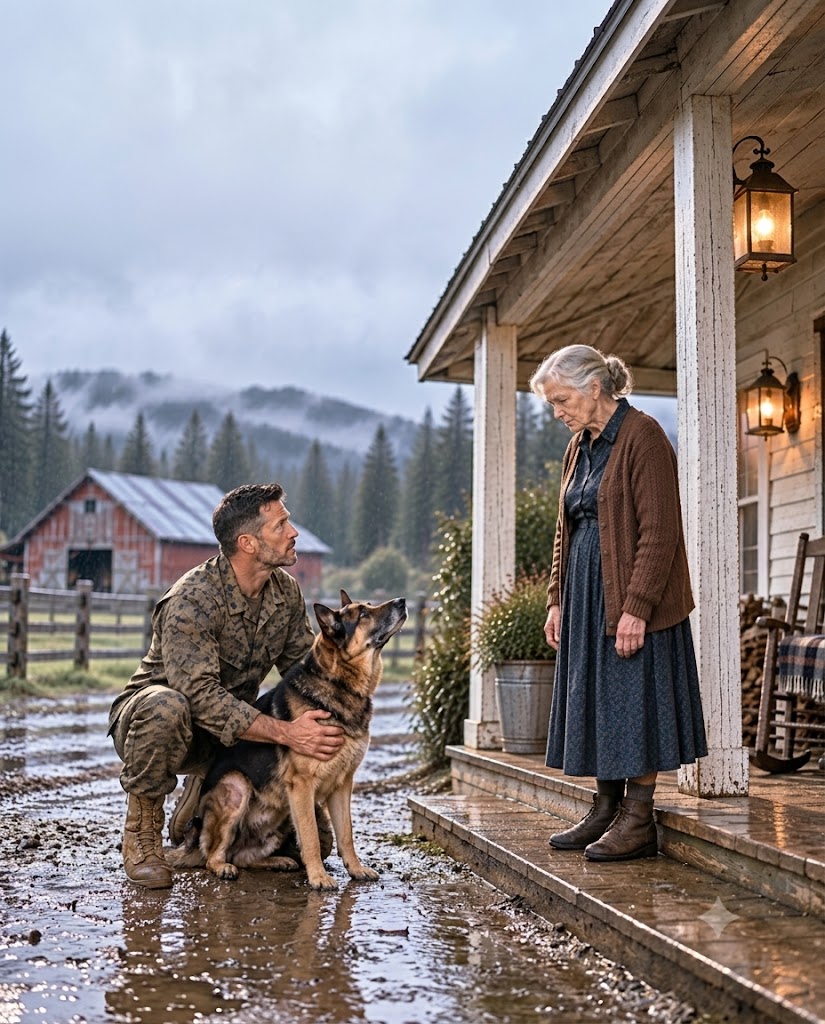
Part 1
Late February rain swept the rural roads south of Port Angeles, Washington, turning the shoulders dark with mud and hanging a cold gray veil over the fur-covered hills.
Gunnery Sergeant Adrien Keane saw the temperature warning flash across the dashboard and muttered under his breath.
At forty-one, Adrien stood a little over six feet, broad through the shoulders without carrying unnecessary weight, with short dark brown hair beginning to gray at the temples and a small pale scar near the right side of his square jaw.
His gray-green eyes had the steady measuring quality of a man accustomed to noticing problems before they became emergencies. That habit had served him well as a Marine.
It had also made asking for help feel dangerously close to failure.
He eased the pickup onto the gravel shoulder and killed the engine. Behind him, a black-and-tan German Shepherd lifted his head from a folded blanket.
“Easy, Vandal.”
Vandal was seven, nearly eighty pounds when healthy, with a dark saddle across his back, intelligent amber-brown eyes, and a small notch missing from his left ear.
His years as a military working canine were over, and Adrien had legally adopted him after his service ended. But Adrien had never learned to think of him as anything except his partner.
Now, one hind leg was shaved around a fresh surgical incision after orthopedic surgery, and three weeks of restricted movement stood between Vandal and the beginning of anything resembling normal life.
No stairs. No jumping. Medication on schedule. Controlled steps only.
Adrien understood rules. What he did not understand was how every plan he had made had collapsed in less than twenty-four hours.
The specialized facility arranged to care for Vandal had called the previous afternoon. A staffing emergency meant they could no longer provide the overnight post-operative monitoring he required.
Adrien had spent hours calling alternatives. Ordinary kennels would not accept Vandal at this stage of recovery.
The veterinary clinic ahead was his final possibility. And at eight the next morning, Adrien was supposed to report for a three-week rehabilitation program for the shoulder injury he had spent months pretending was merely inconvenient.
He rubbed that shoulder now, feeling the familiar deep ache.
If the clinic said no, he already knew what he would do. He would cancel his own treatment.
A hard gust shook the truck. Across the road, a sheet of plywood slammed against the side of a weathered red barn.
An elderly woman was fighting to hold it over a damaged section of door, one boot sliding in the mud.
Adrien looked at Vandal. “Stay.”
He crossed the road before he had time to reconsider.
The woman was small, perhaps five-foot-four, but she stood remarkably straight for someone Adrien guessed was well into her seventies.
Silver hair was gathered into a low bun beneath the rain, and a lined narrow face framed clear gray-blue eyes that seemed more irritated by his arrival than relieved.
Her brown cardigan was protected by an old canvas coat, and mud darkened her practical leather boots.
“I’ve got it,” Adrien said, catching the plywood with both hands.
“I didn’t ask for help.”
“No, ma’am.”
She studied him. Adrien kept holding the board.
Something almost like amusement touched her face. Together, they secured it enough to survive the weather.
“I’m Lenora Pike,” she said finally.
“Adrien Keane.”
Her eyes moved past him toward the pickup. Adrien turned.
Vandal was sitting up, watching through the rain-streaked window.
Ten minutes later, Lenora was standing beside the open rear door. She did not reach inside.
“Recent surgery.”
Adrien looked at her sharply. “Yes, ma’am. Hind leg.”
“And he’s compensating through the front. You know dogs.”
“My husband Warren did search and rescue work with them for years. Training, rehabilitation. I spent enough time beside him to learn when not to touch one.”
Her husband had been gone for several years. She offered nothing more.
The rain strengthened. “Bring him into the mudroom,” she said.
Adrien hesitated.
“He’ll get colder sitting in that truck than walking twenty feet.”
That was enough.
Using Vandal’s support harness, Adrien guided him slowly inside the farmhouse. Lenora placed water on the floor, then sat several feet away instead of calling him.
Vandal watched her. Then he watched Adrien.
Adrien moved toward the door. Vandal immediately pushed himself upward. His recovering leg trembled.
“Down,” Adrien said.
Vandal remained standing. Lenora saw it.
“Not disobedience,” she said quietly. “Fear of separation.”
Adrien returned to him and Vandal settled.
“You’re supposed to be somewhere,” Lenora said.
Adrien glanced at her. She nodded toward the overnight bag in his truck.
For several seconds, he said nothing. Then the words came harder than he expected.
“I need help.”
He explained the clinic, the canceled arrangement, the rehabilitation program. His eyes kept returning to Vandal.
“Three weeks,” Adrien said. “Keep him here. Three weeks. I’ll come back whenever they release me. That barn door, the porch boards, your gutter, the fence—I can repair them.”
Lenora’s expression hardened. “I can hire a carpenter.”
“Then don’t do it for the carpentry.”
Silence filled the mudroom.
“One night,” she said. That was all she offered.
—
Adrien slept little. At dawn, his bag waited beside the door.
He crouched beside Vandal and pressed one hand against the shepherd’s chest. “I’ll be back.”
Vandal rose.
“Stay.”
The dog tried to follow. His hind leg buckled.
Adrien caught him before he hit the floor. Something inside Adrien decided instantly.
He stood, grabbed his overnight bag, and pulled it away from the door. “I’m not going.”
Lenora appeared from the kitchen. She looked at the bag, then at Adrien.
Without arguing, she lowered herself carefully to the floor near Vandal. She waited until the shepherd’s breathing slowed, then rested one hand on the floor between them.
Vandal leaned toward her voluntarily.
Only then did Lenora look up. “Three weeks, Marine.”
Adrien didn’t move.
“Go take care of what’s broken in you.” Her hand remained still beside Vandal. “I’ll take care of what’s healing in him.”
Adrien looked at the dog who had trusted him through years when trust had mattered more than words. Then he looked at a woman he had not known yesterday.
Minutes later, his pickup rolled slowly through the gate of Pike Farm. Vandal did not follow.
In the rearview mirror, Adrien could see Lenora standing beneath the porch roof with the German Shepherd beside her.
He drove until the farm disappeared behind the trees. For the first time in years, Adrien Keane was heading toward something he needed while leaving behind the one thing he had always believed he could never entrust to anyone else.
And back at Pike Farm, Lenora Pike closed the door against the rain with a Marine’s wounded canine inside—and a reason for saying yes that Adrien did not yet understand.
—
By the third morning, the rain had thinned to a silver mist over Pike Farm, leaving the porch boards damp and the pastures shining beneath a low ceiling of clouds.
Lenora discovered quickly that Vandal liked routine almost as much as she did.
At six-thirty came medication hidden inside a spoonful of wet food. At seven, breakfast. Twenty minutes later, she clipped the support harness around his middle and guided him outside for the few controlled steps his recovery allowed.
She had spread non-slip runners between the mudroom and kitchen, blocked the staircase with an old wooden gate, and taped a sheet of paper beside the refrigerator where she recorded medication, appetite, water, bowel movements, incision condition, and every short walk.
When Vandal hesitated, she waited. When his hind leg trembled, she supported him without lifting his weight. When he became impatient, she refused to negotiate.
“You can glare at me,” she told him once. “The doctor didn’t prescribe running.”
Vandal stared at her. Lenora stared back. He lay down.
Each evening, Adrien received a message. *Medication done. Ate everything. Incision clean.*
The first night he answered immediately. “Thank you.”
The second night, he added, “Any swelling?”
By the fourth, he was staring at his phone before Lenora’s message arrived.
His own rehabilitation days were structured around exercises that exposed exactly how much strength and mobility he had lost in his shoulder. Adrien disliked being corrected, disliked being told to stop, and disliked most of all discovering that determination could not substitute for healing.
Yet every evening when Lenora’s message appeared, some tension left his chest. Vandal was eating. Vandal was safe. Vandal was still there.
Lenora never told Adrien that she had begun sleeping downstairs.
Her bedroom was on the second floor. Vandal was forbidden to climb stairs.
The first night, she had left him in the mudroom with a padded bed, then made it halfway upstairs before hearing the faint scrape of his nails against the floor below. She stopped.
A few minutes later, she came back carrying a pillow and blanket. By the next evening, a folding mattress had appeared near the kitchen wall.
She treated the arrangement as logistics, not affection. Vandal apparently disagreed. He began sleeping with his head pointed toward her.
On the fifth afternoon, a dark SUV stopped beside the farmhouse. Dr. Mara Ellery stepped out carrying a medical bag.
She was fifty, tall and spare, with straight chestnut hair cut neatly at her jaw, light brown eyes behind narrow rectangular glasses, and the controlled movements of someone who had spent decades around frightened animals and anxious owners.
Her face was angular rather than soft, and she possessed a professional directness that could sound severe until one noticed how carefully she lowered her voice around an injured animal.
“I’ll be honest, Mrs. Pike,” Mara said after entering the mudroom. “I wasn’t enthusiastic when Adrien told me where Vandal was staying.”
“Neither was I.”
That made Mara pause. Lenora handed her the medication log.
Mara read it, checked Vandal’s incision, tested the temperature around the surgical area, then watched Lenora position the support harness. Her gaze moved to the non-slip runners, the blocked staircase, and the clear path to the back door.
“You’ve done this before.”
“My husband worked with search and rescue dogs.”
Mara glanced at her. “That explains the log.”
“No, I explained the log. Warren hated paperwork.”
For the first time, Mara smiled. She approved the arrangement with conditions.
No stairs, no unsupervised yard time, no additional exercise because Vandal appeared stronger, and an immediate call if the incision changed or he stopped bearing weight.
Lenora listened without interrupting.
“He’s healing,” Mara said before leaving. “That doesn’t mean he’s healed.”
“I know the difference.”
Mara seemed satisfied by that answer.
—
Saturday morning, Adrien’s pickup came through the gate. Vandal heard it before Lenora did.
His ears rose, his head came up. His entire body seemed to gather itself toward the sound.
“Don’t you dare!” Lenora warned.
The door opened. Adrien stepped inside.
For a second, neither Marine nor canine moved. Then Adrien crouched. “Come here, partner.”
Vandal stood carefully. One step, another. His hind leg trembled but held.
Adrien’s expression changed in a way Lenora had not seen before. The hardness around his eyes disappeared.
“That’s enough,” he whispered, reaching him instead of making Vandal finish the distance.
He spent nearly an hour checking everything Lenora had already checked until she finally folded her arms. “If you inspect that incision again, you’re going to wear it out.”
Adrien looked almost embarrassed. Almost.
Then he noticed the toolbox he had left beneath the covered porch. Twenty minutes later, Lenora found him replacing a loose porch board.
“I thought your shoulder was being rehabilitated.”
“It is.”
“Does rehabilitation involve my porch?”
“No, ma’am. The deal starts after the three weeks.”
Adrien drove the final screw, tested the board with his boot, and moved toward the barn latch.
“This isn’t the deal.”
Lenora watched him go. She did not stop him.
He repaired the latch, secured a loose section of low gutter he could reach without climbing, and stopped when his shoulder warned him instead of pretending it had not.
By late afternoon, Lenora set two bowls of stew on the kitchen table. She did not ask if he was staying. Adrien sat.
The following morning, the routine continued. Vandal was stronger. Adrien did less checking and more watching.
Lenora talked to the dog as though he were a stubborn farmhand, and Vandal had begun looking toward her before attempting something he had been told not to do.
Sunday morning, Lenora reached automatically into the cabinet and removed two mugs. She froze.
Adrien saw it from the table. For a moment, her fingers tightened around the second mug.
She poured coffee into both anyway, then picked one up as if intending to carry it to the sink.
Adrien reached out and pulled it gently toward himself. “Waste of good coffee.”
Lenora looked at him for several seconds. Then she sat down.
Adrien did not ask whose mug it had been. He did not move toward the chair at the far end of the table that remained slightly angled away from everything else.
He simply drank the coffee where Lenora had allowed him to sit.
Later that afternoon, Vandal stood in the mudroom while Adrien waited several feet away.
“Come on, partner.”
Vandal took one careful step toward him, then stopped. His head turned.
Lenora was sitting beside the kitchen doorway. The shepherd changed direction.
One step, then another, then a third. Lenora said nothing as Vandal reached her and lowered his muzzle onto her knee.
Adrien watched the hand that had once remained deliberately on the floor finally settle gently behind Vandal’s ear.
Something inside him should have tightened. Instead, for the first time since leaving Vandal at Pike Farm, Adrien felt himself breathe without counting the distance between them.
His partner had not forgotten him. Vandal had simply learned there was someone else in the world he could trust.
—
## Part 2
The second week brought two dry mornings to Pike Farm, and pale sunlight finally reached the wet fields, exposing every sagging rail and weathered hinge the rain had hidden.
Adrien stood beside the barn with a pencil behind one ear and a small notebook balanced against his palm. He had already measured the loose section of fence twice.
Now he was calculating lumber for the porch rail, replacement hardware for two barn fittings, and enough treated boards to rebuild the section near the lower pasture.
His shoulder was improving, but not enough to let him forget it. The rehabilitation staff had made that clear. Light work was acceptable. Heavy lifting was not.
So Adrien measured, wrote, and planned instead.
Vandal rested nearby on a folded blanket beneath the porch roof. His controlled walks had grown slightly longer, though Lenora still enforced every limit Mara had set.
The dog had learned that one look from her usually meant an argument was already over.
Adrien wrote another number.
“You can stop doing that.”
He looked up. Lenora stood on the porch.
“Doing what?”
“Spending money I didn’t ask you to spend.”
“It’s materials.”
“I know what lumber is.”
Adrien closed the notebook. “The south fence needs replacing.”
“No.”
“Three posts need resetting and six boards need replacing. The tack room window frame is soft. I’m aware. The porch rail—”
“Adrien.”
Something in her voice stopped him.
She disappeared inside and returned with a thin folder. She handed it to him.
Adrien opened it reluctantly. There was no dramatic notice inside. No foreclosure warning, no overdue tax bill.
Instead, he found ordinary financial statements, insurance documents, and paperwork showing Pike Farm clear of debt.
He looked at her.
“The farmhouse is sound,” Lenora said. “The roof was inspected last year. Plumbing works. Wiring was updated six years ago. I have savings, insurance, and enough sense to call a contractor if something becomes unsafe.”
Adrien glanced toward the barn. “Then why does half this place look like you stopped caring whether it lasts?”
The words came out harder than he intended. Lenora did not flinch.
“Because I did.”
That answer unsettled him more than anger would have.
Adrien looked down at the folder. The bargain he had constructed in his head suddenly made no sense. Three weeks of care for three weeks of labor. Something measurable, something repayable.
“You didn’t need me to fix anything.”
“No.”
“Then why did you agree?”
Lenora’s gaze shifted toward Vandal. The shepherd had raised his head at the change in Adrien’s voice.
“You weren’t asking me to save your dog, Marine.” She looked back at Adrien. “You were asking me not to make you leave him alone.”
Adrien said nothing.
“I saw you that first night. Every time you moved toward the door, he tried to follow. And every time he struggled, you came back. By morning, he fell once, and you were ready to throw away something you’d waited months to do.”
“He needed me.”
“Yes.” Adrien’s jaw tightened. Lenora’s voice softened. “And you needed someone to tell you that being somewhere else for three weeks wasn’t the same as abandoning him.”
The word struck deeper than Adrien wanted it to. He looked toward Vandal. The dog was watching Lenora now.
“I knew that feeling,” she continued. “With Warren near the end, I thought attention was a kind of control. If I stayed awake, I could catch the next problem sooner. If I checked his breathing one more time, maybe nothing would happen while I wasn’t looking. I kept thinking love meant standing guard.”
Adrien finally met her eyes. “Did it help?”
“No.”
There was no bitterness in the answer. That made it heavier. “It exhausted both of us. And when there was nothing left to fix, I still spent months wondering what I had missed.”
The farm was quiet around them. Lenora nodded toward Vandal.
“So when you stood in my mudroom offering to repair half my property because you couldn’t bear to leave him with strangers, I knew exactly what you were doing.”
Adrien looked down at his notebook. For perhaps the first time, the list embarrassed him.
After a moment, he asked, “If you could fix all this whenever you wanted, why didn’t you?”
Lenora studied him, then turned toward the barn. “Come with me.”
She led him past the stalls to a door Adrien had assumed was storage. The lock resisted before Lenora worked it free.
The tack room smelled of leather, dust, cedar, and years without enough air.
Adrien stopped.
Small riding helmets lined one shelf. Beneath them were brushes sized for children’s hands, several pairs of worn rubber boots, and faded labels bearing first names.
Along one wooden post, pencil marks climbed upward with dates and initials beside them.
“What was this?”
Lenora ran two fingers over the nearest helmet. “Pike Farm.”
Adrien waited.
“Not the property. What it used to be.”
She explained that twice a month, families connected to the military, Coast Guard, firefighters, and search and rescue teams around the peninsula came out for Saturdays.
Nothing formal enough to become an institution. Children learned to brush horses, clean stalls, plant vegetables, and spend a few hours somewhere adults were not talking about deployments, night shifts, or emergency calls.
“Warren started it.”
“We did.”
The correction came quickly. Adrien nodded.
Lenora glanced toward a dusty desk. “Warren could repair a gate with whatever happened to be in his truck. He could read a frightened dog better than most people read a newspaper. But give him a registration form and he’d behave as if I’d handed him an explosive.”
A small smile appeared. “I handled schedules, permission slips, food, parents, children. He handled animals, repairs, and coffee strong enough to remove paint.”
Adrien smiled, too. For the first time, Warren sounded less like a ghost and more like a husband.
Then Lenora’s expression changed. “He got sick. We canceled one Saturday, then another. Eventually, we stopped putting dates on the calendar.”
Her hand rested on the desk. “He went into the hospital after the last one. And after he died, I kept the house.”
“That wasn’t what I asked.”
“I know.”
Adrien looked around at the helmets. “You could have reopened.”
“I could have hired someone to fix every board on this farm. Why didn’t you?”
Lenora’s eyes moved across the room that had waited without her. “Because I didn’t know who I was fixing it for anymore.”
Neither spoke.
Near the desk, Adrien noticed an old wall calendar still hanging open. One Saturday had been circled heavily in blue ink. Beneath it were several names and a note about apples for the horses.
The following Saturdays were blank.
Adrien stared at the circle for a long time. He could have told Lenora Warren would want the place reopened. He could have promised to restore everything. He could have turned grief into another problem for his hands.
Instead, he asked one question. “What time did the kids used to arrive?”
Lenora looked at him. “Nine.”
Adrien walked back toward the barn opening. Beyond the wet yard stood the old farm gate. Its hinges were sound, but its paint was faded, closed against the road.
He slipped the pencil from behind his ear. “Then we should probably start with that gate.”
—
Saturday arrived clear and cold, with sunlight breaking through the clouds above Pike Farm and thin ribbons of mist lifting from the pasture beyond the newly opened gate.
At 8:47, Lenora checked the kitchen clock for the fourth time. Adrien noticed but said nothing.
The gate they had started with stood open to the road. They had not restored it. They had tightened one hinge, replaced a rotten board, and left the faded paint exactly as it was.
Adrien had suggested sanding it down. Lenora had refused.
“People found it before,” she had said. “They can find it now.”
They had contacted only a handful of former Pike Farm families. No social media campaign, no donations, no announcement beyond a few calls and messages.
Adrien had been careful about that. This was not a rescue operation, and Lenora was not a woman waiting to be rescued.
At 8:59, tires sounded on gravel. Lenora stopped moving.
A blue SUV came through the gate, then a pickup, then a station wagon. Three vehicles, eleven people. That was all.
It was enough to change the sound of the farm.
Doors opened. Children climbed out carrying work gloves and jackets. Adults called greetings that began cautiously and then grew warmer when Lenora answered them.
Some had been children themselves the last time they stood there. Others had once brought sons and daughters who were now nearly grown.
Among them was Daniel Harrow, forty-four, a broad-built man of medium height with sandy brown hair cut close around the ears, a trimmed beard beginning to show gray at the chin, and weathered lines around dark eyes that suggested years spent outdoors.
He worked as a utility lineman and had the thick scarred hands to prove it. His daughter had once spent Saturdays at Pike Farm after Daniel’s years of emergency storm work had made home life unpredictable.
He remembered the place with gratitude, but gratitude had also made him protective of Lenora. He waited until the children moved toward the barn before approaching her.
“You sure about this?”
Lenora looked at him. “You drove here to ask me that?”
“I drove here because Adrien called.” Daniel lowered his voice. “Nobody expects you to bring this place back, Lenora.”
Her face changed slightly.
Daniel continued carefully. “You don’t owe anybody Warren’s farm because you miss him.”
Lenora looked past him toward the open gate. “I’m not bringing Warren back.”
Daniel waited.
“I’m opening a gate.”
Something in his expression softened. He nodded once, picked up a pair of work gloves, and walked toward the lower fence.
Within half an hour, Pike Farm had become organized noise.
Adrien worked beside Daniel, replacing light fence boards while two other adults handled the posts and anything requiring real lifting. His shoulder was stronger than it had been two weeks earlier, but he stayed within the limits his rehabilitation team had set—at least at first.
Inside the tack room, children wiped dust from shelves, sorted brushes, and carried empty buckets into the sunlight.
Then the questions started.
“Mrs. Pike, where do these go?”
“Mrs. Pike, is this brush for the mane?”
“Mrs. Pike, which bucket is feed?”
Lenora answered the first from the doorway. The second pulled her three steps inside. By the fifth, she had tied an apron around her waist and was rearranging the entire operation.
“No grooming brushes on the left. Helmets stay on the upper shelf. And nobody touches feed until I know who measured it.”
Adrien heard her from outside and smiled. Pike Farm had not needed Lenora to remember Warren. It had needed someone to ask her where things belonged.
Vandal spent most of the morning resting on the porch. His walks were longer now, but still controlled, and Adrien had no intention of turning progress into a setback.
The children noticed him immediately.
“Can we pet him?”
“Not yet,” Adrien said. He gathered them several feet away. “You don’t run toward him. You don’t reach over his head. Sit down. Let him decide.”
Most obeyed with the restless patience of children. One boy did not have to be told.
His name was Eli Mercer, nine years old, small for his age, with straight black hair falling over a narrow forehead and serious brown eyes that seemed to observe before they trusted.
His mother quietly explained that Eli disliked crowds and loud voices, so he settled at the far end of the porch steps without calling Vandal at all.
Vandal noticed him.
The German Shepherd rose carefully. Adrien watched every step.
Vandal crossed the short distance, paused beside Eli, then lowered himself onto the boards with a slow exhale.
Eli did not touch him. A minute later, Vandal rested one paw near the boy’s shoe. Only then did Eli smile.
Lenora saw it from the barn doorway. For several seconds, she could not speak.
By early afternoon, Adrien’s shoulder had begun to ache. He ignored it.
The porch rail still shifted under pressure, and Adrien crouched beside it with a hammer while Daniel carried lumber toward the barn.
Lenora appeared behind him. “That’s enough.”
“Almost, Lenora.”
He drove another nail. Lenora reached down and removed the hammer from his hand.
Adrien stared at her.
“That rail still moves.”
“So do you.”
He opened his mouth. She pointed toward a chair.
“You learned to leave an injured dog with me for three weeks. Surely you can leave a porch rail with Daniel for twenty minutes.”
Daniel, passing behind them, wisely said nothing.
Adrien looked at the rail, then at the chair. Finally, he sat.
Daniel returned, picked up the hammer, and finished the job. Adrien hated watching someone else do work his hands could technically perform, but he stayed seated.
Late in the afternoon, Lenora brought out Mabel, an older chestnut mare with a broad white blaze, a graying muzzle, and the patient disposition of a horse that had spent years learning the difference between frightened children and careless adults.
Her gait had slowed with age, but she remained steady enough for a controlled leadline walk.
A little girl named Sophie Lane, eight, freckled and red-haired, wore one of the cleaned helmets. Her father held the lead while Lenora checked the strap twice.
Then Mabel began walking. One slow circle around the paddock. Nothing extraordinary.
Yet Lenora stood completely still.
Adrien saw tears reach her cheeks. He moved beside her but did not ask if she was all right. He had begun to understand that some questions demanded answers people should be allowed to choose for themselves.
Mabel completed the circle. Sophie laughed. Lenora covered her mouth.
Then, unexpectedly, she laughed, too.
“I’m not crying because Warren missed this,” she said.
Adrien waited.
Lenora wiped one cheek. “I’m crying because he’d be furious I waited this long.”
Her laughter broke again through the tears.
Across the yard, children were returning brushes to the tack room. Daniel was testing the repaired fence. Eli still sat beside Vandal. The old gate remained open.
Adrien looked at Lenora. For the first time since he had met her, Warren’s memory had not made the farm quieter. It had given her something to laugh about while the place filled with noise.
—
## Part 3
At the end of the third week, morning light fell across the wet pasture beneath a clearing sky, and the old gate stood open without anyone needing to explain why.
Dr. Mara Ellery crouched beside Vandal in the mudroom, one hand moving carefully along the shepherd’s recovering hind leg. Vandal tolerated the examination with the grave patience of an animal who had learned that resistance only made medical appointments longer.
“Walk him.”
Adrien clipped on the leash. Lenora opened the back door.
Vandal crossed the threshold without the support harness. His first steps were deliberate, but the hesitation that had once accompanied every movement was gone.
Adrien walked him across a short stretch of level ground, turned, and came back. Mara watched the leg.
“No running, no jumping, no stairs unless I clear them later.”
Adrien nodded.
“And you’re still using the ramp.”
“He hates the ramp.”
“I didn’t ask for his opinion.”
From behind them, Lenora said, “I’ve been telling him that for three weeks.”
Mara almost smiled. “He’s where I want him to be. Healing on schedule. Don’t confuse improvement with permission to get careless.”
Adrien looked down at Vandal.
Three weeks earlier, the dog had collapsed trying to follow him across a mudroom. Now he was standing beside him again—not finished, but stronger.
Adrien understood the distinction better than he had before. His own rehabilitation had ended the previous afternoon. His shoulder still required exercises and restraint, but the constant deep ache had eased.
His range of motion had improved, and for once, he had completed treatment without deciding halfway through that somebody else needed him more.
After Mara left, Lenora walked Adrien toward the barn.
A sheet of paper had been pinned beside the tack room door. Two Saturdays each month, limited families, no more than the farm could safely handle.
Daniel had already organized several former families into a rotation for fence work, lifting, horse care, and anything Lenora should not be doing alone.
Adrien read the schedule twice. “You made a volunteer list.”
“Daniel made a volunteer list. I corrected it.”
“Of course you did.”
“He had people arriving at eight.”
Adrien glanced at her. “Nine,” they said together.
For a moment, neither spoke.
Then Adrien noticed the lower fence. One board had warped. The tack room window still needed trim. A gutter bracket near the barn leaned slightly away from the wall.
His eyes moved automatically from one problem to the next.
Lenora saw him doing it. “No.”
“I haven’t said anything.”
“You’re thinking loudly.”
Adrien pointed toward the fence. “There’s still work.”
“There will always be work.”
He looked at her.
Lenora folded her hands in front of her. “Your debt is paid, Marine.”
The words landed differently than Adrien expected. For three weeks, the bargain had given him a reason to return. Every board, screw, and latch had belonged to an equation he understood.
Vandal had been cared for. Adrien owed labor. Labor could be measured.
Paid meant finished.
He looked toward the porch, where Vandal lay watching them.
“You kept him safe.”
“I said I would.”
“I didn’t finish everything.”
“You were never going to.”
Adrien almost objected. Lenora raised one eyebrow.
“There will always be another loose board, another hinge, another fence post. If you’re waiting until nothing here needs fixing before you believe we’re even, you’ll die on this farm with a screwdriver in your hand.”
That pulled a quiet laugh from him.
Then Lenora’s expression softened. “You did what you promised.”
Adrien nodded. This time he did not invent another obligation.
He packed his tools into the toolbox and carried it to the pickup. Vandal approached the ramp, paused as if personally offended by its existence, then walked up under Adrien’s steady hand.
Lenora stood several feet away. Adrien closed the rear door.
He could have said he would be back next Saturday. He did not.
Lenora could have asked. She did not.
“Take care, Mrs. Pike.”
“You, too, Marine.”
The pickup passed through the gate. Lenora watched until it disappeared.
—
The following Saturday at 8:45, she carried two mugs onto the porch. She placed them on the small table between the chairs. Then she went about opening the barn.
At 8:52, Vandal barked somewhere beyond the gate.
Lenora stopped.
A pickup turned onto the gravel drive. She did not smile immediately. She made Adrien earn the last twenty feet.
The truck stopped near the porch. Adrien stepped out, lowered the ramp, and Vandal walked carefully down.
The shepherd looked toward Adrien, then Lenora, as though confirming both were exactly where they belonged.
Adrien reached into the truck and lifted out his toolbox. Lenora looked at it.
“Something break?”
“No, ma’am.”
“Then why the toolbox?”
Adrien glanced down at it. “Something eventually will.”
Lenora folded her arms. “Our deal is over, Marine.”
He looked at her. “That’s why I’m here.”
For several seconds, Lenora said nothing. Then she nodded toward the porch. “Coffee’s getting cold.”
Before Adrien could answer, tires sounded on the road. The first family vehicle came through the gate, then another. Children climbed out carrying gloves. Someone called Lenora’s name from beside the barn.
Daniel arrived behind them with lumber secured in the bed of his pickup.
Within minutes, Pike Farm had begun making its Saturday noises again.
Adrien walked toward the lower fence with his toolbox. One replacement board lay beside the posts. He bent, took hold of one end, and instinctively prepared to lift.
His shoulder gave the faintest warning.
Three weeks earlier, he would have ignored it. Adrien straightened.
Daniel was approaching. “Grab the other end.”
Daniel looked briefly at him, then at the board. “Thought Marines did everything the hard way.”
“Rehabilitation ruined me.”
Daniel laughed and took the opposite end. Together they lifted.
From the porch, Lenora watched them carry the board toward the fence. Vandal settled beside her chair, stretching his recovering leg carefully before resting his head near her boot.
Lenora reached down once and touched the familiar notch in his left ear.
On the table beside her waited two mugs. One had belonged to a habit formed during a marriage. The other no longer belonged to absence.
Adrien looked back from the fence. Lenora lifted his mug slightly.
He nodded.
No one had replaced Warren. Adrien had not repaired grief. And Lenora had not repaired everything in the Marine who had appeared beside her road.
Vandal was still healing. Adrien was still learning when to stop.
The fence would loosen again. Paint would peel. Horses would age. People would leave.
There would always be work.
But Pike Farm had never needed everything fixed.
Three weeks earlier, Adrien had come through its door because he had finally been forced to say, “I need help.”
Now the debt was gone. The obligation was gone.
And still, on Saturday morning, the gate was open—and they came back.
—
Maybe miracles do not always arrive with thunder, bright lights, or answers we immediately understand.
Sometimes God sends them quietly. A wounded dog. An open door. A stranger brave enough to say, “I need help.”
Or a lonely heart willing to answer, “Come inside.”
Adrien thought he was asking Lenora to care for Vandal. Lenora thought she was simply giving an injured dog a safe place to heal.
But perhaps God was doing something neither of them could see yet.
While Vandal’s leg grew stronger, Adrien learned that asking for help was not weakness. And Lenora discovered that opening her door could also reopen a part of her own life.
Maybe that is true for us, too.
We spend so much time waiting for God to remove our burdens that we sometimes miss the people He sends to help us carry them.
If this story touched your heart, share it with someone who may need that reminder today.
Tell us in the comments where you’re watching from and whether someone once entered your life at exactly the right time.
Subscribe to the channel for more stories of faith, loyalty, kindness, and second chances.
May God bless you, protect your family, strengthen you through every difficult season, and place the right people beside you when the road becomes too heavy to walk alone.
And may you always recognize the quiet miracles He sends to your door.









