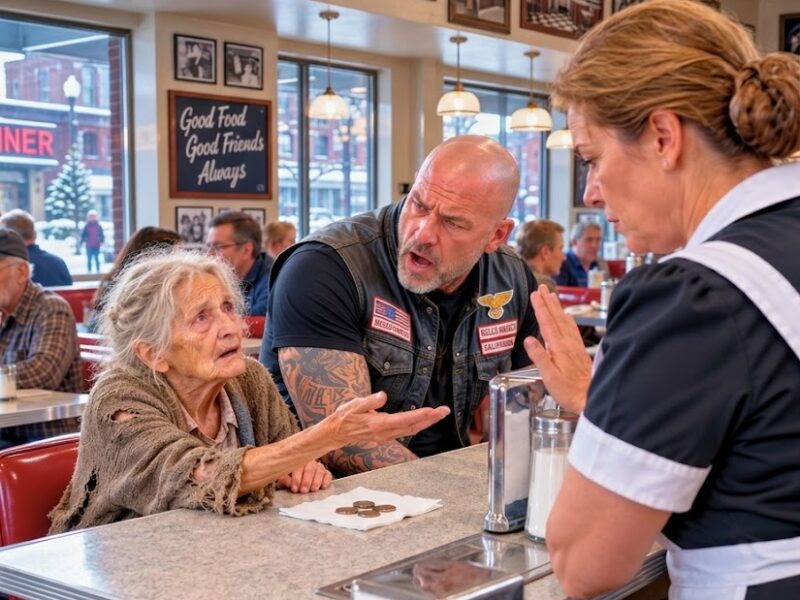
“Please, just one bowl…” the old lady begged. The waitress hesitated—until the Hells Angels boss heard her.
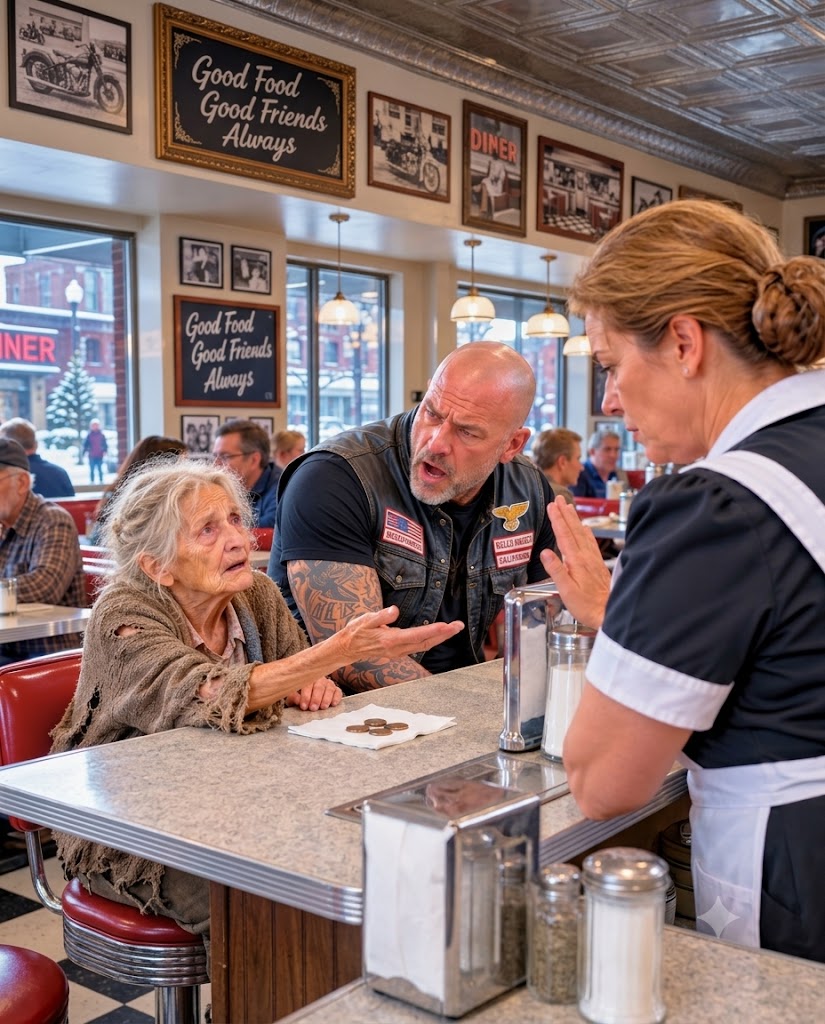
The coins hit the counter like a small, sad hail, scattering across the worn Formica. A nickel, its face worn smooth, rolled off the edge and spun in a slow, dizzying circle on the linoleum floor. Thin, trembling fingers, blue with cold, chased after it. “Please,” the old woman whispered, her voice thin as the winter air outside. “Just one bowl.”
A man in a grease-stained apron, a man who had been manager for exactly three weeks, leaned over the counter. His voice was loud enough for the whole room to hear, a performance for the truckers in their booths and the couple by the window. He told her to take her dog and get out. He said paying customers didn’t want to smell her.
The young waitress behind the counter, a girl named Die, went still. Her hand, which had been reaching for the soup ladle, froze in mid-air. Nobody moved. Nobody said a word. The woman’s name was Edith Caldwell, and she had a son nobody in that diner had ever met. What that son did when he walked through the door twenty minutes later would leave grown men staring at the floor and cost one man everything he had worked for.
Stay with me on this one.
To understand that morning, you have to understand the Blue Spruce Cafe. It sat on the edge of Cheyenne, Wyoming, right where the town gave up and the plains took over. A truck stop on one side, a railroad on the other. It was the kind of place where the coffee was burnt by nine and nobody complained, because the coffee had always been burnt and always would be. It was January. The thermometer out back read nine degrees before you figured in the wind, and the wind in Wyoming is never something you can figure in.
Edith Caldwell came to the Blue Spruce every Sunday. Had for eleven years. She was seventy-six, widowed since the spring. Her husband’s heart had quit on him out in the yard, and she drove an old Ford pickup older than most of the men who worked the counter. On Sundays, she’d park near the window and leave the engine running a minute, so the cab would hold a little heat. Then she’d come inside, sit at the end stool, and order one bowl of soup. Always one vegetable if they had it. Chicken if they didn’t.
Here’s the thing about that one bowl. She never ate all of it herself. She’d take half, maybe less, and she’d ask for a paper cup on the side. Into that cup went the rest, careful not to spill a drop. Because out in the truck, curled up on a folded horse blanket, there was an old beagle named Biscuit, fourteen years old, gray around the muzzle, mostly deaf, blind in one eye. Biscuit had belonged to her husband. When the man died, the dog was all she had left of him that still breathed, and she wasn’t about to let it go hungry. So, the soup got shared. Half for her, half for the dog. Every Sunday, rain or shine or nine degrees.
The regulars knew her. The old cook, a big quiet fellow named Sam Havson, who also owned the place, knew her. Sam would slide that bowl across the counter and pretend not to notice when she counted out her coins. Sometimes the soup came out a little fuller than a dollar should buy. Sometimes there was a biscuit on the plate she hadn’t ordered. Nobody said anything about it. That’s how it worked. That’s how small towns are supposed to work.
But Sam wasn’t in that Sunday. His back had gone out on him Thursday, and he’d stayed home with a heating pad and a bottle of aspirin. In his place, he left the new man. Carl Mercer, thirty-eight, loud, with a mustache he was too proud of, and exactly three weeks on the job as shift manager. Carl had come up from Denver with a lot of opinions about how a diner ought to be run. Efficiency, image, clientele. He used words like that. He’d been telling Sam for a week that the place attracted the wrong kind of people and that to compete with the new chain going up by the highway, they needed to class things up.
Behind the counter that morning was Die. Nineteen years old, four days into the job. Her mama was sick and her daddy was gone, and that waitress apron was the only thing standing between Die and real trouble. She was a good girl, quick with the coffee pot, careful with the plates, and scared to death of doing anything wrong. She didn’t know Edith. She didn’t know the Sunday soup. She knew only that the man signing her time card was watching her like a hawk, and she needed the hours.
So when Edith came in that morning, shuffling, her coat too thin for the weather and her coin purse already open in her hand, Die did what any new girl would do. She looked to the boss. Edith sat down at the end stool. She set her purse on the counter and she smiled at Die the way you’d smile at a granddaughter. And she said, “Just one bowl of soup today, honey. And could I trouble you for a paper cup on the side?”
Die reached for the ladle. That was it. That was all she did. She reached for the ladle. And that’s when Carl Mercer came out of the back. He’d seen Edith through the kitchen pass. Seen the thin coat, the shaking hands, the little pile of coins. She was already counting out one at a time, pennies, nickels, a couple of dimes. And in his head, the man did a quick, ugly piece of math. This was exactly the kind of customer he’d been complaining about. This was the image problem walking through his door.
“Hold on,” Carl said. “Hold on, hold on.” He came around the counter, wiping his hands on his apron, and planted himself between Die and the old woman. “What’s the hold up here?”
“I was just going to get her soup,” Die said.
Carl looked at the coins. He picked one up, a penny, and turned it over like it was something he’d found on the bottom of his shoe. “Soup’s a dollar ten,” he said, “with tax.”
Edith nodded. “I know. I have it. I’m sorry. My fingers don’t work so well in the cold.” And she kept counting, slower now, because she could feel the whole room turning to look.
That’s where it started. And believe me, it got worse fast. Carl didn’t wait for her to finish. He raised his voice the way a man does when he wants an audience, when he’s performing for the truckers in the booths and the couple by the window. He said the Blue Spruce wasn’t a soup kitchen. He said if folks wanted a handout, they could go down to the church. He said he was trying to run a respectable place and he couldn’t have people coming in off the street, counting out pennies while paying customers waited.
Edith’s hand stopped moving. “I’m not asking for a handout,” she said quietly. “I’m paying. I always pay.”
“Yeah,” Carl said. “And what’s the cup for? You taking food out of here? For what?”
And here’s the part that made the whole room go quiet. Edith, this proud old woman who had never asked anyone for anything in her life, looked down at the counter and in a small voice, she said, “It’s for my dog. He’s out in the truck. He’s old. I just share my soup with him. That’s all. It’s cold out and I don’t like him to go without.”
Now, a decent man hears that and his heart cracks a little. A decent man says, “Ma’am, let me get you both something warm,” and he means it. Carl laughed. He laughed out loud, right in her face. And he turned to the room like he was sharing the best joke he’d heard all week.
“She’s buying soup for a dog,” he said. “You hear that? We got a lady here feeding our soup to a dog in the parking lot.” He shook his head. “No. No, we’re not doing that. I’m sorry. You need to take your change and you need to go right now.” He swept his hand across the counter. The coins went everywhere. They skittered across the Formica, bounced off the napkin holder, rained down onto the floor. A nickel rolled off the edge and spun in a slow circle before it fell flat.
Die gasped. She actually put her hand over her mouth. But she didn’t move and she didn’t speak, because Carl Mercer signed her time card, and she was nineteen and she was scared, and sometimes being scared freezes a person right in place. She would hate herself for that silence for the rest of the day. And that night, lying awake. She just stood there, frozen, one hand on the ladle and one hand on her mouth, while an old woman got down on her knees on a cold diner floor to pick up her own pennies.
Edith didn’t cry. That’s the thing that got to everybody later. She didn’t cry and she didn’t argue and she didn’t curse the man. She got down slow, her knees popping, and gathered what coins she could reach. She left the ones under the stool. She couldn’t bend that far. She stood back up, holding her little fist full of change, and she looked at Carl Mercer and she said, “There’s no call to be cruel. I never did anything to you.”
Carl crossed his arms. “Doors that way.”
So she went. She buttoned her thin coat up to the neck and walked out into nine degrees and a wind that cut straight through. And the bell over the door jingled behind her, cheerful as anything, like nothing had happened at all. Through the window, they all watched her climb into that old Ford. They watched her sit a minute. They couldn’t see the dog, but they could see her lean toward the passenger seat, toward the horse blanket, and they could see her shoulders. And then she just sat, both hands on the wheel, the exhaust from the tailpipe curling up white into the cold, not going anywhere.
Because here’s the thing nobody in that diner knew. She wasn’t leaving. It was Sunday. And on Sundays, Edith Caldwell waited.
Carl Mercer brushed his hands together like a man who’d just taken out the trash. “All right,” he announced to the room. “Sorry about that, folks. Who needs a warm up on that coffee?” And just like that, the Blue Spruce went back to normal. The truckers went back to their eggs. The couple by the window went back to their quiet argument. The radio in the kitchen started up again with some country station playing low. Die bent down quiet and picked up the two coins from under the stool, a dime and a penny, and slipped them into her apron pocket without a word. She didn’t know why she did it, except that it felt wrong to leave them there.
Carl poured himself a cup of coffee and leaned against the back counter, satisfied, telling one of the truckers how in Denver they’d never have put up with that kind of thing. How Sam was too soft and that was his whole problem. The morning settled. The clock on the wall ticked toward nine. It was over. As far as every man and woman in that diner was concerned, it was a sad little thing that had happened. And now it was done, and the soup was still hot, and the day would roll on the way days do.
Then the door opened.
It wasn’t the little jingle this time. The door opened hard, caught by the wind, and banged against the stop. A gust of freezing air rolled across the floor and lifted the napkins off the tables, and in walked four men. You heard them before you saw them. Boots on the linoleum, the creak of leather. They came in single file and filled the doorway one after another. And the cold came in with them and didn’t leave even after the door swung shut. They wore denim and leather, worn and road-stained. And on the back of each vest was a patch anyone in Wyoming would have recognized in a heartbeat. Hells Angels.
And under the rockers, the three men in back wore a smaller patch, but the man in front, the big one, his vest said just one word across the bottom. President. He was built like something you’d use to hold up a bridge. Broad through the shoulders, gray coming into a dark beard, hands like a pair of catcher’s mitts. The others called him Ray. Around the county, they called him Ironwood Ray Caldwell. And the story was he’d earned that name taking a tire iron across the back and standing right back up. He didn’t look like a man who hurried. He had the stillness of somebody who had never in his adult life had to raise his voice to be obeyed.
Ray took two steps inside and then he stopped, because something was wrong and he felt it before he knew what it was. See, every single Sunday for eleven years, Ray Caldwell rode out to the Blue Spruce to have breakfast with his mother. That was the arrangement. She came early, had her soup, and around nine, her boy showed up with his brothers, and they’d all crowd into the big corner booth, and she’d fuss over them and call them by their full Christian names and make them wipe their boots. Eleven years. He hadn’t missed but a handful. And when he did, he called the diner ahead so Sam could tell her.
This was his mother. The woman who raised him after his daddy drank himself sideways. Who worked two jobs and never once let him see her cry. Who still, at seventy-six, worried that he didn’t eat enough. And she wasn’t at her stool. Her coffee cup wasn’t out. Sam wasn’t at the grill. There was a new girl behind the counter with eyes like a cornered rabbit and a man in a manager’s apron Ray had never seen before. And down on the floor, half under the end stool, catching the light, was a single nickel nobody had bothered to pick up.
Ray looked at that nickel for a long moment. Then he looked at Die. “Where’s my mother?” he said. It wasn’t loud. That’s what Die would tell people afterward. He didn’t yell. His voice came out low and even and filled the whole room anyway. The way thunder fills a valley before you ever see the lightning. “Where’s my mother?”
And the whole diner, which had gone back to normal just a few minutes before, went dead quiet all over again. The trucker set down his fork. The couple by the window stopped arguing. The country station played on, small and far away. If you’re still with me, and I think you are, do me a favor and hit that subscribe button. Because what Ray Caldwell did next is the whole reason I wanted to tell you this one. He didn’t throw a punch. He never threw a punch. And it was worse than any punch Carl Mercer could have imagined.
Die opened her mouth. Nothing came out. Her hands were shaking now, the ladle rattling against the soup well. And Carl, God help him, didn’t understand yet what had just walked into his diner. He pushed off the back counter and came forward with that same loud, in-charge voice he’d used on Edith. “Can I help you fellas with something? We don’t want any trouble in here. This is a family place.”
Ray turned his head and looked at Carl the way a man looks at a thing he’s trying to decide is worth his time. “I asked the girl a question,” he said. And Die, nineteen years old and four days on the job, found her voice. It came out cracked and fast, and once it started, it all came pouring out of her like water through a broken dam. She told him. She told him there was an old woman came in for soup, for one bowl to share with her dog, and that the manager, him, Carl, yelled at her and called her names in front of everybody and swept her coins off the counter and made her get down on the floor to pick them up and then threw her out into the cold.
And Die said, her voice breaking, “And I didn’t do anything. I’m so sorry. I just stood there. I didn’t do anything.”
The silence after that had a weight to it. Ray Caldwell closed his eyes for a second. Just a second. When he opened them, he didn’t look at Carl. He looked out the window at the old Ford sitting in the lot with the exhaust curling up white, at the small shape of his mother behind the wheel, waiting on her boy the way she’d waited eleven years of Sundays. And something moved across his face that was harder to watch than any anger. It was hurt. The big man was hurt.
Then he turned to the three riders behind him. “Go bring her in,” he said, quiet. “And the dog. Bring the blanket, too, so he’s warm.” Two of them went, the bell jingling, the cold rolling in and out. Now Carl finally started to understand. Maybe it was the word president on the vest. Maybe it was the way the whole room had turned against him without a single person saying a word. Maybe it was just the animal part of a man’s brain that knows when it has made a terrible mistake. His face went from red to something gray.
“Look,” he said. “Hey, I didn’t know. I didn’t know she was anybody’s mother. How was I supposed to know?”
Ray walked up to the counter. He didn’t lean over it the way Carl had leaned over Edith. He stood there straight, and he was so much bigger than Carl that the manager had to tip his head back to meet his eyes. “That’s the thing,” Ray said. “You didn’t know whose mother she was. So you figured she wasn’t anybody’s. You figured she was nobody.” He let that sit. “An old woman comes in from the cold with a dollar in change, trying to feed a dog that’s older than you’ve had this job. And you figured, well, this one’s safe. This one can’t do anything to me. Nobody’s going to make me pay for this one.” He nodded slowly. “That’s who you are. I know who you are now. Took me about thirty seconds.”
Carl started to say something. Ray lifted one hand, just a few inches off the counter, and Carl stopped. The door opened. The two riders came back in, and between them walked Edith, small and confused, clutching the horse blanket to her chest. And bundled up inside that blanket, poking his gray muzzle out into the warm, was Biscuit. The old beagle sniffed the air and let out one creaky, happy little bark, the way dogs do when they smell soup.
And Edith saw her son standing at the counter, and her whole face changed. “Raymond,” she said. “What are you doing up there? Come sit down. You’ll catch cold standing by the door.”
“In a minute, mama,” Ray said, and his voice had gone soft as a Sunday. “You go on and sit in the booth. Get Biscuit settled. I’ll be right over.” They walked her to the big corner booth, and one of the riders, a huge bearded man with a teddy bear’s gentleness, folded the blanket into a nest on the bench so the dog could curl up warm. Edith sat. She looked around at the quiet room, at all the faces pointed her way, and she still didn’t quite understand what was happening. She never would fully understand it. That was the kind of woman she was.
Ray turned back to Carl. “Now,” he said, “you’re going to listen and you’re not going to talk. Can you do that? Nod if you can do that.” Carl nodded. “Good.” Ray reached into his vest and took out a worn leather wallet. And from the wallet he counted out bills onto the counter, slow and deliberate, the way his mother had counted out her coins a half hour before. He laid them down one at a time where everyone could see.
“My mother’s soup,” he said, laying down a bill. “The dog soup, in a bowl, not a paper cup, a real bowl.” Another bill. “And breakfast for every single person sitting in this room right now, on me, because they had to watch what they watched this morning and nobody should start a Sunday that way.” Bill after bill after bill. “And a pot of fresh coffee, because this coffee is burnt. And my mother’s been drinking your burnt coffee for eleven years and never said a word, because she’s got better manners than everybody in this county put together.”
By now, Die was crying, quiet, trying to hide it, swiping at her face with the back of her wrist. Now, here’s the part you’re going to want to pay attention to. Ray said to Carl, “This is Sam Havson’s place. Sam and me go back twenty years. When my chapter needed a spot to run the toy drive every December, the one that puts presents under the tree for about three hundred kids in this county who wouldn’t have any otherwise, where do you think we run it out of? Right here. Sam lets us use his lot, his back room, feeds my guys for free the whole week. So, the way I see it, this cafe doesn’t just belong to Sam. In a way, it belongs to a lot of people. And you spit on it this morning.”
He paused. “I’m going to call Sam right now from that phone on the wall, and I’m going to tell him exactly what you did. And then Sam’s going to make a decision about whether a man like you runs his counter. I think we both know what that decision’s going to be.”
Carl’s mouth opened and shut. “You don’t have to call him,” he said, and his voice had lost every bit of the swagger. “I’ll quit. I’ll just go right now.”
“No,” Ray said. “You’re not going to just go. Because if you just go, then this stays a story about a big biker who scared a manager out of a diner. And that’s not the story. That’s not what happened here this morning, and I won’t have it told that way.” He pointed at the corner booth, at the old woman settling her dog on a blanket. “That’s the story. A woman who never hurt a soul in seventy-six years got treated like garbage in front of a room full of people because she was poor and she was old and she loved something enough to share her last dollar with it. That’s the story. And before you walk out that door, you’re going to make it right, as far as a man like you can make anything right.”
The whole diner was holding its breath. Ray said, “You’re going to go in that kitchen and you’re going to make the best bowl of soup you’ve ever made in your life, in a real bowl, and you’re going to carry it out to that booth and set it down in front of my mother and look her in the eye and apologize. Not to me. To her. And then you’re going to fill a second bowl for that dog and set it on the floor like it’s a paying customer. And then when that’s done, you can take your coat and you can go, and you can spend the rest of your life being grateful that I’m a man who settles things with words.”
For a second, Carl just stood there. Everybody wondered if his pride would pick that moment, the worst possible moment, to make its last stand. But it didn’t. The pride had drained right out of him the second that door banged open. He turned and went into the kitchen, and the whole room listened to the clatter of the ladle and the pot. And a few minutes later, Carl Mercer came back out carrying two bowls of soup on a tray, and his hands were shaking worse than Edith’s ever had.
He walked to the corner booth. The riders shifted to let him through. He set the first bowl down in front of Edith, careful not to spill. Then he crouched and set the second bowl on the floor. Old Biscuit hauled himself up off the blanket and limped over and started to eat, tail going slow, and that creaky old tail wagging was about the only sound in the place. Carl stayed crouched down there a moment. Then he looked up at Edith, and whatever was going on inside that man, I can’t tell you, but his voice came out thick. “Ma’am,” he said, “I’m sorry. What I did was wrong. There’s no excuse for it. I’m sorry.”
Edith looked at him for a long moment. And this is the part I think about the most. She didn’t gloat. She didn’t make him feel the way he’d made her feel. She reached out one of those thin, shaking hands and patted him on the shoulder, light, the way you’d comfort somebody. And she said, “We all have bad mornings, young man. See that you have a better one tomorrow.” And then she picked up her spoon and started on her soup, because she was hungry and it was Sunday and her boy was here.
Carl Mercer stood up. He took off the manager’s apron and folded it and set it on the counter, and he walked out of the Blue Spruce Cafe into the cold. And as far as I know, he never worked in that town again. Not because anybody ran him off. Word just travels in a place like Cheyenne. Everybody knew, and nobody hires the man who threw an old woman’s pennies on the floor.
Ray went and sat down in the booth beside his mother. He kissed her on the top of her head. “Your coffee is cold, mama,” he said. “Let me get you a fresh cup.”
“Oh, it’s fine,” she said. “You don’t make a fuss.”
“I’m making a fuss,” he said. “Just this once.”
Now, the story could end there and it would be a good enough story. But I want to tell you what came after, because the after is where you really see what kind of people these were. When Sam Havson heard what had happened, he drove in that same afternoon, with his bad back and all, and the first thing he did was find Die. Poor Die had spent the whole day certain she’d be fired. She’d stood there and done nothing, after all. Instead, Sam sat her down and said, “I heard you picked up that nickel, the one under the stool. I heard you kept it safe in your apron and tried to give it back to Ray.” She nodded, crying again. And Sam said, “Nineteen years old, four days on the job, a boss twice your size telling you what to do. You were scared. That’s not a sin. The sin was his.”
And then he told her she wasn’t just keeping her job. He was making her the morning lead. More hours, more money, because he said, “You’ve got a good heart, and a good heart is the only thing I can’t teach back here.” Die kept that dime and that penny. Taped them to a little card and kept them in her purse for years. She told folks later it was to remind her that the next time somebody weak needed somebody to speak up, she’d better be the one to do it. And by every account, she was. She worked that counter for twenty-two years. They say she never once let a soul get turned away hungry on her watch, and that she always, always kept a bag of dog biscuits behind the register.
As for Edith, she kept coming every Sunday. Her stool was waiting, her coffee was hot, and there was never again any question about the paper cup. Sam had a special bowl for Biscuit, kept it on a shelf behind the counter, an old chipped enamel thing. And when the beagle finally passed that spring, warm and old and never once hungry, Sam put that bowl up on a high shelf and left it there. It’s probably still there. Some things you don’t take down.
And Ray Caldwell kept riding out every Sunday with his brothers, filling that corner booth, letting his mother fuss over him and call him Raymond and tell him to wipe his boots. He never told the story himself. Didn’t like to. If you brought it up, he’d just say a man ought to be able to walk into a room and know that the littlest person there is going to be treated like the biggest. That’s all respect is. It’s not fear. It’s that.
I think about the way that morning started. An old woman on her knees on a cold floor, picking up her own pennies, while a whole room of decent people sat on their hands. And I think about how it ended. That same woman in a warm booth, her dog fed, her son beside her, a man who’d wronged her walking out into the snow. Nobody got hit. Nobody got hurt. One bully just found out the hard way that the quietest person in the room is sometimes the one you should have been kindest to. And that real respect, the kind that lasts, you don’t get it by making yourself big. You get it by refusing to let anybody else be made small.
So the next time you see somebody counting out their last few coins, somebody the world has decided is nobody, do yourself a favor. Be the one who reaches for the ladle. You never know whose mother you’re looking at. And more than that, it shouldn’t matter whose mother she is. That was the whole point. That was always the whole point.









