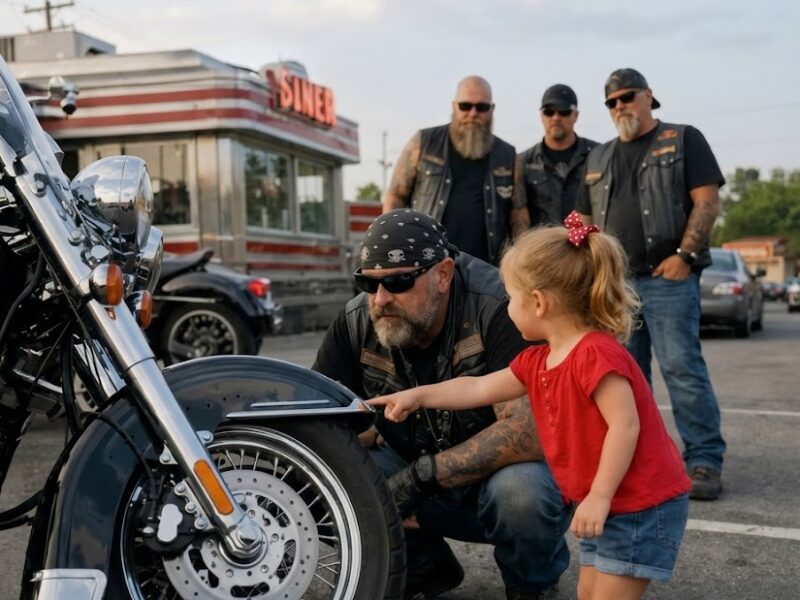
“Please Don’t Start Your Bikes!” Little Girl Warns a Group of Hells Angels—What They Discovered Left Everyone Speechless
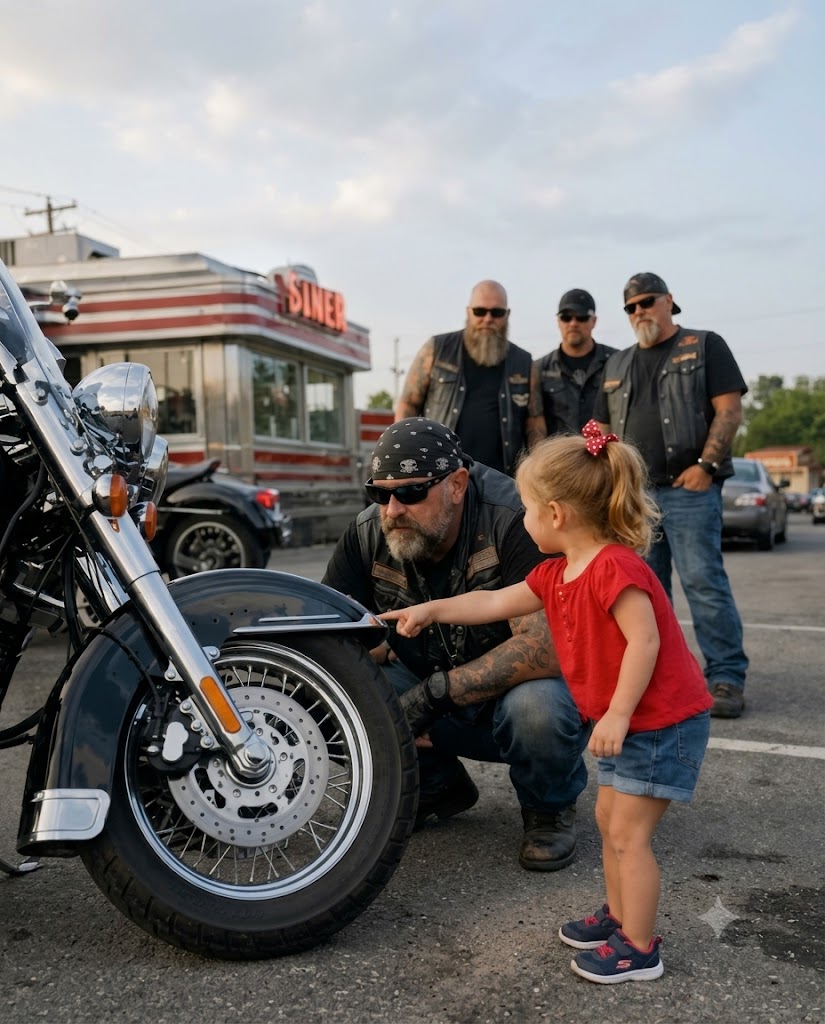
She was seven years old, four feet tall, wearing Velcro sneakers and a yellow T-shirt, and she walked straight toward thirty Hells Angels without breaking stride.
Her mother froze.
The whole town would have walked away, but Lily had seen something.
A man crouching beside a motorcycle, hands moving fast where they shouldn’t be.
She didn’t know what leather patches meant. She didn’t know what these men were supposed to be.
She only knew that someone had to say something, so she did.
What happened next didn’t just stop a crime.
It forced an entire town to face a truth it had been avoiding for thirty years.
The morning Clarkson held its breath.
The sky was the color of old pewter. Low clouds pressed down on the town like a hand on a shoulder.
The air carried the particular heaviness that July in Kentucky knows how to manufacture. Thick, damp, and still, as though the world itself was waiting for something to happen.
Along the stretch of Maple Creek Road that cut through the heart of downtown, shop owners had already begun propping their doors open, hoping to coax a breeze that wasn’t coming.
Mrs. Hutchins at the bakery had written “Peach Cobbler, Today Only” on her chalkboard in cheerful pink letters.
The hardware store had its garden hoses coiled on a folding table out front, priced at $12.99 apiece.
The gas station at the corner of Maple and Third had a hand-painted sign in the window. “Cold Drinks. Ice Cold.”
Sandra Carter walked with the practiced tension of a woman who had learned to be aware of everything at once.
Her left hand gripped the strap of her canvas grocery bag, fingers white against the worn fabric. Her right hand held her daughter’s, and she squeezed it a little too tight, though she didn’t realize it.
Sandra had grown up in Clarkson, and she loved it the way people love the place where their roots are buried.
With complicated loyalty. With quiet frustration. With a tenderness she rarely admitted out loud.
She knew which sidewalk squares were cracked, which neighbors would wave back and which would look straight through you, which streets were fine on a Wednesday and which you avoided after dark.
She knew where she stood in this town, and she knew where she was comfortable.
Standing on the sidewalk outside Renfro’s Hardware, she was not comfortable.
“Mama.” Lily tugged her hand.
“Stay close, baby.”
They had turned the corner from the parking lot behind the grocery store and walked directly into the outer edge of a situation Sandra hadn’t anticipated.
Thirty yards ahead sat the front lot of the old Clarkson Feed and Supply, shuttered for two years now, its parking lot repurposed by default as overflow space.
It was filled with motorcycles.
Not a few. Not a modest cluster. Dozens of them, row after row of chrome and steel and custom paint, arranged with a precision that surprised her.
Each bike was set at the same angle, handlebars gleaming even under the flat gray sky.
Men moved between them. Big men, broad-shouldered men, men whose leather vests caught the dim light and held it.
Sandra stopped walking.
Her first instinct was to cross the street. Her second instinct was to turn back the way they’d come.
Both instincts were honest, and she was honest enough with herself to know exactly where they came from.
Not from any specific experience. Not from anything that had actually happened to her.
They came from years of accumulated signals. From the way people talked about bikers in the same tone they used for bad weather.
From the images she’d absorbed without realizing she was absorbing them.
From the simple, uncomfortable fact that these men did not look like the men she was used to standing near on a Wednesday morning in Clarkson.
“Mama, look at the motorcycles.”
Lily’s voice was not afraid. It was the voice she used for Christmas lights and bakery windows and the fountain in the park on Saturday afternoons.
Pure, uncomplicated wonder.
“I see them,” Sandra said, keeping her voice even.
She made her decision. They would walk quickly on their side of the street, and they would not make eye contact.
It was the decision of a woman who prided herself on being reasonable, on not being the kind of person who made assumptions.
It was a decision that was itself a form of assumption, though she would not have said so.
Lily had other ideas.
The girl was seven years old and had not yet learned the social geometry that tells you how much space to put between yourself and certain kinds of strangers.
She had not learned to calculate danger from appearance. She had not learned to read a leather vest the way adults read it, as a warning sign, as a symbol of something to navigate around.
She saw motorcycles, and she was delighted. She saw large men with tattoos, and she was curious.
She was, in the most essential way, still unfiltered.
And so she was the one who saw it.
They were passing along the sidewalk, Sandra steering them at a brisk pace, when Lily looked between the parked cars toward the lot and stopped so abruptly that Sandra’s arm jerked straight.
“Mama, wait.”
“Lily, come on.”
“That man.”
Lily’s voice dropped. It changed. It lost the wonder and became something quieter and more serious, the tone she used when she was telling the truth about something important.
“That man is doing something to the motorcycle.”
Sandra looked toward the far edge of the lot, half hidden between two large bikes and the corrugated metal wall of the old feed building.
A man crouched beside one of the motorcycles.
He wasn’t a biker. Sandra could see that immediately.
He was thin where the bikers were broad, nervous where they were unhurried. He wore a gray T-shirt and a faded green cap pulled low.
His hands were moving beneath the gas tank of the bike with the rapid, furtive focus of someone who absolutely did not want to be seen.
“He’s messing with it,” Lily said simply.
Sandra’s grip on her daughter’s hand tightened.
The correct thing, the safe thing, the reasonable adult thing was to keep walking.
This was not her business. These were not her people.
Whatever was happening in that lot had nothing to do with Sandra Carter and her daughter on their way home from the grocery store on a Wednesday morning in July.
Lily looked up at her, seven years old, with her mother’s dark hair and eyes that were somehow greener than anyone else’s in the family, an unexplained inheritance from no one anyone could name.
She looked up at Sandra with an expression that was not a question.
It was a statement. A statement about what was right.
“We have to tell them, Mama.”
Sandra opened her mouth. Closed it.
The man in the green cap was still crouching by the bike. She could see the tension in his shoulders, the way he kept glancing toward the main group of bikers gathered fifty feet away.
“Lily—”
But her daughter had already taken a step toward the lot.
Lily Carter did not run. She walked.
That was the detail Sandra would remember later, when she tried to make sense of the morning.
Not that her seven-year-old daughter had approached a motorcycle club without hesitation, but that she had done it with a calm deliberateness that seemed to belong to someone three times her age.
No sprint. No drama. No moment of summoned courage.
Just a small girl in a yellow T-shirt and sneakers with Velcro straps, crossing a cracked asphalt lot toward thirty-some bikes like she was walking into her classroom.
“Lily.”
Sandra’s voice came out as a hiss. She moved after her daughter, grocery bag swinging, her heart making decisions her brain hadn’t caught up to yet.
The men closest to the lot’s entrance saw them first.
Two of them, both big, both bearded, both wearing the cuts, the leather vests with patches Sandra couldn’t read at that distance.
They straightened and exchanged a look that Sandra, in her current state of adrenaline, interpreted as threatening.
She would revise that interpretation later.
What it actually was, she would come to understand, was surprised.
Lily walked straight to the nearer of the two men and looked up at him.
He was enormous. Six-foot-two at least, with forearms like structural beams and a beard that had gone mostly gray at the edges.
His vest read “Hells Angels” across the back in an arc above a grinning skull, and below that, in a rocker patch, “Kentucky.”
His name, she would learn it soon, was Duke Mercer.
He had been the vice president of the Clarkson chapter for eleven years, and in those eleven years he had been approached by many people, in many parking lots, for many reasons.
He had never been approached by a seven-year-old girl.
“Excuse me,” Lily said.
Duke looked down at her. His expression did not soften exactly. It was more that it opened, like a window being cracked.
“Hey there.”
“There’s a man by your motorcycles.”
She pointed, precise and unhesitating, toward the far edge of the lot.
“He’s messing with one. I think he’s doing something bad to it.”
The silence that followed lasted perhaps two seconds.
Duke’s eyes moved from the girl to the direction she was pointing, then to Sandra, who had arrived at her daughter’s side and was standing very still, her grocery bag clutched in both hands now like a shield.
“Which bike?” Duke asked.
His voice was level.
“The black one with the silver thing on the side,” Lily said. “He was under the part where the gas goes in.”
Duke turned his head and said something low and brief to the man beside him, who immediately moved toward the interior of the lot.
Then Duke looked back down at Lily.
“How long ago?”
“Just now. Like a minute.”
Duke nodded. He looked at Sandra.
“You with her?”
“She’s my daughter,” Sandra managed.
“Okay.”
He looked back at Lily.
“You did good telling me that. You stay here.”
He walked.
Not ran. Walked, with the measured pace of a man who had learned that running communicates panic, and panic changes situations.
He moved toward the back of the lot along the line of bikes with his eyes forward, and two other men fell in beside him without a word being said, the way water flows to fill a space.
Sandra put her arm around Lily’s shoulders.
“You okay?” she asked.
“Mhm.”
Lily was watching the men move across the lot with the attentive calm of someone watching a nature documentary.
“Do you think they’ll catch him?”
Sandra did not answer, because at that moment she saw them catch him.
Or rather, she saw them emerge from between the bikes with Ray Dunbar walking between them.
He wasn’t being dragged. He was walking. But his body language made it clear that walking was the only option currently available to him.
His green cap was gone. His face was the color of old paste.
One of the bikers held his right wrist, and in that hand was a small plastic bottle. The other biker was holding something Sandra couldn’t identify.
A piece of metal. Small. Curved.
They brought him to the center of the lot.
The gathering of men shifted and tightened, not aggressively, but with the natural coherence of a group reorganizing around a center of gravity.
Sandra watched a man detach from the far edge of the group and walk toward the center with an authority that was different from the others.
Quieter somehow. But more concentrated.
He was the tallest person in the lot. His beard was more gray than dark, his forearms cross-hatched with old tattoos that had blurred at the edges with age.
He moved like a man who had stopped needing to prove anything to anyone a long time ago.
James Holloway, president of the Clarkson chapter, had been riding for thirty years and had seen most of what life between small American towns and open highways had to offer.
He had been betrayed by people he trusted. He had watched men he respected make decisions they couldn’t take back.
He had also, over thirty years, learned to read a situation quickly and accurately.
He looked at Ray Dunbar. He looked at the bottle and the bracket.
He said nothing for a long moment.
Then he looked across the lot, past the rows of bikes, to where a woman and a small girl were standing at the edge of the asphalt.
“Who are they?” he asked Duke quietly.
“The girl’s the one who flagged us,” Duke said. “She saw him. Walked right up and told me.”
James looked at the girl for a moment.
She was looking back at him with green eyes that were entirely unafraid.
He turned back to Ray.
“What were you going to do?”
Ray said nothing.
“The fuel line bracket,” Duke said. “He’d pulled it loose. And that bottle—”
“I know what he was going to do,” James said.
He looked at Ray for a long, still moment. Then he looked at his men.
Then he looked again at the little girl across the lot.
Something shifted in his face that none of the men could have named, but all of them could see.
James Holloway had been called many things in his forty-eight years, and he had answered to most of them without complaint.
His father had called him reckless. His ex-wife had called him unreachable.
The Kentucky State Police had called him a person of interest twice, in investigations that never resulted in charges because there was never anything to charge him with.
The town of Clarkson had called him, collectively and without much discussion, someone to avoid.
A category established not by any specific incident, but by the accumulation of his appearance, his reputation, and the sound of his motorcycle on a quiet street.
He had stopped arguing with any of it a long time ago.
You could not argue with a category. You could only be what you actually were, and let the category be wrong.
What he actually was, in the practical and specific sense, was a man who owned a small motorcycle repair shop on the county road outside of Clarkson.
He employed three people. He paid his taxes with a precision that would have surprised his critics.
He had been wiring $400 to his sister in Bowling Green every month since her husband left.
He cooked his own meals. He kept his word.
He had a code that was not complicated, but was absolute.
You did not touch another man’s bike. You did not put innocent people at risk. You did not lie to someone’s face.
Beyond that, he did not ask much of the world, and the world largely returned the favor by staying out of his way.
Ray Dunbar was not a stranger to him.
That was the part that sat in James’s chest like a stone as he stood in the center of the lot with thirty of his people and one frightened man between them.
Ray had grown up two miles outside of Clarkson, same as James.
They had gone to the same middle school. They had been part of the same awkward cohort of boys, too old for kids’ games and too young to know what came next.
They hadn’t been friends. Ray had run with a different crowd, the kind that spent its energy figuring out who to blame for things.
But James knew him. Knew his family. Knew his history.
He knew, therefore, that this was not random.
“Duke,” he said quietly.
Duke Mercer stepped close. “Yeah.”
“The bike he tampered with. Who does it belong to?”
Duke’s jaw tightened.
“Mine.”
James absorbed that.
He looked at Ray, who had found a spot on the asphalt six inches in front of his own feet and was committed to it.
“Ray.” He kept his voice level. “Look at me.”
Ray looked up. His eyes were moving too fast, a man calculating exits that didn’t exist.
“You know what you almost did?”
Ray said nothing.
“Duke has a daughter,” James said. “She’s ten. He rides with her on the back when he goes to his mother’s house on Sundays. You know that?”
Something moved across Ray’s face.
It was not remorse, exactly. It was the expression of a man who had told himself a story to get this far and was now being shown the parts of the story he’d edited out.
“I wasn’t—” Ray started.
“You were,” James said.
The men around them were quiet.
That was one of the things James had always understood about leadership. When you spoke at the right volume, in the right way, you didn’t need noise to back you up.
The quiet of thirty men listening was louder than anything Ray Dunbar could say.
James turned and walked toward the edge of the lot.
The two men escorting Ray brought him along without being told. Duke followed, and the rest of the group resettled, waiting, watching, but not interfering.
This was how things worked when James Holloway was handling something.
You held your position. You trusted the process.
At the edge of the lot, Sandra Carter was still standing with her arm around her daughter.
She looked, James thought, like a woman who had expected a different kind of scene than the one she was witnessing.
He couldn’t blame her. He knew what people expected from men who looked like him.
He stopped six feet away and looked down at the girl.
“You’re Lily?”
Lily blinked. “How do you know my name?”
“Duke told me.”
He crouched down, which brought him to eye level with her.
Still large. Still weathered. But suddenly something different in his posture.
Not a wall. A person.
“What you did was brave. You understand that?”
Lily considered the word carefully, the way children consider things they’re not sure they agree with.
“I just told you,” she said. “Somebody had to.”
“Somebody had to,” James repeated.
He stood back up and looked at Sandra.
She was watching him with an expression he recognized. Not hostility, not warmth, but the specific alertness of a person revising something in real time.
He didn’t ask her to revise it. He wasn’t in the business of convincing anyone of anything.
“Is she yours?”
“Yes,” Sandra said.
“You raised her right. It takes courage to walk up to strangers. A lot of adults wouldn’t have done it.”
Sandra glanced down at her daughter.
Something crossed her face that was quieter and more complicated than any expression she’d worn so far.
“She made the decision,” she said. “I just followed.”
James nodded once.
Behind him, Ray Dunbar was being held by two men who were waiting for instruction.
The plastic bottle and the bracket were in Duke’s hands. The situation had not resolved itself yet.
There were still decisions to make, and James had not made them.
But he needed a moment, and he allowed himself one.
Thirty years of riding. Thirty years of being the thing people cross the street to avoid.
Thirty years of knowing that the code you lived by was invisible to people who judged you by the patch on your back.
And a seven-year-old girl in Velcro sneakers had walked across a parking lot to tell him the truth when she didn’t have to.
He turned back toward the center of the lot, where the real weight of the morning was still waiting to be dealt with.
Duke Mercer set the plastic bottle and the metal bracket on the hood of the only car in the lot, a dusty Ford F-150 that belonged to one of the newer members.
Then he took two steps back, crossed his arms, and waited.
He did not need to say what he was thinking. The men around him knew.
There are moments in a group with a history when the accumulated weight of shared understanding makes words unnecessary, and this was one of them.
Thirty men, some of whom had known each other for decades, some of whom had bled for each other in circumstances they didn’t discuss with outsiders.
All of them standing in a cracked asphalt lot in Clarkson, Kentucky, waiting to see what James Holloway was going to do.
What Ray Dunbar had nearly done was clear.
The fuel line bracket on Duke’s bike had been deliberately loosened. And the bottle, a small plastic container with no label and a sharpened tip, held a substance that, introduced into the fuel system, would have caused the engine to fail.
Not immediately. Not in the lot.
On the road, at speed, most likely on the highway, where a sudden engine seizure would have thrown Duke Mercer into the lane of oncoming traffic at sixty miles an hour.
Duke’s daughter rode on the back of that bike on Sundays.
James stood in front of Ray Dunbar and said nothing for a long time.
Ray’s hands were free. He wasn’t being restrained, technically, but the men on either side of him communicated restraint clearly enough.
“Why?” James finally said.
One word. Not quite a question.
Ray’s jaw worked. He was not a physically imposing man, and in this particular arrangement of space and people he looked diminished even beyond his natural size, a figure cut down to its essential smallness.
“You know why,” he said.
“Tell me anyway.”
Ray looked at the ground.
“The shop.”
His voice was flat, the voice of a man who had spent so much energy on one thing that he’d burned through all his feelings about it.
“You underbid me on the Renfro contract three years ago. I had that contract. I’d had it for four years, and you came in and—”
“I bid what the work was worth,” James said.
“I lost the contract.” Ray’s voice cracked at the edges. “Forty-eight thousand dollars a year, James. I lost the contract, and then I lost the shop. The whole shop. Do you have any idea—”
He stopped. Started again.
“Everything I had was in that shop.”
The lot was very quiet. Even the distant sound of Maple Creek Road seemed to have receded.
James looked at Ray with an expression that was not warm and not cold.
It was the expression of a man doing careful, honest accounting.
“You lost your shop because you were charging twice what the work was worth,” he said. “You know that. I know that. The Renfros knew that. What I did was bid a fair price. That’s all.”
“That’s all,” Ray repeated.
The words came out bitter and hollow.
“Yes.” James didn’t soften it. “That’s all. And what you almost did.”
He paused.
“Duke has a little girl.”
Ray closed his eyes.
“Ten years old,” James continued. “Her name is Caitlyn. She’s got her father’s stubbornness and her mother’s common sense. And she doesn’t know a thing about business contracts or what you lost or why you’re standing in this parking lot right now.”
“She just knows that Sundays are for riding with her dad.”
The silence that followed was different from the silences before it.
It was heavier. And more honest.
Duke Mercer, who had been standing apart from the group with his arms still crossed, made a sound that was not quite a word.
He turned away and walked six steps toward his bike and stood with his back to everyone.
James watched him, then turned back to Ray.
“Here’s what I’m going to do,” he said. “I’m not going to do what you think I’m going to do.”
“Partly because it’s not what we do. Partly because that girl over there is watching, and I’m not going to let her see that.”
He glanced toward the edge of the lot, where Lily and Sandra were still standing.
Lily was watching with that same unblinking attention. Sandra’s arm was still around her.
“We’re going to call the sheriff,” James said. “You’re going to stay right where you are until he comes. You’re going to tell him exactly what you came here to do and why.”
“And after that, whatever the law does with you is the law’s business. Not mine.”
Ray blinked.
He had expected many things. This was not among them.
“That’s it? You’re just—”
Ray seemed to be struggling to locate the frame that would make this comprehensible.
“I almost killed—”
“I know what you almost did,” James said. “I also know that you didn’t. And I know that the reason you didn’t is standing over there in a yellow shirt.”
He said it simply, without drama.
“A seven-year-old girl decided to tell the truth when she could have walked past and it would have been none of her business. That’s what stopped this. Not me. Not Duke. Not any of us.”
“Her.”
He looked at Ray directly.
“Live with that.”
He turned and walked toward the edge of the lot.
Duke was already on his phone. The sheriff’s office was eleven minutes away.
Everyone in Clarkson knew the response times, the way you know the schedule of a bus you’ve always lived near.
James walked toward Lily and Sandra, and the men in the lot rearranged themselves quietly around the business of waiting.
He stopped in front of the girl.
“What happens now?” Lily asked.
“Now we wait for the police.”
Lily thought about this.
“Is the man going to be okay?”
James considered the question with the seriousness it deserved.
“He’s going to have to face what he did,” he said. “That’s not the same as okay. But it’s honest.”
Lily seemed to accept that.
She looked past James to the rows of motorcycles gleaming in the flat gray light.
“Your bikes are really nice,” she said.
James Holloway, for the first time all morning, smiled.
It changed his face completely. It took twenty years off, cracked the weathered surface, and showed something that had always been underneath.
Something that the town of Clarkson, in thirty years, had never thought to look for.
“Yeah,” he said. “They are.”
While they waited, something happened that no one in the lot would have predicted.
The men began to drift toward the edges of the asphalt, giving Sandra and Lily room, and one of them, a lanky man with a salt-and-pepper ponytail whom the others called Wrench, came over carrying a paper cup.
He held it out to Sandra, a little awkwardly, like a man handing over something he wasn’t sure he was allowed to give.
“Water,” he said. “From the cooler. It’s cold.”
Sandra stared at the cup for a second longer than she meant to.
Then she took it. “Thank you.”
“Your hands are shaking, ma’am,” Wrench said gently. “No shame in that.”
She looked down. He was right.
She had not noticed. She drank the water, and it was the best water she had ever tasted.
Lily, meanwhile, had wandered to the nearest bike and was standing a respectful three feet away, hands clasped behind her back like a child in a museum.
“You can look,” said a voice behind her. “Just don’t touch the pipes. They get hot even when they’re off.”
She turned to find a stocky woman in a vest of her own, gray braid down her back, reading glasses pushed up into her hair.
“I’m Dot,” the woman said. “This one’s mine.”
“It’s purple,” Lily said.
“It’s plum,” Dot corrected. “There’s a difference.”
“What’s the difference?”
“Purple is what you call it when you don’t care. Plum is what you call it when you do.”
Lily nodded with the solemnity of a girl receiving a great secret.
Sandra watched this exchange from five feet away, the paper cup in her hand, and felt something in her chest rearrange itself.
These were not the people she had crossed the street to avoid.
Or they were. And the street had been the problem.
The sheriff’s car arrived at 11:47, faster than anyone had predicted.
Deputy Craig Beaumont, twenty-nine years old, three years on the county roads, a man who would later describe this call as the most surprising of his career, pulled into the lot.
He found thirty bikers arranged in a wide and orderly semicircle around a single man sitting on the asphalt with his knees up and his hands visible, waiting.
James Holloway walked to meet the deputy before he had finished climbing out of the cruiser.
“We called it in,” James said. “Ray Dunbar tampered with one of our bikes. We’ve got the tool he used and the substance. We didn’t touch any of it. It’s on the hood of that truck.”
Beaumont looked at the truck. At the lot. At the bikers. At Ray Dunbar on the ground.
He processed the gap between what he had expected and what he was seeing.
“Anybody hurt?”
“No,” James said. “We caught it before he got away. Because of her.”
He turned and indicated Lily Carter, who stood with her mother at the edge of the lot and gave Deputy Beaumont a small, factual wave.
The deputy had been raised in Clarkson.
He had grown up with the town’s understanding of the Hells Angels chapter: the careful distance, the unspoken rules of coexistence, the assumption that certain situations were best observed from across the street.
He had acted on that understanding professionally, not out of malice, but out of the accumulated common sense of a small town.
He looked at James Holloway and did the arithmetic the morning had laid out for him.
Then he took out his notepad.
Ray Dunbar was charged with criminal mischief and reckless endangerment, charges the district attorney would later assess as likely to stick, given three witnesses and the physical evidence.
He was taken from the lot without incident, and the thing he had almost done left with him, contained now in the space of the law.
Before the cruiser pulled out, Ray turned his head toward the window.
His eyes found the small figure in the yellow shirt.
He looked at her for three full seconds, the way a man looks at a mirror he didn’t know he was standing in front of.
Then the cruiser turned onto Maple Creek Road, and he was gone.
The rest of the morning rearranged itself.
Duke Mercer walked back to his bike and crouched beside the fuel line bracket with the focused attention of a man checking every inch.
A mechanic named Marcus, one of the three employees at James’s shop, knelt beside him with a flashlight and a set of wrenches, and together they went over the machine like surgeons.
“Bracket’s bent,” Marcus said. “Line’s nicked, right here. See that? Another ten miles of vibration and it’d have gone clean through.”
“How much would that have cost me?” Duke asked, and then shook his head. “No. Wrong question.”
Marcus looked at him. “What’s the right question?”
“How many Sundays.”
Neither of them said anything after that.
When Duke stood up, he stood for a moment with his hand on the seat, not moving, looking at the metal and chrome he had built up over years.
The machine that had carried him across the country and back.
The machine that had been thirty seconds from betraying him on an ordinary Wednesday.
Then he walked to where Lily was standing.
He was enormous. She barely came up to his belt buckle.
He crouched down the same way James had, bringing himself to her level.
“Hey,” he said.
“Hi,” Lily said.
“That’s my bike you spotted him at. The black one.”
“I know. I pointed to it.”
“You did.”
He reached up and pulled something from the zipper pocket of his vest.
It was a small pin. A motorcycle, chrome, about the size of a thumb, the kind of thing sold at bike shows and rest stops along the interstate.
He held it out to her.
“I’ve had this for about fifteen years,” he said. “I want you to have it.”
Lily looked at it, then looked at him.
“Why?”
Duke seemed to need a moment to find the answer. Not because he didn’t know it, but because the honest version was larger than a parking lot conversation.
“Because you didn’t have to do anything,” he finally said. “You could have kept walking. Nobody would have blamed you. But you didn’t.”
He paused.
“That matters. That matters more than most things.”
Lily took the pin carefully. She turned it over in her palm, looking at it from every angle.
“Thank you,” she said.
She said it the way her mother had always taught her, looking at the person, meaning it.
Duke stood up. He looked at Sandra.
She had been watching the whole exchange with an expression that had traveled a long distance in the course of one morning. From tension to alertness to something more open. More honest.
“You’ve got a remarkable kid,” Duke said.
“I know,” Sandra said.
She hesitated.
“And I’m sorry. For what we assumed this morning, when we first saw the lot.”
Duke tilted his head slightly.
“What did you assume?”
Sandra was quiet for a moment.
She was a woman who had always prided herself on her honesty, and in this particular moment, honesty cost something.
“That you were people we needed to walk away from,” she said.
Duke nodded slowly.
“Most people do,” he said. And then, without bitterness, without recrimination: “We’re used to it.”
“That doesn’t make it right,” Sandra said.
He looked at her steadily.
“No,” he agreed. “It doesn’t.”
They stood there for a moment, two people from the same small town who had lived parallel lives inside its borders and never found a reason to see each other clearly.
The moment was not comfortable. It wasn’t meant to be.
It was the particular discomfort of accuracy.
James Holloway joined them.
He had finished with Deputy Beaumont and had the case number written on the inside of his wrist in ink, the way he always noted things he needed to remember.
He looked at Lily, who was still examining the pin.
“Going to keep that?”
“Yes,” Lily said. “I’m going to put it on my backpack.”
“Good place for it.”
He looked at Sandra.
“Will you be okay getting home?”
“We’re fine,” Sandra said. “It’s only a few blocks.”
She paused.
“Thank you for how you handled it. For not—”
She stopped.
“For not doing what you expected,” James said quietly.
It was not an accusation. It was an observation.
Sandra didn’t look away.
“Yes.”
He nodded.
“We have a code,” he said. “Might not look like much from the outside, but it’s ours. It took a long time to build it, and we don’t put it aside lightly.”
He glanced at Lily.
“She gave us a chance to use it this morning. We won’t forget that.”
They walked home down Maple Creek Road, Sandra and Lily, the grocery bag in one hand and the chrome pin in the other.
The sky was beginning to break up, the gray thinning at the edges, the first pale suggestion of real light burning through.
The town looked the same as it always did, every shopfront familiar, every cracked sidewalk square a known quantity.
But something had shifted in the way Sandra walked through it.
She had always thought of herself as someone who didn’t make assumptions.
She had believed it carefully, the way you believe a thing when you’ve never had reason to test it.
This morning had tested it, and she had not come through the way she’d expected to.
Her daughter was seven years old, with no concept of reputation or category or the complicated social geometry of small towns.
Lily had walked across a parking lot and told the truth to someone she’d never met and had no reason to trust.
And the person she had trusted had been worthy of it.
It was, Sandra thought, the simplest possible story.
It was also the one she had nearly missed, standing on the sidewalk with her grocery bag and her accumulated assumptions, trying to steer them both away from it.
As they passed the bakery, Mrs. Hutchins leaned out of her doorway, flour on her apron, her eyes wide.
“Sandra Carter, did I just see half the sheriff’s department pull into the old feed lot?”
“One deputy,” Sandra said.
“Well, what on earth—”
Sandra stopped. She looked at her daughter. She looked at the pin.
“I’ll tell you all about it tomorrow,” she said. “I think I need to tell it right.”
Mrs. Hutchins blinked, then, to her credit, nodded.
That evening, Sandra Carter sat at the kitchen table after dinner while Lily showed her father the pin and explained, in the thorough and literal way of seven-year-olds, everything that had happened.
Her father listened with widening eyes and asked twice if she was sure.
And Lily said yes both times, with the patience of someone who has already made peace with the facts.
After Lily was in bed, Sandra called her own mother. She told her the story.
Her mother was quiet for a moment at the end of it.
“She’s something else, that girl.”
“She is,” Sandra agreed.
“Takes after someone.”
Sandra laughed. A real laugh, the kind that loosens something.
“She’s better than all of us,” she said.
Across town, in the small repair shop on the county road, James Holloway sat at his workbench in the quiet of the late evening and did not work.
He sat with a cup of coffee and the day laid out in his memory.
Thirty years of being the category people cross the street for. And one small girl who hadn’t crossed the street, who had done the opposite.
He thought about what Duke had said to her. You didn’t have to do anything. Nobody would have blamed you.
He thought about his own life, and all the times he had moved through a world that expected nothing good from him.
How he had met that expectation with the opposite of what they thought he’d be, because the only power left to a man that everybody has already judged is the power to surprise them.
He didn’t know if Lily Carter would remember this morning in twenty years.
He hoped she would.
He hoped she’d carry it the way he intended to carry it, as a reminder that the best version of any of us is the version that does the right thing without stopping to calculate who’s watching.
Outside, the motorcycles stood in a row in the dark, patient and silent.
It should have ended there. A good story usually does.
But Clarkson was not a town that let a thing end quietly.









