“Please Don’t Send Us Back,” the Elderly Couple Begged a Marine—Then His K9 Found What They Had Hidden
Part 1
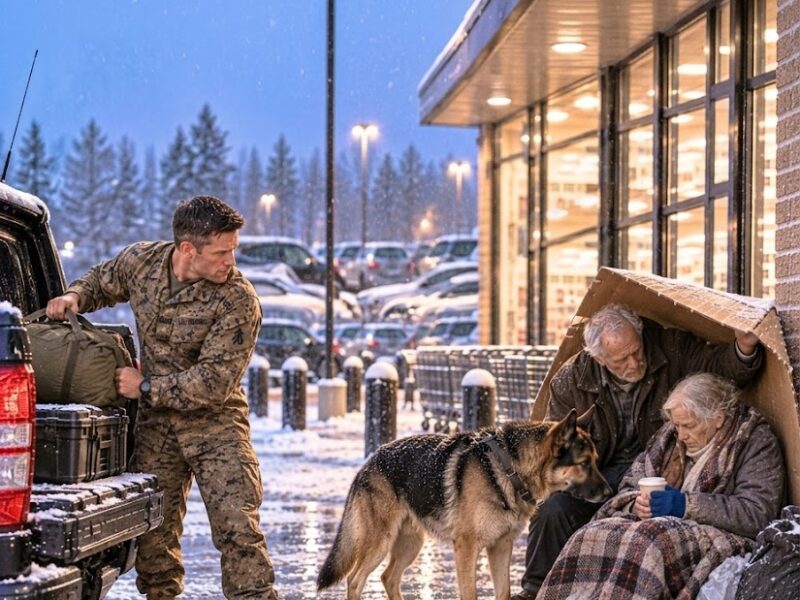
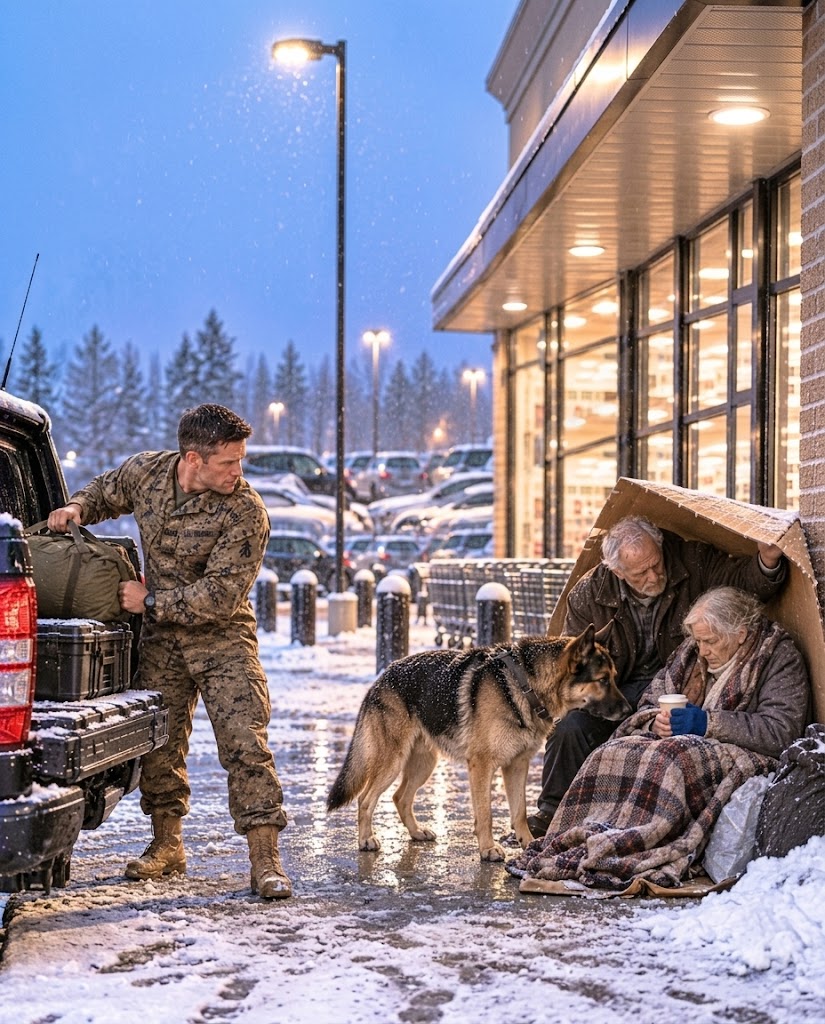
Snow swept across a grocery store parking lot outside Spokane, Washington, turning the pale yellow lights into something softer and sadder than they had any right to be.
An elderly man was using flattened cardboard to shield his trembling wife from the freezing wind, wedging each piece against the narrow store overhang while his hands shook from more than cold.
She wore only one blue wool glove.
Nearby, a Marine was about to leave with his German Shepherd, Striker, but the canine refused to get into the truck.
The dog stood planted in the snow, ears angled toward the far end of the lot, and no command could move him.
Then the woman looked at the Marine and whispered, “They don’t let dogs in there.”
Minutes later, her son arrived and she immediately grabbed her husband’s sleeve.
The Marine noticed, and suddenly the question wasn’t why they were out in the cold.
It was what they had walked away from.
Late January had buried the outskirts of Spokane beneath heavy snow, and by 6:15 p.m. the storm had finally passed, leaving hard wind sweeping loose powder across the grocery store parking lot.
Gunnery Sergeant Everett Shaw had already spent eleven hours on his feet when he pushed a cart toward his pickup.
At forty-one, the active-duty Marine stood six-foot-one with a compact, hardened build, short dark brown hair touched with gray at the temples, blue-gray eyes, and a thin scar beneath his right jaw.
Years in the Corps had given him the habit of noticing exits, hands, and changes in a room before he noticed decorations.
It had also taught him not to mistake confidence for certainty.
He loaded two grocery bags into the truck bed, shut the tailgate, then glanced toward the German Shepherd waiting beside him.
Striker was seven, a large black-and-tan canine with amber eyes, a small notch in his right ear, and the first silver hairs beginning to show around his muzzle.
The dog was disciplined enough that Everett rarely repeated himself.
“Load up.”
Striker looked at the open rear door, then he looked away.
Everett paused.
“Striker.”
The Shepherd remained planted in the snow, ears angled toward the far end of the parking lot.
No bark, no growl, just complete attention.
Everett followed his stare.
Beyond several shopping cart corrals near the recycling bins, an elderly man was pulling flattened cardboard from a container.
He carried each piece to a plastic chair beneath the narrow store overhang and wedged it against the windward side.
Only then did Everett see the woman sitting there.
He closed the truck door without putting Striker inside.
The old man noticed them approaching and straightened with difficulty.
Gideon Weller was seventy-eight, perhaps five-ten before age had bent his shoulders, with thinning white hair, pale blue eyes, a weathered face, and large hands marked by old cuts and thickened knuckles.
His right knee barely flexed when he moved, yet his first instinct was not to protect himself.
He shifted between Everett and the woman.
“We’re all right,” he said.
Everett hadn’t asked yet.
The woman behind him was Lenora Weller, seventy-five, small-framed and barely five-four, with shoulder-length silver-white hair escaping from beneath a knitted cap.
Her pale face had the softness of someone who had once smiled easily.
But tonight her expression seemed delayed, as though every sound had to travel farther than it should before reaching her.
She wore an old winter coat and only one blue wool glove.
Her bare hand trembled around a paper cup.
Everett looked at the cardboard shield, then at Gideon.
“You waiting for somebody? Trying to get home? Where’s your car?”
Gideon’s jaw tightened.
“Not here.”
He explained that several drivers had canceled after seeing their address.
Snowplows were still clearing secondary roads.
He said it matter-of-factly, but Everett heard the exhaustion underneath.
Striker approached slowly and stopped several feet from Lenora before sitting.
Her eyes focused on him.
For the first time, something almost warm crossed her face.
“They don’t let dogs in there.”
Gideon turned sharply.
“Lenora.”
The warmth vanished.
Everett caught it—the change in her eyes and the fear behind the old man’s interruption.
“In where, ma’am?”
Lenora lowered her gaze to the cup.
Gideon answered instead.
“She gets confused sometimes.”
Everett studied Lenora’s shaking hand.
“I’m calling paramedics.”
“No.”
The force in Gideon’s voice made Striker’s ears rise.
Everett looked back at him.
“No ambulance,” Gideon said more quietly. “She’s cold, that’s all.”
Everett had learned long ago that fear could make good people sound guilty.
He had also learned that love could convince people they knew better than doctors.
Looking at Lenora, he could not dismiss another possibility.
Perhaps Gideon had taken a cognitively impaired woman somewhere she should never have left.
“You’re sitting outside in January,” Everett said. “She’s shaking badly enough she can’t hold that cup. That’s more than cold enough for me.”
Gideon’s expression hardened, but underneath it, Everett saw something less confrontational.
Desperation.
Then headlights swept across them.
A dark SUV entered the lot.
Lenora’s bare hand immediately reached for her husband’s sleeve.
“No,” she whispered.
The vehicle stopped nearby.
A man stepped out, tall and broad through the shoulders, around forty-seven, with neatly cut brown hair graying above the ears, a trimmed beard, and a clean dark overcoat that made him look more like a tired professional than someone anyone should fear.
Bennett Weller, Gideon and Lenora’s only son, had spent years solving problems by appearing calm before anyone else could become angry.
Tonight, his controlled face carried what looked like genuine worry.
“Dad.”
Gideon said nothing.
Bennett’s attention moved immediately to his mother.
“Jesus, she’s freezing.”
He took one step forward.
Lenora tightened her grip on Gideon’s sleeve.
Bennett stopped.
Everett noticed that, too.
“Who are you?” Bennett asked him.
“Everett Shaw.”
Bennett glanced at his posture, then at Striker.
“Military?”
“Marine.”
Bennett exhaled as if relieved to find a reasonable person.
“Then maybe you can help me. My mother has cognitive problems. My father took her out of a care facility today against medical advice.”
Everett looked at Gideon.
Gideon did not deny it.
That bothered him more than a denial would have.
“I called you because we needed the Buick,” Gideon said.
“And I told you I’m taking Mom back to Silver Pines.”
At the name, Lenora’s breathing changed.
Everett saw her shoulders draw inward.
Bennett saw it, too, but his expression became pained rather than cruel.
“Mom, you’re sick. You need to be somewhere safe.”
Lenora stared at the snow.
Everett felt the situation shifting beneath his feet.
An hour earlier, perhaps Gideon had believed he was rescuing his wife.
Perhaps Bennett truly was trying to rescue her now.
Everett had seen families torn apart by less than fear and good intentions.
Then Lenora looked at Striker.
The Shepherd had not moved.
Her fingers disappeared into Gideon’s coat sleeve.
Gideon turned toward Everett, and whatever pride had kept him from asking for help finally broke.
“Before you decide I’m the crazy one,” he said quietly, “let my wife tell you why we left.”
Everett looked at Lenora.
She slowly raised her eyes, and at the mention of Silver Pines, the hand holding her cup began to shake again.
The wind drove a thin sheet of powder across the parking lot as Everett waited for Lenora to speak.
She never did.
Her eyes stayed on the snow between her boots while Bennett stepped closer with the careful patience of a man approaching someone frightened enough to mistake help for danger.
“My mother has cognitive impairment,” Bennett said. “She forgets where she is. Sometimes she gets agitated. Dad doesn’t want to accept how much she’s changed.”
Gideon’s mouth tightened.
“Don’t talk about her like she isn’t standing here.”
“Then stop pretending tonight was safe.”
That landed harder than an accusation because Everett could see the truth inside it.
Whatever had happened at Silver Pines, Gideon had ended up with a vulnerable seventy-five-year-old woman sitting outside in January.
Good intentions did not make hypothermia less dangerous.
Everett crouched far enough from Lenora not to crowd her.
“Mrs. Weller, do you know where you are?”
Her gaze slowly found his.
“A grocery store.”
“Do you know who this man is?”
He indicated Gideon.
“My husband.”
Her answer came faster.
Then she glanced toward Bennett.
“And that’s my son.”
Bennett’s shoulders loosened slightly, as though the recognition supported his argument.
Everett asked one more question.
“Where do you want to go?”
Lenora looked at Bennett, and something in her face closed.
“Home.”
Bennett rubbed a hand over his beard.
“Mom, I don’t want to go back there.”
Everett stood.
That did not settle whether Lenora understood every consequence of leaving Silver Pines, but it settled the immediate argument.
She was cold, physically unsteady, and needed medical attention before anyone decided where she would spend the night.
Everett called a nearby urgent care and confirmed it was open.
Bennett objected that Silver Pines had her records and medication list.
Everett answered that those records could be requested.
Gideon said nothing until Everett opened the pickup’s passenger door for Lenora.
Then the old man quietly said, “Thank you.”
Twenty minutes later, fluorescent light replaced the blue darkness of the parking lot.
A nurse took Lenora behind a curtain while Gideon, Bennett, Everett, and Striker waited in a small examination area.
The clinician on duty, Dr. Hannah Vic, was a compact woman in her early fifties with warm brown skin, short black curls threaded with gray, and dark eyes sharpened by years of emergency and urgent care work.
She spoke gently without becoming sentimental, the manner of someone accustomed to separating frightened families from immediate medical facts.
Her initial examination found Lenora mildly hypothermic and dehydrated, but stable.
She needed warming, fluids, observation, and follow-up evaluation.
There was no immediate reason to send her back into the snow.
Once Lenora was wrapped in heated blankets and holding water with both hands, Gideon finally explained.
Three months earlier, Lenora had begun losing small pieces of ordinary life.
She put the sugar bowl in the refrigerator.
She asked Gideon twice whether he had paid the electric bill, then laughed when he showed her the receipt she’d filed herself.
One afternoon, she drove to a pharmacy she had used for fifteen years and called him because she could not remember the route home.
That frightened Gideon enough to stop dismissing the problem as age.
Bennett had suggested Silver Pines.
“Thirty days,” Gideon said. “That was what you told us. For an assessment.”
“Because you couldn’t do one at home,” Bennett replied.
Gideon did not argue with that.
The first month had seemed reasonable.
Then Silver Pines reported episodes of agitation and an increased fall risk.
They recommended another few weeks of observation.
Bennett urged his father not to pull Lenora out before the professionals understood what was happening.
So Gideon agreed.
Then he agreed again.
Thirty days became seven weeks, then ten.
“The longer she stayed,” Gideon said, “the less of her I saw.”
During scheduled visits, Lenora often struggled to stay awake.
Sometimes her speech dragged.
Twice Gideon had to help hold her upright when she stood.
Staff told him cognitive decline could accelerate unpredictably, and Gideon had believed them because the alternative was admitting he had placed his wife somewhere unsafe.
Everett watched Bennett.
The younger Weller looked troubled, not exposed.
“You saw the same things,” Gideon told him.
“I saw Mom getting worse. You saw what they showed us.”
Bennett’s eyes hardened.
“And today you decided you knew better than everyone.”
“No. Today I arrived early.”
The room changed.
Gideon had been scheduled for a late afternoon visit.
A canceled appointment in Spokane left him nearly two hours ahead of schedule, so he drove directly to Silver Pines instead of waiting.
Lenora had been awake when he entered her room—fully awake, sitting beside the window and folding a towel.
She recognized him immediately.
Her voice had been clearer than he had heard it in weeks.
Gideon had asked why.
Lenora had stared toward the hallway before whispering, “They give me something before you come.”
Bennett shook his head.
“Dad, she gets confused about medication.”
“That’s what I thought.”
Gideon had gone to the nurse’s station and asked for the current medication list and administration record.
He was given the family-facing list he had seen before.
But when he asked specifically what Lenora had received that afternoon, the answers became vague.
One employee said the nurse responsible was unavailable.
Another told him the administrator could discuss it the following morning.
“So I went back to her room,” Gideon said, “and I asked Lenora what she wanted.”
Everett turned toward her.
Lenora had been listening quietly from beneath the heated blanket.
“What did you tell him?” Everett asked.
Her forehead tightened with the effort of retrieving the moment.
“I told him I wanted my house.”
Bennett lowered his eyes.
Gideon explained that Lenora had never been placed under guardianship.
No court had declared her legally incapacitated.
Silver Pines was a voluntary residential arrangement.
Staff strongly advised against taking her home and required Gideon to sign paperwork acknowledging that they were leaving against medical advice, but Lenora repeatedly said she wanted to leave with her husband.
They left.
The plan had not been to sit outside a grocery store.
Gideon ordered a rideshare because his Buick was at home.
Snow closures prevented the driver from reaching their neighborhood, so they were dropped at the commercial strip while Gideon tried to arrange another ride.
After repeated cancellations, he called Bennett and asked him to bring the Buick.
Bennett said he would come but would take Lenora back to Silver Pines.
Gideon hung up.
Everett finally understood how they had reached the cardboard shelter without pretending Gideon had made no mistakes.
He had acted out of fear, love, and perhaps stubbornness.
None of those guaranteed he was right.
Dr. Vic returned and recommended that Lenora undergo a fuller cognitive and medication evaluation once she was warm and rested.
Everett looked from father to son.
“Tomorrow,” he said, “someone who doesn’t work for Silver Pines evaluates her.”
Bennett frowned.
“And if they say Dad was wrong—”
Everett held his gaze.
“Then deal with what’s true.”
Gideon nodded slowly.
“And if they’re wrong?” Bennett asked.
Everett glanced toward Lenora.
“Same answer.”
Morning came, clear and brutally cold over Spokane, sunlight flashing against snowbanks while yesterday’s storm hardened into ice.
Inside a quiet medical office, Gideon sat beside Lenora and waited to learn which parts of his fear were real.
Dr. Celeste Rowan was fifty-six, tall and slender, with warm olive skin, straight dark hair streaked heavily with silver and cut just above her shoulders, and thoughtful brown eyes behind thin rectangular glasses.
Years of evaluating older adults had made her deliberate with words.
She disliked diagnoses that frightened families more than they informed them.
She spent nearly an hour with Lenora, asking questions, testing recall, watching her follow simple instructions, and speaking to her without allowing Gideon to answer on her behalf.
Everett waited near the window with Striker while Gideon twisted his wedding ring around one swollen knuckle.
When Rowan finally removed her glasses, Gideon leaned forward.
“Silver Pines didn’t invent her memory problems,” she said.
The words hurt him more than he expected.
Rowan explained that Lenora’s performance was consistent with mild cognitive impairment.
She had difficulty retaining recent information and occasionally lost the sequence of multi-step tasks.
There would be days when she functioned better and days when she struggled.
Gideon stared at the floor.
Some private part of him had hoped a doctor would tell him everything he had watched disappear over three months could be blamed on Silver Pines.
“Then Bennett was right,” he murmured.
“About your wife having cognitive impairment?”
“Yes.”
“About everything else? I haven’t said that.”
Rowan’s concern was the difference between Lenora sitting before her now and the near-incapacitated woman described in portions of the facility information available to the family.
Lenora could identify people, communicate preferences, follow simple directions, and participate meaningfully in decisions.
That did not prove misconduct.
Neither did Gideon’s description of her excessive sleepiness.
Illness, dehydration, stress, medication effects, or several other factors could produce similar changes.
“I need to know exactly what she received,” Rowan said. “Not what somebody remembers, not what a family list says.”
Records.
That brought Mallerie Keane into the case.
At forty-five, the elder rights attorney was a lean woman of medium height with light brown skin, dark auburn hair worn in a practical chin-length bob, and gray-green eyes that rarely left a document once she began reading it.
Her restrained manner came from years of watching family disputes become louder as facts became thinner.
She promised no scandal and accused no one.
She simply began requesting records.
While Lenora rested, Everett drove Gideon home for her glasses, clothes, and personal papers.
Their modest house sat beyond a secondary road where plows had left high ridges beside the mailboxes.
In the attached garage, Everett was reaching for a box of documents when Striker stopped beside an older Buick.
The Shepherd sniffed once along the passenger door and remained there.
“That’s her side,” Gideon said.
Everett glanced toward him.
“Probably still smells like her.”
Gideon stared at the Buick as if the obvious had suddenly become important.
“Wait.”
He opened the passenger door and reached beneath the seat.
His fingers caught the strap of a faded canvas tote.
Inside were ordinary things—tissues, a grocery receipt, two peppermint candies fused inside their wrapper, a paperback with a bent cover, and a pair of inexpensive reading glasses Gideon had forgotten Lenora owned.
Then he stopped.
At the bottom lay a blue wool glove, the match to the one Lenora had worn in the grocery store parking lot.
Gideon held it across both palms.
“She kept asking me where this went.”
His voice broke on the final word.
Everett said nothing.
The glove proved nothing except how many small questions had gone unanswered while Gideon worried about larger ones.
But Gideon was no longer looking at it.
“The hospital,” he said.
Everett waited.
“A few weeks ago. She fell at Silver Pines. They sent her somewhere outside their system.”
Gideon remembered arriving after the fall and finding Lenora already discharged back to Silver Pines.
A packet had accompanied her, but he had treated it as routine paperwork.
He could not remember the hospital’s exact medication notes.
Everett called Mallerie.
She did not ask Gideon to hunt for the packet.
She obtained authorization and requested the official record directly from the outside hospital.
Hours later, the first documents arrived.
Mallerie read them twice before calling Rowan.
During Lenora’s outside hospital visit, staff had performed a medication reconciliation—a list assembled to establish what drugs a patient was reportedly taking at the time of care.
One medication on that reconciliation did not appear on the medication list Silver Pines had previously provided Gideon.
Gideon stared at the two documents side by side.
“What does that mean?”
“It means they don’t match,” Mallerie said. “That’s all for now.”
“That’s exactly what it means.”
There could be legitimate explanations—a medication discontinued later, an incomplete family copy, a transcription error, or information entered incorrectly at the hospital.
Mallerie refused to turn a discrepancy into an accusation.
Instead, she widened the record requests: medication administration records, physician orders, incident reports, staffing information relevant to documented events, correspondence concerning Lenora’s care.
The picture did not become clearer immediately.
It became stranger.
As additional material was reviewed, repeated terms began appearing in records involving several residents.
Agitated. Combative. High fall risk.
Some clusters occurred during periods when staffing records showed unusually thin coverage.
Medication changes appeared around some of those periods, though the available documents did not yet establish why or whether each change had been properly authorized.
Mallerie found another problem.
Several incident reports referenced hallway locations that should have been covered by security cameras.
The cameras had not always been functioning.
Again, that proved little by itself.
Cameras failed. Equipment broke. Maintenance was delayed.
So Mallerie requested the work orders.
Gideon sat at her conference table late that afternoon while she arranged printed pages into chronological stacks.
Everett remained nearby, Striker resting quietly beneath his chair.
Lenora was elsewhere, resting under Rowan’s supervision, unaware that the questions surrounding three months of her life were multiplying faster than anyone could answer.
Mallerie turned over another maintenance report, then stopped.
Her eyes moved to Gideon.
“What?”
She slid the page across the table.
It concerned a corridor camera outage reported during one of the periods Mallerie had flagged.
Near the bottom was the regional facilities authorization.
Gideon read the name once, then again.
The room seemed to lose its air.
Everett leaned forward but did not touch the document.
Gideon’s finger rested beside the signature line.
For three months he had been asking himself what Silver Pines might have done to his wife.
Now, for the first time, he wondered how much his son already knew.
Bennett Weller.
Part 2
By the following afternoon, Spokane’s winter sun had disappeared behind a ceiling of gray cloud.
Meltwater froze along the curbs, and inside Mallerie Keane’s office, one name remained at the center of a growing stack of records.
Bennett did not deny the signature.
He sat across from Mallerie with both hands clasped between his knees while Everett and Gideon remained on the other side of the conference table.
For the first time since the grocery store parking lot, Bennett’s practiced calm looked less like confidence than exhaustion.
He explained what his title actually meant.
As a regional facilities supervisor, he oversaw maintenance operations for Silver Pines and several properties owned by the same company.
Heating systems, access controls, plumbing, repairs, security equipment.
Those were his responsibilities.
He did not prescribe medication.
He did not administer it.
He did not supervise nurses.
“So the camera was your responsibility,” Mallerie said.
Bennett looked at the work order.
“Yes.”
“And it was down.”
“Yes.”
“For how long?”
His silence answered before he did.
“Longer than that report says.”
Gideon slowly turned toward his son.
Bennett admitted there had been chronic staffing problems at Silver Pines and complaints that remained unresolved for weeks.
Cameras sometimes stayed broken because replacement equipment was delayed or budgets were frozen.
None of that had seemed extraordinary to him anymore.
That was the part he hated admitting.
Dysfunction had become ordinary.
Then Mallerie placed two versions of a maintenance log side by side.
“Why are these timestamps different?”
Bennett swallowed.
A senior manager had asked him to clean up several maintenance entries before an internal review.
One timestamp was adjusted.
Another was removed.
The changes made it harder to establish that certain corridor cameras had been unavailable during incidents involving residents.
“You falsified records,” Gideon said.
“I changed maintenance timestamps.”
“You knew why.”
“I knew they didn’t want questions.”
The distinction sounded pathetic even to Bennett.
He had told himself medication belonged to physicians.
Resident behavior belonged to nursing staff.
Staffing belonged to administrators.
His job was equipment.
He had a mortgage, bills, and a career built over two decades.
If he challenged every questionable instruction, he had reasoned, somebody else would simply replace him.
He had not known Lenora was receiving medication in a way that might be improper.
But he had known enough to stop asking questions.
Gideon rose from the table without speaking.
Before anyone could follow him, his phone rang.
It was Dr. Rowan.
Lenora had begun shaking violently.
Within the hour, the questions about camera logs became secondary.
Lenora was in a hospital bed under continuous monitoring after developing nausea, pronounced tremors, difficulty balancing, and a frightening sensation that she could not draw a full breath.
Gideon sat beside her while clinicians worked through immediate possibilities.
No one announced a dramatic diagnosis.
Her heart and lungs were evaluated.
Acute neurological danger was considered, blood tests were ordered, and her recent medications became part of the investigation.
A hospital physician explained that several things could cause the symptoms.
One possibility, depending on what Lenora had actually been receiving and for how long, was withdrawal or rebound after abrupt discontinuation of a regularly administered medication.
“Possibility,” the physician emphasized. “We need the complete administration history.”
Gideon heard only one part.
“Regularly?”
The physician could not answer yet.
Gideon stared at Lenora, sleeping beneath a white blanket, and understood how little he knew about the last three months of his wife’s life.
He had known which sweaters she preferred, how she took her coffee, which knee hurt before rain.
Yet he could not say with certainty what had been put into her body every day.
Bennett arrived after dark.
He stopped just inside the room.
Gideon did not stand.
“Did you know?”
Bennett looked toward his mother.
“Not about Mom.”
Gideon’s eyes lifted to him.
“That wasn’t my question.”
Bennett opened his mouth.
Nothing came out.
For several seconds, only the monitor beside Lenora filled the room with its steady electronic rhythm.
Bennett left.
He did not return that night.
By morning, portions of the requested medication administration records had begun arriving.
The documents still required full verification and clinical interpretation, but they strengthened the concern that Lenora had received the medication more regularly than Gideon had ever been told.
Dr. Rowan refused to leap beyond the records, and the hospital team continued monitoring Lenora while reconciling dates, doses, orders, and discontinuation timing.
Late that afternoon, Bennett appeared at Mallerie’s office carrying an old black laptop beneath one arm and a scratched external hard drive in his hand.
He sat both on the table.
Mallerie did not touch them immediately.
“What are these?”
“My insurance policy.”
Years earlier, Bennett had begun keeping copies of work emails and maintenance records after watching another employee blamed for delays that had originated higher in management.
At first, he saved them to protect himself.
Over time, the archive grew.
Emails, work orders, camera status logs, internal requests, revised files, and communications he had never expected anyone outside the company to see.
“Are these company records?” Mallerie asked.
“Some are copies of records I had access to through my job.”
“Then we’re going to handle them carefully. I’m not asking you to open anything else, alter anything, or delete anything. We preserve what you brought and determine the lawful next step.”
Bennett nodded.
Gideon stood near the window.
“If you give her that,” he said, “you lose your job.”
Bennett looked at the laptop.
“I probably already have.”
“That why you’re doing it?”
“No.”
Gideon waited.
Bennett’s voice lowered.
“I kept telling myself I didn’t know enough to accuse anybody. Maybe that was true at first.”
He rubbed his thumb against the scratched edge of the drive.
“After a while, I think I just made sure I never knew enough.”
For the first time, Gideon looked directly at his son.
Bennett slid the laptop and drive toward Mallerie.
“I won’t do that again.”
Mallerie took custody of them.
Bennett turned toward his father, perhaps expecting anger, perhaps hoping for something easier.
“Dad—”
“No.”
One word.
Bennett stopped.
Gideon’s face held no rage now.
That would have been simpler.
“You doing the right thing today doesn’t change what you chose yesterday.”
Bennett lowered his eyes.
Gideon walked past him and returned to the hospital.
The laptop remained on Mallerie’s table, its lid closed, the external drive beside it.
For months, Bennett had kept those files because he feared Silver Pines might someday sacrifice him to protect itself.
Now he had sacrificed the protection of silence instead.
Whether that would be enough to help his mother was still unknown, and whether Gideon would ever call him son the same way again was something no document could decide.
By early March, winter had begun loosening its grip on Spokane.
Snowbanks collapsed into dark ribbons of water along the roads, and patches of brown grass appeared beneath a sky that finally seemed wide again.
The files Bennett surrendered did not produce flashing lights outside Silver Pines the next morning.
There were no dramatic arrests, no single document that explained everything.
What they produced was slower and more difficult to dismiss.
Corroboration.
Emails were compared with work orders.
Camera logs were matched against incident reports.
Medication administration records were examined beside physician orders and hospital records.
Staffing schedules were reviewed against periods when residents had repeatedly been described as agitated, combative, or at high risk of falling.
Investigators also examined when families had been notified and when they had not.
The discrepancies became large enough for regulators to widen the inquiry.
Other residents received independent medical reassessments.
Some employees were temporarily removed from duty while records and decisions were reviewed.
Families who had once accepted sudden changes in their parents or spouses as unavoidable progression began asking questions of their own.
Silver Pines and its parent company faced regulatory scrutiny and civil claims, though determining individual responsibility would take far longer than Gideon once imagined justice should require.
Bennett lost his job.
He cooperated anyway.
That did not make him innocent.
Weeks after Lenora’s hospitalization, Bennett came to see her.
He looked diminished without the overcoat, company badge, and practiced certainty that had once seemed inseparable from him.
He sat several feet from his mother and told her what he had done.
The records he altered, the questions he avoided, the things he had convinced himself belonged to somebody else’s department.
Lenora listened.
Some details had to be repeated.
When he finished, Bennett’s voice nearly disappeared.
“Mom, I’m sorry.”
She studied him for so long that Gideon almost interrupted.
Then Lenora said, “I may forgive you someday.”
Bennett’s eyes lifted.
“That doesn’t mean today.”
He nodded once.
Gideon did not soften the sentence for him.
Lenora’s recovery was measured in weeks, not miracles.
Her medications were reviewed and adjusted under medical supervision.
A new care plan accounted for both her cognitive impairment and her desire to remain involved in decisions about her own life.
She still misplaced objects.
She occasionally asked Gideon a question he had answered ten minutes earlier.
One morning, she called Everett by the wrong name and corrected herself only after seeing Striker.
But she was more alert.
She laughed again, and when someone discussed her care, they spoke to her before speaking about her.
Eventually, Lenora went home.
Gideon learned that bringing her home did not mean pretending nothing was wrong.
He organized medications carefully, accepted outside support, changed routines, and stopped treating help as evidence that he had failed his wife.
Love, he discovered, was not proving he could carry everything alone.
Sometimes it was building something strong enough for another person to hold.
That was why Everett found him on the front porch one Saturday morning, wrestling with a length of railing.
“You’re off by half an inch,” Everett said.
Gideon looked over his shoulder.
“I was a carpenter before you learned to shave.”
“And you’re still off by half an inch.”
Gideon stared at the level, then muttered something Everett politely pretended not to hear.
They worked through the morning.
The porch had only three steps, but winter made them treacherous.
Everett secured the final section of handrail while Gideon treated the shaded portion of the walkway, where meltwater repeatedly froze overnight.
Striker rested nearby, watching both men with the patient expression of a supervisor unwilling to participate in manual labor.
The front door opened.
Lenora stood there.
Everett noticed her hands first.
Two blue wool gloves—the one from the grocery store parking lot and the one Gideon had found beneath the Buick’s passenger seat.
Gideon immediately pushed himself upright.
Lenora reached for the railing.
He started toward her.
“Give her a second,” Everett said.
Gideon stopped.
Lenora looked down.
Three steps.
Her fingers tightened around the new rail.
She took the first.
Gideon’s hands hovered uselessly at his sides.
Lenora took the second.
Striker rose.
He did not climb toward her.
He simply waited at the bottom.
Lenora paused before the third step.
For a moment, Everett saw frustration cross her face.
Not fear of falling exactly, but anger at a body and mind that now required fought-for things once done without thinking.
Gideon shifted forward.
Everett said nothing this time.
Lenora breathed out.
Then she stepped down.
Both boots reached the walkway.
Striker approached only after she was steady.
He lowered his head beneath her gloved hand.
Lenora stared at him.
The Shepherd’s amber eyes remained fixed on her while her fingers moved slowly over the silver beginning to gather around his muzzle.
“Do I know you?”
Everett smiled faintly.
“He knows you.”
Lenora considered that.
Then she stroked Striker’s head.
“That’s good enough for today.”
Gideon turned his face away for a moment.
Everett understood why.
There had been a time when Gideon wanted his old wife returned to him exactly as she had been.
The woman who remembered appointments, roads, grocery lists, every name.
That woman had not completely vanished.
But neither could love demand that she remain unchanged.
Lenora was here.
That had to be enough for today, too.
Later, Everett loaded his tools into the pickup.
Striker waited beside the open rear door and this time climbed inside on the first command.
“Everett.”
He turned.
Lenora stood at the edge of the porch, both blue gloves resting on the railing.
“Thank you for finding us.”
Everett looked toward Striker.
“He found you, ma’am.”
Lenora smiled.
“Then thank God he was looking.”
Everett lowered his head for a second, accepting the words without trying to improve them.
Behind Lenora stood the house she had asked for from beneath a heated blanket weeks earlier.
Behind Everett lay the road back toward Spokane.
The last dirty remnants of winter were melting along its edges.
That January night, Lenora had sat behind cardboard in a frozen parking lot, wearing one blue glove while other people argued over where she belonged.
Now she stood outside her own home wearing both.
Her memory was imperfect.
Her future would require help, but the hand on the railing was hers.
The three steps behind her were hers.
And when Lenora turned toward the open door, no one told her whether to go inside.
She chose for herself.
Sometimes God’s miracles do not arrive with thunder, angels, or signs in the sky.
Sometimes they come quietly, a faithful dog who refuses to get into a truck, a stranger who chooses to look twice, or a hand reaching out when someone has almost lost the strength to ask for help.
Lenora never received the miracle of having every lost memory returned.
Instead, she received something just as precious.
The chance to be heard, to be safe, to come home, and to take those three small steps for herself.
Maybe that is how many of God’s miracles appear in our own lives.
Not by removing every hardship, but by placing the right person, the right act of kindness, or even the right faithful companion in our path when we need them most.
So today, look a little closer at the people around you.
Someone may be fighting a battle they cannot explain.
Your kindness could become the answer to a prayer you never heard.
If this story touched your heart, share it with someone who still believes compassion matters.
Tell us in the comments where you’re watching from and what this story meant to you.
And subscribe for more stories of faith, courage, loyalty, and second chances.
May God protect your home, strengthen you through every difficult season, guide your steps when the road is uncertain, and bless you and the people you love.
Amen.









