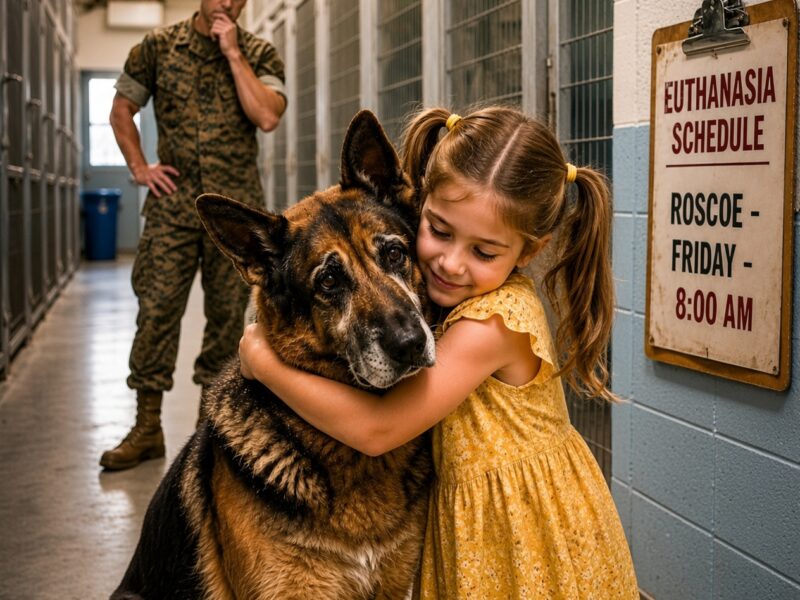
“Please don’t let him die, Daddy,” the little girl begged. The Marine looked at the wounded dog in her arms—and froze. He knew that scar. He knew that tag. He knew that dog.
**Part 1**
The rain had just stopped, leaving the Wilmington streets slick and reflective under the gray October sky. Staff Sergeant Caleb Walker, a tall, broad-shouldered Marine with close-cropped dark hair, stood in the lobby of the Cape Fear County Animal Shelter. He was 37, with the disciplined bearing of a man who had spent years solving problems in a straight line. His nine-year-old daughter, Sophie, stood beside him, clutching a cardboard box of old blankets.
She had insisted on donating them herself. It was supposed to be a simple trip. Drop off the blankets, thank the staff, go home. But as Caleb filled out the donation form, Sophie wandered a few steps into the kennel corridor.
“Stay where I can see you,” Caleb called out.
“I will.”
She stopped at Kennel 24. Inside sat an aging German Shepherd with a silver muzzle and tired eyes. He didn’t bark. He just walked to the gate and sat. Sophie knelt down. “Hi,” she whispered. The dog’s tail moved once against the floor.
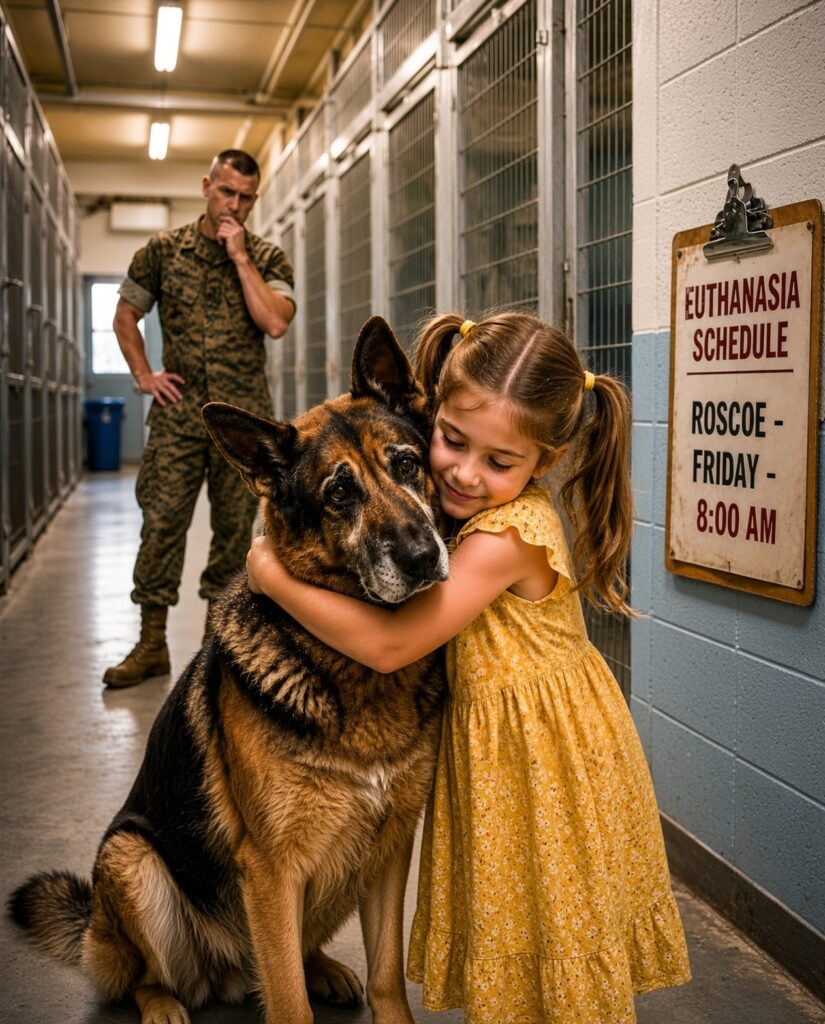
That was when she saw the clipboard. Large red letters were printed across the top: Euthanasia Schedule. Below them: Major. Friday, 8:00 a.m.
Sophie’s smile disappeared. “Dad.” Something in her voice made Caleb turn immediately. He crossed the hallway in three quick strides. Sophie pointed toward the clipboard. “What does that mean?”
Rachel Bennett, the shelter manager, a woman of 34 with tired green eyes and auburn hair pulled into a loose ponytail, stepped forward. “Major has been here almost five months,” she said quietly. “He’s older. He needs medicine for his joints every day. A lot of families come here hoping for a younger dog.”
Sophie looked through the gate. “Tomorrow?”
Rachel nodded. “We’re very full right now.”
What she didn’t tell Sophie was that Major’s date had already been moved twice. Each extension meant finding temporary space in a building that had almost none left.
Sophie turned back to the dog. “Can I touch him?”
Rachel studied Major for a moment. “He’s very gentle.” She unlocked the kennel.
Sophie entered slowly. Major remained where he was. She sat beside him for several seconds. Neither moved. Then Sophie placed one hand against the fur on his shoulder. Major turned his head. Sophie slid both arms gently around his neck.
Caleb felt his jaw tighten. The old shepherd stood perfectly still. Then slowly, he lowered his head onto Sophie’s shoulder. Rachel looked away for a moment.
Sophie didn’t sob. She didn’t beg immediately. She simply held him. Finally, she looked toward her father. “Dad, what happens to him tomorrow?”
Caleb knew what she was really asking. Not what the clipboard meant, but what he intended to do about it.
“We can’t bring an animal home just because we’re upset right now,” he said carefully.
“He needs medicine.”
“I know.”
“He doesn’t have anybody.”
“I know.”
“Then why can’t we be somebody?”
Caleb exhaled. There were practical reasons. His schedule changed constantly. Their rental house had rules he hadn’t checked. Major would need veterinary care. Sophie was nine. Caleb was still trying to figure out how to rebuild an ordinary home life after spending months away. Bringing home an 11-year-old German Shepherd because they met him 20 minutes earlier was exactly the kind of emotional decision Caleb had trained himself not to make.
“We have to think about things before we promise them,” he said.
Sophie looked disappointed, but didn’t argue. That almost made it worse. Before leaving the kennel, she noticed Major’s collar. It was an old brown leather collar worn soft with age. Beneath the buckle sat a scratched metal plate, so faded that the markings were impossible to read. Sophie touched it briefly.
“Did he have a family before?” she asked.
“We don’t really know,” Rachel said. “He was found wandering outside town. His old records didn’t lead us anywhere.”
That evening, Caleb made dinner while Sophie remained unusually quiet. She ate half of what was on her plate and went upstairs early. At 2:00 the next morning, Caleb woke unexpectedly. The hallway outside his bedroom was dark. Sophie’s door stood open. Her bed was empty.
Caleb was downstairs within seconds. A small lamp was glowing beside the couch. Sophie sat cross-legged on the living room rug in her pajamas. Coins and folded bills were spread in front of her. Beside them sat a small metal box where she had been saving money for six months toward a new bicycle. She had emptied almost everything. She was placing the money into a white envelope.
“You should be asleep,” Caleb said quietly.
Sophie looked up. “I don’t need the bike anymore.”
Caleb looked at the envelope. Written across the front in Sophie’s careful handwriting were two words: FOR MAJOR.
At 6:50 the next morning, the sky above Wilmington was still the color of wet slate when Caleb stepped into his daughter’s bedroom. Sophie was asleep on her side, her two ponytails long since fallen loose during the night. On the dresser sat the white envelope. Caleb stood there longer than necessary. He had spent the remaining hours doing what he always did when emotion threatened to make a decision for him: gathering facts. He had checked the lease for the small rental house they were preparing to move into, searched average veterinary costs for senior German Shepherds, read about arthritis treatment, calculated food expenses, and looked at his duty schedule for the next three months. None of it produced the kind of clean answer he wanted.
“Sophie.”
Her eyes opened slowly.
“Get dressed.”
She pushed herself upright. “Where are we going?”
Caleb picked up the envelope from the dresser. “Wear something warm.”
Ten minutes later, Sophie came downstairs in jeans, sneakers, and a yellow sweatshirt. She noticed the envelope in Caleb’s hand, but didn’t ask again. When he turned onto the road leading toward Cape Fear County Animal Shelter, she recognized it immediately. Her head snapped toward him. “Dad.”
Caleb kept his eyes on the road. “We’re going to ask questions.”
Sophie tried not to smile too soon.
Rachel Bennett was unlocking the shelter’s front entrance when she saw them crossing the parking lot. Caleb rested both hands against the reception counter. “Show me the paperwork.”
Rachel stared at him for a second, then put down her coffee. “All of it?”
“All of it.”
Within five minutes, the counter was covered with forms. Rachel did not try to make Major sound easier than he was. She explained that his arthritis would require daily medication and regular monitoring. Because of his age, she strongly recommended a complete veterinary examination, including his heart and hips. Long runs were no longer appropriate. Stairs should be limited when possible. His weight needed to stay controlled because extra pounds would make his joints work harder.
“He may have several good years,” Rachel said. “Or you may get much less time than that. Nobody can promise you.”
Caleb listened without interrupting. Then came the housing issue. Caleb and Sophie were scheduled to move into a rental house in several weeks. The lease mentioned pets only in general terms. He had not yet spoken directly with the owner about a large German Shepherd.
“I need to know you have somewhere legal to keep him,” Rachel said.
“I have my current place until the move,” Caleb said. “And if the next house won’t approve him, I’ll change the house.”
Sophie looked up at him.
“I’m not signing something I can’t follow through on,” Caleb continued.
That was when Sophie placed the envelope on the counter. “This is for his medicine.”
Rachel looked down. “What’s in it?”
“My bike money.”
Rachel gently pushed it back. “No.”
“But Major needs it.”
“He does,” Rachel said. “And that is very generous. But Major doesn’t need you to give up everything you saved.”
Sophie frowned. “Then what do I do with it?”
Rachel leaned closer. “You take care of him. You remind your dad when his medicine is due. You make sure he has water. You sit with him when he’s having a slow day. That’s worth more to him than your bicycle money.”
Sophie looked toward Caleb as though waiting for confirmation. Caleb nodded once. The clock above reception showed 7:36.
At 7:42, Staff Sergeant Caleb Walker signed his name on the final adoption form. Rachel removed the sheet from Major’s file. Then she walked into the kennel corridor and took down the clipboard beside Kennel 24.
Sophie followed her. Major was lying toward the rear of the run. When Sophie appeared, he lifted his head but did not stand. She entered after Rachel unlocked the gate and sat on the floor exactly where she had the evening before.
“Hi, Major.”
For several seconds, he only watched her. Then the old German Shepherd pushed himself upright. His hind legs were stiff, but he crossed the kennel without hesitation. Sophie opened her arms. Major did not climb into them. Instead, he stepped close and pressed his forehead gently against the center of her chest. Sophie closed her eyes and wrapped her arms around his neck.
From outside the gate, Caleb understood something he had missed the previous afternoon. Sophie had not simply decided that Major needed saving. Major had already become hers in some quiet way that paperwork had only now made official.
A voice behind Caleb interrupted the moment. “That dog come in recently?”
Caleb turned. The man standing several feet away was in his late 60s, tall despite a slight forward bend in his shoulders, with a weathered face, a thick gray mustache, and close-cut white hair beneath a faded canvas cap. His name was Walter Briggs. He wore an old green field jacket over a plaid shirt and carried two large bags of donated dog food, one in each hand.
Walter ran a small volunteer rescue operation on several acres outside Wilmington, mostly helping older working breeds that were difficult to place. Years around dogs had made him observant and patient. He rarely approached an unfamiliar animal quickly, and he had a habit of watching first and asking questions second.
Rachel recognized him. “Morning, Walter.”
Walter barely looked away from Major. “Where did you get him?”
“County Road about 30 miles northwest of here,” Rachel said. “Someone found him wandering alone. No useful ID. His microchip information was years out of date.”
Walter set down the food bags. His eyes moved to Major’s worn leather collar. For a brief moment, something changed in his expression. Recognition, perhaps, or uncertainty.
Caleb noticed. “You know him?”
Walter looked at Caleb, then back at the dog. “No.” The answer came a little too quickly. He adjusted his cap. “Just reminds me of one I knew a long time ago.”
He did not elaborate. Before leaving, however, Walter paused once more at the kennel entrance and studied the scratched metal section of Major’s collar. Then he walked away without another word.
Twenty minutes later, Major stood beside Caleb’s pickup. Getting him inside proved more difficult than signing the adoption forms. Major planted all four paws on the pavement when Caleb opened the rear door. He leaned backwards slightly, staring into the cab as though uncertain what entering a vehicle might mean.
Caleb did not pull him. “Take your time.”
Sophie climbed into the rear seat. “Major.”
The dog looked at her. She patted the seat beside her. Major hesitated only another second before placing his front paws inside. Caleb supported his hindquarters carefully, and the old shepherd climbed in. During the drive home, Major ignored the passing houses, traffic, and trees. He lowered his head onto Sophie’s legs and remained there.
At home, Caleb drove directly to a pet supply store and returned with what Sophie later called “too much dog stuff.” Two bowls, a new leash, senior dog food, joint support treats, a thick orthopedic bed expensive enough that Caleb checked the receipt twice.
Major sniffed the bed once. That night, he slept on the hardwood floor outside Sophie’s bedroom. Caleb found him there just before midnight, curled against the door with his muzzle resting across his paws.
“You know I bought you a bed.”
Major opened one eye. Caleb sighed.
By Saturday morning, Sophie had taped a handwritten chart to the refrigerator. “Major Schedule.” Breakfast, medicine, short walk, rest, dinner, medicine check. She added small boxes beside each item so they could mark them complete.
Caleb pretended the system was excessive. Secretly, he approved.
Then the strange things began. That afternoon, the low thumping sound of a military helicopter crossed above the neighborhood. Major had been resting beside the couch. His head rose instantly. His ears came forward. He stood and tracked the sound until it disappeared toward the coast.
Caleb noticed.
The following Monday, Caleb came downstairs in uniform. Major was beside Sophie near the kitchen. The moment he saw Caleb, the dog rose. Not casually. He straightened, focused, and watched him with an intensity Caleb had not seen before. Later that morning, while moving Major away from the front door, Caleb raised one hand almost without thinking and gave a familiar silent signal. “Stay.”
Major froze perfectly. Caleb lowered his hand. Major remained exactly where he was.
Sophie looked between them. “How did he know that?”
Caleb did not answer.
That evening, he finally decided to clean Major’s old collar. He sat at the kitchen table while Sophie worked on homework nearby. The leather was cracked and worn with dirt pressed deep around the buckle. Caleb loosened a damaged strip near the metal plate. A thin layer of old leather peeled back. Letters appeared underneath.
Caleb leaned closer.
Sophie noticed his expression. “What is it?”
He rubbed the plate carefully with his thumb. Most of the inscription was still badly worn, but several characters remained clear. K9 M417. Caleb stopped moving.
Major lay beneath the table, completely unaware that the first real clue to his forgotten life had just appeared.
Caleb Walker stared at the worn metal plate in his hand for nearly a minute before speaking. The kitchen had gone quiet around him. Sophie sat across the table with her homework forgotten, while Major rested beneath her chair, his silver muzzle stretched across his paws. Under the peeled edge of the old leather collar, the letters remained faint but unmistakable. K9 M417.
Caleb had spent enough years around military working dogs to know that markings like those were rarely decorative. Someone had numbered Major for a reason. Someone had trained him long before the shelter ever found him wandering alone outside Wilmington.
The following morning, Caleb called Rachel Bennett before breakfast. Rachel was already at the shelter, the sound of dogs moving through the morning routine following her voice through the phone. She pulled Major’s intake file again and checked everything they had. His microchip had been registered years earlier to an address west of Wilmington, but the phone number connected to it no longer existed. Letters sent there had been returned. Rachel agreed to drive past the property after work and discovered a weathered one-story house standing empty behind an overgrown yard. A faded real estate notice hung crookedly near the road. Whatever family had once lived there was gone. The microchip had reached another dead end.
Caleb tried a different direction. He contacted Gunnery Sergeant Marcus Cole, an old friend stationed near Camp Lejeune. Marcus was 40, powerfully built with a shaved head, a square jaw, and the calm, dry humor of a man who had spent two decades learning not to panic when everyone else did. He and Caleb had served together early in their careers, and Marcus had become one of the few people Caleb trusted enough to call when he did not yet understand the problem himself.
Caleb sent him a photograph of the tag and asked whether M417 appeared in any current Marine Corps working dog records Marcus could access through normal channels. Marcus called him back that afternoon.
“Nothing. Nothing current. Nothing I can find at all. That doesn’t mean the number is meaningless. It could belong to an old local program, a contract dog, county search and rescue, something that never sat in the system you’re thinking of.”
Caleb looked across the yard. Major was standing beside Sophie while she attempted to teach him that her yellow tennis ball was apparently more interesting than lying in the autumn sun. Major disagreed.
“You sure he isn’t just somebody’s retired pet with a fancy tag?” Marcus asked.
Caleb watched Major’s eyes follow Sophie’s hands. “He knows silent commands.”
Marcus paused. “That changes things.”
It was two days later when Walter Briggs returned. Caleb found him outside the shelter after dropping off a copy of Major’s updated veterinary paperwork for Rachel. Walter stood beside an aging red pickup loaded with bags of donated food. In daylight, Caleb could see more clearly how years outdoors had marked him. Walter’s hands were large and rough, his knuckles thick with age, and a pale scar crossed one eyebrow. He moved slowly but deliberately, like someone whose body had aged before his habits had.
Rachel had told Caleb that Walter rarely talked about his earlier career. He had spent years working with search dogs before retiring to his small rescue property, and he was known for taking older Shepherds other people considered too difficult or too expensive.
Caleb held up a photograph of the collar plate. “I found this under the leather.”
Walter did not need to lean closer. The change in his face was immediate. His mouth opened slightly, then closed.
“You knew what you were looking at the other morning,” Caleb said.
Walter remained silent.
“Who is M417?”
Walter looked through the shelter doors toward the kennel corridor, though Major was no longer there. “Not who,” he said finally. “Which dog.”
Caleb waited.
Walter removed his cap and ran one hand across his short white hair. “Eight years ago, after two bad hurricane seasons, several counties along the coast expanded joint search and rescue programs. Civilian handlers, county emergency teams, military volunteers. The structure changed depending on the year and the funding. Dogs trained for collapsed structures, flood searches, missing persons.” He pointed toward the photograph. “M series was one of our tracking groups.”
Caleb felt his attention sharpen. “And M417?”
Walter looked directly at him. “Major.”
That afternoon, Walter came to Caleb’s house carrying a rectangular plastic storage case. Sophie opened the door before Caleb could reach it. Major had been asleep near the hallway. The moment Walter stepped inside, the old shepherd’s head rose.
Walter stopped. For several seconds, man and dog simply looked at one another. Walter was no longer the reserved old rescue volunteer Caleb had met at the shelter. His shoulders had lowered and something vulnerable appeared in his face.
“Hello, Major.”
Major stood. His arthritis made the movement slow, but he came forward. Walter did not reach for him. Instead, he lowered himself carefully onto one knee and held his hand loosely near his side. Then he made a small motion with two fingers. Major stopped. Another movement. Major crossed directly to Walter’s left side and sat.
Sophie stared. Caleb felt a chill move across his arms. Walter’s eyes filled before he could hide it. Major leaned forward and sniffed his jacket. A moment later, the shepherd pressed his head briefly against Walter’s shoulder. Walter closed his eyes. He still did not wrap his arms around the dog. He let Major decide how long to stay.
“I looked for you,” he whispered.
Later, at the kitchen table, Walter opened the storage case. Inside were folders, old training sheets, laminated maps, and photographs with dates written on their backs. He explained that Major had never been an ordinary patrol dog. He had been trained primarily for search and rescue work, locating missing people, searching damaged buildings after storms, following human scent over difficult ground, and working around water, debris, emergency vehicles, and unfamiliar teams.
“He wasn’t the fastest dog,” Walter said, “but once he had a scent, he was stubborn.”
Sophie smiled. “That sounds like Major.”
“It does.”
Walter pulled out a photograph. Caleb stopped breathing for a moment. A much younger Major stood in the center of the image, his black and tan coat darker and his posture powerful. One ear stood straight, the other leaned slightly outward, exactly as it did now. Kneeling beside him was a young Marine officer, Captain Aaron Walker, Caleb’s older brother.
Aaron had been six years older than Caleb, tall and athletic, with the same dark hair and gray-blue eyes that ran through the Walker family. But where Caleb had always been quiet and methodical, Aaron had possessed an effortless warmth that drew people toward him. He remembered birthdays, learned everyone’s names, and seemed naturally suited to leadership. Caleb had admired him from childhood and quietly measured himself against him for years. Aaron had later died in a training accident, an event the family rarely discussed beyond the simple facts because the silence had been easier than reopening the grief.
Caleb picked up the photograph. “That’s Aaron.”
Walter nodded. “He handled Major during part of the program.”
Caleb looked at him sharply. “We were told Aaron’s dog had been reassigned.”
“He was.” Walter’s voice grew quieter. “After Aaron died, Major stayed in the program. Eventually, the partnership system was reorganized. Funding changed. Dogs were transferred between agencies and contractors. I signed Major’s handover myself.” His fingers rested on the edge of the case. “That’s the part I’ve regretted.”
Walter explained that Major had passed through several organizations afterward. One rescue unit closed. Another merged into a regional program. Paper records became incomplete. Walter had tried to locate Major years later, but reached disconnected numbers, expired contracts, and people who no longer knew where the dog had gone.
“At some point,” Walter said, “I lost him.”
“You didn’t abandon him,” Sophie said.
Walter gave her a sad smile. “Doesn’t always feel different when you’re the one who stops looking.”
Sophie took the photograph from Caleb and lowered it toward Major. “Look.”
Major sniffed the edge. Then he sniffed Aaron’s image. He remained there longer than Caleb expected. Finally, Major lowered himself beside Sophie’s chair and rested his head beneath the photograph.
Sophie looked up. “He remembers Uncle Aaron.”
Caleb’s expression tightened. “We don’t know that.”
“But he could, Sophie.”
She understood from his tone and did not push further. Caleb knew she meant no harm, but hearing Major described as Uncle Aaron’s dog brought back an old feeling he had spent years learning to ignore. Aaron had always been the brave one people remembered easily. Even after his death, Caleb sometimes felt as though every accomplishment of his own was compared with a man who could no longer disappoint anyone.
Walter seemed to understand. He reached into another folder. “This might matter more than the photograph.”
It was an old evaluation report. Near the bottom, beside Aaron Walker’s signature, was a handwritten sentence. Caleb read it once. Then again. Major never leaves anyone behind.
That evening, after Walter left, Caleb placed the photograph in a drawer instead of displaying it. Sophie noticed but said nothing.
Life continued. Major remained Major. He took his pills hidden inside cheese. He ignored the expensive bed whenever Sophie’s doorway was available. He waited near the kitchen each morning while she checked his medication chart. Knowing his past had not made him younger. But it changed the way Caleb watched him.
Several days later, Caleb and Sophie took Major for a slow walk through a wooded trail not far from their neighborhood. The air was cool and dry, and brown leaves covered the path beneath longleaf pines. Halfway through the walk, Sophie stopped. “My mitten.”
She checked both pockets. Only one yellow mitten remained. “I had it back there.”
Caleb looked along the trail. They had walked nearly a quarter mile. Then he looked at Major. An idea came to him. He took Sophie’s remaining mitten and held it near Major’s nose. Major sniffed once. Caleb lowered his hand. “Find Sophie’s glove.”
For half a second, nothing happened. Then Major changed. His head dropped. His nose moved across the leaves. The relaxed old dog disappeared behind an expression of complete concentration. Major stepped off the trail and began following a path Caleb could not see, slowly, precisely, without hesitation. Caleb and Sophie followed. Major was remembering.
The lost mitten was found less than 10 minutes later. He had followed Sophie’s scent off the path through a patch of pine needles, around a fallen log, and directly to the yellow mitten caught beneath a fern. Sophie celebrated as though Major had solved a major criminal case.
Caleb was less enthusiastic. “He’s 11,” he reminded Walter Briggs the next time the older man visited. “I’m not turning him back into a working dog.”
Walter listened without arguing. He had spent too many years training animals to mistake activity for purpose. “Neither am I,” he said. “There’s a difference between making an old dog work and letting him do something he still loves.”
Walter began stopping by twice a week, usually carrying a small canvas scent bag and something Sophie was not supposed to see him hide. Their exercises were simple. A glove beneath a bucket, a cloth behind a garden chair, a tennis ball placed somewhere inside the shed behind the house. Major was never hurried. If he became tired, they stopped. Walter taught Sophie to watch the dog instead of the clock.
“His nose tells you what he knows,” he explained. “His body tells you how much he can handle.”
Sophie learned to recognize the changes. When Major’s mouth closed and his head lowered, he was concentrating. When his tail moved slowly from side to side, he was working scent. When he looked back at her, he was checking whether she was still with him.
Caleb continued pretending he disapproved more than he actually did. Then he began repairing the old storage shed behind the rental house. The building had once held lawn equipment and boxes left by a previous tenant. Caleb cleared half of it, repaired a loose section of flooring, and mounted shelves along one wall. When Sophie asked what he was doing, he answered, “Making space.”
Walter arrived the next afternoon, looked inside, and smiled. “That looks suspiciously like a scent room.”
Caleb kept tightening a screw. “It’s a shed.”
“Of course it is.”
By the end of the week, the shed contained scent containers, old towels, several toys, and a folding mat where Major could rest between exercises. The old shepherd changed most clearly during those sessions. At home, he remained calm and deliberate, content to sleep near Sophie’s room or follow Caleb through the kitchen. But when Walter held out a scent cloth, Major’s posture sharpened. His ears came forward, his eyes focused. He looked for a few minutes at a time like the younger dog in Aaron Walker’s old photograph.
Caleb slowly stopped seeing the exercises as an attempt to reclaim Major’s past. They were simply giving him a reason to use a part of himself that had never disappeared.
News of Major’s history began traveling beyond the Walker household. Rachel had mentioned the discovery to a local rescue volunteer who mentioned it to someone at a community newsletter. The story remained simple. A Marine and his daughter had adopted an elderly German Shepherd only minutes before his shelter deadline, then discovered the dog had once worked in search and rescue with the Marine’s late brother.
People began arriving at Cape Fear County Animal Shelter asking about senior dogs. Some brought bags of food, others left checks for medication costs. A local pharmacy offered discounts on several common prescriptions used by older animals. Rachel, who had learned not to trust sudden waves of attention until they became something practical, used the interest carefully. She organized a Saturday event called Second Chance Seniors.
That was where Sophie met Tyler Reed. Tyler was 13, narrow-shouldered and slightly tall for his age, with straight dark-blonde hair that fell over his forehead and serious blue-gray eyes that made him appear older than he was. He usually wore a faded navy hoodie and kept his hands in his pockets whenever adults spoke to him. Tyler was not rude. He was simply guarded. His father had left the family two years earlier, and since then, Tyler had developed the habit of deciding that needing people was dangerous. He came to the shelter after school several times a week because his mother worked long shifts at the hospital and Rachel had agreed to let him help fold blankets, refill water bowls, and clean empty carriers.
Sophie found him standing beside a table covered with photographs of older dogs. “You put them crooked,” she told him.
Tyler looked at the board. “They’re straight enough.”
“They’re definitely not.”
He looked at her. Sophie moved one photograph half an inch. “There.”
Tyler almost smiled. Within an hour, the two of them were rebuilding the entire display. Sophie wrote a title in thick blue marker: Senior Dogs Still Have Stories. Tyler added each dog’s age beneath its photograph and insisted they include something personal instead of only medical information. One 12-year-old hound liked sleeping under desks. A gray-muzzled retriever carried the same stuffed duck everywhere. Another elderly shepherd refused to eat carrots but would accept almost any other vegetable.
Major lay beside the table while they worked. A six-year-old boy named Noah Price stopped several feet away. Noah was a small, curly-haired child, wearing a red jacket and holding tightly to his father’s hand. He had been nervous around large dogs since a playful dog had knocked him down at a family picnic the previous year. Caleb noticed the way Noah watched Major while refusing to come closer.
“You don’t have to touch him,” Caleb said.
Noah nodded. Major did not move. Several minutes passed. Noah came one step closer, then another. Sophie sat beside Major and kept talking to Tyler as though nothing unusual was happening. Eventually, Noah reached out and touched two fingers to Major’s shoulder. Major’s tail tapped once against the floor. Noah stayed there for nearly five minutes.
Caleb watched quietly. The dog, once considered too old to be chosen, was now helping a child trust again without doing anything more than lying still.
By the end of the weekend, three senior dogs had gone home. Rachel stood in the unexpectedly quiet section of the kennel wing and allowed herself a small smile. It was not a miracle. There were still dogs waiting. There would always be more work than space. But three empty kennels meant three animals sleeping somewhere else that night.
The changes reached Sophie, too. A few days after the event, Walter arrived with an old bicycle in the bed of his pickup. The frame had been cleaned and repainted. The tires were new, and a small yellow bell had been attached to the handlebars. Sophie stared at it. Walter shrugged. “Someone at the rescue donated it. Needed work.”
“You fixed it mostly.”
Caleb examined the brakes. Walter gave him a look. “They work.”
Sophie hugged Walter before he could prepare for it. The old man stood stiffly for a moment, then rested one hand gently on the back of her head.
The money in the FOR MAJOR envelope remained untouched in Sophie’s drawer. Caleb had decided it should stay there. On Friday evenings, another routine began. Caleb put his phone in a kitchen drawer unless he was on duty. Sophie chose dinner. Sometimes they watched a movie. Sometimes they walked Major slowly around the neighborhood. Caleb had once believed rebuilding their relationship required some large gesture to compensate for the months he had been away. He was beginning to understand that Sophie had never asked for that. She wanted consistency. She wanted to know that when he was home, part of him was actually home with her.
That realization became clearer after Caleb met Tyler’s mother. Linda Reed arrived at the shelter near closing time one evening, still wearing navy hospital scrubs beneath a gray coat. She was 41, tall and slender with tired brown eyes, dark hair pinned hurriedly at the back of her head, and the slightly tense posture of someone accustomed to carrying too many responsibilities without asking for help. Linda worked as a respiratory therapist at New Hanover Regional Medical Center. Since her husband had left, she had been supporting Tyler alone, picking up extra shifts while trying to keep enough structure around him that his life did not feel as unstable as hers sometimes did.
She found Tyler sitting with Sophie near Major. “You didn’t answer my messages.”
“My phone died.”
“You could have borrowed one. I’m here every Thursday.”
“That isn’t the point.”
Tyler’s expression closed immediately. Caleb recognized it. He had seen the same expression on Sophie.
Linda lowered her voice, but frustration remained beneath it. “You can’t just disappear when you’re upset.”
“I wasn’t upset.”
“You left the house Tuesday and went into the woods for two hours.”
Tyler stared at the floor.
Later, while Tyler helped Rachel carry supplies, Linda apologized to Caleb for the argument. “I’m trying to keep him safe,” she said. “Every rule sounds like an attack to him.”
Caleb looked across the room at Sophie. “I know that feeling.”
Linda gave him a tired smile.
Tyler later told Sophie that he sometimes walked into the woods near Blackwater Creek when arguments at home became too much. He liked places where nobody expected him to answer immediately. Sophie did not lecture him. She only said, “You should at least tell somebody where you are.”
Major, lying beside them, lifted his head whenever Tyler spoke. Walter noticed that, too.
Then the weather began changing. A tropical system that had been drifting north across the Atlantic strengthened unexpectedly. Early forecasts suggested it would remain offshore, but new models showed a wide band of moisture pushing toward southeastern North Carolina. By Thursday evening, Walter stood in Caleb’s kitchen studying a weather map on a tablet. The forecast showed days of heavy rain. Walter enlarged the area west of Wilmington. Several creeks crossed the wooded lowlands. One of them was Blackwater Creek.
Caleb noticed Walter’s expression. “What?”
Walter tapped the screen. “If this forecast holds, those low trails are going to change fast.”
From the living room came Sophie’s laughter as Tyler showed her how badly Major had failed to catch a tossed treat. Walter looked toward them, then back at the map. Outside, the wind had begun moving through the trees, and far beyond Wilmington, the storm was still coming.
By Friday afternoon, the tropical system Walter Briggs had been watching was no longer a distant shape on a weather map. It had strengthened during the night, slowed near the Carolina coast, and pushed far more rain inland than forecasters had expected. Wilmington disappeared beneath a curtain of gray. Gutters overflowed, low roads collected water, and the Cape Fear River began rising along with the narrow creeks that twisted through the wooded country west of town.
At New Hanover Regional Medical Center, Linda Reed had been working since before sunrise. The respiratory therapy department was unusually busy because several roads had already closed and hospital staff were preparing for the possibility that the evening shift might not arrive on time. Linda had checked her phone whenever she could. Tyler had answered her first message shortly after noon. He ignored the second. The last conversation between mother and son had not ended well.
That morning, Linda had discovered that Tyler planned to go to the shelter after school despite the worsening weather. She told him to come directly home. Tyler complained that she treated him like a little kid. Linda, already tired and worried, reminded him that disappearing into the woods whenever he was angry was not independence. Tyler had gone quiet in the way she hated most. Then he said, “You don’t listen anyway.” Linda had replied too sharply.
Now at 4:26 p.m., she called him again. No answer. She called a neighbor. The neighbor checked the house. Tyler was gone. So was his navy backpack. Linda felt the first cold weight of fear settle into her chest. By 5, police had been notified. Tyler’s bicycle was still at home, which meant he had probably left on foot. One neighbor remembered seeing him walking toward the western trail system several hours earlier. That trail eventually connected with the woods around Blackwater Creek, the same creek Walter had pointed to on the weather map.
Caleb received the call while securing loose equipment behind his house. He was already wearing rain gear when Linda’s name appeared on his phone. Ten minutes later, he was driving toward the temporary search command post with Major lying in the rear of the truck.
Caleb had not intended to bring him. Sophie had refused to stay home without knowing what was happening, and Rachel had volunteered to meet them at the command center and remain with her. Major came because Sophie did.
By the time they arrived, darkness was beginning to gather beneath the storm clouds. County police vehicles and rescue trucks lined the edge of an old maintenance lot near the trail entrance. Portable lights had been set up beneath a canopy. Maps were spread across folding tables while search teams checked radios, flashlights, and rain gear.
Linda stood beneath the canopy with both arms wrapped around herself. She looked smaller than Caleb remembered. “I should have gone after him this morning,” she said as soon as Caleb approached. “I knew he was upset.”
“You didn’t know he was going into the woods.”
“I knew he does it.” Her voice cracked. “I kept thinking if I made enough rules, I could keep something else from leaving.”
Caleb understood what she meant without asking. Tyler’s father had already left once. Linda had spent two years trying to make the rest of the family impossible to lose.
Sophie stepped closer. “Major came back once.”
Linda looked down at her.
Sophie nodded toward the old shepherd. “Tyler will too.”
Linda closed her eyes briefly, then squeezed Sophie’s hand.
The first search teams had already covered the main trails. They found footprints in several places, but the rain had softened every track into shallow impressions. Water crossed portions of the lower trail, washing away whatever scent or signs Tyler might have left behind. A sheriff’s tracking dog had searched near the road earlier, but heavy traffic and runoff complicated the trail.
Walter arrived shortly after 6. His canvas jacket was soaked across the shoulders, and rainwater ran from the brim of his old cap. He studied the map, listened to the search coordinator, then looked toward Major.
“We’ve got Tyler’s scent article.”
Linda immediately opened the plastic bag containing clothes brought from home. A navy hoodie lay inside.
Caleb knew what Walter was thinking before he said it. “No.”
Walter looked at him. “I didn’t ask yet.”
“You were going to.” Caleb glanced toward Major. The old dog stood beneath the canopy beside Sophie. His hind legs were steady for now. But Caleb knew how quickly fatigue could change that. “He’s 11. The ground is bad. This isn’t somebody’s mitten behind a fallen tree.”
“I know he’s not going out there.”
Walter did not argue. He simply looked back at the map.
For another 40 minutes, teams searched without a meaningful lead. Then one crew radioed that part of the footbridge over a feeder channel had been damaged. Another reported that water was moving across a section of the lower trail. The search area was getting smaller, not because they were finding Tyler, but because conditions were making parts of the woods harder to enter.
Sophie stood near the table holding Tyler’s hoodie. Major lifted his head. She noticed. Walter noticed, too.
Sophie crouched and let Major smell the fabric.
Caleb turned. “Sophie.”
She froze. Major did not. His nose remained against the hoodie for several seconds. Then his head came up. The old shepherd looked toward the dark trail entrance. His entire posture changed. Caleb recognized it immediately. The same concentration from the missing mitten. The same stillness Walter had shown him in the training shed.
Major stepped forward. The leash tightened in Sophie’s hand. He pulled again, not hard, but deliberately.
Walter spoke quietly. “He has something.”
Caleb stared at Major. The dog’s back legs trembled once.
Caleb almost said no again. Then he remembered the sentence Aaron had written years earlier. Major never leaves anyone behind.
Caleb took the leash from Sophie. “If he slows down, we stop.”
Walter nodded.
“If he struggles, we stop.”
“Yes.”
Caleb clipped a second safety line to Major’s harness. Then he looked at Sophie. “You stay here with Rachel.”
Sophie’s eyes were frightened, but she nodded.
Caleb placed a hand against Major’s neck. “You’re not doing this alone, old man.”
They entered the woods with two rescue personnel several steps behind them. Major did not run. He could not have. He searched at the pace his body allowed, nose low, stopping frequently while rain moved through the pines around them. His work was slow enough that someone unfamiliar with him might have mistaken it for uncertainty. Walter would not have. Caleb did not.
Major ignored side paths where runoff crossed the trail. He passed a fallen tree, circled once near a patch of disturbed ground, then continued northwest. The first section of standing water reached Caleb’s ankles. Major crossed carefully. Farther ahead, mud replaced the firm trail. Caleb shortened the leash and steadied Major twice when his rear paws slipped.
After nearly 20 minutes, Major stopped. His hind legs were shaking.
Caleb crouched. “That’s enough.”
Major looked toward him.
Caleb reached for the harness. “We go back.”
Major turned away. His nose dropped again. Then he continued.
Caleb let out a tired breath. “You really were Aaron’s dog.”
The damaged footbridge appeared through the rain several minutes later. One side remained intact while the lower section had been washed loose, forcing the team to take a safer route around the creek edge. Major hesitated there longer than anywhere else. Then he turned away from the original trail and moved through a stand of young pines. The ground sloped downward. A rescue officer behind Caleb called for them to slow.
Major suddenly stopped. He lifted his head. Then he barked once.
Caleb froze. “Tyler.”
Nothing.
Major barked again.
A faint voice answered from below. “Help.”
Caleb moved toward the edge of a shallow ravine. Tyler was there. He had taken shelter beneath a cluster of trees, then slipped down the wet slope when the ground gave way beneath him. One leg was caught beneath a fallen branch. He was soaked, frightened, and cold, but awake and able to speak.
“I can’t get up.”
“We’ve got you,” Caleb called. “Stay still.”
The rescue team immediately began preparing a line. Major stood at the ravine edge, looking down at Tyler.
“Major,” Tyler called weakly.
The dog’s ears lifted. For the first time since entering the woods, his tail moved.
Then the saturated earth near the creek shifted. Caleb heard the movement before he understood it. A section of soft bank gave way beneath Major’s rear feet. The old shepherd slid sideways into shallow, rushing water below the slope.
“Major.”
Caleb reached for the leash, but the line had pulled across a fallen branch. At the same moment, the rescue team reached Tyler. For half a second, Caleb looked between them. Then the decision became simple.
“Get the boy.”
The rescuers continued toward Tyler. Caleb moved down the safer side of the slope toward Major. The shepherd was struggling to regain footing against the current, his movements slower than they had been years ago. Caleb reached him within seconds. He caught the handle of Major’s harness.
“I’ve got you.”
Major stopped fighting the water. Caleb guided him toward firmer ground while one of the rescuers above secured the line. Minutes later, Tyler was free. Major was back on stable ground.
The radio crackled. At the command post, Walter stood beside Linda, Rachel, and Sophie when the message came through. “Boy located. Dog located him. Both coming out.”
Walter lowered his head. For years, he had carried the belief that losing Major’s records meant he had failed the dog. Now Major had completed one more search when nobody had expected anything from him at all. Walter wiped his eyes beneath the excuse of rain.
When Tyler finally reached the command post wrapped in a dry rescue blanket, Linda ran to him and held him without saying a word. Tyler looked over her shoulder. “Where’s Major?”
Caleb arrived several minutes later carrying the old shepherd’s weight against his side. Major could walk, but only slowly. His body trembled from cold and exhaustion. Sophie reached him first.
The veterinary hospital confirmed what Caleb had hoped. Major had mild hypothermia and a significant strain in his already arthritic rear leg, but no major injury. He would need warmth, fluids, pain management, and observation. Hours later, Sophie sat beside his recovery bed. Major lay beneath a thick blanket. This time, she was not holding an old dog beneath a shelter clipboard while a clock counted down toward morning. She was waiting beside the dog who had gone into a storm and brought her friend home.
Sophie rested one hand against his silver muzzle. “Major.”
His eyes opened slowly. He looked at her, then his tail moved once beneath the blanket. Just once. For Sophie, it was enough.
Major came home six days after the search at Blackwater Creek. The veterinary team had been careful with their expectations. His body had handled the cold and exhaustion better than anyone feared, but his rear leg had suffered a significant strain on top of the arthritis he already carried. He would recover, they said, but not completely back to where he had been before the storm. His walks would need to stay shorter. Stairs would have to be limited. Hard searches through unstable terrain were finished.
Caleb Walker listened to every instruction without argument. When the veterinarian finally said Major could leave, Sophie was already standing beside the old shepherd with his leash in both hands. Major took three slow steps toward her. His gait was uneven. His muzzle seemed whiter beneath the clinic lights, but when Sophie crouched, his tail moved. That was enough for her.
At home, Caleb added a low wooden ramp beside the porch steps. Walter Briggs helped build it, though he complained that Caleb measured everything three times before cutting a board. “It’s a ramp,” Walter said.
“It still needs to be level.”
“It’s for a dog. A dog with arthritis.”
Walter shook his head. “You Marines can turn anything into an engineering project.”
Major tested the ramp that afternoon. He walked halfway up, stopped, looked at Caleb, then continued to the porch. Sophie applauded as though he had climbed a mountain.
For the first few weeks, recovery became part of the household routine. Medicine in the morning, gentle movement, rest after meals, short walks when the weather was dry. The old scent shed stayed mostly quiet. One afternoon, Sophie asked whether Major would ever search again. Caleb looked toward the dog sleeping near the doorway. “No.”
Sophie seemed disappointed for only a second. “He liked it.”
“I know.”
“Does that mean he’s retired?”
Caleb considered the word, then he smiled. “He doesn’t have anything left to prove.”
Major opened one eye at the sound of his name, decided nothing important was happening, and went back to sleep.
Tyler Reed visited three days later. He still moved carefully from the stiffness left by his time in the ravine, but his doctors expected him to recover fully. He wore the same navy hoodie Major had followed through the storm, though it had been washed so thoroughly that Sophie joked it probably no longer smelled like Tyler at all. Linda Reed came with him.
Something had changed between mother and son. They were not suddenly perfect. Tyler still rolled his eyes when Linda reminded him to charge his phone. Linda still asked more questions than he liked, but now Tyler answered them more often.
When they entered the Walker home, Tyler carried a small box. Major was lying on his orthopedic bed. The old shepherd raised his head immediately. Tyler stopped several feet away. “Hey, Major.”
Major struggled up. Caleb started to help him, but Tyler shook his head. “It’s okay.”
Major crossed the room slowly. Tyler knelt. For several seconds, he simply pressed his forehead against Major’s. Linda turned away and wiped beneath one eye.
Then Tyler opened the box. Inside was a new dark leather collar. Attached to it was a rectangular silver tag. On the front: MAJOR. HOME. Sophie read it aloud. Then Tyler turned the tag over. Three more words were engraved there. NO ONE LEFT BEHIND.
Walter, who had arrived shortly before them, became unusually interested in the kitchen window. Caleb noticed. “You all right?”
Walter cleared his throat. “Dust.”
“There’s no dust.”
Walter ignored him.
The story of what happened at Blackwater Creek spread through Wilmington quickly. At first, the attention focused on Tyler’s safe return. Then people learned about Major. An 11-year-old German Shepherd who had once been scheduled to lose his place at the shelter had helped locate a missing boy in dangerous weather less than a month after being adopted. Rachel Bennett received calls from local newspapers, rescue organizations, retired handlers, and people who simply wanted to donate. She rejected every attempt to turn Major’s story into spectacle.
When one reporter asked whether the shelter considered Major a hero, Rachel answered carefully. “He was valuable before he found anybody.”
That sentence traveled almost as far as the rescue story itself. The donations kept coming. Some arrived in large checks from businesses. Most were smaller. $20, $50, a bag of senior dog food, a box of joint supplements, an envelope from an elementary school containing $37.12 collected by students. Rachel kept a handwritten list beside her desk.
Within two months, the shelter board approved something she had wanted for years. They called it Major’s Second Watch program. The name came from Walter. “Working dogs spend their lives watching over everybody else,” he explained. “Seems fair somebody watches over them when they get old.”
The program was broader than that. It helped retired working dogs whose handlers could no longer cover medical costs. It supported senior dogs waiting for adoption. It created emergency foster placements when older animals struggled inside busy kennels. It offered medication assistance. Bonded pairs could receive reduced adoption fees if keeping them together made placement more difficult. And when families wanted an older dog but worried about the first months of veterinary expenses, the program could help bridge that gap.
Rachel managed it with the same practical discipline she brought to everything at the shelter. Walter became its volunteer adviser. He pretended to dislike meetings, then attended every one. Tyler began volunteering on Saturdays. At first, Rachel gave him simple jobs. Laundry, water bowls, supply shelves. Eventually, she trusted him to help photograph senior dogs for adoption profiles because Tyler had discovered something unexpected. He was patient with animals that did not immediately trust people.
Sophie created her own position. She called herself the senior bed inspector. No one had appointed her. No one successfully removed her. Every Saturday, she walked through the older dog section checking blankets, orthopedic beds, and water bowls while carrying a clipboard three sizes too large for her. Caleb once asked who had authorized the clipboard. Sophie answered, “Management.” Rachel looked away so he would not see her smiling.
The shelter began changing physically, too. A quiet corner near the back was renovated with softer flooring and lower beds for older dogs. Local volunteers built ramps leading to the exercise yard. One retired veterinarian offered monthly wellness checks. By spring, 12 senior dogs had been adopted through the new program. By summer, the number had reached 21. Caleb kept none of those statistics on his refrigerator. Sophie kept all of them. She added a small star beside each successful adoption.
The more the months passed, the less Major’s connection to Aaron felt like something Caleb needed to solve. For years, Aaron’s memory had carried a strange weight. Caleb loved his brother. That had never been the problem. The problem was that Aaron had become frozen at his best. Young, admired, remembered for everything good. Caleb had continued living. Living meant making mistakes. Coming home tired, missing phone calls, struggling with Sophie, getting impatient, wondering whether he was enough.
Major changed the way Caleb thought about that. The dog had once belonged to a chapter of Aaron’s life, but Major had not returned to replace Aaron. He had entered Caleb’s life as something new.
One evening, Caleb finally removed Aaron’s old photograph from the drawer. He framed it. The picture showed Aaron kneeling beside a younger Major, one hand resting lightly on the dog’s shoulder. Caleb placed it on the living room shelf.
Sophie noticed immediately. “You put Uncle Aaron up.”
Caleb nodded. Major looked at the photograph from across the room, then went back to chewing a treat. Sophie laughed. Caleb did too.
A year passed. Late October returned to Wilmington with cool mornings and golden leaves gathering along the sidewalks. On the anniversary of the day they first met Major, Caleb and Sophie drove back to Cape Fear County Animal Shelter. Major rode in the back seat. He was slower now. His muzzle had become almost completely silver and sometimes Caleb supported his hindquarters when he climbed out of the truck, but his eyes remained clear.
Kennel 24 still existed. It no longer looked the same. The old enclosure had been widened and redesigned as part of the quiet senior section. There was no clipboard hanging beside it, no schedule, no hour printed beneath a name. Instead, Rachel had mounted a small wooden sign above the entrance. EVERY OLD DOG STILL HAS A STORY.
Sophie stood beneath it for a long moment. “Was this exactly where he was?”
Rachel nodded. “Almost exactly.”
Sophie looked at Major. The old shepherd had already lost interest in history. He wanted the sunny yard.
Outside, autumn light stretched across the grass. Walter sat near the fence talking with Tyler, who had grown several inches since the storm. Linda stood nearby holding two cups of coffee while Rachel carried paperwork toward a family meeting an elderly hound.
Major lowered himself onto the grass. Sophie sat beside him. Caleb remained a few steps away. For a moment, the scene looked almost like the one from a year earlier. Sophie, Major, Caleb, watching. But everything around them had changed. A year ago, Caleb had stood in a shelter hallway wondering whether emotion was pushing his daughter toward a responsibility they were not prepared to carry. Now he knew better. Sometimes responsibility did not begin after certainty. Sometimes it began because somebody decided not to walk away.
Sophie wrapped both arms around Major’s neck. The old dog rested his head against her shoulder. Then slowly, Major lifted one front leg and placed it across her arm. Caleb smiled. A year earlier, that same embrace had happened beneath a deadline. Now there was no deadline, no clipboard, no countdown to 8 in the morning. Major was no longer the old dog nobody wanted. He was Sophie’s dog, Tyler’s friend, a living piece of Aaron’s story, the reason dozens of senior animals had received another chance. And somewhere along the way, without Caleb realizing exactly when it happened, Major had become something even simpler. Family.
Sophie looked toward her father. “You think he knows?”
Caleb walked over and sat beside them. “Knows what?”
“That we saved him.”
Caleb looked at Major, then at the shelter, at Walter, at Tyler, at Rachel, at the rows of senior dogs sleeping behind windows that had once seemed much less hopeful. He placed one hand against Major’s head. “I’m not sure we were the only ones doing the saving.”
Major closed his eyes beneath the warm Carolina sun, and this time, nobody was waiting for morning to take anything away.









