“Please Buy My Toy Plane, Sir…” A Little Boy Asked the Bikers for Help—Then They Learned Why
The afternoon sun beat down on the cracked asphalt of the industrial district, turning the air thick and heavy.
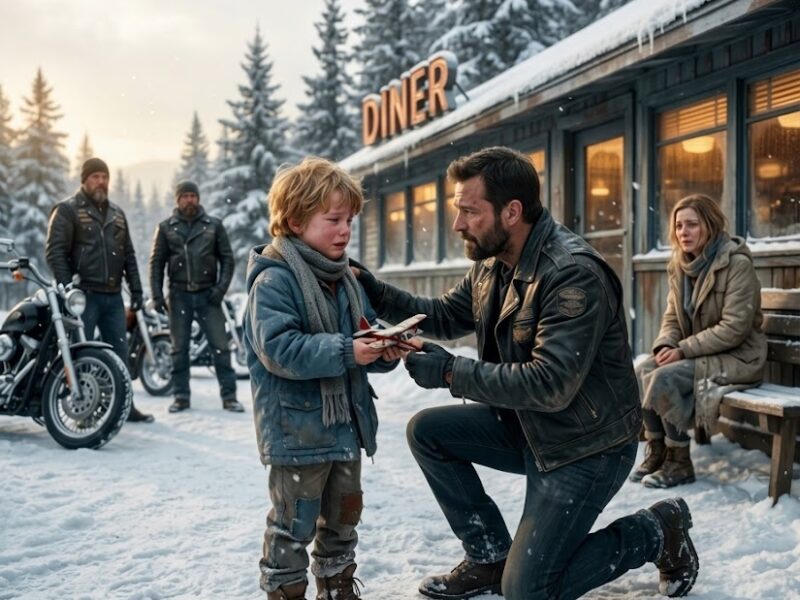
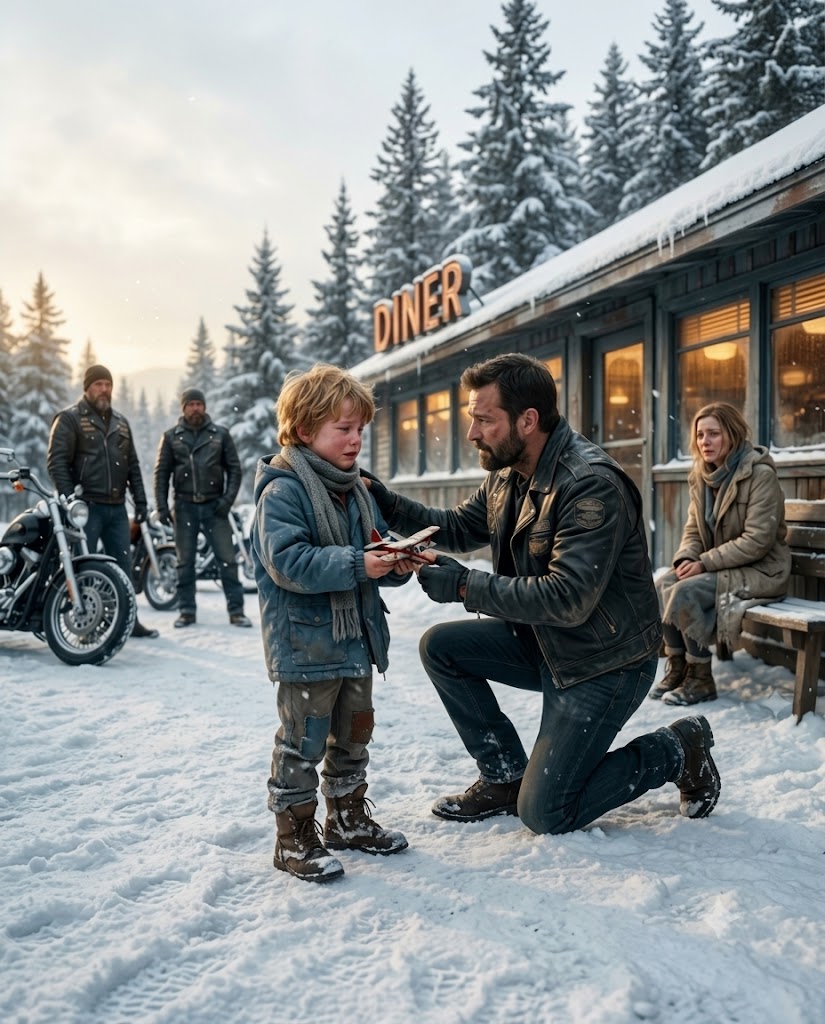
A small boy stood alone at the railroad crossing, clutching a model airplane to his chest like a lifeline.
His clothes were worn thin, his sneakers held together with duct tape, and his deep brown eyes held a weight no child should carry.
He watched the rumble of motorcycles approach, the kind of sound that made most people step back and look away.
But Tommy didn’t step back.
He stepped forward, holding out the battered P-51 Mustang with trembling hands.
“Please buy my toy plane, sir,” he said, his voice barely carrying over the engine noise.
“It flies really good. Well, not really, but you can pretend.”
Hawk cut the engine and swung off his bike, his leather creaking as he knelt down.
Up close, he could see the boy was cleaner than his clothes suggested—someone was still trying to take care of him.
“Why are you selling it, Tommy?” Hawk asked, reading the name stitched inside the boy’s worn collar.
Tommy’s lip quivered and he looked back toward the fence, where a thin figure sat in the shadows.
“Mommy hasn’t eaten in three days,” he whispered.
“She says she’s not hungry, but I know she’s lying. She gives me all the food.”
Behind the fence, in the shadow of an abandoned loading dock, Hawk could just make out a woman.
She was thin as autumn leaves, sitting against the wall with her head in her hands, wearing a business skirt that had seen better days.
Even from here, he could see her shoulders shaking.
Diesel moved closer, his massive frame casting a shadow over the boy.
“What happened to your dad, son?”
Tommy’s grip on the airplane tightened until his knuckles went white.
“He was a soldier, Army. He went to Afghanistan when I was five. He said he’d come back and we’d finish building my model collection.”
The boy’s voice broke completely.
“He didn’t come back the same way. He came back in a box with a flag on it.”
The bikers exchanged glances, each of them understanding loss in a way that didn’t need words.
“Where do you live now?” Jade asked gently, crouching down beside Hawk.
Tommy pointed past the loading dock.
“There’s a place under the overpass. Mom put up some cardboard to make walls. We have sleeping bags.”
He paused, his small chest heaving.
“It’s just—we don’t have food anymore.”
The words hit like punches.
A veteran’s widow and child living under an overpass in America, in a city with glass towers scraping the sky.
“Tell us what happened,” Knox said, his gravelly voice thick with controlled anger.
“All of it.”
Tommy looked at his mother again, then back at the bikers.
Maybe it was something in their faces—the same righteous fury his father used to get when he saw injustice.
Or maybe he was just tired of carrying the weight alone.
“Mom worked at this big company,” he began. “Meridian Properties. She managed buildings, helped people find apartments, fixed things when they broke.”
His small chest puffed with pride for a moment.
“She got awards and everything. After Dad died, she got the job because she said she had to take care of me. Had to make him proud.”
“What changed?” Reaper asked.
“There was this man, Mr. Crane. He was her boss’s boss or something.”
Tommy’s face twisted with a confusion too adult for his years.
“He started coming by her office, saying things, telling her she was pretty, asking her to dinner. Mom always said no.”
“Why do grown-ups do that?” Tommy asked, looking up at the circle of leather-clad men.
“When someone says no, why don’t they listen?”
None of the bikers answered. They all knew why. They’d all seen it before.
“Then one day, Mr. Crane tried to—he grabbed her in the parking garage after work.”
Tommy’s hands were shaking now.
“She pushed him away and told him she was going to report him. He laughed. He actually laughed and said nobody would believe her over him.”
“Mom went to HR the next day. She had bruises on her arms from where he grabbed her.”
“Let me guess,” Diesel rumbled. “They investigated her right out of a job.”
Tommy nodded.
“Two weeks later, they fired her. Said her performance was slipping, said clients were complaining. But Mom showed me the reviews. Everyone loved her. It was all lies.”
“And then?” Hawk prompted, though he could already feel the rage building in his chest like a pressure cooker about to blow.
“Then she couldn’t get another job. She’d apply everywhere, and at first they’d be interested. But then after they made phone calls to check her references, they’d say the position was filled.”
The boy’s voice was flat now, reciting facts he’d heard whispered late at night.
“It happened ten times. Fifteen times. Twenty times. Mom said she was blacklisted.”
“Jesus Christ,” Mouse muttered.
“We ran out of money,” Tommy continued. “First, we stopped buying new things. Then we sold stuff. Mom’s jewelry, the TV, Dad’s tools.”
He swallowed hard.
“Then we couldn’t pay rent anymore. The landlord said he was sorry, but he had to evict us. That was three weeks ago.”
Three weeks.
This child had been homeless for three weeks while the man who destroyed his mother’s life probably played golf and slept in a bed worth more than most people’s cars.
“Mom tries to get food at the shelters,” Tommy said. “But there’s not always enough. She makes sure I eat. She always makes sure I eat.”
He looked down at the airplane, and a single tear rolled down his cheek.
“Dad gave me this kit the week before he deployed. He said we’d build it together when he got back.”
Hawk stood slowly, every muscle in his body coiled tight.
He’d served, too. Marines, two tours in Iraq. He’d come home with shrapnel in his leg and ghosts in his head.
The Angels had saved him, given him a brotherhood when he had nothing else.
And he’d seen too many brothers come home to nothing, to a country that thanked them for their service and then forgot they existed.
He reached into his vest, pulled out his wallet, and placed every bill he had into Tommy’s small hands.
Two hundred and thirty-seven dollars.
“Keep the Mustang,” he said, his voice rough with emotion.
“Your dad would want you to have it. He’d want you to remember him every time you look at it.”
The other Hell’s Angels did the same, emptying their pockets until Tommy’s hands overflowed with cash.
Over a thousand dollars appeared in those small, trembling hands.
“I—I can’t,” Tommy stammered. “This is too much.”
“It’s not enough,” Jade said softly. “Not nearly enough, but it’s a start.”
“Take it to your mom,” Diesel told him. “Get food. Get a motel room for a few nights. Get whatever you need.”
But Hawk wasn’t done. His jaw was set, his eyes hard as flint.
He stood, turned to his brothers and sister.
“Who wants to take a ride?”
They all knew that look. They’d seen it before.
The night they’d defended a battered woman from her ex-husband who’d violated a restraining order.
The day they’d stopped a loan shark from burning down a family’s restaurant.
The time they’d surrounded a school bus when gang members tried to intimidate kids.
The Hell’s Angels had their own code, their own justice.
They didn’t start trouble, but they damn sure finished it.
Mouse, the youngest and largest of them, grinned.
“I was hoping you’d say that.”
“Get your mom,” Hawk told Tommy. “We’ll be back in a few hours. Find a safe place to stay tonight—somewhere with a phone. Can you do that?”
Tommy nodded, still staring at the money like it was a miracle he didn’t quite believe in.
“Good. We’ve got some business to attend to.”
The engines roared back to life—thunder given mechanical form.
The Hell’s Angels pulled out, leaving Tommy standing there with enough money to survive and a hope he hadn’t felt in weeks.
In the cab of his bike, Hawk pulled out his phone. Reaper did the same.
They had connections—not the kind that Maxwell Crane had, but the kind that mattered.
By the time they reached downtown, they had a file building.
Three other women who’d complained about Crane. Two who’d been paid settlements with NDAs attached.
One who’d tried to sue and been crushed by Meridian’s legal team.
Phone records that showed patterns of calls right before women’s careers suddenly ended.
Emails that HR had thought were deleted but weren’t.
A digital trail of cruelty and abuse of power.
Meridian Properties occupied the top three floors of the Sterling Tower downtown.
All glass and steel and arrogance.
The building gleamed in the afternoon sun, a monument to wealth built on the backs of people like Sarah Miller.
The receptionist’s face went pale when six Hell’s Angels walked through the lobby like a thunderstorm given human form.
They didn’t run, didn’t shout.
They just walked with the confidence of people who knew they were right and didn’t give a damn who disagreed.
“We’re here to see Maxwell Crane,” Hawk said. It wasn’t a request.
“Do you have an appointment?” the receptionist started, her hand already moving toward security.
“Now.”
Hawk’s voice dropped to something cold and absolute.
Something in his eyes made her reach for the phone instead.
Security showed up—two rent-a-cops with potbellies and attitudes.
One reached for his radio.
Reaper smiled, and it wasn’t friendly.
“You really want to do this? We’re not leaving until we talk to Crane. You can make this easy, or you can make it memorable. Your call.”
The guards looked at each other, looked at the six bikers who’d faced down worse than mall cops.
Made a smart decision.
“Third floor,” one muttered. “Corner office.”
They found Crane in his corner office, windows overlooking the city he’d helped reshape—helped hollow out.
The office was obscene in its luxury.
Persian rugs, leather furniture, a desk that probably cost more than Sarah Miller had earned in six months.
Abstract art on the walls, the kind rich people bought to prove they were cultured.
He was on a call, laughing about a golf game, feet up on his desk, when his door opened without warning.
“What the hell is this?” he demanded, swinging his legs down and standing, his face flushed red.
Hawk walked to the desk and placed something on its polished surface.
The model airplane—the P-51 Mustang with its red body and silver wings, slightly battered from being loved by a child.
“You know a woman named Sarah Miller.”
Crane’s eyes flickered just for a second with recognition.
Then the shutters came down, the executive mask sliding into place.
“I don’t know what you’re talking about, and you need to leave before I have you arrested for trespassing.”
“Yes, you do.”
Jade stepped forward. She was the only woman in their crew and often the most frightening when she needed to be.
Her voice was ice.
“You got her fired. You blacklisted her. You destroyed her life because your ego couldn’t handle being told no by a woman who had more integrity in her pinky finger than you have in your whole body.”
“That’s defamation.”
“That’s the truth,” Reaper cut in, pulling out his phone.
“And we’ve got proof. Phone records showing calls between you and HR three times the day before she was fired. Emails from your corporate account to competitors, specifically mentioning Sarah Miller. Testimony from three other women you’ve done this to.”
He held up his phone.
“One call to the press, one click to send these files to the state labor board, one social media post, and this all becomes very, very public.”
Crane’s face went from red to white.
“What do you want? Money? How much?”
The bikers looked at each other, and Knox actually laughed—a sound like grinding metal.
“You still don’t get it. We don’t want your money, you piece of trash.”
Hawk leaned across the desk, his hands flat on the surface.
“Sarah Miller gets her job back. Full pay, benefits, back pay for every single day she’s been out of work. Those other women you blacklisted? Same deal. Every single one of them.”
He smiled, and it was the coldest thing Maxwell Crane had ever seen.
“And you? You resign today, effective immediately. You issue a public apology for creating a hostile work environment, and you make a donation to the women’s shelter on Fifth Street. Six figures minimum—maybe seven if you’re feeling generous, which you should be, considering we’re giving you a choice instead of just burying you.”
“You can’t force me to—”
“We’re not forcing anything,” Knox said softly, dangerously.
“We’re giving you a choice. Do the right thing. Walk away with some dignity. Or watch your whole world come down around you, because we don’t bluff. We don’t negotiate. And we sure as hell don’t forget.”
Mouse cracked his knuckles, the sound loud in the office.
“We’ve already sent copies of everything to our lawyer. Anything happens to us, to Sarah Miller, to her kid, to anyone connected to this—it all goes public automatically.”
“You’ll be done. Not just here, everywhere. Every news outlet, every social media platform. Your name will be synonymous with sexual predator and corporate corruption.”
“Your wife will know, your kids will know, your parents, your friends, everyone at your country club. We’ll make sure of it.”
The silence stretched like wire about to snap.
Crane looked from one face to another, searching for weakness, finding none.
These weren’t people he could intimidate or buy off.
These were people who’d decided he was a problem that needed solving.
“And if I refuse?”
Hawk picked up the airplane, turning it slowly in his hands.
“Then we make sure everyone knows exactly what kind of man you are. Starting with the military veterans networks. You know, people who might take it personally that you destroyed a fallen soldier’s widow and left his kid homeless.”
He turned toward the door.
“You’ve got until 5:00. After that, we start making calls.”
They walked out the way they’d come in—boots echoing on marble, leaving Maxwell Crane standing alone in his glass tower with the weight of his sins finally pressing down.
Behind them, they could hear him already on the phone, his voice shaking.
By evening, the news was spreading like wildfire.
An anonymous whistleblower had exposed a pattern of harassment and retaliation at Meridian Properties.
The vice president had resigned, citing personal reasons.
Four women, including Sarah Miller, had been rehired with full compensation, formal apologies, and promotion opportunities.
The company pledged sweeping policy reforms, mandatory training, and donated half a million dollars to local charities supporting victims of workplace harassment and homeless veterans’ families.
The board of directors issued a statement condemning Crane’s actions.
His name was scrubbed from the company website.
His corner office was emptied by the end of business.
The glass tower he’d ruled from no longer had a place for him.
When the Hell’s Angels returned to that railroad crossing, the sun was setting gold and amber, painting the industrial wasteland in colors too beautiful for such a broken place.
Sarah stood now, tears streaming down her face, Tommy clutched against her side.
She was still thin, still weak, but there was light in her eyes again—the light of someone who’d been drowning and suddenly felt solid ground beneath her feet.
Hawk dismounted and handed the boy his airplane.
“You were right,” Hawk said gently. “It flies real good.”
Tommy held the Mustang tight, then looked up at the bikers with eyes that had found their light again.
“My dad always said Hell’s Angels were heroes. He had a friend who was an angel back before he enlisted. He said angels look after people who can’t look after themselves.”
Mouse laughed, a sound that didn’t match his intimidating size.
“Nah, kid. We’re just people who remember what it’s like to need someone to care.”
Sarah stepped forward, her voice breaking.
“I don’t—I don’t know how to thank you. You gave us our lives back.”
“I got a call an hour ago. I start back at work on Monday with a raise. And they’re paying me for the time I lost. We can get an apartment again. Tommy can go back to school. I can—”
She broke down completely, and Jade moved forward to hold her while she sobbed.
“You don’t owe us anything,” Hawk said quietly.
“You just survive. You build a good life for that boy. You remember his father. And if you ever see someone else in trouble, you help them. That’s how this works. That’s how we make the world a little less terrible.”
They shared pizza that night, sitting on curbs and crates in that forgotten corner of the industrial district.
The Hell’s Angels, the mother, and the boy who’d been willing to sell his last connection to his father for love.
Tommy told them stories about his dad—about the day they’d started building the Mustang, about how his father used to do silly voices when he read bedtime stories.
The bikers listened and laughed and shared their own stories of brothers lost and found.
The last light painted everything gold.
The motorcycles, the fence, the small airplane standing proud on Tommy’s knee, wings catching the dying sun like it was ready to fly after all.
Diesel pulled out his phone and showed Sarah pictures of his daughter, who was studying to be a lawyer.
“When she graduates, I’ll send her your way. Pro bono work, if you want to pursue anything legal against that bastard.”
“We’ve also got connections with veteran services,” Knox added. “Better ones than what you’d find on your own. We’ll make sure you get everything your husband’s sacrifice entitled you to. Every benefit, every program. You’re not alone anymore.”
For just a moment, in that industrial wasteland where hope had seemed like a foreign concept, the world felt like it had justice after all.
Not the kind that came from courts and lawyers, but the kind that came from people who gave a damn.
As the sky darkened and stars began to appear, Tommy looked up at Hawk.
“Will I see you again?”
Hawk smiled, and it was genuine this time.
“Yeah, kid. You’ll see us. We check in on our own. You’re part of the family now.”
The boy nodded solemnly, understanding in some deep way that he’d been adopted by something bigger than himself.
A brotherhood that didn’t care about blood or background, only about doing right by people when the world did them wrong.
The Hell’s Angels mounted their bikes as the streetlights flickered on.
The engines rumbled to life—a sound that no longer seemed threatening but protective, like the growl of a guardian watching over its territory.
They rode out into the night, leaving behind a woman who could breathe again and a child who didn’t have to sell his treasures to survive.
Somewhere above them, maybe Tommy’s father was watching.
And maybe, just maybe, he was proud—not just of his son’s sacrifice, but of the rough men in leather who’d answered a little boy’s prayer when heaven seemed too far away to hear.
Because sometimes the bravest thing we can do is stand up when everyone else looks away.
Sometimes justice doesn’t come from a courtroom or a badge.
It comes from people who refuse to let cruelty win.
And sometimes the roughest exteriors hide the biggest hearts.









