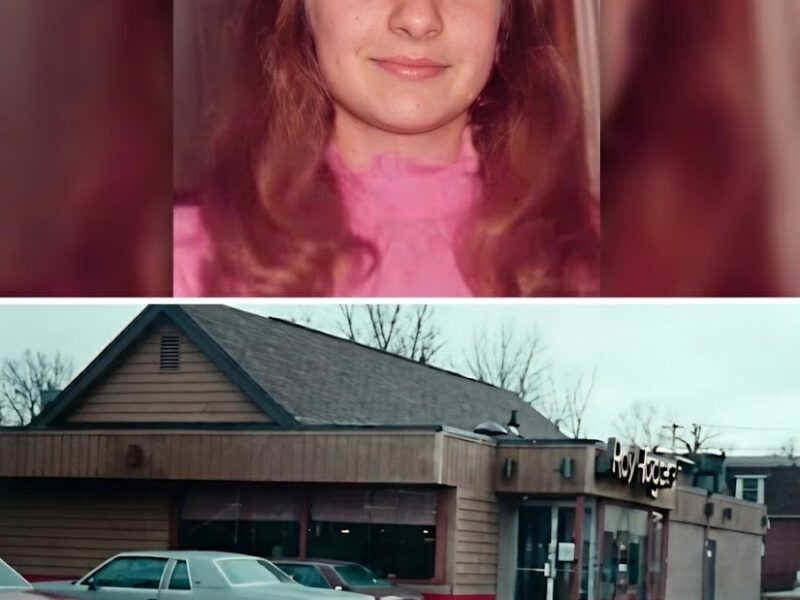
Pennsylvania’s 1984 Restaurant Cold Case Was Solved—The Arrest Stunned the Community
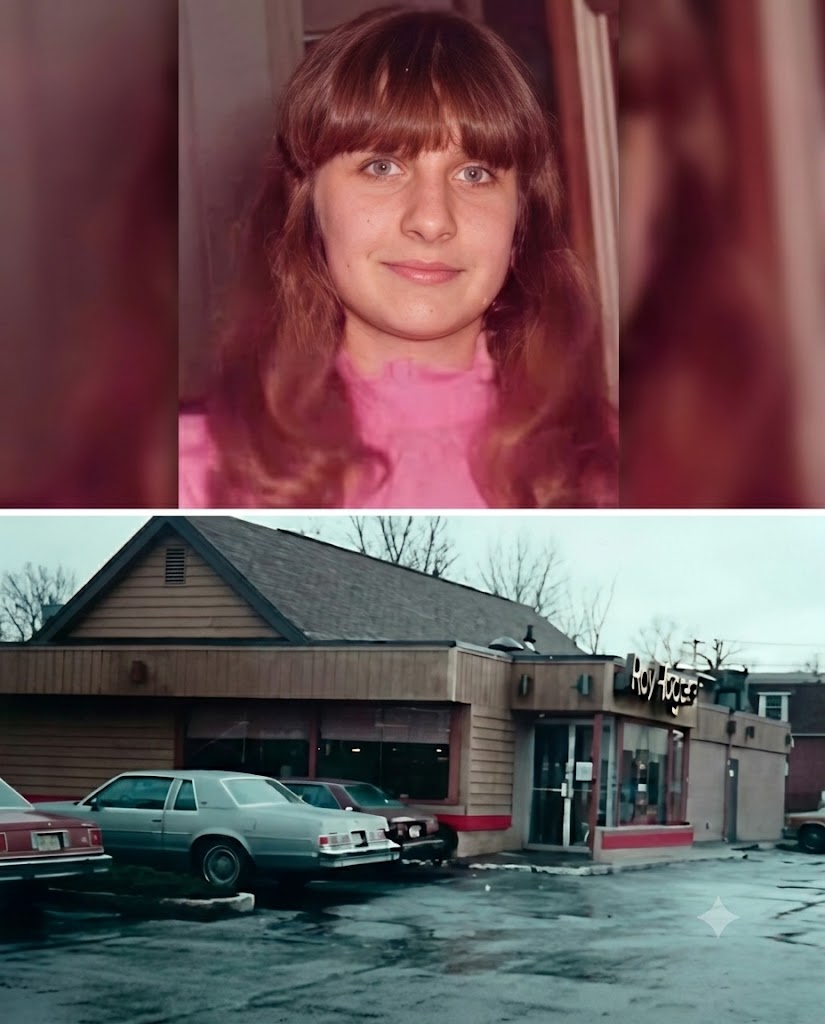
The morning of February 4th, 1984, broke cold and gray over Falls Township, Pennsylvania, the kind of winter light that made the Lincoln Highway look like a strip of abandoned film.
The day manager of the Roy Rogers restaurant arrived before dawn to open for the breakfast shift, his breath fogging as he fumbled with the keys.
He expected the usual quiet—the hum of the walk-in cooler, the smell of yesterday’s fry oil, the soft click of the office door.
What he found instead stopped him in the kitchen doorway with his coat still half-zipped.
The night manager was on the floor, face up, still wearing her winter coat.
Her head had been slammed against the concrete with such force that the medical examiner would later describe the damage as a brain hemorrhage caused by blunt impact.
Hand marks circled her neck, dark and deliberate, the print of fingers that had squeezed until the skin bruised.
A kitchen knife stood embedded in her throat, driven with enough force to reach the tile underneath.
A plastic trash bag was wrapped around her head, twisted at the neck.
The coroner determined the stab wound had likely paralyzed her but had not killed her—she was conscious when she was suffocated.
Her cause of death was asphyxiation.
The safe behind the counter was open and empty.
Roughly $2,500 was missing.
The drive-thru window was partially open, a thin gap of cold air slipping through.
Every exterior door was locked from the inside.
Investigators treated it as a robbery from the first hour, because that was the story the scene told them, and they believed it.
They collected fifteen fingerprints that matched nothing in any database, fifteen silent smudges of a stranger who did not exist in the files.
They recovered skin tissue from under the victim’s fingernails—evidence that she had fought back, clawed at her attacker, left a piece of him behind.
In 1984, there was no technology that could read it.
The case went cold.
The evidence went into a locker.
It stayed there for fifteen years.
Two weeks after the murder, the man who killed her signed his name in her funeral guestbook.
That guestbook was collected as part of the case file.
It sat in police records for fifteen years.
Nobody ever opened it.
—
Her name was Terry Lynn Brooks.
She was twenty-five years old, a magna cum laude graduate of the University of Maryland who had chosen the restaurant industry over the career her degree was built for because she loved the work—the rhythm of a Friday night rush, the satisfaction of a closing checklist done right.
She was engaged to be married that summer.
Two days before she was killed, she and her fiancé had put down a deposit on a honeymoon trip to Hawaii, a detail that would later feel like a cruel joke tucked inside a tragedy.
It took fifteen years, a room full of retired forensic experts eating lunch in Philadelphia, and a cigarette butt pulled from a trash can on a public curb to finally close the case.
Before we go any further, if you’re new here, this channel covers cold cases that took decades to solve.
Subscribe so you don’t miss the next one.
Drop where you’re watching from in the comments.
And if you stay until the end of this one, you’ll find out why a forensic psychologist told detectives they had been solving the wrong crime for fourteen years—and why the answer had been sitting in a guestbook since the week of the funeral.
Now, back to the case.
Terry lived in Falls Township, Bucks County, close to her father George and her stepmother Betty.
Her sister Vicki was nearby.
The family was tight, the kind of household where people kept track of each other without being asked, where a missing car in the driveway was a five-alarm fire before breakfast.
By the winter of 1984, Terry was the night manager at the Roy Rogers on Lincoln Highway and Oxford Valley Road in Fairless Hills.
The restaurant was owned by Marriott, a corporate stepping stone she was climbing with intention.
She had been promoted recently and was building toward something bigger within the company, a career she had chosen for herself against the grain of her degree.
Her fiancé, Scott Keefe, was twenty-two.
They had been together for a while and were planning a summer wedding.
Two days before everything changed, they put down a deposit on a honeymoon to Hawaii.
He drove by the restaurant regularly after closing to check on her, sat with her while she finished paperwork, gave her rides home.
To her family, he was attentive and caring.
To everyone on the outside, the relationship looked like it was heading exactly where it was supposed to.
On the evening of Friday, February 3rd, 1984, Terry worked the closing shift.
Around ten o’clock p.m., she called Scott to tell him she would be working late.
The last of the teenage crew left around one-thirty in the morning.
Terry stayed behind to finish paperwork, the same routine she followed every Friday night.
She locked the doors, secured the restaurant, and settled in alone.
She never came home.
By six a.m., the day manager was standing in a kitchen he had walked through hundreds of times.
Nothing in the room looked the way it was supposed to.
Terry’s shoes were against a far wall—not there by force, but by distance, the kind of gap that told a story before anyone said a word.
Her purse was on the floor, contents scattered.
Officer Nelson Whitney, one of the first on scene, looked at the distance between the shoes and the body and read it as the opening act of violence.
She had been pushed out of them.
Whatever happened in that kitchen started fast and started hard.
The medical examiner’s report filled in what the crime scene suggested.
Terry had been punched in the face.
Her head had been driven into the concrete floor with enough force to cause a brain hemorrhage.
A bone in the back of her neck had been severed by the knife wound.
On the underside of her right ring finger, there was a deep defensive cut—the kind left when someone grabs at a blade.
Investigators preserved the tissue samples from that wound and from beneath her fingernails, logged roughly ninety pieces of physical evidence, and collected more than two hundred witness statements in the weeks that followed.
Everything was boxed and stored at Falls Township.
Later that morning, Scott Keefe showed up at the Brooks family home.
He knocked on the door and told them Terry’s car was not in the driveway.
He said he had driven by and noticed it was missing, which concerned him.
Vicki answered the door.
George checked Terry’s bedroom.
The bed was untouched.
Her things were exactly where she had left them the night before.
George picked up the phone and called the Roy Rogers.
The day manager answered.
George identified himself as Terry’s father and asked if she was there.
The manager told him what he had found that morning.
George was still holding the phone when the weight of it hit the room.
Betty, Vicki, and Keefe were all standing there.
A father absorbing the worst sentence of his life while his daughter’s fiancé stood in the kitchen and watched.
Keefe stayed with the family.
He was still sitting there when police arrived a short while later to officially notify them.
Vicki described the moment as a bomb going off inside the house.
There was nowhere to go and nothing to do and no way to take back what had been said.
To the officers processing the scene, the open safe, the missing cash, and the partially open drive-thru window told a clear story.
A stranger had targeted a woman working alone late at night, forced entry through the window, robbed the restaurant, and killed her when the situation escalated.
That theory took hold within the first hour.
It would guide every investigative decision for the next fifteen years.
Nobody in that first wave of investigators stopped to ask why a robber would drive a knife through a woman’s throat and into the floor beneath her.
Nobody asked why a man after cash would wrap a bag around her face and hold it there while she was still breathing.
Nobody asked why every door was locked and there was no sign of forced entry at the window.
The answers were already in the room.
They just pointed somewhere no one was looking.
The first suspect was a recently fired cook named Steve Daily.
He had worked at the Roy Rogers until Terry let him go after he threw a violent tantrum in the kitchen and cursed at her in front of the staff.
Getting fired did not make him go away.
He kept coming back to the restaurant as a customer, sitting in the dining area, making his presence felt.
Co-workers noticed it.
Management noticed it.
When investigators brought him in, his alibi for the night was thin, but he agreed to a polygraph and passed it.
Without enough to hold him, detectives moved on.
Then the case took a turn that would consume resources for weeks and lock investigators into a theory that had nothing to do with what actually happened in that kitchen.
Two weeks after Terry’s murder, another female assistant manager at a nearby Roy Rogers was attacked by an unknown man who came out of the bathroom while she was closing alone.
She survived.
One week after that, roughly 130 miles northwest in Scranton, a lone female employee at a different restaurant was attacked after closing by a man who waited until she was alone, demanded money, and when she could not access the safe, stabbed her to death.
Scranton police had a suspect named Steve Duffy.
Falls Township investigators obtained his fingerprints.
They did not match anything from Terry’s scene.
Both attacks turned out to be completely unrelated, but the damage was done.
The serial robber theory had taken root, and it reinforced the narrative that Terry had been killed by a stranger during a botched holdup.
Every lead that followed pointed outward toward unknown predators targeting women who worked alone in fast-food restaurants late at night.
Scott Keefe was interviewed early in the investigation as a matter of routine.
He told detectives he had not gone to the restaurant that night because he had an early shift the next morning.
Terry’s family described him as a loving and attentive fiancé.
He had an alibi.
He was cleared.
By the mid-1980s, every lead had been exhausted.
The fingerprints matched no one.
The serial robber theory had collapsed under its own weight, but the thinking behind it—that the killer was a stranger—had not.
The file was boxed up alongside the ninety pieces of evidence and two hundred witness statements that had produced nothing.
The case went cold.
—
Betty Brooks did not accept it.
She never said it to investigators.
She never said it publicly, but something about the robbery theory had never sat right with her.
The violence was too much.
The staging felt wrong.
She could not explain what she believed had happened, but she knew in a place deeper than logic that the official version was incomplete.
George did not share it.
To him, the investigation had done its work, and the answers simply had not come.
That difference sat quietly between husband and wife for years.
It never became an argument.
It never became a conversation.
It just lived in the house with them, the way grief does when two people carry it differently.
Vicki carried it her own way.
She had opened the front door that Saturday morning and seen Keefe standing there.
She had been in the kitchen when her father picked up the phone and heard the words that split the family in two.
She was the one who described it as a bomb going off.
The blast never fully settled.
It just became something the family lived inside of.
1984 became 1990.
1990 became 1995.
The Roy Rogers where Terry was killed eventually closed.
The intersection of Lincoln Highway and Oxford Valley Road moved on without her.
Detectives who had worked the original case retired or transferred.
New officers inherited the file, read through the stacks of reports, and reached the same conclusion every time.
Every actionable lead had been exhausted years earlier.
The evidence sat in storage.
The biological material from Terry’s fingernails and the wound on her right ring finger sat in a police locker waiting for technology that did not yet exist.
George and Betty still lived in Falls Township.
They still drove past the roads Terry had driven.
Keefe had moved on.
He married someone else, had a child, divorced.
He eventually moved back to his parents’ house in Falls Township, not far from where the Brooks family still lived.
The family had little contact with him after the funeral, and over the years he faded from their daily lives.
But he never fully left their thoughts, and Betty’s quiet feeling never went away.
In 1998, fourteen years after the murder, a new Falls Township Police Chief named Arnold Colon made a decision that would change the course of the case.
DNA technology had advanced dramatically since 1984.
Cases that had been unsolvable were being reopened across the country with results that would have seemed impossible a decade earlier.
Colon believed the biological evidence preserved from that kitchen floor could finally be tested.
He ordered the case reopened and assigned investigator Nelson Whitney and prosecutor Lori Markle to lead the new effort.
Then Colon did something no one in Falls Township had tried before.
He brought the case to the Vidocq Society.
The Vidocq Society operated out of Philadelphia—a group of forensic psychologists, retired detectives, and evidence specialists who had spent their careers solving violent crimes and were not ready to stop.
They met once a month in a Victorian dining room, reviewed a single cold case over lunch, and offered their expertise for free.
By the time Falls Township brought them the Terry Brooks file, the group had already built a reputation for seeing what overworked local departments had missed.
Forensic psychologist Dr. Richard Walter sat through the entire presentation.
When investigators finished laying out fourteen years of dead ends and a robbery theory that had never produced a suspect, Walter stood up and told them they had been looking at the wrong crime.
“This was not a robbery,” Walter said, his voice flat and certain.
The violence was too personal.
What robbery suspect would drive a knife through someone with that kind of force?
What robber would wrap a bag around a woman’s face and hold it there while she was still alive?
Walter called it rage, not robbery.
The staged safe and the missing cash were misdirection, not motive.
The killer was someone who knew Terry, someone who had been close to her, someone who felt rejected or threatened by her independence.
Walter told the detectives to stop chasing strangers and go back to the people closest to Terry—specifically anyone who had been pushed away by her in the weeks before she died.
In one afternoon, the theory that had guided the investigation for nearly fifteen years collapsed.
—
Investigators went back to the beginning.
They pulled old files.
They reread every witness statement.
They combed through every name connected to Terry’s personal life, and in the process, they found someone who should have been in the original file but never was.
Cindy Bradney had been one of Terry’s closest friends, a former co-worker from a previous job who knew things about Terry’s life that nobody in the family or on the investigative team had ever heard.
When Whitney and Markle sat her down, what she told them rewrote the case from the ground up.
The relationship between Terry and her fiancé had become strained in the months before the murder.
Those regular check-ins, the drive-bys past the restaurant, sitting with her while she finished paperwork—none of it was concern.
It was control.
He was jealous.
He was possessive.
He monitored who she talked to and when she was alone.
Bradney said his jealousy had become an issue, that he would not let Terry stay alone, and that she was afraid to tell him she did not want to be married.
The week before the murder, Terry had told Cindy she wanted to call off the wedding.
She just did not know how to tell him.
Everything Richard Walter had profiled from the crime scene—the personal rage, the rejection, the misdirection—matched exactly what Cindy Bradney had been carrying for fifteen years.
The robbery theory was dead.
And for the first time since 1984, the investigation had a direction.
Investigators asked the Brooks family about Terry’s boyfriends.
George and Betty remembered one name.
They thought it was O’Keefe.
Whitney and Markle searched arrest records and news articles for any mention of an O’Keefe connected to Terry.
Nothing came back.
Then they opened the funeral guestbook—the one that had been sitting in police files since 1984.
A name was written inside it, not O’Keefe, but Alfred Scott Keefe.
The man who had killed her had signed his name at her funeral.
The guestbook had been in police custody for fifteen years.
Nobody had ever opened it.
Finding him took work.
Keefe had been off the radar for years, but investigators caught a break when they discovered he had recently been arrested for driving under the influence in another jurisdiction.
The DUI gave them a current address in Warminster, Pennsylvania, where he was living with his brother Charles.
Whitney and Markle began watching the house.
They observed his routine and waited for the right moment to collect what they needed without alerting him.
Keefe was a smoker.
He discarded his cigarette butts in the trash outside.
In October of 1998, Whitney moved on it.
He pulled the butts from the trash can before collection.
They also obtained cigarette butts from Charles at a restaurant to eliminate him as a possible match.
The DNA from Keefe’s saliva was tested against the skin tissue that had been preserved from under Terry’s fingernails since February of 1984.
Charles came back negative.
Keefe came back positive.
Fourteen years of dead ends, a robbery theory that led nowhere—and the answer had been a man the investigation cleared in the first week.
The evidence Terry left on her killer when she fought back in that kitchen finally had a name attached to it.
On February 5th, 1999—fifteen years and one day after the murder—Alfred Scott Keefe was brought in for questioning at the Falls Township Police Station.
He was thirty-seven years old.
He had been living quietly in Warminster, drawing no attention to himself for over a decade.
To anyone who knew him, he was a man who had once lost his fiancée to a terrible crime and had moved on with his life.
He told the same story he had given in 1984.
He did not go to the restaurant that night.
He had an early shift the next morning.
He had nothing to do with what happened to Terry.
Investigators told him about the DNA.
They asked him to take a polygraph.
He agreed.
He failed.
After the results came back, the story he had held together for fifteen years started coming apart in pieces.
He told detectives he did not mean for it to happen.
Then he caught himself and pulled back.
He said he had not done it.
Investigators kept the pressure steady and let the silence do its work.
His account kept shifting in small ways, each shift pulling him closer to something he could not take back.
Then he said she came at him first.
It was the first time in fifteen years he had placed himself inside that restaurant on the night Terry was killed.
From that point, there was nowhere left to go.
He told investigators he had gone to the Roy Rogers late that night—not randomly, but deliberately—because Terry had been distant and he suspected she wanted to end the engagement.
He went there to confront her after the other employees had left.
She let him in through the locked door.
That was the detail that had puzzled investigators since the first morning.
Every entrance secured, no sign of forced entry.
She opened the door because she knew him, because she trusted him.
They argued.
Terry told him the engagement was over.
She did not want to marry him.
Keefe said he could not accept it.
Somewhere in that argument, something in him broke.
He punched her in the face.
He choked her with his hands.
He grabbed a kitchen knife from an open drawer and drove it into her throat.
But she was still alive.
He could see her breathing.
So he grabbed a plastic trash bag liner, wrapped it around her head, and held it in place until she was gone.
After she was dead, he moved through the restaurant with purpose.
He opened the safe and took roughly $2,500 in cash.
He opened the drive-thru window, climbed out, and left every exterior door locked behind him.
When the day manager arrived the next morning, it would look exactly like what Keefe needed it to look like—a robbery.
Then he admitted something that reframed the morning after entirely.
Going to the Brooks family home had not been grief.
It had not been worry.
It was calculated.
He went there to position himself as the concerned fiancé, so that when the news broke, he would be standing in the middle of the family’s pain, above suspicion, surrounded by people who trusted him.
Officer Whitney put it plainly.
The visit was a misdirection that worked for fifteen years.
He sat in their kitchen while George picked up the phone and learned his daughter had been murdered.
And Keefe sat there and watched.
Alfred Scott Keefe was charged with first-degree murder and robbery.
District Attorney Alan Rubenstein called it one of the most brutal homicides he had ever encountered.
Prosecutors announced they would seek the death penalty.
In 2000, Keefe pleaded guilty to first-degree murder and robbery to avoid a full trial.
On June 6th, 2000, he was sentenced to life in prison without the possibility of parole.
He offered a brief statement with minimal remorse and said nothing of substance about why he did what he did or why he let fifteen years pass without coming forward.
The arrest sent a shockwave through the Brooks family, but Betty Brooks was not surprised.
She had carried a quiet suspicion for fifteen years, and now she finally had confirmation.
The split that had sat between her and George—one believing the investigation had done its work, the other unable to accept the official story—was finally resolved.
Not in a way that brought peace, but in a way that at least brought an answer.
Betty also shared something she had held onto since just after the funeral.
About two weeks after Terry was buried, Keefe made a point of telling the family he had a date.
The man who had sat in their kitchen watching George learn his daughter was dead was already moving on to someone new before the ground over Terry’s grave had settled.
—
On the night of February 3rd, 1984, Terry Lynn Brooks stayed late at a Roy Rogers restaurant on Lincoln Highway to finish paperwork the way she did every Friday.
She locked the door, settled in alone, and expected nothing more than a quiet drive home.
She was twenty-five years old.
She had a degree she had earned with honors, a career she had chosen for herself, and a future she was building on her own terms.
When the man she was supposed to marry came through that door and tried to take all of it from her, she fought him hard enough to trap his skin under her fingernails.
That evidence sat in a police locker for fifteen years.
His name sat in a guestbook for fifteen years.
It was the same amount of time, and nobody looked at either one until a room full of retired experts in Philadelphia told the detectives they had been solving the wrong crime.
The guestbook was the quiet witness nobody thought to call.
It had been there since the week of the funeral, a bound book of signatures from mourners who came to pay respects, to shake hands, to say words they would forget by the following Sunday.
Among those signatures was a name written in the hand of the man who had put her in the ground.
The guestbook sat in a cardboard box in a records room, shelved between files that had been read a hundred times and one that had never been read at all.
When Whitney and Markle finally opened it, the pages were stiff with age, the ink faded but legible.
Alfred Scott Keefe.
He had signed it two weeks after the murder, standing in a funeral home among grieving family and friends, playing the role of the devastated fiancé.
That single signature connected the man to the crime in a way no fingerprint or witness statement ever had.
It placed him at the center of the aftermath, not as a mourner, but as an author of the grief.
The DNA was the lock.
The guestbook was the key.
And the $2,500 that had been taken from the safe—the money that had launched a fifteen-year search for a phantom robber—was the magician’s distraction, the hand that waved while the other hand did the work.
Keefe had not needed the money.
He had needed the story the money told.
A robbery explained the violence to people who wanted an explanation.
A robbery made the killer a stranger.
A robbery kept the people closest to Terry from looking at each other.
For fifteen years, the story worked.
For fifteen years, the Brooks family lived inside a version of events that pointed away from the man who sat in their kitchen and watched a father’s face collapse.
Betty Brooks had felt the wrongness of it in her bones, but she had no evidence, no name, no way to prove what she knew without proof.
She had only the violence, the staging, the sense that the official version was too clean for the mess it was supposed to explain.
When the call finally came, when the DNA matched and the guestbook was opened and the name was spoken aloud, Betty did not cry.
She had been waiting too long for tears.
She said she always knew.
Not because she was clairvoyant, not because she had some special insight, but because she had paid attention to the details that did not fit and refused to let them go.
George had let them go.
He had trusted the investigation, trusted the process, trusted that the answers would come if the work was done right.
The work had been done right, in a way—the evidence was preserved, the file was kept, the case was never officially closed.
But the work had been pointed in the wrong direction for fifteen years, and that was the tragedy inside the tragedy.
The system had worked exactly as designed, and the design had been wrong.
—
The Vidocq Society lunch that changed everything took place in a Victorian dining room in Philadelphia, where retired detectives and forensic specialists ate catered sandwiches and reviewed cold cases as a form of public service.
Dr. Richard Walter, a forensic psychologist with a reputation for reading crime scenes the way other people read novels, listened to the Falls Township presentation with increasing impatience.
When the detectives finished, he did not congratulate them on their thoroughness.
He told them they had wasted fifteen years chasing a story that the killer had written for them.
“Look at the violence,” Walter said, tapping a photograph of the kitchen floor.
“This is not the work of a man who wanted money. This is the work of a man who wanted to erase a person.”
He pointed to the knife, the bag, the hand marks on the neck.
“Every one of these acts is personal. Every one of them is about control, about rage, about a relationship that ended badly.”
Walter told them to find the man who had been rejected, the man who could not let go, the man who had been inside Terry’s life and inside her trust.
The detectives went back to the file and found Cindy Bradney, a name that had been mentioned once in a witness statement and never followed up.
Bradney told them about the jealousy, the possessiveness, the control.
She told them about the week before the murder, when Terry had said she wanted to call off the wedding but did not know how to tell him.
She told them about the fear in Terry’s voice when she talked about his reaction.
The profile and the witness statement fit together like two halves of a broken plate.
The investigation had been looking for a stranger, and the stranger had been the man they cleared in the first week.
—
The arrest of Alfred Scott Keefe in February 1999 was not dramatic.
There was no SWAT team, no televised perp walk, no crowd of reporters camped outside the police station.
There was a man in his late thirties, living with his brother in Warminster, driving a car that had been registered in his name, smoking cigarettes that he threw away in the trash.
Whitney and Markle watched him for weeks, learning his routine, waiting for the moment when they could collect the DNA without alerting him.
When they finally pulled the cigarette butts from the trash can outside his brother’s house, they had what they needed.
The lab compared the DNA from the saliva on the cigarette to the skin tissue from under Terry’s fingernails.
The match was positive.
The man who had been cleared in 1984 was now the primary suspect in 1999.
When they brought him in for questioning, Keefe was calm at first.
He told the same story he had told fifteen years earlier.
He had an early shift the next morning.
He did not go to the restaurant.
He had nothing to do with it.
Then they told him about the DNA.
They told him about the skin tissue from under Terry’s fingernails.
They told him about the guestbook with his signature in it.
They asked him to take a polygraph.
He agreed, and he failed.
After the polygraph, the story began to crack.
He said he did not mean for it to happen.
Then he said he did not do it.
Then he said she came at him first.
That was the moment the fifteen-year wall came down.
He had placed himself inside the restaurant.
From there, the confession came in pieces.
He had gone to the Roy Rogers to confront her.
She had let him in because she knew him.
They argued.
She told him the engagement was over.
He punched her.
He choked her.
He grabbed the knife.
He drove it into her throat.
She was still alive.
He wrapped the bag around her head and held it until she stopped breathing.
Then he opened the safe, took the money, opened the drive-thru window, and left.
He locked the doors behind him.
He went home.
He went to work the next morning.
He came to the Brooks family house and sat in their kitchen while George learned his daughter was dead.
He signed the guestbook at the funeral.
He told the family he had a date two weeks after the burial.
He lived fifteen years as a man who had lost his fiancée to a terrible crime.
He married someone else.
He had a child.
He divorced.
He moved back to Falls Township.
He drew no attention to himself.
He might have lived the rest of his life without ever being caught if the DNA technology had not advanced, if the case had not been reopened, if the Vidocq Society had not told the detectives they were solving the wrong crime.
But the DNA did advance.
The case was reopened.
The Vidocq Society did tell them.
And the guestbook did have his name in it.
—
The sentencing took place in June 2000, in a courtroom in Doylestown, Pennsylvania.
Keefe pleaded guilty to first-degree murder and robbery to avoid a full trial and the possibility of the death penalty.
He was sentenced to life in prison without the possibility of parole.
He offered a brief statement with minimal remorse.
He said nothing of substance about why he did what he did or why he let fifteen years pass without coming forward.
The Brooks family sat in the courtroom and listened.
Betty Brooks had waited fifteen years for this moment, and when it came, she did not feel the relief she had expected.
She felt the weight of all the years that had been taken from them.
She felt the absence of Terry, the hole in the family that had never healed, the birthdays and holidays and ordinary Tuesdays that Terry had not been there for.
She felt the strange, hollow satisfaction of an answer that had come too late to change anything.
George sat beside her, and the split that had lived between them for fifteen years was finally resolved.
Not in a way that brought peace, but in a way that at least brought an answer.
Vicki sat in the courtroom and remembered the morning she opened the front door and saw Keefe standing there.
She remembered the phone call, the words that split the family in two, the bomb that went off inside the house and never fully stopped exploding.
She remembered the way Keefe had sat in their kitchen and watched.
The guestbook sat in the evidence file, a bound book of signatures that had been collected and stored and never opened for fifteen years.
It was the quiet witness that finally spoke.
The $2,500 was the story that kept everyone looking in the wrong direction.
The DNA was the science that caught up with the crime.
The knife, the bag, the hand marks on the neck, the defensive wound on the ring finger—these were the details that had told the truth from the first hour.
The truth had been in the room the whole time.
It had just been pointing at the wrong man.
Terry Lynn Brooks was twenty-five years old when she was killed.
She was a magna cum laude graduate who loved the restaurant industry.
She was engaged to be married that summer.
She had put down a deposit on a honeymoon in Hawaii two days before she died.
She fought back hard enough to leave her killer’s skin under her fingernails.
She left evidence that waited fifteen years for technology to catch up.
She left a family that never stopped carrying her.
She left a guestbook with a name in it that nobody thought to read.
And she left a story that took fifteen years, a room full of retired experts, and a cigarette butt pulled from a trash can to finally tell.
—
The Roy Rogers on Lincoln Highway is gone now.
The intersection of Oxford Valley Road and Lincoln Highway has moved on without her.
The building that once held the kitchen where she died has been repurposed, repainted, reimagined into something else.
But the case file still exists.
The evidence log still lists ninety pieces of physical evidence and two hundred witness statements.
The guestbook still has his signature in it.
The DNA match still sits in a lab report, a scientific confirmation of what a forensic psychologist saw in an afternoon and what a mother felt in her bones for fifteen years.
Betty Brooks died without ever fully recovering from the loss of her daughter, but she died knowing the truth.
George Brooks died without ever fully reconciling the difference between his faith in the system and the system’s failure to see what was right in front of it.
Vicki Brooks carried the memory of that Saturday morning for the rest of her life.
Scott Keefe sits in a prison cell in Pennsylvania, serving a life sentence without the possibility of parole.
He has never explained why he did what he did.
He has never explained why he let fifteen years pass without coming forward.
He has never explained why he signed his name in the guestbook at the funeral of the woman he killed.
The guestbook remains the strangest detail in a case full of strange details.
A man who had just committed a murder, who had staged a robbery, who had sat in a family’s kitchen and watched them learn the worst news of their lives, walked into a funeral home and signed his name.
He did not have to.
He could have stayed away.
He could have disappeared.
He could have let the investigation chase strangers for the rest of his life.
But he signed the book.
He put his name on the record.
He left a trace that would sit in a police file for fifteen years, waiting for someone to open it.
Maybe he wanted to be caught.
Maybe he wanted to see his name next to hers one more time.
Maybe he thought no one would ever look.
The detectives who finally opened the guestbook in 1998 found his signature on a page near the back, written in blue ink, clear and deliberate.
It was the same handwriting that appeared on the statement he gave to police in 1984, the same handwriting that signed his marriage certificate years later, the same handwriting that signed his divorce papers, the same handwriting that signed the confession in 1999.
The handwriting never changed.
The name never changed.
The truth never changed.
It just took fifteen years for anyone to read it.
—
If this case stayed with you, let me know your thoughts in the comments and tell me where you’re watching from.
Subscribe so you don’t miss the next one.









