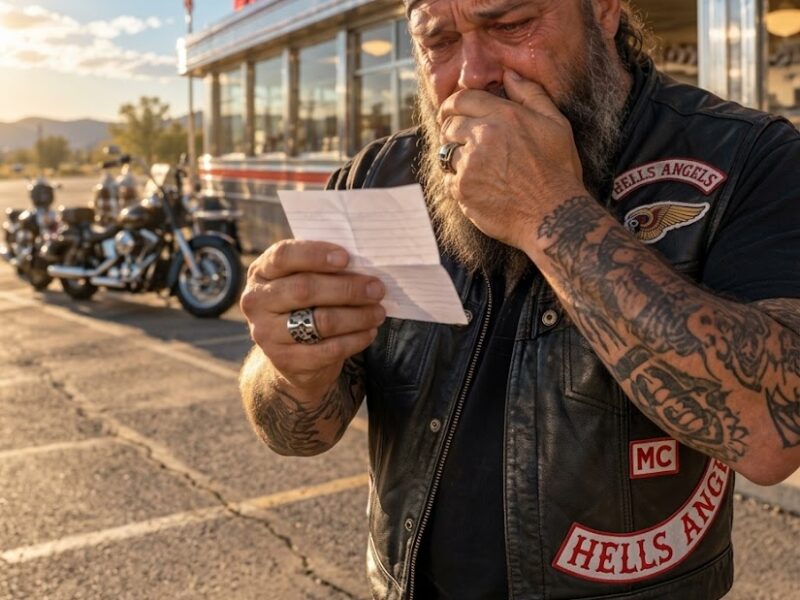
One Hell’s Angel read a note that wasn’t meant for him. Then he made one call — and 400 riders showed up.

She had $30 left and four days until the bank took her father’s house.
She had already been told no by the loan officer.
She had already been told no by the pastor’s wife.
She had already been told no by everyone who mattered.
So she folded one sheet of paper into quarters and walked toward the man everyone warned her to avoid.
Leather cut, arms sleeved in ink, beard gone silver, built like he’d absorbed forty years of other men’s worst days.
Every eye in that diner had already decided who he was before he lifted his head.
Nine years alone raising her son.
She set the note by his coffee cup and walked out before she could watch him read the four sentences that would bring four hundred strangers to her front door by sunrise.
—
The Sundown Diner had been serving eggs and gasoline station coffee to the same stretch of old Route 66 since before Meredith Thorne was born.
And on the second Thursday of October, it smelled the way it always smelled — bacon, grease, burnt toast, and the thin mountain air that slipped in every time the door swung open on Milton Road.
Meredith had worked the counter there for six years, long enough to know which regulars wanted their coffee black before she asked, and long enough to know exactly which booth the Hells Angels liked, and to have stopped flinching — mostly — when the whole row of chrome and leather rumbled into the gravel lot at seven in the morning.
She was twenty-nine years old, and some mornings she folded napkins into precise little triangles because her hands needed something to do.
She felt sixty.
Her son Caleb was nine, sleeping two rooms down the hall in the house on Fort Valley Road that her father had bought the year she was born, back when a Navy pension and a little luck could still buy a man four walls and a yard with a ponderosa pine in it.
Caleb didn’t know yet that a folded slip of paper from the bank was sitting under a coffee can on the kitchen counter, its return address printed in the kind of blue ink that made her stomach drop every time she looked at it.
He didn’t know that in four days, if she didn’t find $9,200, the county would sell that yard and that pine tree and that house to whoever raised a number highest on the courthouse steps.
She hadn’t told him.
She hadn’t told anyone except Rosalie Quinn, who owned the diner and who had a way of reading Meredith’s face across the room the way other people read a newspaper headline.
“You’re doing the thing again,” Rosalie said, setting down a rack of clean mugs.
“The thing where you smile with your mouth and not your eyes.”
“I’m fine,” Meredith said, which was what she always said, and which had stopped being true sometime around the day her father’s lungs finally gave out on her six months back, in a spring so cold it still snowed on the San Francisco Peaks the week they buried him.
Roger Danvers had been a Navy man for eleven years and a sick man for the twenty-five after that.
And Meredith had spent her whole adult life learning to love him in the small, unglamorous ways that chronic illness demands — driving him to appointments, learning to read the rasp in his breathing the way other daughters learn to read moods.
She had not resented a minute of it.
What she resented now was that loving him for that long, and paying for the oxygen and the specialists and the hospital stays that Navy disability never quite covered, had eaten through every dollar of equity in the only house she had left of him.
She glanced up out of habit toward the corner booth by the window, where six motorcycles were lined up outside like a fence of chrome, and where the man everybody in town called Preacher — though nobody under sixty could tell you why — sat with his hands wrapped around a coffee mug, saying almost nothing the way he always did.
Meredith had grown up half afraid of that corner booth.
Her father never had been.
She remembered being maybe six years old, tugging on her dad’s sleeve outside this very diner, asking why he’d nodded at that scary man like they were old friends.
And her father crouching down to her eye level and saying, in the careful voice he used for things he meant: “That man is the reason you have a father, Mary. Don’t you ever let anybody tell you different.”
She hadn’t understood it then.
She’d filed it away the way children file away things adults say and don’t explain.
And she had not thought about it in years.
Not really.
Not until three nights ago, lying awake doing math that refused to come out right, when the memory had surfaced whole and unbidden.
Her father’s voice. The corner booth. A name she hadn’t heard him say in a decade.
Ledbetter.
—
She looked at the man again now.
Virgil Ledbetter. Sixty-six years old, according to the driver’s license Rosalie had once glimpsed when he paid by check, built like a retired lineman, silver in his beard the color of the frost that had been showing up on the windshields lately.
He came in most mornings alone or with one or two others, and left cash under his plate, and never once in six years had he raised his voice or caused a single piece of trouble that Meredith had witnessed.
And still the whole town talked about the Hells Angels like they were a weather system to be watched and waited out.
She’d asked her father once, years later, what exactly Ledbetter had done.
He’d only shaken his head and said it wasn’t his story to tell all of, and that some debts didn’t need repeating out loud to still be owed.
Now her father was gone, and the debt she owed was to a bank on Aspen Avenue, and time was doing what time does — moving forward, whether she was ready or not.
She refilled Virgil Ledbetter’s coffee without being asked, the way she did every morning, and he nodded his thanks without looking up, the way he did every morning.
And she went back behind the counter and folded another napkin into a triangle, and did not yet know that before the week was out, she would fold something else — one sheet of paper, into quarters — and that the folding of it would change more lives than just her own.
Outside, the wind came down off the peak, smelling like the first snow of the season, and the flag over the hardware store across the street snapped once, hard, like a held breath finally let go.
—
The loan officer’s name was Dennis Wickham, and he had a way of steepling his fingers when he delivered bad news that Meredith had come to recognize the way you recognize a doctor’s tone before he says the word.
“The reinstatement amount is $9,211,” he told her, sliding a printout across the desk like it was a menu. “Plus fees if we go past the fourteenth. After that, Mrs. Thorne, I’m not able to stop the sale. The house goes to auction on the courthouse steps, and whatever it brings, brings. I truly am sorry.”
He didn’t sound sorry.
He sounded like a man reading the second half of a form he’d read a thousand times.
“I can pay two thousand now,” Meredith said. “I get paid again Friday, if you just—”
“I don’t set the terms. I only follow them.” Wickham closed the folder. “You missed four payments, Mrs. Thorne. The bank was patient during your father’s illness. It isn’t the bank’s obligation to be patient forever.”
She left his office on North San Francisco Street with her hands shaking too hard to get her key in the truck’s door on the first try, and she sat there a long minute, watching her breath fog the windshield, doing the math again — the same math — hoping it might behave differently this time.
It didn’t.
She tried the credit union.
She tried her cousin in Prescott, who had two kids and a mortgage of his own, and said gently that he wished he could.
She tried, in a moment of pure desperation on Tuesday night, the church her father used to attend twice a year — on Christmas and on the anniversary of her mother’s death — and the pastor’s wife had patted her hand and promised to pray and mentioned delicately that the benevolence fund had already been spent for the quarter.
By Wednesday, she had been told no by everyone who mattered, in every tone people used to say no gently, which is somehow worse than being told no with any anger in it at all.
Deputy Sam Overton pulled her over on Wednesday evening for a taillight that had been out for exactly one day.
And while he wrote up the fix-it ticket, he glanced at the Fort Valley Road address on her registration and said, not unkindly, “Heard about your situation. Whole town’s heard. Shame.”
“Thank you,” Meredith said, because there wasn’t much else to say to that.
“You want some advice?” Overton leaned an elbow on her window frame. “Stay away from that motorcycle crowd down at the Sundown. I’ve seen women in your spot get talked into all kinds of arrangements with men like that when they’re desperate. I’m not saying they’d hurt you. I’m saying they’ll want something back, and it won’t be interest.”
She thought about telling him that her father used to nod at one of those men like an old friend.
She didn’t.
Overton meant well in the narrow, careful way that people who have never needed anyone dangerous mean well, and there wasn’t time to argue him out of twenty years of assumption in a five-minute traffic stop.
—
That night, after Caleb was asleep, she sat at the kitchen table with the coffee can and the bank’s letter, and underneath it, the shoe box of her father’s things she hadn’t been able to open since the funeral.
She opened it now.
There wasn’t much.
A folded American flag in a triangle case.
A photograph, corners soft with handling, of a much younger Roger Danvers standing on the deck of a gray ship with three other sailors, all of them squinting into hard foreign sunlight.
A commendation letter, the kind of official language that tells you something terrible happened without quite saying what.
And a single loose Polaroid — older, water-stained — of her father, thinner, younger, a bandage wrapped around one forearm, standing beside a man half his age again in size, a man with a beard that hadn’t gone silver yet, wearing a leather cut with wings on the back.
On the back of the Polaroid, in her father’s handwriting, four words: *The man who pulled me.*
Meredith sat with that photograph a long time.
She remembered then more than the one afternoon outside the diner.
She remembered her father some nights sitting up too late with the television off and the porch light on.
And when she’d asked once who he was waiting for, he’d said, “Nobody, baby. Just thinking about a man I used to know. Owe him more than I ever paid back.”
She remembered him saying, more than once, in the offhand way fathers say things they mean too much to say directly, that if anything ever happened to her — if she ever needed help and he wasn’t there to give it — she should find Ledbetter.
That the man kept his word the way some men kept scripture.
She had never needed to test that until now.
—
Rosalie found her at the diner counter the next morning before opening, staring at a blank sheet of paper like it might write itself.
“You’re not actually thinking about walking up to him,” Rosalie said.
“I don’t know what else to do.”
“He’s not a loan officer, Meredith. You can’t just ask him for money like it’s a service he provides.”
“I’m not asking for money.” Meredith turned the pen over in her fingers. “I’m asking if what my father used to say about him was true.”
Rosalie was quiet a moment, wiping down a counter that didn’t need wiping.
“Your dad was Navy,” she finally said. “I remember him. Quiet man. Sat right where Ledbetter sits now, some mornings, years back, before you were old enough to work here. I always figured there was a story between those two. Nobody was going to tell me. And I’ve made a policy of not asking men like that for their stories.”
“Then how do I ask?”
Rosalie set down the rag. “You don’t ask him anything. You tell him what’s true and let him decide what he owes, if anything. That’s the only kind of asking a man like that will respect.”
Meredith went home that night and wrote four sentences, crossed them out, and wrote them again.
She did not sign her name.
She did not need to.
If her father’s memory of the man was worth anything at all, the name Danvers would be enough.
She sat with the finished note a long time before folding it.
The kitchen quiet except for the tick of the stove clock and the wind working at a loose shutter somewhere on the north side of the house.
Caleb’s door was shut, a strip of nightlight glowing gold under it.
She thought about how she would explain any of this to a nine-year-old if it went badly.
If the man read four sentences from a stranger’s daughter and simply finished his coffee and rode away, the way any reasonable person might, the way she half expected him to.
She thought about her father’s voice again, steady across thirty years.
*He kept his word the way some men kept scripture.*
It was a strange thing to be betting a house on.
It was the only thing she had left to bet.
—
Virgil Ledbetter’s left knee had been telling him for two years that riding season was getting shorter every October, and on the morning everything changed, it woke him up before his alarm did, aching with the particular cold that meant frost on the peaks by nightfall.
He lay in the dark of his trailer off Fort Valley Road a while, doing the private accounting a man does at sixty-six — what still worked, what he could no longer ask his body to do without paying for it later, how much longer he had any business being road captain emeritus of anything.
He’d stepped back from real leadership three years ago, after his second knee surgery, handing the gavel to younger men with better hips, and let Merl Sutcliffe run the chapter’s day-to-day.
He still rode.
He still sat in his booth most mornings at the Sundown, because habits from a Navy career don’t leave a man just because the Navy did, and because the coffee was decent, and nobody there asked him to be anything other than quiet.
Nobody at that diner, or in this town, knew what he’d done with most nights for the last twenty years, and he preferred it that way.
Three, sometimes four nights a week, after the diner and before sleep, Virgil sat in that same trailer with a landline phone and a laminated card of numbers and took calls from men.
Veterans, mostly. Some he’d served with, most he hadn’t. Who had gotten to the kind of hour and the kind of thought that scared them enough to dial.
He was a certified peer support specialist through the VA, had been since his own worst year, the year after he got out, when a chaplain and a stubborn wife — who eventually left anyway — had kept him breathing through it.
He didn’t advertise the work.
He didn’t take money for it.
Most of his own club brothers thought those nights he disappeared, he was just an old man who liked his privacy.
He liked his privacy less than people assumed.
What he liked was not explaining himself, which was a different thing entirely.
—
That morning, Rosalie set his coffee down without her usual joke about the weather, which told him something was different before he’d even looked up.
When he did look up, the corner booth was empty except for him, and there was a folded square of paper sitting where his refill usually landed, tucked half under the saucer, like it was trying not to be noticed.
He didn’t recognize the handwriting.
He unfolded it anyway, because thirty years of being handed things by strangers — court summonses, worried mothers’ phone numbers, the occasional threat — had taught him that ignoring paper never made it less real.
*My father was Roger Danvers. He served on the Cole. He always said if I was ever in real trouble and he couldn’t help me, I should find you, because you kept your word better than anyone he ever knew. He passed this spring. I’m about to lose the only house he ever owned. I’m not asking you for anything. I only wanted you to know he never stopped being grateful, and neither do I.*
Virgil read it twice, then a third time, slower, his thumb pressed hard against the fold like he could hold the paper still enough to keep the words from moving.
Roger Danvers.
Twenty-two years old.
The last time Virgil had held that name in his mouth with any regularity — a kid from a landlocked town who couldn’t swim well and joked about it anyway, bunked two decks below where Virgil had spent that whole terrible afternoon in October of 2000 doing damage-control work he still, twenty-five years later, did not describe to anyone who hadn’t been there.
He remembered the water rising black with fuel.
He remembered a hatch that wouldn’t give and a voice on the other side of it that had stopped sounding calm.
He remembered getting Danvers out with a dislocated shoulder and burns on one forearm.
And he remembered, months later, stateside, promising the kid — swearing it the way you only swear things once in a life and mean every word — that if the day ever came Roger Danvers needed him, distance and time would not be an excuse.
Then they’d both gone home.
Then years happened, the way years do.
Virgil had written twice, gotten one letter back, moved trailers, lost the address.
He had told himself, in the vague way a man tells himself things he doesn’t want to look at directly, that Roger was fine, that no news was good news, that the promise still stood, even if the man who’d made it had let too much silence grow up around it.
He had not known Roger Danvers was dead until a stranger’s handwriting told him so on the back of a folded note beside his coffee cup.
His hand was over his mouth before he understood he was crying.
The way grief sometimes arrives ahead of the thought that should have warned you it was coming.
Rosalie, refilling a mug three booths down, saw it happen and did not come over, which he would be grateful for later.
Two men Virgil didn’t know, truckers passing through on 66, looked up from their own breakfast and looked away fast, the way people look away from things they’ve already decided aren’t their business.
An old biker crying into a napkin over a folded piece of paper.
The kind of image that fits nobody’s idea of what a man like that is supposed to do in public.
He sat with it until his coffee went cold.
Then he did the only thing that made any sense to a man his age with a debt twenty-five years overdue.
He called Merl Sutcliffe.
—
“I need four days to find nine thousand dollars,” Virgil said without preamble when Merl picked up. “And I need it to look like four hundred men showed up because they wanted to, not because I begged.”
There was a long pause on the line.
“Four days is nothing, Preacher. You know that.”
“I know what four days is. I also know what twenty-five years of owing somebody feels like, and I’m done owing.”
“You still got the pull for a call like this. You’ve been out of the chair three years.”
It was a fair question, and it landed exactly where Virgil’s own doubt had already been sitting all morning — whether the men who’d known him only by reputation, three states over, would answer a call from a road captain emeritus who hadn’t run so much as a poker run since his last surgery.
Whether the debt was his to call in at all, or whether he’d let it go too long to still have the standing to ask.
“I don’t know,” Virgil admitted, which cost him something to say out loud. “But I’m going to find out. You in, or do I make the calls myself?”
Merl didn’t hesitate a second time.
“Give me the list. I’ll start with Prescott and work north.”
—
What happened over the next three days did not look, from the outside, like anything organized.
It looked like phones ringing in kitchens in Kingman and Winslow and Show Low, in Prescott and Cottonwood, and clear down into Tucson.
A chain of men and women calling other men and women, most of whom had never met Meredith Thorne and never would, all of whom understood exactly one piece of information that mattered.
Preacher Ledbetter — who never asked anybody for anything — was calling in a debt from the *Cole*.
Enough of them had served, or buried someone who had, or simply understood what that ship’s name meant to men of a certain age, that the reason traveled faster than any argument could have.
Merl Sutcliffe ran the numbers twice, then a third time, sitting at Virgil’s kitchen table with a legal pad, tally marks in columns — riders confirmed, dollars pledged, dollars still needed.
By Friday night, the dollar figure had cleared $9,211 with room to spare, wired into a cashier’s check drawn against the chapter’s benevolent fund, and topped off quietly by contributions that arrived in twenties and fifties from men who had never once been asked to explain themselves and didn’t offer to.
The ride count kept climbing past anything Virgil had planned for.
Three hundred by Saturday.
Past three-fifty by Monday night.
Chapters riding in from two states.
Some of the men Virgil hadn’t spoken to in a decade.
Men who remembered him from before the knees went bad.
From before he’d stepped back and let the world assume an old man in a leather cut had nothing left to give but a nod and a coffee order.
He told Merl four hundred without knowing, really, if the number would hold.
It held.
And then it went a little past it, which was its own kind of answer to the question he’d asked himself in his trailer that first morning.
—
Meredith didn’t know any of this was happening.
She spent those same three days doing the ordinary, desperate things.
A second job inquiry at the feed store on Route 66 that didn’t pan out.
A conversation with a bankruptcy attorney in town who quoted her a retainer she didn’t have.
Nights lying awake calculating and recalculating a number that refused to shrink.
She had told herself by Sunday that leaving the note had probably meant nothing.
That Ledbetter had likely read four sentences from a stranger, folded them back up, and gone about the business of being exactly the kind of man everybody assumed him to be.
Polite. Closed off. No further obligation implied.
She was wrong.
And she found out how wrong at 8:41 on Tuesday morning, standing on the steps of the Coconino County Courthouse on Aspen Avenue, with Dennis Wickham’s trustee already setting up a folding table and a laptop, when the sound reached her before the sight did.
A low rolling thunder rising off Milton Road that she mistook, for three or four full seconds, for weather coming down off the peaks.
It was not weather.
It was motorcycles.
More of them than she had ever seen, gathered in one place, filling both lanes of Milton and turning up San Francisco Street in a column that did not seem to have an end.
Engines idling down to a low grumble as riders parked two and three deep along every available curb near the courthouse square.
Four hundred and six of them by Merl’s final count, though nobody was counting by the time they arrived.
Meredith stood on the courthouse steps with her heart going so hard she could feel it in her teeth.
And somewhere in that wall of leather and chrome, she found the one face she recognized.
—
Virgil Ledbetter walked up those steps at 8:53 a.m. on a Tuesday in the second week of October, twenty-five years and two days after a ship called the *Cole* nearly took a piece of him along with seventeen better men who didn’t come home from it.
And he held out a cashier’s check made out for $9,211, with an envelope of cash behind it for the fees Wickham hadn’t mentioned in his office.
Deputy Sam Overton, who had been dispatched to the courthouse on a routine crowd-control call the moment the department’s radio started lighting up about a biker gathering, arrived expecting exactly the kind of trouble he’d warned Meredith about six days earlier.
What he found instead was four hundred people standing in near silence, hats off in more than a few cases, while an old man in a leather cut spoke quietly to a trustee about a debt that had nothing to do with intimidation and everything to do with a promise made on the deck of a warship a quarter century before anyone on those steps but Virgil had been born.
“You want to tell me what’s actually going on here?” Overton asked Merl, hands still resting out of habit near his belt.
Merl nodded toward Virgil. “Ask him. He’ll tell you the parts he wants you to know.”
It was Meredith, in the end, who told Overton the rest.
The *Cole*. Her father. The photograph in the shoe box. The four sentences she’d left under a coffee saucer six days before.
Overton listened with his sunglasses pushed up on his head.
And when she finished, he looked past her at Virgil, still speaking with the trustee, still holding himself with the same closed-off quiet Overton had watched from a distance for years and never once thought to ask about.
“He got a commendation for that day?” Overton asked.
“A Navy and Marine Corps Achievement Medal,” Meredith said. “My father kept a copy of the citation in a shoe box for twenty-five years.”
Overton was quiet a moment.
Then he walked up the courthouse steps, past the trustee’s folding table, and stood in front of Virgil Ledbetter and did something none of the four hundred people watching had ever seen a Coconino County deputy do for a member of that club.
He took off his hat.
“Sir,” Overton said, “I owe you an apology I didn’t know I needed to make until about four minutes ago.”
Virgil looked at him a long moment, the way a man looks at weather he isn’t sure will hold.
“You don’t owe me anything, Deputy. You were doing your job the way you understood it.”
“Doesn’t mean I understood it right.”
Overton put his hat back on and turned to the trustee, who was still shuffling papers like he wasn’t sure the sale could actually be stopped this cleanly.
“This reinstatement’s good. Let’s get it processed before that check has time to feel lonely in your hand.”
—
At 9:04 a.m., five minutes after the trustee’s sale had been scheduled to open, Dennis Wickham’s office confirmed by phone that the loan was reinstated in full and the sale cancelled.
The house on Fort Valley Road, no longer anyone’s business but Meredith Thorne’s.
Four hundred motorcycles did not cheer, exactly.
It wasn’t that kind of crowd.
But a sound went up anyway, low and rolling, engines revving once in something that functioned on Aspen Avenue that Tuesday morning as the closest thing bikers have to church bells.
—
By November, the story had done what stories do in a town the size of Flagstaff, traveled from the courthouse steps to the feed store to the pews of the church that hadn’t had money for Meredith six weeks earlier, growing a little in the telling each time, though the truth of it needed no help to be remarkable.
The pastor’s wife brought over a casserole and an apology in the same visit.
Dennis Wickham never apologized for anything, because men who steeple their fingers for a living rarely do, but he did, Meredith noticed, start greeting her by name instead of by file number when she came in to sign the reinstatement paperwork.
What surprised her most wasn’t the town’s turnaround.
It was how ordinary Virgil Ledbetter remained through all of it.
Still in the corner booth most mornings.
Still leaving cash under his plate.
Still saying almost nothing unless something needed saying.
He hadn’t wanted the attention any more than he’d wanted the crying fit at his coffee, which two different regulars had already turned into a story taller than what actually happened.
He’d asked Rosalie more than once to please stop letting people buy his breakfast.
“They’re not buying it for you,” Rosalie told him. “They’re buying it because it makes them feel like they were part of something. Let them have that. It costs you nothing but a thank you.”
He was working on the thank-you part.
Twenty-five years of not explaining himself was a hard habit to unlearn in a month.
—
Caleb took to him faster than anyone expected, in the unguarded way nine-year-olds attach themselves to adults who treat them like they matter.
By the second week of November, Virgil was showing up on Saturday mornings with a spare helmet sized for a child, walking Caleb’s slow loops around the empty church parking lot on Fort Valley Road while Meredith watched from the porch with her hands wrapped around a coffee mug, feeling something in her chest loosen that had been clenched since spring.
“He talks about my grandpa like he really knew him,” Caleb told her one evening, unprompted, working on homework at the kitchen table. “Not like people talk about somebody at a funeral. Like he actually remembers him being a person.”
“He does remember,” Meredith said. “Better than almost anybody left alive.”
It was on one of those Saturday mornings, sitting on the porch steps while Caleb practiced a slow figure eight in the church lot under Virgil’s supervision, that Meredith finally asked the question she’d been circling for a month.
“Why did you actually do it? All of it. Four hundred people for a note from a stranger.”
Virgil settled onto the step below her, joints announcing themselves the way they always did on cold mornings, and was quiet long enough that she thought he might not answer at all.
“Twenty-five years ago, I told a scared kid on a sinking ship that if he needed me, distance wasn’t going to be a good enough excuse,” he finally said. “Then I let twenty-five years of distance happen anyway. That note wasn’t really from a stranger. It was your father finally collecting on a debt I should have paid a long time before he had to send his daughter to do it for him.”
“The town still thinks you’re dangerous,” Meredith said. “Some of them, anyway.”
“Some of them always will. People see the leather and the ink and figure they’ve got the whole man measured out before he says a word.”
He watched Caleb complete his figure eight and throw both hands up in triumph, wobbling the bike dangerously in the process.
“Most of the men who rode in that morning have spent their whole lives being sized up wrong by folks who never once asked them a real question. Doesn’t stop them from doing right by somebody when it matters. Never has.”
He said it plainly, without performing it for her, the way a man says something he’s turned over in his head for longer than he’s been willing to say it out loud.
Meredith thought about her father’s shoe box, the commendation letter with its careful official language, the photograph of two young men on a gray ship who had no way of knowing then what either of them would still owe each other a quarter century on.
“He’d want to thank you properly,” she said. “My dad, if he could.”
“He thanked me plenty, the only way that ever mattered.” Virgil pushed himself up off the step, knee complaining the whole way. “Kept himself alive twenty-five extra years. Raised a daughter who’d write four honest sentences to a stranger instead of giving up quiet. That’s a man paying a debt forward better than I ever paid mine back.”
—
Deputy Sam Overton still wrote the occasional fix-it ticket to members of the club that fall, because a taillight out is a taillight out regardless of who owns the bike.
But he’d taken to lifting two fingers off his hat brim when he passed Virgil’s booth through the diner window most mornings.
And once, in early December, he stopped in and left an anonymous twenty in the tip jar with Meredith’s name penciled on a napkin underneath it, which Rosalie pretended not to notice him doing.
The house on Fort Valley Road kept its pine tree and its yard and its coffee can — empty now, since Meredith no longer needed to hide anything under it.
She kept the shoe box on a shelf where Caleb could reach it.
And some evenings he took the Polaroid down just to look at it, the way children look at proof that people they love were once young and unfinished and brave in ways nobody had to tell them about for it to be true.
—
On a Thursday morning in mid-December, with the first real snow of the season finally sticking to the ponderosa pines along Milton Road, Rosalie Quinn came around the counter of the Sundown Diner with the coffee pot in hand, same as she had ten thousand mornings before, and topped off two mugs at the corner booth without being asked.
One for the old man in the leather cut.
And one now for the young woman who sat across from him most Thursdays before her shift, the two of them talking quietly about nothing in particular while the snow came down outside the window.
“Storm’s supposed to clear by the weekend,” Rosalie said, setting the pot back on its burner. “Good riding weather, if you’re still up to it, Preacher.”
“Always up to it,” Virgil said, and reached for the sugar the way he had every morning for six years, like it was any other Thursday at all.
Nobody in the diner made anything of it.
Not the truckers by the door.
Not the county worker reading his newspaper.
Not even Caleb, who burst in minutes later with snow melting in his hair, demanding to know if Virgil still meant it about teaching him to check his oil.
It was, by any measure that mattered to the world, an unremarkable Thursday.
That was, Meredith had come to understand, more or less the point.
The four hundred motorcycles and the courthouse steps had been the loud part, the part people would tell for years, the way Flagstaff told stories about hard winters and good harvests.
The truer part — the part her father must have understood all along, when he told a six-year-old not to let anyone talk her out of what she’d seen with her own eyes — was smaller than that.
It was a booth by the window.
It was a coffee pot topped off without being asked.
It was an old man who had spent a quarter century keeping a promise nobody was watching him keep, simply because he’d given his word.
Outside, the snow kept coming down soft and steady over Route 66, dusting the handlebars of six parked motorcycles, and the flag over the hardware store hung heavy and still, waiting for the wind to decide to move it again.









