On My 18th Birthday, My Family Handed Me a $72,000 Debt—Then the Bank Manager Revealed Who Really Owed It
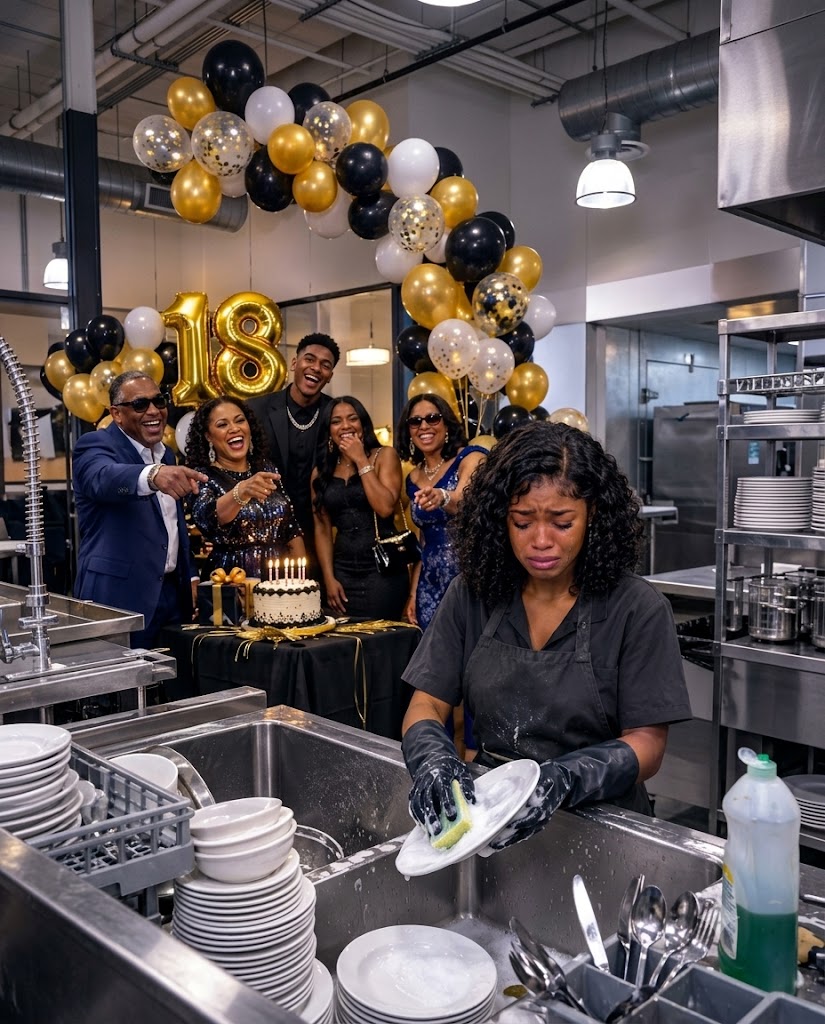
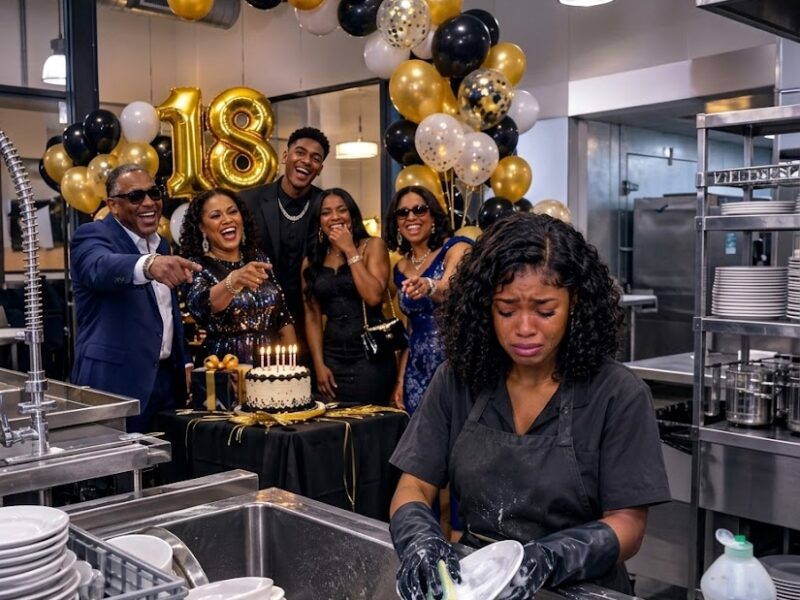
The fluorescent lights in the diner kitchen buzzed with a low, angry hum, a sound I’d known my whole life but never really heard until that night.
I stood at the stainless steel sink, the mountain of dirty plates before me a testament to a birthday party I wasn’t allowed to attend.
My hands, slick with grease and soapy water, trembled so badly I could barely hold the sponge.
I could hear the muffled laughter from the dining room, the clinking of glasses, the sound of my family celebrating the day I was born while I stood just a few feet away, scrubbing their mess.
My father, Harlon, had pushed a black rubber apron toward me, his expression unreadable.
“Time to start paying your way, Maddie,” he’d said, his voice flat. “You’re an adult now.”
My mother, Greer, had nodded, her lips pressed into a thin, bloodless line.
And my brother Weston had just laughed, a sound that cut through me sharper than any knife in the kitchen.
The paper Harlon had handed me was still seared into my brain: **$72,000**.
That was the number, my value, the sum total of my existence reduced to a debt I was expected to repay for the crime of being born.
I was just 18, standing under harsh lights that reflected off the stainless steel, wearing a cheap rubber apron, my eyes blurred with tears I refused to let fall.
I turned on the hot water, the steam rising to fog the air around me, and I began to wash.
Each plate I cleaned felt heavier than the last, not with grease, but with the weight of a future that had been stolen from me before I even knew it existed.
The first plate slipped, my butterfingers still clumsy with shock, but I caught it just before it shattered in the sink.
I took a deep, shuddering breath and kept going.
I didn’t want them to hear me cry.
That small dignity was all I had left.
That, and a single, nagging question that was beginning to form in the back of my mind like a crack in a dam.
For years, I’d believed my parents were saving for my college.
They told me my education was my way out of the diner, out of this life.
My father had smiled when I was 13 and told me not to worry about the cost.
My mother had promised when I was 15 that the financial side of things was handled.
I had believed them.
I had been a fool.
A few days later, the routine had already settled in.
Harlon left a list of tasks by the sink every morning, a daily reminder that I was no longer his daughter but his indentured servant.
Greer would remind me of my “responsibilities” with a cold, distant look in her eyes.
Weston was the worst, though.
He would saunter into the kitchen, lean against the doorframe, and smirk.
“Looks like college got a little more expensive than you expected,” he’d joke one afternoon, motioning to the ever-present stack of dishes.
I didn’t answer him.
I had learned that my family was much more comfortable when I was quiet, when I didn’t ask questions.
But the questions were coming, rising unbidden in my mind, demanding answers.
The first one was the simplest, yet the most profound: what *exactly* was this $72,000?
It was a number, a threat, a leash, but it wasn’t a real debt.
There was no loan agreement, no terms, no interest rate, no document with my signature.
It was just a figure Harlon had conjured, a number I was supposed to trust.
The morning after my birthday, I found my mother in the diner’s small, cluttered office, sorting through receipts.
“Mom,” I said, standing in the doorway. “Where did the 72,000 come from?”
She didn’t look up.
“We’ve been keeping track of everything we’ve spent on you,” she said, her voice sounding distant, like she was reading a script. “Everything.”
I stared at her back, my frustration mounting.
“I owe you for being my parents?”
She finally turned, her eyes cold.
“We raised you, Maddie. Don’t make this uglier than it needs to be.”
That answer chilled me to the bone.
It wasn’t about the money, I realized.
It was a choice, a deliberate act.
They had chosen to turn 18 years of parenting into a bill.
I left the office without another word.
I wanted to believe there was some innocent explanation, that my father had taken out some kind of educational loan for me and this was their warped way of teaching me a lesson about responsibility.
The alternative was too painful to even contemplate.
The alternative was that my parents had lied to me for years, manipulating my trust while quietly, methodically, treating me like a business expense.
I remembered a conversation I’d had with my college counselor, a man named Camden.
He had asked me if my family had discussed their financial contribution.
I’d told him, with the absolute, unshakeable confidence of a child who trusted her parents, that they had it all covered.
I felt my stomach clench.
The lie had become such a part of my reality that I had sold it to others.
A few nights later, the crack in the dam finally broke.
The diner was closed, and I was alone in the office, tasked with organizing old paperwork.
A file folder slipped from my hands and hit the floor, scattering papers across the cracked linoleum.
Cursing under my breath, I crouched down to gather them, and that’s when I saw it.
My name.
Maddie Carter.
My blood ran cold.
It was an old financial statement, a document that looked official.
It was an education savings account statement.
My heart hammered against my ribs as I picked it up.
I had seen a statement like this years ago.
Greer had shown it to me with a proud smile, telling me there was enough to give me a strong start after high school.
I remembered the relief I’d felt, the gratitude.
But the number on this statement was not the one I remembered.
The balance was drastically lower, almost nonexistent.
It had been decimated.
I sat on the floor of that dusty office, the paper trembling in my hand, trying to make sense of it.
Maybe it was an old statement?
Maybe the money had been moved?
But the transaction history told a different story.
It was all there, in black and white.
Withdrawals.
Large, repeated withdrawals.
And the money hadn’t vanished.
It had been transferred.
The destination was an account associated with the diner.
I felt a cold, hard knot form in my stomach.
I pulled out my phone and, with shaking hands, began to photograph everything.
The withdrawal dates, the amounts, the account numbers.
I didn’t know exactly what I was looking at, but I knew it was wrong.
I put the papers back exactly as I had found them, my heart pounding a frantic rhythm against my ribs.
Then, I heard footsteps in the hallway.
I scrambled to my feet just as my mother appeared in the doorway.
“What are you doing?” she asked, her eyes narrowing with suspicion.
“Cleaning,” I said, my voice tight.
She looked from me to the filing cabinet, then back to my face.
“You’re supposed to be finishing the kitchen.”
“I’m done.”
She watched me for a long, silent moment before turning and leaving.
I let out a breath I didn’t realize I’d been holding.
That night, sleep was impossible.
My mind raced with a single, terrifying question: why would money saved for my college be funneled into the diner?
The next morning, I reached out to Camden.
I was embarrassed, confused, and terrified I was jumping to conclusions.
I asked if he could help me review my college financial information because, as I vaguely put it, “something’s changed.”
He agreed to meet me that afternoon.
I sat across from him in his small office, the smell of coffee and old books filling the air.
I told him about the $72,000.
I told him about the dishes.
I told him my father had called it a debt.
Camden didn’t laugh or dismiss me.
He listened, his expression grave.
“Did your parents ever give you any formal documentation showing that you personally owe this money?” he asked.
“No.”
“Did you sign a loan agreement?”
“No.”
“Are they giving you a repayment schedule, an interest rate?”
“No.”
He paused, his eyes fixed on mine.
“Then, legally and logically, we need to separate what they’re *calling* a debt from what is actually documented as a financial obligation.”
That sentence was a lifeline.
For the first time, someone was treating me like a rational human being instead of a disobedient child.
I showed him the photos on my phone.
His expression tightened as he scrolled through them, his jaw working.
“These transactions deserve an explanation,” he said, choosing his words carefully. “Do you know where this money went?”
“I think it went into the restaurant,” I whispered. “Maybe… maybe to my brother.”
Camden looked at the dates again.
“Could the 72,000 be where this money came from?” I asked, the thought just forming in my mind.
“It’s possible,” he said slowly. “But we shouldn’t assume. We need the complete records.”
That evening, back at the diner, I found my father in the office.
Weston was there too, sprawled in a chair, scrolling on his phone.
I knew I couldn’t ask the questions I wanted to ask.
Not yet.
I remembered how easily Harlon had turned my birthday into a public spectacle.
I remembered Greer’s cold eyes and Weston’s cruel laughter.
So, I chose a different question.
“Dad,” I said, my voice steadier than I felt. “How much do I actually owe you?”
“72,000,” he said, without looking up from his invoices.
“Is there paperwork for that?”
He finally raised his eyes, a flicker of annoyance in them.
“What kind of paperwork?”
“Something showing that I actually owe it. Like a real loan.”
His face hardened.
“You don’t need paperwork for everything that happens in a family, Maddie.”
I nodded slowly.
That was all I needed to hear.
I didn’t argue.
I didn’t tell him about the account, or Camden, or the photos on my phone.
I simply walked back into the kitchen, put on the apron, and started washing dishes.
But this time, something was different.
Before, I was washing dishes because I thought my parents had the right to demand it.
Now, I was washing them because I needed them to believe I was still afraid.
And as the hot water ran over my hands, one question repeated itself in my mind like a drumbeat: if my college money had been saved for me, who had taken it?
And why had they decided I should be the one to pay it back?
The next few days were a masterclass in my family’s brand of deception.
After I asked about the paperwork, my father stopped leaving financial documents lying around.
The office cabinet that had always been unlocked was suddenly secured with a small key he now kept on his belt.
My mother started doing a sweep of the office before she left every evening.
And Weston, who usually treated me with a kind of tolerant amusement, suddenly became very interested in my whereabouts.
“You spending a lot of time in Dad’s office lately?” he asked one afternoon, leaning against the doorframe as I washed a pot.
“Not really,” I said, keeping my voice neutral.
He smiled, but it didn’t reach his eyes.
“Good. You don’t want to get confused by things you don’t understand.”
It wasn’t concern.
It was a warning.
I became more careful, more covert.
I only looked when I was sure no one was around.
I only recorded what I could see without moving anything.
And the more I looked, the clearer a painful pattern became.
Weston was the child who always needed help.
When he was 19, my parents bought him a used pickup truck so he could get to work.
When he was 21, they loaned him $10,000 for a deposit on an apartment.
When he wanted to start his own food truck business, they called it an “investment.”
They never used the word “debt” with Weston.
They called it support.
They called it family.
They called it giving him a chance.
But with me, everything had a price tag.
I remembered asking for a new laptop for my final year of high school.
My old one would shut down mid-assignment.
My mother told me to save my own money.
I worked extra shifts at the diner and bought a refurbished one myself.
I remembered asking if I could go on a weekend trip with friends after graduation.
My father told me money didn’t grow on trees.
Yet when Weston wanted to pursue a risky business venture, money appeared.
At first, I tried not to resent him.
Weston was my brother.
When we were kids, he was the one who taught me how to ride a bike.
He used to sneak me pieces of pie from the kitchen when we were supposed to be in bed.
There was a time I would have defended him against anyone.
But growing up changes the way you see things.
I began to realize that every time Weston fell, someone was there to place a cushion underneath him.
Every time I fell, Harlon told me to get up and try harder.
And now, they were telling me I owed them $72,000.
I couldn’t stop thinking about the education account.
I asked Camden if there was any way to find out where the money had gone.
He told me I needed the complete account history, not just the pages I’d photographed.
He also advised me not to confront anyone until I had a clearer picture.
So, I waited.
It was harder than it sounds.
Every night, I walked into the diner and faced the same people who had laughed while I cried.
I served customers, cleaned tables, and washed dishes.
I listened to Harlon complain about expenses, knowing that some of those expenses might be tied to money that was supposed to be mine.
One Friday night, the diner was unusually busy.
I was carrying a tray of burgers toward the kitchen when I heard them talking near the office.
I wasn’t trying to eavesdrop, but then I heard my name.
I froze.
The office door was slightly ajar.
I heard my father say, “She’ll get over it.”
Then my mother’s voice, sharp and cold: “She needs to understand that we can’t keep carrying her.”
I stood completely still, the tray heavy in my hands.
Then Weston said something that made my fingers clench around the tray’s metal edge.
“She doesn’t know about the old account, does she?”
There was a moment of silence.
Then Harlon answered, “Not yet.”
My heart started pounding.
I didn’t hear anything else because a customer walked past me toward the restroom, and I quickly continued into the kitchen, my mind racing.
The old account?
What old account?
And why did Weston sound worried that I might know about it?
That night, after everyone had left, I waited until the diner was completely empty.
I went into the office, my heart pounding a frantic rhythm against my ribs.
I searched the filing cabinets again.
Most of the folders were now locked, but one drawer had been left unsecured.
Inside were older records—vendor invoices, tax documents, loan statements.
Then I found a folder with a handwritten label: “Vacation, Maddie.”
My hands started shaking.
I opened it.
The first page was a statement from several years earlier.
The balance was much higher than what I had seen recently.
I flipped through the pages.
The withdrawals began around the same time Weston had started his food truck business.
One transaction was especially large.
I photographed it, then another, then another.
I didn’t need to be a financial expert to recognize what was happening.
Money was leaving my education account and moving toward accounts associated with the diner.
I kept turning pages until I reached a document that made my breath catch in my throat.
It was a financial summary prepared for Harlon.
There were several categories: diner expenses, business obligations, Weston’s business, and education savings.
Someone had been moving money around deliberately.
But I still didn’t know if my father had taken the money permanently or if he had intended to replace it.
Then I found a line that changed everything.
A transfer from my education account to a business obligation connected to Weston.
The date was just a few weeks after Weston had told the family his food truck business was struggling.
I sat down in my father’s chair, the room spinning around me.
I wasn’t angry at Weston.
I was hurt.
Because I finally understood why everyone was so determined to convince me that I owed them.
If I believed I had caused the $72,000 problem, I wouldn’t ask where the money had gone.
I would just work.
I would wash dishes.
I would stay quiet.
And eventually, I would spend years trying to repay a debt that was never truly mine.
I took pictures of everything and returned the papers exactly where I found them.
Before leaving, I noticed another folder underneath the financial records.
It had the name of the diner’s accountant on it: Shephard.
I knew him.
He had handled the diner’s books for years.
He wasn’t a stranger.
He had been to our house for dinner.
He had known me since I was a little girl.
I wondered if he knew what had happened.
The next morning, I called him.
He didn’t answer, so I left a message, asking if we could speak privately about some old financial records.
He called back that afternoon.
“Maddie,” he said, his voice careful. “What exactly did you find?”
I told him I had seen transfers from my education account.
There was a long pause on the other end of the line.
“Did your parents ever tell you those funds were being moved?” he asked.
“No.”
Another pause.
“Did they tell you that you had agreed to it?”
“No.”
His voice became quieter.
“Maddie, I think you need to see the complete records before you make any decisions.”
My chest tightened.
“Do you know where the money went?”
“I know where some of it went,” he said. “But I don’t want to tell you something without the documents in front of me.”
That was enough for me.
I asked if we could meet.
He agreed.
We met the following afternoon at a small coffee shop a few miles from the diner.
I arrived early, not wanting anyone from my family to see me with him.
Shephard arrived carrying a thin, worn folder.
He sat down across from me and placed it on the table.
“I need you to understand something before we go through this,” he said. “I’m going to tell you what the records show. I’m not going to tell you what I think your parents intended.”
I nodded, my throat tight.
He opened the folder.
The first document showed the original balance of the education savings account.
It was a significant amount, far more than I had ever imagined.
Then he showed me the withdrawal history.
Several transfers had gone toward diner obligations.
Others were connected to a business account.
I recognized the name.
It was Weston’s company.
I stared at Shephard.
“How much?” I whispered.
He gave me the figure.
I felt the air leave my lungs.
It was far more than the $72,000 they were demanding from me.
“Did Weston know?” I asked.
Shephard shook his head slightly. “I can’t tell you what he knew. I can only tell you that the transfers were authorized by your parents.”
I looked down at the papers, my world tilting on its axis.
For years, I had thought my parents were protecting my future.
They had been using my future to protect someone else’s present.
“But if they used my college money,” I said, the words feeling foreign on my tongue, “why did they tell me I owe them 72,000?”
Shephard didn’t answer immediately.
Instead, he pulled out another document.
It was an internal calculation, a spreadsheet.
At the top was a handwritten note from my father: “Maddie’s total family expenses, $72,000.”
My eyes moved down the page.
It included school expenses, clothing, food, medical costs, transportation, and miscellaneous family expenses.
But it also included something that wasn’t a normal parenting expense.
A portion of the diner’s financial shortfall had somehow been incorporated into the calculation.
I looked at Shephard, my mind reeling.
“This isn’t a loan,” I said, the realization dawning on me.
“No,” he said.
“Then what is it?”
He took a breath.
“It’s a number your father created.”
I stared at him, the words feeling heavier than the $72,000 itself.
My father had taken 18 years of ordinary parenting expenses, mixed them with other family financial problems, and turned the total into a debt—a debt he expected me to believe I had to repay.
I thought about the apron, the laughter, the birthday cake I never got to eat.
Then I remembered Harlon saying, “You’re an adult now.”
I had believed he was teaching me responsibility.
Now I understood what he was actually trying to teach me: that if he called something my responsibility loudly enough, maybe I would never ask whether it really belonged to me.
Shephard closed the folder.
“There is one more thing,” he said.
I looked up.
He reached into the folder and pulled out a printed email.
It was from my father.
The date was several months before my 18th birthday.
I read the first few lines.
Then I saw my name.
My heart dropped.
Harlon had discussed my upcoming 18th birthday and the possibility of having me work at the diner.
But the final sentence was the one I couldn’t stop reading.
It said that once I turned 18, I would need to understand what the family had invested in her.
I looked at Shephard.
“This was planned.”
He didn’t answer directly.
“You should read the whole thing,” he said.
I did.
And by the time I reached the bottom, I knew my birthday hadn’t been an impulsive punishment.
It had been a plan.
My parents had already decided that when I turned 18, they would make me responsible for a number they had created.
I folded my hands together so Shephard wouldn’t see them shaking.
For the first time, I wasn’t wondering whether my family had treated me unfairly.
I knew they had.
Now, I needed to understand exactly how far they had gone.
And I knew the next person I needed to talk to wasn’t Shephard.
It was Weston.
Because if my college money had helped save his business, then he wasn’t simply my favorite older brother anymore.
He was part of the answer.
And before I confronted him, I wanted to know exactly what he had been told about the money they took from me.
I left the coffee shop with Shephard’s folder still running through my mind.
Until that afternoon, I had been trying to figure out where my college money had gone.
Now, I had a much bigger question.
What did Weston know?
I didn’t call him that night.
I knew if I confronted him while I was angry, he could turn the conversation into something emotional and make me look like the jealous little sister who couldn’t accept that her brother had needed help.
So, I waited.
I went back to the diner, put on the same apron, and washed dishes like nothing had changed.
But inside, everything had changed.
I was no longer trying to prove that my parents were wrong.
I was trying to understand exactly how many people had known the truth while I was being told a completely different story.
The next afternoon, Weston came into the kitchen while I was drying glasses.
He looked at me for a moment and said, “Dad said you’ve been asking questions.”
I put the glass down carefully.
“What kind of questions?”
He shrugged. “About the money.”
I looked directly at him. “Which money?”
His expression changed for just a second. It was tiny, but I noticed it.
“The 72,000,” he said. “You know, what you owe Mom and Dad.”
I asked him where he thought that money came from.
He laughed nervously. “Why does it matter? They raised you.”
“That’s not what I asked.”
He looked away. “Maddie, just let it go. You don’t want to make things worse.”
I felt something inside me go cold. “Worse for who?”
He didn’t answer.
I turned off the faucet.
“Did money from my college account help pay your business debts?”
Weston stared at me for several seconds. Neither of us moved.
Then he said, “Who told you that?”
It wasn’t a denial. That was all I needed.
I asked again, “Did it?”
He ran a hand through his hair. “It wasn’t like that.”
“What was it like?”
He lowered his voice. “Dad said the money was just being moved temporarily.”
“Did you know it was my college money?”
“I knew there was money available.”
“That’s not the same answer.”
He looked irritated now. “What do you want me to say?”
“The truth.”
He sighed. Then he admitted that his business had been failing. He said he had borrowed money from Harlon because he was trying to keep the food truck alive. He said Harlon told him not to worry because the family had savings and that everything would be sorted out later.
I asked him whether he knew those savings were intended for my college.
He didn’t answer immediately. Finally, he said, “I knew there was an account for you.”
My chest tightened. “And you still took the money.”
“I didn’t take anything, Maddie. Dad handled it.”
“But you benefited from it.”
He looked at me. “Yes.”
That one word hurt more than I expected.
I had spent years defending Weston when people criticized him.
I had celebrated his successes.
I had believed that when he was struggling, our parents were helping him because that was what families did.
But when I needed help, they had handed me an invoice.
I asked him one final question. “When did you find out they were going to make me pay it back?”
His face changed again. “After your birthday.”
“So you knew.”
“I heard Dad talking.”
“What did he say?”
Weston looked toward the kitchen door. “He said once you turned 18, you would need to start working and that it would teach you responsibility.”
I closed my eyes for a second.
The email Shephard had shown me suddenly made sense.
This wasn’t something Harlon had invented on my birthday.
He had planned it.
And Weston had known enough to understand what was happening.
I didn’t yell at him.
I simply said, “Thank you for telling me.”
He looked surprised. “That’s it?”
I nodded.
“What else do you want me to do?”
I looked at him. “I wanted my brother to tell me the truth. You finally did.”
Then I walked away.
That conversation gave me something the documents couldn’t: a human confirmation.
But I still needed the complete financial records.
I called Shephard again.
He agreed to meet me, and this time he brought additional documents.
He showed me the original balance of the education account, the transfers, the diner obligations, and the records associated with Weston’s business.
Then he showed me something I hadn’t seen before.
The $72,000 calculation wasn’t simply a list of expenses.
It had been assembled *after* the money had already been moved.
The timing mattered.
My parents hadn’t discovered that I supposedly owed $72,000 and then decided to make me work.
They had already moved money out of my education savings.
Then they created a number that could be used to justify making me responsible for it.
I stared at the paperwork. “Why would they do that?”
Shephard was careful with his answer. “I can’t tell you why they made those decisions. I can tell you what the records show.”
That was exactly what I needed. Facts, not guesses.
He showed me the dates again.
The transfers, the internal notes, the calculation, the email from Harlon—everything lined up.
I suddenly remembered something from when I was 16.
I had been sitting at the kitchen table with my mother when I asked whether my college fund was safe.
She had smiled and said, “Of course it is.”
I had believed her.
Now I understood why she had been so confident.
She knew I wasn’t going to check.
That night I went home and found my grandmother, Loralai, sitting on the front porch.
She had always been different from my parents.
She noticed things.
She didn’t talk constantly, but when she did, I usually remembered her words.
She looked at me and immediately knew something was wrong.
“You’ve been crying,” she said.
I sat beside her for a few minutes, not saying anything.
Then I asked, “Grandma, did Mom and Dad ever tell you they had saved money for my college?”
Loralai looked at me. “Yes.”
“How long ago?”
She thought for a moment. “Years ago. Your father told me they had been putting money away since you were little.”
I swallowed. “Did he ever tell you he planned to make me pay them back for raising me?”
Her expression changed. “No.”
I looked down at my hands. “He did.”
Loralai was quiet for a moment. Then she asked, “Maddie, what happened?”
I told her everything.
Not every detail, but enough.
The birthday, the $72,000, the dishes, the college account, Weston’s business, Shephard’s records, Harlon’s email.
When I finished, Loralai didn’t immediately respond.
She simply reached over and held my hand.
Then she said something that made me cry harder.
“You were never supposed to carry that.”
I looked at her. “What?”
“That burden. They were the adults. You were their child.”
I had been trying so hard to be rational that I hadn’t allowed myself to feel what the situation actually meant.
My parents had spent years teaching me to be responsible, but they had used that responsibility against me.
Loralai told me that she remembered Harlon talking about my education when I was younger.
She remembered him saying that I was the one who would probably go far because I was always disciplined.
Then she paused. “I don’t understand why he would do this to you.”
Neither did I.
But I was beginning to understand something else.
Harlon didn’t just want money.
He wanted control.
If I believed I owed him $72,000, then every decision I made could be questioned.
Where I went, what college I attended, whether I moved away, how much money I earned, how long I worked at the diner—even whether I could leave.
The debt wasn’t just a number. It was a leash.
And suddenly, the diner felt different.
The next morning, Harlon called me into his office.
He was sitting behind his desk with my mother beside him.
There were papers on the table.
He gestured toward the chair. “Sit.”
I did.
My mother folded her hands.
My father looked at me. “Your mother and I have been talking.”
I waited.
“We think you’ve had enough time to process everything.”
I said nothing.
“You’re 18 now,” he continued. “It’s time you started thinking like an adult.”
I almost smiled at the irony.
He pushed a paper toward me. “This is your work schedule for the next six months.”
I looked at it.
Six days a week, long shifts, almost every evening.
I looked up. “For what?”
“For the debt.”
I asked, “How much of my paycheck goes toward the 72,000?”
“All of it, except what you need for basic expenses.”
I stared at him. “And if I don’t agree?”
His expression hardened.
“You live under our roof,” my mother added. “We’re not asking you to do anything unreasonable.”
I looked at the schedule again, then at my father.
“Did you use my college money?”
The room went silent.
Harlon’s face didn’t change. My mother looked at him.
“What are you talking about?” she asked.
“I know about the education account.”
Harlon leaned back in his chair. “You’ve been digging through things you don’t understand.”
“I know money was transferred.”
“Money gets moved between family accounts all the time,” he said dismissively. “It went into Weston’s business.”
Weston wasn’t in the room, but his name changed the atmosphere immediately.
My mother said, “Your brother needed help.”
I looked at her. “And I didn’t.”
She looked away.
Harlon’s voice became sharper. “This is exactly the problem. You keep making everything about yourself.”
I almost laughed.
My entire future had been turned into a debt, and somehow I was the selfish one.
I stood up. “I need time to think.”
Harlon pointed toward the schedule. “You don’t have time to waste.”
I looked at him. “No, I don’t.”
Then I walked out.
For the first time, I didn’t feel like a scared 18-year-old girl.
I felt like someone who had finally seen the whole picture.
But I still had one thing left to do.
I had to make sure the evidence couldn’t disappear.
So I copied everything.
The account records, the emails, the calculations, the transfer histories, the work schedule, the messages.
I kept one set with Loralai, another with Camden.
And the original documentation remained with Shephard.
I wasn’t planning to destroy my family.
I wasn’t planning to embarrass them.
I wasn’t even planning to tell the entire town what they had done.
I simply wanted the truth somewhere they couldn’t rewrite it.
Then that evening, Harlon made the mistake that changed everything.
He called a family meeting.
He told me everyone would be there, and he said they were going to discuss my financial responsibility in front of the family.
I knew exactly what that meant.
They wanted to make the $72,000 story official.
They wanted everyone sitting around that table to hear that Maddie Carter had become 18, received a debt, and needed to work until she paid it.
I agreed to attend.
But this time, I wouldn’t be walking into that diner empty-handed.
I would be walking in with the records, and for the first time since my birthday, I knew something Harlon didn’t.
He thought he was bringing me into that room to explain what I owed.
I was bringing the truth into that room to show what they had taken.
The family meeting began at 7:00 p.m.
I walked into the diner’s private dining room with my heart pounding, but I refused to let anyone see it.
Harlon sat at the head of the table. My mother was beside him.
Weston leaned back in his chair, looking uncomfortable, while two of my aunts sat quietly near the window.
There was an envelope in front of my father.
He tapped it with his fingers. “Maddie,” he said, “we need to settle this tonight.”
I sat down. “Settle what?”
He looked almost offended. “The debt.”
I glanced at the envelope, then looked around the table.
Everyone had been told one version of the story. Tonight, they were going to hear another.
Harlon opened the envelope and pulled out several pages.
“We’ve calculated everything your mother and I have spent on you. Food, clothing, school, medical expenses, transportation, activities—everything. It comes to $72,000.”
One of my aunts quietly whispered, “Seventy-two thousand?”
Harlon nodded. Then he looked directly at me. “You’re 18 now. We aren’t asking you to pay it all immediately. We’re giving you an opportunity to work it off.”
I could feel my hands trembling beneath the table, but I kept my voice calm.
“Can I ask one question?”
Harlon smiled. “Of course.”
“Where is my college money?”
The smile disappeared. My mother shifted in her chair. One of my aunts looked confused.
“That’s not relevant,” Harlon said.
“It is to me.”
“You’re changing the subject.”
“No,” I said. “I’m explaining the subject.”
I reached into my bag and placed a copy of the education account records on the table.
The room went completely silent.
I put down another page, then another.
The original balance, the withdrawals, the transfers, the diner expenses, Weston’s business.
Nobody spoke.
Weston stared at the papers. Harlon reached for them.
I pulled my hand back. “You’ve had these records long enough.”
My mother whispered, “Where did you get those?”
“Shephard.”
That name changed everything.
Harlon’s face hardened. “You went to the accountant?”
“Yes.”
“You had no right.”
I looked at him. “Did I have a right to know what happened to money saved for my education?”
He didn’t answer.
One of my aunts picked up the first page. She studied it carefully.
“Is this showing money transferred from Maddie’s education account?”
Harlon immediately said, “Those transfers were temporary.”
I looked at him. “Then why was I never told?”
Nobody answered.
Weston finally spoke. “Dad told me the money would be replaced.”
I turned toward him. He lowered his eyes.
“And did you believe him?” I asked.
“I don’t know.”
I said nothing. The silence became heavier.
Then I placed the final document on the table.
It was the internal calculation Shephard had shown me—the $72,000 figure.
One of my aunts read it. Her expression changed as she reached the bottom.
“This includes restaurant losses,” she said, her voice barely a whisper.
Harlon quickly said, “That’s being taken out of context.”
I looked at him. “Is it?”
He didn’t respond.
I could feel tears building in my eyes, but I refused to wipe them away.
For years, I had been afraid of making my father angry.
Now I realized I was more afraid of becoming someone who stayed silent just because he was angry.
“You used my college savings to help keep this diner running and to help Weston,” I said, my voice clear and steady. “Then you added up the cost of raising me and called it a debt.”
My mother shook her head. “We were doing what was best for the family.”
I looked at her. “Was I not part of the family?”
She went quiet.
That question hurt more than anything else I had said.
Harlon stood up. “This is enough.”
“No,” I said softly. “It isn’t.”
He stared at me.
“I’ve been told for years that I need to be responsible. So, I’m being responsible now.”
I placed one final document on the table.
The email, the one Shephard had shown me.
Harlon’s email, written months before my 18th birthday, discussing my upcoming birthday and the plan for me to start working.
I watched him read it. His face changed.
One sentence had been highlighted: *The family had invested in me*.
My aunt looked from the paper to my father. “You planned this before she even turned 18.”
Harlon didn’t answer.
And that was the moment I finally understood that I didn’t need to convince anyone.
The documents were doing it for me.
Weston quietly pushed his chair back. “I think I should leave.”
Harlon turned toward him. “Sit down.”
But Weston didn’t. He looked at me.
Then he said, “I’m sorry.”
Two words. They didn’t fix anything, but they were the first honest words I’d heard from him in a long time.
I gathered my papers.
“I don’t want your restaurant,” I said, looking at Harlon. “I don’t want your money.” Then I looked at my mother. “I just want the future you promised me.”
I stood. “And I’m going to build it myself.”
As I walked out, I heard Harlon call my name.
For the first time, I didn’t stop.
I had spent 18 years believing that leaving my family meant losing everything.
That night, I finally realized staying could have cost me much more.









