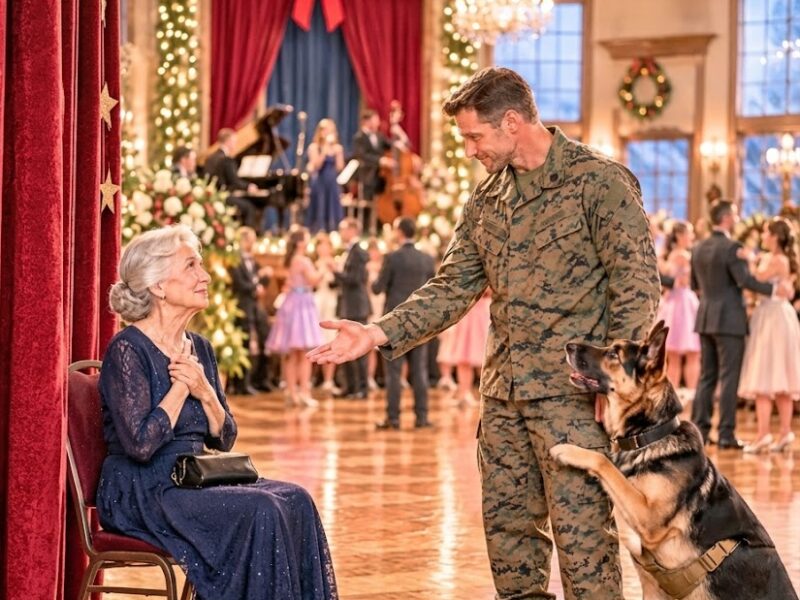
“Nobody Wants to Dance With Me,” the Elderly Woman Cried—Then a Marine’s K9 Brought Him to Her
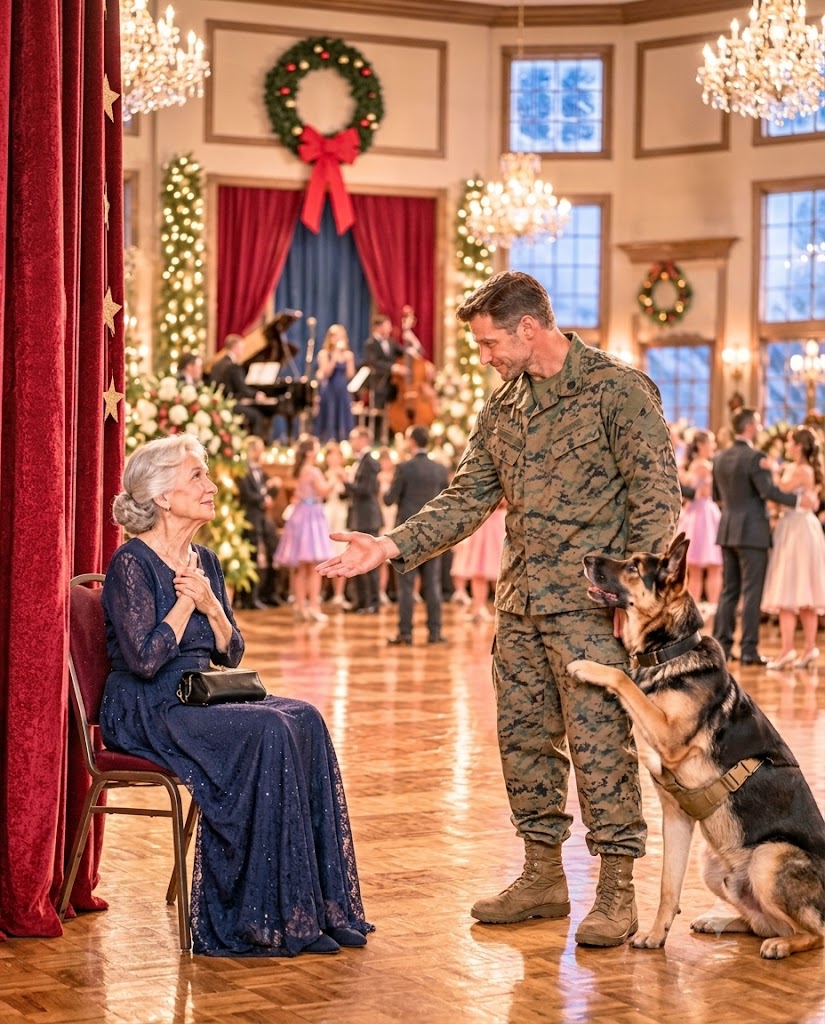
Nobody wants to dance with me, the elderly widow whispered as her late husband’s waltz filled the theater.
Across the crowded room, a U.S. Marine was about to leave when his German Shepherd suddenly lifted its head.
He followed the dog’s gaze and saw her standing alone, fighting back tears.
He didn’t know her name.
She couldn’t imagine the grief he carried.
But when he offered her his hand, neither knew that their lives had crossed once before, seven years earlier.
If you enjoy stories of loyalty, hope, and second chances, subscribe and help us reach 1,000 subscribers.
Your support keeps these stories alive.
—
On December 5th, a bitter wind swept off Lake Superior and through the streets of Marquette, Michigan.
Inside the community theater, golden lights warmed the polished dance floor while snow gathered against the windows.
Agnes Fenwick stood beside the stage curtain, smoothing a crease that no one else would have noticed.
At seventy-six, she was a slight woman with narrow shoulders, pale skin, and silver hair pinned into a careful bun.
Her dark blue dress had been altered twice to fit her shrinking frame.
She had polished her old dancing shoes until their worn leather shone.
Nothing about her appearance was extravagant, but every detail had been chosen with the quiet determination of someone trying to remember how to feel beautiful.
She had almost stayed home.
For thirty-eight years, Agnes had worked behind this theater’s curtains, repairing costumes, finding missing buttons, and reassuring frightened performers before they stepped into the light.
Her husband, Walter, had composed music for its productions.
He had been a gentleman who spoke softly in conversation but seemed to say everything he meant when he sat at a piano.
Seven years had passed since his death.
In that time, familiar faces had disappeared from the theater.
New employees had arrived, and Agnes had gradually stopped receiving requests for help.
Nobody had deliberately shut her out.
That was what made it difficult to explain.
She had simply become someone people greeted warmly before turning back to their own lives.
A friend had invited her dancing a few years earlier.
Agnes had declined, ashamed of the strange feeling that enjoying herself without Walter would somehow betray him.
This morning, however, she had opened her bedside drawer and taken out the anniversary card he had given her at their last dance together.
His message remained on the front.
On the back were a few private lines Agnes had written after his death, words she had never managed to say aloud.
She had slipped the card into her handbag and come because Walter’s waltz was on tonight’s program.
Now, as couples gathered beneath the lights, Agnes gathered her courage.
“Would you care to dance?” she asked an older gentleman near the refreshments.
He apologized.
His wife was waiting.
A second man explained that his niece would not allow it.
A third smiled kindly but turned toward friends calling his name.
None of them meant to hurt her.
Agnes knew that.
Yet with each refusal, the distance between her and the dance floor seemed to grow.
Then the pianist began Walter’s waltz.
Agnes recognized the opening notes before the other instruments joined.
She remembered his hand against her back, his habit of counting under his breath when he grew nervous, the way he always insisted she was the better dancer.
She looked down at the shoes she had spent an hour polishing.
“Nobody wants to dance with me,” she whispered.
—
At the far end of the hall, Gunnery Sergeant Declan Rourke was preparing to leave.
Forty-two, tall and broad-shouldered, he had a square, weathered face, close-cropped dark brown hair touched with gray, and a clean-shaven jaw.
His gray-blue eyes missed little.
Years of military service had made his movements economical and his manner reserved, though people who knew him understood that his quietness was not indifference.
He was home on short leave, visiting an old friend who had helped organize the fundraiser.
Declan had come as a guest, not in any official capacity.
He had stayed near the exit, partly because crowds still exhausted him more than he liked to admit.
Beside his chair lay Bracken, a seven-year-old black and tan German Shepherd with a deep charcoal saddle, an alert expression, and the patient stillness of a retired military working dog.
Bracken had worked alongside Declan during his final years of service.
When the dog retired, Declan had completed the adoption process and brought him home.
The theater organizers had permitted Bracken to remain in a designated space near the exit where he rested on his own mat.
As Agnes turned toward the curtain to hide her tears, Bracken lifted his head.
Declan followed the dog’s gaze.
He saw a small woman standing alone while the room moved around her.
He rose, left Bracken resting in his assigned place, and crossed the floor.
“Ma’am,” he said gently.
Agnes turned.
Up close, she could see that the Marine’s expression was serious but not stern.
“Would you allow a Marine to have this dance?”
For a moment, she could only stare at his outstretched hand.
“I’m afraid I’m rather out of practice.”
“So am I,” Declan admitted.
“You may have to rescue me.”
A surprised smile touched her face.
She placed her hand in his.
Before they could take a step, a voice sounded from the stage.
“Ladies and gentlemen, we’ll now begin our fundraising auction.”
Russell Hargrove, the theater board chairman, stood beneath the microphone.
Fifty-three, neatly dressed with thinning brown hair and a brisk, practical manner, Russell was a man accustomed to keeping events on schedule.
He had worked hard to stabilize the theater’s finances and disliked delays that might jeopardize a carefully planned evening.
The musicians stopped.
Agnes withdrew her hand immediately.
“Oh dear, we’ve missed our chance.”
Declan saw her glance toward the audience, embarrassed by the attention.
He turned toward Russell without raising his voice.
“Sir, could we have three more minutes? Just one dance.”
Russell checked the program in his hand.
“I’m sorry. We’re already behind.”
Agnes touched Declan’s sleeve.
“Please, it’s all right.”
But from the piano came the first few notes of Walter’s waltz.
Miriam Sloan, a sixty-eight-year-old retired pianist with short white hair and bright, attentive eyes, had recognized Agnes the moment she entered.
She had played beside Walter for years and knew what this music meant to his widow.
Her fingers paused above the keys as she looked toward Russell.
A few guests began clapping in time.
Russell looked from Miriam to Agnes, then set his program aside.
“Three minutes,” he said, yielding with a reluctant smile.
Miriam resumed the waltz, her fingers moving steadily across the keys.
One violinist joined her, then another.
Declan offered his hand again.
This time, Agnes took it without hesitation.
They moved onto the floor.
Declan managed two respectable steps before placing his foot exactly where hers needed to go.
“Oh,” Agnes exclaimed.
“My apologies, ma’am.”
“You’re leading with the wrong foot.”
“I suspected there was a problem.”
“You’re counting too quickly.”
“I’ve been told that before.”
She laughed, a clear, unguarded sound that startled her more than it startled him.
Declan relaxed, allowing her to guide him.
Slowly, they found the rhythm.
Around them, other couples resumed dancing, but Agnes scarcely noticed.
She was listening to Walter’s music without feeling that she had to endure it.
When the final note faded, applause rose through the hall.
Declan bowed.
Agnes curtsied awkwardly, laughing again.
For the first time in seven years, she had danced to her husband’s waltz.
She had not forgotten Walter.
She had simply discovered that remembering him did not require standing alone.
As they stepped away from the floor, her handbag slipped from her wrist.
Its clasp sprang open, and the old anniversary card slid across the boards.
Declan bent to retrieve it.
The card had fallen face down.
As he lifted it, he caught a glimpse of the handwriting on its back.
Just a few slanting letters written in dark ink.
His hand stopped.
He did not read the message.
He turned the card over and returned it to Agnes.
But something in his expression had changed.
“Thank you,” she said, tucking it safely away.
Declan nodded.
He knew that handwriting, or believed he did.
Somewhere among his belongings was a letter he had carried for seven years through postings, moves, and nights he preferred not to remember.
He looked at Agnes, suddenly aware that he had no idea who she really was.
And for the first time that evening, the Marine could not find the words to ask.
—
By morning, a thin layer of snow covered the rooftops of Marquette.
The theater’s lights were dark, but Declan Rourke could not forget the handwriting he had glimpsed on Agnes Fenwick’s anniversary card.
Before leaving the fundraiser, he had asked whether he might call to thank her properly for the dance.
Agnes had written her number on the back of a spare program, looking faintly amused that a man who had stepped on her toes twice considered himself the grateful one.
Now Declan sat at his friend’s kitchen table with the program beside his phone.
Bracken rested near the door, his ears shifting whenever a car passed outside.
Declan had spent years learning not to trust a first impression, especially when it concerned something he wanted desperately to be true.
He could have searched through his belongings for the letter immediately.
Instead, he called the number Agnes had given him.
“Mrs. Fenwick, this is Declan Rourke from last night.”
“I remember you, Marine. My left shoe remembers you, too.”
He smiled.
“I was wondering if Bracken and I might visit. Only if it’s convenient.”
There was a brief silence.
“I’ve just put the kettle on,” she said.
“That seems convenient enough.”
Her house stood on a quiet residential street, its front steps swept clear and a narrow path carefully salted.
Inside, Declan found a home maintained with the same precision Agnes had brought to her dress.
The furniture was old but sound.
A folded blanket rested over the sofa arm, and photographs of theater productions occupied a bookcase beside a modest upright piano.
Nothing suggested she needed someone to take charge of her life.
Yet the stillness was striking.
Even the ticking clock seemed unusually loud between their words.
Agnes welcomed Bracken with a bowl of water and directed him toward a rug beside the sofa.
He settled there after Declan released him from his leash.
She watched the dog arrange his paws, then returned with tea and two plates of buttered toast.
“I haven’t entertained a guest with four legs in quite some time,” she said.
“He has excellent manners until someone opens a packet of biscuits.”
“Then he’ll fit in here.”
Declan noticed a sewing basket near the piano.
A half-repaired costume lay across its lid, bright red fabric against the faded upholstery.
Agnes followed his gaze and explained that a young volunteer had asked her to mend it for the theater’s Christmas program.
It was the first request she had received in months.
“Once, I could tell you which performer had lost a button simply by hearing the panic in their footsteps,” she said.
“Now I have to ask where they keep the needles.”
She spoke without bitterness.
For thirty-eight years she had known the building from its dressing rooms to its loading door.
Walter had worked with the musicians while she kept productions moving backstage.
They had often walked home after midnight, exhausted and pleased, discussing everything that had gone wrong without the audience ever noticing.
After his death, she continued volunteering, but new staff arrived, equipment changed, and fewer people knew whom to call.
Eventually, she stopped offering.
“Last night wasn’t really about those gentlemen refusing me,” Agnes admitted.
“They were perfectly polite. I think I was afraid the theater had forgotten I’d ever belonged there.”
Declan held his cup without drinking.
He understood the distinction between being unwelcome and no longer being needed.
He had seen good people struggle with it after leaving work that had given their days a shape.
He did not offer her a reassuring answer he could not prove.
Instead, he asked about the card she had dropped.
Agnes glanced toward the piano.
“Walter gave it to me at our last anniversary dance. I wrote something on the back after he died. Rather foolish, perhaps.”
“Not foolish.”
“I took it with me because I thought I might lose my nerve at the door.”
Declan remembered only the slope of the letters, the unusual way certain words seemed to lean forward.
He chose his next question carefully.
“Did you ever write letters to people you didn’t know?”
Agnes looked surprised.
Then she nodded.
Seven years earlier, a community group had collected messages for service members stationed overseas.
She had written dozens, usually late at night when sleep would not come.
She never learned who received them.
“It helped to imagine somebody opening an envelope and finding a friendly word,” she said.
“I suppose I needed that thought as much as they needed the letters.”
Declan felt his pulse quicken.
He wanted to ask what she had written, whether she remembered a particular sentence, but the letter in his possession belonged to a painful chapter of his own life.
He was not ready to place it between them on the strength of a familiar handwriting style.
He thanked her for the tea.
When he left, Agnes stood in the doorway, watching Bracken descend the steps with measured care.
For the first time in a long while, she found herself looking forward to another conversation.
—
Three days later, on December 9th, Agnes returned to the theater to collect old program notes for the Christmas production.
The lobby smelled faintly of fresh paint.
A notice on the office door announced that renovations would begin the following week.
Beneath it, a printed schedule stated that the former archive room had to be cleared before December 15th.
Agnes read the notice twice.
The archive contained more than unused costumes and outdated equipment.
Walter had donated original scores to the theater, including handwritten arrangements revised during rehearsals.
Other composers had left music there, too, along with playbills, photographs, and production records.
Agnes kept copies of a few pieces at home, but she knew that some originals existed nowhere else.
She found Russell Hargrove reviewing renovation plans in the office.
He greeted her by name and offered a chair, though his attention kept returning to the documents spread across his desk.
“The board approved the work last month,” he explained.
“We need that room for classes. We’re paying to store anything that still needs assessment, but we cannot preserve every box indefinitely.”
“Have the music collections been cataloged?”
“Some have. We’re digitizing selected material.”
“Selected by whom?”
Russell set down his pen.
“By the staff with the resources we have.”
Agnes described the handwritten scores and the notes that would mean little to someone unfamiliar with the productions.
She offered to help identify them before the removal.
Russell listened, but the contracted movers were already scheduled and the staff had been assigned other tasks.
“I remember what you and Walter did for this place,” he said.
“But I cannot reopen the whole plan because we disagree about a few boxes.”
“It isn’t a disagreement about boxes.”
“I know what it means to you, Agnes. I also know what it costs to keep this building open.”
His words were not cruel.
That made them harder to dismiss.
Agnes asked permission to inspect the inventory before leaving.
In the basement corridor, sealed cartons stood against the wall, each marked with a number.
A young temporary assistant with sandy hair and a nervous, obliging manner showed her the printed list.
He explained that he could answer questions about the labels but had no authority to change them.
Agnes traced one entry with her finger.
It identified a collection of unidentified sheet music pending review.
She recognized the inventory number.
“That box contains Walter Fenwick’s anniversary waltz,” she said.
The assistant checked his paperwork.
“I’m sorry, ma’am. It isn’t identified that way here.”
Agnes stared at the sealed carton.
Walter had written that piece for them, then given the original score to the theater so other musicians could play it.
His pencil corrections were still in its margins.
She did not want the music returned to her.
She wanted someone to understand what they were holding before deciding its fate.
“Can you leave this one aside?”
“I can make a note,” the assistant said, “but I can’t promise anything.”
Agnes thanked him.
When he went back upstairs, she remained beside the boxes, listening to footsteps overhead.
The music that had filled the hall four nights earlier was now a line on a disposal review list.
And by December 14th, the room that had protected it for decades would have to be empty.
—
On December 10th, gray clouds hung low over Marquette, and wind rattled the bare branches outside Agnes Fenwick’s kitchen window.
Declan Rourke arrived carrying a small metal box he had retrieved from his belongings after their first conversation.
Agnes had called him the previous evening about the theater’s archive.
She had spoken carefully, describing the renovation deadline and the inventory entry that failed to identify Walter’s waltz.
Declan had listened without promising to fix it.
Now, he set the box on her kitchen table beside a stack of old theater programs.
“There’s something I should have shown you yesterday,” he said.
“But I needed to be certain first.”
Agnes opened the box.
Inside lay a single envelope, its corners softened by years of handling.
The paper was creased where it had been folded and unfolded many times.
She recognized the handwriting before she read a word.
“Oh,” she whispered.
Declan remained standing, giving her room to look.
Agnes drew out the letter.
It began without a name, just as the volunteer program had instructed.
She had written it seven years earlier, not long after Walter died, on an evening when the silence of her house had become almost unbearable.
She remembered sitting at this very table wondering what she could possibly say to a stranger facing troubles she could not imagine.
“I wrote this,” she said.
“I thought you had—”
Agnes looked up.
“You received it?”
Declan nodded.
For a moment he seemed to be searching for a place to begin.
He pulled out a chair but did not sit until she did.
“I was overseas. A Marine I served with had been killed. We’d worked together long enough that I could tell what he was thinking from the way he looked at a map.”
Declan’s voice remained steady, but his hands rested motionless on the table.
“Afterward, I stopped answering calls from home. I told myself I was keeping busy. Mostly, I was avoiding anyone who might ask how I was.”
He had received the letter during a routine distribution of mail.
It was addressed to no one in particular.
At first, he had nearly left it unopened.
Then, alone in his quarters, he had read about a widow learning to live in a house that sounded different without her husband’s footsteps.
Agnes lowered her eyes to the page.
Near the bottom, her younger self had written, “You do not have to understand every sorrow before you let someone care about you. Somewhere, somebody is hoping you make it home.”
“I remember that sentence,” she said.
“I nearly crossed it out. I thought it sounded too simple.”
“It was simple,” Declan replied.
“That was why I could hear it.”
He explained that the letter had not suddenly made him well.
He had still struggled with grief, and there had been days when speaking to anyone felt impossible.
But he had called his family.
Later he had spoken honestly with a fellow Marine and accepted support instead of insisting he could manage alone.
He kept the letter through moves and changes of assignment, taking it out whenever he found himself withdrawing again.
Agnes pressed a hand against her mouth.
She had never expected an answer from any of the people who received her letters.
She had imagined them reading a few lines, perhaps smiling, then carrying on with their lives.
The thought that one envelope had traveled with this man for seven years was almost too much to hold.
“But you didn’t know,” she said.
“At the dance.”
“No. Bracken noticed you standing by the curtain. I looked over and you seemed like someone who shouldn’t have to stand alone. That was all.”
“And the card?”
“I recognized the writing when I picked it up. After you told me about the letters, I went back and found mine.”
Agnes gave a small, disbelieving laugh.
“All that time, I thought I was writing into the dark.”
Declan glanced at the letter between them.
“You weren’t.”
Bracken lay near the kitchen doorway, following their voices with his ears.
Agnes reached down and he shifted closer at her invitation, resting his head briefly against her knee.
She stroked the fur behind his ear, grateful for the ordinary warmth of him.
Later, while searching a cabinet for Walter’s personal copies of his music, Agnes discovered a photograph tucked inside an old album.
Walter stood in their backyard beside a German Shepherd they had owned years before.
The dog had died before Walter, and Agnes admitted she had never brought another animal home.
“Loving one,” she said, “meant accepting a goodbye I was not sure I could bear again.”
Bracken lifted his head when she spoke, then settled back against her chair.
Agnes returned the photograph to its page and left the album open beside her.
—
By afternoon, Miriam Sloan had joined them.
She arrived with a canvas bag of concert programs and the practical determination of someone accustomed to rehearsals running late.
Agnes spread her surviving copies across the dining table.
Some bore Walter’s notes.
Others had dates, cast lists, or penciled changes that helped identify pieces in the theater’s inventory.
Miriam recognized arrangements performed during productions long absent from the current repertoire.
They did not have access to the sealed archive cartons, and Agnes refused to pretend otherwise.
Instead, they worked from her own papers, publicly available playbills, and the inventory the theater had permitted her to inspect.
Declan created a list of titles, dates, and possible matches.
He called former performers whose numbers Agnes still had.
Miriam contacted musicians who might recognize unfamiliar scores.
By evening they had evidence that the threatened collection held more than Walter’s compositions.
It documented decades of work by people whose names had rarely appeared above the title of a production.
“Russell will say these are memories, not a preservation plan,” Agnes warned.
“Then give him a plan,” Miriam said.
Agnes stared at the papers.
She knew how to repair a costume minutes before a curtain rose.
She knew how to find a missing page in a score.
Speaking before a board, however, felt different.
Russell had already turned her away once.
She feared appearing to be an elderly widow asking the theater to preserve everything simply because she missed her husband.
Declan did not tell her that she had nothing to fear.
“What would you recommend,” he asked, “if somebody brought you this collection and you had to make room for a new program?”
Agnes considered the question.
“I’d identify the originals, keep what cannot be replaced, make copies people can actually use. We don’t need every duplicate.”
She stopped.
“And I’d ask the people who worked here what the labels don’t tell us.”
“Then that’s what you tell the board.”
Over the next two days, the three of them shaped her answer into a proposal.
Agnes requested a three-month pause on disposal, not on the renovation itself.
The cartons could leave the old room on schedule and remain in secure temporary storage while volunteers inventoried them.
A smaller permanent collection could preserve significant originals.
Useful materials could be digitized and duplicates assessed for removal.
Declan helped gather tentative volunteer commitments while Miriam arranged for advice on basic preservation methods.
Neither claimed the work would be free or effortless.
On December 12th, Agnes read the final pages aloud.
Her voice shook at first, then steadied as she reached the section explaining why accurate identification mattered.
She was no longer asking the theater to return her past.
She was offering to help it carry its history into the future.
Declan placed the old letter beside the proposal.
Agnes looked at the words she had once sent to a stranger, then picked up her pen.
She signed her name.
The board would meet the next day.
For the first time since discovering the sealed cartons, Agnes was frightened of something other than losing Walter’s music.
She was frightened of speaking for it, and determined to do so anyway.
—
Snow fell thickly over Marquette on the afternoon of December 13th, blurring the theater windows and muffling traffic outside.
Agnes Fenwick entered the boardroom carrying a folder she had checked three times before leaving home.
Miriam walked beside her while Declan followed with a small box of programs and reference materials.
Bracken remained with Declan’s friend that afternoon.
The boardroom was crowded and Declan had no reason to bring him into a meeting.
Agnes noticed the empty space beside the Marine’s boots anyway.
She had grown accustomed to the dog’s quiet presence, just as she had grown accustomed to Declan asking what she thought before offering his own opinion.
Russell Hargrove welcomed them and began with the figures.
The theater’s aging sound equipment needed replacement.
Its training classes had a waiting list but nowhere suitable to meet.
Ticket sales covered less than the board had hoped, and the renovation contract left little flexibility.
The archive room had been chosen for conversion because it was large enough to serve a practical purpose.
“We cannot afford to preserve the building by making it unusable,” Russell said.
Agnes agreed.
She had spent enough years working there to know that nostalgia could not pay an electrician or repair a leaking roof.
When Russell invited her to speak, she stood slowly, placed her folder on the table, and looked at the people seated around it.
“I’m not asking you to cancel the renovation,” she began.
“I’m asking you not to decide what is worthless before we know what it is.”
She showed them an inventory page listing unidentified sheet music.
Beside it, she placed a copy of an old program identifying one of the pieces as Walter’s anniversary waltz.
Then she displayed photographs and rehearsal notes that connected other anonymous scores to past productions.
Some pages bore revisions made during performances.
Others preserved the names of accompanists, stagehands, and visiting artists who had never appeared in the theater’s official histories.
“These aren’t all treasures,” Agnes said.
“Some are duplicates. Some may have little reason to stay, but someone must identify them before that decision can be made.”
Miriam explained how handwritten arrangements could reveal changes that printed scores did not preserve.
She identified several compositions from their rehearsal markings and described why an original annotated score could matter even when a playable copy existed.
Agnes listened, grateful that Miriam spoke about the music as working material rather than sacred objects no one was permitted to touch.
A board member asked whether Agnes expected the theater to keep every costume sketch and faded photograph.
She answered no.
Another asked who would decide what qualified as historically significant.
Agnes proposed that volunteers prepare an inventory, consult preservation guidance, and present recommendations for the board to review.
Originals worth retaining could occupy a much smaller storage area.
Materials suitable for scanning could become accessible without repeated handling.
Duplicates could be assessed and removed under an agreed procedure.
Russell folded his hands.
“And who pays for the time and equipment?”
“That’s the part I was afraid you’d ask,” Agnes admitted.
A few people smiled.
She took a breath and explained that the initial work would rely on volunteers.
Existing office equipment was appropriate, and outside advice could be sought at no cost through library resources.
Anything requiring specialist conservation would need separate approval.
She had no intention of spending money the theater did not possess.
Then she placed one last program on the table.
It was yellowed at the edges from a production decades earlier.
On the final page, beneath the technical crew, was Russell’s name.
Agnes remembered him as a young man who had once stayed after rehearsals trying to understand a temperamental sound system.
Walter had shown him how to trace the problem without blaming the equipment or himself.
Russell took the program.
His expression changed almost imperceptibly.
“He told me to listen before touching anything,” Russell said.
“He said that about most things,” Agnes replied.
Russell ran a finger beneath his younger self’s name.
For a moment he seemed to see the building as it had been.
Then he returned the program to the table.
“I remember,” he said.
“But remembering doesn’t answer how we sustain this.”
“No,” Agnes said.
“That’s why I brought the rest of the folder.”
Declan passed around a list of people willing to help if the board approved a trial.
Former performers had offered time identifying photographs and scores.
A local history teacher was interested in involving older students in supervised cataloging.
The public library had offered guidance on basic handling and digitization, though it had not promised staff, equipment, or storage space.
“I helped make the calls,” Declan told the board.
“Mrs. Fenwick and Miss Sloan know the collection. The volunteers would need a local coordinator because I’m returning to my unit. This cannot depend on me being here.”
Russell studied the names.
“People are enthusiastic when something is new. Three weeks later, you may have two volunteers and a room full of boxes.”
“That could happen,” Agnes said.
“So let us test whether it will.”
She proposed a heritage concert late in December.
Miriam could perform selected music using copies already available to them.
Agnes could explain the work behind the productions, and visitors could register for specific volunteer shifts rather than merely sign a general statement of support.
The board could establish minimum commitments, a manageable storage plan, and a cost ceiling before authorizing further work.
The discussion lasted nearly an hour.
Russell asked what would happen if the concert drew little interest.
Agnes answered that the board would then have clearer evidence on which to make its next decision.
She could not promise success.
She could promise a careful inventory and an honest report.
When the vote came, Agnes kept her hands folded in her lap.
The board approved a limited trial.
The renovation would proceed and the cartons would leave the old archive room before December 15th.
Instead of being discarded, they would be placed in secure temporary storage with disposal suspended through the end of February.
The board had agreed to a shorter period than the three months Agnes had requested, allowing it to evaluate the results before considering a longer-term commitment.
Agnes would advise the volunteer group and the board would review its progress before making that decision.
The late December concert would serve as the first test of community participation.
The board also agreed on minimum volunteer commitments, a storage plan, and a spending limit against which the trial would be evaluated.
Russell looked toward Agnes after announcing the result.
“This is an opportunity to demonstrate a workable plan,” he said.
“Not permission to keep everything.”
“I understand,” she answered.
“That’s all I asked for.”
Outside the boardroom, Miriam embraced her.
Declan smiled, but Agnes noticed him checking a message on his phone.
His leave was ending.
He had received confirmation that he must return to his unit the following morning.
“You’ll miss the concert,” she said.
“I will.”
The disappointment struck her harder than she expected.
She had known his visit was temporary.
Yet somewhere between the tea, the letters, and the long hours sorting programs, she had begun to measure her days by the possibility of seeing him and Bracken.
She felt ashamed of how quickly that familiar fear returned.
They walked together toward the theater entrance.
Snow had gathered against the glass doors, and the lobby was nearly empty.
“You don’t need to promise you’ll come back,” Agnes said.
“I know what it is to wait for something life may not allow.”
Declan did not offer an easy reassurance.
“I’ll keep in touch when I can,” he said.
“But you have people here, Agnes. Miriam, the volunteers, and a project that belongs to you whether I’m standing beside you or not.”
“I know.”
She looked down at the folder in her arms.
“Knowing doesn’t always make it easier.”
“No,” he said.
“It doesn’t.”
He left her at the door with a quiet good night.
Agnes watched his car disappear into the falling snow, then went home to a house that seemed especially silent.
On her kitchen table lay the volunteer list marked with names, telephone numbers, and promises that had yet to become work.
For several minutes, she sat without removing her coat.
Then she picked up the phone and called Miriam.
“I’ll be at the theater in the morning,” Agnes said.
“We have boxes to save.”
—
On December 14th, pale sunlight broke through the clouds above Marquette.
Agnes Fenwick stood on her front steps as Declan Rourke pulled up beside the curb, his bags packed for the journey back to his unit.
Bracken sat calmly in the back seat, watching through the window.
Declan stepped out and Agnes came down one step to meet him.
Neither mentioned how difficult the previous evening had been.
He thanked her again for the letter she had written seven years earlier.
She thanked him for the dance.
“You know,” she said, “I’m beginning to think you were the one who needed lessons.”
“I was hoping you wouldn’t remember that part.”
“Oh, I remember every step.”
They laughed.
Then Declan grew quiet.
“I’m glad I found out who wrote it.”
“I’m glad it found you,” Agnes answered.
He did not promise another visit.
She did not ask him to.
When he drove away, she watched until the car turned the corner, then went inside to collect the folder waiting on her kitchen table.
Miriam would be at the theater in half an hour.
There were volunteers to meet, a temporary storage space to prepare, and cartons to receive and check against the inventory before the following day’s deadline.
The house was quiet when Agnes left.
For once, that quiet did not determine what the rest of her day would become.
—
Over the following weeks, the temporary storage room filled with the careful sounds of work.
Pages turning, pencils moving, and people asking questions.
Agnes and Miriam supervised the volunteers as they numbered cartons, recorded contents, and separated original scores from later copies.
The younger helpers learned to handle fragile paper without forcing it flat.
Older performers brought photographs and programs they had kept at home, supplying dates and names that the theater’s records lacked.
One volunteer, a college student with round glasses and an untidy blonde braid, asked Agnes why a particular costume sketch had three different names written beside it.
“Because the first two actors grew out of the part,” Agnes said.
“And the third insisted the sleeves made him look like a frightened goose.”
The student laughed and wrote the explanation down.
Agnes found herself answering questions she had once assumed nobody would ask again.
She was no longer the sole keeper of every memory.
Others were learning where to find the answers.
And she discovered that sharing her knowledge did not diminish what Walter and their friends had built.
It gave that work somewhere to go.
—
Late in December, the theater held its heritage concert.
Miriam played Walter’s waltz on the piano and local musicians performed other pieces identified during the preliminary inventory.
Agnes stood before the audience with a few handwritten notes.
She spoke about a stagehand who could repair anything with wire and patience, a seamstress who hid peppermint candies in costume pockets, and the musicians who had stayed after performances to make certain the next evening would be better.
She did not speak long.
She did not need to.
When the concert ended, enough visitors had registered for specific volunteer shifts to meet the board’s agreed participation target.
The proposed storage and cataloging costs also remained within the trial’s limits.
Russell Hargrove thanked the audience and announced that the work would continue through the review period.
He acknowledged that he had underestimated the collection’s value.
Agnes accepted his words with a small nod.
“If we keep these records,” she told him afterward, “let’s remember to include the people who worked behind the curtain.”
Russell looked toward the busy lobby.
“We should have done that years ago.”
—
Throughout January and February, the volunteers continued cataloging and digitizing selected materials.
They documented which originals needed specialist attention and which duplicates could eventually be removed.
By the February review, they had cataloged most of the collection, identified several previously unattributed scores, and established a rotating schedule for the work still ahead.
Before the deadline, the board reviewed their progress and voted to continue the preservation program under a modest, sustainable plan.
The renovation had proceeded, the classes had gained their new space, and the archive had earned a smaller but secure place in the theater’s future.
Declan heard about these developments in fragments.
He called when his duties allowed, sometimes for only a few minutes.
He asked how the volunteers were getting along, whether Miriam was taking breaks, and whether Agnes had finally stopped trying to lift heavy cartons herself.
“I supervise,” Agnes informed him.
“It is a position of considerable authority.”
“I can hear that.”
She sent photographs of cataloged scores and postcards covered in her familiar handwriting.
Declan occasionally wrote back.
He told her about walks with Bracken, who had developed a preference for sleeping beside an empty chair in his living room.
Their conversations were not reports or obligations.
Some contained nothing more important than a story about the weather or a particularly stubborn volunteer.
Agnes came to value those ordinary exchanges as much as the remarkable coincidence that had brought them together.
—
In early March, Declan returned to Marquette on another period of authorized leave.
He had called the theater to confirm its schedule, but Agnes did not know which day he would arrive.
That afternoon, she was helping two students identify production photographs when she heard footsteps in the corridor.
She looked up and saw Declan standing in the doorway with Bracken beside him.
For a moment, she simply stared.
Then Bracken recognized her.
At Declan’s quiet permission, he crossed the room and approached.
Agnes bent to stroke his familiar black and tan coat.
He leaned gently into her hand before settling beside her chair.
“Well,” she said, looking up at Declan, “you took your time.”
“I wanted to give you a chance to finish the inventory.”
“Then you’re several years too early.”
He laughed and she rose to embrace him.
There were no accusations, no speeches about distance.
Agnes had news to share and he listened as she showed him the new catalog, the volunteers’ work, and the space set aside for the collection.
That evening, the theater hosted a dance to thank everyone who had helped.
Agnes wore the same dark blue dress she had worn in December, though she had loosened the seams slightly to make it more comfortable.
She greeted visitors at the door, introduced younger volunteers to older performers, and demonstrated a waltz step to a student who kept turning the wrong way.
Declan watched from near the exit.
Bracken rested on his mat, permitted there again by the organizers.
When the music began, Agnes accepted a dance with an older friend from the volunteer group.
She moved easily, laughing when he forgot a turn.
Declan realized that she had not spent the intervening months waiting for him to return.
She had been living them.
When the song ended, Agnes spotted him.
This time, she crossed the floor without hesitating.
She stopped before him and extended her hand.
“Would you care for another dance, Marine?”
Declan’s smile widened.
“I was hoping you’d ask.”
He took her hand as Miriam began Walter’s waltz.
They had barely reached the second measure when Declan stepped out of time.
“Still the wrong foot,” Agnes whispered.
“I was counting on you to notice.”
She guided him back into rhythm.
Nearby, Bracken watched for a moment before lowering his head onto his paws.
Agnes heard the familiar music, felt the warmth of a friend’s hand, and saw the people who now knew her name.
Walter was still gone.
Declan would return to his duties.
Her house would sometimes be quiet.
None of that had changed.
But when the waltz ended and Declan asked whether she wanted another, Agnes glanced around the room.
There were friends waiting to speak with her, volunteers waving from the refreshments table, and more than one person ready to claim a dance.
“Quite a few people want to dance with me these days,” she said.
“I can see that.”
Agnes squeezed his hand.
“But I think I’ll choose this one with you.”
—
Sometimes God’s miracles arrive quietly.
They do not always change our circumstances or bring back what we have lost.
Sometimes they come through a stranger who offers a hand, a faithful dog who notices someone standing alone, or a simple act of kindness that finds its way back to us years later.
Agnes could not bring Walter home, but she discovered that love had not left her life.
And Declan learned that a few words written with compassion could carry someone through their darkest days.
In our everyday lives, we may never know how deeply a kind word, a phone call, or a moment of patience can touch another heart.
Perhaps God places us in someone’s path because we are meant to remind them they have not been forgotten.
If this story touched your heart, please share it with someone who needs encouragement.
Tell us in the comments where you’re watching from and subscribe to The Last Patrol for more stories of loyalty, kindness, and hope.
May God bless you and your loved ones, protect your home, and remind you that you are never truly alone.









