Nobody Wanted the Injured German Shepherd—Until a Retired Navy SEAL Paid $12 to Save His Life Always
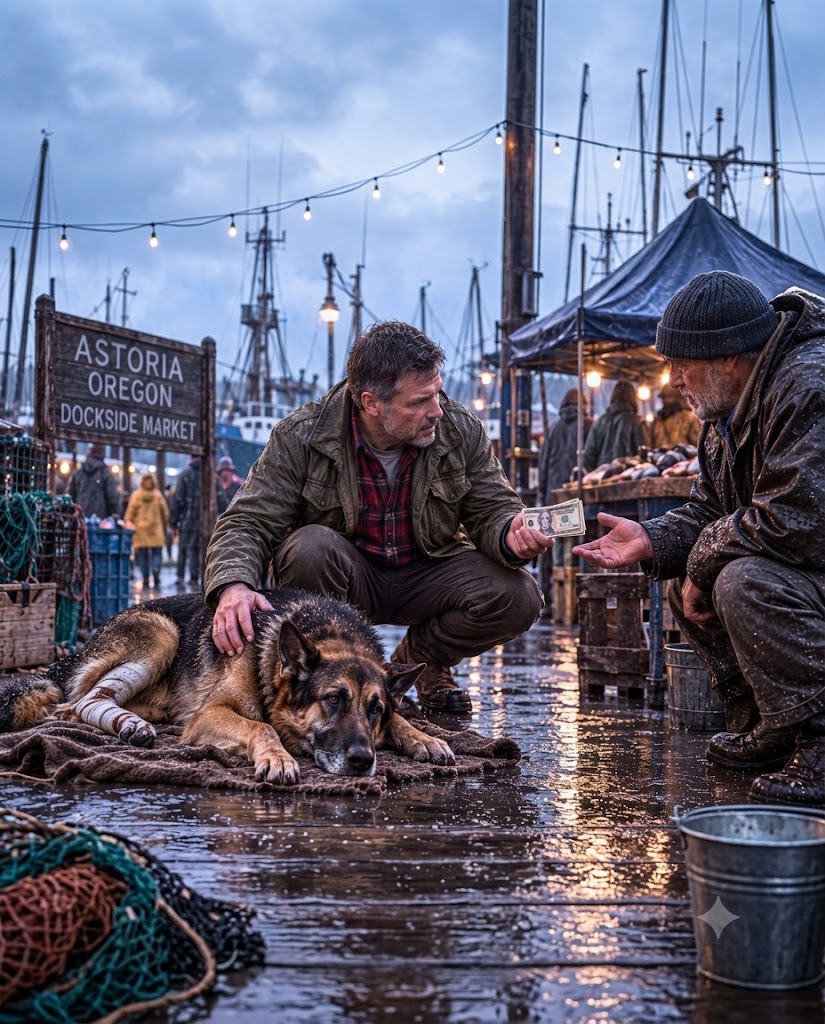
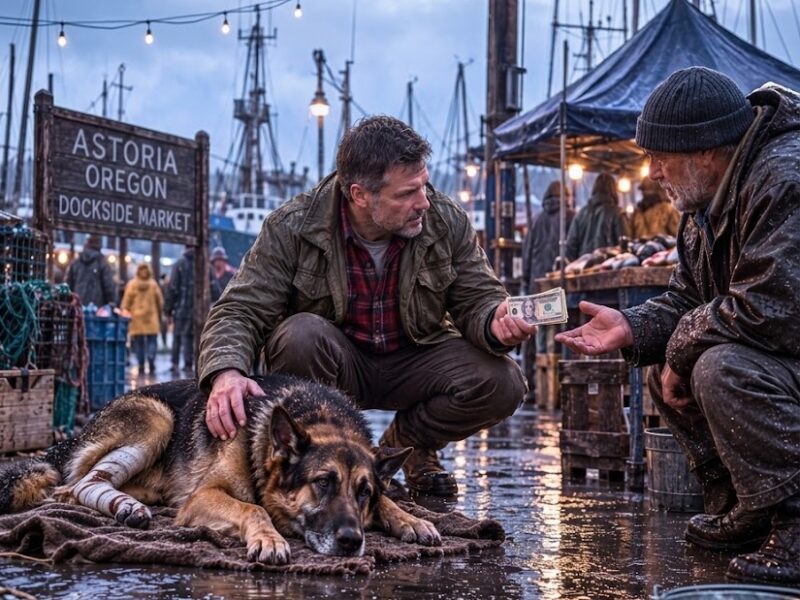
The November wind came hard off the Columbia River, cold enough to sting the eyes and sharp with the smell of salt, diesel, and rain-soaked rope along the old docks of Astoria, Oregon.
Gulls wheeled above the masts while the Saturday salvage market shivered under gray canvas tents.
Cole Bennett had not come looking for a dog.
He had come for two brass hinges, a coil of weather stripping, and a socket wrench if the price did not insult him.
His houseboat door had been slamming all week whenever the tide changed.
Cole moved through the narrow rows with his shoulders slightly hunched against the wind.
He was forty-one, tall in the spare, hard manner of men who had carried too much weight over too many miles.
His brown hair was cut close, showing silver at the temples.
A faded Navy cap sat low over hazel eyes that took in exits, hands, and movement.
Old habits.
Some were useful.
Some followed him like unpaid debts.
Near the far end of the market, where the tents thinned and the pavement gave way to gravel, Cole found a table stacked with rusted cleats, chipped buoys, cracked life rings, and old tools still smelling faintly of salt water.
Beside the table sat a German Shepherd.
The dog was not tied tightly.
A frayed rope ran from his collar to a crate, loose enough for him to shift if he wanted.
He did not shift.
He sat with his injured hind leg tucked carefully beneath him, sable coat dark with rain, black mask giving his face a grave dignity.
A little silver touched his muzzle.
His right ear tipped slightly when the wind moved.
Cole stopped.
The man behind the table noticed and rubbed at his beard.
“Looking at the dog, maybe twelve dollars.”
Cole looked from the dog to the man.
“That include the rope?”
“Take the rope, too. He came up from a cousin down near Coos Bay. Supposed to be a guard dog, but he’s no good for it. Limp comes and goes. Too quiet. I can’t use him.”
Cole felt something small and hot move in his chest.
He disliked that tone.
The way some people spoke about a living creature as if usefulness were the only measure of worth.
“What’s his name?”
“Don’t know. Called him whatever came to mind.”
The shepherd did not lower his head.
He did not beg or bark or press himself forward.
He simply looked at Cole with steady amber eyes, and Cole found himself suddenly back on a dark deck in another ocean, looking at men who had learned not to ask for mercy because mercy was unreliable.
“Does he bite?”
“Hasn’t bitten me.”
“That’s not the same answer.”
The man shrugged.
“You want him or not?”
Cole reached into his jacket and pulled out a folded ten and two singles.
Twelve dollars for a life.
It felt like something he would not understand until later.
“I’ll take him.”
The man snatched the money and looked relieved, which told Cole more than he liked.
Cole stepped around the table and crouched several feet from the dog, careful to angle his body instead of facing him head-on.
“Hey, partner,” Cole said quietly. “I’m Cole. I own a door that hates me and a coffee pot that burns everything.”
The dog’s ear flicked.
Cole reached for the knot on the crate, moving slowly.
The shepherd watched his hands, not fearfully.
Professionally.
That word rose in Cole’s mind before he could stop it.
The dog tracked movement the way trained men tracked angles.
Once the rope came free, Cole stood and gave a soft click of his tongue.
The shepherd rose with effort, favoring the hind leg, then stepped forward.
He did not pull.
He placed himself at Cole’s left side as neatly as if he had been taught the position and had never forgotten it.
Cole looked down.
“Well, now.”
He led the dog through the market.
At the edge of the lot, Hannah Pike stood beside the Anchor Light bakery van, loading empty bread trays into the back.
“Cole Bennett,” she called. “Please tell me you did not trade good money for another broken engine part.”
“No.”
Her eyes dropped.
The teasing softened at once.
“Oh. His name is not settled yet,” Cole said.
The shepherd looked at Hannah, then at Cole, then away toward the river.
Hannah came closer but stopped at a respectful distance.
“Handsome fellow.”
“He was twelve dollars.”
Her mouth tightened.
“Then you underpaid for the dog.”
At his truck, Cole opened the passenger door, expecting to lift the shepherd in.
Before he could bend, the dog gathered himself and climbed onto the seat with careful dignity.
He settled facing forward, shoulders square, eyes on the rain-blurred windshield.
Cole stood with one hand on the doorframe.
“You’ve done that before.”
The shepherd blinked once.
On the drive back to the houseboat, Cole tried several names in his head.
When they passed the old pilings where the tide slapped black water against barnacles, the dog turned toward the river with such solemn attention that Cole thought of Daniel Boone crossing wilderness with a stubborn heart.
“Boon,” Cole said aloud.
The dog’s left ear lifted.
“All right. Boon it is.”
Cole’s houseboat sat in a narrow slip beyond the main marina, patched and weathered with cedar siding the color of old driftwood and windows that rattled when the wind came from the west.
Cole laid an old wool blanket near the heater and filled a stainless bowl with water.
“No one is going to corner you here,” Cole said.
Boon lowered himself onto the blanket, slow but controlled.
He did not touch the food.
Cole sat down.
He watched.
Cole understood that hunger could wait.
Safety came first.
He hung his wet jacket, then set his faded Navy cap on the narrow counter.
Boon’s head moved, his gaze fixed on the trident patch sewn to the front, sun-bleached and frayed.
Slowly, with the care of someone approaching a relic, Boon stood and crossed the small room.
He pressed his nose to the patch.
Then he sat perfectly straight, not like a pet hoping for praise, but like a working dog acknowledging command.
Cole felt the hair rise along the back of his neck.
Outside, the wind shoved rain against the windows.
Inside, Boon stared at the old symbol on the cap, and Cole understood with a chill that he had not brought home a stray.
He had brought home a secret.
Rain tapped all night on the roof of the houseboat, light at first, then steady, then soft again, as dawn spread pale over the marina.
By morning, Astoria looked rinsed and tired, with fog folded low between the pilings and the river sliding past in a long sheet of pewter.
Cole woke before his alarm.
Sleep had never trusted him much.
He listened to the boat creak against its lines, the heater ticking near the galley, the faint scrape of claws from the main room.
Boon was awake, too.
That did not surprise him.
He pulled on jeans and a sweatshirt, then stepped from the narrow bedroom.
Boon lay on the wool blanket by the heater, head raised, amber eyes alert.
The food in the bowl remained mostly untouched, though the water had gone down by half.
“Morning,” Cole said.
Boon watched him as if deciding whether mornings were a reliable institution.
“I agree,” Cole muttered. “Poorly designed.”
The dog’s tail moved once, barely.
Cole poured coffee into a chipped mug and leaned against the counter.
He knew better than to crowd a dog like Boon.
Trust came in inches, sometimes less.
He placed fresh food in the bowl, then opened the battered logbook where he kept repair lists and things he did not want to forget.
Boon went on the second line, though Cole did not know what to write beside the name.
Around nine, footsteps sounded on the dock.
Light ones, quick and certain.
Boon lifted his head before the knock came.
“Cole, it’s Hannah. I bring peace offerings and carbohydrates.”
Cole opened the door.
Hannah stood under a yellow raincoat, holding a paper bag against her chest and a covered pot in one hand.
Steam escaped through the lid.
“You keep feeding me, people will think I’m charming,” Cole said.
“No danger of that,” she replied, stepping in. “I made clam chowder. Also bread that came out uneven.”
Boon sat up.
Not friendly, not unfriendly.
Watching.
Hannah looked his way but did not approach.
“Good morning, Boon. I hear you live with the most difficult man on the river.”
Cole set the pot on the small stove.
The smell filled the houseboat almost immediately.
Cream, onion, pepper, clams, warm bread.
Boon’s ears twitched at the laughter.
Cole saw it.
Hannah did too, but she pretended not to.
“Where did he come from?” she asked.
“Man at the market didn’t know. Said a cousin brought him up from the coast.”
“And you believed him?”
“I believed he wanted twelve dollars.”
Hannah’s expression cooled.
“Boon is safe now.”
Cole cut a small piece from the warm bread and placed it near Boon’s bowl, then backed away.
Boon sniffed once, looked at Cole, and after a long pause, took it delicately.
Hannah kept silent, which was wise.
Cole was grateful for the tiny courtesy.
After Hannah left, the day settled into small work.
Cole replaced one hinge on the door, swore at the second, and discovered the socket wrench he had bought was a size too small.
Boon remained near the heater, but each hour he seemed to track Cole with less suspicion.
When Cole opened the toolbox, Boon’s eyes followed every movement.
He measured.
By midafternoon, the wind shifted.
The marina lines groaned.
Somewhere outside, a loose metal sign banged against a post.
Cole felt Boon’s attention sharpen.
“Just weather,” he said.
Boon did not look convinced.
Cole carried the toolbox to the door, intending to fetch a larger wrench from the storage locker on the dock.
The old brass latch caught.
The door jerked.
The toolbox slipped from his hand.
It hit the floor with a violent crash of steel on wood.
Boon moved before the echo faded.
He came off the blanket low and fast.
He placed himself between Cole and the door, body angled, head level, ears forward.
His eyes swept the room, then the dock beyond the window, then back to Cole’s hands.
Cole froze.
He had seen dogs react to noise.
This was different.
This was a trained protective response, clean as a drill.
“Boon,” Cole said softly.
The dog held.
Cole felt an old part of his mind come awake, the part that named patterns.
Left-side position.
Threat scan.
No wasted motion.
No confusion after noise.
He set the fallen tools aside and took one slow breath.
Then he lifted his right hand, palm down, two fingers closing toward the floor.
Boon dropped instantly, chest touching the wood, chin low, eyes still up and working.
Cole had not spoken.
The room seemed to narrow around that fact.
“Well,” Cole whispered.
Boon waited.
Cole gave another signal, small, almost embarrassed by his own need to know.
“Heel.”
Boon rose, crossed to Cole’s left side, and sat so close Cole could feel the heat of him through denim.
For a long moment, neither moved.
The rain ticked along the windows.
Cole looked down at the German Shepherd he had bought for twelve dollars, and a strange pressure built behind his ribs.
“Who taught you that?” he asked.
Boon looked straight ahead.
If dogs could keep classified files, Cole thought Boon had locked his in steel.
That evening, Cole called Reed Lawson for the first time in nearly two years.
He stood on the deck under a dripping awning, phone pressed to his ear while Boon watched from inside.
Reed answered on the fifth ring.
“Bennett, either the world is ending or you dialed by accident.”
Cole described the dockside market, the limp, the cap, the hand signals, the protective stance after the toolbox fell.
“Cole,” Reed said at last, “that is not obedience class. That is working dog imprinting. Military, maybe federal. If he’s responding to silent signals that clean, somebody put serious time into him.”
Cole looked through the rain-streaked glass.
Boon had lowered himself back to the blanket, but his gaze stayed on Cole, steady as a lighthouse beam.
“Can you come look at him?” Cole asked.
“Send me video first. Good light. Simple commands.”
“I know how to handle a dog.”
“You know how to handle a mission. This is not the same thing.”
After he hung up, Cole stepped back inside.
Boon lifted his head.
Cole crouched several feet away and met his eyes.
“Looks like you and I both have paperwork in our bones,” he said.
Boon sighed as if paperwork was exactly what he had feared.
Cole laughed once.
Then the houseboat rocked in the rain, and for the first time in months, the room did not feel empty.
Morning broke with a rare blue tear in the clouds above Astoria, though the dock still gleamed wet and cold.
Sunlight touched the river in narrow silver strips, and the gulls sounded offended by the improvement.
Cole carried his coffee to the small deck and found Boon already seated by the door, posture straight, nose lifted into the wind.
The shepherd looked assigned watch over the entire Columbia.
“You’re judging the harbormaster,” Cole said.
Boon did not deny it.
Reed had asked for video.
Cole hated video.
Cameras made him feel inspected.
Still, he set his phone on the galley shelf and angled it toward the open space between the table and the heater.
“All right,” he told Boon. “Nothing fancy. We’re not trying to impress anybody.”
Boon stood.
That was not a command.
The dog stared at him.
“Fine. You’re ready. I admire the attitude.”
Cole began with voice commands, soft and clear.
Sit.
Down.
Stay.
Boon answered each one without hesitation.
Then Cole switched to hand signals.
Boon’s attention sharpened.
Palm up, move.
Two fingers down, down.
Closed fist, hold.
Boon knew them.
Not roughly, not as tricks, as language.
Cole added a tennis ball he had found in a drawer.
He tossed it toward the bedroom door after giving the stay signal.
Boon watched it bounce and did not move until Cole released him.
Then he crossed the room, collected it gently, and returned to Cole’s left side.
“Somebody loved training you,” Cole murmured.
At that, Boon’s ear dipped.
Maybe nothing.
Cole felt it anyway.
He sent the video to Reed and waited.
Waiting was a bad room in Cole’s head.
He filled it by working on the door hinges.
Then by checking Boon’s leg, though he did not touch more than the dog allowed.
Boon tolerated a light hand over the shoulder and ribs.
When Cole’s fingers neared the left hind leg, Boon shifted away.
“All right,” Cole said at once. “Your choice.”
By late morning, Hannah arrived carrying a box of bakery leftovers and a look that suggested Cole needed supervision.
“You’re frowning at your phone,” she said from the dock. “That usually means either a bill or a person.”
“Person’s worse.”
He opened the door.
Boon rose but did not block her this time.
Progress small as a match flame.
Hannah placed the box on the table.
“Cinnamon rolls with cosmetic defects.”
“What defect?”
“Quality control is a lonely burden.”
Cole poured coffee while she unwrapped the box.
Boon watched the rolls with the solemnity of a monk resisting temptation.
Hannah noticed.
“No cinnamon for you, sir. I have learned things from Dr. Ross. But I did bring plain chicken.”
She pulled a small container from her coat pocket.
Cole raised an eyebrow.
Boon took the offered piece only after Cole nodded.
Hannah’s face softened, but she did not crowd the moment.
She turned instead to the view outside, where fog was beginning to creep back over the water.
“Frank Dalton asked about you.”
Cole went still.
“Why?”
“Veterans breakfast tomorrow at the American Legion. He said to remind you that the door works both ways. In and out. And no one will chain you to a chair.”
“Tempting offer.”
“Lauren Hayes has been going.”
Cole knew the name.
Everyone around Astoria knew Lauren.
Former Coast Guard rescue swimmer.
Local pride.
A year ago, a rescue off Cape Disappointment had gone wrong.
She survived.
Her career did not.
“Good for her,” Cole said.
“She sits near the back and looks ready to bolt.”
“Then we have something in common.”
Hannah looked at him, steady but not sharp.
“You don’t have to talk.”
His phone buzzed before he could answer.
Reed.
Cole stepped outside to take the call.
The air smelled of tide mud and rain.
Boon followed him to the threshold but stayed inside, as if respecting some line.
“I watched the video three times,” Reed said. “And he’s not police-trained. Not primarily. That heel position, the release timing, the way he checks your hands before the room. That looks Navy or Marine Corps working dog protocol. Maybe attached to a special operations support unit.”
Cole closed his eyes briefly.
“Can you identify him?”
“Maybe. I need a chip scan, dental age, any scars or identifying marks. There were a few shepherds that went missing in the last five years during overseas movements, but records are a mess once contractors, local transfers, and damaged ships get involved.”
“Missing?”
“It happens. Blasts, evacuations, bad paperwork, local rescues. A dog gets pulled out alive, and nobody knows where he belongs. Years pass.”
Cole looked at Boon.
The shepherd stood framed by the doorway, dark sable coat lit by the weak gray day, eyes fixed on him.
“He has a limp,” Cole said.
“Old. He doesn’t like the leg touched.”
“Get him to Emily Ross. She has the right scanner and more patience than either of us.”
“That’s a low bar.”
“True.”
Cole ended the call with the uneasy feeling of a door opening somewhere he had not meant to go.
“Bad news?” Hannah asked.
“Unclear news.”
“That’s the kind that keeps a person up.”
“Most kinds do.”
She touched his sleeve lightly, then let go.
“Come tomorrow. Bring Boon. Let other people stand in the room with you for once.”
Cole did not say yes.
He did not say no.
Hannah left him with rolls, soup, and too much to think about.
That night, the wind rose hard after midnight.
Metal halyards clanged against masts like distant rifle bolts.
Cole came awake already moving.
Breath gone shallow.
Hands searching for a weapon that was not there.
The small bedroom had dissolved.
Smoke.
Shouting.
A black sea under a broken moon.
Someone calling his name through static.
Then weight hit the mattress.
Boon had pushed the door open with his muzzle.
He climbed beside Cole without permission, pressed his solid body against Cole’s shaking legs, and laid his head across Cole’s ribs.
Not random comfort.
Pressure, steady and deliberate.
Cole gripped the blanket.
The room wavered.
Boon breathed slow and out.
Cole followed because there was nothing else to hold.
The phantom radio faded.
The bedroom returned plank by plank.
Window, shelf, rain.
The dog wore against him like an anchor dropped into deep water.
Cole put one trembling hand on Boon’s neck.
“Who taught you to do that?” he whispered.
Boon did not move, but from the darkness came one quiet huff, almost impatient, as if the answer should have been obvious.
Fog lay thick over Fort Stevens the next afternoon, softening the old military batteries until they looked like ruins from a dream.
The air smelled of wet pine, ocean grass, and cold sand.
And somewhere beyond the trees, the Pacific beat its slow drum against the shore.
Cole had not planned to walk that far.
After the night before, he had woken hollow and embarrassed, as if Boon had caught him failing at something private.
That was foolish.
The dog had not judged him.
Boon had simply done what trained helpers do.
He had shown up.
Still, Cole spent the morning avoiding the truth with repairs he did not need to make and coffee he did not need to drink.
By two, the houseboat felt too small.
“Walk?” he asked.
Boon rose so fast, Cole suspected the dog had been waiting all day for him to reach the correct conclusion.
The trail through Fort Stevens was nearly empty.
Fog beaded on Cole’s jacket and Boon’s sable coat.
The shepherd moved well enough, though the limp showed whenever the ground sloped.
Cole kept the pace slow, pretending it was for Boon.
Boon pretended to believe him.
They passed concrete walls dark with moss, old gun emplacements facing a war long gone, and plaques that named history in tidy lines.
Cole disliked plaques.
They made hard things look finished.
At a bend in the trail, a foghorn sounded from the mouth of the river.
Long, low, mournful.
Cole stopped.
The sound slid under his ribs before he could brace against it.
It became another horn from another vessel.
Another night, another sky ripped open by fire.
He smelled fuel where there was only wet pine.
The trail narrowed, tilted.
His right hand went numb.
“No,” he tried to breathe.
The air would not fit.
Boon moved in at once, shoulder pressing against Cole’s thigh.
Cole staggered toward a tree and grabbed the bark hard enough to scrape his palm.
The fog thickened in his vision.
He was back near the Gulf of Aden, boots slipping on a deck slick with water and smoke, men shouting through comms.
“Not there,” someone said.
The voice was not from memory.
Cole blinked.
A woman stood thirty feet down the trail, hands open at her sides, keeping distance.
She had rain-dark hair pulled into a practical knot, a blue Coast Guard sweatshirt beneath a weatherproof vest, and a scar running pale along one cheek.
“You’re at Fort Stevens,” she said. Calm, but not soft. “Oregon. Foggy afternoon. One dog. One nosy former rescue swimmer who should mind her business.”
Boon leaned harder against Cole’s leg.
Cole dragged air in.
It scraped his throat.
“That’s it,” Lauren said. “No need to answer me.”
The foghorn called again, but this time Boon nudged Cole’s hand until Cole’s fingers sank into the thick fur at his neck.
The present had texture.
“In,” Lauren said, then demonstrated without making it theatrical. “Out.”
Cole hated needing the help.
He also took it.
The old battle withdrew by inches.
The trees came back, the gravel under his boots, Boon’s steady breathing.
He straightened slowly, his palms stinging where bark had bitten.
“You always narrate strangers back to reality?” he managed.
“Only the lucky ones.”
His mouth twitched despite himself.
Lauren came no closer until Boon looked at her, then back at Cole, deciding she was not a threat.
She took that as permission to lean against a nearby rail.
“Hannah said you might bring the dog to breakfast,” she said.
“Hannah says many dangerous things. She tried to make me join a church choir after one conversation.”
“Did it work?”
“I’m not brave enough for sopranos.”
Cole let out a short breath that might have been a laugh.
His hands were still shaking, but less.
Boon sat against his boot, solid and calm.
Lauren’s gaze dropped to the shepherd.
Her expression changed.
“Where did you get him?”
“Dockside market. Recently. Yesterday.”
She looked more closely, not touching, studying the black mask, the silver around the muzzle, the tipped ear.
“I saw a briefing once. Not official for us, just a notice that floated through after a joint exercise. Missing military working dog. Shepherd. Dark sable. Naval Support Unit. I think there was a blast overseas. They thought he was gone.”
The fog seemed to still.
Cole kept his hand on Boon.
“You remember the name?”
“No. A call sign, maybe. Mako something.”
Boon’s ear lifted.
Cole felt it through his fingers.
Lauren noticed, too.
Her face lost color.
“He knows that word.”
Cole looked down at Boon.
The dog was no longer watching the trail.
He was staring into the fog with the unbearable patience of a soldier hearing an old radio call.
“Mako,” Cole said quietly.
Boon stood.
No excitement, no confusion.
He simply stood at attention beside Cole, wounded leg and all, gaze forward, waiting for the rest of an order that did not come.
Lauren whispered, “Good Lord.”
Cole swallowed.
“I need a vet with a scanner.”
“Emily Ross,” Lauren said at once. “She handles half the working dogs in the county.”
“Reed said the same.”
“Reed Lawson?”
Cole looked at her.
“Coast Guard circles are small,” she said. “And rescue people collect dog people.”
The foghorn sounded once more, but this time it did not pull Cole under.
Boon was too close.
Lauren too real.
The old name hanging between them like a flare over dark water.
They walked back together.
Not exactly companions.
Not strangers either.
Lauren kept a careful pace.
Boon moved between them and the trees, every so often glancing at Cole as if to confirm he remained present.
Near the parking lot, Lauren stopped beside an interpretive sign slick with mist.
“I go to breakfast because Frank told me I was getting too good at disappearing,” she said. “He was irritatingly right.”
“Frank has that talent.”
“You should come. Boon too.”
Cole looked toward the ocean.
He could not see it.
“Maybe.”
“That’s veteran for yes with escape routes.”
“It’s a respected dialect.”
She smiled.
“Whatever Boon was, he’s still here. That matters.”
Cole opened the truck door.
Boon climbed in, then looked back toward the foggy trail.
As Cole started the engine, his phone buzzed with a text from Reed.
“Any update?”
Cole typed three words, then stared at them before sending.
“He knows Mako.”
The reply came less than a minute later.
“Do not lose that dog.”
Cold rain slid down the windows of Astoria Veterinary Clinic, blurring the feed store across the street into soft red and gold smears.
Inside, the air was warm and smelled faintly of antiseptic, wet dog, and the cinnamon rolls someone had left near the coffee machine.
Cole stood beside Boon in the waiting room and tried not to pace.
Boon sat at his left knee, dark sable coat brushed dry with an old towel from the truck, head level, eyes moving from door to door.
The limp had shown more after the walk at Fort Stevens.
Not dramatic, not helpless, just sharper the way old pain speaks louder when weather turns.
“Cole Bennett,” a woman called from the hallway.
Dr. Emily Ross was fifty, with silver threaded through auburn hair and reading glasses hanging from a cord around her neck.
She had the kind of calm that did not ask permission to enter a room.
Boon watched her hands first.
Emily noticed and stopped three feet away.
“May I say hello?”
Cole glanced down.
Boon did not retreat.
“Slow,” Cole said.
Emily crouched sideways, offered the back of her hand, and waited.
Boon leaned forward, sniffed, then sat again.
“Very polite,” Emily said. “And very serious. I feel underdressed.”
Cole almost smiled.
“He has standards.”
In the exam room, Emily moved with care.
She checked Boon’s ears, teeth, paws, spine, and shoulder muscles, narrating each step in a soft voice.
Boon allowed it because Cole stood close and because Emily never hurried him.
When she reached the left hind leg, she paused at the stiffness in the joint.
“Old injury,” she said. “Stable, from what I can tell, but he’s been compensating for a long time. Cold weather will make him sore. We can help with that.”
Cole nodded, relieved by the word help.
It was a better word than fix.
Fix carried arrogance.
Emily ran her fingers along Boon’s shoulders next.
Near the left side, just under the skin, she stopped, her brow folding.
“There’s something here.”
Cole’s chest tightened.
“What kind of something?”
“Small, hard. Could be a microchip. Could be damaged.”
She reached for a handheld scanner on the counter.
“Let’s see what it says.”
The first pass gave nothing.
The second, nothing.
Boon glanced at Cole as if bored by technology’s lack of discipline.
“Hold still, partner,” Cole murmured.
Emily angled the scanner lower, then higher, then pressed it almost flat against the spot.
A weak beep cracked the silence.
Cole stopped breathing.
The scanner display flickered, died, then steadied long enough for Emily to read.
Her face changed slowly, professional calm giving way to something like wonder.
“Mako 6,” she said.
Boon’s ears came forward.
Cole felt the name move through the dog like a current.
Emily looked at the screen again.
“Registered U.S. Navy working dog. Status listed as missing after a maritime evacuation incident near the Gulf of Aden two years ago.”
The room seemed to tilt.
Cole placed one hand on Boon’s neck, not to steady the dog, but himself.
“Read it again,” he said.
Emily did.
“Mako 6. Navy working dog. Missing, Gulf of Aden.”
The words landed one by one, hard and cold, and each explained something Cole had not wanted to hope or fear.
The silent hand signals, the pressure therapy, the way Boon had sat before the trident patch as if reporting for duty.
“Can you tell who owned him?” Cole asked.
“Not from this display. The chip is damaged. I can contact the registry and send a report, but once military records are involved, there may be follow-up.”
“Meaning?”
Emily removed her glasses.
“Meaning someone may need to verify his identity and determine his status. Retired, transferred, unclaimed, still property of a unit. It depends on records I can’t see.”
“Property,” Cole said and disliked how the word tasted.
Emily’s expression softened.
“I know. But paperwork is how institutions understand responsibility. It doesn’t always understand love.”
Boon leaned lightly against Cole’s leg.
Cole looked down.
The dog had no idea a scanner had just cracked open the floor beneath them.
Or maybe he knew exactly and was waiting to see whether Cole would stand.
Emily printed a medical summary and copied the chip number by hand in case the scanner failed again.
She also sent images and notes to Reed Lawson at Cole’s request.
While they waited for the documents, a receptionist named Mia brought Boon a plain biscuit approved by Emily and pretended not to glow when he took it gently.
“He looks like he has opinions,” Mia said.
“He has filed several,” Cole replied.
Emily reviewed medication, joint care, rest, and slow conditioning.
Cole listened harder than he usually listened to doctors.
Every instruction felt like a small way to keep Boon with him without saying that aloud.
As they left, the rain had eased into mist.
Boon stepped carefully from the clinic doorway, then paused on the sidewalk.
Across the street, a flag snapped wetly above the feed store.
Boon stared at it.
Cole remembered the text from Reed.
“Do not lose that dog.”
His phone buzzed in his pocket before he reached the truck.
Reed’s name flashed on the screen.
“I got Emily’s message,” Reed said, voice low. “Cole, Mako 6 was real. I trained with him for six weeks.”
Cole closed his eyes.
“Was he yours?”
A pause.
“Not exactly. But I knew him.”
Boon looked up at Cole from the passenger seat, calm and trusting in a way that felt unbearable.
“What happens now?” Cole asked.
Reed’s breath crackled through the line.
“Now I come to Astoria. And Cole, listen to me. Until we know who signs what, there’s a chance they may ask to take him for evaluation.”
The rain tapped the truck roof like fingers.
Cole gripped the phone harder.
“Evaluation,” he repeated.
“I’m not saying it will happen. I’m saying be ready.”
Cole looked at Boon, at the old warrior who had slept beside him in the dark and brought him back from places no one else could reach.
Suddenly, twelve dollars felt like the smallest price he had paid.
The larger bill had just arrived.
The sky over Astoria hung low and gray the next morning, pressing mist against the windows of the houseboat.
Across the marina, ropes creaked and a fishing boat’s bell tapped softly in the wind, counting seconds Cole did not want to count.
Reed was on the road.
Emily had sent the records.
Somewhere in some office, Boon’s old name had begun moving again through systems Cole could not see and did not trust.
He made coffee and forgot to drink it.
He checked Boon’s water twice.
He read the same paragraph of an old navigation manual four times without learning where anything was.
Boon lay by the heater with a folded towel under his hip, watching Cole wear a path into the floorboards.
“I know,” Cole said. “Pacing is not leadership.”
Boon sighed.
“You’re very free with critique for a man who refuses to pay rent.”
The dog thumped his tail once, generous but not impressed.
By ten, Hannah appeared with a paper bag and no jokes at first.
That alone told Cole she had heard something.
“Emily called me. She said patient confidentiality seems flexible in pastry towns.”
“She said you might forget to eat.”
“That’s not a diagnosis.”
“It’s a pattern.”
Hannah set breakfast on the counter and looked at Boon.
“So he has a past. A classified one, apparently. Are they taking him?”
Cole did not answer fast enough.
Hannah’s jaw tightened.
“No. It may not be that simple.”
“It rarely is.”
“Still no.”
He wished certainty worked because she wanted it to.
He wished many things worked that way.
At noon, Frank Dalton called from the American Legion, saying Lauren had asked whether Cole and Boon were coming to the veterans breakfast after all.
Cole nearly refused out of habit.
Then he looked at Boon, who was still watching him with steady, infuriating patience.
“We’ll stop by,” Cole said, surprising himself.
The Legion Hall smelled of coffee, eggs, old wood, and floor wax.
A dozen veterans sat scattered around long tables, talking in low voices.
Frank Dalton, broad-shouldered and silver-haired, greeted Cole with a handshake that did not try to prove anything.
“Good to see you, Bennett.”
“We’re here for the coffee.”
“Then God help you.”
Boon stayed at Cole’s left side, calm amid scraping chairs and clinking mugs.
People noticed him.
Of course they did, but no one crowded him.
Frank had likely warned them, and Cole was grateful enough not to mention it.
Lauren sat near the back, one chair angled toward the exit.
She wore a navy jacket and kept her hands wrapped around a cup she had not touched.
When Boon saw her, he moved only after Cole gave a quiet nod.
The shepherd crossed the short distance and lay beside her chair, close enough for warmth, not close enough to trap.
Lauren looked down.
“Hello, Mako something.”
Boon rested his chin on his paws.
“He goes by Boon now,” Cole said.
“Boon,” she corrected softly. “Good name.”
For twenty minutes, Cole listened more than he spoke.
A Vietnam veteran talked about fishing.
A young former corpsman described his garden with the seriousness of a campaign plan.
Frank complained about the coffee he himself had made.
Laughter came in rough human bursts.
It did not fix anyone.
Maybe that was why it helped.
Lauren stayed the whole time.
When the meeting ended, she stood slowly and glanced at Boon.
“He makes a room feel less cornered.”
Cole understood exactly.
“Yes.”
Outside, his phone rang.
Reed again.
“I’m twenty minutes out,” Reed said. “Cole, there’s something you should know before I get there.”
“Tell me.”
“Mako 6’s original handler survived the incident but was medically retired. He signed off on a search for two years. After that, the dog remained listed missing, presumed unrecoverable. No active handler assignment that matters.”
Cole leaned against the truck.
Boon sat at his feet, looking toward the road as if he already heard Reed coming.
“Does it mean Boon stays?”
“It means there’s a path. Not a guarantee.”
The word path was better than nothing.
Barely.
Reed arrived under a sky the color of wet tin, driving a dark pickup with North Carolina plates and a cracked windshield.
He stepped out wearing a canvas jacket and the guarded expression of a man trying not to feel too much too soon.
He was forty-three, compact, strong through the shoulders, his hair cut close.
His eyes went to Boon and stayed there for a moment.
No one moved.
Then Reed gave a low whistle.
Three notes, soft as breath.
Boon’s whole body changed.
The shepherd surged forward, tail driving, ears high.
Cole’s hand tightened on the leash, then loosened because Boon was not fleeing.
He was remembering.
Boon reached Reed and pressed his head hard against the man’s thigh.
Reed bent both hands in Boon’s fur.
“Hey, Mako. Hey, old man.”
Cole looked away because the reunion felt too private.
Then Boon stepped back.
He turned.
He came to Cole and sat at his left side.
Reed saw it.
Hannah, who had followed them outside with a box of leftovers, saw it too.
Lauren stood silent near the Legion door, eyes bright.
Reed swallowed.
“Well,” he said. “That answers one question.”
“Which one?” Cole asked.
Reed looked at Boon, then at him.
“He remembers me. But he’s reporting to you.”
The words should have comforted Cole.
Instead, they opened something tender and dangerous.
Boon sat between the past and the present, between Reed and Cole, waiting for humans to catch up to what he already knew.
Rain returned before evening, sweeping across the Astoria-Megler Bridge in silver curtains and turning the river below into a restless slate field.
The houseboat rocked gently in its slip while Reed Lawson sat at Cole’s table, both hands wrapped around coffee he had not touched.
Boon lay on the floor between the men.
Not exactly neutral ground.
More like sacred ground.
He had greeted Reed with unmistakable joy, then returned to Cole with unmistakable choice.
And since then, both men had been handling their words like glass.
“He was smaller when I knew him,” Reed said at last.
“Most of us were.”
Reed gave a faint smile.
“Fair.”
Cole waited.
Silence was not always empty.
Sometimes it gave a man room to tell the truth.
“Mako 6 worked maritime support,” Reed said. “Detection, tracking, security on evacuation routes. Smart dog. Too smart some days. His handler, Aaron Vale, used to swear Mako could tell when a briefing was nonsense.”
Boon’s ear twitched at the old name, but he did not rise.
“What happened near the Gulf?” Cole asked.
Reed stared into his coffee.
“A civilian evacuation went bad. Weather, bad intelligence, panic, too many moving pieces. There was an explosion near the convoy route. Aaron was injured and evacuated. Mako disappeared in the confusion. Search teams went back more than once. Nothing. Later, there were reports that locals found a shepherd alive and moved him inland for care, but by then the trail split into rumor.”
Cole looked down at Boon’s silvered muzzle.
The dog was asleep now, or pretending.
Working dogs were good at pretending rest while listening to everything.
“How does he end up in Oregon?”
“People move. Dogs move with them. Rescues, private transport, bad paperwork, good intentions, worse intentions. I doubt we’ll ever know every hand that brought him here.”
Cole disliked that he wanted a map, a chain of custody, someone to blame.
Thankfully, the question was not required.
Instead, there was Boon, alive and warm on the floor, which was more important than the missing pages.
Reed set down the mug.
“I spoke to Aaron this afternoon.”
Cole went still.
“He knows Boon is alive.”
“Yes.”
“What did he say?”
Reed’s voice softened.
“He cried, Cole. Then he asked if the dog was safe.”
Cole looked toward the rain-streaked window.
“Is he coming?”
“No. Aaron has a service dog now and a family in Idaho. He said if Mako found another veteran, maybe that was the mission God saved him for.”
The words landed quietly, heavier because Reed did not dress them up.
“He said that?”
“He did. He also said he wants pictures when you’re ready.”
Cole pressed his thumb into the edge of the table until the feeling in his throat passed.
“What about the Navy?”
“Emily’s report is moving. Frank knows someone at the county veterans office. We can request retired status and a service dog evaluation through civilian channels. It will take documents and patience.”
“I’m short on one of those.”
“Then let the rest of us carry some.”
Cole almost rejected it.
Reflex.
Then Boon shifted in sleep and rested one paw against Cole’s boot.
Before he could answer, Hannah burst through the door without knocking.
Her face had lost all color.
Rain shone on her coat.
“Evelyn Brooks is missing.”
Cole stood.
Reed did too.
Hannah spoke quickly.
Evelyn had been a volunteer keeper at the old lighthouse museum for years, long after her knees should have convinced her to stay home.
She lived near Fort Stevens and still walked the trails when the weather allowed.
Her neighbor had found her back door open, her raincoat gone, her phone on the kitchen table.
Deputy Grace Miller had search teams out, but the storm was moving hard off the ocean, and the ground near the old batteries was already slick.
“They’re asking anyone who knows the area,” Hannah said. “Lauren is there. She called me because she thought of Boon.”
Boon was already standing.
Cole looked at Reed.
Reed did not hesitate.
“If he’s scent-trained, and I know he is, he may be their best chance.”
“His leg.”
“We work slow. We keep him safe. We let him tell us what he can do.”
That mattered.
Boon was not a tool.
Not to Cole.
Not anymore.
He took Boon’s weather vest from the hook by the door, the one Hannah had brought from the bakery after declaring no respectable dog should face Oregon rain naked.
Boon stepped into it with solemn patience.
Reed checked the fit with practiced hands, then looked up at Cole.
“You lead him,” Reed said. “You know his old commands, and he knows your voice.”
Cole clipped on the leash.
Outside, the rain came sideways, rattling against the dock and hissing into the river.
Hannah stood back to let them pass, but she caught Cole’s sleeve for one second.
“Bring them both home,” she said.
Cole nodded because words would have taken too long.
The drive to Fort Stevens was a blur of wet pavement, wiper blades, and headlights smeared by rain.
Boon stood braced in the back seat, nose working at the cracked window.
Reed sat beside him, one hand steady near the dog’s shoulder, while Cole gripped the wheel and forced his breathing to stay even.
At the trailhead, Deputy Grace Miller waited under a yellow slicker, flashlight angled down.
Lauren stood beside her, rain streaming from her hood, face tense but determined.
“You brought him,” Lauren said.
Cole looked at Boon.
“He brought us.”
Grace held out a clear evidence bag with a knitted glove inside.
“This is Evelyn’s. Found it on her porch rail. Can your dog track in this weather?”
Cole crouched in front of Boon, opened the bag, and let him take the scent.
Boon inhaled once, twice, then his head lifted toward the black trees, and his body went still with purpose.
Reed whispered, “He has her.”
The storm slammed rain through the beam of Grace’s flashlight.
Boon stepped forward, pulling not hard but certain toward the dark mouth of the trail.
Cole followed, and every instinct in him knew the night had just become a mission.
The storm hit Fort Stevens with a bitter roar, bending shore pines and driving rain through the old battery grounds in cold sheets.
Flashlights cut narrow tunnels through the dark, and the flooded trail shone black beneath the boots of the search team.
Boon moved at the front with Cole, nose low, vest dark with rain.
Reed stayed just behind them, watching the dog’s gait as carefully as the trail.
Deputy Grace Miller followed with the radio while Lauren brought up the rear, scanning the ditches and broken concrete edges where a person could fall out of sight.
“Main path is left,” Grace called over the wind.
Boon ignored it and angled right.
Cole went with him.
“Bennett,” Grace said, not doubting yet, but close.
“Trust him.”
The words came out before Cole thought about them.
He realized he did trust Boon.
Not vaguely, not as sentiment.
He trusted him the way men trust rope over a drop after checking the knots with their own hands.
The ground rose toward the old concrete batteries, slick with moss and needles.
Boon moved in a broken zigzag, pausing at puddles where scent pulled, then lifting his head when wind scattered it.
Twice he stopped and looked back, not for permission but to make sure the humans were keeping up.
Cole’s bad knee complained.
Reed noticed but said nothing.
Lauren slipped once on the mud.
Her hand struck a tree trunk, and for a breath her face went blank.
Cole knew that look, the body remembering danger before the mind gives consent.
“Lauren,” he called. “You good?”
She swallowed and nodded.
“Still here.”
Boon glanced back at her, then continued.
The small check seemed to steady her more than any speech could have.
They passed a rusted interpretive sign and crossed a low stretch where water ran over the trail.
Grace’s radio crackled with other searchers reporting nothing near the parking lots, nothing near the museum, nothing along the main loop.
Time pressed hard.
Evelyn Brooks was seventy-six, and the cold did not bargain.
Boon stopped near a cluster of salal bushes beside a cracked service road.
He sniffed a broken twig, then a strip of mud beside a boot print nearly erased by rain.
His tail gave one sharp flick.
“What is it?” Grace asked.
“Direction change,” Reed said.
“She left the path here.”
Grace crouched, shone her light, and swore softly.
“We walked past this twice.”
“Not tonight,” Cole said.
Boon pushed through the brush.
Cole followed, branches scraping his sleeves and slapping cold water against his face.
The path was not a path at all, only a narrow animal run between ferns, sloping toward the older maintenance structures, half swallowed by forest.
The rain sounded different there, muffled by branches and concrete.
Cole’s flashlight caught old boot scrapes in the mud, then lost them under running water.
Grace marked the spot with a strip of orange tape, while Reed checked Boon’s leg with one quick glance.
The dog was wet, breathing hard, but his eyes were bright and fixed.
He was not wandering now.
Every step had weight, as if the invisible thread in the storm had pulled tight around his chest.
A gust of wind drove ocean smell inland.
Salt and kelp and raw cold.
Boon lifted his head, searching.
For a moment, he seemed to lose the thread.
Cole crouched beside him, shielding the dog’s face from the worst of the rain with his body.
“Take your time, partner.”
Boon’s sides moved with deep, steady breaths.
He turned left, stopped, turned right, then pulled toward a low hill covered in grass and blackberry vines.
Reed’s flashlight found a dark rectangle at the base of the hill.
Old drainage access.
Grace stepped forward.
“That should be sealed.”
“It’s not,” Lauren said.
Her voice had changed, more focused.
“Look at the vines. Something went through.”
Boon reached the opening and gave three sharp barks.
The sound punched through the storm.
Cole knelt beside him.
“Evelyn!”
Rain hammered the leaves.
No answer.
Grace called into the radio.
“Possible find. Old drainage access east of battery. Russell, need medical and rescue gear.”
Boon barked again, then lay down near the entrance, nose pointed into the dark.
Reed touched Cole’s shoulder.
“Do not send him in. Too tight, too unstable.”
“I know.”
Knowing did not make waiting easier.
Boon trembled, not from fear, from restraint.
His whole body wanted to finish the search.
Cole put a hand on his back.
“You did your job,” he said. “Now we do ours.”
Lauren had already pulled a headlamp from her pocket.
Grace caught her arm.
“Hayes, I can’t—”
“I can fit,” Lauren said.
“You’re not on duty.”
“Neither is the woman in there.”
The words hung in the rain.
Lauren’s hands shook as she tightened the lamp strap.
Cole saw terror in the movement, but not surrender.
“Rope,” she said.
Reed and Grace secured a line around her waist.
Cole checked the knot without thinking.
Lauren noticed and gave him a tight smile.
“Old habits. Useful ones.”
She lowered herself to the entrance, shone the lamp inside, and called again.
“Mrs. Brooks! Evelyn, can you hear me?”
For several seconds, there was only rain.
Then Boon lifted his head.
From inside the dark came a faint sound.
Tap.
Tap.
Tap.
Lauren froze.
Grace’s radio went silent in her hand.
Cole felt Boon lean into his knee, steady as a promise.
Evelyn was alive.
Rain rattled through the pines above Fort Stevens, hard enough to sound like handfuls of gravel thrown against leaves.
In the hollow below the old battery, flashlights shook over concrete, mud, and the black mouth of the drainage access where Evelyn Brooks had answered with three faint taps.
Lauren lay flat near the opening, headlamp cutting a small cone into the dark.
“Evelyn, my name is Lauren. We’re right here. Can you speak?”
For a moment, there was only water dripping somewhere inside.
Then a thin voice came back.
“I’m cold.”
The words nearly buckled Cole’s knees.
Alive was a fragile word in weather like that, but it was still alive.
Grace’s radio crackled as she called for medical support to hurry.
Reed kept one hand on Boon’s back, not restraining him exactly, reminding him to stay.
Boon trembled with purpose, eyes locked on the opening, ears forward.
Cole crouched beside him and felt the tight energy running through the dog’s body.
“You found her,” Cole said. “Now we wait.”
Boon gave him a look that suggested waiting was a poor human invention.
Lauren slid in feet first, the rope at her waist running through Grace’s gloved hands.
The access was too narrow for anyone broad-shouldered, but Lauren moved with practiced control.
Cole heard her breathing shift, saw her pause once, then continue.
The old fear was there.
He could see it in the tremor of her fingers before the darkness swallowed her.
But fear was not command.
Not tonight.
“Talk to me, Hayes,” Grace called.
“I have visual,” Lauren answered, voice echoing. “She’s sitting in a dry pocket past a partial collapse. Conscious, shivering. I need the thermal blanket.”
Reed passed it to Cole.
Cole passed it to Grace.
Grace fed it along the rope line.
The system formed without discussion, each person taking the job closest to hand.
That was how people survived bad nights.
Not by speeches.
By useful hands.
Boon lowered his head to the mud and gave a low whine.
“I know,” Cole murmured. “She’s close.”
Minutes stretched.
The rain seeped down Cole’s collar.
His knee ached.
He ignored it.
Inside the access, Lauren spoke gently to Evelyn, telling her what was happening, telling her she was not alone, telling her the dog who had found her was waiting outside like a very strict old captain.
To Cole’s surprise, Evelyn laughed.
It was weak, but real.
“She says she knew the dog had manners,” Lauren called.
“She hasn’t met him at breakfast,” Cole said.
Reed gave one short laugh.
Even Grace smiled in the storm.
When the rescue team arrived with a collapsible stretcher and better gear, the work became slower and more careful.
Lauren stayed inside until Evelyn was secured.
Twice, loose dirt shifted.
Once, everyone went silent as a stone clicked down the concrete interior and splashed into water.
Cole placed his hand on Boon’s shoulders and felt the dog hold still by force of will.
At last, Lauren backed out, soaked to the skin and smeared with mud.
Her face was pale, but her eyes were clear.
“Bring her slow,” she said.
The stretcher emerged inch by inch.
Evelyn Brooks lay bundled in the thermal blanket, white hair plastered to her forehead, lips bluish but moving.
Cole knelt beside her as the medics checked her pulse.
“Mrs. Brooks, I’m Cole. You’re safe now.”
Her eyes shifted toward Boon.
“That dog,” she whispered.
Cole looked down.
“Yes, ma’am. That dog.”
Boon stepped closer only when Cole allowed it.
He lowered his head until Evelyn’s shaking fingers could touch the wet fur between his ears.
The shepherd stood like a statue while the medics wrapped another blanket around her.
“I heard him,” she said. “I thought maybe I was dreaming.”
“He’s hard to dream up,” Reed said softly. “Too bossy.”
Boon ignored the insult with dignity.
They carried Evelyn up through the brush, the rescue team moving carefully over slick ground.
Boon walked beside the stretcher, close but never in the way.
Lauren stayed near the rear, one hand on the rope coil, breathing hard.
At the trailhead, ambulance lights painted the rain red and white.
Grace watched the medics load Evelyn, then turned to Cole.
Her face was wet with more than rain, though she would never have admitted it.
“We searched the main loop for almost an hour. He went straight off trail.”
“Not straight,” Reed said. “He worked the scent.”
Grace looked down at Boon.
“Then he worked it better than we worked the map.”
Boon shook water from his coat, sending a spray across Reed’s pants.
“That was personal,” Reed said.
Cole laughed before he could stop himself.
The sound came out rough, almost rusty, but it warmed him more than the jacket Hannah had insisted he wear.
Lauren stood under the ambulance lights, arms wrapped around herself.
Cole walked over with Boon at his side.
“You went in,” he said.
She looked toward the dark trail.
“I almost didn’t.”
“But you did.”
Boon leaned his shoulder lightly against her leg.
“Just once.”
Lauren looked down and pressed her mouth tight, fighting tears she did not seem ashamed of anymore.
“He found her,” she said.
“You brought her out.”
The ambulance pulled away slowly, tires hissing over wet pavement.
Grace went back to the radio.
Reed began coiling the line.
Hannah arrived in a borrowed truck with towels, coffee, and a face full of worry that turned sharp when she saw Cole standing upright.
“Thank God,” she said.
By morning, the story had outrun the storm.
A retired Navy SEAL, a missing military dog, a former Coast Guard rescue swimmer, and an old lighthouse volunteer pulled alive from the dark.
Cole wanted no part of headlines, but when his phone lit up before sunrise with a message from Frank Dalton, he knew quiet was over.
“The town knows about Boon,” Frank wrote. “So does the press. We need to talk.”
The morning after the rescue dawned clear and cold over Astoria, with sunlight flashing off puddles and frost silvering the ropes along the marina.
The storm had blown itself out, leaving the town scrubbed raw and bright beneath a pale winter sky.
Cole stepped onto the dock with Boon and found a paper bag hanging from his door handle.
Inside were two biscuits from Hannah, one plain strip of cooked chicken wrapped separately for Boon, and a note that read, “Eat before becoming unbearable.”
He was already unbearable, but he ate anyway.
By nine, people had begun to wave from the road above the marina.
By ten, a fisherman Cole barely knew left a thermos of coffee near the gangway.
By noon, the hardware store owner had taped a sign in the window that said, “Thank you, Boon,” with a crooked paw print drawn beside it.
Cole stared at it through the truck windshield.
“This is getting out of hand.”
Boon sat in the passenger seat wearing the expression of a dog who found civic gratitude acceptable if snacks followed.
“Do not encourage them.”
Boon sneezed.
Inside the hardware store, three people thanked Cole before he reached the nail bins.
He tried to redirect every word toward Boon, but that only made people smile harder.
An older veteran named Sam Alvarez gripped Cole’s hand and held it longer than expected.
“My wife knew Evelyn,” Sam said. “You and that dog gave a lot of folks a gift last night.”
Cole had no ready answer.
He settled for, “Boon did the work.”
Sam looked down at the shepherd.
“Good leaders always say that.”
The sentence followed Cole back to the truck.
That afternoon, Frank Dalton called again, this time not asking.
“Legion Hall. Five o’clock. Bring Boon. Reed too, if he’s still in town.”
“Frank—”
“No speeches required.”
“You say that like a man planning speeches.”
“I’m planning coffee. The rest is in God’s hands.”
Cole considered claiming illness, engine trouble, sudden disappearance.
Then Boon put his head on Cole’s knee, heavy and warm, and Cole heard Lauren’s voice from the trail.
Still here.
“We’ll come,” he said.
The Legion Hall was fuller than the breakfast had been.
Not crowded exactly, but alive.
Veterans, neighbors, deputies, two medics from the rescue, Emily Ross, Hannah with trays of food, and Lauren standing near the back, but not by the exit this time.
Reed leaned against the wall beside Frank, arms crossed, watching Boon with a pride he did not bother hiding.
People gave Cole space that made it possible to stay.
Evelyn was not there, still under observation at the hospital, but Grace read a message from her.
Her voice wavered only once.
Evelyn thanked the search team.
Lauren, Cole, and the solemn dog with the eyes of an admiral.
Boon looked at the room as if he accepted the promotion.
Laughter moved through the hall, gentle and relieved.
Frank spoke briefly about service that did not end when a uniform came off.
Cole listened with his hands in his jacket pockets.
Boon pressed against his leg.
He felt the old urge to leave, then felt Boon breathe.
In.
Out.
The room stayed real.
Lauren stepped forward next, surprising everyone, possibly herself.
“I left rescue work because I thought the part of me that could help people was gone,” she said. “Last night, Boon found Evelyn, but he also reminded me how to move toward fear instead of away from it. I don’t know what that means yet. I just know I’m grateful.”
No one clapped at first.
The silence was too respectful.
Then Hannah began, and the room joined softly.
Cole looked at Lauren.
She gave him a small nod.
Boon wagged once, slow and satisfied, like an old instructor pleased with a student.
Afterward, Emily and Reed spread papers across a side table.
Medical notes, chip report, photos, a statement from Grace, a written account from Lauren.
Frank had already called a veteran service officer in Portland who knew the right federal forms.
It was a small mountain of paperwork, but for once, paperwork looked like a bridge instead of a wall.
“We request retired military working dog status recognition,” Reed said, tapping one page. “Then civilian service dog evaluation based on his current tasks for you.”
“He already does them,” Cole said.
“I know. The form needs to learn slowly.”
Hannah passed behind them with coffee.
“Forms are not bright creatures.”
“No creatures,” Cole said, and she laughed without knowing why he corrected her.
Reed grew serious.
“There may be a formal review. Maybe in person, maybe virtual. Someone will want to confirm his identity and suitability. And if they disagree, then we argue with documentation, witnesses, and every stubborn veteran in this room.”
Cole looked around.
Sam Alvarez was helping fold chairs.
Grace was speaking with Emily.
Lauren was stacking cups, steady as if she had done it for years.
Hannah was feeding people who insisted they were not hungry.
For the first time, Cole understood community not as noise, but as a net.
His phone buzzed near nine that night after he and Boon had returned to the houseboat.
An email sat at the top of his inbox from a military working dog program liaison.
Subject: Mako 6 Status Verification.
Cole opened it with Boon’s head resting on his boot.
The message was polite, official, and brief.
A review had been scheduled at the Astoria Legion Hall in six days.
Boon’s records, witnesses, and current placement would be evaluated.
At the bottom, one line waited like a blade.
Final disposition will be determined after verification.
Snow fell in tiny hard flecks over Astoria on the morning of the verification, dusting the roofs and melting as soon as it touched the river.
Outside the American Legion Hall, the flag snapped in a clean north wind while Cole stood beside his truck and tried to convince his hands they were not cold.
Boon sat at his left side, calm as carved stone.
His coat had been brushed until the sable shone, and Hannah had polished his collar tag with the corner of her apron while claiming she was only removing dog grime and male neglect.
Reed had checked Boon’s gait twice.
Emily had brought copies of everything.
Frank had opened the hall early and made coffee strong enough to wake the dead or frighten them away.
“Ready?” Reed asked.
Cole looked at Boon.
“Ask him.”
Boon yawned.
“Professional confidence,” Reed said.
Inside, the hall felt warmer than Cole expected.
Not easier.
Warmer.
Grace Miller sat near the front in uniform.
Lauren sat beside Hannah, hands folded, but steady.
Sam Alvarez and several veterans lined the back wall like quiet reinforcements.
Emily had organized medical records into labeled folders.
Frank stood by the coffee urn pretending not to watch the door.
The liaison arrived at nine exactly.
Captain Denise Harper wore civilian clothes under a dark coat, but everything about her posture still said command.
She greeted Boon first, crouching at a respectful distance and offering her hand without reaching.
“Mako 6,” she said softly.
Boon’s ears lifted.
Then he looked at Cole.
Harper noticed.
Boon then Cole.
He liked her a little for that.
The review began at a folding table near the stage.
Harper scanned the chip report, Emily’s exam notes, Reed’s statement, and the old records pulled from military archives.
She asked precise questions.
When had Cole found him?
Who witnessed the first behaviors?
What tasks did Boon perform?
Had he shown stress responses around crowds?
Did his leg limit movement?
Was Cole prepared for long-term care?
Cole answered as plainly as he could.
He did not dress Boon up as a miracle, though part of him wanted to.
He talked about pressure during panic episodes, silent command response, scent tracking, public calm, old injury care, rest breaks, and the fact that Boon had chosen work, even when no one ordered him.
Emily spoke next, explaining Boon’s health and why a stable home mattered.
Grace described the search for Evelyn with the clipped honesty of law enforcement.
Lauren told them how Boon had stayed steady at the drainage entrance and how his presence had helped her re-enter a rescue scene without breaking.
Reed saved his statement for last.
“I knew this dog as Mako 6,” he said, standing beside the table. “He was disciplined, intelligent, and bonded strongly to his handlers. When I saw him again, he recognized me. That matters. But after greeting me, he returned to Mr. Bennett’s left side and held position. That matters more. Working dogs tell you where they belong if you’re humble enough to listen.”
The room went very quiet.
Captain Harper folded her hands.
“Mr. Bennett, I need to ask directly. If Boon is recognized as retired and released into your care, what do you intend to do?”
Cole had prepared answers, sensible ones.
Words about care plans, training refreshers, veterinary compliance.
They vanished.
He looked at Boon.
The dog looked back with those steady amber eyes.
Eyes that had found him at a market, in a nightmare, on a fog trail, in a storm.
“When I saw him, someone had priced him at twelve dollars,” Cole said.
His voice came rougher than he wanted.
“I thought I was buying him a warm place to sleep. I didn’t know he had carried a name across half the world. I didn’t know he had already served this country better than most people will ever understand.”
He stopped.
The room let him.
“People keep saying I saved him. That’s backwards. Boon got me through nights I was too proud to admit were killing me. He found Evelyn. He helped Lauren step back into who she is. He brought me into rooms I had avoided for years. If he stays with me, I will care for him as family. Not equipment. Not a trophy. Family. And if he can help other veterans the way he helped me, we will do that together at his pace.”
Hannah wiped at her eye with a napkin and pretended it was flour.
Lauren stared at the floor.
Reed looked toward the ceiling.
Frank cleared his throat with suspicious force.
Harper’s face remained professional, but her eyes had softened.
“Thank you.”
She took a sealed folder from her bag.
“Before I read this decision, there is one more item.”
She turned her laptop toward the room.
On the screen appeared a man in his forties with a tired face, kind eyes, and a service dog lying behind his chair.
Aaron Vale.
Boon stood.
The room forgot to breathe.
Aaron leaned close to the camera.
“Hey, Mako.”
Boon gave one low sound.
Not a bark, not a whine.
Something deeper.
Cole’s throat tightened.
Aaron smiled through tears.
“I looked for you, buddy,” he said. “I’m sorry I couldn’t bring you home.”
Boon stepped closer to the laptop but stayed beside Cole.
Aaron saw it.
His smile changed, grief and peace sharing the same small space.
“Looks like you found him,” Aaron said to Cole.
Cole could barely answer.
“Looks like he found me.”
Aaron nodded.
“Then let him finish that mission.”
Captain Harper opened the folder.
Paper whispered in the silent hall.
Cole felt Boon’s shoulder touch his leg, warm and steady, as the decision came into the light.
Christmas morning came clear and cold over the Columbia River, with pale sunlight shining on frost along the docks and a blue sky washed clean by winter wind.
The houseboat windows glowed gold from the little heater inside, and Boon stood on the deck beside Cole, wearing a new collar tag that caught the light every time he moved.
Boon Bennett.
Retired military working dog and service partner.
Cole had read the words so many times that morning, he could have recited them in his sleep.
Captain Harper’s decision had been official, careful, and kinder than Cole had expected from any government document.
Mako 6 was recognized as retired, released from unresolved status, and approved to remain in Cole’s permanent care pending routine civilian service dog certification.
Aaron Vale had signed a statement supporting the placement.
Reed had signed as witness.
Emily had cried after pretending not to.
Boon had accepted the tag with the grave patience of a dog who understood humans needed ceremonies to catch up with truth.
“You look smug,” Cole told him.
Boon sneezed frost from his nose.
“That’s not a denial.”
At ten, they walked to the American Legion Hall.
Cole did not park around back.
He did not wait until the last second to enter.
He walked through the front door with Boon at his left side.
And when voices turned toward him, he stayed.
The hall was dressed for Christmas with pine wreaths, white lights, and a small nativity set on the table near the coffee.
Hannah had brought enough food to feed a destroyer crew.
Frank wore a tie with tiny anchors on it and dared anyone to comment.
Lauren stood near a bulletin board where a new sign had been pinned.
Veterans K9 Support Walk.
Saturdays at 9.
“You did that?” Cole asked.
Lauren nodded.
“Frank bullied the printer. Hannah bullied Frank. I mostly held tape.”
“Leadership comes in forms.”
“So does panic,” she said, then smiled. “But I’m coming anyway.”
Evelyn Brooks arrived just before the ceremony, bundled in a blue coat, moving slowly with a cane and the determined expression of a woman who had no intention of being treated like porcelain.
When she saw Boon, her face opened.
“There’s my admiral.”
Boon approached gently and lowered his head for her hand.
Evelyn touched the fur between his ears.
“You found me in the dark,” she whispered.
Cole heard it.
So did half the room.
No one rushed to fill the silence.
Frank called everyone together.
There were no grand speeches, despite Cole’s suspicion.
Grace presented Boon with a county search and rescue commendation.
Captain Harper had sent a certificate recognizing Mako 6’s service and retirement.
Reed read a short message from Aaron Vale, thanking Astoria for giving an old teammate a harbor.
Cole expected the attention to feel like a trap.
It did not.
Boon leaned against his leg.
Hannah stood in the second row with her hands clasped.
Lauren wiped a tear and did not hide it.
The room felt less like a crowd than a shelter built from names he finally knew.
Frank handed Cole a small microphone.
Cole almost refused.
Then Boon looked up at him.
“When I met Boon,” Cole said, “he was sitting beside old fishing gear in the rain. A man told me he wasn’t worth much. I believed the dog more than I believed the man.”
A few people laughed softly.
“I didn’t know his history. I didn’t know he had crossed war, water, loss, and years of confusion to reach that dock. I only knew he looked at me like he understood what it meant to keep breathing after the world had changed. Since then, he has saved a life in the woods, helped more than one person stand inside fear, and reminded me that being alone is not the same as being strong.”
His hands were not steady, but his voice held.
“Boon is not my possession. He is my partner. He is my family. Wherever I go, he goes. That’s our deal.”
Applause rose warm and full.
Boon endured it with dignity, though his tail betrayed him by sweeping against Cole’s boot.
In the weeks that followed, the Saturday K9 support walks became a real thing.
Sometimes six veterans came, sometimes twenty.
Lauren organized routes gentle enough for sore knees and steady enough for anxious hearts.
Hannah brought coffee and biscuits.
Reed visited when he could and pretended he was only checking training standards, though everyone knew he came to see Boon.
Emily monitored Boon’s leg and declared him stubborn but manageable, which Cole considered a family trait.
Cole still had hard nights.
Healing did not erase the past like chalk from a board.
Some foghorns still pulled him backward.
Some dreams still left his shirt damp and his hands shaking.
But now Boon was there, heavy and warm, breathing slow.
In.
Out.
And when morning came, Cole got up.
On New Year’s Day, he and Boon walked the river path before sunrise.
Frost silvered the grass.
The Columbia moved broad and quiet beside them, carrying the first light toward the sea.
Cole stopped near the pilings where he had named Boon and looked down at the shepherd.
“You ready for another year, partner?”
Boon leaned against him, solid as a vow.
Together they walked on, their tracks side by side along the river, a man and a dog no longer lost, carrying each other home.
Sometimes God sends help in a form we do not expect.
It may arrive as a neighbor with warm food, a friend who refuses to let us disappear, or a loyal dog who sees our pain without needing us to explain it.
Cole thought he was giving Boon shelter.
But love has a holy way of rescuing both sides at once.
The broken places in our lives are not proof that we are finished.
They may become the very doors through which grace enters.
If this story touched your heart, take a moment to notice who God has placed in your path.
Someone near you may need patience, kindness, forgiveness, or simply a steady presence.
And maybe while you are helping them, your own heart will begin to heal, too.
Share this story with someone who needs hope today.
Leave a comment and type amen if you believe God still works through love and loyalty.
May God bless you, protect you, and remind you that you are never truly alone.









