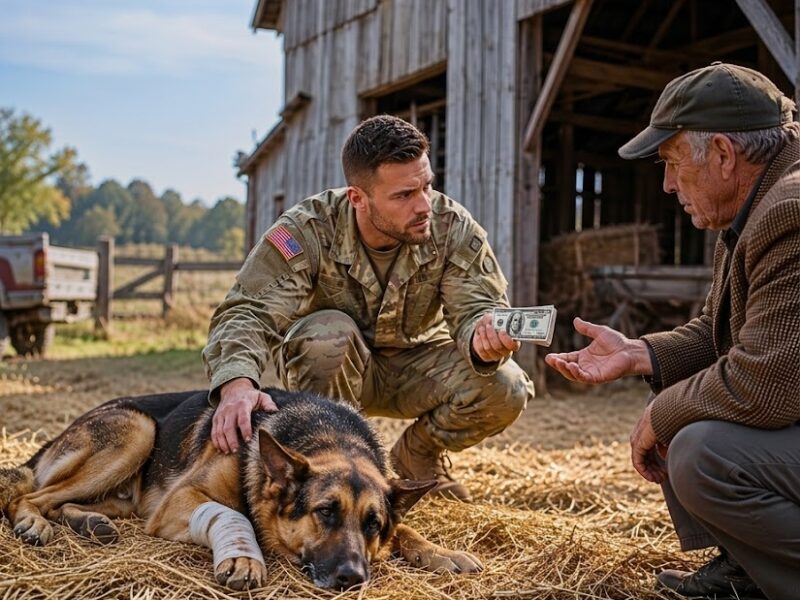
Nobody wanted the injured German Shepherd. He was broken. He was scared. The shelter said he was “unadoptable.” Then a PTSD veteran walked in, pulled out his last $10, and said four words: “I’ll take him.”
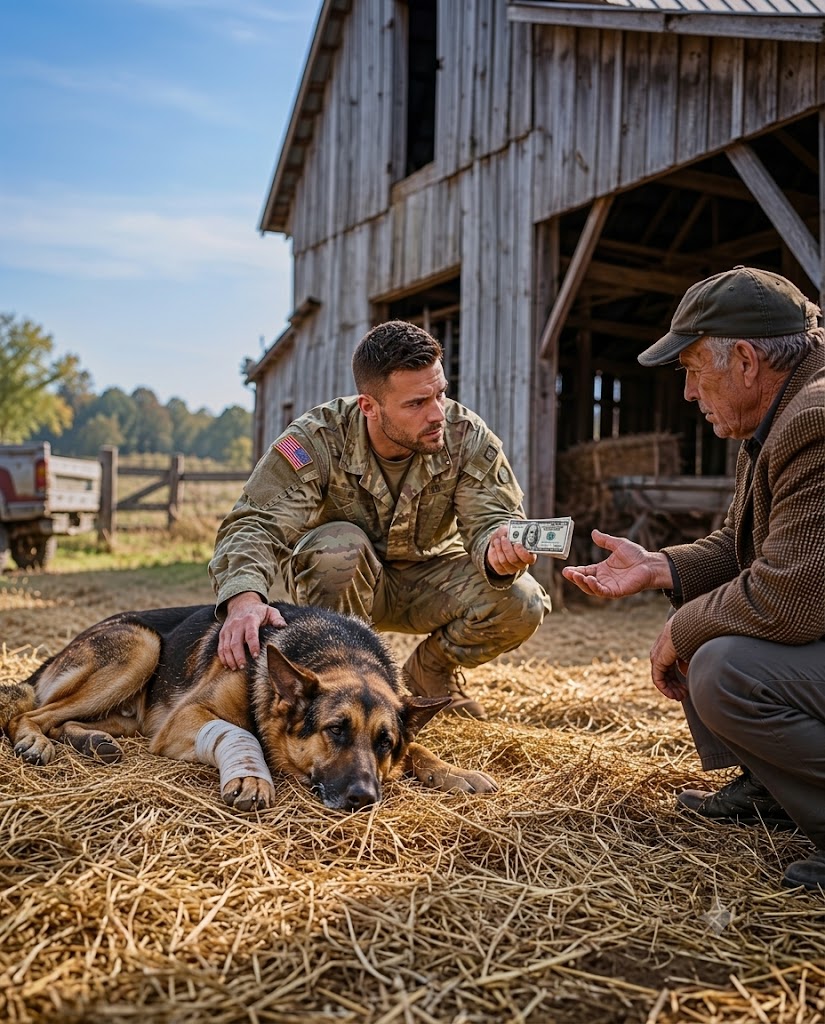
The rain had stopped an hour ago, but the flea market still smelled like wet cardboard and rust.
Mark Thompson pulled his truck into the gravel lot behind the old feed store, killing the engine with a shudder that matched the ache in his lower back.
He was forty-two years old, a former Marine with two tours in Afghanistan and one in Iraq behind him, and he had come here for one reason only: a wrench.
The porch railing at his farmhouse had been loose for three weeks, wobbling every time he leaned on it, and he figured ten bucks at a flea market beat twenty at the hardware store.
What he didn’t figure on was the dog.
The German Shepherd sat at the far edge of the lot, tied to a fence post with a rope that looked like it had been chewed and re-knotted a dozen times.
The dog was thin—ribs visible under a patchy coat of tan and black—and one hind leg was held off the ground, the paw turned slightly inward.
A heavyset man in a stained plaid jacket stood beside him, arms crossed, face set in the expression of someone who had already given up on the day.
Mark walked past him once, then stopped.
The dog’s eyes caught his—deep amber, steady, unflinching—and something passed between them that Mark couldn’t name.
He turned back.
“How much?”
The man grunted. “Ten bucks. He’s worthless. Hurt his leg, can’t work no more, eats too much. Take him or he goes to the shelter Monday.”
Mark knew what the shelter meant for an older dog with an injury in a small town like Pine Hollow.
He reached into his pocket, pulled out a crumpled ten-dollar bill, and handed it over.
The man snatched it and walked away without another word.
Mark crouched slowly, careful not to startle the dog, and loosened the knot around the fence post.
“Hey, buddy,” he said softly. “You’re coming with me.”
The dog didn’t resist. He stood on three legs, wobbled once, then stepped forward with quiet obedience.
Mark led him to the truck, and the dog hopped in with surprising ease, settling onto the passenger seat as if it had always been his.
On the drive home, Mark glanced over twice.
The dog just sat there, gazing out the window at the passing trees, his amber eyes reflecting the autumn light.
When they reached the small farmhouse at the edge of town, Mark led him into the barn, spread a thick wool blanket in the corner, and set down a bowl of water and a dented dish of kibble.
The dog sniffed the food but didn’t eat. He just lowered himself onto the blanket, curled slightly to rest the injured leg, and watched Mark move about.
“You’re safe now,” Mark murmured, kneeling beside him.
For a brief second, he thought he felt the dog’s body relax under his hand.
—
That first night, Mark didn’t sleep much.
He could hear the soft rustle of the wool blanket in the barn, the occasional scrape of claws against the wooden floorboards.
The old farmhouse creaked in the cold, and the wind rattled the windows like distant thunder.
In the morning, frost dusted the grass outside, glinting pale gold in the first light.
Mark stepped into the barn with a dented coffee mug in one hand and a bowl of fresh water in the other.
The dog lay curled on the blanket, head lifting slightly as Mark entered.
His amber eyes met Mark’s—guarded, but alert.
He didn’t growl. He didn’t wag his tail. He just watched.
Mark set the water down beside the half-full bowl of kibble from last night.
“Morning, Hunter,” he said in a low, steady voice.
The name had come to him sometime in the night, unbidden and certain.
The dog sniffed at the water but didn’t drink.
Mark knew better than to push. He’d been in that place himself—the one where hunger didn’t matter as much as keeping your guard up.
He poured himself another cup of coffee, pulled over a crate, and sat across from the dog.
He didn’t reach for him. He didn’t make sudden movements. He just sat there, sipping quietly, letting Hunter’s gaze wander over him.
—
On the third day, the weather shifted.
A thin drizzle fell, tapping against the barn roof like fingertips on a table.
Mark sat in a worn armchair he’d carried from the house, a blanket over his lap, flipping through a book about woodworking.
Hunter lay a few feet away, head resting on his paws, ears twitching occasionally at the sound of rain.
The barn smelled faintly of hay and motor oil.
Mark hummed without realizing it—a tune he remembered from long nights on deployment, when someone in his unit would play harmonica to break the monotony.
The sound seemed to draw Hunter’s attention.
The dog lifted his head, watching Mark with that steady gaze.
Then, without prompting, Hunter shuffled forward.
One slow step, then another, until his front paws rested just inches from Mark’s knee.
Mark froze, not wanting to break the moment.
He kept humming, eyes lowered, and after a long pause, he felt the brush of Hunter’s nose against his hand.
It was a light touch—cautious, but deliberate.
“You’re getting there, buddy,” Mark said softly.
That night, as Mark headed back to the house, he glanced over his shoulder.
Hunter was still lying in his corner, but his head was up, ears forward, watching Mark go.
There was something different in that look—not just weariness, but curiosity.
It wasn’t full trust yet, but it was a beginning.
And beginnings, Mark knew, were worth holding on to.
—
By the end of the week, the November winds had grown sharper in Pine Hollow.
The barn doors rattled softly when a gust pushed through, and the smell of damp leaves drifted in from the fields.
Mark had settled into a rhythm with Hunter—mornings spent checking on him, afternoons repairing tools or chopping wood, evenings reading in the old armchair by the stall.
Hunter still kept his distance most of the time, but now his eyes followed Mark with more curiosity than suspicion.
That morning, Mark was tightening the loose hinge on the barn’s side door.
The rusty metal gave way suddenly, and the heavy toolbox he’d perched on a crate toppled to the ground with a loud metallic crash.
In an instant, Hunter’s ears snapped forward, his muscles tensing like coiled wire.
He sprang to his feet and moved in a quick arc to stand between Mark and the source of the noise, head lowered, eyes scanning the space beyond the open door.
It was the kind of movement that wasn’t born from instinct alone.
It had precision.
Mark froze, taking in every detail—the way Hunter’s paws planted evenly, his body weight balanced for movement in any direction, the stillness in his breathing.
These were habits he’d seen in trained working dogs before.
He crouched slightly, watching.
After a moment, Mark tested a thought.
In a calm but firm voice, he said, “Down.”
The reaction was immediate.
Hunter dropped to the ground, chin flat, legs tucked neatly beneath him.
There was no hesitation, no confusion—only compliance.
Mark narrowed his eyes, his mind already piecing together a picture.
“You’ve done this before,” he murmured.
—
Later that afternoon, when the clouds began to bruise purple along the horizon, Mark decided to test again.
He picked up an old tennis ball from a box of odds and ends.
Standing a few feet from Hunter, he pointed sharply and said, “Stay.”
He tossed the ball across the barn.
Hunter didn’t move.
His eyes tracked the ball, but his body stayed locked in place.
Only when Mark said, “Okay,” did Hunter stand, cross the distance in a few strides, and return the ball, dropping it gently at Mark’s feet.
That night, after dinner, Mark picked up his phone and scrolled through the contacts list until he found a name he hadn’t dialed in nearly a year.
Tom Reyes.
Tom had been a fellow Marine—shorter than Mark, but built like a steel beam, with close-cropped hair and a dry humor that could cut through any tense moment.
After leaving active duty, Tom had joined a military K-9 training program and now worked as a consultant for law enforcement.
When Tom answered, his voice was warm but tinged with surprise.
“Mark Thompson. Thought you fell off the map.”
“Something like that,” Mark replied. “Listen, I’ve got a dog here. German Shepherd. I picked him up at the flea market. He’s got some skills. Military kind of skills.”
“Like what?” Tom asked, his tone sharpening with interest.
Mark described the reactions—the protective stance after the toolbox fell, the perfect down, the steady stay and retrieval.
“Those aren’t backyard tricks,” Tom said after a pause. “That’s muscle memory from serious training. If he’s as sharp as you say, he’s been through the program. Question is, which one?”
Mark glanced over at Hunter, lying in the corner with his head resting on his paws, but eyes fixed on him.
“I don’t know yet,” Mark said. “But I intend to find out.”
—
The next day, Sarah Johnson stopped by again.
Sarah was in her late fifties, tall and wiry, with sharp blue eyes and a smile that could melt most people’s defenses.
She ran the coffee stand at the flea market every Saturday and seemed to know everyone’s business.
She also had a habit of showing up when people least expected it.
Widowed young when her husband died in a logging accident, she had since filled her life with town committees, church fundraisers, and making sure no neighbor went unnoticed.
It gave her a sense of purpose that softened the sharp grief she’d carried for decades.
She arrived with a thermos of soup and a knitted blanket she insisted was “for the both of you.”
She noticed Hunter sitting near the barn door, ears twitching as her car pulled up.
“He’s watching like a guard,” she said with a small smile.
“More than that,” Mark replied. “He’s trained. Professional level.”
Sarah’s brows lifted. “Well, that explains the way he moves—like he’s thinking ahead of everyone else.”
Mark didn’t elaborate.
The thought of what Hunter might have been through before ending up here had lodged in his mind like a splinter.
And if the dog’s past was half as intense as his instincts suggested, then they had both walked through more than their share of fire.
—
That evening, while closing up the barn, Mark decided on one last test.
Standing in the doorway, he raised his hand into a flat palm and said, “Sit.”
Hunter’s haunches lowered smoothly to the ground.
Mark then turned his body halfway, curling his fingers in the air—a hand signal he’d seen military handlers use.
Without a word, Hunter stood, circled once, and sat again on Mark’s right side.
It confirmed what he already suspected.
Whoever had trained Hunter had done it with precision, discipline, and purpose.
This was no accident.
As the light faded and the barn filled with the low hum of night insects, Mark felt the faintest trace of a smile.
“You’re full of secrets, aren’t you?” he said to the dog.
Hunter didn’t move, but his tail gave one slow, deliberate wag.
—
The first frost of winter had crept over Pine Hollow, dusting the edges of the grass with silver and leaving the air thin and sharp.
Mark had been restless all afternoon, unable to focus on the half-finished repairs to his porch.
The hammer in his hand felt heavier than usual, his thoughts drifting back to the conversation with Tom Reyes and the questions that still lingered about Hunter’s past.
As the sky began to bruise into deep shades of violet, he grabbed his jacket and decided to walk the wooded trail behind his property.
The path wound through the back acreage, weaving between maples and oaks stripped bare for the season.
Hunter trotted alongside him, the dog’s gait steady despite the slight limp.
The woods were quiet, except for the crunch of frost-hardened leaves under their steps and the occasional call of a crow heading home.
Mark had always used these walks to settle his mind, but tonight the shadows between the trees seemed deeper, the silence heavier.
A faint smell of smoke drifted through the air—likely from someone’s distant fireplace—but it was enough to stir something in his memory.
Without warning, the scent morphed in his mind into the acrid stench of burning fuel.
His chest tightened.
The trail beneath his feet blurred, replaced by a dusty road half a world away.
The sharp pop of a branch snapping somewhere in the distance became, in his mind, the crack of small arms fire.
His breath came faster, shallow, his vision narrowing.
The cold air seemed suddenly thick, choking.
He staggered to a stop, one hand gripping the rough bark of a tree, trying to orient himself.
Hunter’s reaction was immediate.
The dog stepped in close, pressing the weight of his body firmly against Mark’s leg.
His head nudged at Mark’s hand, grounding him in the present.
When Mark dropped to his knees, Hunter moved with him, leaning harder—a steady, living anchor against the tide of panic.
Mark’s ears still rang with phantom echoes, but the warmth radiating from Hunter cut through the noise.
The dog’s breathing was slow, even, and without realizing it, Mark matched his own breaths to that rhythm.
Inhale, exhale. Inhale, exhale.
The edges of the flashback began to fray, the imagined gunfire fading back into the distant rustle of winter branches.
When Mark finally lifted his head, Hunter was watching him with a still, unwavering gaze.
There was no fear in those amber eyes—only focus and quiet resolve, as if he understood exactly what had just happened and what was needed of him.
A sudden crunch of footsteps approached from deeper along the trail.
Mark turned his head sharply, adrenaline still raw, but the figure that emerged from the gloom was familiar.
It was Carl Benton, a wiry man in his late sixties who lived on the adjoining property.
Carl wore a battered leather hat and a faded green jacket that looked as though it had survived decades of hard use.
He’d been a volunteer firefighter for most of his life before retiring, and though arthritis had bent his shoulders slightly, his eyes still carried the alertness of someone used to reading trouble from afar.
“You all right there, Mark?” Carl asked, slowing his pace as he took in the scene.
Mark forced a breath, nodding. “Yeah. Just needed a minute.”
Carl’s gaze shifted to Hunter, still pressed close to Mark’s side.
“That’s a good dog you’ve got. Knows when to stick with you.”
Mark managed a small, tired smile. “Yeah. He knows.”
Carl gave a short nod, as if satisfied, and continued down the path toward his own property.
Hunter stayed close until Mark rose to his feet, and even then he walked at his side without straying.
The rest of the way home was quiet, but this time the silence felt steady, not suffocating.
Back at the barn, Mark crouched in front of Hunter, resting one hand on the dog’s shoulder.
“You’re more than just a fighter, aren’t you?” His voice was low, almost to himself. “You’ve been trained for this. For me.”
Hunter didn’t move, but his tail brushed once against the blanket behind him—a small motion that felt like agreement.
That night, Mark sat in the armchair longer than usual, book forgotten in his lap, the barn light casting a soft glow over them both.
Something had shifted.
He’d always known Hunter was skilled, but tonight had shown him another side—one that didn’t just protect against danger, but could pull a man back from the edge.
—
The morning after their walk in the woods, the air in Pine Hollow carried the brittle edge of approaching snow.
Mark noticed Hunter still favoring his left hind leg more than usual.
It wasn’t the limp of fatigue. It was sharper—the kind of movement that spoke of a deeper injury that had never fully healed.
Mark decided it was time to have him checked properly.
He pulled on his heavy coat, grabbed the truck keys, and called the vet’s office in town.
The Pine Hollow Veterinary Clinic was a small brick building tucked between the feed store and a bakery that always smelled of fresh cinnamon rolls.
Inside, the space was warm and bright, with the soft hum of a heater and faint country music playing from a radio on the counter.
Behind the desk stood a woman in her early forties—slender, with neat auburn hair pulled into a ponytail.
Her name tag read Mara.
She had the calm efficiency of someone used to managing anxious pet owners and their animals.
“Morning, Mark. What can we do for you?”
“Hunter here’s got an old injury,” Mark said, glancing down at the dog. “Figured it’s time someone took a real look.”
Mara nodded and picked up the phone to let the vet know.
Within minutes, Dr. Benjamin Simmons stepped into the waiting area.
Simmons was in his late fifties, tall with a slight stoop from years bent over examining tables.
His salt-and-pepper beard gave him a scholarly air, and his eyes were the kind that seemed to notice everything without judgment.
“Good to see you, Mark,” Simmons said, shaking his hand firmly before crouching to greet Hunter. “Let’s take him in and have a look.”
In the exam room, Simmons moved with quiet precision, his hands gentle but thorough as he checked Hunter’s leg, joints, and muscles.
He hummed softly as he worked, the way some people do when concentrating.
“Old injury,” he murmured. “Could be from blunt force or shrapnel. Hard to say without an X-ray.”
When his hands moved to the dog’s neck and shoulders, Simmons paused, his brow furrowed as he pressed lightly against a small, hard spot under the skin just behind Hunter’s left shoulder.
“There’s something here,” he said. “Feels like a microchip—but damaged.”
He pulled a handheld scanner from the counter and passed it over the area.
At first, nothing happened.
Simmons adjusted the angle, tried again, and this time, the scanner emitted a faint beep.
The display flickered, then stabilized.
Simmons’s eyes widened.
“Well, this is something.”
He turned the screen toward Mark.
“Your Hunter here isn’t just any dog. He’s registered as Echo-Seven. U.S. military K-9. Status: missing in action, Syria, three years ago.”
Mark stared at the screen, his mind reeling.
“Missing in action?”
Simmons nodded gravely. “The record says he was part of a convoy escort detail. There was an IED explosion during a humanitarian transport in northern Syria. Several vehicles destroyed. Echo-Seven’s handler was injured and evacuated. The dog was reported unaccounted for—presumed dead.”
Mark’s gaze shifted to Hunter, who stood calmly between them, tail still and ears forward, as though the words meant nothing to him.
“How does a dog go from a war zone to a flea market in Pine Hollow?” Mark asked.
Simmons leaned back, folding his arms.
“Best guess? He might have been found by locals. Sometimes military dogs are cared for by civilians if they can’t be returned. If he was injured, they may not have had the means for proper care. From there, it’s not uncommon for animals to be traded or sold—especially through less-than-official channels. Eventually, he could have been moved across borders, ended up with someone who brought him to the U.S. through a rescue network, or even a private sale.”
Mark thought about the limp, the torn ear, the steady, unflinching eyes.
“And the chip?”
“Likely damaged in the explosion,” Simmons replied. “It wouldn’t have been able to transmit properly. Without a scan in just the right way, it’s almost invisible. That’s probably why no one connected him to his old records until now.”
Mark stood in silence for a moment, the truth settling in.
The military stance, the flawless obedience, the unshakable calm in dangerous situations—it all made sense now.
Hunter wasn’t just a survivor.
He was a decorated working dog, a soldier in his own right.
Simmons, seeing the weight of it on Mark’s face, softened his tone.
“Whatever happened out there, he’s here now. And from the looks of it, he’s chosen you.”
Mark glanced down at Hunter, who met his gaze without blinking.
There was no need for words.
Both of them understood.
They’d found each other after walking their own separate, brutal roads—and neither intended to let go.
On the way out, Mara handed Mark a small envelope with Hunter’s medical report.
“You’ve got yourself a hero,” she said with a smile.
Mark didn’t reply immediately.
He just rested his hand on Hunter’s back, feeling the steady rise and fall of his breath.
Hero wasn’t the word he would have chosen—but he knew she wasn’t wrong.
—
The rain had been falling since dawn—a cold, steady drizzle that turned the dirt roads of Pine Hollow into slick ribbons of mud.
By late afternoon, the temperature had dropped further, and a thin mist clung low over the fields.
In the barn, the rhythmic sound of rain on the tin roof was almost hypnotic.
Mark sat on a stool, running a cloth over the metal parts of an old rifle, while Hunter lay curled on his blanket, ears twitching occasionally at the louder gusts of wind.
The sound of tires crunching over wet gravel broke the quiet.
Mark stood and stepped to the barn door just as Carl Benton’s old Chevy truck came to a stop.
Carl climbed out quickly, pulling his battered leather hat lower over his brow.
Even in the dim light, Mark could see the tight lines of worry etched into the older man’s weathered face.
“Mark,” Carl called over, his voice urgent. “Have you seen Mrs. Wilkins today?”
Mark shook his head. “No. Not since last week. What’s going on?”
Carl walked closer, rain dripping from his hat brim.
“Her nephew came by to check on her this afternoon. Found her house unlocked, her coat and boots gone. She’s nowhere in sight. Sheriff’s deputies have been combing the woods for hours, but they’ve had to pull back. Visibility is bad, and the ground’s turning nasty.”
Mrs. Wilkins.
Mark knew her only in passing, but enough to picture her—a slight woman with fine white hair, always neatly pinned back, eyes that crinkled kindly when she smiled.
She was seventy-eight, proud to a fault, and had lived alone at the edge of Mill Road for nearly two decades.
He also knew that a night out in this weather could be lethal for someone her age.
Mark looked down at Hunter.
The dog had risen silently, standing at his side, tail low but ears pricked forward.
It wasn’t just curiosity in his posture. It was readiness.
“Carl,” Mark said, “let’s see if Hunter can find her.”
—
Within minutes, they were at the back edge of Mrs. Wilkins’s property, where a narrow trail disappeared into the trees.
The rain fell harder here, dripping in steady streams from the bare branches overhead.
A deputy in a yellow rain slicker met them at the trailhead, her flashlight beam cutting through the gray.
Her name tag read Collins.
“You’re Mark Thompson, right?” she asked. “Carl says your dog’s got training.”
Mark gave a curt nod. “Military level. He can track if he’s got a scent.”
Collins handed him a knitted scarf. “This was hanging by her kitchen door. Should be recent.”
Mark crouched and held the scarf to Hunter’s nose.
The shepherd inhaled deeply, his nostrils flaring, then looked up at Mark as if to say, “I’ve got it.”
Without hesitation, he lowered his head and began to move forward, pulling slightly against the lead.
They followed him into the trees, their boots sinking into the sodden ground.
The rain muffled most sounds, leaving only the swish of wet branches and the occasional snap of a twig underfoot.
The main trail soon veered left, but Hunter ignored it, angling sharply right toward denser undergrowth.
Carl shot Mark a look. “You sure about this?”
“Trust him,” Mark replied.
The forest floor sloped upward, the mud making every step a fight for balance.
Twice, Carl nearly lost his footing, steadying himself against a tree trunk.
Hunter never faltered, moving in a zigzag pattern, nose close to the ground, tail flicking as he worked.
At one point, he paused, sniffing at a cluster of broken branches before surging forward again.
Fifteen minutes in, the wind picked up, bending the tree limbs overhead.
Mark could feel the damp seeping through his jacket, chilling him to the bone.
They crossed a shallow gully where water gurgled over slick stones.
On the far side, Hunter stopped abruptly, ears swiveling.
He glanced back at Mark, then moved with sudden urgency down a narrow animal path.
The ground leveled out into a small hollow ringed by leaning cedar trees.
And there, half-hidden in the shadow of one, sat Mrs. Wilkins.
She was hunched against the trunk, her raincoat soaked through, her thin legs pulled up beneath her.
Her face was pale, lips tinged with blue.
Mark was beside her in seconds, stripping off his jacket to drape over her shoulders.
“Mrs. Wilkins, it’s Mark. You’re safe now. We’re getting you home.”
Her cloudy eyes blinked up at him, confusion giving way to faint relief.
“I got turned around. I didn’t know which way. And then it got so cold.”
Hunter stood close, pressing his side against her legs as if to lend warmth.
She reached out a trembling hand, and he dipped his head just enough for her fingers to thread into his fur.
Carl’s voice was calm but firm as he radioed Collins with their location.
“We’ve got her. Send the deputies in with the stretcher. Ground’s slippery—she’s not walking out on her own.”
While they waited, Mark stayed crouched beside her, keeping his arm around her shoulders.
Hunter never moved from his spot, his gaze scanning the trees as though guarding them from any further harm.
When the deputies arrived, they worked quickly, wrapping Mrs. Wilkins in a thermal blanket before lifting her onto the stretcher.
As they began the careful trek back to the trailhead, Hunter trotted alongside, occasionally glancing back at Mark as if to check that he was keeping pace.
By the time they reached the clearing, the rain had softened to a mist.
Mrs. Wilkins was loaded gently into the back of the waiting ambulance, her hand briefly brushing Hunter’s head in a silent thank you.
Deputy Collins turned to Mark, rainwater dripping from the brim of her hood.
“We owe your dog a lot tonight. The rest of us were looking in the wrong place. He went straight to her.”
Mark glanced down at Hunter, who shook the rain from his coat, eyes half-closed in that quiet, self-contained way of his.
“That’s what he does,” Mark said simply.
—
The rain from the night of the rescue had long since passed, leaving the air in Pine Hollow bright and clear—the kind of crisp winter sunlight that made the frost sparkle on rooftops.
It had been three days since Hunter found Mrs. Wilkins, and the story had already traveled faster than the cold wind through town.
Mark noticed the change almost immediately.
On his first trip into town after the rescue, he stopped by the hardware store for nails and paint.
Normally, people glanced his way and quickly looked off, respecting the quiet bubble he seemed to keep around himself.
But this time, folks approached.
An older man in a wool cap clapped him on the shoulder.
A mother with two children thanked him for “what you and that dog did.”
Even strangers who didn’t know his name had started nodding as he passed.
By the time Mark returned to his truck, Hunter—waiting patiently in the passenger seat—had a small paper bag of treats from the store owner, a wiry man named Pete who had a reputation for being gruff.
“For your partner,” Pete had said, his voice grumbling but his eyes soft.
That afternoon, Sarah Johnson arrived at Mark’s place carrying a basket lined with a checkered cloth.
She was dressed in her usual winter uniform—a long wool coat, knitted scarf, and leather gloves that looked older than some of the town’s folk.
Her sharp blue eyes scanned the barn before settling on Hunter.
“Well, aren’t you the talk of Pine Hollow?” she said, crouching to scratch behind Hunter’s ears. “You’ve got people who never agree on anything agreeing about you.”
She handed Mark the basket.
Inside were fresh biscuits, a jar of homemade apple butter, and a loaf of bread still warm from the oven.
“I’m not much for attention,” Mark admitted.
Sarah smiled knowingly. “Maybe. But sometimes the right kind of attention can do more than you think.”
—
Later that week, an invitation arrived in the mail, the envelope bearing the logo of the Pine Hollow Veterans Association.
Inside was a handwritten note from their chairperson, a stocky man named Frank Meyers.
Frank was in his early sixties, his hair a steel-gray crew cut, and he carried himself with the easy confidence of someone who’d led men in difficult places.
“Mark,” the note read, “we’d be honored if you and your dog could join us at the community hall this Saturday. The guys would like to meet you both, and I think you’ll find it’s good to be around people who speak the same language.”
At first, Mark almost tossed it aside.
Crowds weren’t his thing, and gatherings had been harder for him since coming home.
But when Saturday came, he found himself standing outside the hall, Hunter at his side, the murmur of voices spilling from the open doors.
Inside, the warm scent of coffee and chili greeted them.
Long tables were arranged with photos of service members, flags folded neatly in triangular cases, and worn medals in display boxes.
The veterans ranged in age from fresh-faced twenty-somethings to men and women with hair as white as the snow outside.
Frank spotted them immediately and came over, his handshake firm.
“Good to finally meet you, Mark. And you must be Hunter.”
He gave the dog a nod that was more like a salute.
They moved through the room slowly, and Mark was surprised at how easily conversation started.
Some wanted to hear about the rescue.
Others just wanted to talk dogs.
A Vietnam veteran with a quiet demeanor told Mark about the shepherd he’d served with in 1969.
A younger Marine laughed about how his unit’s bomb-sniffing dog once stole an officer’s sandwich during an inspection.
Hunter stayed calm and steady throughout, letting hands ruffle his fur, sitting obediently when told.
At one point, a boy of about ten, there with his grandfather, knelt to hug Hunter, his face lighting up as the dog rested his head gently on the boy’s shoulder.
Mark felt something shift.
The walls he’d kept around himself weren’t gone, but they were thinner.
He realized that every smile, every handshake, every shared story was another step toward a life he’d stopped believing he could have.
And Hunter was the reason he was taking those steps.
By the time they left, the winter sky was already turning the color of pale steel, the first stars blinking through.
As they walked to the truck, Mark looked down at Hunter.
“You did more than save Mrs. Wilkins,” he said quietly. “You’re saving me, too.”
Hunter looked up at him briefly, tail giving a slow wag, as if he understood.
—
The first snow of the season had fallen overnight, laying a clean white blanket across Pine Hollow.
Sunlight glinted off the rooftops and made the air sparkle, but the cold was sharp, nipping at exposed skin.
Mark stood outside the town hall, his breath puffing in white clouds.
Beside him, Hunter sat tall and steady, his black-and-tan coat vivid against the snow, amber eyes scanning the crowd gathering near the entrance.
Inside, the hall was already buzzing with voices.
Flags hung along the walls, and a long table at the front was draped in dark blue cloth embroidered with the seal of the Pine Hollow Veterans Association.
Rows of folding chairs filled the room, and the smell of fresh coffee mingled with pine from the wreaths hung for the holidays.
Frank Meyers, the association chair, approached from the stage.
His steel-gray hair was neatly combed, and he wore a blazer that couldn’t quite hide the broad-shouldered frame of a man who had spent decades in uniform.
“Good turnout today,” he said with a grin. “You ready?”
Mark gave a small nod. “As I’ll ever be.”
When the ceremony began, Frank stepped to the microphone.
His voice carried easily over the room.
“Today, we honor not just our veterans, but those who continue to serve in ways that go beyond the battlefield. Some of you know the story of a certain German Shepherd and the Marine he chose to stand beside. But today, we’re going to hear it from the man himself.”
Applause filled the room as Frank motioned for Mark to join him.
Mark walked to the podium, Hunter moving at his side with perfect heel work.
The lights above made the polished wood floor gleam.
Mark rested his hands lightly on the podium, scanning the audience.
He saw Sarah in the second row, her tall frame upright, scarf wrapped neatly around her neck, eyes bright with encouragement.
Carl sat beside her, hat in his lap, his weathered face split into a rare, proud smile.
Even Mrs. Wilkins was there, wrapped in a thick coat, her hands folded around a small thermos of tea.
Mark cleared his throat.
“When I first saw Hunter, he was tied to a post at a flea market. The man selling him said he wasn’t worth much anymore. Ten dollars. That was it.”
His voice softened.
“I didn’t know who he was. I didn’t know what he’d been through. I just knew he needed someone. And maybe I did, too.”
He glanced down at Hunter, who looked back with that calm, steady gaze.
“People have told me I saved him. But the truth is, Hunter saved me first. He’s been there through the roughest nights, the quietest mornings, the moments I thought I’d never get back up. He’s pulled me out of more than one place I didn’t think I could escape.”
There was a stillness in the room now, the kind that meant every ear was listening.
“I’ve registered him as my official service dog—not because he needed the title, but because it means we can keep doing what we’ve already been doing. Helping others. Hunter and I will be working with the Veterans Association, supporting those who are still fighting battles no one can see.”
He let the words settle before adding, “He’s not just my partner. He’s my family. And I can promise you this: wherever I go, he goes. That’s our deal. That’s our vow.”
Applause erupted, rising until it filled the hall.
Frank returned to the stage, presenting Mark and Hunter with a framed certificate and a collar tag engraved with the association’s emblem.
Hunter stood patiently as Mark fastened it to his collar, the medal glinting in the light.
After the ceremony, people lined up to shake Mark’s hand or kneel to greet Hunter.
A young woman with a prosthetic leg and an Army patch on her jacket spent several minutes with the dog, smiling for the first time in what looked like a long while.
An older veteran told Mark, “You’ve got a once-in-a-lifetime dog there. Take care of each other.”
When the crowd began to thin, Mark and Hunter stepped outside into the cold.
Snowflakes drifted lazily down, melting against Hunter’s fur.
Mark crouched beside him, resting a gloved hand on his neck.
“We’ve got work to do, partner,” he murmured.
Hunter’s tail swept slowly through the snow, as if in agreement.
They walked off together, their footprints side by side in the untouched white—a man and his dog, bound by a promise stronger than words.
—
Sometimes God’s greatest miracles don’t come with thunder or blinding light.
They walk quietly into our lives on four legs, carrying the kind of love that heals wounds we thought would never close.
Hunter was more than a dog to Mark.
He was proof that broken things can be made whole again, that second chances are real, and that God places the right souls in our path exactly when we need them most.
In our everyday lives, we may pass by someone or something that needs us just as much as we need them.
Don’t ignore those moments.
They might be your miracle in disguise.
If this story touched your heart, please share it so others can feel the same hope.
Leave a comment below and type amen if you believe God still works miracles through the bonds of love and loyalty.
And don’t forget to subscribe for more stories that remind us we are never truly alone.
May God bless you and protect you always.









