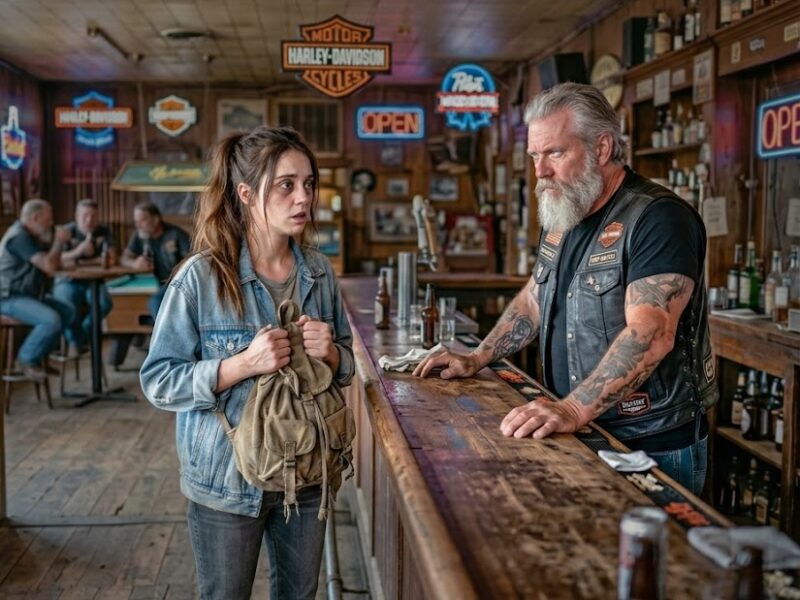
No one wanted the job at the Hells Angels bar. Too rough. Too dangerous. Too many stories about people who didn’t last. Then she walked in—broke, desperate, and out of options—and took it. What she found wasn’t danger. It was family.
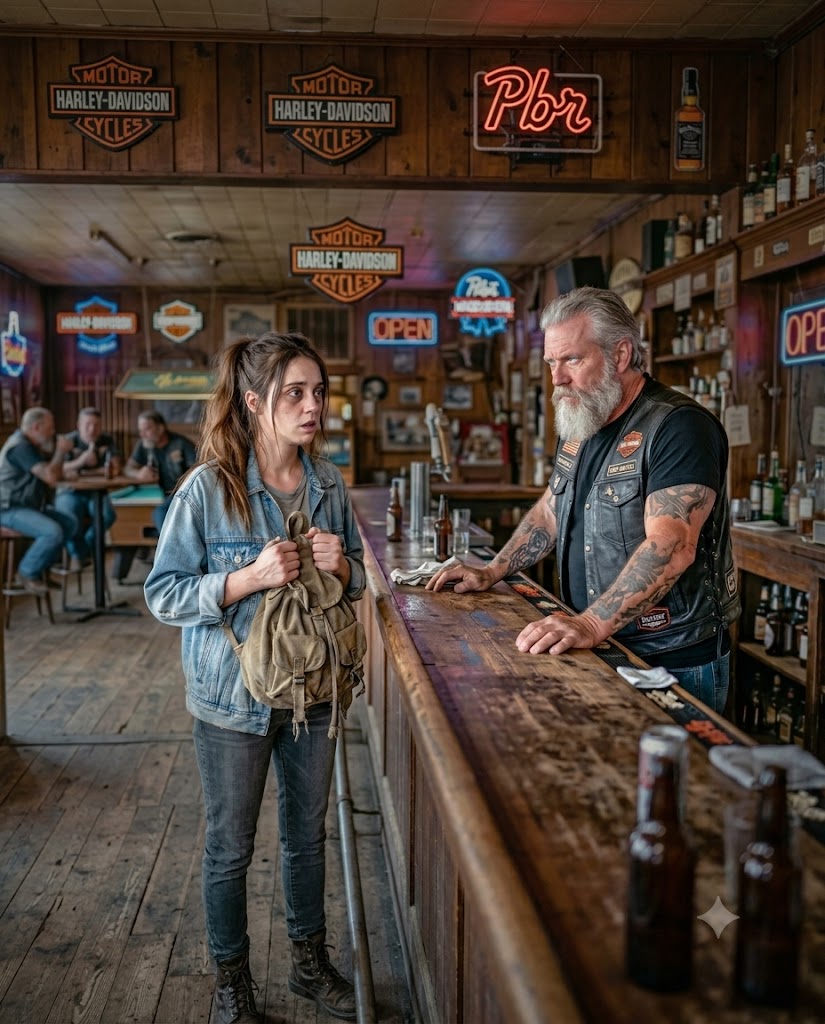
Part 1
The smell of beer soaked into floorboards for thirty years turns sour, heavy, almost like rotting apples and oxidized copper.
Most people walked into the Iron Horse, choked on that decay, saw the leather cuts at the bar, and turned right back around.
Not Rachel.
She needed rent money more than she needed a pulse, and the faded help wanted sign had been gathering dust for six months.
Nobody wanted to pour drinks for the Hell’s Angels.
She did.
Neon light bled through the cracked tinted front window, casting a sick pink hue over the scuffed linoleum near the entrance.
Rachel stood just inside the door, letting the heavy oak slam shut behind her.
It cut off the sound of the midday traffic, replacing it with the low electrical hum of a beer cooler and the rhythmic hollow drip of a leaky tap.
Nobody was at the bar.
The room was long, narrow, and smelled aggressively of stale tobacco, spilled whiskey, and wet dog.
To her right, a line of pool tables sat under low-hanging lamps, the felt bruised and stained.
She shoved her hands deeper into the pockets of her oversized denim jacket to hide the tremor in her fingers.
She wasn’t brave.
Bravery was for people who had options.
Rachel had an eviction notice taped to her apartment door and exactly fourteen dollars in her checking account.
Footsteps sounded from a back room, heavy, deliberate, accompanied by the distinct clink of chain against denim.
A man stepped out from behind a curtain constructed of cheap black beads.
He was older, mid-fifties perhaps, with a thick iron gray beard and a face mapped with deep sunbaked crevices.
He wore a faded black t-shirt tight across a barrel chest.
A leather vest hung open over it.
The red and white winged death head patch barely visible as he turned to grab a rag from beneath the counter.
He didn’t look up.
He just started wiping down the sticky mahogany surface.
His movement slow and mechanical.
“Bars closed,” he rasped.
His voice sounded like tires grinding over gravel.
“Sign in the window says you’re hiring,” Rachel said.
Her voice came out thinner than she wanted.
She cleared her throat, tasting the dust in the air.
“I’m here for the job.”
The man stopped wiping.
He slowly raised his head.
His eyes were a pale, washed out blue, devoid of surprise, devoid of much of anything.
He stared at her for a long, uncomfortable moment.
The silence stretched thick and suffocating.
Rachel forced herself not to shift her weight.
She kept her eyes locked on the bridge of his nose, a trick she’d learned to fake eye contact without enduring the intimidation of a direct stare.
“You lost?” he asked, tossing the damp rag onto the counter.
It landed with a wet smack.
“No. You know who drinks here.”
It wasn’t a question.
“I know, D.”
He leaned forward, resting his massive scarred forearms on the bar.
The smell of old engine grease and dial soap wafted off him.
“Girl like you, you belong in one of those shiny places downtown selling twelve-dollar martinis to guys in suits.
We don’t do umbrellas in our drinks here.”
“I don’t care about umbrellas,” Rachel said.
“I care about cash.
Yours is the only sign I’ve seen that doesn’t require three interviews and a personality test.
Can you pay me on Fridays?”
A short breathy sound escaped his nose.
It might have been a laugh.
He picked up a thick glass mug, inspected it for water spots, and set it down.
“Name’s Hank,” he said.
“Can you pour a beer without giving me two inches of foam?”
“Yes.”
“Can you keep your mouth shut when you see things that ain’t your business?”
“I don’t have the energy to care about other people’s business,” she replied honestly.
The exhaustion in her bones weighed more than her fear.
She felt an overwhelming urge to just sit down on the sticky floor and sleep.
Hank studied her face.
He saw the dark circles under her eyes, the frayed cuffs of her jacket, the cheap worn out sneakers.
He wasn’t looking for a tough girl.
He was looking for someone desperate enough to stay, but smart enough not to steal.
“Twelve bucks an hour, cash under the table.
You keep your tips, but don’t expect these cheap bastards to line your pockets.”
Hank grunted, turning his back to her to fiddle with the register.
“You start at four.
Don’t be late, and don’t play the jukebox.
It’s broken, and if you touch it, it sparks.”
Rachel exhaled, a shaky, invisible breath.
“I’ll be here at four.”
She turned and walked out, the neon sign buzzing a farewell against the back of her neck.
She had the job.
Now she just had to survive the shift.
Friday night at the Iron Horse wasn’t a party.
It was a territorial occupation.
The air inside the bar grew dense, a physical weight pushing against Rachel’s lungs.
It smelled of cheap domestic beer, sweat, leather polish, and the sharp acrid bite of exhaust fumes clinging to the clothes of the men who piled in.
By nine o’clock, the noise was a solid wall.
Deep booming laughter cut through the guttural roar of conversations, competing with a newly fixed jukebox blasting old school Sabbath.
Rachel moved behind the bar like a ghost in a machine.
She learned quickly that efficiency was her only shield.
She didn’t smile.
She didn’t make small talk.
When a heavy calloused hand slapped a crumpled twenty on the bar, she replaced it with a bottle of beer and exact change.
Her eyes already moving to the next order.
The men were massive.
They wore their cuts like armor, the patches denoting ranks and loyalties she didn’t understand and didn’t want to.
They moved with a heavy unbothered arrogance that claimed every square inch of the room.
A few threw crude comments her way, but most treated her like the beer taps.
A necessary utility, entirely invisible until they were empty.
Around eleven, the atmosphere shifted.
It wasn’t sudden, just a slight tightening of the tension in the room.
A group of younger guys, prospects Hank had called them, the ones without the full patches, were getting loud at a booth near the back.
One of them, a jittery kid with a neck tattoo and too much to prove, slammed his empty pint glass on the table.
He stood up unsteady and yelled across the crowded room.
“Hey, sweetheart.
We’re dry over here.”
The bar didn’t go silent, but the conversations closest to the bar dimmed.
Several full-patched members turned their heavy heads, their expressions unreadable, watching to see how the new girl would react.
Rachel was currently up to her elbows in soapy gray water, scrubbing lipstick off a shot glass.
She felt the eyes on her.
The primal lizard part of her brain screamed at her to shrink, to apologize, to rush over with a tray of fresh drinks.
Instead, a profound biting irritation flared in her chest.
Her feet were screaming in agony from the concrete floor.
Her back ached.
She was too tired to be intimidated by a twenty-something kid playing tough guy.
She pulled her hands out of the sink, dried them methodically on a towel tucked into her apron, and grabbed a damp bar rag.
She walked out from behind the counter, navigating the narrow space between the backs of bar stools and the patrons.
She reached the booth.
The prospect grinned, a sloppy, aggressive smirk.
“Took you long enough.
Get us another round and maybe wipe this table.
It’s sticky.”
Rachel looked at the table.
She looked at the prospect.
She tossed the damp gray rag directly onto the center of the table.
It landed with a wet slap, splashing a tiny bit of leftover beer onto the kid’s hand.
“Bar’s up there,” Rachel said, her voice flat, completely devoid of inflection.
“You want a drink, you come get it.
You want a clean table, you wipe it.”
The kid’s smirk vanished.
His face flushed a dark, angry red.
He opened his mouth, his hands balling into fists.
Rachel stood her ground, though her stomach was executing a slow, terrifying barrel roll.
Before the prospect could speak, a massive hand clamped down on his shoulder.
It belonged to a man named Miller, tall, built like a brick wall with a scar slicing through his left eyebrow.
He was a full patch, one of the older guys who usually sat quietly in the corner.
Miller squeezed the kid’s shoulder.
The prospect visibly wilted.
“Kow, she ain’t your maid, kid,” Miller said, his voice low, lacking any anger, which somehow made it more terrifying.
“Go up to the bar and order your drinks, and leave the girl alone.
She’s working.”
The prospect swallowed hard, nodded sharply, and slid out of the booth, keeping his eyes on the floor as he headed for the bar.
Miller looked at Rachel.
He didn’t smile, but there was a faint glint of approval in his dark eyes.
He gave a fractional nod.
Rachel nodded back, picked up the empty glasses from the edge of the table, and walked away.
Her knees felt a little like water, but she kept her spine straight.
As she slipped back behind the safety of the oak counter, she realized something strange.
Her heart rate was returning to normal.
The panic was receding, replaced by a bizarre, grounded calm.
She wasn’t one of them, and she never would be, but she had drawn a line, and the monsters in the room had respected it.
Tuesday mornings at the Iron Horse were the antithesis of Friday nights.
The bar was officially open, but it was practically a tomb.
The air still smelled of stale beer, but the aggressive energy was gone, replaced by the sluggish, hangover-heavy quiet of a space recovering from the weekend.
Rachel liked Tuesday mornings.
The sunlight hitting the dusty front window revealed the dust motes dancing in the air, making the place look older, sadder, and entirely unthreatening.
She was restocking the coolers, her hands numb from the ice, when the front door chimed.
A man walked in.
It was Shane.
He was in his mid-thirties, leaner than Hank or Miller, with dark hair tied back in a messy knot and dark circles under his eyes that mirrored Rachel’s own.
He was the club’s enforcer, or so the whispers went.
Rachel had seen him break a man’s nose two weeks ago in the parking lot with the casual indifference of someone taking out the trash.
Shane didn’t go to his usual stool.
He walked straight to the far end of the bar near the mop closet and sat down heavily.
He didn’t ask for a drink.
Rachel watched him in the mirror behind the liquor bottles.
He was holding his left hand awkwardly against his stomach.
She finished loading the long necks into the fridge, wiped her hands, and walked down to his end of the bar.
As she got closer, she smelled it.
The sharp metallic tang of fresh blood cutting through the ambient scent of old pine and dust.
Shane’s knuckles were split wide open.
Deep, jagged cuts tore across the skin, the blood welling up and dripping slowly onto the scratched floorboards.
He was staring at his hand with a detached annoyance as if it belonged to someone else.
“You’re bleeding on my floor,” Rachel said.
It wasn’t a reprimand.
It was just an observation.
Shane looked up, his eyes hooded and exhausted.
“Yeah, sorry.
Hand me some napkins.”
Rachel looked at the cheap single-ply napkins in the black plastic dispenser.
“Those will just stick to the meat.”
She turned around, crouched down, and rummaged in the cabinet beneath the register.
She pulled out a white metal box with a fading red cross, the bar’s ancient first aid kit.
She set it on the bar in front of him and popped the latch.
It squeaked in protest.
Inside were a bottle of rubbing alcohol, some gauze, and a roll of white athletic tape.
Rachel didn’t ask what happened.
It was the first rule of her employment.
Keep your mouth shut when you see things that ain’t your business.
She pulled out a clean rag from beneath the counter, soaked a corner in the rubbing alcohol, and held it out.
Shane took it.
He pressed it against his ruined knuckles.
He didn’t wince, didn’t suck in a breath, but the muscles in his jaw locked tight.
Rachel unrolled the gauze and snipped a length with a pair of dull scissors.
She laid it on the bar, then cut several strips of the white tape, sticking them to the edge of the wood for easy access.
Shane finished cleaning the worst of the blood off.
He reached for the gauze, fumbling with it awkwardly using his right hand.
Rachel watched him struggle for three seconds.
With a quiet sigh, she reached across the bar and took the gauze from his hand.
Shane stiffened slightly, his eyes snapping to her face, a predator’s reflex.
Rachel ignored his gaze.
She kept her eyes on his hand.
His skin was cold, his fingers stained with grease, and something dark that she chose to believe was motor oil.
She wrapped the gauze firmly around his knuckles, her touch purely clinical.
She pulled a strip of tape from the bar edge and secured the bandage.
“Make a fist,” she instructed quietly.
Shane slowly closed his hand.
The tape pulled taut, but it held.
“It’ll do until you get stitches,” she said, putting the scissors back in the metal box and snapping it shut.
Shane looked at his bandaged hand, then at Rachel.
For the first time since she’d started working there, the veil of intimidating indifference dropped from one of them.
He looked just as tired as she felt.
“Thanks,” he mumbled.
“Don’t bleed on the floor again,” she replied, grabbing her rag and moving down the bar to wipe an invisible spot of dust.
Shane sat there in silence for another twenty minutes before leaving.
Rachel kept wiping the bar.
She realized with a strange twist in her gut that the fear she used to carry everywhere, the fear of her landlord, of the dark streets, of the unpredictable cruelty of the city, was gone when she was in here.
Outside she was prey.
In here, amongst outlaws and violence, she was the bartender.
She was necessary.
She looked at the faint smear of Shane’s blood she was wiping away with the damp rag.
The Iron Horse wasn’t a sanctuary, and these men weren’t saints.
But for the first time in years, Rachel felt something dangerously close to safe.
Water lashed against the frosted glass of the front window, distorting the neon beer signs into bleeding streaks of red and blue.
Summer storms in this part of the city didn’t cleanse anything.
They just stirred up the garbage in the gutters and forced the humidity down your throat.
Inside the Iron Horse, the temperature had climbed by ten degrees.
Twenty men were packed into the main room waiting out the deluge.
The smell was overpowering.
Wet denim, saturated leather, unwashed hair, and the distinct metallic ozone scent of hot motorcycle engines cooling in the rain out front.
It was a suffocating heavy musk that coated the back of Rachel’s throat with every breath.
She stood at the wash sink, plunging empty pint glasses into the hot, sudsy water.
Her hands were pruned and raw, the skin peeling around her cuticles from the harsh industrial sanitizer.
She liked the burn.
It kept her awake.
“Hey, you.”
Hank’s voice, a low rumble of gravel, cut through the thrum of the rain and the low murmur of the men.
Rachel wiped her hands on her apron and turned.
Hank was standing by the bead curtain that led to the back office.
He jerked his chin, a silent command.
Rachel’s stomach tightened.
She had worked at the Iron Horse for two months now.
She knew the rhythm of the taps.
She knew Miller liked his whiskey neat with a single ice cube on the side.
And she knew Shane preferred the dark corner booth facing the door, but she had never been invited past the bead curtain.
That was their territory, the line between employee and insider.
She didn’t hesitate.
Hesitation looked like fear, and fear was blood in the water.
She walked down the length of the bar, pushed through the heavy wooden gate, and approached the doorway.
The black beads clicked against her shoulders like dry bones as she stepped through.
The back room smelled entirely different from the bar.
It smelled of stale cigar smoke, gun oil, and old paper.
The walls were paneled in cheap dark wood covered in corkboards pinned with maps and Polaroid photos she deliberately kept her eyes from focusing on.
In the center of the room sat a massive scarred mahogany desk.
Three men were in the room.
Hank standing by a metal filing cabinet.
Miller, sitting on a dilapidated leather sofa, meticulously cleaning dirt from beneath his fingernails with a pocketknife, and a man she had only seen twice before, a guy they called Trip, who had a restless, twitchy energy and pupils that were always blown wide open.
Spread across the top of the desk were thick, banded stacks of twenties and fifties, a mountain of it.
Next to the cash was a gallon-sized plastic bag filled with something white and crystalline, heavily taped with silver duct tape.
Rachel stopped just inside the doorway, her pulse hammering against the base of her skull, a frantic, trapped bird.
Keep your mouth shut when you see things that ain’t your business.
She locked her eyes on Hank, refusing to let her gaze drift back to the desk.
“Drawer up front is running low on singles,” Hank said.
He sounded completely bored.
He didn’t try to hide the desk.
He didn’t cover the bag.
He was testing her.
“I have enough to break a twenty, but if someone drops a hundred, I’m stuck,” Rachel said.
Her voice held steady.
She dug her fingernails into the meat of her palms, grounding herself in the sharp, localized pain.
Hank stared at her.
Trip paused his pacing, his twitchy eyes darting toward the bartender, assessing her like a potential threat.
Miller didn’t look up from his nails, but the scraping of his blade stopped.
The silence hung in the room, thick and suffocating, competing with the heavy drumming of the rain on the flat roof above them.
“Bottom drawer of the safe,” Hank finally grunted, pointing to a heavy iron box tucked under a window painted black from the inside.
“There’s a lock box.
Key is in the ashtray on the desk.
Bring me the rolls of ones.”
Rachel nodded.
She walked toward the desk.
She had to step past the stacks of illicit cash close enough to smell the dirty metallic scent of the circulated bills.
She reached for the heavy glass ashtray sitting inches from the duct-taped package.
Her hand didn’t shake.
She grabbed the small brass key, crouched by the safe, and unlocked the metal box.
She pulled out three rolls of one-dollar bills, locked the box, and placed the key back in the ashtray.
“Anything else?” she asked, looking squarely at Hank.
A slow, barely perceptible smirk touched the corner of Hank’s mouth beneath his gray beard.
“Get back to the bar.
Thirsty guys out there.”
She pushed back through the bead curtain, the humid beer-soaked air of the main room hitting her like a physical blow.
She walked behind the counter, cracked the rolls of coins against the lip of the register, and dumped the singles into the till.
Her knees felt weak, a delayed rush of adrenaline making her muscles hum.
But as she slid the register drawer shut, she realized she had just crossed an invisible threshold.
They had shown her the beast behind the curtain, and she hadn’t flinched.
Later that night, long after the storm broke and the crowd thinned, a woman sat down at the bar.
She had bleached blonde hair with dark roots, wearing a leather jacket that was too big and too worn to be a fashion statement.
She smelled of vanilla perfume and cheap menthols.
Rachel grabbed a coaster.
“What can I get you?”
“Vodka soda, lime,” the woman said.
Her voice was raspy.
“I’m Brenda.
Trip’s old lady.”
Rachel poured the drink, setting it down.
“Rachel.”
Brenda took a long pull from the glass, her eyes scanning Rachel up and down.
It wasn’t a hostile look, but it was calculating.
“You’re the new girl, the one who doesn’t talk.”
“I pour drinks.
That’s what I’m paid for.”
Brenda let out a dry, hacking laugh.
“Sure, honey, you pour drinks, but you’re standing in the middle of a snake pit, pretending you don’t hear the hissing.
I see you.”
Rachel grabbed a rag and started wiping down the sink edge, ignoring the comment.
“They like you,” Brenda continued, tracing the condensation on her glass.
“Hank thinks you’re smart.
Shane thinks you’re tough.
But don’t let it go to your head.
They protect what belongs to the club.
The minute you become a liability, you don’t exist anymore.”
“I don’t belong to the club,” Rachel said quietly, tossing the rag aside.
“I belong to myself.
I’m just here for the rent money.”
Brenda smiled, a sad, exhausted expression that crinkled the deep lines around her eyes.
“Nobody just works here, Rachel.
You’ll see.
The grime gets under your nails, and eventually it’s just part of your skin.”
Part 2
Bruises bloom yellow before they turn purple.
Rachel learned this standing in the cramped windowless bathroom of her apartment, staring at her reflection in a mirror speckled with black mold.
The skin around her left bicep was a mottled, ugly canvas of mustard and plum.
It throbbed with a dull, insistent ache every time she lifted her arm.
Gary, her landlord, had cornered her in the narrow hallway of her building two days ago.
He was a bloated, red-faced man who constantly smelled of onions and stale breath.
He wanted late fees for rent she had paid on time.
When she tried to push past him, his meaty fingers had clamped down on her arm, a brutal, crushing grip designed to paralyze.
He had leaned in close, whispering threats about changing the locks while she was at her little bartending job.
She had frozen, the same freezing response she hated herself for.
She had handed over the last forty dollars in her pocket just to make him let go.
Now buttoning a long-sleeved thermal shirt, she felt a burning, humiliating rage.
It wasn’t just the money.
It was the sheer crushing reality of her vulnerability outside the walls of the Iron Horse.
Friday night at the bar was a chaotic blur.
The jukebox thumped a heavy bassline that rattled the bottles on the top shelf.
Rachel moved in a state of controlled frenzy, cracking beers, pouring shots, dumping ashtrays.
The thermal shirt was a mistake.
The bar was easily eighty-five degrees, the air thick with body heat and alcohol vapor.
Sweat plastered her hair to her forehead, and her sleeves felt like wet wool against her skin.
Shane sat at his usual corner stool.
He was nursing a bottle of beer, his eyes scanning the room with the casual sweeping precision of a radar dish.
His bandaged hand had healed to angry pink scars, but he still favored it slightly.
Rachel reached high to grab a bottle of mid-tier tequila from the second shelf for a group of rowdy locals.
As she extended her arm, the heavy, damp fabric of her sleeve snagged on the corner of the metal shelf.
It pulled the sleeve down past her elbow.
She felt the cool air hit her skin.
She grabbed the bottle, quickly yanking her arm back down, but not fast enough.
She glanced toward the corner.
Shane was looking directly at her.
His eyes, usually half-lidded and detached, were locked onto her left arm.
He didn’t blink.
Rachel swallowed hard, turning her back to him to pour the shots.
Her hands were shaking slightly.
She didn’t want their pity.
More than that, she didn’t want their involvement.
Brenda’s words echoed in her head.
They protect what belongs to the club.
An hour later, the rush died down.
Rachel was slicing limes near the register.
The knife made a rhythmic thwack-thwack sound against the plastic cutting board.
A shadow fell over the bar.
Shane stood there.
Up close, he was an imposing wall of leather and muscle.
He didn’t sit down.
He just leaned over the bar, resting his forearms on the sticky wood.
“Hot in here to be wearing long sleeves,” Shane stated.
It wasn’t a question.
His voice was quiet, pitched perfectly beneath the noise of the bar.
“I get a chill,” Rachel replied, not looking up from her limes.
Thwack, thwack.
“Roll up your sleeve, Rachel.”
The gentle tone of his voice was completely at odds with the absolute command in the words.
Rachel stopped cutting.
She looked at the knife in her hand, then up at Shane’s face.
There was no anger there, just an intense, terrifying stillness.
“It’s nothing,” she said, her voice tight.
“I ran into a doorframe carrying laundry.”
Shane let out a short hollow exhale.
He reached across the bar.
He didn’t grab her.
He just hooked one thick finger under the cuff of her thermal shirt and gently pushed it up.
The purple and yellow bruise looked worse under the harsh fluorescent light hanging above the register.
The distinct shape of thumb and fingers pressed into the flesh was undeniable.
Shane stared at it for a long three seconds.
The muscles in his jaw tightened, a hard cord of tension flexing beneath his skin.
He gently released her sleeve, letting it cover the mark.
“Doors don’t have fingers,” he said softly.
“It’s handled,” Rachel lied, her chest tight.
“It’s my problem, not yours.”
Shane looked into her eyes.
It felt like he was stripping away layers of skin, reading the exhaustion and the fear she tried so hard to bury.
“You pour drinks in our house,” Shane said, his voice dropping another octave.
“You don’t bleed out there.
Who was it?”
“Shane, please, if you do something, he’ll evict me.
I have nowhere else to go.
I just need the money to move.”
Shane didn’t push.
He didn’t demand a name.
He just nodded once, a slow, heavy tilt of his head, and walked away from the bar, heading toward the bead curtain in the back.
Rachel felt sick.
She spent the rest of her shift waiting for an explosion, waiting for Shane or Miller to gear up and ride out, but nothing happened.
The night ended, the men went home, and she walked back to her apartment, shivering in the damp night air, jumping at every shadow.
Tuesday afternoon, she was walking down her apartment hallway, keys clutched between her knuckles.
She braced herself for the smell of onions and the inevitable confrontation with Gary.
As she rounded the corner to her door, she saw him.
Gary was standing outside her apartment.
Rachel froze, her heart leaping into her throat.
She gripped her keys tighter.
Gary turned.
When he saw her, the color drained entirely from his bloated face.
He looked like a man who had seen a ghost.
He took a hasty step backward, pressing his back against the peeling wallpaper of the hallway.
“Rachel,” he stuttered, his voice trembling so violently it cracked.
“I—I slipped the new lease under your door.
Rent is—rent is reduced for the inconvenience and the maintenance issues.”
He didn’t wait for a response.
He practically ran down the opposite end of the hall, taking the stairs two at a time.
Rachel stood in the quiet, echoing hallway.
She looked down at the gap under her door.
A pristine white envelope sat there.
She unlocked her door, walked inside, and locked the deadbolt.
She picked up the envelope.
Inside was a revised lease agreement, dropping her rent by four hundred dollars a month.
Clipped to the paper was a single crisp fifty-dollar bill, the exact amount he had extorted from her, plus interest.
She sat down heavily on her unmade bed.
The mattress springs squeaked.
She stared at the fifty-dollar bill.
It smelled faintly of gun oil and stale cigar smoke.
She pressed the heels of her hands against her eyes until she saw bursts of static.
She had wanted to remain an outsider.
She had wanted to keep her hands clean.
But as she sat in the quiet of her secure apartment, paid for by the intimidation of violent men, a terrifying realization washed over her.
She didn’t feel guilty.
She felt relieved.
The monster in the hallway was gone, chased away by bigger, darker monsters, and those monsters belonged to her.
Bleach covered a multitude of sins.
Rachel poured a heavy splash of it into the mop bucket, watching the thick liquid swirl into the hot water, turning it a milky chemical white.
The fumes hit the back of her throat, sharp and sanitizing.
It was late August, and the air conditioning in the Iron Horse had surrendered three days ago.
The air inside the bar was a stagnant, suffocating blanket of trapped heat, smelling of stale yeast and old sweat.
It was a Wednesday afternoon.
Slow, dead, the kind of heat that made people mean and sluggish.
Rachel was alone out front.
Hank was in the back office, the rhythmic, heavy thud of a rubber stamp echoing faintly through the bead curtain.
Trip had come in twenty minutes earlier, his jaw tight, eyes darting at shadows.
He had stripped off his leather cut, a massive breach of protocol that Rachel had learned over the past months, draped it carelessly over a bar stool, and vanished into the back with Hank.
The heavy oak front door squealed on its hinges.
The sudden slice of blinding white sunlight cut across the dusty floorboards.
Three men walked in.
They didn’t wear leather.
They wore baggy denim, oversized white t-shirts, and heavy boots.
They walked with a loose, agitated swagger that immediately made the hair on the back of Rachel’s neck stand up.
They weren’t from the neighborhood, and they certainly weren’t affiliated with the club.
They looked like street-level dealers looking to expand territory, or maybe just idiots looking for shade and trouble.
Rachel didn’t stop mopping.
She kept her eyes down, her movement steady, pulling the wet strings of the mop across the scuffed linoleum in wide figure-eight arcs.
The three men stopped near the center of the room.
The tallest one, a guy with a spiderweb tattoo crawling up his throat, scanned the empty pool tables, the dark corners, and finally the lone bartender.
Then his eyes landed on the bar stool and Trip’s cut.
The winged death head patch faced the ceiling, the thick leather absorbing the ambient heat of the room.
In this world, touching another man’s colors was a death sentence.
It was a physical manifestation of the club itself.
The tall man nudged his friend, pointing a tattooed finger at the vest.
A nasty mocking grin split his face.
He took a step toward the bar.
“Hey, sweetheart,” the tall one called out.
His voice was too loud, echoing off the tin ceiling.
“You serving or just pushing dirty water around?”
Rachel leaned the mop handle against the edge of the counter.
She walked behind the bar, wiping her wet hands on her apron.
Her heart was beating a frantic, erratic rhythm against her ribs, but her face remained a blank stony mask.
She positioned herself directly across from the stool where the cut lay.
“What do you want?” Rachel asked.
Her voice was flat.
“We want a beer,” the second man said, stepping up beside the tall one.
He leaned over the wood, invading her space, smelling sourly of unwashed hair and cheap weed.
“And maybe we want a souvenir.”
The tall man reached out his hand, moving toward the heavy leather vest.
Rachel didn’t think.
There was no internal debate, no weighing of consequences.
Survival in the Iron Horse meant reacting before the brain caught up.
She dropped her hand below the counter, her fingers wrapping around the thick taped handle of the sawed-off pool cue Hank kept resting on the shelf next to the backup register tape.
As the man’s fingers brushed the leather, Rachel swung.
She brought the heavy wood up and over the lip of the bar in a vicious, desperate arc.
It connected with the back of the man’s hand with a sickening wet crack that sounded like a heavy boot stepping on dry kindling.
The man shrieked.
It was a high, reedy sound of absolute shock.
He snatched his hand back, cradling it against his chest as the skin instantly began to swell in purple around the shattered knuckles.
“You crazy bitch!” the second man yelled, lunging forward, planting his hands on the bar top to vault over.
Rachel stumbled back, the pool cue slipping from her sweaty grip, clattering against the metal sink.
Panic, cold and sharp, finally pierced through her adrenaline.
She had made a massive mistake.
She couldn’t fight three men.
Before the man’s boots could leave the floor, the bead curtain at the back of the room exploded outward.
Hank came through first, moving with a terrifying locomotive speed that defied his age and size.
He didn’t yell.
He didn’t hesitate.
He grabbed the vaulting man by the back of his shirt collar and the belt loop of his jeans, hauling his entire body weight backward in midair.
He slammed the man face first into the edge of a heavy oak table.
The sound of teeth meeting wood was a dull, hollow thud.
The man crumpled to the floor, instantly unconscious.
Trip was right behind Hank.
The twitchy, restless energy had vanished, replaced by a focused, lethal violence.
He hit the third man with a closed fist.
A brutal driving punch to the throat that dropped the guy to his knees, gasping and choking for air.
The tall man with the shattered hand backed away toward the door, his eyes wide with a sudden horrifying realization of exactly whose bar he had walked into.
“Get him out!” Hank growled to Trip, his breathing heavy, his pale blue eyes locked on the bleeding man on the floor.
Trip grabbed the choking man by his hair, dragging him toward the back exit.
Hank picked up the unconscious man by the collar, dragging him like a sack of garbage.
The tall man scrambled backward, shoving the front door open and spilling out into the blinding sunlight, running blindly down the pavement.
The bar was silent again, save for the drip of the tap and the buzzing of a single fluorescent light.
Rachel stood pinned against the back counter.
Her hands were shaking violently.
Her knees gave out and she slid down the front of the coolers until she was sitting on the sticky floor mats.
A wave of intense nausea hit her.
She turned her head and dry heaved into the floor drain, her body violently rejecting the adrenaline spike.
A heavy pair of boots appeared in her peripheral vision.
Hank crouched down.
He smelled of sweat, exertion, and the faint coppery tang of blood.
He didn’t ask if she was okay.
He didn’t offer a hand to help her up.
He reached up to the bar top, grabbed Trip’s heavy leather cut, and tossed it onto the floor mat beside her.
“He touches that, we go to war,” Hank said, his voice a low, grinding rumble.
“You protected the patch.”
He reached into his pocket, pulled out a thick, crumpled wad of bills, peeled off two hundred-dollar notes, and dropped them onto her lap.
“Clean up the blood before it stains the wood,” Hank commanded, standing up and walking back through the bead curtain.
Rachel sat there on the floor for a long time.
She looked at the two hundred dollars.
She looked at the leather vest.
Her hands were still trembling, but the nausea was receding.
She dragged herself up, grabbed the heavy bleach-soaked mop, and walked over to the puddle of blood near the oak table.
As she pulled the mop across the red smear, turning the white suds pink, a terrifying calmness settled over her.
She wasn’t horrified.
She was just doing her job.
Part 3
Fluorescent lights in the twenty-four-hour grocery store buzzed with an annoying high-pitched frequency that felt like a needle scratching against Rachel’s eardrums.
It was three in the morning on a Sunday.
The shift at the Iron Horse had ended two hours ago, but the adrenaline and the residual noise of the bar still hummed in her blood.
She couldn’t sleep.
Her apartment felt too quiet, too empty, too detached from reality.
She pushed a shopping cart with a squeaking left wheel down the cereal aisle.
The store was painfully bright, freezing cold, and smelled of artificial vanilla and floor wax.
It felt alien.
A woman in pristine athletic wear holding a tiny dog in a designer carrier stepped around Rachel, giving her a wide, uncomfortable berth.
Rachel caught her own reflection in the glass of the freezer section.
She wore a faded black t-shirt, jeans stained with spilled beer, and something darker near the hem.
Her hair was tied back in a messy knot.
Shadows hung under her eyes like bruised fruit.
She looked hard.
She looked like a warning.
She looked down at her hands holding the plastic handle of the cart.
The skin over her knuckles was rough and scarred from washing thousands of glasses.
A deep purple bruise circled her left wrist from hauling heavy kegs.
She didn’t look like a girl trying to make rent anymore.
She looked like a permanent fixture of a world normal people crossed the street to avoid.
She dumped a bag of cheap coffee into the cart and headed for the register.
The teenage cashier looked at her, his eyes darting away nervously as he scanned her items.
He fumbled with the plastic bags.
“Just put it back in the cart,” Rachel said.
Her voice came out flatter, lower than she intended.
It was the same voice she used to tell rowdy prospects to back off the bar.
The kid flinched, hastily shoving her coffee and eggs back into the wire basket.
He handed her the receipt with trembling fingers.
Rachel walked out into the cool night air.
The parking lot was mostly empty, bathed in the sickly yellow glow of sodium vapor lamps.
As she unlocked her battered sedan, a realization settled over her like a heavy lead blanket.
She didn’t fit out here anymore.
The normal world felt fragile, irritating, and completely oblivious to the violence and loyalty that breathed just beneath the surface of the city.
She didn’t drive home.
Ten minutes later, her car crunched over the gravel behind the Iron Horse.
The bar was dark.
The neon sign switched off, but a crack of yellow light spilled from beneath the corrugated metal door of the detached garage at the back of the lot.
Rachel killed the engine and got out.
The night air here smelled different.
Motor oil, exhaust, and damp earth.
She walked to the side door of the garage and pushed it open.
Inside, the space was a chaotic cathedral of machinery.
Motorcycle parts hung from pegboards.
Half-assembled engines sat on greasy workbenches.
In the center of the concrete floor, under a hanging caged bulb, Shane was bent over the frame of a stripped-down Harley.
He wore a stained gray tank top, his arms smeared with black grease up to the elbows.
He didn’t look up when the door clicked shut.
He just reached for a socket wrench with his scarred left hand.
“Forget your keys?” Shane asked quietly, the metallic clink of the wrench loud in the cavernous space.
“Couldn’t sleep,” Rachel said.
She walked over, stepping carefully over a puddle of transmission fluid, and sat down on an overturned plastic milk crate near the workbench.
Shane paused, wiping his forehead with the back of his forearm, leaving a streak of grease across his brow.
He looked at her.
His dark hooded eyes took in the grocery bag she had left in the car, the exhaustion in her posture, the restless way she picked at a callous on her thumb.
He reached down into a battered red cooler sitting near the tire rack, pulled out two bottles of cheap domestic beer, and popped the caps off with the edge of the workbench.
He handed one to Rachel.
The glass was freezing.
She took a sip.
It tasted metallic and familiar.
“Went to the store,” Rachel said, staring at the label on the bottle.
“Felt like I was walking on another planet.
People looked at me like I was going to rob them.”
Shane let out a short, rough breath that might have been a laugh.
He sat down on a stool opposite her, resting his elbows on his knees.
“The civilian world, it gets thin after a while, like paper.”
“It’s quiet,” Rachel murmured, tracing the condensation on her beer.
“Too quiet.
It makes my skin crawl.
I was standing in the bread aisle and all I could think about was checking the corners of the room, wondering who was walking in behind me.”
She looked up at him, her defenses finally slipping, revealing the raw, ugly contradiction she had been carrying for weeks.
“I’m turning into a monster, Shane.
I smashed a man’s hand with a pool cue, and I didn’t feel anything but annoyed that I had to mop up his blood.
Gary drops my rent because he thinks I’ll have you guys kill him.
And I’m glad he’s terrified.
What is wrong with me?”
Shane took a slow pull from his beer.
The silence in the garage stretched, broken only by the distant muffled sound of a siren miles away.
“Nothing is wrong with you, Rachel,” Shane said, his voice dropping into that deep gravelly register that commanded absolute attention.
“You spent your whole life being prey.
Out there in the bright lights, society tells you to be soft, to apologize, to take the hits and file a complaint nobody will ever read.
They breed victims.”
He leaned forward, his dark eyes locking onto hers.
“And here, we don’t do victims.
We do survivors.
The club, it’s a filter.
It catches the people who are too broken, too hard, or too angry to fit into the paper world.
You didn’t turn into a monster.
You just stopped pretending you weren’t an animal like the rest of us.”
Rachel swallowed hard.
The truth of his words felt like a physical weight pressing against her chest.
She looked around the greasy, chaotic garage at the weapons and the machines and the man covered in dirt and scars sitting across from her.
“Is this it then?” she asked softly.
“You just stay in the dark.”
“We protect our own,” Shane said simply.
“Out there, you’re alone.
In here, nobody touches you.
You earn your keep.
You hold the line.
And you have a family.
It ain’t pretty, and it ain’t legal, but it’s real.
Truer than anything you’ll find in a grocery store at three in the morning.”
Rachel looked down at her scarred working hands.
She thought of the cold fluorescent lights, the trembling landlord, the heavy leather cut on the bar stool, and the two hundred dollars in her pocket.
She took a long drink of the cold, cheap beer.
The knot of anxiety that had been tight in her stomach all night finally uncoiled.
“But show me how to change the kegs without bruising my wrist,” she said, looking back up at Shane.
A slow, genuine smile cracked Shane’s tired face.
He stood up, picking up his wrench.
“Finish your beer.
We’ve got a delivery coming in at dawn.”
Gunpowder leaves a bitter metallic film on the back of your tongue.
Rachel didn’t know that until a Tuesday in late October.
The Iron Horse was mostly empty, coasting toward a quiet two a.m. closing time.
Outside, a bitter autumn wind whipped dead leaves against the frosted glass of the front window.
Inside, the heavy heat of the radiators smelled like dust and roasting iron.
She was wiping down the draft towers.
Shane was in his corner booth tracing the rim of a water glass.
Trip was playing a solitary game of pool, the sharp clack of the billiard balls echoing in the cavernous room.
Headlights swept across the front window, cutting through the dimness.
They didn’t pass by.
They stopped, high beams glaring directly through the glass, casting long, distorted shadows across the scuffed floorboards.
Rachel frowned, pausing her rag mid-wipe.
Tires squealed against the pavement.
Doors slammed.
Shane moved before the first shot was fired.
He didn’t yell a warning.
He just flipped the heavy oak table in front of him, diving behind it.
Glass exploded inward.
The deafening staccato roar of automatic gunfire ripped through the bar.
Rachel dropped.
She hit the rubber floor mats behind the counter so hard her breath left her in a sharp, painful rush.
Bottles on the shelves above her shattered into a thousand jagged pieces, raining down a sticky, volatile shower of cheap whiskey, gin, and broken glass.
The smell of alcohol instantly overpowered the room, mixing with the sharp, sulfurous stink of guns.
Wood splintered.
The mirror behind the bar cracked and crashed down in heavy, jagged sheets.
Rachel curled into a tight ball beneath the stainless steel sinks, covering her head with her arms.
Her ears rang with a high-pitched, agonizing whine.
Pop, pop, pop—returned fire, slower, deliberate.
That was Shane.
The heavy concussive boom of his sidearm answered the spray of bullets from the street.
Trip was shouting something.
A feral, wordless roar of pure adrenaline followed by the sound of another gun joining the fray from the pool tables.
It lasted maybe thirty seconds.
It felt like an hour.
Tires shrieked outside again, peeling away into the night.
Silence slammed back into the room, broken only by the hiss of a ruptured beer line spraying foam across the floor and the steady dripping sound of ruined liquor weeping from the shelves.
“Everyone good?” Shane’s voice cut through the ringing in Rachel’s ears.
It was tight, strained, but calm.
“Grazed my damn arm,” Trip hissed from the darkness near the jukebox.
“It’s the spiderweb prick.
The one from the summer.
Had to be.”
Rachel uncurled slowly.
Her hands were trembling so violently she could barely push herself up.
Her jeans were soaked in spilled whiskey and sticky syrup.
She peeked over the lip of the bar.
The front window was gone, replaced by a jagged, gaping maw of cold night air.
The neon sign lay dead on the sidewalk outside.
“Rachel.”
Hank was standing in the bead curtain doorway.
He held a pump-action shotgun.
His face an unreadable mask of stone.
“You hit?”
She patted her arms, her chest, her legs.
“No.
No.
I’m okay.”
“Sirens are going to be here in three minutes,” Hank said, his voice dropping into a rapid authoritative clip.
“Trip, get your piece and Shane’s piece out the back door.
Dump them in the storm drain on Fifth.
Shane, grab the ledger.”
Shane was already moving behind the bar, kicking aside broken glass.
His right shoulder was bleeding, a dark stain spreading across his black shirt, but he ignored it.
He pushed past Rachel, heading straight for the bead curtain.
Rachel stood frozen amidst the wreckage of her workspace.
The air was thick with the threat of police, of questions she couldn’t answer, of a world colliding with the one she had chosen.
“Hank,” Shane’s voice called from the back room.
It lacked its usual calm.
“Safe’s jammed.
A stray bullet caught the dial.
I can’t get it open.”
Hank cursed, a vicious ugly sound.
The wail of police sirens breached the neighborhood, faint but growing louder by the second.
They didn’t have time to drill a safe.
The cops would sweep the building.
If they found the contents of that safe—the cash, the records, the product—the Iron Horse was dead, and everyone inside it was going to prison.
Rachel looked at the gaping hole where the window used to be.
She looked at the blood dripping from Trip’s arm.
They protect what belongs to the club.
The minute you become a liability, you don’t exist anymore.
She wasn’t a liability.
Rachel scrambled out from behind the bar.
She ran to the back room, her sneakers crunching over the glass.
Shane and Hank were standing over the heavy iron box.
Shane uselessly pulling at the jammed handle.
“Move,” Rachel ordered, shoving her way between them.
She didn’t look at the safe.
She looked at the heavy false-bottom trash can sitting in the corner of the office.
The one she emptied every night.
“The safe is a decoy,” she said, her voice shaking but completely clear.
“You don’t keep the real weight in there.
I’ve smelled it when I change the bags.”
Hank’s eyes snapped to her, sharp and dangerous.
“Give me your keys,” Rachel demanded, holding her hand out to Hank.
“Your truck is parked out back.
Give me the keys.”
The sirens were screaming now, blocks away.
Red and blue lights began to pulse faintly against the brick buildings across the street.
Hank didn’t ask questions.
He reached into his pocket and slapped a heavy ring of brass keys into her palm.
Rachel grabbed the trash can, tipped it, and twisted the bottom latch.
A false compartment popped open.
Inside were three duct-tape bricks and a leather-bound book.
She shoved them into her oversized canvas tote bag, the one she usually used for her gym clothes and cheap groceries.
“I’m going out the back,” Rachel said, throwing the strap over her shoulder.
“I’ll put this under the floorboards of your truck.
Then I’m coming back in through the front.
I was in the bathroom when the shooting started.
I didn’t see anything.”
Shane looked at her, his hand pressing against his bleeding shoulder.
“If they catch you with that bag, you do ten years minimum.”
“They won’t catch me,” Rachel said.
“I’m just the terrified bartender.”
She didn’t wait for permission.
She bolted through the back door, the cold autumn air hitting her face.
She sprinted across the dark gravel lot, her lungs burning, the heavy bag slapping against her hip.
She found Hank’s rusted Chevy, jammed the key into the door, unlocked it, and shoved the bag deep under the rusted passenger seat, pulling a dirty tarp over it.
She locked the truck, took a deep shuddering breath, and ran back toward the building, looping around the alleyway just as the first squad car screeched to a halt in front of the shattered bar.
Morning light filtered through the broken window, pale and gray.
Yellow police tape stretched lazily across the missing glass, fluttering in the cold wind.
The cops had spent four hours turning the place upside down.
They found a shot-up bar, two uncooperative men with mysterious scrap metal injuries, and a terrified crying bartender who swore she had been hiding in the restroom with her hands over her ears.
They found no guns, no drugs, and no ledger.
Now the bar was empty, save for three people.
Rachel stood near the sink, a heavy push broom in her hands.
She was sweeping the glass into large, glittering piles.
Her muscles ached with a deep bone-weary exhaustion.
She smelled like a distillery and felt completely hollowed out.
Hank sat at the only table that hadn’t been flipped.
Shane sat across from him.
A makeshift bandage strapped tightly around his shoulder.
A bottle of expensive unbroken bourbon sat between them.
Neither man was talking.
They were just watching her.
Rachel swept the last pile of glass into the dustpan, dumped it into a heavy-duty trash bag, and leaned the broom against the wall.
She walked behind the bar, pulled a clean rag from the drawer, and instinctively started wiping down the sticky liquor-soaked wood.
Keep your mouth shut when you see things that ain’t your business.
She dragged the rag over a deep gouge in the mahogany where a bullet had buried itself.
Footsteps approached.
Hank walked up to the bar.
He didn’t sit down.
He reached into his leather cut, pulled out a thick, heavy envelope, and tossed it onto the damp wood in front of her.
“Severance,” Hank said.
His voice was rougher than usual.
“It’s enough to get you out of the city.
Start somewhere else.
Somewhere with shiny floors and umbrellas in the drinks.”
Rachel stopped wiping.
She stared at the envelope.
It was thick, easily ten thousand dollars.
“Freedom.
You did good last night,” Hank continued, resting his massive hands on the bar top.
“You saved my life.
You saved Shane’s life.
And you kept the club breathing.
But you crossed a line.
You ain’t a civilian anymore.
You stay here, you carry the weight of that bag every day.
You become a target.”
Rachel looked at the envelope.
She thought of her quiet, lonely apartment.
She thought of the buzzing fluorescent lights of the grocery store, the terrified landlord, the sterile, polite world that had watched her slowly drown and offered absolutely nothing but a late fee.
She looked up at Hank.
Then she looked past him to Shane, who was watching her with a quiet, intense focus.
She picked up the envelope.
Hank’s shoulders dropped a fraction of an inch, a silent, hidden disappointment.
Rachel didn’t put the money in her pocket.
She turned around, opened the heavy iron cash register, and tossed the thick envelope into the bottom drawer right next to the rolls of quarters.
She slammed the drawer shut.
It locked with a loud metallic clack.
“Register was light on big bills,” Rachel said, turning back to face Hank.
Her voice was steady, completely devoid of the tremor that had shaken it the day she walked in asking for a job.
Hank stared at her, the deep crevices around his eyes tightening.
“I’m not leaving,” Rachel said, tossing the damp rag over her shoulder.
“I’m the only one who knows how to fix the foam on the third tap, and somebody has to clean up this mess.”
A heavy absolute silence settled over the ruined bar.
Then, a low rumble started in Hank’s chest.
It grew, turning into a rough, barking laugh that echoed off the tin ceiling.
Shane smiled, a small, genuine smirk that reached his dark, tired eyes.
Hank reached over the bar, his massive, calloused hand gripping her shoulder.
It wasn’t a threat.
It was an anchor.
“All right, Rachel,” Hank rasped, the amusement still lingering in his gravelly voice.
“You’re on the clock, but you’re taking a raise.
And from now on, you hold the keys to the back room.”
“Done,” Rachel said.
Hank walked back to the table, pouring two fingers of bourbon for himself and Shane.
Rachel stood behind the bar.
The cold wind blew through the shattered window, chilling the sweat on her neck.
She looked at her reflection in the single unbroken shard of the mirror, still clinging to the wall.
She saw the dark circles, the hardened jaw, the permanent stain of grime under her fingernails.
She wasn’t prey anymore.
She wasn’t just a girl hiding from her landlord.
She was Rachel from the Iron Horse.
The monsters outside the door didn’t scare her anymore because she finally belonged to the monsters inside.
She grabbed her rag, turned on the hot water, and started scrubbing the blood out of the wood.
Epilogue
Three months later, the Iron Horse had a new front window, reinforced with steel mesh that was invisible from the street.
The neon sign was repaired, buzzing a fresh pink glow across the sidewalk.
Rachel had learned to change the kegs without bruising her wrist.
She had learned to read the room by the pitch of the laughter.
She had learned that Miller took his coffee black with two sugars, that Trip always paid his tab on the first of the month, and that Shane never talked about the scars on his knuckles but always finished his beer before leaving.
She kept the leather-bound ledger in the safe now.
Hank had given her the combination.
She balanced the books on Sunday mornings when the bar was quiet, sipping cheap coffee from a chipped ceramic mug.
The numbers were ugly and beautiful at the same time.
Cash flowed in, cash flowed out, and Rachel made it all balance.
She had moved out of her moldy apartment and into a small studio above a laundromat, three blocks from the bar.
The rent was reasonable.
The landlord was a tired old woman who paid her taxes on time and never once looked at Rachel like she was a problem to be solved.
The grocery store still felt like another planet, but Rachel had stopped caring.
She bought her coffee at three in the morning and ignored the nervous cashier.
She carried herself differently now.
Her spine was straighter.
Her eyes were harder.
The bruise on her arm had faded to a memory.
Gary the landlord had been arrested in January for tax fraud.
Rachel had read about it in the newspaper and felt nothing.
The Iron Horse was home now.
The men who drank there were not her friends.
They were something more complicated than that.
They were her people.
The family she had chosen.
One Friday night, a girl walked into the bar.
She was young, maybe twenty-two, with dark circles under her eyes and a faded denim jacket that was too big for her shoulders.
She stood just inside the door, letting the heavy oak slam shut behind her.
She looked around at the leather cuts, the pool tables, the neon glow.
She swallowed hard.
Then she walked up to the bar and asked Hank if they were still hiring.
Rachel watched from the far end of the counter, a clean glass in her hand.
Hank glanced over at her, a question in his pale eyes.
Rachel nodded once.
Hank turned back to the girl.
“You start at four,” he said.
“Don’t be late, and don’t play the jukebox.
It’s broken, and if you touch it, it sparks.”
The girl exhaled.
“I’ll be here at four.”
Rachel set down the clean glass and picked up her rag.
She started wiping down the counter, her eyes on the new girl, already wondering how long she would last, already knowing the bar would eat her alive or make her into something new.
Either way, the Iron Horse was open for business.
And Rachel was exactly where she belonged.
She poured herself a shot of bourbon, raised it to the empty air, and drank.
The sour smell of beer soaked into floorboards for thirty years hung in the air, heavy and familiar and somehow, impossibly, like home.









