NO ONE AT THE GATE COULD HELP THE DEAF BILLIONAIRE — UNTIL THE BLACK JANITOR STARTED SIGNING!
The concourse at Hartsfield-Jackson never really slept, even at 5:00 on a Thursday afternoon when the light through the floor-to-ceiling windows turned everything the color of weak coffee.
Katherine Ashworth stood by the pillar at Gate B12 with her coat still buttoned to the throat and her carry-on handle gripped so hard her knuckles had gone pale.
She had been standing there for forty minutes, watching the screen above the counter flicker through departures that weren’t hers.
The agent behind the desk, a young woman with a headset and a name tag that said TASHA, kept tapping at her keyboard without ever once looking up.
Katherine had already given her the note.
She had written it in clear block letters at 3:00, right after she’d come through security, and she had watched Tasha read it and tape it to the edge of her monitor where it stayed, white against black, like a flag nobody saluted.
The note said: I’m deaf. Tell me in writing. Any change in my flight.
She had flown out of Atlanta a hundred times, maybe two hundred, and she had learned a long time ago that the world only worked if you made it work for you.
Her company, Ashworth Freight, moved more cargo through this airport than any other account in the state, and she had signed the contracts herself, sitting across from men in suits who never once asked how she’d built it.
She had built it the way she built everything, by watching hands and reading lips and refusing to sit down when the room wanted her to disappear.
But at 5:00, the screen above B12 went dark for a second and came back with a new gate number for a flight that wasn’t hers, and she realized she hadn’t seen anyone board.
She turned to the desk, and Tasha was gone.
The chair was empty, the headset coiled on the counter like a sleeping snake, and the note was still taped to the monitor, untouched.
Katherine’s heart did something small and tight in her chest.
She walked to the counter and tapped the bell, once, twice, and a man in a blue vest came around the corner with a cleaning cart and a look on his face like he’d been walking these floors since before she was born.
He was tall, Black, with gray at his temples and a badge that said DARNELL on it, and he didn’t say a word.
He just looked at her hands.
She hadn’t even realized she was signing, but she was, the way she always did when the words got stuck, her fingers moving in the air like they were trying to find a door.
“My flight,” she signed. “Boston. Gate changed. No one told me.”
Darnell set down the cart.
He didn’t reach for a pen or a phone or a keyboard, and he didn’t do what most people did, which was to stare at her hands like they were a magic trick that had gone wrong.
He signed back.
“Which flight?”
Katherine blinked.
It had been eleven years since she’d stood at a counter in this airport and had anyone answer her in her own language, and she had stopped expecting it the way you stop expecting rain in a drought.
“DL456,” she signed. “Boston. It was B12. Now I don’t know.”
Darnell nodded and pulled a small notebook from his vest pocket, the kind with the spiral at the top, and he wrote in block letters that matched hers.
Gate changed to B27. Doors close 5:35. Not a minute after.
He tore the page out and handed it to her, and then he signed, “You have time. Go now.”
Katherine took the paper and folded it into her coat pocket, and she wanted to say thank you, but her hands were shaking, and so she just nodded and walked toward the escalator.
She didn’t see what happened next.
She didn’t see Tasha come back to the desk and find Darnell writing in his notebook, and she didn’t hear Tasha say, “You’re not supposed to do that. That’s not your department.”
She didn’t hear Darnell say, “She’s deaf. Somebody had to.”
And she didn’t hear Tasha say, “I got it. Go.”
But she felt it, the way you feel a door close behind you, even when you’re already down the hall.
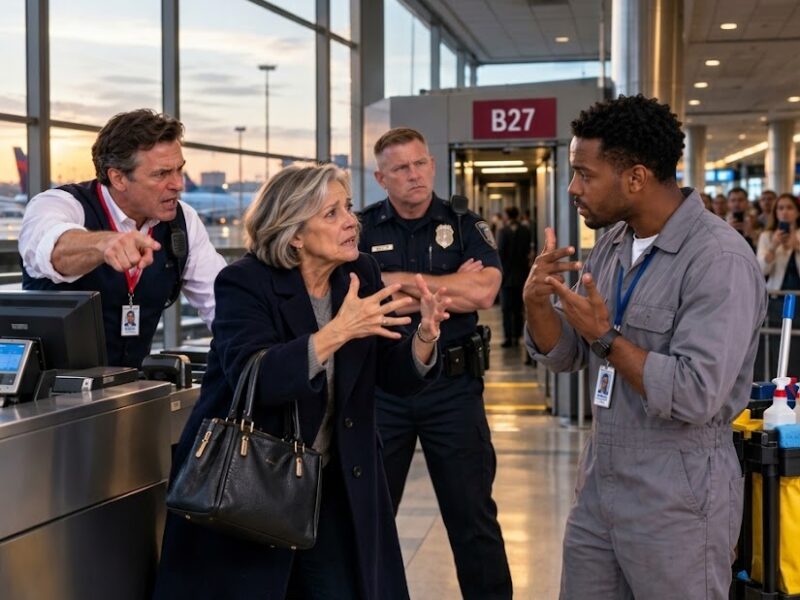
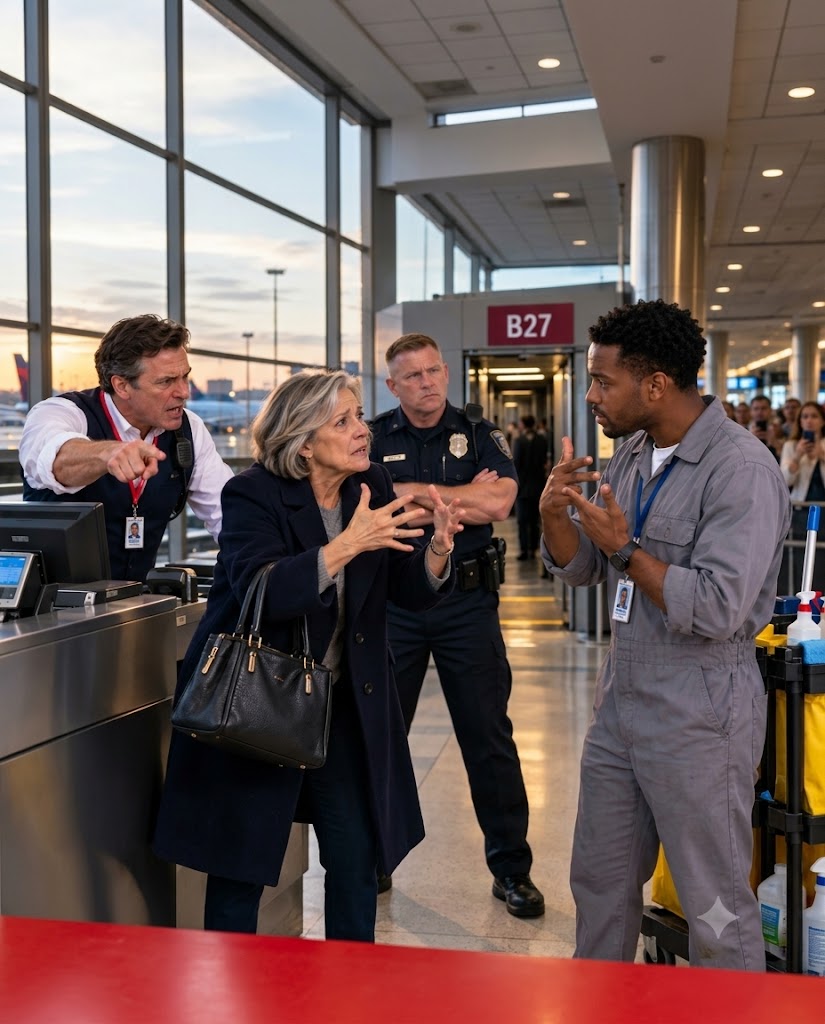
By 5:34, three people in uniform had tried to deal with the woman by the pillar at B27.
Not one of them could read what her hands were saying.
The first was a gate agent named Reed, who had been working the Boston flight and who had watched Katherine walk up to the counter with the folded note in her hand and a look on her face like she was already exhausted.
“Ma’am, hands down,” Reed said. “I need you to calm down for me.”
Katherine couldn’t hear him, but she could read his lips, and she could see the way his jaw was set, and she knew that look.
She had seen it in boardrooms and at customs and in the emergency room the night her mother died, and it was the look people got when they had already decided you were a problem.
She held up the note.
Reed glanced at it and handed it back without reading it.
“Ma’am, if you can’t talk, you can’t fly,” he said.
Katherine stared at him.
She had been flying since she was six years old, when her mother would tap the table twice to tell her she was there, and she had never once been told she couldn’t fly.
She reached for her phone to type something, but the screen was black.
She had forgotten to charge it, and the charging station was at the end of the concourse, and she didn’t have time, because the doors were closing at 5:35 and it was already 5:34.
“Close it, Reed,” someone said over the radio.
Reed reached for the door.
Katherine put her hand on his arm.
She didn’t mean to startle him, but she needed him to stop, and she needed him to understand, and she didn’t have words, so she used her hands.
She signed, “I’m deaf. I need help. My flight is boarding.”
Reed pulled his arm away.
“Ma’am, hands down,” he said again, louder this time, like volume was the same thing as clarity.
The second person in uniform was a supervisor named Brad Kesler, who had been called because a passenger was non-compliant and who arrived at B27 with his radio already in his hand.
He took one look at Katherine and said, “She’s hammered at 5:00.”
Katherine didn’t hear him, but she saw the way his lips moved, and she knew the word.
She had been called drunk before, once in an airport in Denver, when her blood sugar had dropped and she had started slurring her words, and she had spent three hours in a holding room before a nurse finally checked her bracelet.
She held up her wrist.
The bracelet was silver and engraved with MEDICAL ALERT: TYPE 1 DIABETES, and she pointed to it, and then she pointed to her mouth, and then she signed, “I’m not drunk. I’m diabetic. My sugar is crashing.”
Brad didn’t look at her wrist.
He looked at her coat, which was heavy and wool and too warm for the weather, and he said, “Deaf doesn’t sweat through a coat. She’s loaded. Start closing now.”
The third person in uniform was an airport police officer named Puit, who arrived at 5:44 and who found Katherine sitting on the floor by the pillar with her back against the wall and her hands shaking so hard she couldn’t sign.
He knelt down next to her.
“Ma’am, can you hear me?” he said.
Katherine shook her head.
She pointed to her wrist.
Officer Puit looked at the bracelet, and then he looked at her face, and then he looked at the gate agent and the supervisor and the cleaning cart that was parked twenty feet away.
“EMS to B27,” he said into his radio. “Diabetic, conscious, low blood sugar.”
Katherine closed her eyes.
She didn’t see Darnell walk up to the gate.
She didn’t see him stand between her and Brad Kesler and say, “Sir, give us a minute.”
She didn’t hear Brad say, “Hayes, you are off your post. You do not get in the middle of a police call.”
But she felt a hand on her shoulder, and she opened her eyes, and Darnell was there, and he was signing.
“EMS is coming. You’re going to be okay.”
Katherine signed back, “My flight.”
Darnell shook his head.
“You’re not getting on anything like this.”
The paramedics arrived at 5:47.
They checked her blood sugar, and it was 41, which is low enough that most people are unconscious, and one of them said, “She was 94 when we got here. Tell her real food in the next hour, not just sugar.”
Katherine heard that, because she was reading lips, and she nodded.
The paramedic looked at her and said, “Anything to drink today?”
Katherine signed, “Apple juice.”
The paramedic didn’t understand, so Darnell translated.
“She says apple juice. His. I gave the agent at B12 a note at 3:00. It said I’m deaf. Tell me in writing. Nobody told me the gate moved.”
The paramedic nodded and wrote it down.
Katherine looked at Darnell.
“I’ll put it in,” he signed. “B12 by the pillar. That was you.”
Katherine signed back, “I said excuse me twice.”
Darnell smiled.
“My mom. She was deaf. I talked for her from when I was six. When I froze up, she tapped the table twice. Means I’m here. Keep going. You can owe me a juice.”
Katherine laughed, which surprised her, because she hadn’t laughed in hours.
“Darnell,” she signed. “What’s your name?”
He spelled it out. D-A-R-N-E-L-L.
“My mom gave me that one,” he signed.
Katherine reached into her pocket and pulled out the folded note.
She wrote on the back of it, in block letters: I wrote it down this time.
She handed it to him.
Darnell read it and nodded, and then he folded it and put it in his vest pocket, next to his notebook.
The paramedics helped Katherine onto a gurney and wheeled her toward the ambulance, and she didn’t see Brad Kesler watching from the gate, or Reed closing the door to the JetBridge, or Tasha standing at B12 with her headset in her hand.
But she saw Darnell, standing by the pillar with his cleaning cart, and she signed, “Thank you.”
He signed back, “Go. Eat something real.”
And then she was gone.
Darnell went back to work.
He mopped the floors at B27 and B12 and the whole concourse, and he emptied the trash cans and wiped down the counters, and at 10:00 he clocked out and drove home to his apartment in College Park, where he ate a sandwich and watched the news and went to bed.
He figured that was the end of it.
He’d lost jobs before.
He’d never see that woman again.
But by Friday morning, four million people had watched that gate.
The video had been posted by a passenger who had been waiting at B27 for a flight to Denver, and it showed everything.
It showed Katherine standing by the pillar with her coat buttoned to the throat.
It showed Reed telling her to put her hands down.
It showed Brad Kesler saying she was hammered and that deaf doesn’t sweat through a coat.
It showed Officer Puit kneeling next to her and calling for EMS.
And it showed Darnell, standing between Katherine and the supervisor, signing.
The video had no sound, which was the point, because the whole thing had happened in silence.
But four million people watched it anyway, and by Friday afternoon, the hashtag #GateB27 was trending on every platform in the country.
The airline issued a statement.
“We are aware of the incident at Gate B27 and are conducting a full review. Our staff followed procedure.”
The statement was four sentences long, and it didn’t mention Katherine by name, or Darnell, or the note that had been taped to the monitor at B12 for two hours.
It didn’t mention the bracelet, or the blood sugar, or the fact that a woman had been sitting on the floor of the busiest airport in the world, trying to tell people she was dying, and no one had listened.
Darnell found out about the video on Friday night, when his phone started buzzing with texts from people he hadn’t talked to in years.
His cousin sent him a link.
His neighbor sent him a screenshot.
His ex-wife sent him a message that said, “You’re famous,” and then another one that said, “Are you okay?”
Darnell didn’t answer any of them.
He sat on his couch and watched the video on his phone, and he saw himself standing at B27, signing to a woman he’d never met, and he thought about his mother.
She had died two years ago, in a hospital in Decatur, and he had sat by her bed for three days and talked for her, because she couldn’t talk for herself anymore.
He had held her hand and told the nurses what she needed, and he had signed to her even when she couldn’t sign back, because he wanted her to know he was there.
He had tapped the table twice.
He had said, “I’m here. Keep going.”
And then she had stopped.
Darnell turned off his phone and went to bed.
On Monday morning, he went to work like nothing had happened.
He clocked in at 2:00 and got his cart and started on the floors, and he was halfway through the B concourse when his supervisor, a man named Ray, called him into the office.
“Darnell, it’s Ray,” the man said, like Darnell didn’t know his voice.
“The airline filed on you. Says you left your post and got in the middle of a police call at 27.”
Darnell stared at him.
“A woman was going into diabetic shock. Nobody there could—”
“I believe you,” Ray said. “Doesn’t matter. They want you off the contract tonight. I don’t have another building to put you in.”
Darnell nodded.
He had been working at the airport for six years, and he had never missed a shift, and he had never been written up, and he had never once asked for anything.
He reached into his vest pocket and pulled out the folded note, the one Katherine had written on, and he put it on the desk.
“Okay,” he said. “That’s the last of it.”
He left his badge at the desk.
“I’m sorry, man,” Ray said.
Darnell didn’t answer.
He walked out of the office and through the concourse, past B27 and B12 and the pillar where Katherine had been standing, and he didn’t look at any of it.
He figured that was the end of it.
He’d lost jobs before.
He’d never see that woman again.
But by Friday, four million people had watched that gate, and every one of them saw half of it.
The airline saw a liability.
The police saw a non-compliant passenger.
The internet saw a Black janitor signing to a deaf billionaire, and they wanted to know why he’d been fired.
Katherine saw it too.
She was at home in Buckhead, recovering, when her assistant sent her the link, and she watched it three times.
She watched Reed tell her to put her hands down.
She watched Brad Kesler say she was hammered.
She watched herself sitting on the floor with her back against the wall, and she watched Darnell stand between her and the supervisor, and she watched him sign, “You’re going to be okay.”
She watched him get fired.
Katherine had built her company by knowing when to fight and when to walk away, and she had walked away from a lot of things.
But she wasn’t going to walk away from this.
She called her lawyer.
She called the airline.
She called the airport authority.
And then she called a woman named Denise Carter, who ran the station at Hartsfield-Jackson, and who had been dodging reporters for three days.
“Miss Ashworth, you didn’t have to come in person,” Denise said, when Katherine walked into her office on Tuesday morning.
“You asked for my statement,” Katherine signed, and her interpreter, a woman named Carla, voiced it. “This is it.”
Denise looked at the interpreter, and then at Katherine, and then at the two men standing behind her.
One was Brad Kesler, who had been suspended pending termination.
The other was Darnell Hayes, who had been fired and who had no idea why he was there.
“Mr. Kesler, Mr. Hayes, Katherine Ashworth,” Denise said. “She owns Ashworth Freight, biggest cargo account at this station. She’d like Mr. Hayes to voice for her today. I’ll sign the room.”
Brad Kesler’s mouth opened.
“Hold on. He’s the one I filed on and he’s not certified.”
“I’m certified,” Darnell said.
“I’ll be watching every word he says,” Brad said.
Denise nodded.
“Then sit down.”
Katherine sat at the head of the table, and Darnell sat next to her, and Carla sat on the other side, and for the next hour, Darnell voiced for a woman he had met once, in the worst moment of her life.
“Thursday 3:00 I gave the agent at B12 a note,” Katherine signed. “I’m deaf. Tell me any change in writing. She taped it to her screen.”
Darnell voiced it.
“At 5, I was asleep under a broken monitor. Nobody wrote anything. I woke up to an empty gate.”
Darnell voiced it.
“Word for word,” he said. “I’ll sign my name to it.”
Denise slid a folder across the table.
“Officer Puit’s report. EMS on scene at 5:44, blood sugar 41, no sign of alcohol. He also mentions a written request left at the B12 counter. So Friday morning, I had that drawer sealed. Your report went in at 5:41. You had all weekend to correct it. You didn’t. You’d already filed on Mr. Hayes that night.”
Brad Kesler leaned forward.
“She looked intoxicated, sweeping, slurring, falling into the counter. Anybody would have called it. You knew she was deaf.”
“I knew there had been a deaf passenger at 12,” Brad said. “I figured she’d moved with everybody else.”
“You work 12 Thursday,” Darnell said. “I showed him the lady by the pillar. I said, ‘She’s deaf. Write it down for her.’ He said, ‘I got it.’ Twice. And at 5:12, I radioed him. She still hadn’t boarded. He paged her by name.”
Denise looked at Brad.
“Tasha B12. Open it, Brad.”
Brad Kesler didn’t move.
“I run 60 departures a shift. Corporate scores me on doors closed on time, not on notes.”
“You couldn’t read my hands,” Katherine signed, and Darnell voiced it. “Fine, you can read English. It was in your drawer. You called the police instead.”
Denise closed the folder.
“Brad, you’re suspended. Effective now. Pending termination.”
Brad stood up.
“Badge,” Denise said.
He put it on the table and walked out.
Denise turned to Darnell.
“Mr. Hayes, the complaint on you. We’re withdrawing it. All of it.”
Darnell didn’t say anything.
He was looking at Katherine, who was looking at him, and neither of them needed an interpreter for that.
“Denise Carter,” Katherine signed, and Darnell voiced it. “The complaint on Darnell Hayes. We’re withdrawing it. All of it.”
Denise nodded.
“Doing what?”
“I’m not,” Darnell said.
Katherine looked at him.
“I sat for it two years ago,” he said. “A week after we buried my mom. The live voicing part. They put a mic in front of me and I just stopped. Couldn’t get a word out.”
He looked at his hands.
“I signed kitchen table, not classroom. Next test date is six weeks out. There are seats and voicing is the section people retake most. It’s a skill. You drill it.”
Katherine signed, “You front the fee. It comes out of my first check.”
Denise raised her eyebrows.
“She paying you for this?”
“She offered,” Darnell said. “I said no. I need a second interpreter who’s still around in March.”
Katherine smiled.
“Last one tonight,” she signed. “There’s a long name in the middle. Don’t stop for it.”
Darnell nodded.
“I moved to Chicago in ’98 to work for a company called—”
He stopped.
“You stopped,” Carla said.
“I didn’t catch the name.”
“Then you don’t say the name,” Katherine signed. “You say a company and you keep going. The signer didn’t stop. The room didn’t stop. The only one who stopped was you.”
Darnell took a breath.
“A company that—”
“Better,” Katherine signed.
“Not there Thursday same time,” Darnell said.
Denise stood up.
“Section four live voicing. The signer begins when the light comes on. Voice continuously until the clip ends. Your time starts now.”
Darnell closed his eyes.
“My sister learned to drive in a church parking lot,” he said. “Every Sunday after service, our dad gave her the keys and sat in the passenger seat with his eyes shut. Three Sundays running, she hit the same light pole. By the fourth, he named it Gerald.”
He opened his eyes.
The room was silent.
Katherine was signing, “Keep going.”
Darnell kept going.
Three months later, there were cameras at Gate B27 again.
This time, somebody had invited them.
Katherine stood in front of a podium with the airline’s logo behind her and a crowd of reporters in front of her, and Darnell stood next to her, in a suit that fit him better than anything he’d ever owned.
“Three months ago, some of you ran a video of me,” Katherine signed, and Darnell voiced it. “My company didn’t ask this airline for money. We asked for screens at every gate it runs in Atlanta and training for every agent who stands behind one. They said yes.”
A reporter raised her hand.
“Miss Ashworth, the airline statement at the time said its staff followed procedure.”
Katherine smiled.
“Had you been drinking that day?”
“Yes,” Katherine signed. “Apple juice.”
Darnell voiced it.
“He was buying.”
The room laughed.
“And your clip ends about two seconds before the officer reads my medical bracelet,” Katherine signed. “All my life I thought being understood was something you paid for. Then the man who mopped this floor answered me in my own language. He didn’t send a bill. He got fired for it. Six weeks ago, he got certified.”
She looked at Darnell.
“This is his first job.”
Darnell stepped forward.
“That’s all I needed that Thursday,” he said. “Someone to tell me where my plane was.”
He looked at the cameras.
“Every gate in Atlanta tells you now in letters you can read from the last chair.”
He paused.
“Darnell still taps twice when he passes B12. It’s what his mother did when somebody needed to know. I’m here. Keep going.”
The room was quiet.
Katherine reached over and tapped the table twice.
Darnell looked at her and nodded.
“Have you ever been the only person in a room who understood somebody?” he said. “Tell us what happened in the comments. We read them.”
He smiled.
“If Darnell earned that suit, hit like and subscribe for more stories like this one. And next time someone at a gate looks lost, look at their hands first.”
The cameras kept rolling.
Katherine folded the note in her pocket, the one Darnell had written at B12, the one she’d written on the back of, the one that had started all of it.
She didn’t need it anymore.
But she kept it anyway.
Because some things you hold onto, even when you don’t have to.
Because some things are worth remembering.
Because some things are worth fighting for.
And because, at the end of the day, the only thing that really matters is whether somebody, somewhere, understands you.
Darnell understood her.
And she understood him.
And that was enough.
That was more than enough.
That was everything.
The cameras kept rolling, and the room kept applauding, and Katherine Ashworth stood at the podium with a man who had mopped her floor and saved her life, and she thought about her mother, who had tapped the table twice when she was six years old, and who had taught her that being understood was worth fighting for.
She thought about the note in her pocket.
She thought about the bracelet on her wrist.
She thought about the gate, and the pillar, and the four million people who had watched half of it.
And then she thought about Darnell, standing next to her in a suit that fit him better than anything he’d ever owned, and she knew that some things were worth more than money.
Some things were worth more than contracts and cargo and billions of dollars.
Some things were worth everything.
She reached over and tapped the table twice.
Darnell looked at her and smiled.
“I’m here,” he said. “Keep going.”
And she did.









