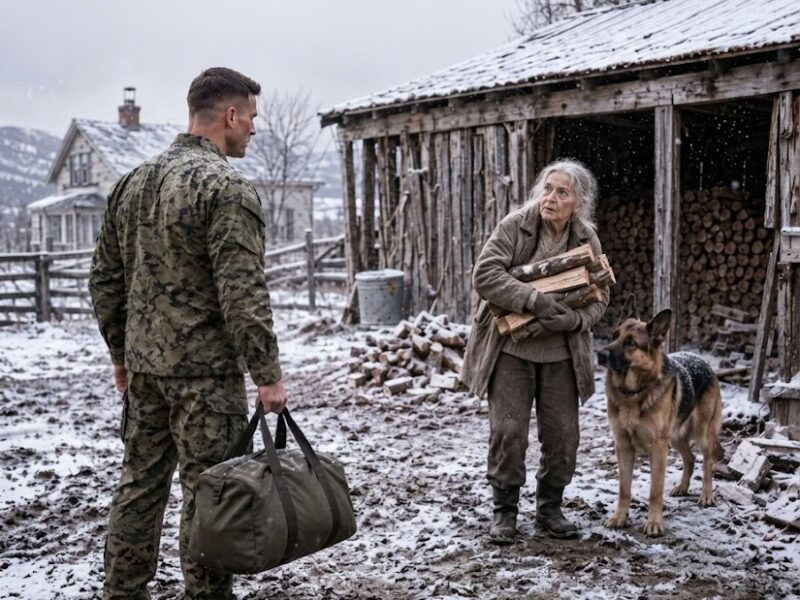
Navy SEAL Thought His Mother and Dog Were Living Well — The Truth Broke His Heart
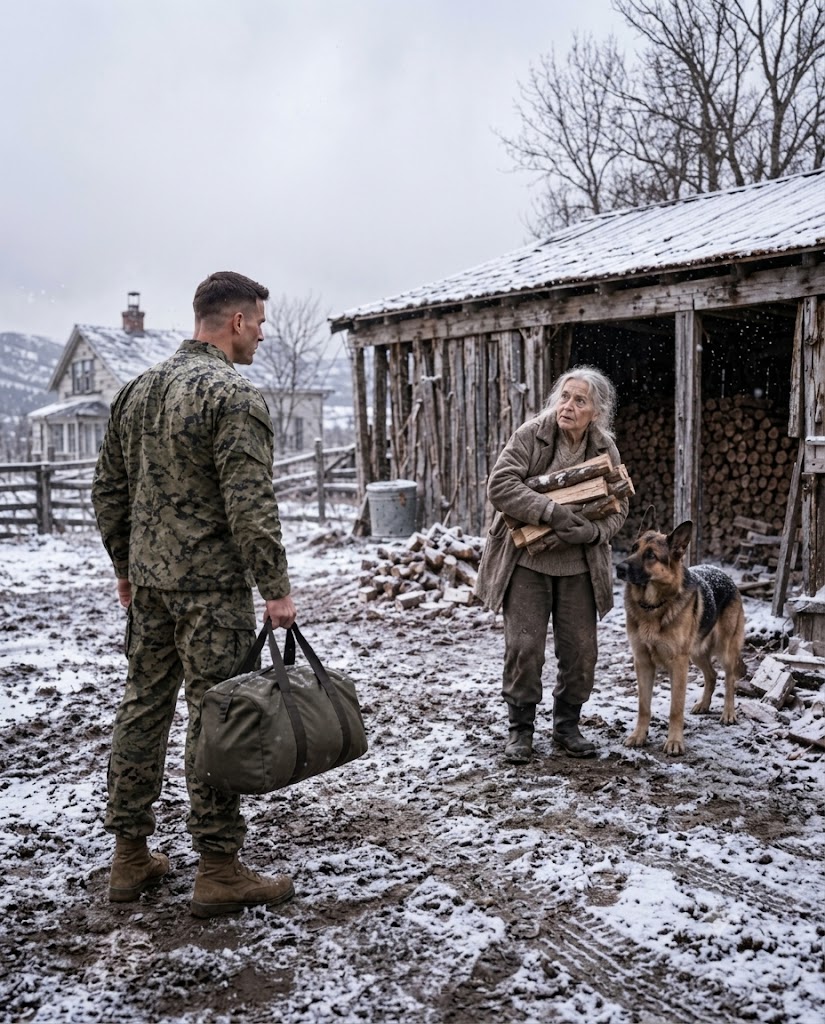
Part 1
For seven years, Navy SEAL Damon Bain sent money home every month, believing his elderly mother was safe and cared for in the family house by Lake Aurelia.
He had stood in airfields where seasons meant nothing, in temporary quarters where men slept in shifts, in dim rooms where the only proof of home was a photograph on his phone.
Every month, $1,800. Sometimes more. The memo lines never changed much: Mom’s medication, heat, groceries, house expenses.
Whenever Damon asked his older brother Warren how their mother was doing, the answers came back fast and clean. Mom’s fine. Heat is handled. Her medication is covered.
Sometimes Vanessa, Warren’s wife, sent pictures. His mother sitting on the porch. A Thanksgiving table crowded with food. The old garden in summer. Fresh flowers in a vase beside the kitchen window.
Damon had looked at those photographs from hundreds of miles away and allowed himself to believe that home remained exactly where he had left it.
That belief had been convenient. He understood that now, though he did not yet understand how costly it had been.
—
At forty, the former Navy SEAL still carried his discipline in the way he moved—quiet, measured, never wasting a step.
He stood six foot one, broad across the shoulders with the hard, balanced build of a man who trained regularly without looking as though he lived inside a gym.
His face was unmistakably masculine. Angular cheekbones. A strong square chin. A straight nose. Clean-shaven skin lightly weathered by years outdoors.
Dark brown hair touched with silver at both temples was cut in a neat undercut. His blue-gray eyes were the feature people remembered most. They were deep and steady, but there was a sadness in them that had not been there when he was twenty-five.
Even on leave, Damon dressed with the same controlled simplicity he brought to everything else. A fitted long-sleeved green camouflage uniform. Matching trousers. A plain black belt. Dark brown military boots polished enough to show that old habits had survived every change in his life.
He had twelve days off. For the first time in years, he had no schedule waiting at the end of each morning. No briefing. No training block. No flight manifest with his name buried somewhere near the bottom.
And so without telling anyone, Damon turned his truck north toward Larksburg Bay.
He told himself the surprise was for his mother. The truth was harder. He had postponed this road too many times.
Seven years had passed since he had truly come home. There had been short visits. Funerals. Two rushed holidays. Forty-eight hours here. A single night there.
But never enough time to sit at the kitchen table until the coffee went cold. Never enough time to walk beside Lake Aurelia without checking a phone. Never enough time to ask his mother questions that required more than a yes or no answer.
—
The farther north he drove, the more the landscape began remembering him.
The highway narrowed. Birch trunks appeared pale against the woods, their remaining leaves burning yellow in the late October sun. Pines gathered thickly along the ridges. Thin patches of the season’s first snow survived beneath shaded ditches where sunlight had not reached them.
Then Lake Aurelia appeared between the trees. Silver-blue. Cold. Enormous.
Damon lowered his window despite the chill. The air smelled of pine, damp earth, and distant wood smoke. For a moment, he was seventeen again, driving an old pickup too fast along the lake road while his father shouted that tires cost money.
The memory made him smile. It lasted three seconds.
Then Larksburg Bay came into view.
The Bain house stood on a low rise above the road. Damon slowed automatically. He expected familiarity.
Instead, he almost drove past it.
The old gray roof had been replaced with dark metal. The garage door was new. A broad stone driveway had replaced the cracked concrete pad his father used to complain about every spring. An expensive black SUV sat near the garage, clean enough to reflect the birches behind it.
Damon remained inside the truck for several seconds. None of those improvements were wrong. In fact, under normal circumstances, they would have pleased him. Maybe the money had helped. Maybe Warren had done exactly what he said.
Still, something in Damon tightened.
He stepped out. Before he reached the porch, the front door opened.
Vanessa Bain stood there.
—
At forty-three, Vanessa was a handsome woman in a controlled, deliberate way. She was about five foot six, slender without appearing fragile, with pale skin, high cheekbones, and hazel-green eyes that usually gave people the impression she was listening two sentences ahead.
Her dark chestnut hair fell straight to her shoulders and was parted neatly to one side. She wore a charcoal turtleneck beneath a camel-colored knee-length coat, black trousers, and spotless ankle boots.
Vanessa had always been organized. Invoices labeled. Birthdays remembered. Thank-you cards mailed before anyone else had purchased theirs. Damon had once admired that about her.
Now, when she saw him, organization vanished from her face. Her lips parted. Her hand tightened around the door handle.
“Damon?”
He smiled slightly. “Surprise.”
For one second, Vanessa simply stared. Then the smile came. “Too late. Not much too late.”
But Damon had spent years learning to notice fractions of seconds.
“My God,” she said. “You didn’t tell anyone.”
“That was the idea.”
She stepped forward and hugged him. Her body felt stiff before it relaxed. “You should have called. We would have—”
The sound of footsteps interrupted her. Warren appeared behind her.
—
Damon’s older brother was forty-six, about six feet tall, broad through the chest, but heavier around the waist than Damon remembered.
His rectangular face had a wide forehead and a large, familiar nose inherited from their father. Chestnut-brown hair was beginning to silver and thin at the temples. A short layer of dark stubble covered his jaw, more from exhaustion than style.
His brown eyes carried the dullness of a man who had not slept properly in a long time. He wore a blue and black flannel shirt beneath a brown work jacket, dark jeans, and worn work boots.
“Look what the government finally returned,” Warren said.
The old joke landed almost normally. Almost.
The brothers embraced. Damon felt Warren slap his shoulder twice. For a moment, something uncomplicated passed between them. Blood memory. Two boys who had once fought over fishing poles and slept in the same room during thunderstorms.
Then Damon looked past him into the house.
“Where’s Mom?”
Warren’s hand fell from his shoulder. Vanessa glanced toward the kitchen. A tiny movement, but Damon saw it.
“She’s over at the cabin,” Warren said.
Damon blinked. “What cabin?”
Warren gave him a puzzled look. “The lake cabin. By the old workshop.”
Damon stared at him. That building had never been a proper cabin in his mind. Their father had used it to store hand tools, lumber samples, fishing equipment, and whatever machinery he did not want their mother complaining about inside the garage.
There had been a cot. A sink. A wood stove. But no central heating. No proper winter insulation that Damon could remember.
“You mean Dad’s work cabin?”
“We fixed it up for Mom. She likes it there.”
Vanessa stepped in gently. “She wanted something smaller. The house became too much for her.”
Damon looked through the open doorway. New hardwood floors. New cabinetry visible beyond the hall. A modern light fixture hanging where his mother’s old brass chandelier had once been.
His eyes returned to Warren. “How long?”
Warren hesitated. “Couple years.”
Something cold moved through Damon that had nothing to do with Minnesota.
—
Then Damon noticed something on the wall beside the door. A photograph.
His mother stood between Warren and Vanessa on the front porch, wearing a pale blue sweater and smiling into the camera.
Damon knew that photograph. Vanessa had sent it to him six months earlier with the message: “Mom enjoying the first warm day of spring.”
He had stared at that picture from hundreds of miles away and felt relieved.
But now he saw what the photograph had not shown. Behind his mother, reflected faintly in the glass storm door, stood two cardboard boxes. One had his mother’s name written across it in black marker.
Nell. Cabin.
Damon said nothing. The photograph suddenly felt different. Not necessarily a lie, but no longer proof of what he had believed.
And for the first time since turning onto the lake road, Damon wondered how much of home he had actually been seeing and how much had simply been framed for him.
“I’m going over there,” he said.
Vanessa straightened. “Let me call her first.”
“No. She might be resting. I want to surprise her.”
Vanessa glanced at Warren again. Too quick.
Damon reached into his pocket for the truck keys. “Which road?”
“You remember it?” Warren said quietly.
Damon looked at him. Yes, he did. That was the problem.
—
The road curved downhill behind the property and followed Lake Aurelia through birch and pine. Afternoon sunlight streamed between the trunks, turning the remaining leaves almost golden.
It was beautiful enough to make Damon angry. Everything looked peaceful. There should have been comfort in that. Instead, each mile produced another question.
Why had no one told him his mother had moved? Why had Warren said heat is handled instead of Mom’s using the cabin stove? Why had Vanessa continued sending photographs from the main house?
Damon tightened his hands around the steering wheel, then deliberately loosened them. Facts first. That discipline had saved him from mistakes before. It would have to save him from one now.
The cabin appeared beyond a bend. Damon slowed.
The first thing he saw was the fence. It leaned outward in two places. The second was a small two-wheeled cart beside the porch. Inside it were crushed aluminum cans, old copper fittings, and pieces of scrap metal.
Then he heard the ax.
Thunk. Pause. Thunk.
A woman stood beside a chopping block near the woodshed. Small. Bent slightly at the shoulders. She raised the axe again, but slower this time. The third swing never came. She lowered it and rubbed her wrist.
A German Shepherd stood at her right side.
—
The dog was seven years old, large but lean, with a rich golden-brown coat covered by a distinct black saddle along his back. His muzzle was dark, almost black, and his upright ears gave him a permanently attentive expression. A small scar notched the outer edge of his right ear.
Amber-brown eyes followed the woman’s every movement. Around his neck was a worn dark brown leather collar with a small metal tag.
Damon stopped breathing for a second.
The woman wore an old brown-gray canvas coat faded at the elbows and cuffs. A cream sweater showed beneath it. Dark brown trousers disappeared into worn black boots. Gray knitted gloves covered her thin hands, and one had been patched near the thumb. Her white hair was tied loosely at the nape of her neck.
She looked smaller than Damon remembered. Older. Not simply seven years older. Life had reduced something around her edges.
Damon parked. The dog heard the truck first. His head snapped toward it. When Damon stepped out, the German Shepherd moved immediately—not charging, not barking. He simply crossed in front of the woman and planted himself between her and the stranger.
His weight shifted forward. His ears remained high.
Damon stopped. “Easy.”
The woman turned. Her face was narrow and weathered, with fine wrinkles gathered deeply around light blue eyes. Her cheeks had thinned, but Damon recognized the stubborn line of her mouth instantly.
Eleanor Bain. Nell. His mother.
For one terrible moment, she did not recognize him.
Damon felt something inside his chest give way. “Mom.”
The axe slipped from Nell’s hand. It landed softly in the wood chips. Her mouth opened.
“Damon.”
Cinder looked from Nell to Damon. His posture changed—not relaxed, but listening.
Damon walked closer. Nell took one step toward him and stopped, as if seven years suddenly weighed too much to cross all at once. Then she smiled, and Damon saw the mother from every memory he had tried to preserve.
He reached her. She wrapped both arms around him. She felt frighteningly light.
Damon closed his eyes. He wanted to say he was sorry. He wanted to ask a hundred questions. Instead, he held her.
Cinder came nearer and sniffed Damon’s sleeve.
Nell laughed quietly against her son’s chest. “That’s Cinder. He thinks he owns me.”
Damon looked down at the dog. Cinder stared back.
“Does he?”
“Mostly.”
—
The small joke helped only for a moment. Then Damon saw the pile of unsplit wood beside the chopping block.
“You’re cutting this yourself?”
Nell shrugged. “Wood doesn’t usually volunteer.”
It was exactly the sort of answer she had always given. Dry. Practical. Designed to prevent concern.
Damon looked toward the cabin. “Show me inside.”
Nell hesitated—barely—but he felt it.
Inside, the cabin smelled of pine smoke, old timber, and canned soup. A small wood stove stood near one wall. Clear tape crossed a crack in the window. Several cans of food were arranged neatly on a shelf beside an old radio. A plastic medicine organizer sat on the table.
Two coats hung from wooden pegs near the stove. Beside Nell’s narrow bed was a thick, worn cushion where Cinder slept.
Everything was clean. Everything was cared for.
That almost made it worse. Poverty had not defeated his mother’s dignity. It had simply forced her dignity to work harder.
Damon touched the wall near the window. Cold.
He turned. “Where’s the heater?”
Nell pointed toward the wood stove. “That little thing does fine.”
“That isn’t what I asked.”
Her expression softened. “You just got here.”
Damon looked around again. The patched glove. The canned food. The cart outside. The cracked window.
Seven years of monthly transfers passed through his mind like numbers on a bank statement. $1,800. Again. Again. Again.
He looked at his mother. “Where’s the money I’ve been sending?”
Nell’s faint smile disappeared. Cinder lifted his head from beside her chair.
The cabin became very quiet.
Nell studied Damon’s face as though trying to decide whether he was making a strange joke. Then she asked softly, “What money?”
—
For several seconds after Nell spoke, Damon did not move. The room seemed to contract around him. The stove clicked softly as the metal expanded with heat. Somewhere outside, a branch scraped against the side of the cabin.
Cinder remained near Nell’s chair, head lifted, watching Damon with the weary stillness of an animal measuring whether a man’s anger might become dangerous.
Damon had felt anger before. He knew its temperature. This was different. It was colder. More disciplined.
He turned toward the door. “I’m going back up there.”
Nell’s voice stopped him. “No.”
Damon looked over his shoulder. His mother had lowered herself into the wooden chair beside the stove. In the stronger light, he noticed things he had missed in the first shock of seeing her—the stiffness in her fingers, the faint swelling around one wrist, the way she shifted her left knee before putting weight on it.
Her face was lined but not defeated. There was still something firm in the set of her jaw.
“Mom, I said no. They’ve been lying to me.”
“Maybe. Maybe.”
Nell folded her hands in her lap. “Being angry before you understand everything is how families turn one bad thing into ten.”
Damon almost laughed, but there was nothing funny in him. “You’re living in a work cabin.”
“I’m aware.”
“You’re cutting firewood with a bad wrist.”
“That part is less enjoyable.”
He stared at her. The dry humor was familiar. It made the situation hurt more.
Damon pulled out the chair opposite her and sat. For years, whenever he called home, he had asked one question in some version or another. Mom okay?
He had never noticed how easy that question was to answer.
Now he leaned forward. “What happened?”
—
Nell looked toward the stove. For a while, she said nothing. Then she began.
Two years after Damon left, Warren had told her the main house needed serious work. The wiring was old. The roof leaked above the upstairs hallway. Moisture had damaged part of the basement wall. The heating system was becoming unreliable.
Vanessa suggested Nell stay in the cabin for a few months while contractors moved through the house. At the time, it made sense.
Damon listened without interrupting.
The cabin had already been cleaned out enough to use during summer weekends. Warren brought over a better mattress. Vanessa stocked the kitchen. Someone installed a newer stove pipe.
It was supposed to be temporary.
“How temporary?”
“Three months. Maybe four.”
Damon looked around. Five years later, the temporary place still looked temporary.
Nell continued. The repairs took longer than expected. Then Warren’s business began having trouble. Then Vanessa said clients needed to use part of the main house for meetings because the office near the shop was being renovated.
Then there were delays. Then taxes. Then new financing. Then winter. Then spring.
One explanation replaced another so gradually that no single day had felt important enough to fight over.
At some point, Nell said, “I stopped asking when I was moving back.”
“Why?”
She gave him a tired smile. “Because every time I asked, everyone looked exhausted.”
The answer struck Damon harder than he expected. Not because it excused Warren—because it sounded exactly like his mother.
Nell had always been capable of carrying discomfort if carrying it made everyone else’s lives easier. He remembered her eating the burnt piece of toast when he and Warren were children. Wearing the older coat one more winter. Driving the car with the broken radio because the boys needed school shoes.
He had once thought those things meant strength. Now he wondered how often the family had simply grown accustomed to letting her sacrifice first.
—
“What happened to your things?”
“Some are here. Most are in storage.”
“Whose storage?”
Nell shrugged. “Warren arranged it.”
Damon breathed in slowly. “How much money have you been getting?”
“Enough.”
“That’s not a number.”
“Social Security and a little savings from me.”
Nell shook her head. “No.”
Damon sat back.
She explained that she believed Damon occasionally sent something for Christmas or her birthday. A gift card. Flowers. Once, money for a medical co-pay. But monthly support? No. She had never known.
Damon began mentally calculating. Seven years. Eighty-four months. $1,800 each month.
The number became almost obscene in the tiny cabin.
“What do you live on after bills?”
Nell looked toward the window. “Whatever is left.”
Again, not a number.
Damon waited. This time she answered properly. Some months there was enough. Some months there was not.
She had started repairing small wooden items because she still remembered many of her husband’s techniques. Old stools. Chair backs. Picture frames. A loose drawer. She sold what she could.
She collected aluminum cans when people left them beside recycling bins. Copper fittings from discarded plumbing sometimes brought better money. During autumn, she gathered fallen branches from public forest edges and from land where owners allowed it.
“People throw away useful things,” Nell said.
Damon looked toward the little cart outside. “And Cinder goes with you?”
At the sound of his name, the German Shepherd’s ears moved. Nell smiled and reached down. Cinder rose and pressed his head beneath her palm.
“He goes everywhere I let him.”
The dog’s body was sturdy but not heavy. His black saddle caught the orange light from the stove, while the golden fur along his neck looked softer than Damon had expected. The scar at the edge of his right ear gave him a slightly rough look that did not match the patience in his amber eyes.
“In winter,” Nell said, “he pulls the cart when the road is flat.”
Damon stared at the dog. “You trained him to do that?”
“Not exactly.”
She explained that one winter the cart had become difficult to move through packed snow. Nell tied a line to the front while she adjusted the load. Cinder leaned forward against it by instinct. The next day, he did it again.
After that, Nell bought a proper padded harness and only let him pull light loads.
“Nothing heroic,” she said. “He just dislikes watching me struggle.”
Damon looked away. That sentence stayed with him.
—
Later that afternoon, Nell opened a small drawer to look for a receipt. Something metallic rolled forward and struck the wood.
Cinder immediately stood—not barking, not growling, just alert.
Nell froze. Damon noticed the change in her expression. It was not fear. It was grief.
She reached into the drawer and removed an empty watch box. Dark leather. Worn at the corners.
Damon recognized it before she spoke. “Dad’s.”
He remembered the watch inside it. A simple steel piece with scratches across the clasp. Worn every day for nearly thirty years.
“Where is it?”
Nell did not answer at first. Cinder came closer and rested his muzzle lightly against her knee. She ran one finger along the empty velvet.
“I sold it.”
Damon felt something twist inside him. “When?”
“Two winters ago.”
“Why?”
“The electric bill.”
The words were quiet. Ordinary. That made them worse.
Damon looked at the empty box and understood suddenly that poverty was not always announced by hunger or eviction. Sometimes it arrived as a missing object. A wedding ring pawned. A watch sold. A memory converted into heat.
And the most painful part was that the person doing it could still tell everyone she was fine.
Damon stood and walked to the window. Outside, the lake was turning gray beneath the late-day sky.
He asked the question he had been avoiding. “Why didn’t you tell me?”
Nell remained silent long enough that he turned back. Her face was gentle, almost apologetic. That irritated him more.
“Don’t protect me now.”
“I’m not.”
“Then tell me.”
Nell folded the watch box closed. “You called from places I didn’t know.”
“That doesn’t matter.”
“It mattered to me.”
She reminded him of one call three years earlier. Damon had been exhausted. He had told her he might be unreachable for an unknown period.
Nell remembered his voice. Not frightened. Not dramatic. Just distant in the way men sound when their mind is already somewhere else.
“You said you had to leave the next morning,” she said. “What did you want me to say? That the stove was giving me trouble? That Warren and Vanessa were arguing about money?”
“Yes.”
Nell shook her head. “No, you didn’t.”
Damon stared at her. She did not say it cruelly. That was what made it land.
“You wanted to know I was safe enough for you to go do what you needed to do.”
Damon looked down.
She continued, “So I told you I was.”
The cabin became quiet again. Then Nell gave a faint smile. “You came home because of a furnace?”
Damon could not answer, because part of him knew the answer was yes. If he had known about the cabin, the bills, the watch, the cart—he would have come.
But another part of him knew something more uncomfortable. He had not looked closely enough to know.
—
That night, Damon refused Warren’s text asking when he was coming back to the main house. He replied only: Staying with Mom tonight.
The cabin had no guest room. Nell offered him the bed. He refused. She offered the chair. He refused that too.
Eventually, Damon took an old blanket and stretched out on the narrow sofa. Cinder watched the entire negotiation, then made his own decision.
The German Shepherd settled on the floor between Nell’s bed and the door. Not beside Damon. Between Damon and Nell.
“Still doesn’t trust me,” Damon said.
Nell turned off the lamp. “He trusts what he knows.”
“Fair.”
Sometime near dawn, Damon woke to the sound of nails tapping softly across the floor. He opened his eyes. Cinder was standing beside a narrow metal cabinet.
The dog looked at Damon, then at Nell’s brown-gray coat hanging on a peg, then back at the cabinet.
Damon sat up. “You need outside?”
Cinder did not move toward the door. Instead, he touched the cabinet once with his nose.
Nell stirred. “What’s he doing?”
“You tell me.”
She pushed herself upright and squinted. “Oh. That’s where I keep mail and paperwork. He knows the routine. I put on that coat when I walk to the box.”
Damon stood. He did not touch the cabinet. “Can I look?”
Nell regarded him for a moment, then nodded.
The cabinet opened with a metallic click. Inside were ordinary things. Electric bills. Prescription receipts. Insurance notices. Bank envelopes. A few letters Vanessa had brought over.
Damon sorted slowly—not because he expected a revelation, but because he had finally learned the danger of assuming he already understood what he was looking at.
Halfway down the stack, a white envelope carried the logo of a regional commercial lender.
Damon opened it. The heading read: Commercial Loan Confirmation. Borrower: Warren Bain.
He read farther. A collateral section referenced property interests connected to Eleanor Bain.
Damon stopped. He read the line again, then handed it to his mother.
Nell adjusted her glasses. Her eyes moved across the page. Once. Twice. She looked up.
“What is this?”
“You’ve never seen it?”
“No.”
“You never agreed to a business loan?”
“No.”
Cinder stood beside the open cabinet. Damon looked at the papers in his hand. The anger returned, but this time it had shape.
He closed the folder carefully—not slammed, not crushed, carefully—because whatever had happened here was no longer just about money that had failed to reach his mother.
Someone had tied her name or her property to something she did not understand.
Damon placed the document on the table. Outside, the first weak light of morning began whitening the lake. He looked at Nell, then at Cinder, and for the first time since coming home, Damon understood that he was no longer asking whether his family had hidden hardship from him.
He was asking how much of his mother’s life had been used while everyone told him she was fine.
—
## Part 2
By eight the next morning, Damon had made one decision. He would not confront Warren yet.
Every instinct in him wanted to drive back to the main house, place the documents on the table, and demand answers. But anger could force people into stories they were prepared to defend. Facts were harder to escape.
So Damon stayed quiet.
He made coffee in Nell’s narrow kitchen while pale morning light moved slowly across Lake Aurelia. The sky was clear, almost painfully blue, and frost glittered along the grass beside the cabin.
Nell stood at the counter cutting an apple into thin slices. Her movements were deliberate. Her left knee bothered her more in the morning, and Damon noticed she shifted her weight before every turn.
Cinder sat beside her. The seven-year-old German Shepherd had already learned Damon’s presence did not mean immediate danger, but he still watched him carefully. His black and golden coat caught the sunlight coming through the window, and the small scar on his right ear looked sharper in the morning light.
Damon poured coffee. “I need to know what your days actually look like.”
Nell placed a slice of apple on her plate. “You’ve seen the glamorous part.”
“I’m serious.”
“So am I.”
He waited. Nell eventually looked at Cinder. “If you want to understand it, walk with him.”
Damon frowned. “Walk where?”
“Where we go.”
Cinder’s ears lifted at the change in tone. Nell reached for her old canvas coat.
Damon immediately noticed. “You’re not walking far on that knee.”
“I’ve been walking on it for years.”
“That doesn’t make it a good idea.”
She gave him a look that could still reduce him to fourteen years old. “I didn’t say I was walking all the way.”
Damon almost smiled. Almost.
—
They left together. The road behind the cabin curved into a narrow strip of woods where birch and pine crowded close enough to break the wind.
Cinder walked at Nell’s pace, not Damon’s. That detail stayed with him. Every time Nell slowed, the dog slowed. When she stopped to adjust her glove, he stopped without being told.
After ten minutes, Cinder left the path and moved toward a shallow ditch filled with fallen branches. Nell pointed. “This is where I get most of the dry wood.”
Damon looked around. “You cut here?”
“No.”
She tapped one branch with her boot. “Deadfall.”
He understood. She was not illegally cutting trees. She collected what storms and winter had already brought down. Some pieces were light enough to carry. Others she dragged to the roadside and returned for later with the small cart.
Damon lifted one branch. It was heavier than it looked. “How often?”
“Depends on weather.”
“Mom.”
She sighed. “Twice a week when it’s cold.”
Damon looked at Cinder. The dog sniffed along the edge of the trees, then returned to Nell. “Does he help?”
“He supervises.”
Cinder looked toward Damon. Nell added, “Aggressively.”
For the first time since arriving, Damon laughed without feeling guilty about it. The sound surprised all three of them.
They continued toward the old county road. Half a mile farther, Nell stopped. “That’s enough for me.”
Her breathing was steady, but Damon could see the stiffness in her knee. He wanted to tell her to go home. Instead, he asked, “You want me to keep going?”
Nell nodded toward Cinder. “He knows the route.”
Damon looked at the dog. “Apparently, everyone around here has more information than I do.”
Nell’s smile was faint. “That can happen when you’re gone a long time.”
The words were not meant to wound. They did anyway.
Damon watched his mother turn slowly toward the cabin. Then he followed Cinder.
—
The first stop was a recycling yard near the edge of town. A corrugated metal building sat behind stacks of sorted aluminum, copper, and old appliances. The place smelled like cold iron and damp cardboard.
A man stepped out from behind a scale. His name was Earl Benton.
Earl was in his late fifties, short and thick through the chest, with a weather-reddened face, a gray beard trimmed close to his jaw, and a dark knit cap pulled low over thinning hair. His hands were broad and permanently marked with black grease beneath the fingernails. He had the blunt manner of someone who preferred machinery to conversation.
But his expression softened when he saw Cinder. “Well, there’s the foreman.”
Cinder walked directly to him. Earl scratched behind the dog’s left ear. Then he noticed Damon.
“You boy?”
“One of them.”
“Which one?”
“Damon.”
Earl studied him. “The Navy one.”
Damon nodded.
Earl gave a short grunt. “About time.”
The phrase landed harder than Damon expected. Again. About time. How many people had watched his mother struggle while believing he knew?
Earl seemed to notice Damon’s expression. He did not apologize. Instead, he pointed toward a large blue bin. “She brings aluminum. Mostly copper when she finds it. Never takes anything she shouldn’t.”
Damon glanced at Cinder. “He comes every time?”
“Unless the weather’s bad.”
Earl laughed once. “Actually, even then.”
He explained that Nell never asked for special treatment. She weighed every load, took whatever the scale said. If Earl tried rounding up, she noticed.
“She can count faster than my machine when she thinks I’m being generous.”
Damon could hear his mother saying exactly that. He thanked Earl. The man only nodded.
Then Cinder moved on.
—
Bell & Pine Resale sat three blocks from the town square. The shop occupied an old brick storefront with wide windows crowded by chairs, lamps, carved boxes, framed landscapes, and mismatched dishes.
A brass bell rang when Damon opened the door. The woman behind the counter looked up.
Marabel was sixty-seven, about five foot four, with a comfortably rounded build and a warm, expressive face shaped by years of easy laughter. Her brown eyes were bright behind thin oval glasses. Silver-brown hair curled loosely around her chin, and the cold had left a permanent rose in her cheeks.
She wore a thick moss-green cardigan over a cream blouse, dark brown trousers, and low leather shoes. She looked like the sort of woman who remembered everyone’s birthday and also remembered exactly how much money they owed her.
Cinder entered first. Marabel’s face immediately softened. “There you are.”
Then she saw Damon. The warmth disappeared—not into hostility, into recognition. She looked at him for a long time.
Finally, she said, “So you came back.”
Damon did not like the tone—not because it was cruel, because it carried history.
“Marabel. You remember me?”
“Yes. Good.”
Cinder moved behind the counter as though he owned the store. Marabel did not stop him.
Damon looked around. “You know my mother comes here.”
“I do.”
“What does she sell?”
Marabel studied him. Then she walked to a shelf near the back. “Come here.”
She showed him several pieces. A wooden stool with new joints. A picture frame repaired at one corner. An old drawer box with fresh runners. A brass lamp cleaned until it almost looked expensive.
“She fixes what people throw away.”
Damon ran a thumb along the edge of the stool. The sanding was careful. He remembered his father teaching both boys how to smooth pine without rounding the edge. Warren had hated it. Damon had been impatient.
Nell had apparently remembered everything.
“She makes these?”
“Some. She gets paid fairly.”
Marabel gave him a look. “No.”
Damon’s jaw tightened. Then Marabel added, “She gets paid more than fairly.”
He looked at her.
Marabel smiled slightly. “Your mother has pride the size of Wisconsin. If I offered charity, she’d stop coming.”
“So you overpay.”
“I pretend I have terrible business instincts.”
Damon looked around the crowded shop. “That part seems believable.”
Marabel laughed. Cinder thumped his tail against a cabinet.
The humor lasted only a moment. Then Marabel’s expression changed. “There’s something else.”
—
Marabel reached beneath the counter and brought out a narrow wooden box. She placed it between them.
Damon knew the box—not the empty case from the cabin. This one was older. His father had kept it inside a desk drawer for years.
Marabel opened the lid. Inside lay the steel watch Damon remembered from childhood. The face was scratched. The metal band had been repaired twice. The second hand still moved.
Damon stared. “I thought she sold it.”
“She did.”
“Then why is it here?”
“Because I bought it.”
Marabel’s voice softened. “And because I never intended to sell it.”
Damon looked at her.
Marabel adjusted the watch slightly on the cloth. “She needed money for electricity.”
“I know.”
Damon swallowed. “You could have just given her the money.”
“I tried.”
And Marabel smiled without humor. “She told me she wasn’t a church collection plate.”
That sounded like Nell.
Marabel had paid for the watch, then kept it hidden in the shop. She had told herself that one day Nell might want it back.
Damon reached toward it, then stopped. For years, he had assumed that if something belonged to his family, he had a right to protect it. Now he was beginning to see how often protection could look like possession.
“Can I take it?”
Marabel did not answer. Damon understood why. That was the wrong question.
Marabel nodded. “Ask your mother.”
—
Nell came to the shop around noon after resting her knee. Damon placed the watch in front of her. She looked at it for a long time.
Cinder sat beside her chair.
“Do you want it back?” Damon asked.
Nell touched the metal band, then withdrew her hand. “No.”
Damon was surprised.
“Marabel bought it.” Marabel opened her mouth. Nell looked at her. “Don’t.”
Marabel closed it.
“It belongs to her now,” Nell said.
Damon wanted to argue. Then he remembered what Rebecca had not yet needed to teach him. His mother’s choices were still hers.
So he nodded.
Marabel wrapped the watch again.
Before they left, she told Damon something else. There had been months when Nell delayed filling prescriptions—not dramatic emergencies, nothing cinematic, just quiet postponements. Three days. A week. Sometimes longer.
One winter, she had used the cabin’s electric heat only at night and relied on the wood stove during daylight.
Damon walked outside alone. Cinder followed.
He sat on the curb. The dog lowered himself beside him.
Damon looked down the street. All those years he had sent money on schedule. Never missed a month. He had believed consistency meant responsibility.
Now he understood that money sent without attention could become another form of absence.
—
On the return walk, Nell stayed behind at Marabel’s shop to rest and talk. Damon took Cinder.
The dog followed the familiar road for several blocks. Then, without hesitation, he turned onto a narrower dirt lane.
Damon stopped. “Wrong way.”
Cinder continued—not running, not searching, just walking.
Damon followed.
The lane ended near an old storage trailer half hidden behind brush. Cinder stopped near the door. He sniffed once, then sat.
Damon examined the trailer. A faded parcel marker had been fixed to a post beside it. He took out his phone and photographed the number.
He did not touch the lock.
—
At the county records office later that afternoon, Damon searched the parcel information through the public terminal.
The result made him sit straighter. The land surrounding the cabin and part of the old workshop property appeared in documents connected to Warren’s commercial financing. Nell’s name appeared among the associated property interests.
The language was technical. Not proof. But enough.
Damon called Owen Pike. They had attended school together before their lives separated completely. Owen now worked at Larksburg Community Bank.
Damon explained only what was necessary. Owen was careful. “If your mother wants to review accounts she has legal access to, she needs to come herself.”
“Can I be there if she authorizes it?”
“Tomorrow. A pause. 10:30.”
—
Damon returned to the cabin before sunset. Nell sat near the stove, brushing Cinder’s coat.
Damon placed the public property printout on the table. He did not say, “I’ll fix this.” He did not say, “Warren is finished.”
Instead, he sat across from his mother. “Do you want to find out what this means?”
Nell looked at the papers, then at Cinder. The German Shepherd rested his chin on her knee. She stroked the black fur between his ears.
When she looked back at Damon, her expression had changed. Not frightened. Resolved.
“Yes.”
And for the first time since Damon returned to Larksburg Bay, the search for the truth belonged to Nell, too.
—
## Part 3
Larksburg Community Bank opened at nine. Damon and Nell arrived at 10:20.
The building stood on a corner across from the old courthouse—red brick with narrow windows and a brass clock above the entrance. Nothing about it felt dramatic. People came and went, carrying coffee, envelopes, mortgage folders, and the ordinary anxieties of ordinary lives.
Damon preferred it that way. He had learned enough in the last two days to distrust anything that looked too much like a revelation.
Nell walked beside him slowly. Her knee was stiff from the previous day, but she refused Damon’s arm until the curb rose higher than she expected. Then she took it only for one step.
Inside, Owen Pike was waiting near the reception desk.
At thirty-eight, Owen had the neat, careful appearance of a man whose life had been built around avoiding unnecessary mistakes. He stood about five foot ten, slim rather than athletic, with a long face, soft jawline, light brown hair combed neatly to one side, and brown-green eyes behind thin rectangular black glasses.
He wore a pale blue shirt, navy tie, charcoal trousers, and a dark gray wool coat he had not yet removed. Damon remembered him as a quiet teenager who had once corrected a math teacher and then apologized for being right.
That quality had survived.
“Mrs. Bain,” Owen said, offering Nell his hand. “Good to see you.”
Nell smiled. “You always were too polite.”
“I work in banking now. They encourage it.”
His eyes shifted toward Damon. “Been a while.”
“Too long.”
Owen nodded but did not make anything of it. That earned Damon’s respect immediately.
He led them into a small office with frosted glass walls. Before sitting, Owen explained something clearly.
“I can show Mrs. Bain anything she has legal authority to access. Damon, you can be present if she wants you here, but I can’t discuss account information with you independently.”
Damon nodded. “Understood.”
Owen looked at Nell. “You want him here?”
“Yes.”
That one word mattered.
—
Owen began with identification, then signatures, then old account records.
Nothing happened quickly. That frustrated Damon more than he expected. He had spent years in environments where a problem was identified, isolated, and acted upon. Here, every answer required another form, another authorization, another screen.
But perhaps that was good. Slow systems were sometimes the only thing standing between suspicion and accusation.
Owen pulled up records from several years earlier. Nell’s Social Security deposits had originally entered a checking account solely in her name.
Four years ago, the management pattern changed. Some bills began being paid through a linked household account. Other transfers moved automatically.
Damon leaned closer.
Owen raised one finger. “Let me explain before anyone decides what this means.”
Damon sat back.
The change had occurred after Nell’s fall. At first, she did not remember. Then Owen mentioned the month. January. A freezing rainstorm.
Suddenly, Nell touched her left wrist. “I fell by the mailbox.”
Damon looked at her. “You never told me that.”
“It healed.”
“That’s not the point.”
Nell gave him a brief look. It was becoming a familiar argument between them.
Owen continued. The fall had fractured her wrist badly enough to require surgery. For several weeks, Nell had struggled to drive, write checks, carry groceries, or manage paperwork.
Vanessa stepped in.
Nell remembered signing authorization forms.
“She brought them to the house,” Nell said slowly. “Before I moved to the cabin.”
“What did you think you were signing?” Owen asked.
“Something so she could pay the hospital and utilities until my hand worked again.”
Owen nodded. “That would be consistent with a limited financial authorization.”
He printed several pages. Some signatures were unmistakably Nell’s. She recognized them. Damon did too.
The problem was not that her name had obviously been forged. The problem was what happened afterward.
The authorization had been used for more than Nell remembered discussing.
Owen would not characterize it as legal or illegal. He only said, “These need to be reviewed by someone independent.”
“A lawyer,” Damon said.
“Yes.”
Nell stared at the papers. Her expression was not angry. It was embarrassed.
Damon hated that most.
“Mom.”
She looked at him.
“You didn’t do anything wrong by trusting someone.”
Nell folded her hands. “I signed without reading.”
“You were injured.”
“I still signed.”
Owen spoke gently. “Signing something and understanding how it was later used are two separate questions.”
That sentence changed the room.
—
As Owen gathered another set of records, Nell noticed a handwritten notation on one photocopied authorization page. Three words had been added in blue ink beside her signature: for temporary recovery.
Nell touched the paper. “That’s mine.”
Owen looked up. “The handwriting?”
“Yes.”
Damon leaned closer. The phrase was small, almost trivial, but Nell’s hand had written it. Not Vanessa. Not Warren. Nell.
She had apparently understood the arrangement as temporary strongly enough to write the limitation beside her own name.
Owen did not celebrate the discovery. He did not say it proved anything. He simply copied the page separately.
But Damon felt something shift. For the first time, a piece of paper reflected his mother’s memory rather than someone else’s interpretation of it.
Nell stared at those three words. Her eyes filled slightly, though she did not cry. “I knew I wasn’t giving everything away.”
Damon said nothing. He simply sat beside her.
Sometimes justice began not with a confession. Sometimes it began with a sentence written in the margin because someone years earlier had felt uneasy enough to leave herself a breadcrumb.
—
Owen gave them copies of everything Nell was entitled to receive. Before they left, he said, “Don’t assume intent from the records alone.”
Damon nodded. “I won’t.”
“And don’t move money or confront anyone based on what I showed you.”
“I understand.”
Owen adjusted his glasses. “Good.”
Then he looked at Nell. “Call an elder law attorney.”
Nell sighed. “I’m seventy-two, Owen. You don’t need to say elder like it’s a diagnosis.”
For the first time, Owen laughed. Damon did too.
The humor loosened something tight in the room.
—
Outside, Damon called Rebecca Shaw. She answered on the third ring.
Rebecca was sixty-one, and although Damon had not seen her since his father’s estate planning years earlier, he remembered her immediately when she agreed to meet by video that afternoon.
She was slender, upright, with an angular oval face, sharp gray-blue eyes, and ash-blonde hair streaked with silver in a sleek bob. She wore a cream turtleneck beneath a charcoal blazer, and thin silver glasses that she lowered whenever she wanted someone to listen carefully.
Her manner was calm without being soft.
She reviewed only what they could legally share. Then she gave Damon rules.
“Do not take documents from anyone’s house unless you have a right to them.”
“I know.”
“Do not access accounts using saved passwords.”
“I wasn’t planning to.”
“Do not threaten your brother.”
Damon paused.
Rebecca raised an eyebrow. “That pause is why I said it.”
Nell smiled faintly.
Rebecca continued. “Let the records tell you what happened. Your job is not to make the facts more dramatic.”
Damon leaned back. “Understood.”
—
That evening, Warren came to the cabin. He arrived alone. No warning.
Cinder heard the truck before anyone else. The German Shepherd stood, moved beside Nell, and watched the door.
Warren entered after Nell called for him. He looked worse than the day before. His work jacket hung open. Dark stubble had thickened along his jaw. His eyes were bloodshot from either poor sleep or too much thinking.
“You went to the bank,” he said.
Damon remained seated. “Yes.”
Warren looked at Nell. “You could have called me.”
Nell replied quietly, “I’m beginning to understand that I should have called more people besides you.”
Warren flinched. Damon saw it. Not outrage. Shame. That mattered.
Warren sat for several minutes. Nobody spoke.
Finally, Damon said, “Tell me about the business.”
Warren rubbed both hands over his face.
After their father died, the family woodworking shop had nearly collapsed. Orders fell. Two experienced employees left. Warren refused to close it.
Their father had built the shop from a rented shed and one table saw. To Warren, shutting it down felt like burying him twice.
So he expanded. That was the first mistake.
He leased better equipment, then financed a larger workspace. For one year, business improved. Then orders slowed. Material costs climbed. A hotel contract fell through. The loan remained.
Damon listened.
“When did my money start going into it?”
Warren looked toward the stove. “Not all of it.”
“That wasn’t the question.”
Warren swallowed. “Third year.”
Damon stayed still. “Why?”
“One payroll cycle. That’s how it started.”
“Yes.”
Warren gave a hollow laugh. “I told myself I’d replace it before anyone noticed. Then came another month. A supplier threatened to stop deliveries. Then insurance. Then spring taxes.”
Warren repeated the promises he had made to himself. Just until next month. Just until spring. Just until the next contract.
Each promise had become permission for another transfer.
“Vanessa handled most of it,” Warren said. She understood the accounts better.
Damon’s voice stayed level. “Did Mom know?”
Warren looked at Nell, then at the floor. He said nothing.
That silence answered everything.
—
The next morning, Damon went to the main house. This time, he did not arrive unannounced. Vanessa was waiting.
Damon placed seven years of transfer statements on the dining table. The total exceeded $150,000.
Vanessa did not pretend otherwise. “Yes,” she said. “The money came here.”
Damon pointed at the memo lines. “Medication. Heat. Groceries. House expenses.”
“Taxes,” Vanessa replied. “Insurance. Repairs. Business expenses that kept the property alive.”
“That is not what I sent it for.”
Vanessa’s composure tightened. “And where were you when the roof failed?”
Damon said nothing.
“Where were you when the bank was threatening Warren?”
Silence.
“Where were you when your mother fell on ice and couldn’t write her own name for six weeks?”
Damon’s jaw tightened.
Vanessa continued, “You transferred money and thought the transfer itself made you present.”
The words landed because Damon could not dismiss them. Part of them was true. That did not excuse what she had done. But truth did not become false simply because it came from someone who had crossed a line.
Vanessa opened a folder. Inside were documents signed by Nell. Damon examined them. The signatures looked real. Some probably were.
Vanessa watched him. “You wanted fraud to look simple.”
“I wanted my mother to know what she signed.”
“She signed.”
“That’s not the same thing.”
—
Rebecca reviewed copies later that afternoon. Her conclusion was deliberately unsatisfying.
“The signatures may be genuine.”
Damon stared at the screen. “So that’s it.”
“No.” Rebecca removed her glasses. “The relevant questions are what Eleanor was told, what authority the documents actually granted, whether that authority was later exceeded, and how Damon’s transfers were represented and used.”
Nell sat beside him.
Rebecca continued, “A real signature does not automatically make every later action proper.”
Damon looked at the papers spread across the cabin table. For days, he had wanted a clean villain. A forged name. A stolen account. A lie so obvious that anger would become simple.
Instead, he had found something more human and more difficult.
Warren had loved their father’s shop enough to destroy boundaries trying to save it. Vanessa had treated control as responsibility until she stopped recognizing the difference. Damon had sent money faithfully while avoiding questions that might have required him to come home.
And Nell had trusted all of them.
The truth was no longer divided into good people on one side and bad people on the other. It was worse than that. Good people had made selfish choices. Frightened people had justified dishonest ones. And love, left without honesty for long enough, had become something capable of doing real harm.
—
## Part 4
Three days after Damon came home, the air over Lake Aurelia changed. The hard blue sky softened beneath high clouds, and the wind carried the dry metallic smell that usually arrived before the season’s first lasting snow.
Damon had spent most of the morning at Nell’s kitchen table. Bank statements lay in careful stacks. Copies from Rebecca sat beside them.
Nothing was hidden now—at least not deliberately. Yet Damon had begun to understand that having papers in front of him was not the same as understanding what had happened. Numbers told him where money went. They did not tell him how a family reached the point where no one stopped it.
By early afternoon, his eyes hurt. Cinder solved the problem by dropping his leather lead beside Damon’s boot.
Damon looked down. The German Shepherd stood perfectly still, amber eyes fixed on him.
“You’re subtle.”
Cinder nudged the lead once.
Nell laughed from the chair beside the window. “He’s been waiting twenty minutes.”
“You could have told me.”
“I wanted to see how long it took the Navy to recognize a request.”
Damon looked at his mother. There was more color in her face than there had been the first day, though the lines around her eyes seemed deeper whenever the subject of Warren or Vanessa came up.
Her white hair was tied loosely behind her neck, and she wore the same faded brown-gray canvas coat over her cream sweater. She stood carefully.
Damon immediately noticed her knee. “You’re coming?”
“I’m walking to the bend. After that, we’ll see.”
Cinder’s tail moved once.
—
They took the path north of the cabin. The ground was firm from the previous night’s frost. Birch leaves scraped across the road like dry paper.
Damon kept his pace deliberately slow. Cinder did the same.
A hundred yards beyond the old workshop road, the dog turned. Damon recognized the dirt lane immediately. The trailer.
Nell did too. She stopped. Her expression changed. Not surprise. Recognition.
Damon glanced at her. “You know this place.”
Nell looked toward the brush at the end of the lane. “My things are still there.”
Damon stared at her. “What things?”
“Most of the house.”
The answer was so simple that it took him a moment to understand it.
“When you moved out.”
Nell nodded. “Vanessa said everything needed to be cleared for the contractors. She and Warren packed what I didn’t need right away and left it here. It was supposed to be temporary.”
That word again. Temporary.
Damon was beginning to dislike it more than any accusation.
—
They reached the trailer. It was an old enclosed storage unit set on blocks. Its white paint chalked and peeling from years of Minnesota weather. Rust darkened the hinges. Dead weeds had grown around the wheels.
Damon looked at the lock. “I’m not opening anything unless you have the right to.”
Nell reached into the pocket of her coat. A small brass key rested in her palm. “Would this help?”
Damon almost smiled. “Yes.”
Nell opened the lock herself. The doors resisted at first. Damon helped only after she nodded.
When they finally swung outward, a smell of dust, cedar, old fabric, and trapped summers came into the cold air.
Damon stood at the threshold. It felt less like looking into storage than looking into a life someone had paused.
Boxes were stacked along both walls. A wooden rocking chair stood upside down near the back. His mother’s sewing machine was covered by a yellowing sheet. A set of floral china sat inside an open crate, each plate wrapped in newspaper.
Wedding albums. Christmas decorations. His father’s winter coats. A lamp Damon remembered from the hallway. Even a wooden ruler with pencil marks showing Damon and Warren’s childhood heights.
Nell stepped inside. Her fingers rested on the rocking chair.
“Your father hated this thing,” Damon remembered.
“It squeaked. He said it sounded like a dying goose.”
“He tried to fix it six times.”
“Seven.”
Cinder slipped between them and moved deeper into the trailer. He did not search wildly. He went directly to a low wooden chest. Then he sat.
Nell smiled faintly. “He remembers that.”
“What?”
She opened the chest. Inside were folded blankets. One dark plaid blanket lay near the top, worn almost smooth with age.
“That belonged to your father,” Nell said. “I brought it back to the cabin one winter. Cinder slept on it for nearly a year.”
The dog lowered his nose toward the fabric.
Damon watched him. There was nothing mystical in the gesture—just memory. A scent attached to warmth. A road attached to someone loved.
Yet something about it still felt sacred. Cinder had been walking back to this trailer because it belonged to the map of Nell’s life. Humans had simply failed to ask why.
—
Damon crouched beside the chest. Beneath the blankets was an old brown leather satchel.
He stopped. His father had carried that bag to the bank, the lumberyard, tax meetings, and once to Damon’s high school principal after Damon broke a classroom window with a baseball.
“I know that.”
Nell nodded. “So do I.”
Damon did not open it immediately. “Yours?”
“Mine now.”
“Can I?”
“Yes.”
The leather buckle cracked softly. Inside were papers that smelled faintly of dust and cedar. Old property tax receipts. Hand-drawn measurements. A survey map. Correspondence with an insurance company.
Then Damon found a narrow black notebook.
His father’s handwriting filled the pages in blunt capital letters. Materials. Costs. Fence measurements. Water lines. Notes about which birch tree needed removal.
Nothing dramatic—until Damon reached the final section.
Estate. Rebecca Shaw.
Below it was a file number. Then another note.
Nell keeps cabin plus north acreage use for life. Boys deal with rest later. Do not move her.
Damon read the sentence twice. His throat tightened.
Nell stood beside him. “Dad wrote this.”
“Yes.”
She touched the page for several seconds. Neither spoke.
—
Cinder suddenly moved—not toward the notebook, toward one of the old coats hanging from a metal rail. He pushed his nose beneath the sleeve of a heavy green wool jacket.
Something dropped onto the floor. A small brass key.
Nell stared at it, then laughed. Not politely. A real laugh. “Oh, Henry.”
Damon looked at her. “What?”
“Your father lost that key for six years.”
“To what?”
“The old document cabinet.”
Damon looked toward the back of the trailer. There, partly hidden behind two boxes, stood a narrow metal cabinet.
For one brief second, Damon’s pulse accelerated. Then Nell shook her head. “Don’t get excited.”
She picked up the key. “He kept fishing licenses in there.”
Damon laughed despite himself. Cinder looked between them as if both humans had finally understood something obvious.
Nell turned the brass key in her fingers. “You know, your father used to say nothing was ever truly lost. It was usually just put somewhere by a man too stubborn to remember where.”
Damon smiled. The moment carried no miracle, no secret confession—just an old key falling from an old coat because a dog remembered a familiar smell.
But Damon felt something loosen inside him. Not every discovery had to hurt. Some pieces of the past could return simply to remind them that this family had once laughed together. And perhaps that was worth protecting, too.
—
Damon photographed the notebook pages. Then he called Rebecca.
She answered from her office. When Damon read the handwritten note aloud, Rebecca stopped him almost immediately.
“Important distinction.”
“I know.”
“No, I need you to actually hear it. Your father’s notebook is not a deed.”
Damon looked at Nell. “I understand.”
“It doesn’t establish ownership. It doesn’t override a trust. It doesn’t automatically invalidate anything Warren signed.”
“So it means nothing.”
“I did not say that.”
Rebecca asked Damon to read the file number. He did. There was a pause.
“That number looks familiar.”
Rebecca had worked with Henry Bain during the estate planning process years earlier. She searched her archived index. Within an hour, she located the corresponding trust file. By late afternoon, she had obtained the formal trust documents from secure storage.
Damon and Nell joined her on a video call from the cabin. Rebecca appeared in the same charcoal blazer, silver-framed glasses low on her nose as she read.
“This is better,” she said.
“Better how?” Damon asked.
Rebecca turned to one section. The language was formal, but its meaning was clear enough.
Nell possessed lifetime occupancy and use rights over the cabin and a defined portion of the northern acreage. The trust also established conditions for transactions that materially affected that property interest.
Damon leaned forward. “And Warren’s loan?”
“Slow down.” Rebecca’s gray-blue eyes fixed on him. “We do not yet know whether the lender received all relevant disclosures, whether the collateral language actually reaches Eleanor’s protected interest, or whether an authorization was used beyond its intended scope.”
“So what do we know?”
“We know enough to ask questions before anyone does anything else with the property.”
That was different from victory. Damon had started learning the distinction.
—
Rebecca explained the next steps. She would send formal notice requesting preservation of relevant records. Any pending action involving the disputed property should pause while authority was reviewed. The financial accounts needed an independent audit. Vanessa’s prior authorization required examination. And the commercial loan documents needed to be compared against the trust.
Nell listened carefully. When Rebecca finished, Nell asked the question Damon had not.
“What happens to Warren?”
Rebecca removed her glasses. “Nothing automatically.”
Nell nodded slowly. That seemed to matter to her. She did not want revenge disguised as procedure. She wanted truth.
The preservation notice went out before evening.
Warren called seventeen minutes later. Damon stared at the phone. Rebecca had told him not to create unnecessary confrontation.
He let it ring.
A voicemail arrived. Then another call. Then a text: What exactly are you trying to do?
Ten minutes later, another: You don’t understand how the trust works.
Then: Call me before Vanessa sees this.
Damon read that sentence twice. Before Vanessa sees this.
Interesting.
—
An hour later, Vanessa called Nell directly. Nell put the phone on speaker.
Vanessa’s voice was controlled. Almost too controlled. “Rebecca Shaw sent Warren something.”
Nell answered. “She sent both of you something.”
A pause. “Warren told me he understood the trust when we signed the loan documents.”
From the background, Warren’s voice cut in. “I said I understood the business authority.”
Vanessa’s tone sharpened. “You told me the landside was covered.”
“I said the accountant thought it was.”
“You never said that.”
Damon remained silent. Nell looked at him across the table. Neither needed to speak.
For the first time, the fault line between Warren and Vanessa was visible. Warren believed Vanessa had handled the legal details. Vanessa believed Warren had confirmed the property authority.
Neither could honestly claim ignorance. They had both known enough to ask harder questions. Neither had wanted the answers badly enough to stop.
After the call ended, Damon looked toward Cinder. The dog was asleep near the stove, one paw resting over the faded blanket they had brought back from the trailer.
He had not uncovered a crime. He had not understood a trust. He had simply walked an old road. The humans were the ones who had finally learned to look.
Damon turned toward his mother. “Rebecca will handle the records.”
Nell nodded.
“And us?”
Damon understood what she meant. “That part we handle ourselves.”
Outside, the first snow began falling over Lake Aurelia. Not enough to cover the ground. Just enough to make every dark thing briefly easier to see.
—
## Part 5
The first audit summary arrived on a Thursday morning. Rebecca sent it in three parts.
Damon read the first page standing at Nell’s kitchen counter. By the second page, he had sat down. By the third, he was angry enough that Cinder left his place near the stove and quietly positioned himself beside Nell.
The numbers were not simple. That almost made them worse.
Not every dollar Damon had sent had been misused. Property taxes had been paid from the shared account. The roof really had been repaired. Insurance premiums had been covered. Several major plumbing and electrical repairs were legitimate. Some of the money had gone toward expenses that benefited the entire property.
Damon could live with that.
What he could not live with was everything else.
Payments had gone into Warren’s woodworking business. Equipment leases. Commercial credit cards. A delinquent supplier account. Three payments connected to the black SUV parked outside the main house. And multiple transfers that appeared to have covered business debt at the same time Nell was purchasing her own prescriptions, paying cabin electricity, buying groceries, and feeding the wood stove from whatever dry branches she could collect.
Damon stared at the page. “Tell me I’m reading this wrong.”
Rebecca’s voice came through the laptop speaker. “You’re not.”
Nell sat at the table, hands folded around a cup of tea.
Damon pointed at one line. “$840 toward vehicle financing.”
“Yes.”
“While Mom was paying for her own heat.”
Rebecca did not answer immediately. She did not need to.
Damon pushed back from the table. “Warren sells the business. He sells the equipment. Vanessa gets out of the house. Mom moves back. We separate everything today.”
Rebecca removed her glasses on the screen. “No.”
Damon looked at her. “No?”
“No. That house belongs to my mother.”
“That wasn’t my question.”
Damon went still.
Rebecca leaned closer. “Have you asked Eleanor what she wants?”
Damon looked at Nell. “She wants her life back.”
“That is not the same thing as wanting the life you imagined she should have.”
The sentence irritated him because it sounded like something he should already have understood.
Damon turned toward his mother. “You want to go back to the house, right?”
Nell took a sip of tea. “No.”
The answer came so quickly that he thought he had misunderstood. “What?”
“I don’t want to move back.”
Damon stared at her. “The cabin isn’t safe.”
“Then fix the cabin.”
“That house is yours.”
“So is the decision.”
Damon opened his mouth. Nell lifted one finger—not angrily. Just enough.
He stopped.
Cinder settled closer to her chair. Damon looked down at the dog. The German Shepherd rested one paw over the other, calm and alert, amber eyes moving between the two humans.
The irony was not lost on Damon. For years, everyone had claimed to know what was best for Nell. He was now doing the same thing more loudly.
Rebecca spoke again. “Schedule a family meeting.”
Damon looked at Nell. She nodded. “My cabin.”
Rebecca asked, “Do you want me present?”
Nell thought about it. “No.”
Rebecca nodded. “Then call me afterward.”
—
Warren arrived first that evening. He looked smaller than Damon remembered. Not physically—something else. The exhaustion in his face had deepened, and he had stopped pretending he was merely annoyed by the situation.
His brown work jacket hung loose across his shoulders. Gray showed clearly now in his chestnut hair, and the stubble along his jaw had gone uneven.
Vanessa arrived six minutes later. She came separately. That detail did not escape Damon.
Vanessa’s camel coat was buttoned neatly to the throat. Her dark chestnut hair was perfectly arranged, but the skin beneath her hazel-green eyes looked tired. She carried no folders this time. No numbers. No prepared defense.
Nell sat near the stove. Cinder rested beside her chair.
Damon remained standing for several seconds before his mother pointed toward the opposite seat. “Sit.”
He did.
Warren looked at the table. “So what did the audit say?”
Nell answered. “Enough.”
Vanessa’s mouth tightened. “That is not a number.”
“No,” Nell said. “It’s a beginning.”
The room became very quiet.
Damon slid the preliminary summary across the table. Warren read it first. His eyes stopped on the equipment payments, then the vehicle financing, then the commercial accounts.
He did not deny them.
Vanessa read next. Her expression barely changed, but she pressed one thumb into the edge of the paper until the nail went white.
Damon watched both of them. He had wanted outrage. Instead, he saw recognition. They already knew most of it. That hurt more.
Warren spoke first. “I was going to fix the furnace.”
Nell looked at him. “When?”
Warren rubbed his forehead. “Last winter.”
“You said that the winter before.”
He looked down. “There was a supplier bill.”
“And the winter before that?”
Warren did not answer.
Nell waited.
Finally, he said, “The compressor went out at the shop.”
“And before that?”
Warren’s shoulders dropped. “I don’t remember.”
Nell nodded. “I do.”
No one spoke.
Warren looked toward the stove. “I kept thinking I’d catch up.”
Damon heard the phrase for what it was. Not a lie exactly. A delay repeated until it became a decision.
Warren continued, “Every month there was something. Payroll. Equipment. Taxes. A repair. I kept thinking if the shop stabilized, I could put everything back.”
Damon’s voice hardened. “You knew she didn’t have proper heat.”
“Yes.”
“You knew.”
“Yes.”
The answer was quiet.
Damon’s hands tightened beneath the table. Cinder lifted his head. Nell noticed. She did not touch the dog. She only looked at Damon.
That was enough. He unclenched his fists.
Vanessa spoke. “When the business started failing, we were already too deep.”
Damon turned toward her. “You were moving money.”
“Yes.”
She did not hesitate. That surprised him.
Vanessa continued, “At first I moved one transfer for payroll. And then insurance. And then—” She exhaled. “Everything.”
Her voice did not sound proud. It sounded tired.
“I thought if the company failed, the bank would come after the house next. Then the land. Then everything Warren’s father built would be gone.”
Nell asked softly, “And me?”
Vanessa looked at her. “I thought the cabin was temporary.”
Nell did not react. “When did temporary stop being temporary?”
Vanessa’s face changed. She looked away. “I don’t know.”
Nell leaned back. “That is the problem.”
—
Cinder suddenly stood. Everyone looked at him.
The German Shepherd did not growl. He walked across the room and stopped beside a cardboard box Damon had brought from the trailer. For several seconds, he simply stared at it.
Then he reached in gently and pulled out a faded strip of fabric—part of an old apron.
Nell recognized it immediately. Her mother’s.
She took it from Cinder. The fabric was worn thin. Blue flowers almost erased by time.
Nell smiled. “My mother used to wear this when she canned peaches.”
Warren looked up. “I remember that.”
“So do I,” Damon said.
Vanessa did not. She had joined the family years later.
Nell held the faded cloth between her fingers. “My mother used to tell me something.”
She paused.
“She said, ‘A house is not the wood, not the roof, not the land under it.'”
Damon watched her.
“She said, ‘A house belongs to the person who is allowed to close the door and still feel like the life inside is theirs.'”
Nobody moved.
Cinder returned to Nell’s side. The dog had not uncovered another clue. He had only brought her an old piece of fabric. But somehow it made the argument about property feel suddenly too small.
Damon looked toward the cabin walls. He had spent days trying to restore what had been taken from his mother. For the first time, he understood that restoration did not necessarily mean returning everything to where it had been.
Sometimes it meant letting someone choose where the next chapter began.
—
Warren broke the silence. “I can sell part of the north acreage.”
Rebecca had already warned Damon that such a decision could not simply be made at the table. Still, Warren continued, “I sell land, clear part of the business debt, repay Mom, fix this place properly, then we close the audit.”
Vanessa looked at him sharply. “You cannot promise that.”
“We have to do something.”
“I know.”
Warren looked at Nell. “You’ll get money back. We repair everything. We settle it between us.”
Damon leaned forward. “No.”
Nell raised her hand. “Don’t.”
Damon turned toward her. “Mom—”
“I said don’t.”
The room fell silent.
Nell looked first at Warren. “You decided I should move here.”
Warren lowered his eyes.
Then she looked at Vanessa. “You decided where my money should go.”
Vanessa’s jaw tightened.
Finally, Nell looked at Damon. “And now you are deciding which house I should live in.”
Damon felt the words land one at a time.
Nell continued, “Do any of you see the pattern?”
No one answered.
Damon did. That was worse. He had arrived believing he was different because his intentions were better. But intention did not erase control.
He lowered his head. “What do you want?”
This time he asked it properly.
Nell looked around the cabin. “I want this place repaired.”
Warren started to speak. She stopped him with a glance. “Insulation. Safe heating. Windows. Handrails. Whatever an inspector says it needs.”
She turned toward Damon. “I do not want to return to the main house.”
Damon nodded.
“I don’t want to move in with you either.”
He almost smiled. “I wasn’t going to.”
Nell raised an eyebrow.
Damon stopped. “Yes, ma’am.”
Vanessa looked down.
Nell continued. “My bank account will be mine.”
Damon nodded.
“No one gets access unless I choose it.”
Again, he nodded.
“The audit continues.”
Warren shifted. “Mom—”
“It continues.”
He fell silent.
“If money is owed to me, it will be handled through Rebecca and whatever process she recommends.”
Vanessa asked, “You want to take us to court?”
Nell shook her head. “I want an accounting. That isn’t the same thing.”
“No.”
Nell’s voice remained calm. “I don’t want revenge.”
She looked at Warren. “I also don’t want forgiveness used as a receipt.”
Warren closed his eyes. That sentence seemed to hurt him.
Good, Damon thought—then immediately felt ashamed for thinking it.
Nell continued. “I keep my rights to this land.”
No one objected.
“I decide whether any land is sold.”
Again, silence.
“And nobody asks me to sign something at a kitchen table because everyone is tired and wants the problem gone.”
Vanessa looked at Nell for the first time since Damon returned. The control in Vanessa’s face broke completely. “I really did think I was saving the family.”
Nell studied her. There was no cruelty in the older woman’s expression—only sadness. “When did you know you weren’t?”
Vanessa opened her mouth. Nothing came out. She looked down.
That was answer enough.
Warren rubbed both hands together. “What happens to us now?”
Nell gave a tired sigh. “I don’t know.”
The honesty surprised everyone.
She looked at both sons. “All of you have spent years deciding my life because you thought you were helping.”
Her gaze rested on Damon last. “Let me try the rest myself.”
Damon swallowed, then nodded. “All right.”
It was the hardest promise he had made since coming home. Not because it required action—because it required restraint.
Cinder rose and placed his head gently across Nell’s knee. She rested one hand between his ears.
No barking. No accusation. No dramatic victory. Just an old woman beside a stove, a loyal dog at her feet, and three adults finally forced to listen instead of explain.
Damon looked at his mother and realized that perhaps this was the first thing they had truly returned to her.
Not money. Not land. Not a house.
A voice.
And this time, no one interrupted it.
—
## Part 6
Three months later, winter had settled completely over Larksburg Bay.
Lake Aurelia had frozen near the shoreline, its surface pale beneath the morning sun. Snow rested heavily on the roofs, and the birch trees stood white and silver against the darker pines. Smoke rose in thin columns from chimneys across the valley.
The town looked quieter. Nell’s life was not.
The audit had ended without the kind of miracle people like to imagine. There had been no single courtroom scene where a judge struck a gavel and made every wrong disappear. No police cars had arrived. No one had lost everything overnight.
Instead, the consequences came in paperwork, meetings, revised agreements, bank appointments, sale listings, payment schedules, and signatures that—for once—Nell understood before she placed her name beneath them.
The final accounting confirmed that some of Damon’s money had legitimately supported property taxes, insurance, structural repairs, and expenses connected to the family home. But a substantial amount had been redirected into Warren’s business—enough that no one could continue calling it a misunderstanding.
Warren and Vanessa agreed, through Rebecca’s supervision, to separate every business account from property connected to Nell. The black SUV disappeared from the driveway before Christmas. Several woodworking machines Warren no longer needed were sold. A large commercial sander. A newer edge bander. Two delivery trailers.
The business did not collapse. It shrank.
Warren closed the newer showroom and returned to the original workshop his father had once used. That seemed to humble him more than any legal letter could have. For years, he had told himself that he was the man keeping the Bain legacy alive. Now he worked in a smaller shop with fewer orders and no illusion that sacrifice automatically made every decision noble.
He and Vanessa entered a formal repayment plan—not because Nell demanded punishment, but because the numbers required responsibility.
Vanessa had moved out of the main house temporarily. She rented a small apartment in town. Whether she and Warren would remain married was uncertain.
Neither of them asked Nell to forgive them. Not anymore. That was progress, too. Some apologies became selfish when they demanded an answer. Nell was finally allowed to leave hers unanswered.
Her Social Security now entered an account in her name alone. Her insurance mail came directly to the cabin. Her prescription notices came to her own phone. No one had access to her banking unless she authorized it.
Rebecca remained involved only where necessary. The rest belonged to Nell—exactly as she wanted.
—
And the cabin changed. Not dramatically.
Damon had expected the repairs to bother him. Part of him still wanted to rebuild everything. New walls. New kitchen. Bigger rooms. Something impressive enough to erase the shame he felt every time he remembered his mother splitting wood in the cold.
Nell refused. “I need a house,” she told him. “Not a monument to your guilt.”
So the cabin remained small. The old single-pane windows were replaced with double-glazed ones. The walls received proper insulation. A safe heating system was installed. The roof was repaired. A handrail ran beside the steps. The bathroom gained grab bars that Nell complained made her feel ninety.
A small covered porch was added facing the lake. That was the only unnecessary thing she allowed. She loved it.
On clear mornings, she sat there with coffee while Cinder watched the trees.
The seven-year-old German Shepherd had also changed in subtle ways. His golden and black coat had thickened for winter, especially around his neck and chest, making him look larger than he was. The small scar on his right ear remained his most recognizable feature. His amber eyes were still vigilant, but he no longer watched Damon every second.
Trust, like winter thaw, had arrived slowly.
—
One afternoon, Marabel Bell arrived carrying something beneath a quilt. She had driven over in an old station wagon that complained loudly when it stopped.
Marabel climbed out wearing her familiar moss-green cardigan beneath a heavy winter coat, silver-brown curls escaping around her knitted hat.
“What did you bring?” Nell asked.
“Something ugly.”
“That narrows nothing down in your store.”
Marabel uncovered the old rocking chair—the same one from the trailer. Its varnish was dull. One arm was loose. The runners were scratched.
Nell stood looking at it for a long moment. Then she smiled. “I thought you sold this.”
“Nobody wanted it.”
“That means you priced it too high.”
“I always do.”
Damon carried the chair onto the porch. Nell refused to let him repair it. Over the next week, she tightened the joints herself, sanded the worn armrests, and applied fresh oil to the wood.
Damon watched but did not interfere. That was becoming one of the harder skills he had learned at home. Knowing when help was needed—and knowing when help was simply another form of taking over.
—
One evening, Damon came outside and found Nell sitting in the finished rocking chair. Cinder lay across the porch boards beside her. Snow was falling lightly beyond the railing.
Damon noticed an old coffee mug resting on the table. It had a faded blue line around the rim.
His father’s mug. He had not seen it in years.
“Where’d that come from?”
Nell looked at it. “The trailer.”
“I thought most of that stuff was still packed.”
“It is.”
She wrapped both hands around the mug. Then she smiled. “Your father hated this cup.”
Damon laughed. “He used it every morning.”
“He hated throwing things away more.”
They sat together without speaking. A few minutes later, Cinder stood and walked to the porch steps. He stared out into the snow. Then he turned once toward Nell.
Damon followed the dog’s gaze. Nothing was there. No visitor. No hidden object. No mystery waiting beneath the trees. Just the lake, the falling snow, and the road disappearing into white.
For weeks, Damon had learned to notice every time Cinder stopped or changed direction. He had begun expecting meaning.
Now the dog simply returned, circled once, and lay beside Nell again.
Damon understood something unexpected. Not every silence was hiding a secret. Not every old road led to evidence. Sometimes peace looked exactly like nothing happening.
And after everything his mother had endured, perhaps that was the rarest gift of all.
—
Damon had five days left before returning to duty. He wanted more. For once, he did not pretend otherwise.
One morning, he helped Nell finish opening a new account structure that kept all her personal funds under her control. Damon would still contribute money, but this time they discussed it—not as a son deciding what his mother needed, as two adults agreeing on what help actually looked like.
“How much?” Damon asked.
Nell named an amount lower than he expected. “That’s not enough.”
“For what?”
“Everything.”
“I already have income.”
“I know.”
“Then why did you ask me?”
Damon sighed. Nell smiled.
They compromised. The transfers would be visible to Nell directly. No third person would manage them. No shared password. No silent redistribution. If Nell wanted a change, she would change it.
Then they made another agreement. Damon would stop asking, “Everything okay?” The question had become almost insulting—too easy to answer.
Instead, he wrote down better ones.
How many days of medication do you have left? What was the electric bill this month? Did your knee hurt more after the cold front? When is Cinder’s next veterinary visit? What needs fixing before winter gets worse? And finally—what do you want help with?
Nell looked at the list. “That’s a lot of questions.”
“You complained I didn’t ask enough.”
“I reserve the right to complain when you ask too many.”
“Fair.”
—
The morning before Damon left, he found Nell outside stacking firewood. His body reacted before his mind did. He crossed the yard. “I’ll do that.”
Nell straightened. She was holding two short pieces of birch. “They weigh less than my purse.”
“You shouldn’t be carrying anything on ice.”
“I am standing on dry boards.”
Damon reached for the wood. Nell pulled it slightly away.
He stopped. Three months earlier, he would have taken it anyway. Now he looked at her.
“You want help?”
“Yes.”
“With what?”
Nell nodded toward the larger pieces. “Those.”
Damon picked them up. Nell carried the smaller pieces. Cinder walked between them.
That was all. No argument. No rescue. Just work divided according to need.
—
The next morning, the sky was clear. Damon loaded his bag into the truck. His camouflage uniform was clean and fitted, his dark boots polished, silver showing clearly at his temples in the cold morning light.
Nell stood on the porch. Cinder beside her.
Damon walked up the steps one final time. “I still have to go.”
Nell looked at him. “I know.”
“I’ll call Wednesday.”
“Not at five in the morning.”
“I’ll check the time.”
“Good start.”
He hugged her. This time she did not feel fragile to him. She felt small. There was a difference. Small was not helpless.
He released her. Cinder followed Damon down the steps. The dog trotted several yards toward the truck. Damon turned and crouched.
For a second, he thought Cinder might come closer. Instead, the German Shepherd stopped. He looked at Damon, then back at Nell. His ears shifted slightly.
The choice seemed to require no thought at all.
Cinder turned. He walked back toward the porch, up the steps, and sat beside Nell. She rested a hand on his head.
Damon smiled. “Yeah.”
Cinder watched him.
“I know.”
Damon climbed into the truck. The engine started. He drove slowly down the lane. In the mirror, the cabin became smaller between the birch trees. The new windows reflected winter sunlight. Smoke rose steadily from the chimney.
Nell remained on the porch until the truck reached the bend. Then she went inside.
The cabin was warm—not overheated, just comfortable. She placed one small piece of birch into the stove, not because she needed to. The heating system was working perfectly. She simply liked the smell of wood smoke in the morning.
Cinder stretched out on the old plaid blanket near her chair.
Outside, sunlight moved across frozen Lake Aurelia.
—
For years, the cabin had been the place Nell was sent when everyone else decided what was convenient. It was the place left over. The smaller place. The temporary place that lasted too long.
Now the walls were the same. The lake was the same. Even the old stove remained.
But the meaning had changed.
Nell had chosen to stay. That choice transformed the little cabin more completely than any renovation could. It was no longer evidence of what had been taken from her. It was evidence of what she had recovered.
Not money. Not property. Not even family.
Something quieter. Something harder to return once lost.
The right to decide what her own life should look like.
And this time, everyone else would have to knock before entering.
—
Sometimes the miracle is not that God changes everything overnight. Sometimes the miracle is that He opens our eyes before it is too late.
Damon spent years believing that love could be measured in money sent, bills paid, and promises made from far away. Warren believed responsibility meant holding everything together, even when the choices he made were slowly hurting the people he wanted to protect. Vanessa convinced herself that control was necessary because fear had taught her that losing the family business meant losing the family itself.
And Nell quietly carried the cost of all of it.
Yet God did not send thunder from the sky to expose the truth. He used smaller things. A faithful dog who remembered old roads. A forgotten box. A handwritten note. A mother who finally found the courage to say what she wanted. A son who learned that helping someone does not mean taking control of their life.
Sometimes the miracles we pray for do not look like miracles at first. They look like a phone call we almost did not make. A question we finally ask. A door we decide to knock on. A truth we stop avoiding. Or an old dog quietly leading us back toward something important we have overlooked.
Cinder could not understand money, property, or legal documents. But he understood loyalty. He understood when Nell moved slowly. He knew when to wait for her. He knew which paths she had walked and where she needed him to stay.
Perhaps there is something deeply human in that lesson. The people we love do not always need us to carry them. Sometimes they need us to slow down enough to walk beside them.
In everyday life, it is easy to assume that the people closest to us are fine because they say they are fine. Parents grow older quietly. Friends hide financial trouble behind ordinary conversations. Someone we love may be lonely even while telling us not to worry.
And sometimes we are so busy providing, working, surviving, and solving problems that we forget to ask the questions that cannot be answered with one word.
Do you have enough? Are you sleeping well? What are you worried about? What do you need help with?
And perhaps the most important question of all: What do you want?
Real love gives. But real love also listens. Real love protects, but it does not take away another person’s dignity. Real love stays close enough to notice when something has changed.
By the end of this story, Nell did not receive a perfect life. Her family was still healing. Some damage could not be repaired in a few months. Trust would take longer than paperwork.
But she regained something more important than a house. She regained the right to choose what her own life would become.
And maybe that is where grace entered the story. Not by erasing the past, but by giving everyone another chance to live differently from that day forward.
If this story brought someone to your mind today, perhaps do not wait. Call them. Visit them. Ask one more question than usual. Listen a little longer after they say they are fine.
Sometimes God answers prayers through ordinary people who decide to pay attention.
And sometimes the person He is asking to notice is us.
If this story touched your heart, share in the comments what lesson stayed with you most—or tell us about a person or an animal whose loyalty changed your life. If you know someone who may need this message today, please share this story with them.
And if you believe stories about faith, kindness, second chances, and the quiet bond between people and animals still matter, consider subscribing to the channel and joining us for the next story.
May God bless you and your family. May He protect those you love—especially the ones carrying burdens they have never spoken aloud. May He give you wisdom to know when to help, patience to know when to listen, and humility to understand the difference.
And wherever life takes you, may God place faithful hearts beside you on the roads you were never meant to walk alone.









