
My Wife’s Family Mocked My Father on His Deathbed—Then His $10 Billion Trust Revealed Their Secret
Part 1
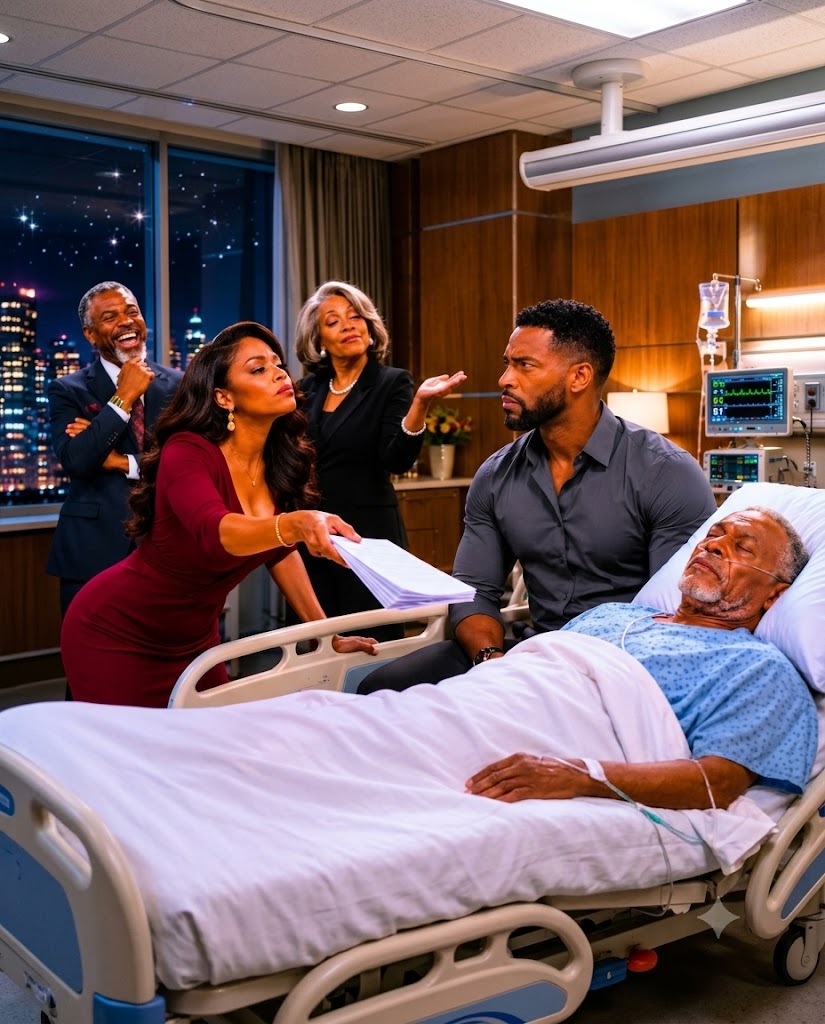
Put the pen in his hand, Malcolm.
Your father does not have time for your pride. Just sign it. Please do not embarrass me in front of my family.
No.
Then when he dies, do not expect us to clean up the mess, son. Let them laugh. The trust knows who they are.
The room went silent for one breath. Then Preston laughed again. That was the last mistake his family made before my father died. He died forty minutes later at 9:07 in the evening with my hand on his wrist and the brass key rising and falling on his chest until it stopped rising.
The hospice nurse, a woman named Evelyn Carter, wrote the time on her chart and stepped back to give me the room. Nobody else stepped back. Charles checked his watch. Elaine said she would call the church in the morning. Preston asked whether anyone had eaten. Vanessa stood at the foot of the bed with that folder pressed against her coat like a schoolbook and said, “We can finish this at the house.”
My phone rang while I was still holding my father’s hand. I did not recognize the number. I answered because I could not think of a reason not to. Malcolm Hayes. A man’s voice, older, careful. My name is Samuel Price. I represent your father. Is he gone?
Yes.
I am sorry. I truly am. A pause. Now listen to me. Do not sign anything they brought into that room.
I looked up. Vanessa was watching me. She mouthed, “Who is that?” I said I would call him back and put the phone in my navy jacket pocket. My wife did not ask how I was breathing. She held out her hand for the folder and said, “Give that back to my father. It is his copy. I kept it.”
That was the moment my grief turned into something colder, and it was the first thing I wrote down in this whole story. The folder rode in the glove box of my car for four days. Vanessa mentioned it every one of those days. Not loudly. Vanessa never did anything loudly. She would set a plate down and say, “You are making this harder than it has to be. My father is only trying to keep things simple while you are not yourself.”
On the third night, I read the papers under the dome light. I am a facilities director at a small private school. I fix boilers and negotiate roofing bids, but I have read enough contracts to know what a prepared document looks like. And these were prepared. The notary block was already filled in with a date from the week before my father entered hospice. The witness line had a name typed on it. Somebody had sat at a desk in a quiet office and built that folder while my father was still able to say my name. They had not come to help me. They had come to collect.
Samuel Price drove out to my father’s house on Saturday morning. He was in his late sixties, thin, with reading glasses he kept pushing up with one finger. He spread the pages across my father’s kitchen table, the same table where I ate cereal as a boy, and read for eleven minutes without saying a word. Then he took the glasses off and tapped the first page.
This grants broad financial authority not to you, to your spouse, effective on execution. Page two has an emergency management clause. If a physician or a family member certifies that you are impaired by grief, control moves without a hearing. He turned a page. Page three is a spousal consent trap. By signing, you would be agreeing that any asset of your father’s is a marital interest subject to joint decision. And here, this wording, temporary authority pending administration. That phrase does not protect anybody. It simply lets your wife stand in your place and speak for your father’s estate.
They put that in front of a dying man. They put it in front of you, Samuel said. Your father was the excuse. He gathered the pages and squared them against the table. This was not written for grief. This was written for control.
I asked how much my father had. Samuel said we would get there. Then his phone rang and he stepped outside, and I was alone in that kitchen with a coffee can full of screws and a calendar two years out of date. That was when I found the note in my father’s Bible in the drawer by the sink. His handwriting had gotten shaky near the end, but the letters were his.
When they laugh, do not answer. Open the box.
No address, no bank name, just the brass key in my pocket, warm from my body heat, and a sentence that assumed I would already know where to go. I was still holding it when Vanessa called.
Do not be upset, she said in the voice she used for other people’s bad news. Preston is over at your father’s house. He is helping with the inventory.
I said, “I am at my father’s house.”
There was a silence on her end that lasted exactly as long as it takes a person to decide what to say next.
I found him in the study. Preston Whitmore was standing behind my father’s desk in a quarter-zip sweater with the bottom drawer pulled all the way out and set on the carpet. My father’s little security camera, the one he bought after the church van got broken into, had been turned to face the bookshelf. On the blotter was a ledger book open with Preston’s hand flat across the page.
There he is, Preston said, not even startled. I told Vanessa somebody should get ahead of this. You are in my father’s house. I am doing you a favor. He looked around at the shelves, the taped chair, the framed photographs of people I had never been introduced to. Look at this place, Malcolm. It is a museum of almost a business, almost a house, almost a man. He smiled. There is nothing here. I am saving you the disappointment.
A year earlier, I would have put him through the wall, and he wanted that. I could see he wanted it. He had his phone face up on the desk, so I did not touch him. I photographed the drawer on the floor, the turned camera, the ledger under his hand, the door frame with no damage, the clock on the wall reading 11:20. Then I called Samuel Price and put him on speaker and said, “I want a lawyer to hear this. Preston, tell him again why you are here.”
Preston stopped smiling and walked out.
That night, I asked my wife one question. I asked whether she knew her brother had gone into my father’s house. Vanessa was taking the pins out of her hair, laying them on the dresser in a row. My family may be direct, she said, but they are not enemies. And why do I feel surrounded? She did not answer. She looked at me in the mirror for a long moment, and I watched her decide that the question was rude and that being hurt by it was easier than answering it. She turned out the lamp on her side of the bed. In fourteen years of marriage, that was the first night neither of us said good night.
Two days later, Evelyn Carter called me.
Mr. Hayes, I’m probably not supposed to do this. Her voice was low, like she was in a stairwell. A complaint was filed about you, about the hospice room. It says you were aggressive with family, that you frightened your father, that staff had to intervene. None of that happened. I know it did not happen. I was standing three feet from you. She exhaled. I wrote incident notes that night before I went home. I write them every time a room goes wrong. I have them.
Will you give them to my attorney?
The silence went on so long I thought the call had dropped. I am a single mother, she said finally. I have eleven years in. If I get pulled into a family fight with people like that, I lose everything and they lose a weekend.
I have thought a great deal about what I said next because it was the first time in my life I asked for something without apologizing for asking. I am not going to push you, I said. You do not owe my family anything. I will only say this. My father deserved at least one honest record of that room.
She did not agree. She did not refuse. She stayed on the line breathing for four or five seconds. Then she hung up without saying no.
Samuel found the box on a Thursday. Not a bank. My father never trusted banks with anything he loved. It was a place called Meridian Private Depository, forty minutes north, a low brick building with no sign on the road, and a woman at the desk who asked for the key before she asked for my name.
The brass key fit a small square door in the third row. Inside was a drawer, and inside that a canvas envelope soft as cloth from handling. A letter folded in thirds. A navy blue fountain pen, capped, the barrel worn pale where a thumb had rested on it for thirty years. A small audio drive. A trust summary page. One sheet. My father’s name at the top and mine beneath it. A document titled Character Clause Addendum. And a list printed small, running to eleven pages, of grants my father had funded anonymously.
I read the letter standing up.
Son, if you are holding this, they laughed before they knew what they were standing next to. I never hid what I had because I was ashamed of it. I hid it because the moment people can see a man’s money, they stop being able to see the man. I wanted to know who was kind to me when I looked like nobody. Now you know, too. Do not use this to punish them. Use it to tell the truth. The truth costs them more.
I stood in that little room and cried the way you cry when there is nobody you are willing to let hear it.
Samuel explained it in the car. My father had spent forty-one years buying small things nobody wanted. Machine shops. Two laundromats. Warehouse land near a rail spur that a city eventually needed. He never sold a company he could keep, and he never told a soul what he owned. He built a private trust around all of it, folded the returns back in, and named it the Hayes Legacy Trust. Four trustees, a professional administrator, and a review process he had insisted on over his attorney’s objection.
How much? I said.
Enough that I want you sitting down, Samuel said. And not today. Today you have a house to protect.
I let him have that because I was thinking about something worse. The Whitmore family had laughed at my father for eleven years. Charles had once introduced him at a Christmas table as Malcolm’s dad, who is very handy, and I had let it happen. Not because I was noble. Because part of me, the part I do not enjoy looking at, had been faintly embarrassed by the taped chair. My father had let those people mock him to protect a secret. I had let them mock him because I did not want a scene. He had been quiet on purpose. I had been quiet out of cowardice.
Vanessa came to my father’s house that Friday unannounced in a pastel pink blouse with a casserole she had not made. Samuel was at the kitchen table on a call. She heard the words trust administration, and I watched my wife’s face change the way weather changes.
Malcolm, she said, setting the dish down very carefully. We should handle this together.
Fourteen years. I had emptied her mother’s flooded basement. I had sat through Preston’s toasts. In all that time, I do not remember the word together arriving on its own. It always came with something, and this time it came with a trust.
Together, I said. That is a new word this week.
She said I was being cruel, but when she left, she did not go home. She went to her parents’ house and stayed four hours.
The dinner invitation came the next Tuesday. Charles called it a family meeting. Good china, a roast, Elaine’s pearl earrings, a fire going even though it was not cold. Charles waited until dessert, then laid out the proposal like a man reading a weather report. Vanessa would take temporary control of anything relating to my father’s estate. Charles would serve as adviser at no charge, given his background in investment consulting. Preston would review the assets. And I would be, in Charles’s word, protected. Protected from bad decisions. Protected from predators. Protected from myself.
You have had a shock, Charles said. There is no shame in stepping back.
I said nothing. Silence has always been my native language, and I have never known whether that is strength or a disease. Elaine reached over and put her hand on mine, and her hand was warm and dry, and she wore the expression she used in the church vestibule.
No one is saying you are incapable, Malcolm, she said gently. We are saying grief makes small men smaller.
Preston laughed into his napkin.
I looked at the four of them, the fire, the roast, the pink of my wife’s sleeve, and I asked the only question I had. Who drafted the hospice papers?
Charles said the firm they used handled a great many things. Elaine said this was not the evening for accusations. Preston said something about a paralegal. Vanessa looked at her plate. Four people at that table knew the answer. Not one said it out loud.
She followed me into the driveway. It was raining lightly and she stood without a coat, arms crossed.
Please do not do this, she said.
I waited for the apology. I gave her room for it. I stood in the rain with my keys in my hand and waited for her to say, I am sorry they did that to your father. Or even, I am sorry I asked you to sign.
My father is on two boards, she said. My mother has the auxiliary. If you humiliate them over a misunderstanding in a hospital room, it will follow all of us for years.
That is what you are afraid of.
I am afraid of losing everything I have built, she said. And you are the only one who is treating this like a war.
I drove home alone. An email was waiting, sent at 9:08 from a law office I did not recognize, copied to Preston. It accused me of withholding marital financial information and demanded disclosure within ten days. The war had a return address now, and it was not mine.
Evelyn Carter walked into Samuel’s office on a Monday with a spiral notebook and a printout of the record she filed the night my father died. Her notes were plain and terrible. Four family members entered at approximately 6:40 in the evening. Documents were placed on the patient’s blanket. A male family member laughed at the patient’s necklace and made a remark about unpaid bills. A female family member instructed the son to sign. The patient spoke clearly and by name to his son at 6:51. The nurse asked the family twice to lower their voices.
Everything I had said, in another person’s handwriting, dated that night.
They filed a complaint against me too, Evelyn said. Not just against you. Failure to manage the room. She put her hands flat on the table. I am suspended pending review as of this morning.
Then do not do this.
I already did it. She said, I did it at seven this morning. I only came here to tell you why.
The audio drive was the last thing we opened, and I am glad we waited. It was recorded in his kitchen. I could hear the refrigerator. He sounded tired but completely himself, the way he sounded reading instructions off a paint can. He said he had built the trust to outlast his own judgment. Money left to good people goes bad the moment bad people get near it. And he had watched that happen twice and would not watch it a third time. So he had written a review mechanism into the trust itself. Any person seeking influence over the trust, its beneficiary, or its assets through coercion, false filings, intimidation, unauthorized entry, or reputational sabotage could be brought before the trustees, and the trustees could permanently exclude them.
Then he said this.
Malcolm, this is not a trap I set for anybody. It is a door with a lock on it. Nobody falls through a door. They have to work the handle. If they come for you, they will do it in writing because people like that always do. Do not chase them. Just make sure the truth is written down somewhere they cannot reach. The trust knows who they are.
That was what he had meant, holding my wrist with the last strength in his body. Not magic. Not vengeance. Just a man who had watched people carefully for eighty years and knew exactly what they would do next.
Samuel sent the formal preservation notice on Thursday to Charles, Elaine, Preston, and Vanessa. It required them to preserve every document, draft, email, and message relating to my father, the hospice papers, the complaint against Evelyn Carter, and the entry into my father’s home.
For six days, I believed I had won. I had a witness with contemporaneous notes, photographs with timestamps, a trust with a mechanism, an attorney, and my father’s own recorded voice. Samuel warned me not to enjoy it. I did anyway. I slept a full night for the first time since the hospital.
Charles Whitmore did not call, did not shout, did not send an angry letter. That should have frightened me more than it did. Later, after preservation, we would read what he wrote to his family that same evening. Then we stopped treating him like a grieving son and started treating him like an adverse party.
It came all at once on a Tuesday in the shape of paper. The emergency petition landed at the courthouse before eleven in the morning. It asked for immediate temporary financial control on Vanessa’s behalf. And it said five things about me. That I had been mentally unstable since my father’s death. That I was concealing substantial assets from my wife. That I had threatened Preston Whitmore in a private residence. That I had exercised undue influence over an elderly, dying man in his final weeks. And that Vanessa required protection while the matter was reviewed.
Attached were photographs cropped out of my father’s own security camera. In the frames they submitted, I was in the study doorway with my hand raised and my mouth open, and Preston was half turned with his arm up in front of his chest. Out of frame, the drawer on the floor. The ledger under his hand. The fact that he was standing in a dead man’s house without a key. A photograph does not lie. It simply agrees to be cut.
Then Samuel called me at six in the morning, which he had never done. The Character Clause Addendum existed in three places. The paper original in the depository, a working copy at the administrator’s office, and a digital archive. Sometime that week, the archive had been accessed with a legacy credential belonging to a retired trustee and written over. What came back was fragments, half the operative language, no signature page.
We still have the paper original, I said.
We have a paper document with no verifiable chain, Samuel said. They will say you produced it after the dispute began. Not fatal, but not clean. And in front of a judge, clean matters.
And then on Friday, my wife signed an affidavit. She did not accuse me of hitting anyone. She was too careful for that. And I think in her own mind that carefulness let her sleep. She wrote that after his father’s death, my husband became cold, secretive, and intimidating. She wrote that he stopped sharing information with me. She wrote that he began keeping documents in his vehicle and taking phone calls outside the house. She wrote that she no longer felt she knew what he was capable of. Every one of those sentences was true. Every one of them was a knife.
That is the thing about a quiet man. Everything that makes him easy to live with can be reframed in an afternoon. Fourteen years of not raising my voice became cold. Fourteen years of handling things alone so she would not have to worry became secretive. My silence, which I had always told myself was dignity, turned out to be an empty page, and her family got to it first with a pen.
I sat in Samuel’s office and could not speak. Then he said the sentence that ended the first half of my life.
Malcolm, dignity is not a defense if you let them write the record.
I said that if we told the whole truth about that hospice room, it would be public, that Vanessa’s name would be in it, that everyone she had ever wanted to impress would know she stood there and told me to sign.
Yes, Samuel said. That is what it costs.
I drove to the hospice chapel that night. I had not been inside a church in nine years. It was a small room with six chairs and a window of frosted glass. My father used to sit there in the afternoons when he was still walking, not praying much, he said, just resting somewhere nobody needed anything from him.
I sat in his chair and thought about a Saturday when I was nineteen. A neighbor had accused him of taking a table saw. He knew who really took it and said nothing for three weeks. And I asked him why he let people talk.
Because I know who I am, he had said.
Then later, coming back into the room as though he had been arguing with himself in the hallway. But do not learn the wrong thing from me, son. Never build a house so quiet that liars can speak for you.
I had been building that house for forty-two years. It had beautiful rooms, and a family of strangers had moved in and started giving tours.
I called Samuel from the parking lot.
I am done trying to keep this private, I said. I do not want to win quietly. I want a record. I want everything that happened in that room and everything that happened after it written down in a place where the Whitmores can never revise it. Whatever that costs my marriage, it costs.
That was the night my objective changed, and everything after it flowed from that one sentence.
Part 2
I started with the grant list because it was the only thing in the box I had not understood. Eleven pages. No foundations, no press mentions, no plaques. A high school chemistry teacher’s tuition for her master’s degree. A hospice nurse whose car was replaced after a flood. Four widows’ property taxes paid quietly for six years. A mechanic’s shop lease covered through a bad winter. Forty-one roof repairs, all within thirty miles of the house I grew up in. Two hundred nine students over thirty-one years, with a note in my father’s hand. No letters, no ceremonies, no names.
He had not hidden his money out of shame. He had hidden it so that giving would never become a performance, so that no one he helped would ever have to be grateful in public. The Whitmores had looked at a man in a taped chair and seen an embarrassment. They had been standing next to a monument the whole time and never once looked up.
And then, one at a time, without me asking, people started moving.
Evelyn Carter filed her own statement with the hospital ethics board while suspended, calling the complaint against her retaliatory. Samuel found a cold-storage legal backup of the trust records, taken quarterly, held off site, and never connected to the network that had been compromised. And Marian Bell, a former trustee, seventy-six years old, agreed to testify after refusing twice.
Samuel told me why she changed her mind. In our second meeting, I had said I did not want the Whitmores destroyed, only corrected. She told him that if I had wanted blood, she would have stayed home, because she had known Arthur Hayes for thirty years and would not help anybody turn his life’s work into a weapon.
They were not helping me anymore. They were choosing my father.
Preservation orders are dull. They are also merciless because they arrive before people think about what is already on their phones. Charles’s messages came back first. A week before the emergency petition, he had written to Elaine and Preston. If Malcolm wins this, we are the family that laughed at a dying man. That is the only fact anyone will remember. Vanessa holds the line or we are finished socially.
And three days later, to Preston alone. We need control before valuation. After valuation, we have no leverage.
Preston’s records explained his hurry. His fund had lost a lead investor in the spring and was quietly winding down. He had personal guarantees on two loans, and he had spent months looking for a rescue. None of that proved a conspiracy. Samuel was careful with me about that. It was motive, not magic. But motive is what makes a pattern legible.
The cold-storage backup confirmed the clause word for word. Any person seeking to obtain influence, benefit, or control over the trust, its beneficiary, or its assets through coercion, false filings, intimidation, unauthorized entry, reputational manipulation, or spousal pressure may be permanently excluded from advisory, beneficiary, or derivative access.
Understand what this is, Samuel said. The clause does not punish rudeness. Trustees have to find a pattern of conduct on evidence, item by item. If we bring them anger, they do nothing. If we bring them a sequence, they act.
There was one more conversation before the hearing, and I asked for it. We met in a conference room with Samuel and Vanessa’s attorney present. My wife wore a pastel pink scarf and did not take off her coat. She looked tired in a way I had never seen, and some part of me still wanted to get her a glass of water.
I had one question, and I had practiced it in the car until it came out level.
Did you sign that affidavit because you believed it or because they needed it?
She opened her mouth. She looked at her attorney, then at the table, then at the window. Twenty seconds. I counted them. She never answered. In that silence, I stopped being married months before any paper said so. A woman who believes what she signed says so. A woman who cannot say either sentence out loud is telling you which one is true.
The hearing began at nine the next morning. They came in beautifully. Charles in a charcoal suit, Elaine in cream with her pearls, Preston with a leather folio, Vanessa in soft pink between her mother and father, seated where the family could see her at all times.
Their attorney was good. He did not call me a monster. He called me a grieving son, sympathetically, six or seven times. A man in pain. A man who had begun hiding documents in his car. Who had frightened his brother-in-law. Who had isolated his wife. Who had spent his father’s final weeks alone with him and emerged with a story about hidden assets. He asked for a temporary protective arrangement. Nothing permanent, nothing punitive.
Judge Miriam Cole took notes, and I could not read a thing on her face.
Samuel stood up and did not mention money at all.
Your Honor, we will not begin with assets. We will begin with a timeline.
He walked it through in order. The hospice papers, drafted and notarized eight days before my father entered hospice, at a firm retained by Charles Whitmore. The room itself, four family members, documents on a dying man’s blanket. My father’s final statement to me, clear and by name, at 6:51, recorded in the nursing chart. The complaint against Nurse Evelyn Carter. Eleven days later, Preston Whitmore inside my father’s home before the funeral, with a drawer removed and a camera turned. Photographs submitted with their context cropped away. And an emergency petition filed the same week the archive was accessed with a retired credential.
Their attorney said each item had an innocent explanation, and most single items did. Concerned in-laws. A worried brother. An inventory.
The judge asked one question. She asked whether the hospice papers predated the hospice admission. Their attorney said he would need to confirm the drafting date. He never did confirm it.
Evelyn Carter testified after the recess, still suspended, in a plain gray dress with her notebook. She read her notes. She confirmed the documents on the blanket. Preston laughing at the necklace and the remark about unpaid bills. Vanessa telling me to sign. My father speaking clearly to me before he died, oriented, in her professional assessment.
Elaine’s attorney tried to make her small. Was hospice work emotionally taxing? Might an exhausted nurse misread a family’s grief? Might the laughter have been nervous?
Evelyn set her hands on the rail.
Grief lowers the voice, she said. It does not make a room laugh at a dying man.
Nobody moved for a second or two. Judge Cole wrote something down and underlined it.
Preston went next, with the photographs enlarged on a board. He was excellent for about four minutes. He described me in the doorway. He used the word looming.
Then Samuel displayed the unedited sequence from the same camera, taken off my father’s own recorder. Eleven minutes before I appeared, Preston enters the study alone. He removes the bottom drawer and sets it on the carpet. He photographs pages of a ledger. He crosses to the camera and turns it toward the bookshelf, which is why the last portion is audio only.
Mr. Whitmore, Samuel said, you have testified that you were helping with an inventory.
That is correct.
Who asked you to?
It was understood.
Understood by whom?
Mr. Hayes was buried nine days after that recording. Did you have a key?
The door was unlocked.
Did you tell Malcolm Hayes you were going?
I was doing him a favor.
And when you turn the camera toward the bookshelf, Samuel said, was that also the favor?
Preston said the camera was in his way. The judge asked him to repeat that answer, which is the only time in the entire hearing that she asked anyone to repeat anything.
Then they called my wife.
She was calm. She agreed we had grown distant. She agreed she had been frightened. Her attorney sat down satisfied.
Samuel asked her two questions.
Mrs. Hayes, in fourteen years of marriage, have you ever seen your husband threaten anyone?
No.
In the hospice room on the evening Arthur Hayes died, did you hear members of your family laugh at him?
The room was so quiet I could hear the court reporter’s fingers stop. Vanessa looked at her father. Charles’s face never moved. And I watched my wife weigh her whole life, everything she had built, the boards and the auxiliary and the Christmas table, against a single word under oath.
Yes, she said.
Elaine made a small sound. Charles closed his eyes.
It did not fix us. It did not undo the affidavit or give me back the woman who held that folder against her coat. But it broke the story they had spent five weeks building, and it broke it in her own voice, and I do not think she has ever forgiven me for asking.
Charles stood up himself for the last argument. His attorney tried to stop him. He waved the man down.
Everything the court had heard was noise, he said. The real issue was simple. Malcolm Hayes had concealed a substantial inheritance from his own wife, refused disclosure for weeks, and used the sympathy of grief to hide marital wealth. A man who hides ten thousand dollars is a liar, he said. And a man who hides a fortune is a fraud.
He had spent the whole hearing driving us toward the one door he thought would save him. He wanted the money in the room. He believed that the second the number was spoken, everyone would stop looking at the hospice bed and start looking at me.
Samuel let him finish.
Your Honor, since counsel has raised concealment, we will now address the estate. Arthur Hayes was the settlor of the Hayes Legacy Trust, an irrevocable private trust with a value of approximately ten billion dollars.
I heard it land. A pen dropped somewhere behind me. Elaine turned to Charles with her mouth open, and for the first time in eleven years, I saw the Whitmore family look at my father’s name with something other than amusement.
Then the danger arrived, exactly as Samuel had warned. Judge Cole did not look impressed. She looked interested in a way that made my stomach drop. She asked whether the trust had any marital nexus. When I had learned of its existence. Whether I had disclosed it. Whether the settlor had been competent when the trust was funded and amended.
For about ninety seconds, ten billion dollars was not my shield. It was the largest possible reason to doubt me.
Samuel answered in order. The trust was irrevocable, funded over four decades with no marital contribution, no co-mingling, and no spousal interest under its terms. I had learned its full scale nineteen days earlier and disclosed it through counsel at the first hearing where it was relevant. The last amendment was eleven years old, with medical certification of the settlor’s capacity attached.
Then he introduced the Character Clause Addendum, and Marian Bell was sworn in. She held her purse in her lap. Nineteen years as a trustee. She had personally witnessed the addendum, and the language before the court was identical to the language she witnessed.
Samuel introduced the cold-storage backup with its custody log and the access record showing the archive entered with a retired credential and overwritten during the week the emergency petition was drafted.
This clause, Samuel said, does not operate on wealth. It does not care that the Whitmore family is prosperous or that Arthur Hayes appeared poor. It operates on conduct, and only on a pattern.
He laid the pattern down one piece at a time. Documents drafted for control eight days before the hospice admission. Coercion at the deathbed, corroborated by an independent nurse’s contemporaneous record. A retaliatory complaint filed against that nurse. Unauthorized entry into the settlor’s home before his funeral. Evidence presented to a court with its context deliberately removed. An emergency petition alleging instability with no medical support of any kind. An affidavit obtained from a spouse under family pressure, which that spouse had now materially contradicted under oath. Preston Whitmore’s undisclosed financial exposure and personal guarantees. And Charles Whitmore’s own written words. We need control before valuation.
They did not fall into anything, Your Honor, Samuel said. Every one of these was a document somebody chose to sign.
Judge Cole ruled before lunch. She denied the emergency petition in full. She found no evidence of impairment, concealment, or undue influence, and vacated the temporary restrictions. She referred the cropped exhibits and the petition itself for review of false filings, and noted for the record that the entry into Arthur Hayes’s residence and the complaint against Evelyn Carter were matters for civil and institutional review.
She confirmed the truth. She did not hand it to me. I had spent five weeks carrying it up to her one piece at a time.
Afterward, in the hallway, Samuel asked me the last question of the whole matter. The trustees would convene within ten days. Under the character clause, we could seek maximum exclusion and support every civil and regulatory referral available. Preston would face personal liability. Charles’s board seats would not survive it.
You can take all of it, Samuel said. Say the word, and I will file everything today.
I stood there in that hallway with my hand in my pocket, and the brass key was in it, warm again, the way it had been on my father’s chest. In my other hand was a leather case with a navy blue fountain pen inside, worn pale where his thumb had rested.
Do not use this to punish them. Use it to tell the truth. The truth costs them more.
No, I said. I want the record corrected. I want my father’s name left clean. After that, let the consequences belong to the people who chose them.
That is the only part of this story I am proud of.
The trustees met eleven days later and did their work without me in the room. The Whitmore family received no advisory role, no beneficiary interest, no derivative access, and no route of influence through Vanessa, permanently. The civil review of the entry into my father’s home went forward, and so did the referral on the false filings. Charles resigned from both boards within a month in a letter that used the words to focus on family matters. Preston’s guarantees came due on schedule, and no fortune arrived to meet them. Elaine’s name came off the auxiliary letterhead in the spring.
Evelyn Carter was reinstated with back pay after the ethics board found the complaint against her retaliatory. She still works nights.
Vanessa and I separated in November. She asked near the end whether there was any version where we tried again. I told her the truth, which took me forty-two years to learn how to say. I could forgive her for being afraid of her family. I could not build a marriage on top of a sworn statement she was still unable to explain. Truth without trust is not a marriage. It is a witness stand with a bed in it.
She cried. I did not comfort her. And that one held breath was the hardest honest thing I have ever done.
We held the memorial for my father in April in the fellowship hall of a church that seats maybe ninety people. Two hundred forty came. I did not know most of them because he had made sure of that. A chemistry teacher who said Arthur Hayes paid for her master’s degree and asked her never to mention it. A nurse who drove eleven hours. A mechanic who kept his shop through a bad winter and never learned why the lease stopped arriving. A widow, eighty-one years old, who stood up in the third row and said only, He fixed my roof and then he fixed it again, and sat back down. A former student, now a city engineer. A hospice volunteer who had sat with him twice a week for reasons that had nothing to do with money.
I stood at the front of that hall and understood finally that my father had never been small. He had been quiet. Those are not the same thing, and the whole world had spent his lifetime confusing them, and so had I.
In June, I signed the trust transition in Samuel’s office. The Hayes Legacy Trust now funds five things: elder legal protection, hospice dignity grants, education support, community repair funds, and caregiver relief. No plaques, no naming rights. My father’s rules.
I signed with his navy blue fountain pen, the same pen a family once tried to force into a dying man’s hand, and my signature came out steadier than I expected.
The brass key hangs in a small frame on the wall of my office now with one line printed underneath it, and that line is the only inheritance I actually needed.
A key only looks small to people who do not know what it opens.
Tell me in the comments, have you ever stayed quiet so long that people mistook your patience for weakness?









