My Wife Walked Out of My Father’s Funeral With Her Ex—By Sunrise, Her Name Was Gone From Every Trust I Controlled
Part 1
Claire, you’re leaving right now in the middle of my father’s service.
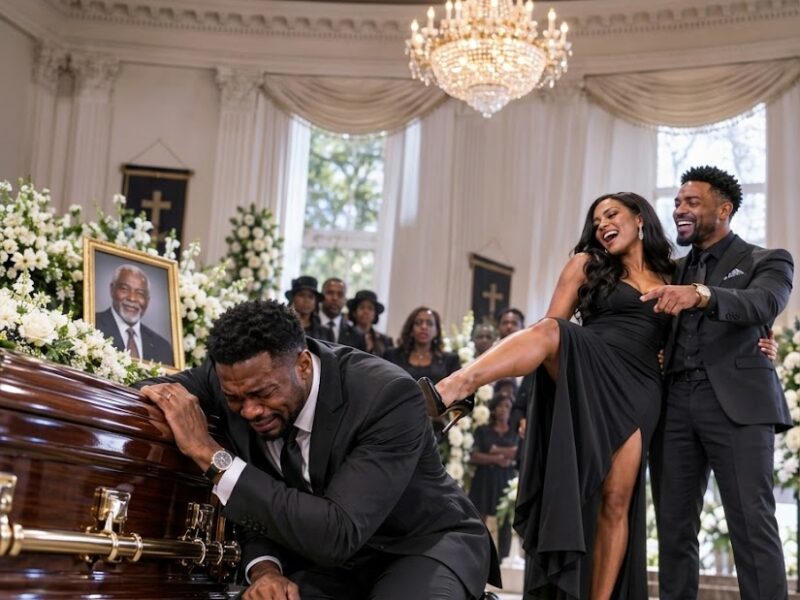
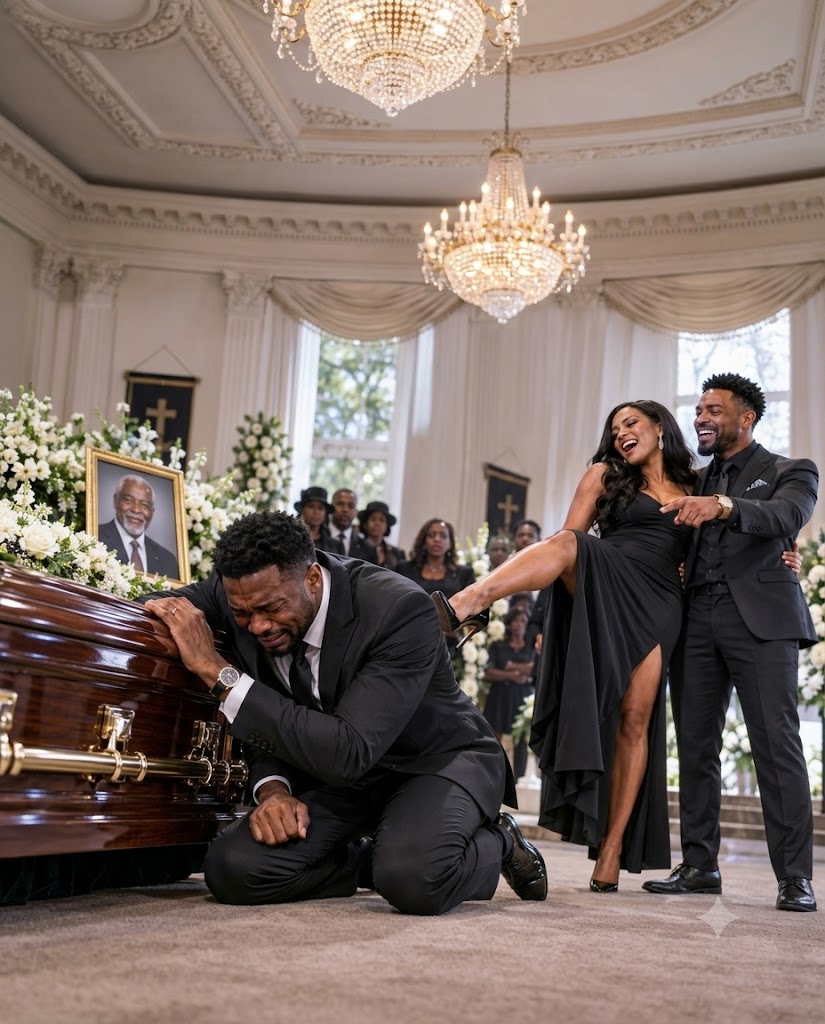
The words hung in the air between us like frost on a window, and I watched her hand find another man’s fingers in the pew ahead of me. The last hymn hadn’t finished echoing through New Hope Baptist Church when Claire Brooks stood up, smoothed her black dress, and followed Ryan Mercer down the center aisle.
She didn’t glance toward my father’s casket. She didn’t look at the framed photograph of Elijah Brooks that sat beside it, the one where he wore his favorite flannel shirt and held a hammer like it was an extension of his hand. She just walked past my relatives, past the deacons, past thirty years of Sunday mornings, and out into the Atlanta rain.
Ryan had been her fiancé before me. Everyone in that church knew it. The old women who had watched me grow up, the men who had worked alongside my father, even the teenagers who only came for the free food after the burial. They all knew Ryan Mercer had left Claire first, gone to New York for a bigger paycheck, and come back five years later in a tailored suit with a smile that promised everything he hadn’t delivered the first time.
My twelve-year-old daughter, Nia, looked up from the front pew. Her small fingers gripped the hymnal so hard the cover bent.
Is Mom coming back?
I watched Ryan open the passenger door of a silver Mercedes. Claire climbed inside without turning around. The car pulled away from the curb, windshield wipers slicing through the downpour, and I felt something inside my chest go quiet. Not break. Not shatter. Just go quiet, like a radio station signing off at midnight.
I don’t know, I told Nia.
By eight the next morning, I was seated across from an estate attorney, changing every beneficiary I legally could.
Twenty-four hours earlier, I had believed grief was the heaviest thing I would carry that weekend. My father, Elijah Brooks, had died at sixty-eight after a stroke, leaving behind a neighborhood construction company, three rental buildings, and a reputation for keeping promises no one else remembered making.
He had taught me to frame walls, read blueprints, and never sign a document I hadn’t studied. He had also taught me to listen more than I spoke, which is why I noticed things most people missed.
What I missed was my own wife walking out the door while my father’s body was still in the church.
—
The funeral had been planned for weeks. Claire helped choose the flowers, contacted reporters about the “community impact” of my father’s legacy, and stood beside me at the visitation like a woman who hadn’t been sleeping in the guest room for a month.
She answered Ryan’s calls in the hallway. She checked her phone during the eulogy. At dinner the night before the service, she asked whether Elijah had left instructions concerning Bellwood Avenue.
I stared at her across the table.
My father has been dead for four days.
Claire lowered her voice. Ashford’s board meets Monday. If that property is part of the estate, delays could cost my company millions.
It was the first time she said *my* company, as though their family stood on the other side of a line I hadn’t realized she had drawn.
I told her I hadn’t opened the sealed estate packet. Her expression tightened. Later that night, I found her searching Elijah’s study. She claimed she was looking for a photograph for the funeral display.
On the morning of the service, Claire dressed in black silk and kept her phone face down. I asked whether Ryan would attend.
He represents Ashford, she said. Your father was a business owner.
I reminded her that Elijah had rejected three Ashford offers.
Claire fastened an earring without looking at me. That doesn’t mean we need to make an enemy of them.
—
At the church, Ryan sat two rows behind the family, even though there were empty seats near the back. Halfway through Elijah’s former foreman describing how my father paid workers during a recession, Ryan received a message. Claire’s phone vibrated seconds later.
She read it, gripped her purse, and whispered that she needed air.
I expected her to return. Instead, through the rain-streaked window, I saw her enter Ryan’s car. I remained beside the casket until the final prayer. I greeted every mourner, helped my aunt into her coat, and carried a plate of food to an elderly carpenter who had worked with Elijah for thirty years.
Only when the church emptied did I check my phone.
Claire had sent one message. *Something urgent came up at Ashford. Ryan needed me. Don’t turn today into a scene.*
There was no apology. No question about Nia.
My daughter sat alone in the fellowship hall, folding the corner of a napkin until it tore. I crouched beside her. Nia was Claire’s child from a brief relationship, but I had raised her since she was three. Her biological father had never been involved.
Did Mom leave because Grandpa did something wrong?
I swallowed. No. Grandpa protected people. Sometimes that makes powerful people nervous.
—
After the burial, I drove Nia home through heavy rain. Claire’s closet was half empty. Her passport, jewelry case, and two suitcases were gone.
On the kitchen counter lay an envelope addressed to me. Inside was a printed separation agreement prepared weeks earlier. It offered me temporary access to the guest room, divided our bank accounts, and proposed that Claire retain primary custody of Nia.
A handwritten note said, *Please be reasonable. Ryan is helping me manage this.*
I read the sentence twice.
The document also required me to disclose anything inherited from Elijah, including property connected to Bellwood Avenue. Claire hadn’t left the funeral because of an emergency. She and Ryan had chosen the moment when I was least likely to resist and made their move.
Nia stood in the doorway clutching her grandfather’s old baseball cap.
Where’s Mom?
I told her Claire would be staying elsewhere that night. Nia’s eyes moved toward the missing suitcases. She understood more than I wanted her to.
Am I staying with you?
I couldn’t promise what the law hadn’t yet protected, but I would not let fear enter my voice. Tonight, tomorrow, and every day I’m allowed to fight for.
Nia stepped into my arms. While she cried against my chest, I saw a blinking red light beneath the bookshelf in Elijah’s study. It came from a small digital recorder I had never noticed.
Beside it sat an empty groove in the wood, shaped precisely like the brass key Elijah had given me six months earlier.
—
The key opened a metal drawer concealed behind the bookshelf. Inside were property maps, corporate ledgers, a flash drive, and a letter bearing my name.
Elijah’s handwriting had become uneven near the end, but the message was clear. Ashford had spent two years purchasing Bellwood properties through shell companies. Ryan Mercer had offered Elijah cash personally if he would sell the grocery parcel before residents learned how essential it was.
Elijah refused and began assembling an alternative plan: a community land trust, giving local residents permanent stakes in the redevelopment.
The letter ended with a warning. *Someone near you has been feeding Mercer information. Do not accuse anyone until you know what they gave him. Anger will make you loud. Evidence will make you effective.*
I looked toward Claire’s empty closet and felt something colder than anger.
—
At seven the next morning, I entered the office of Simone Grant, Elijah’s estate attorney. Simone was fifty-three, silver-braided, exacting, and unimpressed by theatrical grief.
She listened while I described the funeral, Claire’s departure, and the separation papers. Then she opened Elijah’s estate file.
Before we change anything, she said, you need to understand what belongs to you and what does not.
Elijah had transferred controlling ownership of Brooks Restoration and the Bellwood parcel into a revocable trust. Upon his death, I became trustee. The beneficiaries were me, Claire, Nia, two relatives, and a charitable foundation.
I also had personal life insurance, investment accounts, retirement funds, and transfer-on-death holdings naming Claire first.
Can I remove her?
Simone answered, From some today. From others only through the proper process.
I didn’t demand shortcuts. I changed the beneficiaries on my personal life insurance, brokerage account, savings certificates, and business succession policy. Nia’s education trust became the primary beneficiary, with Elijah’s community foundation second.
I removed Claire as my medical proxy, financial agent, and emergency business successor. Because federal rules protected spousal rights to part of my retirement plan, Simone prepared the required legal notices instead of pretending a signature could erase them.
I also amended the Brooks trust. Claire’s individual distribution was suspended pending an accounting of confidential information shared with Ashford. Her money wasn’t redirected to me. It was assigned to a housing defense fund for Bellwood residents.
Every change was documented, witnessed, and lawful. What began as pain slowly became a boundary.
Simone studied me after the final signature. Are you doing this to punish her?
I looked through the window at workers opening shops below. Last night, my daughter asked whether she was still safe with me. Claire was planning her exit while my father was dying. If I die tomorrow, I won’t leave Nia’s future controlled by someone who used a funeral as cover.
Simone nodded once. Then she handed me a document Elijah had signed six weeks earlier. It appointed me chairman of the Bellwood Community Land Trust if I accepted within ten days of Elijah’s death.
The trust controlled not only the grocery parcel but options on fourteen surrounding properties. Ashford believed Elijah had stood alone. In reality, dozens of owners had quietly joined him.
Ryan’s development could not proceed without my approval.
—
## Part 2
At noon, Claire finally called. She didn’t ask how the burial had ended.
My attorney says you met with Simone.
I heard traffic and the muted voice of a hotel receptionist behind her. Your attorney works quickly.
Claire ignored the remark. You cannot make emotional decisions involving your father’s estate.
I asked how she knew what the meeting involved. Silence followed. Then Claire said Ryan had contacts in probate administration. I wrote the explanation down.
Where are you?
That isn’t relevant.
I looked at Nia’s untouched breakfast. It became relevant when you left your daughter at a funeral.
Claire insisted Nia was safe with me, accidentally conceding that her departure had been planned. Then she demanded a meeting concerning Bellwood.
—
Claire arrived that evening wearing the same black dress beneath a camel-colored coat. Ryan waited in his car across the street. I let her enter because Nia was staying with my aunt.
Claire glanced at the open metal drawer and immediately looked away.
You found Elijah’s records.
I hadn’t told her about them. I asked how she knew the drawer existed. Claire claimed Elijah had mentioned it months earlier. I knew that was impossible. Even I hadn’t known.
I placed the separation agreement on the table. How long?
Claire folded her arms. The marriage has been broken for years.
That wasn’t my question.
Her eyes hardened. Ryan and I reconnected during the Bellwood campaign. He sees what I’m capable of. You only see what your father needs.
I asked whether she had been sleeping with Ryan. Claire said emotional intimacy could be more complicated than labels. The carefully polished answer told me enough.
I then asked what Ryan wanted from the funeral. Claire’s composure cracked.
Ashford needed confirmation that the grocery parcel would pass directly to you. Ryan believed grief might make you accept a clean offer before complications arose.
I stared at her. So you walked out of my father’s funeral to help your ex buy his land.
Claire stepped closer. I left because Ryan received notice that another bidder was moving. This project could make me vice president.
I finally understood. She hadn’t merely chosen another man. She had chosen the future she imagined he could purchase for her.
When I told her the beneficiaries had changed, Claire’s face lost color.
You did what?
I explained that Nia’s education and Bellwood’s residents were now protected. Claire accused me of stealing marital assets. I replied that Simone had changed only what the law allowed and preserved everything subject to court review.
You were a beneficiary because I trusted you to protect the people I love, I said. Yesterday you left one of them asking why her mother disappeared.
Claire insisted she would never harm Nia. I placed the separation agreement before her and pointed to a clause allowing Ryan’s law firm to oversee any inheritance disclosure.
Claire read it as if seeing it for the first time. For one second, doubt crossed her face. Then Ryan sounded the car horn outside.
Claire left with the agreement tucked beneath her arm.
—
Ten minutes later, I received an email from Ryan offering four million dollars for the grocery parcel. The offer expired in forty-eight hours and included a confidentiality clause barring me from discussing Ashford’s plans with Bellwood residents.
I forwarded it to Simone. Then I opened Elijah’s flash drive.
It contained audio recordings of meetings, scans of altered environmental reports, and a spreadsheet listing payments to consultants. One payment went to C. Brooks Communications.
My stomach tightened.
Claire had accepted seventy-five thousand dollars from an Ashford subsidiary while presenting herself as a salaried employee. The payment had been made three weeks before Elijah’s stroke. A note beside it read: *Access strategy—family channel.*
I wanted to confront her immediately, but Elijah’s warning held me still. Evidence would make me effective.
—
The next morning, I met Maya Chen, a municipal land use attorney who had assisted Elijah. Maya explained that Ashford’s environmental report omitted underground fuel tanks beneath two acquired lots. Cleaning them could cost millions and delay construction for years.
Elijah had discovered the omission and planned to disclose it at the zoning hearing. Ryan’s team knew. Maya said they pressured him to sell before the report became public.
I asked whether Claire knew about the tanks. Maya slid over an email bearing Claire’s company address. Claire had received the complete findings and replied: *Keep this outside the community presentation until acquisition is secured.*
I felt the last excuse I had been protecting collapse.
Still, I didn’t release the email. A public accusation made too early could let Ashford portray me as a grieving husband seeking revenge. Instead, I called a meeting at the abandoned grocery store.
Residents arrived expecting another speech about displacement. I gave them copies of Elijah’s land trust plan and explained that the controlling parcel now belonged to a trust I managed. No sale could occur without a resident advisory vote.
An auto shop owner asked whether I intended to become their landlord.
No, I replied. If we develop, the trust keeps the land. Businesses and families receive long-term rights they can pass down. Nobody gets rich by pushing you out.
Suspicions slowly gave way to questions, then cautious hope.
Among those listening was Lorraine Mercer, Ryan’s older sister. She owned a bakery on Bellwood Avenue and had refused three Ashford offers. I hadn’t known they were related until she introduced herself.
Ryan stopped speaking to me when I wouldn’t sell, she said. He told the board I was confused and needed family pressure.
Lorraine produced voicemails in which Ryan threatened to report invented health code violations. She also revealed that he had promised Claire an executive promotion once Ashford secured the parcel.
He promises people the future he needs them to chase, Lorraine said. Then he makes sure they have too much to lose to question him.
I realized Claire might be both responsible for her choices and useful to Ryan because of them.
—
## Part 3
Ryan responded to the community meeting by attacking Brooks Restoration. An anonymous complaint alleged unsafe practices at three job sites, bringing inspectors and delaying payroll. A lender suddenly reviewed the company’s credit line. Two clients received emails claiming I had inherited leadership I was unqualified to hold.
The accusations were calculated. Ryan couldn’t easily take the land, so he intended to weaken me until selling seemed necessary.
Several employees urged me to accept the four-million-dollar offer.
Your father could afford principles, one supervisor said. We have mortgages.
I didn’t shame him. I opened the books, showed the cash reserves Elijah had maintained, and promised no worker would miss a paycheck for at least three months. Then I invited an independent safety audit.
The audit found minor violations but no dangerous pattern. More importantly, it revealed that photographs attached to the anonymous complaint came from a project Ashford controlled, not Brooks Restoration.
Maya traced the metadata to a consultant who worked under Ryan. I now possessed evidence of retaliation, but the lender remained nervous.
To stabilize the company, I declined my own salary, sold a vacation property Elijah had left me, and placed the proceeds into payroll reserves.
Claire heard about the sale and called me reckless.
That property was worth nearly a million dollars.
It was an empty house, I answered. These are forty-seven families.
She went quiet because she remembered mocking my refusal to chase visible wealth. The man she called unambitious was risking his inheritance to protect people whose names he knew.
—
Nia struggled in quieter ways. Children at school had seen photographs of Claire and Ryan leaving the funeral posted by a local gossip account. One classmate told her that I wasn’t her real father and could send her away.
That night, Nia asked me directly.
I placed her birth certificate, school records, and the education trust documents on the table.
A court decides certain legal things, I said. But no piece of paper decides whether I show up for you.
Nia examined the beneficiary form carrying her full name.
You put me first.
I shook my head. You were never second.
She began crying—not loudly, but with the exhausted relief of a child who had been pretending not to be afraid.
—
Claire returned two days later to collect more clothes. She found Nia asleep on the sofa beside me, both of us surrounded by zoning maps.
On the kitchen table lay a school form requiring a parent’s signature. Claire reached for it, but Nia woke and carried it to me instead.
The small movement wounded Claire more visibly than any accusation.
In the hallway, she whispered, You’re turning her against me.
I replied, She watched you leave.
Claire said Ryan had insisted the acquisition crisis couldn’t wait. I asked why a corporate deadline mattered during her father-in-law’s funeral.
Because I have spent years waiting for my life to begin, she snapped. With you, every sacrifice became permanent.
I looked at her suitcase. You mistook loyalty for standing still.
Before leaving, Claire noticed a printed copy of the seventy-five-thousand-dollar payment. She froze. I asked what *family channel* meant.
Claire admitted Ryan had paid her as an outside strategist to persuade Elijah and me to support the project. She claimed it was legitimate consulting income. I reminded her that she had never disclosed it on our joint tax planning documents.
Her defense shifted. She said she had intended to use the money for Nia’s future.
I asked where it was. Claire couldn’t answer.
Later, Simone discovered that most of it had funded a private account, luxury travel, and a deposit on an apartment leased jointly by Claire and Ryan. The affair was no longer something Claire could hide behind careful language.
—
The zoning hearing was scheduled for Thursday night. Ashford planned to request expedited approval, assuming Elijah’s death had removed the last organized opposition.
Ryan entered city hall beside Claire, positioning her before the cameras as a grieving family representative. She wore a navy suit and carried a statement describing Elijah as a practical businessman who would have welcomed responsible development.
I sat with Bellwood residents on the opposite side. I could have interrupted when she invoked my father’s name. Instead, I let her finish.
Then the planning chair invited the trustee controlling the grocery parcel to speak.
Ryan’s smile disappeared when I stood.
Until that moment, Ryan had believed I inherited a property. He hadn’t realized I inherited the coalition around it.
I didn’t deliver a speech about betrayal. I presented deeds, environmental records, and the land trust’s signed membership agreements. Maya explained the concealed contamination. Lorraine played Ryan’s voicemail threatening her bakery. The independent auditor showed how photographs had been misrepresented to target Brooks Restoration.
Finally, I submitted Claire’s email instructing Ashford to withhold the environmental findings until acquisitions were complete.
Reporters began typing before the chair finished reading.
Ryan leaned toward Claire and whispered something harsh. She stared straight ahead, realizing he had allowed her name to appear on instructions. Senior executives had avoided signing themselves. He hadn’t made her a partner. He had made her the person whose fingerprints covered the concealment.
The chair suspended Ashford’s application and referred the records to the city ethics office.
Ryan stood abruptly, accusing me of weaponizing private family matters.
I answered from my seat. Nothing I submitted concerns whom my wife loved. It concerns what your company hid from the public.
The distinction silenced the room. Ryan had expected an angry husband he could dismiss as unstable. Instead, I remained focused on land, law, and the people whose homes were at risk.
When Ryan demanded a private conversation, I refused.
You had access to me through my marriage, I said. That access is closed.
Cameras captured the sentence. But I never raised my voice.
—
Outside city hall, Ryan abandoned Claire before the reporters reached them. His driver pulled away while she stood alone on the steps.
Claire called my name, but I was helping Lorraine carry document boxes. For the first time, Claire saw the world Ryan had promised her from the outside.
The promotion vanished that night. Ashford placed her on administrative leave and issued a statement suggesting she had acted beyond her authority. Ryan’s name appeared nowhere.
Claire phoned him repeatedly. He responded with a message instructing her to communicate through counsel.
The man for whom she had left a funeral treated her as soon as she stopped being useful—exactly as she had treated me when she believed I had nothing more to offer.
—
Two days later, Claire asked me to meet at New Hope Baptist Church. Rain tapped the windows as we sat in the same front pew where Nia had asked whether her mother would return.
Claire admitted that Ryan had contacted her a year earlier, praising talents she believed I overlooked. Each secret meeting made the next one easier. By the time Elijah became ill, Ryan had convinced her that acquiring Bellwood would secure her independence.
I kept telling myself I was building something for Nia, she said. But I was building an exit for myself.
I asked why she chose the funeral.
Claire wiped her face. Because Ryan said grief would make you pliable, and I let him say that about you.
Claire asked whether changing the beneficiaries had been meant to frighten her. I told her it had been meant to protect what she was willing to risk.
I did not erase you from our history, I said. I removed your power over a future you had already traded.
She asked whether the marriage could survive if she testified against Ashford and ended all contact with Ryan.
I believed her remorse was real, but remorse did not restore trust on command. I offered to support a fair custody arrangement and agreed that Nia needed both of us. I would not resume the marriage while Claire faced consequences only because Ryan had discarded her.
You need to change when there is no reward waiting, I said. So do I.
—
The investigation uncovered more than anyone expected. Ryan had used consultants to pressure elderly owners, falsified relocation estimates, and concealed environmental risks from Ashford’s own board.
Claire turned over messages and meeting recordings, accepting that doing so could end her career. Her testimony did not excuse her, but it prevented Ryan from blaming junior employees.
He was dismissed and later charged with commercial bribery and evidence tampering. Ashford withdrew from Bellwood rather than face years of litigation. Several executives claimed they had never known the full strategy. I didn’t waste energy proving what they should have known. I focused on what the neighborhood could build once the threat was gone.
Brooks Restoration partnered with the Community Land Trust to redesign the abandoned grocery site. The new plan included affordable apartments, a cooperative market, a medical clinic, and small commercial spaces with capped rent increases.
Residents held voting seats equal to those of financial investors.
I could have sold the parcel for more than four million dollars. Instead, I used it to secure construction financing while keeping ownership inside the trust. When lenders questioned whether neighborhood representatives possessed sufficient expertise, I required training programs rather than removing their votes.
Elijah had wanted residents to receive ownership, not charity. I made that promise the foundation of every contract.
—
The company’s employees began seeing me differently as well. Elijah’s name had once filled every room, leaving his son in permanent shadow. During the crisis, I had protected payroll, opened the books, and invited scrutiny instead of demanding loyalty.
The supervisor who had urged me to sell apologized. I promoted him to lead the new safety program because honesty under pressure mattered more than agreement.
At the first staff meeting after the zoning decision, workers stood when I entered. I asked them to sit.
My father built this company, I said. If it survives only by treating his decisions as sacred, then he trained us badly.
Laughter broke the tension. For the first time, I led without trying to sound like Elijah.
—
Claire moved into a modest apartment and began court-ordered financial disclosures. She didn’t contest the beneficiary changes or demand access to Elijah’s trust. Instead, she repaid what remained of the consulting fee and established a separate account for Nia.
Her communications career was damaged, but a nonprofit later hired her to prepare public records after she completed an ethics program.
Some relatives thought I should forgive everything and bring her home. Others wanted me to destroy her publicly. I refused both forms of pressure.
Forgiveness, I decided, was not a door that automatically reopened. It was the decision to stop carrying another person’s failure as instructions for my own life.
—
Six months after the funeral, the family court formalized shared custody. Because I had been Nia’s consistent parent for nine years, and Claire supported the arrangement, I received equal legal guardianship through adoption.
In the courthouse hallway, Nia held both our hands while the judge’s signed order dried inside a folder. Claire looked at me and said, You could have used everything I did to take her from me.
I answered, Nia is not an inheritance to win.
Claire lowered her eyes. That sentence marked the difference between us more clearly than anger ever had. I protected my daughter without requiring her mother to disappear. Claire finally understood that my restraint had never been weakness.
—
On the first anniversary of Elijah’s death, the grocery building reopened as Brooks Commons. I resisted naming it after my father until residents voted unanimously for the choice.
A bronze plaque near the entrance carried no list of donors. It displayed one sentence from Elijah’s letter: *Ownership is how a community remembers it deserves a future.*
Lorraine opened her bakery inside the market. The former auto shop owner joined the trust board. Children filled the clinic courtyard with chalk drawings.
Nia cut the ribbon while Claire and I stood several feet apart—no longer husband and wife, but learning how to become honest parents.
Claire didn’t seek the cameras. She applauded when I stepped backward and invited the oldest Bellwood resident to enter first.
After the ceremony, Simone handed me a slim folder. My amended estate plan had completed every required waiting period and review. Nia’s trust, the community foundation, and two longtime relatives were protected. Claire retained only the rights created by our final divorce agreement and nothing dependent on my death. Brooks Restoration would pass to an employee and community ownership structure if anything happened to me.
I signed the final page at a table inside the building my father had saved.
Changing the beneficiaries had begun as an act of survival. Finishing the plan felt different. It was no longer about who had betrayed me. It was about who would be strengthened by everything I had built.
—
Nia found me outside near Elijah’s memorial tree.
Do you wish Mom never left with Ryan?
I considered the question. I wished she hadn’t been hurt. I wished my father’s funeral had remained a day of remembrance instead of becoming evidence in someone else’s scheme. But I no longer wished to return to the life I had misunderstood.
I wish people didn’t have to break trust before they learned its value, I said. But once they do, we still choose what happens next.
Nia slipped her hand into mine. Across the courtyard, Claire watched us, then turned toward her volunteer shift at the clinic without asking to join the moment.
I had entered my father’s funeral believing I was losing the man who defined my past. By the next morning, I had also lost the marriage I thought would define my future.
Yet the signatures I placed on those beneficiary forms did more than remove Claire’s name. They forced me to decide what my labor, loyalty, and inheritance were meant to protect.
Ryan had seen grief as leverage. Claire had seen marriage as a bridge to status. Ashford had seen Bellwood as land waiting to be emptied.
I saw people whose futures had been treated as negotiable.
I changed every beneficiary because betrayal showed me where trust no longer belonged. Then I spent the following year proving where it did.
—
## Part 4
The months after the zoning hearing moved faster than I expected.
Spring came to Atlanta with dogwoods blooming along Bellwood Avenue and construction crews breaking ground on Brooks Commons. I spent my mornings at job sites and my afternoons in meetings with lenders, attorneys, and residents who had become partners instead of spectators.
Nia started seventh grade at a new school. She joined the track team and came home with mud on her sneakers and a light in her eyes I hadn’t seen since before Elijah died.
Claire and I settled into a rhythm that was neither warm nor hostile. We met at parent-teacher conferences, shared calendars, and exchanged texts about Nia’s homework. We spoke in complete sentences. We kept our voices level.
It wasn’t friendship. It wasn’t forgiveness. It was a truce built on the only thing we still agreed on: Nia deserved parents who didn’t make her choose.
One Saturday in April, I found Claire sitting alone on a bench outside the community center. She was holding a manila envelope and staring at the construction site across the street.
I almost kept walking. But Nia was inside the center at a birthday party, and I had twenty minutes to kill.
I sat on the opposite end of the bench.
Claire didn’t look at me. I heard from Lorraine that you’re hiring residents for the market build-out.
I nodded. Twenty-two positions so far. The trust votes on the rest next month.
She was quiet for a moment. Then she said, Ryan called me last week.
I felt my jaw tighten but kept my expression neutral. What did he want?
He wanted me to sign an affidavit saying you manipulated the environmental reports to sabotage Ashford. He said his attorneys could make it worth my while.
I watched a crane lift a steel beam into place. What did you tell him?
Claire finally turned toward me. I told him I already gave the city everything I had. And I told him if he contacted me again, I would file a harassment complaint.
I didn’t thank her. I didn’t congratulate her. But I did meet her eyes, and I saw something I hadn’t seen in a long time: a woman who had stopped looking for someone else to blame.
Why are you telling me this? I asked.
Because you should know he’s still trying. And because I want you to understand I’m not that person anymore.
I stood up. I hope that’s true, Claire. For Nia’s sake.
She nodded. For Nia’s sake.
I walked toward the community center, and I didn’t look back.
—
The trial against Ryan Mercer began in late June. The district attorney’s office charged him with commercial bribery, evidence tampering, and conspiracy to commit fraud. The case drew local news coverage because Ashford Development Group was one of the largest real estate firms in the Southeast.
I testified for three hours. I brought the flash drive, the ledgers, the environmental reports, and the recordings Elijah had hidden behind his bookshelf.
Ryan’s defense attorney tried to paint me as a grieving son who had weaponized his father’s death to punish a successful businessman.
I answered every question with facts. Dates. Amounts. Documents. I never raised my voice. I never called Ryan a name.
When the prosecutor asked why I had changed my beneficiaries the morning after the funeral, I paused.
Because I needed to protect the people my father died protecting.
The courtroom was silent.
Claire testified the following day. She admitted her role in concealing the environmental findings and accepting payments from Ashford. She described Ryan’s promises, his pressure, and the moment she realized he had used her as a shield.
The prosecutor asked whether she regretted leaving the funeral.
Claire’s voice cracked. Every day.
Ryan was convicted on all counts. He was sentenced to four years in federal prison and ordered to pay restitution to the affected property owners.
Ashford settled a civil suit with the Bellwood Community Land Trust for eight million dollars. The money funded the clinic, the cooperative market, and a legal defense fund for residents facing displacement.
I didn’t celebrate. I didn’t gloat. I just went home and told Nia the truth: the man who had tried to take her neighborhood was going away for a long time.
She hugged me and asked if we could get pizza.
—
Summer turned into fall. The market opened in October with a ribbon-cutting that drew more people than the church could hold.
Lorraine’s bakery sold out by noon. The auto shop owner, a man named Curtis who had known Elijah for thirty years, gave a speech about what it meant to own something again.
I stood near the back and watched Nia hand out programs. She was taller now, braver, quicker to laugh. She had stopped asking whether her mother was coming back. She had started asking whether she could help with the next phase of construction.
Claire stood across the courtyard, talking to one of the clinic volunteers. She caught my eye and nodded. I nodded back.
We were not a family anymore. But we were something. Maybe that was enough.
—
That night, after Nia had gone to bed, I sat in Elijah’s study and opened the metal drawer one more time. The maps, ledgers, and flash drive were gone—turned over to the court and the trust. But the letter was still there.
I read it again.
*Anger will make you loud. Evidence will make you effective.*
I thought about the morning after the funeral, when I had sat across from Simone Grant and signed away the future Claire had planned for herself. I thought about the seventy-five-thousand-dollar payment, the four-million-dollar offer, the eight-million-dollar settlement. I thought about the number forty-seven—the families who had kept their homes because a dying man had hidden a key behind a bookshelf.
Elijah had known what was coming. He had prepared me without telling me. He had trusted me to find the evidence and use it wisely.
I closed the drawer and locked it.
Then I went upstairs and checked on Nia. She was asleep with her grandfather’s baseball cap on her pillow.
I stood in the doorway for a long time.
—
The first anniversary of the funeral passed quietly. I visited Elijah’s grave with Nia and left a single hammer beside the headstone—the one he had used to teach me how to frame a wall.
Nia asked if we could plant a tree. I said yes.
We chose a maple and planted it near the entrance to Brooks Commons. The plaque beneath it read: *For Elijah Brooks, who believed ownership is how a community remembers it deserves a future.*
Nia watered it every week. She said it was her job now.
—
Claire and I finalized our divorce in December. It was uncontested. She kept her apartment, her car, and her share of the marital assets. I kept the house, the company, and the trust.
We agreed on shared custody. We agreed on holidays. We agreed that Nia would never hear either of us speak ill of the other.
The judge signed the order and wished us both well.
Outside the courthouse, Claire asked if I was seeing anyone.
I told her it wasn’t her business.
She smiled—not bitterly, just tiredly. You’re right. It’s not.
She walked to her car and drove away. I stood on the steps for a moment, feeling the winter wind on my face.
I wasn’t angry anymore. I wasn’t sad. I was just aware—aware of how much had changed, and how much had stayed the same.
—
## Part 5
Two years after Elijah’s death, Brooks Commons was fully operational. The market, the clinic, and the cooperative apartments had become a model for community land trusts across the country. Maya Chen wrote a case study. Lorraine Mercer ran for city council and won.
I still managed Brooks Restoration. I still worked eighteen-hour days. But I had learned to delegate. I had learned to trust the people around me. I had learned that leadership wasn’t about being the smartest person in the room—it was about making sure everyone in the room had a voice.
Nia turned fourteen. She joined the youth board of the land trust and started a campaign to add a skate park to the community center. She wrote letters, organized meetings, and refused to take no for an answer.
She reminded me of Elijah.
One evening, she asked me why I had never remarried.
I told her I hadn’t met anyone who made me want to.
She rolled her eyes. Dad, that’s a terrible answer.
I laughed. What’s a better one?
She thought about it. Maybe you’re still learning how to trust people.
I looked at her—this bright, fierce, stubborn girl who had survived more in fourteen years than most people survive in a lifetime. You’re right, I said. Maybe I am.
She nodded. That’s okay. You have time.
—
Claire moved to Charlotte the following year for a new job. She called Nia every Sunday and visited once a month. She sent birthday cards and Christmas presents. She showed up.
It wasn’t perfect. It wasn’t what I had imagined when we got married. But it was honest.
And honesty, I had learned, was worth more than any promise.
—
The last time I saw Ryan Mercer was at a parole hearing three years into his sentence. I didn’t attend in person. Simone sent me the transcript.
Ryan had applied for early release. He claimed he had found God, taken courses, and reformed.
The parole board denied his request. They cited the severity of his crimes, the number of people he had harmed, and his refusal to accept full responsibility.
I read the transcript and felt nothing—not satisfaction, not pity. Just the quiet recognition that some people spend their entire lives trying to outrun the consequences of their choices.
Ryan was still running. I had stopped.
—
On the fifth anniversary of Elijah’s death, the city renamed the block around Brooks Commons to Elijah Brooks Way. The ceremony was small—just family, friends, and the residents who had fought alongside us.
Nia spoke. She was seventeen now, about to graduate high school, and she had inherited her grandfather’s gift for saying exactly what needed to be said.
My grandpa believed ownership isn’t just about land, she told the crowd. It’s about knowing you belong. It’s about knowing your future is yours to build. He taught my dad that. And my dad taught me.
She looked at me. I’m still learning. We’re all still learning.
I wiped my eyes and pretended it was allergies.
—
After the ceremony, I walked alone to the grocery building—the one Elijah had purchased years earlier, the one that had started everything. It was a bakery now, Lorraine’s bakery, filled with the smell of fresh bread and the sound of people laughing.
I stood outside and looked at the plaque.
*Ownership is how a community remembers it deserves a future.*
I thought about the morning after the funeral. I thought about the brass key, the metal drawer, the letter in my father’s uneven handwriting. I thought about Simone Grant asking if I was doing this to punish Claire.
I hadn’t known the answer then. I knew it now.
I hadn’t changed the beneficiaries to punish anyone. I had changed them to protect what mattered. And in the process, I had become the man my father always believed I could be.
—
Nia graduated high school with honors and a scholarship to Morehouse College. She majored in urban planning and came home every summer to work on trust projects.
Claire and I sat together at her graduation. We didn’t talk much, but we didn’t need to. We watched our daughter walk across the stage, and we clapped until our hands hurt.
Afterward, Nia found us in the crowd. She hugged Claire first, then me.
Thank you, she whispered. Both of you.
I kissed her forehead. You did this yourself.
She shook her head. No. You taught me how to fight.
—
The years passed. Brooks Commons expanded. The land trust added two more buildings—a senior center and a childcare facility. The neighborhood changed, but it didn’t empty. The people who had lived there for generations stayed, because ownership gave them a stake in the future.
I never remarried. I dated occasionally, but nothing lasted. Nia teased me about it, but I didn’t mind. I had learned to be content with my own company.
Claire retired from her job and moved back to Atlanta. She volunteered at the clinic and started a reading program for children in the afternoons. We saw each other at Nia’s events and holiday dinners. We were civil. We were kind.
We never talked about the funeral. We didn’t need to. The past was a room we had both walked out of.
—
On the tenth anniversary of Elijah’s death, Nia—now a land use attorney—gave a speech at the trust’s annual meeting. She stood at the podium, tall and confident, and told the story of her grandfather’s hidden key.
She held up a copy of the brass key, now mounted on a plaque. This key opened a drawer that changed our family, she said. It reminded us that trust isn’t something you give away. It’s something you protect.
She looked at me in the front row. My dad taught me that. He lost a marriage, but he never lost himself. He changed every beneficiary because he had to. Then he spent the rest of his life showing us what it means to be one.
I bowed my head. The room applauded. And for a moment, I felt my father’s hand on my shoulder—the way he used to when I was a boy and had just finished building something with my own hands.
—
After the meeting, Nia and I walked through the neighborhood. The sun was setting over Elijah Brooks Way, and the streetlights were coming on.
Dad, she said. Do you ever regret it?
Regret what?
Changing everything. Divorcing Mom. All of it.
I thought about it. The question deserved a real answer.
I regret that it was necessary, I said. I regret that trust had to be broken before I understood its value. But I don’t regret what I built after.
She nodded. That’s what Grandpa would have said.
We walked in silence for a while. Then she slipped her hand into mine, the way she had when she was a little girl.
Thank you for fighting for me, she said.
I stopped walking. I looked at her—this woman who had grown up in the shadow of betrayal and built something beautiful from it.
You were never a prize, I said. You were always the reason.
She hugged me. I held on.
—
The grocery building still stands at the corner of Bellwood Avenue. The bakery still sells out by noon. Children still play in the clinic courtyard. The maple tree we planted in Elijah’s memory has grown tall, its branches shading the plaque that bears his words.
I walk past it every morning on my way to work. Sometimes I pause and read the inscription. Sometimes I just look.
I think about the rain on the day of the funeral. I think about Claire walking out with Ryan. I think about the metal drawer and the letter and the seventy-five thousand dollars and the four-million-dollar offer and the eight-million-dollar settlement.
Numbers. They meant everything and nothing. What mattered was what I did with them.
I changed every beneficiary because betrayal showed me where trust no longer belonged. Then I spent the rest of my life proving where it did.
Nia was right. Elijah would have said that.
And I think—I hope—he would have been proud.









