My Wife Threw My Father’s Belongings Into the Street—Then the Document in His Old Toolbox Left Her Speechless
## Part 1
The boxes were the first thing I saw when I turned onto our street just before seven that Friday evening.
Maybe eight or nine of them lined up along the curb in front of the craftsman house, mixed in with loose clothing draped over the tops, a coil of rope, a canvas bag spilling its contents onto the sidewalk like a yard sale that had been abandoned mid-setup.
I slowed the truck without meaning to.
It took me a few seconds to connect what I was seeing to anything real, because the math of it didn’t work—those weren’t our boxes, those weren’t our things, and yet they were sitting on our curb in front of our house like they belonged there.
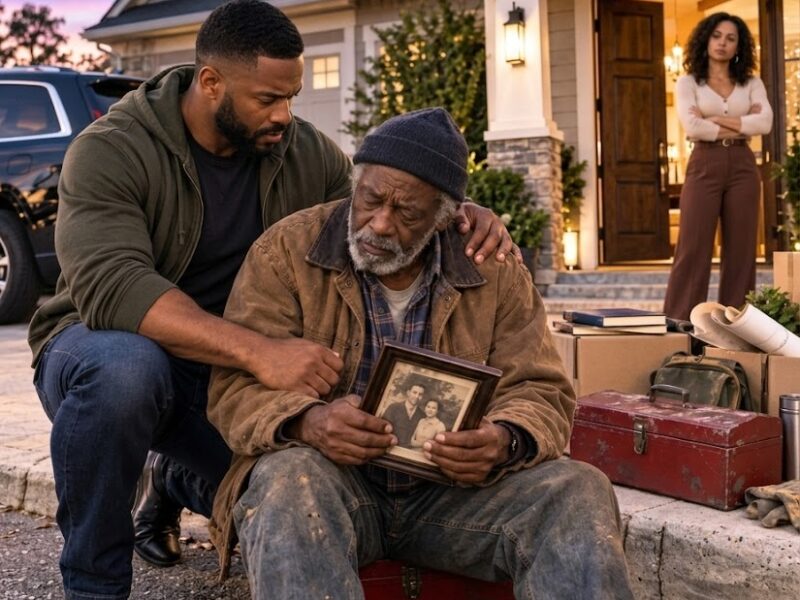
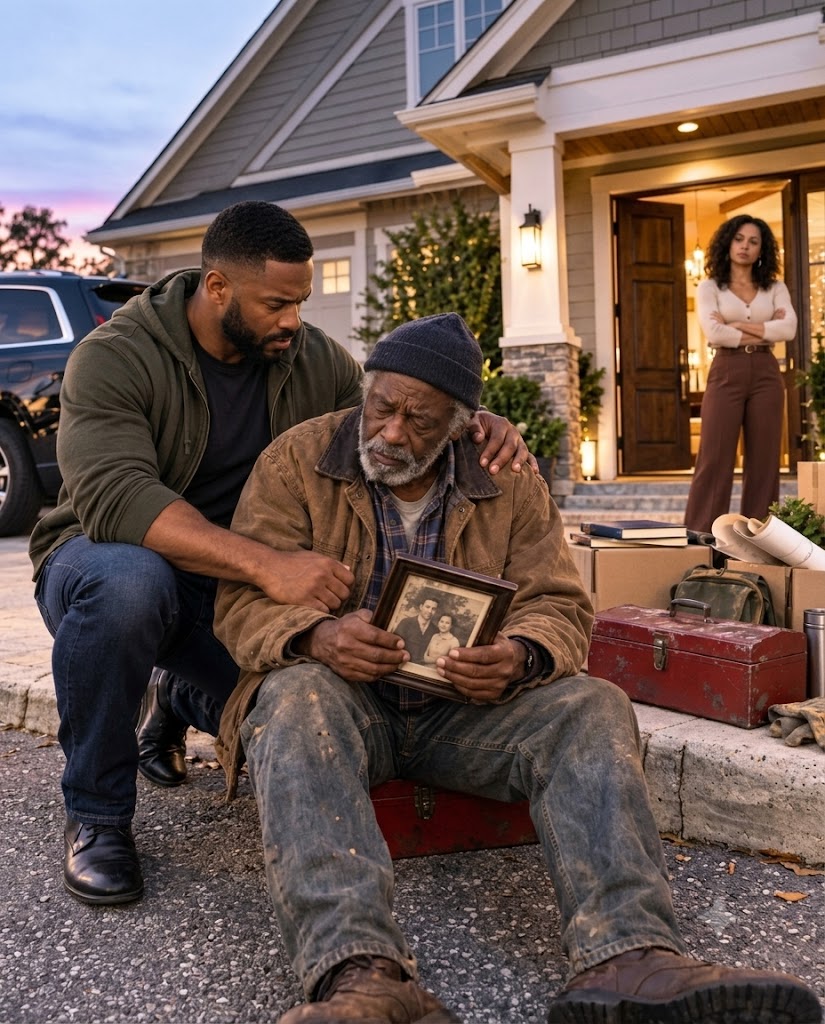
Then I saw my father.
He was crouching down near the largest of the boxes, carefully peeling something off the side of it. A piece of paper. He smoothed it in his hand and looked at it without saying anything, and even from thirty feet away I could see the word written on it in thick black marker.
FREE.
—
There were more of them on the other boxes. Some had already been torn away by the wind or by hands that didn’t care what they were taking.
One box was already missing entirely.
I parked the truck and got out, and my father didn’t hear me come up behind him because he was focused on the framed photograph he was holding, wiping the glass with the hem of his shirt.
I recognized the frame before I recognized the photo inside it. Dark wood chipped at the upper right corner. A crack in the glass that had been there for years, the kind of crack you stop seeing after a while because it’s just part of the object now.
It was a picture of my parents taken sometime in the early 1990s, before I was old enough to remember. My mother was laughing at something off-camera. My father was looking at her.
I said his name quietly.
He looked up, and his expression was the thing that stayed with me. He wasn’t angry. He wasn’t embarrassed. He looked the way a person looks when something they already half-expected has finally arrived.
“Two boxes are gone,” he said, nodding toward the gap where the cartons had been sitting. “Someone took them before I got back. I’d gone out for wood glue. Wasn’t gone more than forty minutes.”
He looked at the empty space on the curb.
“One of them had your mother’s letters in it.”
—
I stood there and let that register.
The box he was describing was a shoe box he’d kept for thirty years, filled with letters my mother wrote him in the years before they married and a few after. I’d seen it maybe twice in my life, both times by accident. He’d never made a ceremony of it. It just existed the way certain things exist in a family—not talked about, not forgotten.
Now it was simply gone, carried away by someone who had no idea what they were holding.
I looked at the house. The porch light was on. Through the front window, I could see the television running the flicker of a home improvement show. Kendra’s car was in the driveway.
I helped my father carry what was left back toward the guest house without saying anything yet. A few neighbors had slowed as they walked past. I didn’t acknowledge them. My father didn’t either. We worked quietly the way men who’ve worked together before tend to work—without needing to narrate every step.
Kendra appeared in the doorway before we’d finished the second trip.
—
She leaned against the frame with her arms crossed and said she’d spent the better part of the afternoon dealing with it, that the guest house was meant to be a temporary situation, and it had already been three weeks.
She said this like she was reporting the outcome of a reasonable decision. Her tone was flat—the kind of flat that’s not calm so much as finished.
I set the box I was carrying down on the porch steps.
“He was supposed to be here six weeks,” I said. “He’s been here three.”
“The space feels different now,” she said. “My mother pointed out that it’s already starting to feel like a permanent arrangement.”
I didn’t say anything about her mother.
I went back for another box.
—
Kendra had been with me for nearly four years, and for most of that time I had believed her capable of things that tonight was making me reassess.
She was someone who said the right things in difficult conversations, who remembered details other people forgot, who could walk into a room full of strangers and come out forty minutes later knowing everyone’s name and half their histories.
That quality had drawn me to her early on. I’d mistaken it, I was starting to think, for a kind of genuine interest in people.
What I hadn’t considered carefully enough was *which* people.
I had introduced her to my father at dinner about three and a half years ago, a few months into our relationship. My father had worn a clean flannel shirt and brought a bottle of wine he’d clearly asked someone to help him pick out. He shook her hand with both of his—the way he did with people he was trying to make feel welcome—and asked her questions for most of the evening.
Kendra was charming. She laughed at the right moments, asked thoughtful follow-ups, said afterward that she really liked him.
I believed her.
But the version of my father she’d liked that evening was a version she’d constructed on her own—a supporting figure, someone who’d done his part and passed the baton. What she hadn’t made room for was the possibility that Howard Barrett might occupy space in a way that complicated the picture she’d built of her own life.
—
The man she’d charmed across a dinner table was easy to appreciate from a comfortable distance.
The man sleeping in the guest house, whose work boots left dirt near the back door, whose radio ran early in the morning, who smelled like sawdust and sometimes forgot to knock before coming into the kitchen—that version required something more than charm to manage.
When the pipe burst at his place last month, the fix was going to gut the entire first floor. My father didn’t complain about it. He called a contractor, arranged the timeline, and started packing a bag the same afternoon.
I told him to stay with us. He said he didn’t want to impose. I told him the guest house had been sitting empty for two years and it would do it good to have someone in it.
He brought almost nothing with him. A duffel bag, his tool chest, a box of papers and drawings from his office, and the smaller box of things that had belonged to my mother.
Kendra agreed to it without objection. But I noticed in the days that followed the way she began narrating his presence in the house as if it were a problem accumulating interest. A coffee mug left on the porch railing became evidence of boundary erosion. The sound of his radio became a pattern of disrespect.
And her mother, Lorraine, who had strong opinions about most things and particularly strong opinions about what Kendra deserved, had begun calling more frequently.
I had let those conversations run their course without stepping into them. I told myself it was because I believed Kendra was reasonable enough to work through it on her own.
What I didn’t admit to myself then was that I also hadn’t told her certain things about my father, about our family, and that my silence had given her room to fill in the gaps with whatever story felt most convenient.
—
We brought the last of the boxes inside, and I asked my father if he wanted something to eat.
He said he wasn’t hungry. He sat down on the edge of the workbench in the guest house and looked at what we’d recovered and said nothing for a while. I stood near the door.
“The tools are gone, too,” he said finally.
I knew the box he meant. A red metal chest smaller than a standard toolbox, with a dented lid and a latch that had been repaired twice. He’d bought it the winter before I was born with money from his first full paycheck at the millwork company where he’d gotten his start.
He used to say it was the first real thing he’d ever purchased for his trade—back when owning good tools meant you were serious about a craft rather than just trying it on.
By the time I was old enough to use it, the chest had traveled through three workshops and two states. Every tool inside had a story. He’d replaced almost none of them.
“We’ll get it back,” I said.
He looked at me with an expression that was patient in a way that felt somehow like correction.
“That’s not really what I’m thinking about right now,” he said.
—
I went inside.
Kendra was in the kitchen standing at the counter with her phone face down in her hand. She looked up when I came in and held my gaze in a way that was trying to be steady and not quite managing it.
I had the sense she’d been rehearsing something while I was outside.
She said she understood I was upset, but that she’d made a decision for the sake of the household, and she hoped I could see why she felt it needed to be made.
She used words like *boundaries* and *clarity* and *our space*. She said she’d talked it through with her mother and they both agreed the situation had been getting out of hand.
I looked at her for a moment.
I thought about the letters that were now in the hands of a stranger somewhere in the neighborhood. Letters that could not be retrieved. Letters that belonged to a dead woman and the man who had loved her for forty years.
I thought about what it would take to hand another person the private correspondence of your dead wife and say, *This belongs to whoever wants it.*
I thought about the fact that she had put free signs on the boxes. That she’d done all of this while my father was out buying supplies to fix a chair he’d made by hand decades ago—a chair that used to sit in the corner of the house where he and my mother ran their business out of the garage in those early years, the years before any of it became what it became.
“You put a sign on those boxes,” I said.
“They were cluttering up the whole side of the property.”
“You put free signs on his belongings and left them on the curb.”
She said she’d done what she needed to do.
—
Her voice had taken on a quality I recognized from other arguments—thinning at the edges, leaning into repetition rather than logic. She said it wasn’t personal. She said he’d had plenty of notice about the terms.
He’d had no such notice. She and I both knew that.
I walked through the kitchen and went to the front of the house, and I looked out toward where the boxes had been. The curb was clear now, except for a single work glove my father had missed. The street was quiet. A few of the neighbors had their porch lights on.
I thought about the tool chest. I thought about the letters that were gone for good. I thought about the way my father had looked at me when I said we’d get it back.
That patient, correcting look. He wasn’t talking about the tools. He was asking me a different question, and I was the only person in a position to answer it.
I pulled out my phone.
Kendra had followed me as far as the hallway. She asked who I was calling.
I scrolled to Bryce Harker’s name. He’d been managing the family’s legal and property affairs for over a decade, and I knew he kept late hours. He picked up on the second ring.
I said his name, and then I said what I needed to say, keeping it short.
“Bryce, hold the transfer. The whole file. Tonight.”
There was a brief exchange on his end confirming he understood, and then I ended the call.
—
Kendra asked what transfer I was talking about.
I looked at her and felt something settle in me that was not anger exactly but was something more durable than anger. There was a specific kind of clarity that comes when a situation stops being complicated and becomes simple.
This was one of those moments.
The question wasn’t how to manage the damage or how to broker a peace between two people who were struggling to share a kitchen. The question was much older and much plainer than that.
My father doesn’t need to find somewhere else to sleep.
“That’s not what’s happening here,” I said.
She started to say something about the guest house, about the original agreement, about how she’d been patient for weeks. I let her finish.
Then I went back outside to where my father was still sitting in the guest house, surrounded by what remained of what he’d brought here.
I asked him again if he was hungry. He said, “Not yet.”
I pulled the other stool from under the bench and sat down across from him. Neither of us said much for a while. The radio was off. The light in the guest house was yellow and warm—the kind of light that makes everything look like a workshop should.
—
“You know,” he said, “the first job I ever ran on my own was a bathroom renovation on a place out near Folsom. 1986. I was twenty-nine years old and I had two guys working under me, and I didn’t know what I was doing for about the first three weeks.”
He wasn’t looking at me while he talked. He was looking at his hands or at the surface of the workbench.
“Your mother kept the books for that job in a notebook from the drugstore. One of those black and white composition books. She wrote everything down in pencil because she said she expected to make mistakes and she wanted to be able to fix them.”
He picked up a screwdriver from the bench, examined the handle, set it down.
“She made very few mistakes,” he said.
I didn’t say anything. I knew what he was doing—not filling silence so much as building something with it. A structure I was meant to sit inside for a while.
“The chair in there,” he said, nodding toward the corner of the guest house where the old Windsor chair stood, its rear right leg wrapped in masking tape until he could get to the repair. “She picked that out at an estate sale in Sacramento. Paid four dollars for it. I thought it was too far gone to be worth fixing, and she told me that anything worth sitting in once is worth sitting in again.”
He looked up at me.
“She was right about that, too.”
—
“What did she say when you made the call?”
“She didn’t understand what it meant yet.”
He nodded. He hadn’t asked me what I intended to do beyond that. He wasn’t the kind of man who needed the whole plan laid out in advance. He’d built his entire working life on the belief that if you did the next right thing with the materials in front of you, the structure would reveal itself in time.
I stood up eventually and told him I’d bring food out later. He said that would be fine.
Walking back toward the main house, I could see Kendra through the kitchen window. She had her phone to her ear. Her posture was the kind that means the person on the other end is doing most of the talking and the listener is gaining strength from it.
Her mother’s number, I was almost certain.
I went inside and got a glass of water and stood at the sink for a few minutes.
There are things you can’t untake once they’ve been taken from you. I didn’t mean only the tool chest, though that was part of it. I meant the version of a moment you’ve been living inside—the one where the people you love exist together without incident, where the future you’ve been building quietly in the background is still intact and moving toward you at a reasonable pace.
That version was gone now. Something had replaced it—something smaller and more accurate and considerably less comfortable.
—
I had been planning to propose to Kendra in a few weeks.
We had an anniversary trip scheduled. I had a ring in the safe in my office—a modest one by some people’s standards, but it was the kind of thing I’d thought about carefully and chosen deliberately and carried around in my chest for weeks before I put it in that safe.
I had been ready to take the next step in the way that readiness feels not like certainty, but like the absence of hesitation.
What I was feeling now was not the absence of hesitation.
I finished the water and set the glass in the sink. Through the window over the kitchen table, I could see the light still on in the guest house—a warm square in the dark.
There are certain things a person does when they believe no one with any real standing is watching.
Kendra had believed that about my father from the beginning. That he was background. That he was a fixture rather than a force. That the calculus of the household was one she could adjust without consequence, because the person most affected by the adjustment didn’t count in the way that mattered.
She had not arrived at that belief out of cruelty. I didn’t think she was a cruel person. But I had begun to think she was a person capable of cruelty when the conditions made it feel like something else—like practicality, like self-preservation, like establishing the terms of her own life.
The conditions tonight had been exactly right for it. And she had done exactly what a person does when they’ve been given permission by silence and by habit to believe that certain people can be moved around like furniture.
—
I thought about the call I’d made to Bryce. I thought about what it would mean in the morning and the morning after that and all the mornings that were now going to be different from the mornings I’d been expecting.
I had not made that call to punish her.
I had made it because it was the only move that was honest. The first honest move I’d made in a long time. Maybe because honesty sometimes looks like action rather than explanation.
My father was sitting in a guest house that belonged to the Barrett Family Property Trust—a legal structure that he controlled and that I had recently been in the process of restructuring.
The house itself, the craftsman on this street that Kendra and I had been living in together for over two years, had been purchased by my father nine years ago. He’d spent close to a million dollars more bringing it back to what it was now. He’d given us the use of it without rent, without conditions, without any expectation beyond the ordinary one that the people inside it would extend each other common decency.
Kendra had not known any of this.
She’d believed the house was mine in some uncomplicated sense. She’d never asked whose name was on the deed, and I had never offered that information—partly because it hadn’t seemed relevant, and partly because I’d grown accustomed over years to not leading with the financial picture.
People changed when they knew. The way they talked to you changed—the way they deferred or competed or tried to locate themselves in relation to what you had.
—
My father was the same way. He’d worn out work boots while sitting on a portfolio most people in Sacramento would find difficult to comprehend. Not because he was performing modesty, but because the work had always been more real to him than the money that came from it.
I had adopted that same habit without fully examining it. And tonight I was beginning to see where the habit had a cost.
Kendra thought she lived with a well-compensated manager at a real estate development firm. She thought my father was a retired tradesman who depended too heavily on his son.
She had built her understanding of the household on those assumptions, and she had acted from within them tonight—which meant she had made a very serious error in a very consequential direction without having any idea how many layers her error actually had.
I didn’t feel satisfaction about that. I felt tired, and I felt the particular kind of grief that comes not from losing something but from seeing it clearly for the first time and realizing it was never quite what you thought.
The light in the guest house was still on.
I pulled a container of leftovers from the refrigerator and heated them up on the stove. I put everything on a plate and covered it with foil and walked it out across the yard.
I knocked on the guest house door before I opened it. My father was at the workbench running his hand along the grain of the chair’s back rail, checking for damage. He looked up when I came in and didn’t comment on the food, which meant he was hungrier than he’d let on.
I set the plate down and sat back on the stool. Outside, through the small window above the bench, I could see the back of the main house. The kitchen light was off now. The bedroom light was on.
Whatever conversation was coming with Kendra, with Bryce, with my own version of the future I’d been planning—it was going to have to wait until morning.
Tonight, there was only this. The workbench, the warm light, my father eating in silence, and the chair that still needed fixing, sitting in the corner, waiting with the kind of patience that only old things seem to have.
—
## Part 2
I woke up the next morning before six, which wasn’t unusual for me.
But the quality of the waking was different. There was no gradual return to consciousness, no slow assembly of the day’s priorities. I was simply awake—fully—with the events of the previous night already arranged in front of me like tools laid out before a job I hadn’t agreed to take.
The other side of the bed was empty.
I could hear movement in the kitchen, which meant Kendra was up, which meant the conversation I had not had the night before was now going to happen in the morning light, without the particular mercy that exhaustion sometimes offers.
I dressed and went downstairs.
She was standing at the counter with her coffee, still in the clothes she’d been wearing the night before. She hadn’t slept either, or if she had, it hadn’t been in the bedroom.
She looked at me when I came in and said she’d been thinking that she wanted to talk through what had happened, that she felt like things had gotten out of proportion.
She used the phrase *out of proportion* more than once. And each time she used it, I understood her to mean that my response had been the disproportionate element—not her actions.
I poured coffee and sat down at the kitchen table.
—
“I need to talk to you about the house,” I said.
She said she agreed that the arrangement with the guest house had clearly created more tension than either of them had anticipated, and perhaps it was time to have a clearer conversation with Howard about a timeline.
She was already reframing last night as a miscommunication about shared space, trying to compress what had happened into something a single reasonable conversation might resolve.
I recognized the impulse. I had done versions of it myself in smaller moments over the years.
This was not a smaller moment.
“The house doesn’t belong to me,” I said.
She looked at me over the rim of her coffee mug and said she didn’t understand what I meant.
“It doesn’t belong to either of us. It belongs to a property trust. The Barrett Family Property Trust. And the person who controls that trust is my father.”
—
Howard had purchased the house nine years ago, spent the better part of another year having it brought back to what it was now, and when Kendra and I decided to live together, he offered it to us to use. No rent, no formal lease, no conditions beyond the ordinary ones that decent people extend to each other.
Kendra set her mug down. She asked why my name wasn’t on anything.
“Because nothing has been transferred yet.”
I told her that three months ago, I’d started the process of moving the house into a new trust that I would control, and that after I proposed, I was going to add her as a co-beneficiary. Bryce had been handling the paperwork. It was almost finished.
The call I’d made the night before had stopped all of it effective immediately.
The silence that followed was the kind that reorganizes a room.
—
Kendra wasn’t looking at me anymore. She was looking at the table, or at the space just above the table, working through the architecture of what I’d just told her.
She had thrown the belongings of the person who owned this house onto the sidewalk with free signs on them—on the same week that she had been weeks away from being legally tied to its future.
She asked why I’d never told her.
It was a fair question, and I had been sitting with my version of the answer for most of the night.
I told her that I’d spent a long time learning to let people find out about the money and the company in their own time, because the knowing of it changed how people behaved sometimes—in ways they didn’t even recognize. I told her I’d never had a specific reason to keep it from her. It had just become a habit. And by the time we were serious enough that it would have been relevant, we were deep enough into the habit that disturbing it felt unnecessary.
She said that was a choice that had affected her without her knowledge.
I said that was true.
I also said that what she did to my father was a choice that affected him without his consent—and that one of those things had happened to someone who had no power in the situation, and one of them had not.
—
She looked up at me. I wasn’t raising my voice. I wasn’t interested in volume.
I said what I’d said the night before was still true this morning. This was not about the house. If my father had been staying in a room he rented for twenty dollars a night and she had walked in and done the same thing, it would have required the same response from me.
The trust and the paperwork and the stopped transfer were relevant facts, but they were not the reason I’d made the call.
The reason I’d made the call was simpler than that, and she already knew what it was.
Kendra didn’t argue with that. She looked like she wanted to, briefly, and then something in her expression shifted and she didn’t.
We sat in the kitchen for another few minutes without talking. Then she asked if she could see what else had been in the boxes we’d brought back inside.
I didn’t know exactly what she meant by the question, but I said yes, and we went out through the back door to the guest house.
—
My father was already up. He’d propped open the guest house door to let the morning air in and was working at the bench with the Windsor chair laid on its side, examining the joinery.
He looked at Kendra when she came in, and she looked at him, and there was nothing theatrical about either of them. He nodded once. She didn’t say anything yet.
The boxes were stacked along the back wall where we’d left them the night before. One of them had come partially open during the move back in, and several rolls of old drawings had slid partway out.
Kendra went over to look at them—maybe to give herself something to do with her hands—and she carefully pushed them back in, and then she stopped.
She was looking at the cover sheet on the top roll.
I watched her eyes move across it. The paper was yellowed at the edges and soft from years of rolling and unrolling, but the logo at the top was still clear—a simple block lettering that read **Crest Line Construction**, and below it, a date from 1994.
She looked at the logo, then at me, then at my father, and then back at the logo.
She asked why the company name on those drawings was the same as where I worked.
—
My father set down the tool he’d been holding. He didn’t say anything. He was leaving it to me, which was how he’d always handled moments like this—not out of conflict avoidance, but out of a belief that the person who owed the explanation should be the one to give it.
I told her everything.
I told her that Crestline Urban Partners had not always been called that, and that in 1994, it was a four-man renovation crew called Crest Line Construction, run by my father out of a garage on the east side of Sacramento.
I told her that over the next three decades, he had built it into a company that now owned and managed residential, commercial, and mixed-use projects across eight cities in the western United States.
I told her the current portfolio was valued at somewhere in the range of six hundred and eighty million dollars.
I told her I wasn’t a senior manager. I was the managing partner, and I had been preparing for the past two years to take over as chairman when my father stepped back from that role.
—
Kendra didn’t say anything for a long time after that.
She looked at the box of drawings again, and then at the old Windsor chair lying on its side on the workbench, and then at my father’s hands—which were the hands of a man who had been doing physical work since before she was born, rough at the knuckles, stained in the grain lines with old wood finish that never completely washed out.
She had looked at those hands before, dozens of times, and she had seen what she expected to see: an aging tradesman living modestly on his son’s goodwill.
She had built a full and detailed portrait of my father from that assumption, and she had acted on that portrait with complete confidence.
The drawings in that box were from the first three projects Crestline had ever completed. My father had carried them with him through every office he’d ever worked in—not as trophies, but as reminders. He said once that the mistakes in early drawings were worth more than the successes in later ones, because you could learn more from what you didn’t know how to do yet than from what you’d already figured out.
Those papers that had been sitting on the sidewalk with free signs on them were the original documents of everything that existed now.
—
The Windsor chair that Kendra had moved out to the curb was the chair my mother had sat in every evening for the first several years of Crest Line’s existence, going over the day’s numbers at the small table in the garage, writing everything in pencil in those composition notebooks.
She had picked it out at an estate sale because she liked its proportions and believed it could be restored. My father had been fixing it incrementally for thirty years, and it still wasn’t done, and that was fine with him.
And the tool chest that was gone—the red metal chest with the dented lid and the twice-repaired latch—was not replaceable. Not because there weren’t other tool chests in the world, but because that one had been purchased with the first real paycheck my father ever deposited as a professional in his trade, bought deliberately and carefully. And every repair he’d made since then had been touched by something that had passed through those tools.
As for the letters—my mother’s letters, the ones in the shoe box that was simply gone—we both understood those were a different kind of loss.
Some things, once carried off, don’t come back.
There would be no posting on a community board, no knock on a stranger’s door that would recover thirty years of handwritten words from a woman who was no longer alive to write more of them.
That box was gone, and the only honest thing to do was to say so and carry that fact without trying to soften it.
—
Kendra understood all of this now. I could see it happening—the reframe. She had walked into the guest house trying to process one set of facts, and she was now being asked to hold a different set entirely, and the two didn’t fit together in any comfortable way.
She said very quietly that she hadn’t known.
I told her that was true.
And then I told her the part that mattered more. I said that she’d made a decision about a person based on what she thought she knew about him. And that the thing she’d used to justify the decision was the belief that he didn’t have enough standing to push back.
She hadn’t asked questions. She hadn’t extended any of the basic assumptions of good faith that she would have extended to anyone she decided was worth the effort.
She’d placed a free sign on his belongings because some part of her had already decided that he and everything he carried with him were disposable.
She started to respond, and then the sound of a car in the driveway stopped her.
—
I already knew the sound. It was Lorraine Monroe’s Lexus—the one she kept in showroom condition as a matter of personal philosophy.
Kendra must have called her mother at some point in the night, which explained why she was here at eight in the morning with the engine barely off before the car door opened.
Lorraine came through the back gate without knocking, which she had done many times before and which I had never commented on, and she walked into the guest house with the bearing of someone arriving at a situation they’ve already decided they understand.
She was a tall woman, always dressed as if she expected to be photographed, and she had a habit of making declarations rather than contributions to a conversation.
She looked at the three of us and said Kendra had called her last night very upset, and that she wanted to know what exactly was going on.
I let Kendra answer that.
—
Kendra told her mother a version of what I’d told her—the trust, the house, the stopped transfer, the drawings, and what they meant.
Lorraine listened with the expression of someone recalculating while pretending not to. And when Kendra finished, the first thing Lorraine said was that this felt like Nolan using financial information as leverage, that it wasn’t appropriate to spring these things on someone after the fact and then act as though they’d committed some kind of offense.
My father was still standing at the bench. He’d been quiet throughout all of it with the particular quality of quiet that isn’t absence but attention. He was listening to every word with his hands resting flat on the surface of the bench.
And when Lorraine said that Kendra had simply been trying to establish healthy boundaries in her own living space, he looked at her with an expression I’d seen a handful of times in my life.
Not anger, not contempt, but a kind of concentrated patience that was harder to absorb than either of those things.
—
Lorraine said that if Howard wanted to be treated with more consideration, perhaps he should conduct himself in a way that made his position clearer.
She said she didn’t mean any disrespect by that, but that people respond to what they can see. And what she’d seen from Howard over the past three weeks was someone who blended into the background.
Howard said, “So if I were poor, what happened yesterday would be acceptable.”
The room went quiet in a different way than it had been quiet before.
Lorraine opened her mouth and then closed it. The question was simple and it had no good answer, and every version of a response she might have assembled would have required her to say something she wasn’t prepared to say out loud in front of all three of us.
She looked at Kendra. Kendra wasn’t looking at her.
Lorraine said she hadn’t meant it that way, that she was simply pointing out that communication could have been better on all sides. She said the situation had clearly become more complicated than she’d realized and that she needed to get to an appointment and hoped everyone could approach this like adults.
Then she left.
—
The gate latch clicked behind her, and her car started, and the sound of the Lexus backing out of the driveway faded down the street, and then it was just the three of us again in the guest house with the morning light coming through the window above the bench.
Kendra had watched her mother leave. She was still watching the gate after the sound of the car was gone.
I understood, or I thought I understood, something of what was moving through her in that moment. Not just the facts of the last twelve hours, but the voice she had been hearing through all of it.
The voice that had been telling her for weeks that she was entitled to do what she’d done, that it was sensible, that it was the kind of clear-eyed practicality that self-respecting women exercised.
That voice had just walked out the back gate when it ran out of answers.
—
I went to the main house. I needed a few minutes alone, and I went to my office, which was the small room at the end of the upstairs hall that I’d kept as a workspace since we moved in.
I sat down at the desk. On the shelf above it, there were a few things I didn’t touch very often—some files, a spare charger, a book I’d been meaning to finish for months.
The safe was built into the wall behind the desk, behind a framed photograph of the Sacramento Riverfront that my father had taken sometime in the early 2000s and given to me when I moved out.
I unlocked the safe.
The ring was in a small dark box toward the back. I’d bought it about six weeks ago from a jeweler in Midtown that a friend had recommended, and I’d spent longer choosing it than I’d expected to—not because I was uncertain, but because I wanted it to be right.
It was not a large ring. It was not a showy ring. It was the kind of ring you buy when you’re choosing for the person rather than for the occasion. When you believe you know what they’ll want to be wearing twenty years from now, when the occasion is long over.
I had been that sure six weeks ago. I had carried the certainty of it like something solid.
I took the box and brought it downstairs.
—
Kendra was in the living room. She’d come back inside from the guest house at some point and was sitting on the couch with her hands in her lap, not on her phone, not looking at anything specific.
She looked up when I came in.
I set the ring box on the coffee table between us. I didn’t open it. I just set it there and looked at her and said, “Six weeks ago, I bought this. I was going to propose on our anniversary trip.”
After that, the plan was to put her name into the legal structure alongside mine—the house, the trust, all of it. I’d had Bryce start preparing that paperwork before I’d even finished paying for the ring, because I was that certain, that ready, that far past any version of doubt.
She was looking at the box.
I told her that this morning I didn’t know how to hold what I’d watched happen last night alongside the future I’d been preparing. I’d been building toward something specific, something I’d thought about in detail, something I hadn’t doubted until yesterday evening.
And now I was sitting in the same house with a version of Kendra that I was struggling to reconcile with the version I’d believed I knew.
—
I told her I wasn’t throwing her out. I wasn’t going to carry her things to the curb and put signs on them.
She had time to find another place, and I would help her do that in whatever way was practical. I wasn’t going to make her feel small in front of anyone—not because she’d earned that courtesy in this particular moment, but because I had no interest in becoming the version of what I’d just witnessed.
But what we’d been building together was paused, and I didn’t know yet what it looked like on the other side of that.
She didn’t say anything for a moment. She was looking at the ring box the way you look at something you reached for at the wrong time—something that was meant for you, but has now receded to a distance that isn’t easily measured.
She asked if there was anything she could say.
I thought about the tool chest sitting in someone else’s garage. I thought about the letters that were simply gone—nowhere in the neighborhood, carried away by someone who had no idea what they were holding. I thought about the way my father had looked up from the photograph of my mother with that patient, correcting look that was not anger but something that required more of me than anger would have.
I told her that I didn’t think tonight was the night for saying things. I told her I thought what mattered now was what happened next, not what was said about what had already happened.
—
She looked at the ring box again. Then she looked at me, and her face did something complicated that I didn’t have a clean name for—not crying, not anger, not the rehearsed composure she’d been reaching for all morning.
It was the expression of a person absorbing the real shape of their own mistake for the first time, when the full dimensions of it are finally visible and there is no more softening to be done.
She said she understood.
She got up from the couch and went upstairs.
I sat in the living room for a few minutes after she was gone, looking at the ring box on the table. The morning light had shifted and was coming in flat through the front windows now, and the house was quiet in the way a house is quiet when it’s holding too much in.
I picked up the ring box and carried it to the kitchen, setting it on the counter near the window that looked out over the backyard—where I could see the guest house, where I could see the warm light still on inside, even in the morning.
The outline of my father moving at the bench, doing the next right thing with the materials in front of him, the same way he had always done.
That image—the lit window, the old man at the workbench, the chair waiting in the corner—was a clearer picture of what I was trying to protect than anything I could have said in the living room.
The future I was pausing for was not the six hundred and eighty million. It was not the trust or the craftsman or the paperwork that Bryce would now have to put back in a drawer.
It was this. The right to look out a window in your own home and see your family in it, intact. Treated with the ordinary dignity that people earned simply by being people.
That was what had been put on the curb, and it was what I was refusing to leave there.
—
## Part 3
The days that followed had a quality I hadn’t experienced before.
Not the sharp, acute pain of an argument, but something slower—more like the sensation of a house settling after a storm. The storm had passed. The structure was still standing. But every room felt slightly different than it had before, as if the walls had shifted by a fraction of an inch in a direction you couldn’t name, and everything familiar now sat at a new angle.
Kendra and I moved around each other carefully that first full day.
She made coffee in the morning and left a cup for me without being asked. I acknowledged it without making anything of it. These were the small negotiations of two people who understood that the big conversation wasn’t finished, but that neither of them had the language for it yet, and that forcing it before the language arrived would only produce more wreckage.
My father stayed in the guest house. He was working on a repair list—the Windsor chair, the latch on one of the windows, a section of weatherboard along the east wall that had started to separate.
He worked through it the way he worked through everything: methodically, without rushing, in an order that only became legible once the whole of it was done.
I brought him lunch on the second day, and we ate together on the back porch, and he didn’t ask me anything about Kendra, and I didn’t volunteer anything, and that was its own kind of conversation.
—
On the morning of the second day, I came downstairs to find Kendra was not in the kitchen.
She was in the backyard, standing near the door to the guest house. My father had already opened it for the morning air.
I watched from the kitchen window as they spoke. I couldn’t hear it from where I was, but I could see the shape of it.
Kendra standing with her arms at her sides rather than crossed—which was different from how she’d stood every other time she’d been near my father in the past three weeks. Howard looking at her with the same quality of attention he brought to everything. Not soft, exactly, but not closed.
The conversation lasted several minutes. At one point, she looked at the ground. At another point, he said something that made her close her eyes briefly.
Then she nodded, and he nodded, and she walked back to the house.
I moved away from the window before she came in.
—
She didn’t tell me what they’d talked about right away. She made herself a second coffee and stood at the counter for a while, looking at the ring box that was still sitting near the window where I’d left it.
I hadn’t moved it deliberately. It seemed important to leave it exactly where it was—not as a reminder or a pressure, but because moving it would mean making a decision about it, and I wasn’t ready to make any decisions about it yet.
Later that evening, she told me about the conversation.
She said she’d gone to apologize. She’d prepared a version of the apology that she thought was honest—something about not knowing the house belonged to him, about not understanding the full picture, about the misunderstanding that had led to the situation.
And then, standing there in front of him, she’d heard herself beginning to say it. And she’d stopped, because she’d realized—standing two feet from my father in the morning light—that the apology she’d prepared was still a version that made the accident the problem. As if the only real error was the one that came from not having enough information.
She told me she’d started over and said something different instead.
—
She told Howard that even if she’d known the house was his, she might have done what she did anyway—because she had already decided how much space he deserved, and she had decided that without ever genuinely looking at him.
She said Howard was quiet for a long moment after that.
And then he asked her what she thought he was now—today, standing in front of her.
Kendra told me she hadn’t had a clean answer for that. She said she’d told him the truth, which was that he was someone she had never actually tried to know.
And Howard had looked at her for a long time and said, “At least now you’re being honest.”
He hadn’t forgiven her. He hadn’t asked her to leave either. He had received what she said and held it without disposing of it in either direction—which was, I was coming to understand, how my father handled most things that mattered.
—
I thought about that conversation for a long time after she told me about it.
I thought about the version of the apology she’d stopped herself from giving—the one that would have been technically sincere and fundamentally self-serving. And the fact that she’d caught herself in the middle of it.
I didn’t know what to do with that. It wasn’t a resolution. It wasn’t a reason to hand her the ring or undo the call to Bryce or go back to the morning before last Friday when everything had been moving in the direction I’d planned.
But it was something real, and I was willing to acknowledge it as that without knowing yet what it meant.
The next morning, I found myself thinking about the tool chest.
I went to my office and checked the security camera app on my phone. The camera above the front door had a wide enough angle that it picked up most of the sidewalk and part of the street, and I scrolled back through the footage from Friday afternoon.
I found the timestamp. I found the man—older, gray-haired, wearing a canvas jacket—walking past the boxes, slowly stopping, picking up the chest, looking at it, then continuing down the sidewalk with it under his arm.
He looked like someone who believed he was doing exactly what the sign invited him to do.
I took a screenshot and was about to post it myself when Kendra appeared in the doorway.
—
She said she wanted to do it. Not me—her. She said she was the one who’d put the free sign on it, and she was the one who should be at the door when it opened.
I thought about that for a moment and then said, “All right.”
She posted to the neighborhood community board with a description of the chest and a note that it had been put out by mistake. The first day, no response. The second day, still nothing.
On the third day, a message came through from a neighbor two streets over who thought she recognized the man in the screenshot.
An hour later, she sent an address.
Kendra went alone the next morning. She came back a little over an hour later carrying the red metal chest with the dented lid and the twice-repaired latch.
She set it on the kitchen table, and her face was composed in a way that was working harder than it looked.
—
She told me the man’s name was Gerald. He was seventy-one, lived by himself, and had been genuinely sorry when she explained what the chest meant. He’d wrapped it in a towel to protect it during the drive over.
She hadn’t called me from the doorstep. She hadn’t sent a photo. She’d just come back with it.
I carried the chest out to the guest house. My father was at the bench. He looked at it when I set it down and didn’t react immediately—just looked at it the way you look at something you expected to be gone.
He unlatched it and checked inside, going through each tool carefully. Then he latched it again.
I told him Kendra had gotten it back. I told him she’d found the man through the community board and gone herself to explain and bring it home.
He said, “That cost her something.”
I said, “I thought it did.”
He nodded once and went back to what he’d been working on. The chest sat on the workbench beside him for the rest of the morning, in exactly the place it had always occupied when he was working.
—
In the days that followed, Kendra also took the damaged frame from the photograph of my parents to a restoration shop in Midtown that specialized in antique frames. She paid for the repair herself and picked it up herself and brought it back and set it carefully on the shelf in the guest house where it had always stood.
As for the letters—my mother’s letters in the shoe box that had been carried away the same afternoon—she asked me once if there was anything to be done.
I told her honestly that there wasn’t. That box was gone in a way that the tool chest wasn’t—taken before either of us got home, by someone whose path we had no way to trace.
She nodded when I said it, and I could see her absorbing the permanence of that loss without trying to argue her way around it.
Some things, once gone, simply stay gone. The right response to that is not to pretend otherwise.
—
She also called her mother.
She told me about it afterward, in the same quiet kitchen where we’d had most of the difficult conversations over the past week.
She said she’d told Lorraine that she needed to stop having opinions about Nolan and his family that Kendra then used as permission for her own behavior. She said she’d told her mother that she’d spent years receiving those opinions like they were practical wisdom—like they were just a mother preparing her daughter for the realities of relationships—and that she understood now they were something else.
They were a set of instructions about which people deserved what. And those instructions had been wrong in ways that cost other people something real.
Lorraine had not received this well. She’d said Kendra was being dramatic, that she was clearly under pressure and wasn’t thinking clearly, that Nolan had too much influence over how she was seeing things.
Kendra told her that was possible, but that she didn’t think so, and that she needed some time with her own thoughts rather than her mother’s.
—
She told me she didn’t know if that conversation would hold. She said her mother was persuasive in ways that had always been difficult to resist. But she’d said it, and the saying of it was different from anything she’d done before, and she wanted me to know she’d done it.
I told her I heard her.
I also told her what I’d been sitting with about my own part in how this situation had taken its particular shape.
I said I had kept too much from her for too long, for reasons that had initially made sense and had eventually just become habit. I said I had watched the friction between her and my father build over the weeks of his stay and had told myself it would work itself out—that stepping in would make it worse—when the truth was that there had been a version of this where an honest conversation three weeks earlier might have changed how Friday evening unfolded entirely.
I wasn’t responsible for the choice she made. But I had built the conditions that made it easier for her to make that choice without understanding the ground she was standing on.
—
Kendra listened without interrupting.
Then she said she’d been thinking about the same thing from her side. She said she wished I’d told her more earlier, but that she also couldn’t fully trust her past self to have received it the way it was meant. The person she’d been carrying—the values she’d been carrying for years—she wasn’t certain that person would have done better with the information.
And that was a hard thing to say, and I recognized it as an honest one.
What I said next was the thing I needed to say clearly.
I told her that changing—actually changing, in the way that produces a different person on the other side of it rather than just a different set of behaviors—wasn’t something you did for a reason outside yourself. You couldn’t do it to make someone stay. You couldn’t do it to recover something you’d lost.
You could only do it if you’d looked at yourself clearly enough that the looking itself became intolerable, and then you changed because you couldn’t stay the same.
If that had happened for her, or was in the process of happening, then something real was possible. If it hadn’t, then everything she was doing—the tool chest, the frame, the phone call to her mother—was just an attempt to negotiate the outcome.
—
She didn’t tell me she’d already changed. She didn’t make a claim about who she was now or who she was becoming.
She said she thought she was somewhere in the middle of that, and she didn’t know yet where it would land, and that felt true to her.
I told her I thought that was probably the most honest thing she’d said to me in days.
Two weeks later, Kendra found an apartment. It was a one-bedroom in East Sacramento, second floor of a building she’d lived near years ago, close to a coffee shop she liked.
She signed the lease on a Thursday and started packing on Saturday. She was methodical about it in the same way she was methodical about most things—moving through the closets and drawers with a deliberateness that wasn’t cold so much as focused, making decisions about what to keep and what to donate rather than just transferring everything wholesale into boxes.
I helped her carry things down to the car in the afternoon. She had five boxes left when I came down for the last round, and I picked up the heaviest two and carried them out to where her car was parked in the driveway.
I set them in the trunk one at a time and went back for the rest. She carried the last one herself.
—
We loaded it together in the kind of coordinated silence that people fall into when they’ve lived together long enough to know each other’s rhythms without thinking about them.
None of it went on the curb. Not a single item touched the sidewalk.
I set every box down with care in the trunk or the back seat so that nothing would shift in transit or arrive at the other end damaged. It wasn’t a performance. It was just what you did when you moved things that belong to someone.
She noticed. I could see that she noticed in the way she looked at the trunk before she closed it. In the brief moment she stood with her hand on the latch and said nothing.
She turned to me and said she was sorry. She didn’t elaborate. She just said it directly and without scaffolding, the way some things can only be said when all the other versions of them have already been tried and found insufficient.
I told her I knew.
She got in the car and drove away, and I stood in the driveway for a moment watching the street after the car had turned the corner and disappeared.
—
The afternoon was quiet. The neighborhood had that suspended quality it sometimes gets on a Saturday when the day has used itself up and is just waiting for evening.
I went back inside. The ring box was still on the kitchen counter. I picked it up and took it upstairs and put it back in the safe—not because I’d made a decision about it, but because leaving it on the counter had served its purpose, whatever that purpose had been, and now it needed to go somewhere that wasn’t out in the open.
My father left three days later. The repairs at his house were finished. The contractor had done the job well, and the first floor had been rebuilt better than it was before.
He packed his duffel bag and his box of drawings and his tool chest, and he put them in the bed of his truck. And then he came back for the Windsor chair, which was now fully repaired—the rear right leg reglued and fitted tight, the surface refinished where the tape had lifted the old finish.
He’d finished it two nights before he left, working late in the guest house until he was satisfied. I’d watched him do the final pass with the cloth and the oil and set it upright and sit in it briefly, the way you sit in a chair when you’re testing it rather than resting in it.
—
On the morning he left, we went into the workshop together.
The chair was sitting in the corner, already wrapped in a moving blanket for the drive. The tool chest was on the bench. The light was the same warm yellow it had always been in there—the same light I’d been aware of through the kitchen window for the past several weeks, the lit window that had come to mean something to me that I didn’t have a clean name for.
We worked for a while on the last small task on his list—a section of the bench surface that had been lifting at one edge, which we fixed with clamps and wood glue holding it together while the adhesive set.
While we waited, my father asked me if I regretted not telling Kendra about the money earlier.
I said probably yes. I said I thought it would have changed some things.
He picked up a small hand plane from the bench and turned it over in his hands, running his thumb along the blade edge to check its sharpness. He didn’t look at me while he spoke.
—
He said that money made everything louder. It changed the volume on a situation without changing the nature of it. And most of the time, all it did was make it harder to hear what was actually happening.
He said what mattered in this situation had already been decided before Kendra knew anything about a trust or a portfolio or a company. She’d made a choice about who my father was from a distance and acted on that choice when she thought the cost would be low.
None of the financial information changed the nature of that choice. It only changed how many layers of consequence it had.
He set the plane back on the bench.
He said the only question worth asking about what came next was whether the person who had made that choice had looked at it honestly enough that something in them had actually shifted, or whether the looking had been in service of recovering what was lost.
He said he couldn’t answer that question, and I probably couldn’t yet either. And that was all right. Some things needed time to become legible.
We unclamped the bench surface and ran a hand along it to test the repair. It held.
—
My father loaded the chair into his truck, and I walked out to the driveway with him. He shook my hand the way he did when something had been settled—the firm grip held for an extra beat.
Then he drove away, the old truck going slowly down the street, the chair visible in the bed through the rear window.
I went back inside and stood in the kitchen for a while.
Three months later, a letter arrived for me. Hand-addressed, my name on the front in handwriting I recognized as Kendra’s.
I opened it at the kitchen table. It was short.
She thanked Howard for not using the position he was in to humiliate her when he had every ability and possibly every reason to. She said she’d spent the weeks since she moved out thinking about the gap between who she’d believed herself to be and who she’d actually been in that situation, and that the gap was larger than she’d wanted to admit.
She said she was not writing to ask for anything. She was writing because she thought he deserved to know that what he’d done—the restraint, the patience, the single question that had no good answer—had cost her something she was still reckoning with. And she was grateful for it.
There was no postscript asking me to call. No reference to where things stood between us or what she hoped might still be possible. Just the letter, addressed to me, clearly intended for him.
—
I drove to my father’s house that afternoon and brought it with me.
He read it at the kitchen table while I made coffee. He read it twice, which was how he read things that were worth reading. Then he sat it down and looked at me across the table.
He told me I didn’t need to decide anything today. He said I didn’t owe it to the situation to arrive at a conclusion on a schedule, and that patience with a process was different from avoiding one.
What he said next I had been half expecting and hadn’t known how to prepare for.
He said, “Don’t confuse forgiving someone with returning them to the position they had before. Those are two separate decisions. One is about what you carry. The other is about what you offer. A person can do one without doing the other, and neither choice makes you the worst for it.”
I held the letter for a moment and then set it on the table between us. I didn’t put it in my pocket. I didn’t hand it back to him. I just left it there, which felt like the most accurate thing I could do with it at that particular moment in a situation that had not yet finished showing me its full shape.
—
Later, on the drive home, I thought about what I was returning to. The craftsman house. The empty guest house. The safe with the ring box in it. The kitchen counter, where the ring had sat for two weeks and which was now just a counter again.
I thought about my father at his kitchen table, reading a letter from a woman he had not forgiven and was not condemning.
I thought about the Windsor chair, which was now sitting somewhere in his house in the position my mother had chosen for it at an estate sale decades ago, restored to exactly the kind of usefulness she’d always believed it had in it.
I thought about what my father had built. Not the six hundred and eighty million of it. Not the eight cities and the mixed-use properties and the company that had started in a garage. But the other version of it—the one built from composition notebooks and estate sale chairs and hand planes and a tool chest bought with a first paycheck.
The version that looked like nothing from the outside. And from the inside was everything.
That was what had been put on the curb. That was what had been retrieved, as much of it as could be.
—
The letters were gone, and that loss was real, and no amount of goodwill or effort was going to change it. But everything else had come back, or was in the process of coming back, or was at least being treated with the seriousness that things deserve when they matter.
I pulled into my driveway and sat in the truck for a moment before going inside. The house looked the same as it always did at this hour—the porch light on, the neighborhood quiet, the light above the front door casting the same yellow square across the same front steps.
It had looked like this before any of it happened, and it looked like this now. And what was different was entirely interior.
The things you carry. The things you set down. The things you leave on the table between you and another person until you’re ready to know what to do with them.
—
Here’s what I kept coming back to, long after all of it was over.
How you treat someone when you think they have no power over you—that’s who you are. Not the version of yourself you perform at dinner tables or in first impressions, but the one that shows up on an ordinary Friday afternoon when no one’s watching and you believe the cost of carelessness is zero.
Kendra hadn’t thought of herself as someone capable of what she did. Most people don’t. That’s exactly the problem.
My father never raised his voice. He never made a threat. He asked one question that had no good answer, and he let it do all the work it needed to do.
That kind of patience isn’t weakness. It’s the longest-running form of strength I’ve ever seen up close.
And Lorraine’s logic—that people should signal their worth visibly, that respect should follow what you can see—that logic is everywhere. It’s in how we size people up in parking lots and waiting rooms and family kitchens. Most of us have applied it without noticing.
The useful thing about a story like this one isn’t the twist at the end. It’s the question it leaves behind.
Who have you been underestimating? And what have you been deciding about them before you’ve actually looked?









