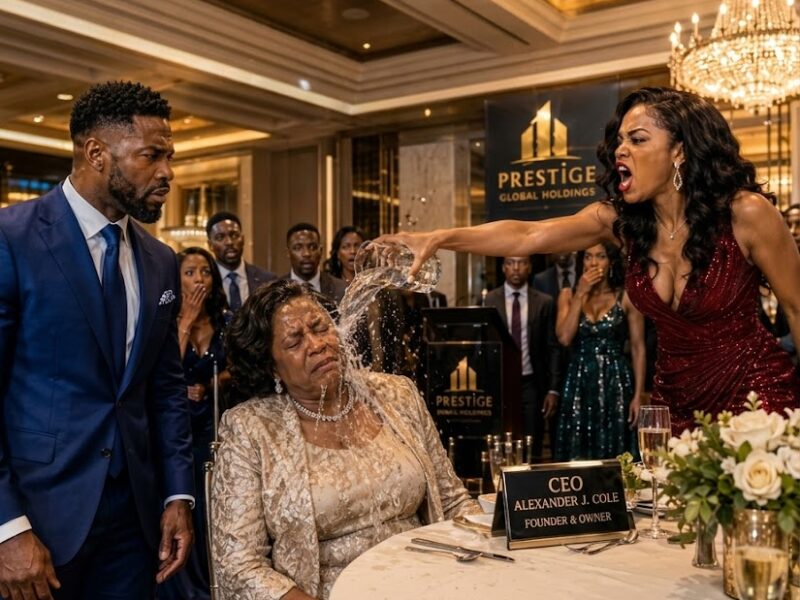
My Wife Poured Water on My Mom for Looking “Poor”—She Had No Idea I Owned the Company Hosting the Gala
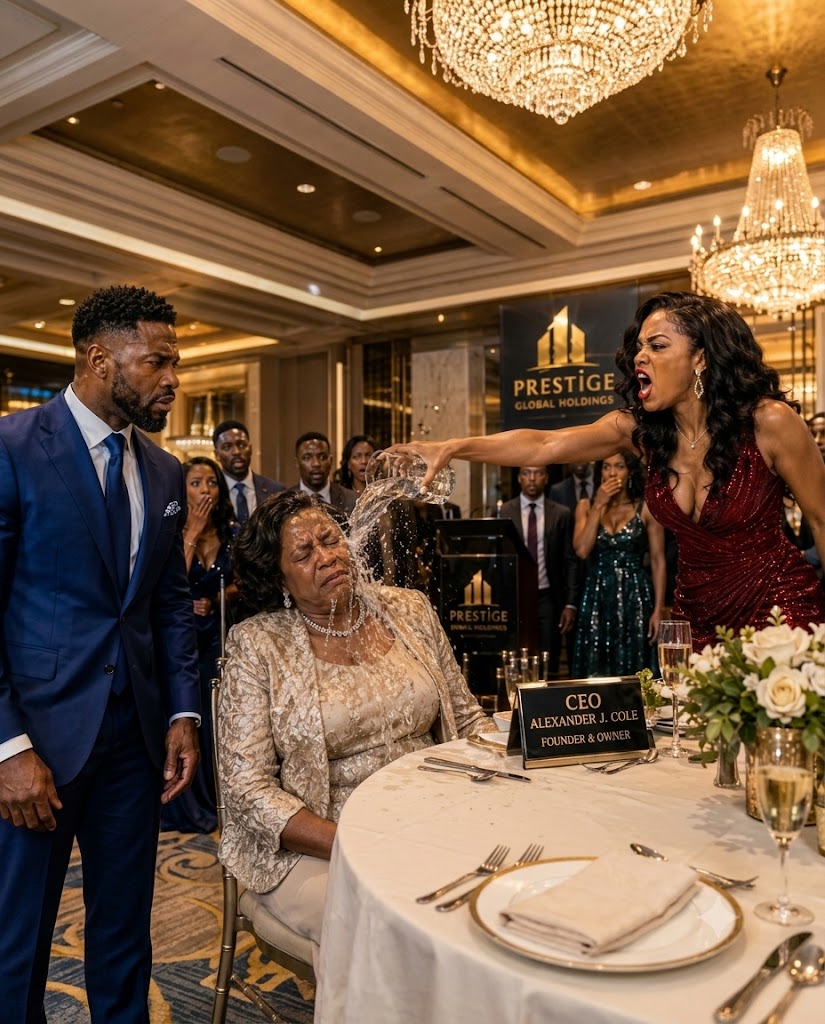
The champagne flute shattered against the marble floor of the Whitmore Ballroom, and in that crystalline explosion of glass and spilled Dom Pérignon, I watched my mother’s dignity dissolve in front of two hundred of Northstar Energy Systems’ most influential stakeholders.
It was 7:42 PM on a Friday in late October, the kind of autumn evening in Charlotte, North Carolina, where the air carries the faint sweetness of dying leaves and the promise of an early frost. The gala celebrating Northstar’s twentieth anniversary had drawn executives from fourteen states, government contractors, hospital administrators, and enough venture capitalists to fund a small nation. Crystal chandeliers cast prismatic light across tables draped in ivory linen, each centerpiece a sculpture of white orchids and silver birch branches. A string quartet played something elegant and forgettable near the entrance, where a young attendant had just helped my mother check her coat—a simple wool wrap she’d owned for over a decade.
My mother, Evelyn Cole, stood frozen near the central staircase, champagne soaking into the navy blue dress she’d chosen because it carried our history. The dress had tiny pearl buttons, one cuff repaired by hand, and fabric softened by years of careful washing. She’d worn it to my graduation. She’d worn it when I signed the first hospital contract. She’d told me it had earned the right to come tonight.
I was forty-five years old, and as far as most employees at Northstar knew, I was completely unimportant—a contract engineer who appeared at headquarters a few times each quarter, sometimes attending formal events because my wife worked for the company. My wife, Celeste, was Northstar’s vice president of corporate affairs. She was articulate, elegant, intensely ambitious, and increasingly ashamed that she believed she had married an ordinary man.
What Celeste didn’t know—what almost no one knew—was that I had founded Northstar Energy Systems twenty years earlier, that I controlled sixty-seven percent of its equity through a private entity called Cole Horizon Trust, and that the technology powering grid storage networks across fourteen states had been developed from a prototype I built in a storage room behind my mother’s bakery.
But that night, none of that mattered. What mattered was the water dripping from my mother’s silver-gray hair, the pearl buttons of her dress dark with moisture, and the sound of laughter—actual laughter—rippling through a ballroom filled with people whose salaries depended on technology my mother’s sacrifice had made possible.
—
Six hours earlier, I had stood in my apartment on the twenty-eighth floor of a building Celeste believed she had chosen for its address and amenities. She didn’t know the building belonged to a property group controlled by Cole Horizon Trust. She didn’t know many things.
“You’re actually bringing her?” Celeste had asked, her reflection in the bathroom mirror revealing nothing of the contempt I heard in her voice. She was applying foundation with the precision of someone who understood that appearances were currency. “To the anniversary gala?”
“She’s never seen the headquarters,” I said, adjusting the cuff of my shirt—a simple white button-down I’d owned for three years. “She’s never walked through the campus built from the money she received for Morning Hearth. I want her to see the research laboratories, the operations center, the walls displaying photographs of projects made possible by her sacrifice.”
Celeste’s hand paused mid-stroke. “Adrien, this is an invitation-only event. Board members will be there. Government clients. Graham is announcing the sale of the municipal infrastructure division.”
“I was invited.”
“You’re a contract engineer.”
“I’m your husband.”
She turned then, and something flickered in her eyes—not guilt, exactly, but calculation. “People will ask questions. They’ll wonder why you’re there. They’ll wonder who she is.”
“She’s my mother.”
“Exactly.” Celeste set down her makeup brush and crossed her arms. “Do you have any idea how this looks? The vice president of corporate affairs bringing her… her…”
“Say it.”
“Her baker mother from some industrial neighborhood nobody’s ever heard of. Wearing a dress that looks like it came from a thrift store.”
I stared at my wife. Four years of marriage, and I was still discovering the architecture of her ambition. “Say that again.”
Celeste’s face tightened. She knew she had gone too far, but pride would not allow her to retreat. “This evening is important to my career. Please don’t make it about your family.”
She returned to the mirror, and I watched her for a long moment—this woman I had met at a regional energy conference, who had transformed a neglected public relations office into one of Northstar’s most influential divisions, who had signed a prenuptial agreement she believed protected her career and investments from a husband with an unstable consulting income. She had no idea she was voluntarily renouncing any possible claim to Northstar.
I should have told her then. I should have explained everything—the trust, the ownership structure, the reason I drove an old hybrid with a dent above the rear wheel and bought clothes only when something wore out. But privacy is not the same as deception, and I had convinced myself that silence was a form of protection. What I didn’t understand yet was that silence can still carry a price.
—
The Whitmore Ballroom occupied the entire thirty-second floor of Northstar’s headquarters, a glass-and-steel tower that rose above the Charlotte skyline like a monument to corporate ambition. My mother had never been inside it. She had never walked through the atrium where photographs of Northstar’s projects lined the walls—hospitals protected by our emergency systems, transit fleets powered by our technology, data centers humming with the infrastructure I had designed.
She chose the navy blue dress with tiny pearl buttons. It was not fashionable. One cuff had been repaired by hand, and the fabric had softened with age. I offered to buy her something new. She shook her head.
“I wore this at your graduation,” she said. “I remember.”
“I remember.”
“I wore it when you signed the first hospital contract.”
“I remember that too.”
“Then it has earned the right to come.”
My mother’s name is Evelyn Cole. She is the strongest person I have ever known. Although strength was never a word she used about herself, she raised me in a narrow apartment behind a neighborhood bakery in Brierwood, an old industrial district where delivery trucks rattled the windows before dawn and the air smelled of yeast, diesel, and burnt sugar.
My father died in a construction accident when I was eleven. He left behind an unfinished toolbox, several months of unpaid bills, and a woman who had less than a week to grieve before the landlord came looking for rent.
My mother did not collapse. She borrowed two ovens from the bakery owner downstairs and began preparing bread before sunrise. At first, she sold dinner rolls, meat pies, and cinnamon loaves to workers leaving the night shift. Later, she added birthday cakes, pastries, and boxed lunches. She mixed dough at three in the morning, woke me at six, checked my homework while packing my lunch, and walked me to the bus stop with flour still dusting her sleeves.
On Saturdays, she accepted extra orders from families who could barely afford them. When parents came up short, she quietly changed the price rather than send a child home without a birthday cake. My mother was not someone who allowed hardship to make her cruel.
By the time I entered secondary school, she had saved enough to lease a vacant corner shop two streets away. It had cracked tiles, unreliable plumbing, and a faded red awning. She named it Morning Hearth. The sign above the entrance was painted by one of our neighbors. The letters leaned slightly to the right. But my mother refused every later offer to replace it.
“That sign remembers when we had nothing,” she would say. “Let it stay.”
—
The moment Celeste saw us enter the gala, her smile disappeared. She drew me aside before my mother had taken ten steps into the ballroom.
“What is she doing here?”
“She came with me.”
“This is an invitation-only event.”
“I was invited. She is my guest.”
Celeste glanced toward my mother, who was thanking a young attendant for helping with her coat. Board members are here, she whispered. Government clients are here. Graham is announcing the sale. Do you have any idea how this looks?
“It looks like I brought my mother to an anniversary celebration.”
“She doesn’t belong in this environment.”
I stared at my wife. “Say that again.”
Celeste’s face tightened. She knew she had gone too far, but pride would not allow her to retreat. “This evening is important to my career. Please don’t make it about your family.”
Then she returned to the crowd.
I should have taken my mother home immediately. Instead, I told myself the evening could still be salvaged. For almost an hour, it seemed I was right. My mother spoke with technicians, kitchen staff, and several junior employees. She asked what they did and listened carefully to their answers. She complimented a young woman’s earrings. She asked a security guard about his children. She moved through the ballroom with the same quiet grace she had brought to every interaction of her life, and I watched her and felt something I could not name—not pride, exactly, but a profound awareness of how much she had given and how little she had asked in return.
Then a server stumbled near the central staircase. A tray tilted. My mother caught one side before the glasses struck the floor, but champagne spilled across her sleeve and onto the dress of a senior director’s wife.
The woman recoiled. “These are Valentino,” she gasped, as though the fabric had been woven from something more precious than silk.
Celeste arrived before anyone could explain. Whether she misunderstood the scene or saw an opportunity to separate herself from my mother, I still do not know. She apologized to the director’s wife, seized a glass of water from the tray, and poured it over my mother’s head.
“Perhaps now you’ll understand that helping where you aren’t wanted only creates problems,” she said.
The ballroom fell silent. My mother stood motionless as water ran over her hair, her face, and the pearl buttons of the dress she had chosen because it carried our history.
Then several people laughed. Graham Voss was among them.
—
Graeme Voss was Northstar’s chief operating officer. In public, he was gracious and reassuring. Behind closed doors, he had the instincts of a man who believed rules existed only for people without influence.
While Celeste was speaking, I saw Graham watching my black document case from across the room. He had studied it twice earlier in the evening. Now, he gave a slight signal to a member of his security staff.
Fortunately, I had already become suspicious. Minutes before the incident, I moved the investigation summaries into a concealed inner pocket of my jacket and replaced them with blank project forms. The security employee collected the case while everyone’s attention was fixed on my mother. He stole nothing of value.
But the attempt told me that Graham knew he was under scrutiny. If I revealed my identity that night, he would destroy the remaining evidence before we could secure it.
So I made the most painful strategic decision of my life. I said nothing about Northstar. I removed my jacket and placed it over my mother’s wet shoulders. Beneath my hands, I could feel her trembling—not from fear, but from the effort required to preserve her dignity.
I looked at Celeste, at Graham, at every person who had found amusement in an elderly woman’s humiliation.
“Remember tonight,” I said. “You will answer for it.”
Then I led my mother from a building she had paid to create while laughter followed us toward the doors.
—
A video appeared online before we reached Brierwood. Someone had begun recording only after the tray tipped. The footage was cut to suggest my mother had forced her way into the reception, interfered with staff, and caused an argument. By midnight, it had more than sixty thousand views. By sunrise, it was everywhere.
Northstar released an official statement at 1:32 PM. Celeste authorized it. The statement called my mother an unauthorized visitor who had disrupted a private event. It described me as the underemployed spouse of a senior executive who had repeatedly attempted to gain access to restricted corporate functions. It was polished, carefully worded, and false.
It also carried Northstar’s name.
I watched the comments multiply from a table inside Morning Hearth. Strangers mocked my mother’s dress, her neighborhood, her hair, her age, and the work-roughened appearance of her hands. They called her a gold digger, a social climber, a woman who had no business entering spaces reserved for her betters.
She sat opposite me with a cup of coffee growing cold.
I called Malcolm Reed.
“I’ve seen it,” he said immediately.
“Withdraw the statement.”
“I can’t do that yet.”
“Celeste used my company to lie about my mother.”
“I know. But Graham is monitoring my decisions. If I override the vice president of corporate affairs to protect a contractor’s family, he’ll ask why. We are days away from the vote.”
I knew he was right. Knowing did nothing to cool my anger.
My mother turned her phone face down. “I’m sorry,” I said.
“For what?”
“For bringing you.”
“You brought me somewhere I had every right to be.”
“You shouldn’t have had to endure that.”
“I have endured worse than wet clothes and foolish people.” She folded her hands around the cup. “What matters is whether you intend to let them keep doing it.”
—
Five months before the gala, Malcolm had contacted me about a series of irregular acquisitions. Northstar had paid nearly forty-six million dollars to companies supposedly supplying modular battery components and specialized cooling equipment. Several firms had no manufacturing facilities. Two listed warehouses that did not exist. Another shared an address with a closed dental clinic. The ownership trail passed through offshore entities and investment partnerships before repeatedly connecting to Graham Voss.
His name did not appear directly. It did not need to.
What disturbed me even more was the authorization attached to several payments. Celeste Cole, vice president of corporate affairs. Graham had created something called the Community Resilience Partnership, publicly described as an initiative to diversify Northstar suppliers and expand energy access in underserved regions. Celeste had been given secondary approval authority. Graham portrayed it as proof that she was ready for a broader executive role.
Some documents she signed without understanding their purpose. Others contained enough inconsistencies that she should have stopped. I did not know whether she had been deceived, careless, or knowingly involved.
Malcolm and I opened a confidential investigation. We restricted access to four people and kept the audit outside Northstar’s standard servers. I carried the most sensitive summaries in a black document case that never left my side.
At the same time, Graham was urging the board to approve the sale of Northstar’s municipal infrastructure division to a private investment consortium. The vote was scheduled for the Friday after the company’s twentieth anniversary gala. The timing gave me one final opportunity to observe Graham with directors, investors, and potential buyers before we challenged him.
I decided to attend. I also decided to take my mother.
—
Graham’s proposed sale involved Northstar’s municipal infrastructure division, the part of the company responsible for transit charging networks, emergency grid support, and long-term public contracts. The buyer was Bellweather Strategic Partners. Our investigators traced its beneficial ownership through four holding companies. Behind them were Graham’s former business partner, his brother-in-law, and two investors who had financed his private ventures.
Graham was trying to sell Northstar’s most stable division to a consortium he effectively controlled. The proposed price was thirty-eight percent below conservative market valuation. Once transferred, Bellweather would own the contracts, equipment, patents, and service infrastructure. Thousands of employees could be dismissed or rehired under weaker terms.
Graham would gain control of assets created with Northstar’s capital while ordinary employees absorbed the damage.
We had financial patterns, questionable vendors, and connections between the buyers and Graham. What we lacked was direct proof of Celeste’s knowledge.
On Wednesday, two days after the gala, I asked her to meet me at our apartment. I said we needed to discuss the marriage before either of us filed for divorce. She agreed too quickly.
When I arrived, she was seated in the living room with a glass of white wine. A legal envelope rested beside her. She looked like someone preparing to offer terms to a defeated opponent.
I sat across from her and placed several copies of supplier contracts on the table.
“What are those?”
“Payments approved under the Community Resilience Partnership.”
She glanced at the first page. “Where did you obtain internal records?”
“Why is your signature on contracts with companies that don’t exist?”
Her expression sharpened. “I authorized dozens of communications and community initiatives. Graham’s team vetted those vendors.”
“One company lists an abandoned petrol station as its manufacturing plant.”
“That isn’t my responsibility.”
“You approved nine million dollars in payments to it.”
“I approved Graham’s recommendation.”
I spread the records across the table—dates, bank transfers, registration filings, and photographs of empty addresses. Celeste studied them. Her confidence did not vanish. It became more cautious.
“Graham said several suppliers were operating under provisional registrations,” she replied. “The program had to move quickly.”
“And you believed him.”
“He is the chief operating officer.”
“You knew something was wrong.”
Her eyes met mine. For several seconds, neither of us spoke. Finally, she looked away.
“I knew some procedures were being bypassed.”
“How many?”
“I don’t know.”
“Did you ask?”
“No.”
“Why?”
She set down her wine. “Because Graham said the sale would change the executive structure. He promised me oversight of public strategy, investor relations, and the foundation division. A position I earned in return for your signatures.”
“He never said it that way.”
“He didn’t have to.”
What followed was not remorse. It was a justification Celeste had rehearsed so often that she now mistook it for truth. She spoke about colleagues whose spouses elevated their social standing. She described attending dinners alone while other executives arrived with partners who owned firms, sat on boards, or donated to political campaigns.
Then she described me. A husband who drove an aging car, avoided cameras, accepted contracts without pursuing promotion, and seemed content to remain invisible.
“I was tired of defending you,” she said.
“Defending me from what?”
“From people who asked what you had accomplished.”
I almost laughed. But there was nothing amusing in the question.
“Did you love me?” She said nothing. “Or did you love the man you thought I might become if you pushed hard enough?”
Celeste looked toward the window. When she answered, it was with a different subject. “After the sale, Graham will announce my new role. Once that happens, I’ll file for divorce. The agreement we signed will keep the process uncomplicated.” She touched the legal envelope. “You don’t have the money or influence for a long dispute, Adrien. We both know that.”
“You’re right,” I said.
She looked relieved.
“I won’t fight to keep this marriage.”
I gathered the records, stood, and left. Inside the elevator, I removed my wedding band. Within an hour, my attorney received the recording of our conversation. The law permitted recording with the consent of one participating party, and my legal team had approved the plan beforehand.
—
Thursday morning, Malcolm called shortly after five.
“Graham filed allegations against you,” he said. “Misuse of corporate accounts, undisclosed consulting payments, falsified board correspondence. The entire package is manufactured, but it’s detailed.”
By noon, the board had suspended him pending review. Northstar’s executive operations passed temporarily to Roland Pike, a senior vice president hired eighteen months earlier at Graham’s recommendation.
Roland immediately approved an emergency security consolidation of the infrastructure division’s financial servers. Two hours later, our investigator discovered the truth. The servers had been erased. Vendor records, routing details, payment histories, audit logs—everything stored inside Northstar’s system was gone. The deletion was systematic and deliberate.
At nearly the same time, Celeste provided a statement to a national business publication confirming our separation. She described emotional control, professional resentment, and a husband unable to accept her success. She did not identify me by name. She did not need to.
She also asked building management to cancel my access to our apartment because the lease carried her signature. What she did not know was that the building belonged to a property group controlled by Cole Horizon Trust.
I could have exposed everything with one call. I chose not to. I moved to a private residence and concentrated on the threat to Northstar.
—
Then Graham’s supporters found my mother.
By Thursday evening, a crowd had gathered outside Morning Hearth. Most were spectators drawn by the viral video. A few shouted through the windows, demanding that the gala intruder apologize. Someone threw flowers against the front door. No one entered the bakery, but my mother was alone inside.
My security team arrived within half an hour. They escorted her through the rear exit and brought her to a hotel registered under a holding company unconnected to our family. She packed one suitcase, as always. She asked only necessary questions.
After making tea in the suite, she sat across from me.
“You have access to things you have never explained,” she said. It was not an accusation.
“Yes.”
“Northstar.”
“Yes.”
“How much of it?”
“Sixty-seven percent.”
She absorbed the answer with surprising calm. “Can you stop the sale?”
“Normally, yes. Graham submitted forged documents claiming I temporarily transferred my voting authority. A court froze the trust’s votes until ownership can be verified, and the company records are gone.”
“Malcolm is suspended.”
“Yes.”
“So the company belongs to you, but tomorrow you may not be allowed to speak for it.”
“That is the situation.”
She walked to the window for a moment. She had the same expression she wore while measuring ingredients for a difficult pastry—still, concentrated, resolving the sequence before beginning the work.
“You spent years hiding because you wanted to keep us safe,” she said. “I understand that.”
She turned.
“But secrecy has become a room where your enemies can move more freely than you can.”
I had no answer.
“What happens tomorrow?”
“Graham called an emergency shareholder meeting. He plans to approve the sale before the court completes its review.”
“Then you need proof he cannot erase.”
“The digital archive was on those servers.”
“I didn’t say digital proof.”
She opened her suitcase and removed a ring of old keys. “Come with me.”
—
We left the hotel through a secured entrance and drove to Morning Hearth after the crowd had dispersed. The front windows were dark. Flowers still marked the door. My mother led me downstairs into the bakery basement.
Behind shelves of mixing bowls and sealed ingredient bins stood the old cabinet I had almost forgotten. She unlocked it. From the lowest compartment, she removed a fireproof blue case.
For several seconds, I could only stare. I had given it to her eight years earlier, before an office move and a series of corporate restructurings buried the memory beneath newer crises.
Inside were the original incorporation papers, certified patent assignments, and the founding shareholder ledger bearing signatures, seals, and registration numbers. There was also an offline storage unit containing Northstar’s early financial architecture. The data predated Graham’s employment by six years. It included the ownership history, trust transfers, initial capital records, original patents, and technical development logs.
No server deletion could touch it. No forged proxy could override it.
“I did what you told me,” my mother said. “I never opened it. I never moved it.”
I held the case in both hands.
“Why did you bring me here instead of telling me at the hotel?”
“Because some things should be returned where they were first entrusted.” She looked toward the ceiling. Above us stood the storeroom where I had built Northstar’s first prototype. “I did not give up this bakery so Graham Voss could steal what came from it.”
Her voice remained calm. That made the words more powerful.
“Go into that meeting tomorrow. Tell the truth. Protect the people who will lose their work if you remain silent.”
“You were humiliated because of me.”
“No. I was humiliated because cruel people believed they could do it safely.” She closed the cabinet. “Make sure they learn otherwise.”
—
The shareholder meeting took place in the same ballroom as the gala, four days earlier. The same room where my wife had poured water over my mother beneath crystal lights while two hundred people watched.
Friday morning, my mother and I entered that room together. She wore the same navy dress, cleaned and pressed. The silver-gray shawl had been replaced by my jacket. I carried the blue case.
Conference tables now filled the ballroom. Projection screens hung behind a central platform. Board members, senior officers, outside counsel, shareholders, and invited journalists occupied assigned seats.
Graham stood at the front in a charcoal suit. Celeste was beside him, dressed in ivory, prepared for the promotion she believed would follow the vote.
She noticed us halfway down the aisle. For one unguarded instant, fear crossed her face. Then she leaned toward Graham.
Two security officers blocked our path. “This meeting is restricted,” one said.
“Let them pass.”
The command came from Dr. Helen Howard, Northstar’s general counsel. She had worked with the company for nineteen years and was one of the few people who knew the complete ownership structure. She stood slowly, holding a copy of the founding charter.
“Mr. Cole possesses attendance rights under sections four and nine,” she said. “Any attempt to remove him would violate both the charter and the trust agreement. If security proceeds, I will document the violation personally.”
The officer stepped aside.
Graham maintained his smile, but I saw his eyes narrow. For the first time, he understood that I was not merely a consultant carrying information he wanted.
I walked to the front, placed the blue case on the presentation table, and faced the room. I had not publicly identified myself as Northstar’s founder in more than a decade. I had prepared no speech.
“My name is Adrien Cole,” I began. “I designed the adaptive energy platform upon which Northstar was founded. I incorporated this company twenty years ago, and Cole Horizon Trust holds sixty-seven percent of its equity.”
Whispers moved through the ballroom.
“Malcolm Reed has acted as public chief executive under my authority since I withdrew from public operations. I remained active as principal technical owner while protecting my family’s privacy.”
I looked at Graham.
“That privacy ends today.”
Celeste stared at me as though the floor had shifted. I watched her reconstruct four years of marriage in seconds. My absences, my meetings with Malcolm, the engineers who deferred to me, the contracts I never seemed worried about losing. She had believed I lacked the importance to stand in that room. Now she understood that the room existed because of me.
Graham recovered first.
“Mr. Cole has presented an interesting story,” he said. “However, his alleged voting rights remain frozen under a court order. He lacks authority to interfere with today’s transaction.”
Helen distributed a document packet.
“The order was lifted at 8:46 this morning,” she said.
Graham’s smile disappeared.
“The proxy materials submitted by Mr. Voss were examined by independent forensic specialists. They contain layered signature images, conflicting creation timestamps, and formatting elements drawn from documents produced years after the stated execution date.”
She waited until every director was looking at her.
“The court found sufficient evidence of fabrication to restore the trust’s voting authority pending criminal review.”
Graham’s attorney whispered into his ear. He brushed the man away.
“The company’s founding records were lost during prior migrations,” Graham said. “An unverifiable trust claim cannot supersede the current registry.”
“The founding records were never lost,” I replied.
I opened the blue case. I placed the certified incorporation papers, shareholder ledger, patent transfers, and trust documents on the table.
“These are the originals. Each seal and witness has been authenticated. The attorneys who executed the documents remain identifiable through their professional registration records.”
I lifted the storage unit.
“This archive contains Northstar’s ownership and financial architecture from its formation through the first fourteen years of operation. It predates Graham Voss’s arrival by six years.”
Helen connected the device to an isolated forensic workstation. The screens illuminated. Ownership transfers, patent assignments, investment records, vendor histories, and trust filings appeared in chronological order.
They did more than establish my authority. They provided a clean baseline against which Graham’s later alterations could be measured. The deception became visible line by line. Shell suppliers appeared where legitimate manufacturers had once been listed. Payment structures changed after Graham assumed operational control. Funds moved into entities connected to Bellweather Strategic Partners.
Graham turned toward the technicians. “Shut this down.”
No one moved.
I removed my phone from my jacket. “There is more.”
Celeste’s face lost its color.
“This recording was made Wednesday in a jurisdiction permitting one-party consent. Its legality and chain of custody have been verified.”
Her voice filled the ballroom.
“I knew procedures were being bypassed. I didn’t ask because I didn’t want to know. Graham promised me oversight of public strategy after the sale, a position I earned.”
The recording continued long enough to establish context, motive, and knowledge. Then I stopped it.
Celeste made a broken sound behind me. I handed the device and a sealed evidence package to Helen.
“The complete recording, external bank records, vendor ownership analysis, evidence of server destruction, forged proxy materials, and documented attempts to intimidate witnesses are being submitted to the appropriate authorities.”
Three investigators entered from the corridor. Two represented the federal financial crimes division. The third was attached to the state attorney general’s office.
Graham looked toward a side exit. An investigator stepped into his path.
The meeting ended without a vote. Graham was detained for questioning on suspected securities fraud, embezzlement, evidence destruction, forgery, conspiracy, and witness intimidation. Roland Pike resigned before noon. His access was disabled before he left the building.
The Bellweather sale was suspended and then permanently withdrawn. Thousands of employees kept their jobs.
—
When most of the room had cleared, Celeste approached me without the platform, cameras, and polished certainty. She seemed diminished. Not physically, but morally, as though the image she had constructed around herself no longer had enough substance to stand.
“I didn’t know,” she whispered.
“I’m aware.”
“You should have told me.”
“Would it have changed what you did?”
“Of course it would have.”
“That is precisely the problem.”
She flinched.
“Graham manipulated me. He made me believe the suppliers were legitimate.”
“You admitted you knew procedures were being bypassed.”
“I didn’t understand the scale.”
“You understood enough to avoid asking questions.”
Her eyes filled with tears. For years, that might have moved me. Now I saw only the timing of them.
“If I were still the man you believed I was on Monday,” I asked, “would you be here apologizing?”
She opened her mouth. I continued before she could manufacture an answer.
“If I were a contract engineer with an old car and modest savings, would you regret humiliating my mother? Would you regret publishing lies about us? Or would you be celebrating your promotion?”
Celeste could not answer. Her silence told the truth more cleanly than the recording had.
I placed my wedding ring on the table.
“You are not sorry because you discovered I was worthy of respect,” I said. “You are frightened because you discovered I had the power to demand it.”
She looked down at the ring.
“You don’t love me differently today. You value me differently. Those are not the same thing.”
—
I terminated her employment with Helen and an outside labor attorney present. I did not conceal her involvement, nor did I use my authority to invent punishment beyond the evidence. Everything went through independent review. If Celeste had committed crimes, the law would decide. If her conduct fell short of criminal liability, she would still answer professionally and personally for the choices she had made.
Justice mattered only if I refused to corrupt it for my own satisfaction.
The prenuptial agreement remained enforceable. It protected the assets each of us had possessed before our marriage, exactly as Celeste intended. Unfortunately for her, Northstar, the trust, the properties, and nearly every significant investment attached to my name predated our relationship.
The divorce was completed without a prolonged dispute.
Malcolm returned as chief executive the following Monday. Employees who had helped Graham falsify records or erase data were dismissed and referred to investigators. Those who had cooperated under pressure received independent legal review rather than automatic punishment. We established permanent safeguards: rotating approval authority, external vendor verification, protected whistleblower channels, and an oversight committee that reported directly to the board.
No executive would again accumulate the unchecked access Graham had exploited.
—
Four months later, I brought my mother back to Northstar headquarters. She wore the navy blue dress. I had once more offered to buy her something new. She had once more looked at me as if I had misunderstood an obvious truth.
The main atrium was crowded with employees from every division. Engineers stood beside drivers, receptionists, researchers, maintenance workers, accountants, and project managers. People filled the staircases and upper walkways because there were not enough seats.
Malcolm stood near the back, pretending not to be emotional.
I stepped to the microphone and told them how Northstar had truly begun. Not with institutional investors, not in a glass laboratory, not through a heroic executive vision polished by a communications department.
It began in an apartment behind a bakery where a widowed mother woke before dawn to feed factory workers and returned home in time to check her son’s homework. It began with an aging workstation in a storeroom beside sacks of flour. It began when Evelyn Cole sold the only business she owned and placed the money beside her son’s dinner plate.
I told them that every hospital protected by our emergency systems, every transit fleet powered by our technology, and every salary Northstar had paid could be traced back to that quiet decision.
My mother had never asked for public recognition. That did not mean she deserved to remain invisible.
I announced the Evelyn Cole Initiative, funded permanently through a dedicated trust. It would provide scholarships for employees’ children, emergency assistance for working families, vocational training in underserved communities, and grants for small neighborhood businesses.
When I called her name, the atrium erupted.
My mother approached the podium slowly. For a moment, she simply looked at the people gathered before her. Something changed in her expression. Not pride alone, but recognition. She was finally seeing the distance traveled from that apartment behind the bakery.
She leaned toward the microphone.
“My son did not become a decent man because he built a large company,” she said. “Money can make a person comfortable. It cannot make him honorable.”
The atrium became quiet.
“What matters is whether you remember who stood beside you before success gave strangers a reason to applaud. What matters is whether you remain grateful when gratitude is no longer required.”
She glanced at me.
“I am proud of the company because it helps people. But I am proudest that my son came home when it mattered.”
No one spoke for several seconds. Some truths do not need applause immediately. They need room to settle.
—
That evening, I drove my mother back to Brierwood. She refused another discussion about moving, although she agreed to let me expand the bakery. The renovation added a training kitchen and a long table where she could teach young people how to bake and manage a small business. She had already selected her first six students.
After dinner, we sat in her apartment with coffee between us. A framed photograph rested on the shelf: my graduation day, my mother wearing the navy dress, one hand on my shoulder while sunlight made us both squint.
The blue case had returned to the flower cabinet beneath Morning Hearth. I considered moving it to a secure corporate vault. My mother said it had already proven where it belonged.
For eight years, that case had remained unnoticed in the basement of a neighborhood bakery while the company it documented became worth billions. Graham had access to executive offices, private networks, legal teams, and confidential databases. He never thought to search Brierwood.
He looked at my mother and saw an elderly baker in an old dress. Celeste looked at me and saw an unimpressive husband who lacked ambition.
Both made the same mistake. They believed power always announced itself through expensive clothes, prestigious titles, luxury cars, and the attention of important people. They never understood that the strongest foundations are often hidden beneath ordinary lives.
My mother poured more coffee into my cup without asking.
“You need rest,” she said.
“I’m fine.”
“You look exhausted.”
“I’ve had a long few months.”
“You’re still exhausted.”
She used the same tone she had used when I was sixteen and believed fatigue could be defeated through argument.
I smiled. “All right. I’m exhausted.”
She pressed her hand over mine once, briefly, firmly, with the certainty that had steadied my entire life.
It was enough. It had always been enough.
—
This was never truly a story about owning a corporation or punishing people who behaved badly. It was about the danger of mistaking humility for helplessness. It was about what happens when status becomes more important than character, and when someone’s quiet life is treated as proof that the life has no value.
The most powerful object in the story was not a patent, a company, or a bank account. It was a blue case protected for eight years by a woman who kept her promise simply because her son had trusted her.
Loyalty like that cannot be purchased. And people who measure the world only by what they can see will almost always recognize it too late.









