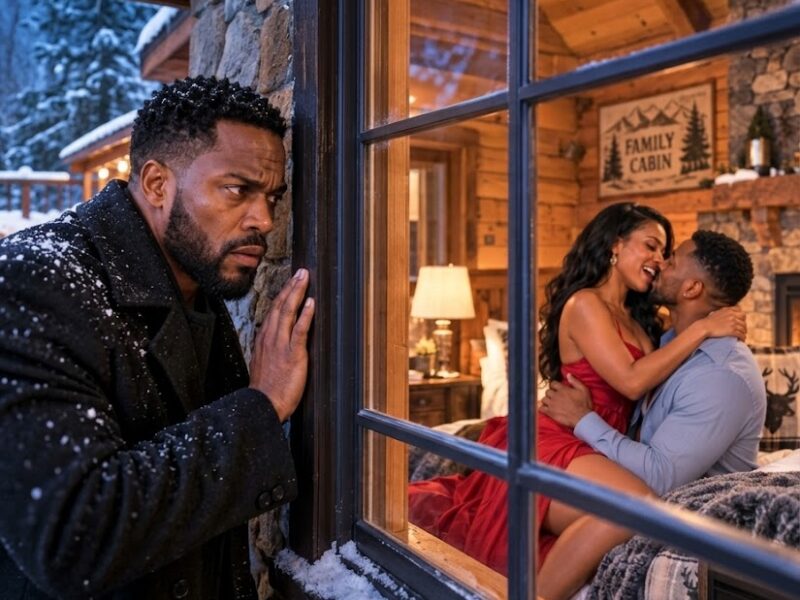
My Wife Moved Her Lover Into My Father’s Cabin and Changed the Locks—She Never Checked Who Legally Owned It
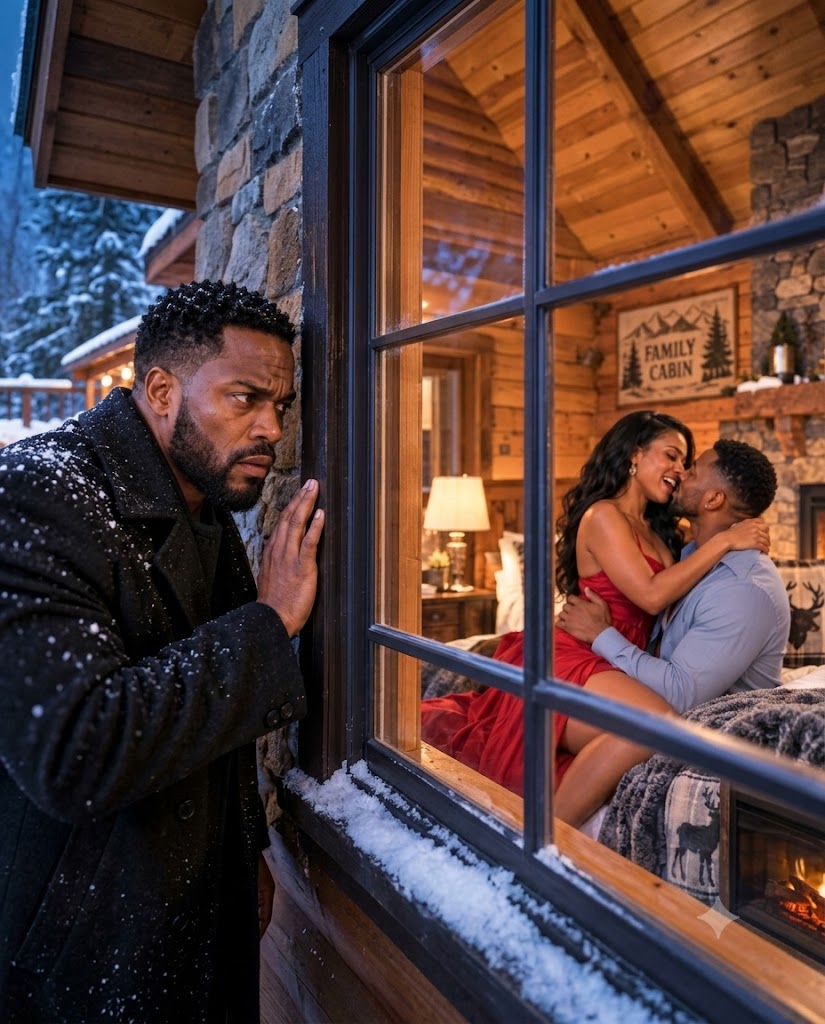
Darius Cole slid the brass key into the lock of his father’s cabin and felt it stop halfway.
He tried again, jiggling the worn metal the way he had done a thousand times before, but it wouldn’t budge. That was when he noticed the fresh scratches around the deadbolt and the silver keypad mounted above it, its tiny red light blinking like a warning.
Through the window, he saw his wife laughing beside a man he had met only once.
Grant Mercer, the developer, sat at his father’s oak table with a champagne bottle between them. Clare called him “just a client” the night she introduced them at a charity dinner in Charleston, but Darius had watched her hand linger on Grant’s sleeve a beat too long.
Grant’s jacket hung over his father’s chair. Walter Cole had built that chair by hand forty-one years ago, back when the cabin was nothing but a collapsing hunting shelter surrounded by neglected timberland.
Clare opened the door only far enough to block the entrance.
“You weren’t supposed to come until Monday,” she said.
Darius looked at the new lock, then at her bare feet and Grant’s unbuttoned shirt. The champagne flute in her hand still had lipstick on the rim.
“Why would I need your permission?” he asked quietly. “To enter my own property.”
Clare folded her arms as if Darius were a trespasser she had caught climbing through a window.
“The cabin belonged to your father, and he’s gone,” she said. “Until the estate is settled, nobody owns it outright.”
Behind her, Grant approached with the relaxed confidence of a man who believed every room would eventually become his.
“Let’s keep this civil,” Grant said, flashing teeth that had probably cost more than Darius’s truck. “Clare and I are preparing the place for an investor retreat.”
Darius noticed architectural renderings spread across the table. One showed the cabin replaced by a glass lodge overlooking twenty luxury villas. Another showed a road cut through the ridge where his father had planted cedar trees.
He removed his phone and photographed everything.
Clare’s expression changed. “Put that away.”
“Not until I understand what you’ve done.”
Grant stepped outside and pulled the door shut behind him. He was tall, silver-haired, and dressed in clothes chosen to look casual while costing more than Darius’s monthly mortgage.
“Your wife said you were having difficulty accepting change,” Grant said. “She also said you repair municipal water lines.”
Darius recognized the intended insult. For twelve years, people had seen his reflective field jacket and assumed he was a laborer who followed instructions. Few bothered to learn that he was a licensed civil engineer responsible for assessing water systems across three counties.
He looked toward Clare. “Is that what you told him?”
She avoided his eyes.
Grant smiled. “Whatever your position is, this project is above your pay grade.”
Darius slipped his father’s old key back into his pocket. “That remains to be seen.”
Clare handed him a white envelope through the narrow space between them. Inside were divorce papers prepared three weeks earlier. Darius read the first page without allowing his hands to shake.
Clare requested their townhouse, half his retirement account, and equitable access to property inherited during the marriage. The cabin was listed as an estate asset with ownership pending.
“You planned this before Dad’s memorial,” he said.
Clare’s jaw tightened. “Our marriage was over long before Walter died.”
From inside, champagne corked loudly against the ceiling, and Grant laughed as though the timing amused him.
Darius placed the papers back inside the envelope.
“You brought him here while my father’s ashes are still in that cabinet,” Clare whispered.
“Don’t make this uglier than it needs to be,” Darius replied. “I didn’t bring ugliness into this house.”
He walked back to his truck without raising his voice, which seemed to unsettle Clare more than anger would have. Grant called after him.
“The locks stay changed.”
Darius paused beside the driver’s door. His father had taught him that a man revealed himself when he believed no consequences were coming. Darius wanted to cross the porch and drag Grant away from the table Walter had built by hand.
Instead, he photographed Grant’s license plate, the construction markers near the ridge, and the survey stakes driven beside the spring.
Then he called Lena Ortiz, an attorney who had handled Walter’s final documents.
“I need the recorded deed,” he said.
Lena heard something in his voice. “What happened?”
Darius watched Clare close the curtains. “Someone forgot whose name is on it.”
—
Walter Cole had purchased the mountain property forty-one years earlier, back when $18,000 could buy eighty-seven acres of timberland and a dream.
He rebuilt the cabin on weekends while raising Darius alone after Darius’s mother died of an aneurysm at thirty-four. Every wall carried a memory: arithmetic lessons at the kitchen table, burnt pancakes on winter mornings, and Walter’s patient hands guiding a frightened twelve-year-old through his first repair of the spring pump.
Walter had been a Black surveyor in an era when contractors sometimes accepted his calculations while refusing to let him enter their offices.
He rarely discussed the insults. He simply checked every measurement twice and taught Darius never to surrender accuracy merely because somebody preferred confidence wrapped in an expensive suit.
Six years earlier, after Walter suffered a minor stroke, he had asked Darius to meet him at the county recorder’s office.
Walter transferred the cabin and eighty-seven surrounding acres to his son through a warranty deed while retaining a life estate.
“This means I live there as long as I breathe,” Walter explained. “But the ground already belongs to you.”
Darius had resisted. He believed the land should remain Walter’s completely.
His father tapped the deed with one thick finger. “Ownership is not always about possession. Sometimes it is about making sure the right person can say no.”
Clare knew Walter had made arrangements, but she had skipped the recording appointment for a spa weekend in Asheville. She later assumed the property remained part of the estate.
Darius had never corrected her because he never imagined he would need to.
Lena emailed the deed within twenty minutes.
There it was on the first page: Darius Elijah Cole, grantee and sole title holder, subject only to Walter’s life estate, which had ended upon his death. The transfer predated several of the debts Clare had accumulated and contained no marital ownership language.
More troubling was Lena’s second attachment. Grant Mercer’s company had submitted a preliminary development inquiry, claiming it held an option to purchase the property from “authorized estate representative Clare Cole.”
The attached option carried Darius’s name beneath a signature that was not his.
Lena called immediately. “Did you sign anything for Mercer Ridge Development?”
“No.”
“Then we may be looking at fraud.”
Darius stared at the unfamiliar signature. Betrayal had just moved beyond the bedroom and into a criminal document.
He could have called 911 and demanded immediate arrests, but Lena advised precision. A false option was evidence. Proving who knowingly created it required more than outrage.
She contacted the recorder, flagged the title, and prepared a formal notice revoking any claimed access.
Darius drove to the county sheriff’s substation with the deed, Walter’s death certificate, photographs of the changed locks, and the forged document.
Deputy Mara Bell listened carefully. Unlike Grant, she did not assume Darius’s work clothes defined his authority.
“Because your wife has previously stayed there, removing her tonight may become a residency dispute,” she explained. “But Grant has no such claim.”
Darius nodded. “I don’t want a spectacle. I want a documented notice.”
Mara studied him. “You’re calmer than most people would be.”
“Calm keeps other people from rewriting what happened.”
—
They returned to the cabin shortly before sunset.
Clare’s rented SUV and Grant’s black sports car stood beside two contractor trucks. Workers were removing Walter’s handmade shutters and stacking them in the yard.
Grant emerged carrying a tablet. His confidence disappeared when he saw the patrol vehicle.
Darius handed him the written notice. “You have no lease, purchase agreement, or permission from the owner. Take your workers and leave.”
Grant glanced at Clare. “He can’t do this.”
Deputy Bell asked, “Do you have proof of ownership or lawful occupancy?”
Grant displayed the forged option.
Darius laid the recorded deed across the hood of his truck.
Clare read his name, the transfer date, and Walter’s retained life estate. Her face drained of color.
“Your father gave it to you six years ago?”
“He did,” Darius said, “and the deed was recorded that same afternoon.”
Clare looked from the document to the cabin as though the mountain itself had deceived her.
Grant recovered quickly. “An inherited asset can still be negotiated during divorce.”
Lena, joining by speakerphone, corrected him. “Not by forging the owner’s signature and commencing demolition without authorization.”
The workers stopped moving. One quietly returned a shutter to the wall.
Deputy Bell instructed Grant to remove his crews and personal belongings.
Clare stepped toward Darius. “I thought the estate paperwork was unfinished.”
“You thought Dad’s death created an opening?” he replied.
Grant muttered that the signature had come from materials Clare supplied.
Clare turned sharply. “You said your lawyers handled it.”
For the first time, their alliance showed a visible crack.
Darius allowed Clare to collect her clothes, but he refused to let either of them remove Walter’s papers or the project renderings.
Grant objected until Deputy Bell reminded him that taking documents from property he had entered without authorization could worsen his position.
As the sun disappeared behind the ridge, contractors loaded their equipment in silence.
Clare stood beside the SUV holding the divorce envelope. “Where am I supposed to go?” she asked.
Darius almost laughed at the cruelty of the question. She owned half the townhouse they had shared and had spent three nights at a luxury hotel with Grant before occupying the cabin.
Still, he answered evenly. “Wherever you intended me to go after changing the locks.”
She flinched, but he felt no satisfaction. Only exhaustion remained.
—
When everyone left, Darius entered the cabin alone.
The air smelled of expensive cologne, sawdust, and the cedar oil Walter used on the furniture. Two wine glasses stood beside the sink.
In the bedroom, Grant’s watch rested on Walter’s nightstand. Darius sealed it in a bag for Deputy Bell rather than throwing it into the woods as he wanted.
He then discovered blue paint sprayed across the floorboards, marking walls scheduled for removal.
On the porch, survey ribbons led downhill toward Mercy Spring, the underground source feeding wells used by nearly four hundred residents. Walter had fought for decades to keep that spring protected.
One rendering placed a parking structure directly above its recharge zone.
Darius understood then that Grant had not chosen the cabin merely for its view. He wanted control of the water beneath it.
At dawn, Darius followed the markers through the forest. Fresh bore holes had been drilled beside the northern slope, and muddy runoff streaked toward the springhouse.
Whoever performed the tests had ignored required erosion barriers.
Near the springhouse, he found a broken lock and a monitoring sensor disconnected from its housing. Walter and Darius had installed that sensor after a fuel spill threatened the valley fifteen years earlier.
Darius reconnected it and downloaded the stored readings. Turbidity had spiked twice during the previous week, precisely when Grant’s crews were drilling.
The contamination had not yet reached dangerous levels, but another storm could carry sediment into household wells.
The changed lock suddenly seemed like the smallest part of the intrusion.
Darius photographed every bore hole, collected water samples, and called the county environmental office.
The inspector assigned to the complaint was Howard Pike, a man who had approved several of Grant’s previous developments.
Howard arrived late, wore polished shoes unsuitable for the mud, and barely examined the drilling sites.
“Exploratory work doesn’t necessarily require a full permit,” he said.
Darius showed him the recharge zone map.
Howard glanced at Darius’s field jacket. “Are you employed by the property owner?”
Darius answered, “I am the property owner, and I stamped the county’s watershed model.”
Howard’s smile stiffened. He promised to review the matter, then departed after making a private call from his vehicle.
An hour later, Darius received an email stating that no immediate violation had been confirmed.
The speed of the dismissal told him more than the inspection had. Grant’s confidence came from somewhere.
—
Clare called seventeen times that morning.
Darius answered only after sending the evidence to Lena.
“Did you sign my name?” he asked.
Silence lingered before Clare said, “Grant gave me a stack of preliminary forms. He said signatures could be corrected after the estate closed.”
“That isn’t an answer.”
“I traced your signature on one document because he said investors needed proof the family supported the concept.”
Darius gripped the phone. “You forged my name.”
Clare began crying. “I didn’t know you owned it. Would it have been acceptable if Dad still did?”
She had no response.
Darius heard Grant speaking in the background, telling her to end the call.
“Are you with him now?”
“He says we can fix this.”
Darius replied, “Grant is trying to decide whether you’re still useful.”
By Monday, Grant had begun rewriting the story.
He told county officials that Darius had verbally approved the resort but withdrew support after discovering Clare’s affair. His public relations consultant described the dispute as a painful domestic misunderstanding interfering with regional investment.
Several local business owners received invitations to a presentation promising jobs, tourism, and increased tax revenue.
Darius’s photograph appeared in an online article beside the phrase “disgruntled husband.”
Nobody mentioned the forged signature or unauthorized drilling.
Grant understood that facts moved slowly while humiliation traveled fast.
Darius’s supervisor called him into an office and warned that the county expected employees to avoid conflicts affecting public projects.
“I disclosed my ownership years ago,” Darius said. “I never reviewed an application for my own property.”
His supervisor sighed. “Then make sure you can prove it.”
The warning struck a familiar nerve. Darius had spent his career watching louder men receive credit for calculations they could not explain. At meetings, developers directed questions to junior white technicians even after Darius introduced himself as lead engineer.
When a system succeeded, he was dependable. When he challenged shortcuts, he became difficult.
Grant was exploiting that pattern, presenting himself as the visionary and Darius as an emotional obstacle.
Walter would have advised him to bring documents rather than speeches.
Darius gathered the title record, water data, inspection history, and correspondence showing he had recused himself from all reviews connected to the cabin.
Then he requested an independent state assessment of the spring.
He would not win by arguing that Grant was arrogant. He would demonstrate exactly where Grant’s plan endangered the valley.
—
Clare returned to the townhouse Tuesday evening and found Darius packing his personal belongings.
She remained by the door looking smaller without Grant beside her.
“Are you leaving me the house?” she asked.
“I’m taking what is mine until the court decides the rest.”
On the dining table lay receipts from restaurants, hotel charges, and transfers from their joint savings account to a consulting company Grant controlled.
Clare followed his gaze. “Those were project expenses.”
“You transferred $42,000 without telling me.”
“Grant said we would recover it when the investors committed.”
Darius closed a box. “He used your money, your access to Dad, and your belief that I was too ordinary to matter.”
Clare’s eyes hardened. “This isn’t only about Grant. We were unhappy.”
“That may be true,” Darius said. “But unhappiness didn’t forge my signature.”
Their marriage had not collapsed overnight.
Clare had once admired Darius’s steadiness. They met during a flood relief project where she coordinated temporary housing and he restored damaged water lines. She loved that he listened before offering solutions.
Over time, however, she built a career arranging luxury events for clients who treated appearance as currency. Grant entered her world, promising introductions, commissions, and rooms where nobody checked prices.
Darius attended when he could, but his quietness embarrassed her among people who mistook performance for power. She began calling his caution a lack of ambition.
He responded by working longer hours instead of confronting the widening distance.
Neither choice excused her betrayal, but Darius refused to simplify their history merely to make leaving easier. A broken marriage could contain two failures without containing equal guilt.
—
Grant’s investor presentation took place at the county conference center on Thursday.
Darius attended with Lena and Dr. Naomi Shaw, a hydrogeologist from the state university who had agreed to review his samples independently.
Grant displayed images of spa villas, hiking trails, and a wellness center called Mercy Ridge Sanctuary. He never mentioned that Mercy Springs supplied drinking water beyond the property line.
When questions opened, Darius stood.
Murmurs spread across the room. Grant smiled for the cameras. “Mr. Cole, I hope we can separate personal pain from economic opportunity.”
Darius connected his laptop to the projector. “So do I.”
He displayed a topographic model showing the resort’s parking area over fractured limestone.
“Your plan directs polluted runoff into the valley’s primary recharge corridor. Personal feelings did not draw these contours.”
Grant claimed the model was outdated.
Darius produced monitoring data from the previous week and laboratory results showing drilling sediment moving toward the spring.
Naomi explained that the concentrations were preliminary but consistent with unprotected bore holes.
Then Darius displayed the forged option beside his verified signature from the recorded deed.
The room became quiet.
“No valid owner authorized this project,” Lena stated.
Grant’s attorney objected that signature authenticity had not been adjudicated.
Darius agreed. “That is why we requested a criminal examination instead of asking this audience to decide.”
His restraint denied Grant the emotional outburst he expected.
Reporters began photographing the documents. County commissioners whispered to one another.
Grant ended the session twenty minutes early, claiming confidential negotiations prevented further discussion.
Outside, Clare waited beside the elevators. She had watched from the back row.
“Grant told me the spring argument was something you invented to punish us,” she said.
Darius handed Naomi the sample case before answering. “You saw the data.”
Clare rubbed her arms. “I didn’t know about the drilling.”
“You saw the stakes. You saw the renderings.”
“I thought it was harmless planning.”
Darius studied her face. For years, he had interpreted her evasions as confusion because acknowledging calculation would have hurt more.
“You kept choosing not to know,” he said. “Every time the truth threatened what you wanted, you let Grant explain it away.”
Clare began to apologize, but Grant appeared and ordered her into his car. When she hesitated, he said, “Remember whose legal team is protecting you.”
Darius watched fear replace admiration in her eyes.
—
That evening, the state suspended all exploratory work at Mercy Ridge pending review.
It should have been a victory. But Darius knew temporary orders meant little to a developer accustomed to shaping rules.
He installed cameras around the cabin and replaced the keypad with reinforced locks.
In Walter’s desk, while searching for historical well records, he found a ledger documenting decades of spring levels. Tucked inside was a letter addressed to him.
Walter had written it months before his death after learning Grant had approached Clare about the property.
“He sees land as empty when it is occupied by people he does not count,” Walter wrote. “Do not protect this place because it was mine. Protect it only if you understand whom its water serves.”
Darius read the sentence three times. His father had anticipated the battle but refused to dictate the outcome.
The ledger revealed something even Grant’s consultants had missed. During heavy rain, groundwater pressure shifted toward an abandoned quarry beneath the northern slope. Walter had recorded two minor collapses there in the 1990s.
Any substantial grading could destabilize the ridge above the proposed villas.
Darius located the original survey maps in a rolled canvas tube, but several pages were missing. He remembered seeing loose maps among Grant’s materials on the first night.
If Grant possessed them, he either understood the risk or planned to conceal it.
Darius sent copies of the ledger to Naomi and requested an emergency geotechnical review.
Hours later, she called. “Your father’s observations are consistent with a concealed fracture network.”
“How dangerous?”
“If the storm forecast for Saturday reaches the upper estimate, those bore holes could channel water directly into the quarry.”
Darius informed Howard Pike and the county emergency office.
Howard responded that field notes from an unlicensed observer could not justify evacuations. Walter had in fact been licensed for thirty-six years, but Howard did not ask.
Grant issued a statement accusing Darius of manufacturing fear to obstruct lawful development.
Then one of Darius’s cameras captured a truck entering the property after midnight. Two men removed equipment from the drilling area and loaded soil cores into sealed containers.
Darius called Deputy Bell rather than confronting them.
By the time she arrived, the truck was gone, but its tire tracks and license plate remained visible in the footage. The vehicle belonged to a testing company partly owned by Howard’s brother.
What had begun as trespassing now pointed toward coordinated concealment inside the permitting system.
Deputy Bell obtained a warrant for records from the testing company. The preliminary logs showed that engineers had identified voids beneath the ridge eleven days earlier.
Grant received the report the morning before he changed the cabin locks.
Instead of halting the project, he instructed the company to reclassify the findings as inconclusive and remove the soil cores. Howard then drafted the dismissal of Darius’s complaint before visiting the property.
Lena warned Darius that exposing the scheme would not automatically stop it. Grant had investors, attorneys, and officials who could delay accountability for years.
“The storm won’t wait for litigation,” Darius replied.
He called residents downstream, organized volunteers to inspect drainage channels, and used his own savings to rent portable water tanks. If authorities refused to act, he would reduce the danger himself.
—
Clare appeared at the cabin Friday afternoon carrying a laptop and a cardboard box.
Darius kept her outside while a camera recorded their conversation.
“Grant threw me out of the hotel,” she said. “He claims I created the forged option without his knowledge.”
She opened the laptop to emails showing Grant had sent the document with instructions to reproduce Darius’s signature from a home insurance form. Another message promised Clare a partnership stake after she secured family control of the land.
“Why didn’t you give this to your lawyer?” Darius asked.
“Grant’s firm selected my lawyer,” she swallowed. “I understand how stupid that sounds now.”
Darius replied, “It sounds like you chose the person offering the future you wanted.”
Clare looked toward the cabin. “I also found the missing surveys in his briefcase.”
The box contained Walter’s original maps and an internal engineering memorandum marked urgent. It described a credible slope failure hazard and recommended abandoning construction above the quarry.
Grant had handwritten one sentence across the cover: “Do not circulate before investor close.”
Darius photographed every page and called Deputy Bell.
Clare began trembling when he mentioned evidence tampering. “Am I going to prison?” she asked.
“That depends on what you did and what you tell the truth about.”
She reached for his hand, but he stepped back.
“I brought this to help you.”
“Bringing back what should never have been taken is not a favor.”
The words hurt her. Yet Darius could not soften consequences simply because remorse had finally become more comfortable than denial.
—
By Friday night, rain hammered the mountain.
The emergency office issued a flood watch but stopped short of ordering evacuations near the ridge.
Darius and Naomi installed temporary gauges along the creek while volunteers delivered bottled water to elderly residents. Clare remained at the sheriff’s office giving a statement.
Grant vanished after leaving his attorney’s building through a service exit. His phone last registered near the cabin.
Darius suspected he had returned for something the search warrant had not yet covered.
Deputy Bell told him to stay away, but a camera alert showed movement inside Walter’s springhouse, followed by a sudden loss of signal.
The water pressure gauge climbed sharply.
Darius knew the springhouse contained the manual diversion valve that could redirect overflow toward an empty spill basin. If Grant damaged it, homes below would face both contamination and flooding.
Darius drove up the mountain with Deputy Bell following several minutes behind. Rain reduced the road to a ribbon of mud.
At the property gate, he found Grant’s sports car abandoned with its door open. Fresh footprints led toward the springhouse.
Darius carried a flashlight, rope, and valve wrench from his truck.
He found Grant inside stuffing monitoring drives and paper logs into a waterproof bag.
“Put them down,” Darius said.
Grant spun around. “You don’t understand what’s at stake. Hundreds of millions disappear if those investors see the original data.”
“People live below this ridge.”
“People always live near something.”
A deep crack rolled beneath them, different from thunder. Dust fell from the rafters. The pressure gauge jumped again.
Darius pointed toward the exit. “We have minutes before the slope moves.”
Grant shoved past him with the evidence bag.
Outside, the ground buckled near the bore holes, sending brown water across the path. Grant slipped and slid toward the quarry cut, catching a cedar root with one hand. The bag tumbled into the runoff.
Darius could have pursued the records or left Grant hanging until Bell arrived.
Instead, he anchored the rope around a tree and crawled toward him.
“Give me your other hand.”
Grant stared up, shocked. “Why would you help me?”
Darius tightened the rope as soil collapsed beneath his knees. “Because your character doesn’t decide mine.”
Grant reached. Darius pulled until both men rolled onto stable ground.
The evidence bag had lodged against a drainage grate below them, but the ridge groaned again. There was no time to retrieve it safely.
Darius dragged Grant toward the springhouse and ordered him to hold the flashlight.
The diversion valve had been chained shut by Grant’s crew to prevent visible discharge from affecting investor photographs.
Darius struck the corroded padlock with the wrench while water rose around his boots.
Grant shouted that the entire structure was shifting.
“Then make yourself useful,” Darius said, handing him a pry bar.
Together, they broke the chain. Darius turned the wheel, but years of mineral buildup resisted him.
Grant wanted to run.
Darius pictured the houses below, including Mrs. Avery’s home, where Walter once repaired a well without accepting payment.
He braced both feet against the wall and pulled until the valve released.
Water roared into the empty spill basin seconds before part of the northern slope collapsed.
The landslide tore through the unoccupied drilling field, crushed Grant’s car, and stopped less than thirty yards from the cabin.
Deputy Bell arrived with firefighters as Darius and Grant emerged from the springhouse, soaked and covered in mud.
Grant immediately claimed Darius had lured him there.
Bell’s body camera recorded his accusation, but so had Darius’s surviving exterior camera, which showed Grant entering alone an hour earlier.
Firefighters recovered the evidence bag from the grate. Inside were Walter’s monitoring drives, altered test results, and Grant’s handwritten negotiations with Howard.
Clare’s emails connected the forged option to the same effort.
Grant looked toward Darius as officers placed him in handcuffs.
“You could have let me fall,” he said.
Darius answered, “Saving your life does not erase what you did with it.”
—
Morning revealed the scale of the disaster that had almost occurred.
The diversion basin held thousands of gallons of sediment-filled water that otherwise would have surged toward the valley wells. The resort’s proposed main lodge site had sunk nearly six feet.
Naomi’s analysis showed that construction would have accelerated the collapse and possibly ruptured the spring channel permanently.
State investigators suspended Howard, seized county records, and opened inquiries into three earlier Mercer developments.
News reports that once called Darius “disgruntled” now described the engineer whose preparation protected the valley.
Darius disliked the heroic framing. Volunteers, firefighters, Walter’s records, and even Clare’s late disclosure had all mattered.
Still, he understood why the correction felt important. For once, the public saw expertise where Grant had encouraged them to see wounded pride.
Clare accepted responsibility for forgery, unlawful financial transfers, and assisting Grant’s unauthorized entry. Her cooperation reduced the likely charges but did not remove them.
She met Darius in Lena’s office during divorce mediation, wearing no jewelry and carrying her own attorney’s files.
“I kept waiting for you to become impressive in the way Grant was,” she said. “I never asked whether he was good.”
Darius listened without rescuing her from the silence.
Clare continued. “You were the person people trusted when something had to hold. I treated that like it was small because it wasn’t flashy.”
Darius looked at the woman he had loved and recognized genuine regret. Recognition did not rebuild trust.
“I hope you become someone who no longer needs disaster to see people clearly,” he said.
Their divorce settlement left Clare with a fair share of the townhouse equity but none of the cabin, land, or compensation connected to the trespass. She agreed to repay the joint funds transferred to Grant’s company.
Darius did not seek to leave her destitute, nor did he conceal assets to punish her. When friends questioned his restraint, he answered that justice required boundaries, not cruelty.
Clare pleaded guilty to a reduced charge and received probation, community service, and a restitution order.
Grant faced fraud, evidence tampering, environmental violations, and reckless endangerment. Howard’s records revealed payments routed through consulting contracts.
The men who had dismissed Darius as a maintenance worker now required his maps to understand the damage they had enabled.
He gave investigators every document without savoring their dependence.
—
Months later, the county offered to purchase the cabin property for watershed protection.
The amount would have made Darius comfortable for life, but the proposal allowed officials to close public access indefinitely.
He declined and created the Walter Cole Land and Water Trust instead.
The trust protected the spring, preserved the forest, and established paid training programs for young surveyors and engineering students from communities often excluded from those professions.
Darius contributed the conservation rights while retaining a small residential parcel around the cabin. He did not put his own name on anything.
Above the classroom door, a simple plaque carried Walter’s instruction: “Accuracy is a form of respect.”
Residents who depended on Mercy Springs served on the trust’s governing board, ensuring no single owner could gamble with their water again.
On the first anniversary of Walter’s death, Darius returned to the cabin before sunrise. The repaired shutters framed warm light from the kitchen.
Students would arrive later to study groundwater mapping, but for one quiet hour, the place belonged to memory.
Darius placed his father’s brass key in a shadow box beside the recorded deed. The old key no longer opened the modern lock, yet he kept it because Walter had taught him that access and ownership were different things.
Clare had believed changing a lock could erase him. Grant had believed forged paper could replace consent. Both had mistaken temporary control for rightful authority.
Darius poured coffee and stepped onto the porch as sunlight reached the protected ridge.
Deputy Bell arrived carrying the watch Grant had left on Walter’s nightstand. The evidence period had ended, and Grant refused to claim it because its sale was being reviewed for restitution.
“The court says it belongs to whoever lawfully controlled the premises,” she explained.
Darius examined the gleaming object that once represented everything Clare thought he lacked. He donated it to the valley’s relief auction, where it funded new water testing equipment for three rural schools.
When the auctioneer asked whether he wanted his name announced, Darius said no. He had stopped measuring victory by who watched him receive it.
The deed proved the land was his, but his choices determined what ownership meant. That distinction was the inheritance Walter had truly intended him to understand.
—
That afternoon, children crowded around the springhouse while Darius demonstrated the diversion valve that had saved their homes.
One boy asked whether he had been afraid during the landslide.
Darius answered, “Honestly, I was terrified. Courage isn’t being certain you’ll win. It’s deciding what must be protected while you’re still afraid.”
From the porch, Lena watched volunteers restore Walter’s long oak table. No champagne waited there now, no secret lovers or resort plans. Only maps, notebooks, and lunch prepared by neighbors.
Darius ran his hand across the repaired wood.
His marriage was over, and forgiveness remained a road rather than a single decision. Yet the cabin no longer felt like the scene of betrayal. It had become proof that what others tried to take could be transformed into something they never had the imagination to build.
As evening settled over Mercy Ridge, Darius locked the cabin and checked the spring gauge one final time. The reading was steady.
Down in the valley, porch lights appeared one by one in homes supplied by water moving silently beneath his land.
Clare once believed his quiet life meant he possessed nothing worth respecting. Grant believed a Black engineer in muddy boots could be pushed aside by money, connections, and a changed deadbolt.
They had both confused visibility with value.
Darius slipped the new key into his pocket and looked back at Walter’s plaque above the door. His name on the deed had stopped them from stealing the mountain. His knowledge had protected the people below it. His character had decided what happened after he won.
The brass key in the shadow box caught the last light through the window. It had never been about the lock. It had always been about who held the door open for others, and who tried to shut them out.
Darius turned off the porch light and went inside. Tomorrow, the students would come. The spring would flow. The mountain would hold.
And Walter’s son would be there to make sure it did.









