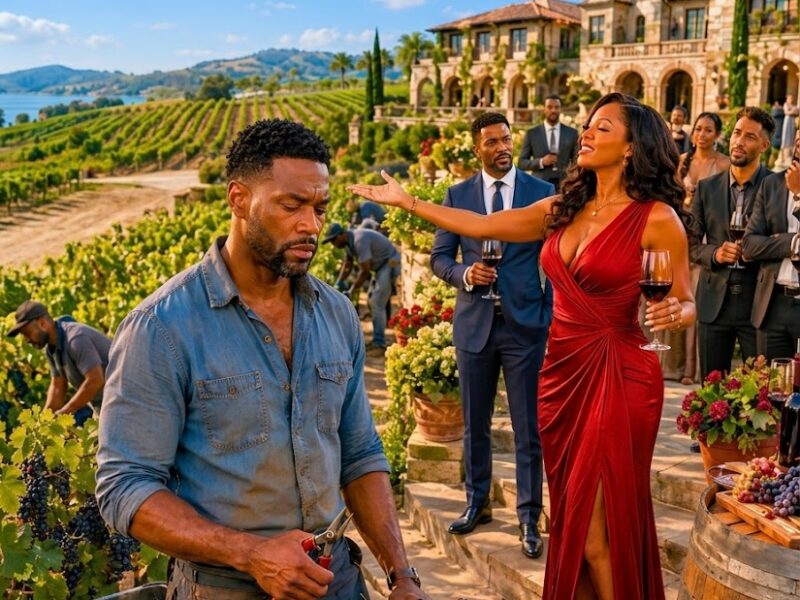
My Wife Called Me “The Man Who Picks Grapes”—She Had No Idea I Owned the $130M Vineyard
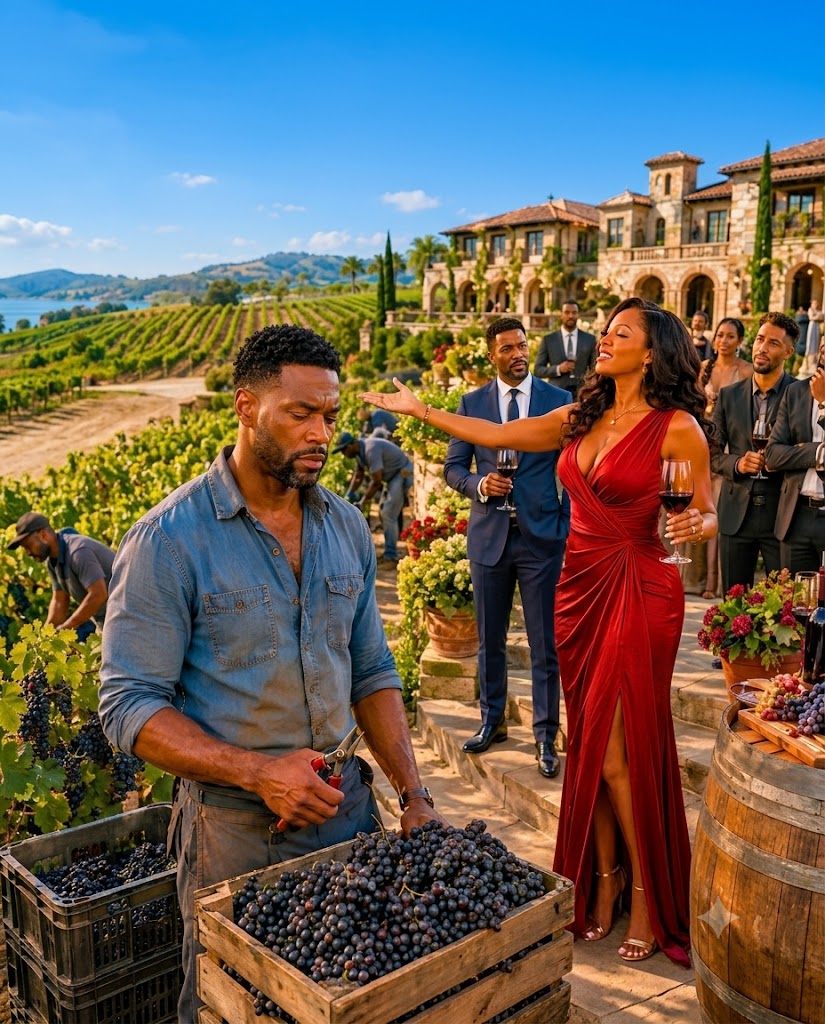
Relax, he just picks grapes.
That was what my wife told the investors gathered beneath the string lights on our terrace, her champagne flute raised toward the golden hills of Bellwether Vineyard. The words landed like a coin dropped into still water, rippling outward through the crowd of tailored suits and expensive watches.
Actually, Malcolm owns Bellwether.
The thought sat in my chest like a stone I had carried for six years, smooth from secrecy, heavy from truth. What no one at that gala understood was that the $130 million sale Simone was celebrating required exactly one signature, and it was attached to the hand currently holding a cluster of Cabernet grapes still warm from the afternoon sun.
And I wasn’t selling.
—
My boots were streaked with dirt from Block 11, where a pump sensor had failed that afternoon. Pruning shears hung from my belt, and my sun-faded work shirt belonged nowhere near the champagne reception Simone had spent three months planning.
To the people holding crystal glasses beneath the lanterns, I looked exactly like what my wife wanted me to look like, a field hand who had wandered too close to the money. What none of them knew was that every row of Cabernet behind us, the limestone cellar beneath the tasting room, the guest villas on the eastern ridge, and even the bottle Simone was holding belonged to Juniper Row Holdings.
And Juniper Row Holdings had one beneficial owner.
Me.
I had not come to embarrass my wife. I had come to stop a sale she had no authority to make.
—
My name is Malcolm Reed, and I grew up three miles from Bellwether in a two-bedroom house behind a farm supply store. My father, Isaiah, spent thirty-two harvests at the vineyard, first repairing irrigation lines, then managing the field crews.
He used to say vines remembered neglect longer than people did. I did not understand him until much later.
As a boy, I hated harvest season because it stole him before sunrise and returned him after dark smelling of dust, diesel, and crushed fruit. By sixteen, I was working beside him on weekends, lifting bins and learning how to read a vineyard by looking at the leaves.
I promised myself I would build a life that did not depend on someone else deciding what my labor was worth. That promise took me through an agricultural engineering degree, seven years designing low-water irrigation systems, and a company I started from a rented warehouse with two friends and a second-hand truck.
We built sensors that could detect vine stress before the leaves showed it. Fifteen years later, a global equipment group bought the company, and I suddenly had more money than anyone in my family had imagined.
I did not buy a yacht. I did not buy a penthouse.
I drove to Bellwether.
—
The vineyard was in trouble then, though tourists would never have guessed it from the stone gates and glossy tasting room. A string of bad vintages, expansion debt, and a water rights dispute had pushed the owners toward a sale to developers who wanted the hillside for luxury homes.
My father had died two years earlier, and the idea of bulldozers cutting through the rows where he had spent most of his adult life felt less like erasure and more like sacrilege. I formed Juniper Row Holdings, named after the street where my parents rented their first apartment, and bought Bellwether through a private transaction for just under $90 million.
The purchase came with two conditions I insisted on. The vineyard staff would keep their jobs, and my identity would remain private while the property recovered. Bellwether needed customers talking about wine, not gossip columns talking about a software millionaire playing farmer.
The board knew the holding company. Three attorneys knew my name. Almost no one else did.
Over the next six years, we repaired wells, replanted sick blocks, restored the old cellar, and bought neighboring acreage that completed the estate. Bellwether’s independent valuation rose to roughly $130 million.
I remained off the website and away from press dinners. When I visited, I wore work clothes and spent more time with the field crews than the executives.
That was how I met Simone.
—
She arrived four years after the acquisition as Bellwether’s director of luxury partnerships, a job built around private clubs, hotel groups, and people who judged a bottle partly by the story they could repeat while opening it. She was brilliant at that work.
She could make a buyer feel as though purchasing wine was admission to a room other people could not enter. We met beside Block 14 during a heat wave.
A drip line had failed, and I was kneeling in the dirt with Mateo Alvarez, Bellwether’s vineyard manager, trying to isolate the pressure loss. Simone walked down with a prospective hotel buyer and asked whether we could move our repair truck because it spoiled the view.
Mateo looked at me. I laughed first.
Somehow, she laughed too.
At dinner two weeks later, I told Simone I had sold an agricultural technology company and managed private farming investments. Before we married, my pre-nup disclosed those holdings by category and value through counsel, but confidential entity names were not attached to her copy.
She had independent representation, accepted the disclosure, and never asked which vineyard sat inside it.
For the first two years, the omission barely mattered. Simone liked that I knew soil and machines but could still sit through a formal dinner without treating a wine list like scripture. I liked the precision beneath her polish.
She could remember the room number of a buyer she met once eighteen months earlier. She noticed details other people missed, which made what happened later harder to excuse.
—
The shift began after she was promoted to senior vice president of brand and hospitality. Her new circle measured people by visible access, which club, which board, which airport lounge, which table at which restaurant.
My old truck became a joke she made around colleagues. My field clothes became something she asked me not to wear when she had guests. I noticed the edits in how she described me, but I did not correct her in public.
Part was pride, part was the discipline my father taught me about letting behavior reveal itself. There was also a business reason. Bellwether’s refinancing covenant still protected Juniper Row’s beneficial owner from publicity. An unnecessary disclosure could have triggered lender review.
Then Adrian Vale arrived.
—
He represented Northline Leisure, a private hospitality group that had spent two years buying wineries, boutique hotels, and destination restaurants. Adrian spoke in acquisition language the way some men speak in compliments. Everything was unlocking value, repositioning assets, or monetizing underused land.
Simone found him fascinating almost immediately. Northline proposed a partnership at first, not a purchase. They would build twenty-four villas on Bellwether’s western ridge, take over the wine club, and fund a new events pavilion.
The projections were enormous. So were the compromises. The villa site sat above our oldest dry-farmed Cabernet block, and the construction plan required rerouting a spring that fed three lower parcels.
I rejected the proposal through Juniper Row’s counsel. The board was told the beneficial owner would not approve development that compromised agricultural operations.
Simone came home furious that night, though she did not know she was complaining to the man who had said no. She called the owner a ghost with sentimental attachments who did not understand modern luxury.
I asked what she thought the owner misunderstood. She said Bellwether was sitting on land worth more as an experience than as a farm.
I remember the word farm because she said it with the faintest curl of dismissal.
I asked whether the people tending that farm counted in her calculation. She said labor could be retained through transition if management handled the optics correctly.
—
Three weeks later, Northline returned with a full acquisition offer. The number was $130 million. High enough to look irresistible on a slide and low enough to leave them room to flip the hospitality assets later.
Again, my lawyers rejected it. This time Simone did not come home angry. She came home energized, which concerned me far more.
She said the board had authorized a strategic review and that Bellwether’s legacy ownership problem would be resolved before Harvest Gala season. I asked what that meant.
She told me not to worry about matters above my pay grade, then smiled as if the insult had been playful. It was the first time my own wife had spoken to me like an employee she could dismiss.
I called Evelyn Shaw, the attorney who managed Juniper Row Holdings. She confirmed there had been no authorized strategic review. Two directors had asked about forcing a sale, but the operating agreement made that impossible without my written approval.
More troubling, someone inside Bellwether had begun circulating a draft presentation that described the Northline transaction as owner-aligned. Evelyn advised me to reveal myself immediately.
I told her not yet.
—
That decision would later look like patience to some people and foolishness to others. My reason was simple. A mistaken presentation could be corrected. A coordinated attempt to misrepresent ownership needed evidence.
If senior management was willing to sell a vineyard they did not control, I needed to know who was participating.
I began visiting Bellwether more often, usually before sunrise. Mateo understood something had changed but did not ask questions. He had known about Juniper Row from the beginning, though not the details of my personal life.
One morning he handed me a revised staffing schedule showing that sixty-four seasonal workers had been cut from the post-harvest plan without board approval. The savings matched a line item in Northline’s acquisition model almost exactly.
The model assumed outsourced field labor after closing. Simone had told me nobody would lose work. The spreadsheet said otherwise.
I asked Mateo where he got it. He said the version had been emailed accidentally to supervisors, then recalled six minutes later. He had printed it before the recall.
—
That same week, the old bottling warehouse was emptied without explanation. Barrels, archived labels, and equipment were moved to temporary storage. Simone told staff the building needed safety work.
County records showed Northline had already requested a preliminary zoning opinion for converting that parcel into a private spa. The application listed Bellwether as the cooperating owner.
I stared at that phrase longer than I expected. Cooperating owner.
My signature was nowhere on the application.
Evelyn’s office sent a preservation notice to the board and quietly began collecting records. We still did not know whether the zoning filing was arrogance, fraud, or a consultant moving too quickly. I wanted facts strong enough to survive a room full of expensive explanations.
At home, Simone became careful with her laptop and work calls. Acquisition papers disappeared when I entered the kitchen, and conversations with Adrian shifted to another room.
I did not turn that secrecy into an accusation about our marriage. I already had a cleaner question to answer. Was Bellwether management knowingly advancing a sale after the owner had rejected it?
—
One Friday, she said she would be in San Francisco overnight with hotel partners. Matteo texted at 9:40 asking why Simone and Adrian were hosting Northline inside the owner’s cellar.
My ownership credentials gave me secure access to Bellwether’s operating system, including cameras in licensed inventory areas. So I opened the feed and watched their private tasting begin.
The meeting itself did not prove anything personal. What it proved was worse in a business sense. Simone was presenting Bellwether as though the acquisition were already settled.
On the audio feed, she told the group the remaining ownership paperwork would be handled at the Harvest Legacy Gala, where public momentum would make reversal difficult. I replayed the sentence twice.
Public momentum would make reversal difficult.
They were not trying to obtain my approval. They were trying to create a public event so costly and embarrassing to unwind that they believed the owner would surrender afterward. It was a pressure tactic dressed as celebration.
And my wife was the person explaining it.
—
Evelyn wanted an injunction the next morning. I asked for forty-eight hours. The gala was nine days away, and Northline’s team was scheduled to arrive with lenders, distributors, and press.
If we stopped the event quietly, Simone could call it a misunderstanding. If we allowed them to state their position in front of witnesses, there would be no ambiguity about intent.
I was not trying to stage revenge. That distinction mattered to me. Bellwether employed two hundred people in peak season, carried contracts with growers across the valley, and supported families who had nothing to do with my marriage.
Any confrontation had to protect the business first. Evelyn drafted a plan that separated the ownership issue from the personal one.
The next morning, I found a note taped inside my locker in the maintenance shed. Ask about Block 7 water tests.
No name.
I photographed it before touching anything else and sent the image to Evelyn. Then I asked Mateo for the lab archive. Whoever left the warning knew enough to be afraid of sending it through Bellwether’s normal channels.
—
The water report was worse than the note suggested. A hydrologist had measured a 38% reduction in spring flow that would affect three lower blocks within two dry seasons. The report recommended immediate remediation and disclosure to regulators.
That report had never reached the vineyard board. It had been attached to an email chain between Simone, Adrian, and Bellwether’s chief operating officer, Nolan Pierce.
Nolan replied that disclosing it before signing would complicate the narrative.
Those three words did more damage to my trust in management than any inflated sales projection could have done. I had promoted Nolan eighteen months earlier through a recommendation delivered anonymously by Juniper Row. He was competent, calm, and popular with staff.
I wanted to believe he had been pulled into someone else’s scheme. Evelyn reminded me that competence was not character. Do not decide who he is before the documents finish telling you, she said.
—
One evening Simone asked whether I had ever considered taking a full-time field position somewhere. I thought she was joking. She said I was happiest outdoors and that it might be healthier for us if I had something to find.
I asked whether selling my company, managing investments, and consulting in agriculture counted as undefined. She said those things sounded bigger when I described them than they looked.
There are insults that make you angry, and there are insults that clarify the architecture of a relationship. That one did the latter.
Simone did not merely underestimate my money. She had stopped believing work existed unless other people could see its title. I realized I had spent years interpreting contempt as impatience because the alternative was admitting what our marriage had become.
—
Two days before the gala, Simone brought home a garment bag and a printed invitation. She placed the invitation beside my coffee and said spouses were technically included, but the evening would be sensitive.
She suggested I come late, avoid the investor tables, and wear the navy suit she had chosen. Then she asked me not to talk shop with anyone unless they asked.
I looked at the invitation. Across the top, embossed in gold, were the words Bellwether Harvest Legacy Gala. Underneath, in smaller type, celebrating the next chapter.
My company was apparently celebrating a next chapter I had never approved.
I asked Simone what exactly would be announced. She kissed my cheek and said, “You’ll understand when you hear it.”
—
The night before the gala, Evelyn came to the small office above the tractor barn with three folders. The first held the operating agreement and certified records showing Juniper Row ownership. The second held the unauthorized zoning application, staffing reductions, and concealed water report.
The third held emails showing who knew the sale lacked owner approval.
Nolan’s name appeared in all three categories. He had not simply gone along. He had instructed staff to backdate two board briefing memos so they would appear to predate my lawyer’s objections. The alteration was clumsy enough for metadata to expose it.
I felt no satisfaction. Betrayal by an employee is cleaner than betrayal by a spouse, but it still damages the same part of you that trusted judgment.
Simone’s emails were more complicated. She never wrote, “I know Malcolm owns Bellwether.” She clearly did not know. But she knew Juniper Row had rejected the deal twice, knew the owner had not signed, and still told Northline that public announcement would corner ownership into acceptance.
Her defense, if she needed one, would be that she expected consent later.
Then Evelyn showed me a message that turned the strategy personal.
—
Adrian asked whether my presence at the gala could create trouble because I was always wandering around the property. Simone replied that I was harmless, that executives assumed I was seasonal staff, and that if necessary, she would keep me with the field people where I belonged.
I read that line without speaking.
Evelyn asked whether I wanted to move the confrontation to a private board meeting. I almost said yes. Public humiliation was the one thing I did not want to imitate.
Then I remembered the planned announcement, the lenders flying in, the staff cuts hidden in a model, and the water report buried because it complicated the narrative. If they were going to use a public room to manufacture consent, the correction had to happen in that same public room.
Not because Simone had hurt me, but because investors, employees, growers, and local officials were being asked to rely on a false statement.
I told Evelyn to prepare certified copies and notify the board chair thirty minutes before the announcement.
—
The gala began at 6:00 beneath strings of warm lights stretched between the tasting hall and the old stone cellar. Bellwether looked beautiful enough to make deception feel tasteful.
Rows of vines fell toward the valley in dark green lines, and the air carried rosemary from the kitchen garden, oak from the barrel room, and the first cool edge of evening.
I arrived at 5:00 because a pump sensor in Block 11 had failed that afternoon. I could have sent someone else. I did not.
My father had taught me never to leave irrigation uncertainty overnight before a hot forecast. And ownership had never made that rule less true.
Mateo and I replaced the controller, flushed the line, and finished fifteen minutes before guests began arriving. I changed nothing except washing my hands.
My suit was hanging in the office, but I left it there. Partly because I was tired of dressing myself to make other people comfortable. Partly because the truth of Bellwether had never lived in its ballroom.
It lived in pumps, roots, weather, crews, and decisions made before anyone poured a reserve vintage under flattering light.
—
When I walked toward the terrace, Simone saw me from across the lawn. Her expression tightened before her smile returned. She intercepted me beside the olive trees and asked why I was dressed like that.
I told her Block 11 had needed repair. She whispered that tonight was not the time to perform authenticity and told me to use the staff entrance if I needed to move around.
I asked whether she was ashamed of me. The question surprised her. Maybe because I had never made her say the quiet part out loud.
She looked toward a group of buyers approaching and answered with a sentence carefully built to sound practical. “I just need people to understand who belongs in which part of the evening.”
Then she stepped away before I could reply.
Adrian joined her near the main terrace. He wore a cream dinner jacket and the expression of a man already posing for the photograph that would accompany tomorrow’s announcement.
Simone touched his arm while introducing him to a resort executive. The gesture lasted half a second too long. It was not proof of an affair, but by then I no longer needed one to understand the betrayal that mattered.
—
A group of investors drifted toward the demonstration rows, where Matteo had asked me to check a late cluster for sun damage. I was holding the fruit in my palm when Simone brought Adrian and three Northline partners behind them.
She introduced Matteo properly as vineyard manager. Then one of the investors pointed at me and asked whether I was the agricultural consultant she had mentioned.
There are moments when anger arrives hot. Mine arrived cold.
I looked at the cluster in my hand and remembered being seventeen beside my father as he taught me to cut fruit without tearing the spur. The insult hurt, but the shame was hers, not mine.
For the first time, I stopped wishing Simone would remember who I was and started accepting who she had chosen to become.
So I smiled and said, “That’s one of the things I do.”
Nothing more. Simone relaxed because she thought I had accepted the role she assigned me. Adrian turned the conversation back to acquisition multiples.
Matteo waited until they were twenty feet away, then asked quietly whether I wanted him to call security. I told him no, not yet.
—
At 7:15, board chair Eleanor Price arrived through the side drive. Evelyn met her in the library with the three folders. Eleanor had served on Bellwether’s board since Juniper Row bought the estate and had always respected the privacy arrangement.
She emerged twenty minutes later, looking older than when she entered, and asked me one question. “How public were they planning to make this?”
I showed her the program. At 8:30, after dinner, Simone and Adrian were scheduled to announce a definitive ownership transition and invite Northline’s managing partner on stage.
Eleanor closed the booklet and said the board had never authorized those words. She asked whether I intended to fire everyone involved before the announcement.
I told her I intended to let them speak first.
—
Dinner was served at long tables between the cellar and the reflecting pool. I took an empty seat near the field supervisors. Simone passed twice without looking at me.
From the stage, she thanked growers, distributors, staff, and the visionaries who understood what Bellwether could become. She did not mention the anonymous owner whose capital had rebuilt the place.
I was strangely grateful for that omission. Had she offered a polished tribute to stewardship, it might have complicated what I felt.
Instead, every sentence moved Bellwether away from land and toward spectacle. Beach clubs, private memberships, destination wellness, branded residences. The vineyard itself became background scenery in a business model designed to make agriculture optional.
At 8:25, Evelyn texted me one word. “Ready.”
Eleanor was seated near the stage with two outside directors. The general counsel had arrived unexpectedly and was reviewing documents in the library. Matteo had asked senior field supervisors to remain after dessert.
Nobody had been told why.
—
Simone stepped to the microphone at 8:30 exactly. She spoke beautifully. That had always been one of her gifts.
She described Bellwether as a heritage property entering a transformative partnership. She praised Northline’s respect for legacy, spoke about protecting jobs, and promised that the vineyard’s essential character would remain untouched.
Every promise contradicted a document in Evelyn’s folders. The outsourced labor model. The spa conversion. The spring diversion.
I watched employees clap because they believed her. That was the moment my patience stopped feeling strategic and started feeling costly.
Lies become heavier once good people begin arranging their futures around them.
Adrian joined her and announced that Northline had agreed to acquire Bellwether for $130 million, subject only to customary closing formalities. Cameras lifted. A local business reporter began typing.
Someone behind me whispered that the anonymous owner must finally have signed.
Simone looked across the crowd and found my face. Her smile contained victory and warning at the same time.
—
Adrian invited Eleanor Price to come forward for the ceremonial toast. Eleanor did not move. Instead, she stood beside her table and said there was a material ownership issue that had to be clarified before any transaction could be represented as approved.
The applause dissolved in layers. First near her. Then across the room as people realized the program had broken.
Simone recovered quickly. She said the board chair was referring to final documentation and assured guests that ownership had been fully briefed.
Eleanor looked at me. That was the signal we had agreed on.
I stood from the supervisor’s table, wiped my palms once against my work pants, and walked toward the stage while two hundred faces tried to understand why the grape picker was moving forward.
Simone met me at the stage steps before I reached the microphone. Her voice dropped to a whisper. “Do not ruin this for me tonight.”
I asked what she thought I was about to ruin. She said, “Whatever wounded husband scene you planned, save it for home.”
That sentence settled me. She still believed the danger was my embarrassment, not the false sale she had announced.
—
I stepped around her and took the microphone. For a second, the speakers gave a faint hum, then the terrace went silent.
I introduced myself by name and said I had spent most of my life around Bellwether. First as the son of a field foreman, later as an engineer, and for the last six years as the beneficial owner of Juniper Row Holdings.
Nobody reacted immediately. The sentence was too far from the version of me they had been given.
Eleanor came to the stage carrying a certified ownership statement and handed it to general counsel. He confirmed that Juniper Row held 100% of Bellwether Vineyard and that I controlled Juniper Row.
The acquisition required my written consent. I had never given it.
The first sound I noticed was not a gasp. It was Mateo exhaling from the supervisors’ table. Then chairs shifted, phones lowered, and several Northline executives turned toward Adrian at once.
Simone stared at me as if the person standing three feet away had changed shape.
She whispered, “You own this?”
I said, “You’ve been working for my company for four years.”
—
She asked why I had never told her. It was a fair question, and I answered it before the room could invent a simpler story.
Bellwether was a premarital asset disclosed in value through our pre-nup, held inside a confidential agricultural company for lender and press reasons. Simone had independent counsel and knew I owned substantial farm investments.
She simply never knew Bellwether was one of them.
I also admitted that privacy had benefited me. It let me see the property without ceremony and hear staff concerns before they were filtered upward.
But I said privacy was not permission for deception. The issue that evening was not whether my wife knew my net worth. It was whether executives had announced a sale after being told twice in writing that the owner had rejected it.
Evelyn joined me on stage and placed the first folder beside the microphone.
—
I did not read private marital messages or discuss suspicion about Simone and Adrian. I kept the facts inside the company.
The unauthorized zoning filing. The staffing model cutting sixty-four workers. The concealed water study. The backdated board memos.
Each item had a date, an author, and a document trail. The room changed as the evidence accumulated. People who had been watching a domestic surprise began watching a governance failure.
That distinction mattered.
Northline’s managing partner asked Adrian whether the acquisition committee had been told the owner had withheld consent. Adrian said there had been confidence that approval would follow.
Evelyn handed over the rejection letters.
Simone tried to interrupt. She said every major transaction involved negotiation pressure and that public announcements often preceded final paperwork.
General counsel asked whether she had authorized the phrase definitive ownership transition. She said communications had developed quickly.
Eleanor asked whether she had seen the second written rejection. Simone did not answer directly.
—
I opened the second folder and held up the water report from Block 7. I asked Mateo to explain in plain language what a 38% reduction in spring flow would mean.
He said three lower blocks could become commercially unreliable within two dry seasons. One of those blocks contained vines planted the year my father first became field foreman.
For the first time that night, my voice almost failed.
Block 7 was where my father first supervised a crew, but I did not ask the room to protect it because of memory. I asked them to look at the numbers. A 38% water loss. Three threatened blocks. Jobs built around them.
Sentiment had been Simone’s accusation. Evidence was my answer.
I announced that Bellwether was not for sale and that the Northline transaction was terminated effective immediately. I also placed Nolan Pierce, Simone, and two project managers on administrative leave pending an independent review.
I did not fire them from the stage. Evidence would determine employment consequences, not applause, humiliation, or my anger.
—
Adrian objected that Northline had incurred substantial diligence costs and could pursue damages. Evelyn answered before I did.
She stated that Northline had received written notice that no binding approval existed and had proceeded at its own risk. Their own counsel, now standing near the terrace doors, said nothing.
That silence was more useful than any argument.
Simone looked at me and asked whether I had planned the evening just to destroy her. I told her no.
“You planned the evening,” I said. “I came because you were going to sell something that wasn’t yours.”
The line landed hard, but I felt no rush of victory. I had wanted correction, not spectacle. And now two hundred witnesses understood why the correction had been necessary.
Then she asked the question that had been waiting beneath everything else. “Was our marriage some kind of test?”
I told her it had never been. I had loved her. I had trusted the boundaries we agreed to around premarital property.
What changed was not that she failed to discover I was wealthy. What changed was that she decided the man she believed had less status deserved less respect.
—
The terrace was quiet enough that I could hear the fountain behind the cellar wall. Simone looked down at my boots, still streaked with dry soil from Block 11.
Earlier, she had used them as evidence that I did not belong among her guests. Now they were simply what they had always been. The shoes of a man who had fixed a pump before protecting his company.
I ended the meeting with three commitments. No seasonal layoffs would occur because of the failed transaction. The Block 7 water study would be published to growers and local regulators. And an outside firm would review every acquisition-related decision made during the previous six months.
Then I handed the microphone to Eleanor and walked off the stage.
I did not stay for the champagne. The event team quietly converted the rest of the night into dinner, and most guests left within an hour.
I went to the crush pad where Mateo was checking a fermentation tank because harvest does not stop for corporate drama. He handed me a flashlight without asking how I felt.
It was exactly the kind of kindness I needed.
—
Around midnight, Simone found me at the crush pad. She had removed her heels and carried them in one hand. She said she could not process that I owned Bellwether.
I told her ownership was not the hardest fact in front of us. “The hardest fact is that you decided I deserved less respect when you thought I had less status.”
She looked away because there was no business language for that.
She said ambition had gotten away from her and that Adrian made the Northline deal feel inevitable. I asked about the staffing cuts and water report.
After a long silence, she admitted she had seen both and convinced herself they could be repaired after closing. That answer hurt more than denial would have. It meant she had understood the cost and chosen momentum anyway.
She cried quietly. I did not comfort her. But I did not weaponize the moment either.
I told her the independent review would decide what happened at Bellwether. And my attorney would contact hers about a separation under our pre-nup.
Then I said the one thing I needed her to hear. “You did not lose this marriage because you failed to recognize an owner. You lost it because you stopped recognizing your husband.”
—
The review took seven weeks. Nolan had directed the backdating and was terminated for cause. Two project managers were cleared after investigators confirmed they had followed instructions without access to the rejection letters.
Simone had not altered records, but she had knowingly made public claims of owner alignment that were false. She resigned before the board completed its employment decision.
Northline withdrew every threatened claim after its internal counsel reviewed Adrian’s communications. Adrian left the firm two months later.
The investigation found no evidence that my marriage had been part of Northline’s formal strategy. The betrayal did not need another secret to make it complete.
Simone had chosen access, status, and a false transaction over truth when truth became inconvenient.
—
The following spring, Bellwether held no gala. We held a field breakfast at sunrise instead.
Growers, cellar staff, kitchen crews, office teams, and seasonal workers ate together at long wooden tables between Blocks 6 and 7. There were no investor speeches.
Mateo complained that I had ordered too much food. It was the happiest event we had hosted in years.
I changed the company structure after that. Bellwether added two employee seats to its operating council and created a protected reporting channel outside management.
Grace Chen, a junior viticulturalist, later admitted she had left the note about Block 7 because her supervisor warned her not to email the report. She was thanked, protected, and eventually promoted.
I also ended my anonymity, not with a magazine profile or a portrait in the tasting room, but with a letter to employees explaining Juniper Row, the acquisition, and why I had stayed private.
I wrote that privacy can protect stewardship, but too much distance creates space for people to invent authority. Ownership carries responsibility to be visible when invisibility begins causing harm.
—
My father’s old pruning knife had been sitting in a box at my house since he died. I cleaned the rust, replaced the cracked handle, and mounted it in the field office.
Beneath it, I placed a small brass plaque with one sentence he used whenever someone complained that vineyard work looked ordinary. “The bottle gets the applause. The row does the work.”
Months later, an envelope arrived from Simone with no return address. Inside were the gold gala program and a handwritten note.
She wrote that she finally understood why the introduction hurt. Not because picking grapes was beneath me, but because she had intended it to make me beneath her. She apologized without asking for reconciliation.
I kept the note and threw away the program.
—
During the next harvest, I went back to Block 14, the place Simone and I had first met. A new hotel buyer was touring with our hospitality director and saw me clipping clusters beside Mateo.
She asked whether I worked in the vineyard. Before anyone else could answer, I said, “Yes, among other things.”
Mateo laughed so hard he nearly dropped his sampling tray.
The buyer asked what else I did. I told her I owned Bellwether. She blinked, looked at my clothes, then smiled and asked why the owner was picking grapes.
I held up the cluster I had just cut and told her the same thing my father had taught me. If you want to understand the value of a vineyard, start with the work that cannot be faked.
Bellwether’s valuation later moved above $130 million, but the number stopped feeling like the point.
—
A vineyard can be priced by acreage, inventory, brand strength, water rights, and future cash flow. None of those measures capture whether the people inside it trust one another enough to protect something that will outlive the quarter they are reporting.
Simone introduced me that night as the man who picks grapes because she believed the phrase put me beneath the room she wanted to impress. She was wrong about only one part of it.
I was a man who picked grapes. I was also the man who owned the vineyard. The first fact never made the second one less true.
What stayed with me was not the silence after the ownership papers were read or the expression on Adrian’s face when the deal vanished. It was the feeling of standing in Block 11 before the gala. Hands wet from an irrigation line.
Knowing I could have sent someone else but choosing to finish the repair because the vines needed water.
Power, I learned, is easiest to recognize when it is announced from a stage. Character is usually visible much earlier, in what a person does when they think the room is not watching.
My wife saw work clothes and assumed they were evidence of rank. My father had taught me they were evidence that something still depended on you.
—
Every harvest now, new employees hear the Bellwether story during orientation. But not the version about a secret millionaire humiliating executives.
They hear the version about unauthorized decisions. Buried reports. And why anyone on the property can raise a concern without going through the person they are concerned about.
That lesson is worth more than the spectacle.
And sometimes when I walk the rows near sunset and the hills turn gold behind the cellar roof, I think about how close Bellwether came to becoming a backdrop for villas. Then I hear crews calling measurements to one another. Forklifts moving fruit. And Mateo arguing with someone about picking windows.
The vineyard sounds alive.
Which is the only ending I ever wanted.









