My Wife Burned My Son’s Last Memory of His Mom—Then Told Us to Leave “Her” House
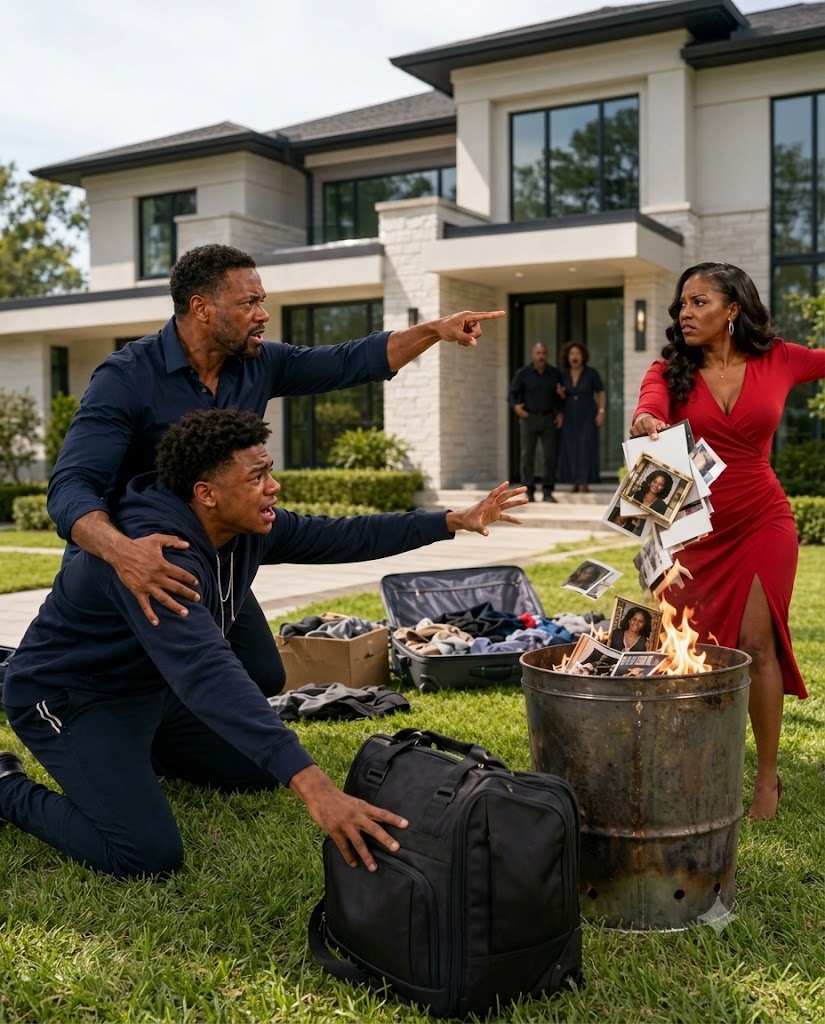
I’ve made my decision. This is my house. I want you both out within the hour.
Please, Mom, stop.
What have you done?
No, my mom’s picture.
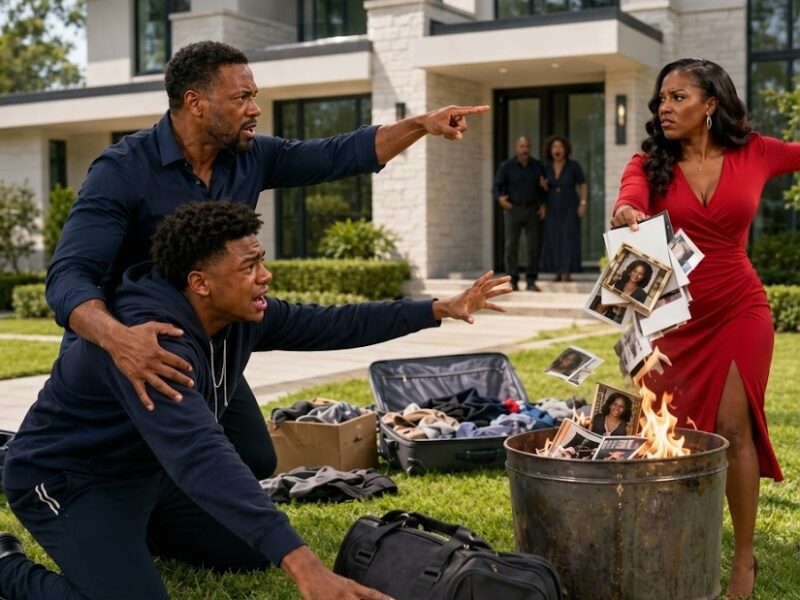
By the time I crossed the mudroom and reached the patio, the canvas case was collapsing into itself inside our steel fire pit. The notebooks had already curled black at the edges. So had the constellation Atlas that had belonged to Hannah, Owen’s mother, the one filled with her handwriting in the margins and tiny circles around the stars she had once promised to show him.
Rebecca stood beside the flames as though she were waiting for a contractor to finish hauling away debris. She told us we had 45 minutes to disappear from her house. What she had apparently forgotten while standing on the stone patio she considered hers was that the county records contained two names on that property deed.
If you have ever watched somebody reveal exactly who they are in one irreversible moment, stay with this story. Some endings begin so quietly that you only recognize them after something is already burning.
That afternoon, it began with smoke drifting through an open kitchen window while I was rinsing a French press. Not Owen calling, not the patio door sliding shut. Smoke, an ugly chemical smell from coated fabric and paper, the kind that makes your nervous system understand danger several seconds before your thoughts catch up.
I put the glass carafe on the counter and walked outside. What I saw there has returned to me in pieces ever since. The hard blue sky, the sprinkler clicking somewhere beyond the fence, Rebecca’s bare feet on the warm pavers, and the fire pit glowing orange beneath a column of dark smoke.
She had her shoulders squared and her arms locked across her chest. She wasn’t looking at the flames like someone shocked by what she had done. She was studying them with the calm satisfaction of someone watching clutter being removed.
Owen stood a few feet away. He was 13, tall for his age and still awkward about what to do with the extra inches he had gained that year. His face was dry, but the skin around his eyes was swollen. Whatever crying had happened had happened before I arrived.
I knew the case inside the fire before I saw the brass telescope patch stitched to its side. Dark green canvas, one leather handle, a stain from the night Owen had dropped hot chocolate on it during a meteor shower in October. His field case.
Inside had been three observation journals, a battered planisphere, two library books, a mechanical pencil set he had saved allowance money to buy, and the old star atlas Hannah had used in college. Owen had asked me only four days earlier if he could bring the atlas to science club because his teacher wanted everyone to show something that explained why they cared about their project.
I had almost told him it was too precious to take out of the house. Then I remembered that precious things are supposed to mean something while you still have them. So I had said yes.
Rebecca announced that she had made her choice. She did not turn toward me when she said it. The house was hers. The marriage was finished. She wanted Owen and me gone before the next hour began.
I looked at my son. He looked back at me with an expression that changed something permanent in me. He wasn’t asking me to save the books. He wasn’t waiting for Rebecca to apologize. He looked like someone who had already accepted that the thing in front of him could not be undone and was now measuring whether the adults around him could be trusted with whatever happened after it.
He was 13 years old. Owen had always been good at noticing pressure changes in a room. Maybe children who lose a parent early learn that skill because the world has already proven it can rearrange itself without warning.
I told him to go upstairs, pack clothes, his laptop, schoolwork, and anything he could not stand to leave behind. He stared at the fire and asked whether there might still be something left of the atlas. I told him we would look when it was safe. Then I went inside instead of arguing with Rebecca, which required more restraint than anything I had done in years.
Before I explain what followed, you need to understand who Rebecca had once been. I am not telling you the good parts because I want sympathy for her, and I am not trying to dilute what happened on that patio. I am telling you because people rarely become strangers in a single afternoon. Usually, the stranger arrives by degrees, wearing the face of someone you remember loving.
When I met Rebecca, she was observant, funny without trying to dominate a room, and unusually attentive to small things. On our second dinner together, she noticed that I checked the time every 20 minutes because Owen was staying overnight with my sister. She did not tease me. She asked what time I needed to pick him up in the morning.
I had been raising Owen alone for almost five years. Hannah died when he was 8. And by the time Rebecca came into our lives, I had developed a suspicion of anyone who treated fatherhood as an obstacle to getting close to me. Rebecca never did.
One winter, maybe four months after we started dating seriously, Owen called me from a neighbor’s house because a pipe had burst in our kitchen while I was 40 minutes away at work. I canceled dinner with Rebecca and started driving home. She asked for the address and arrived before I did.
When I walked in, she had already found the shut-off valve, moved Owen’s school things away from the water, and spread every towel we owned across the floor. Owen was sitting on the kitchen island eating cereal because she had told him that disasters were easier to handle with food.
Rebecca’s jeans were soaked to the knees. She laughed when she saw me and said, I think your house just declared war on plumbing. Owen laughed, too. That mattered more to me than the valve, the towels, or the ruined floor.
There was something about the way she helped that never felt staged. She did not wait for gratitude. She did not glance at me to see whether I was impressed. She simply entered whatever was happening and became useful.
After years of people saying they understood that Owen came first while quietly resenting every time he actually did, Rebecca seemed to understand without needing the rule explained. A year later Owen began calling her Beck instead of Rebecca. The first time he did it, he froze as soon as the word came out.
She kept tying her shoe. She did not smile theatrically or say how happy it made her. She just answered his question and let the nickname become ordinary. That was one of the reasons I married her. Three years later, when she asked whether I would be comfortable with her legally adopting him, I cried in a parking garage where she had brought it up because she thought discussing it over a romantic dinner would make it feel like a performance.
Owen wanted it, too. For a long time, the three of us worked in a way I had stopped believing families could work after Hannah died. That was the Rebecca I remembered when I stood looking at the woman beside the fire pit.
The later version had not appeared overnight. She had accumulated slowly over the original, layer after layer, until the person underneath became difficult to locate. I can tell you approximately when the distance started. I cannot give you the date. Changes like that rarely arrive with timestamps.
First, there were client dinners that stretched later than they used to. Rebecca worked in commercial branding and evening events were not unusual. So there was always a reasonable explanation available. Then came weekends when she had promised to take Owen to the planetarium and rescheduled because a campaign needed fixing.
Then she began carrying her phone from room to room. She used to leave it anywhere. Suddenly it was always face down or in her pocket. Garrett’s name first appeared seven months before the fire.
At first, Garrett was simply the consultant from the Vancouver account. Then he became the person who had recommended a restaurant Rebecca liked, the person whose presentation had saved a difficult pitch, the person who apparently understood why she was frustrated about work in ways I did not.
I heard his name often enough to notice it and infrequently enough to question whether noticing it made me paranoid. So I stored the information in that quiet mental cabinet where people keep facts they are not prepared to combine.
I eventually learned that Rebecca met Garrett at an industry conference. He was divorced, charming, professionally successful, and extremely good at supplying the kind of concentrated admiration that long marriages cannot sustain 24 hours a day.
I do not know what version of our home life she gave him. I know what she gave me. She said she felt invisible. She said our relationship had turned into logistics. She said everything in the house revolved around Owen. Schedules, school, groceries, appointments, responsibilities, and that she no longer knew where she existed inside any of it.
The morning everything broke was a Sunday. Owen was at the dining table building a presentation about light pollution for school. He had index cards spread in rows and kept testing slides against the television because he thought the living room was dark enough to approximate the classroom projector.
Rebecca spent most of the morning in our bedroom with the door closed. That had become normal enough that neither of us commented on it. Shortly after 3, she came downstairs, took Owen’s field case from the hook near the garage, and walked outside. Twenty minutes later, I smelled burning canvas.
After I sent Owen upstairs, I approached the fire pit. The zipper had melted. Most of the journals were already unrecognizable. A corner of one library cover briefly showed through the ash before folding inward. Hannah’s atlas was gone. I knew because I saw a fragment of the maroon cloth binding with a streak of gold lettering disappear beneath the burning pages.
Owen came back carrying a small roller bag and his laptop backpack. He had packed more efficiently than most adults would have. Two jeans, shirts, socks, medication from the bathroom cabinet, chargers, school folders, Hannah’s old scarf from the top drawer of his dresser.
He stopped beside me when the flames had dropped low. Something metallic reflected near the edge of the pit. Before I could tell him not to touch it, he used the long fireplace tongs lying nearby and lifted it free.
It was the brass compass that had been tucked into the side pocket of the field case. Hannah had carried it on hiking trips before Owen was born. The glass face was cracked from the heat. The brass had darkened almost black along one side, and the needle no longer moved freely.
Owen held the tong steady while I wrapped the compass in an old dish towel. He watched me place it inside his roller bag. Neither of us said anything about whether it could be repaired.
We got into my SUV and left. I drove without a plan until I ended up in the parking lot of a 24-hour grocery store beside the highway. Bright lamps, shopping carts ticking across the asphalt in the wind, delivery trucks idling behind the building. It was exactly the kind of anonymous place I needed. Public enough to be safe. Meaningless enough that nobody would ask why a man and a 13-year-old were sitting in a parked car with two bags and nowhere obvious to go.
Owen held the wrapped compass between his palms. I called my attorney. Her name was Priya Shah. She had handled the paperwork when Rebecca adopted Owen and later helped us update our estate documents, which meant she already understood our family structure.
I explained what had happened in less than five minutes. Priya asked whether Rebecca had threatened me or Owen physically. I said no. She asked whether I had evidence that the house belonged to both of us. I told her the deed was in my cloud storage and that both names were on it.
Then she asked about everything else. Checking account, brokerage account, home equity line, vehicles, retirement contributions acquired during the marriage. I answered one by one.
Priya told me that if we were moving toward divorce, and I told her we were, she could request an emergency temporary order preventing either spouse from transferring, draining, selling, borrowing against, or deliberately destroying assets while the case was pending. She said courts did not like unilateral financial behavior.
Once a marriage was clearly dissolving, the burning itself mattered, she told me, because destruction of property could support an argument that protective restrictions were necessary. She asked whether anyone had recorded the patio.
I remembered our neighbor across the alley had a security camera aimed toward his detached garage with part of our yard visible in the background. I also had Owen, though Priya immediately said she would prefer not to drag him into anything more than necessary. She told me to send her the deed and whatever evidence I could safely obtain. We would talk early the next morning.
After the call, I turned toward Owen. He was staring at a neon sign above a noodle restaurant across the parking lot. He asked whether we could eat there. For several seconds, the question felt almost absurdly ordinary. Then I realized ordinary was probably exactly what he needed.
I said yes. He ordered the spicy beef noodles he always ordered and asked for extra fried garlic. I told him I remembered. We took the food back to the car because neither of us wanted to sit under restaurant lights pretending to be normal around strangers.
The evening cooled quickly. Halfway through his meal, Owen asked, Is Rebecca staying there tonight? I said probably. He asked, Can she actually make us leave? I told him she could make the house unbearable for an afternoon, but she could not erase our ownership because she had declared it out loud. The law did not work that way.
He was quiet for another minute. Then he looked down at the towel covering the damaged compass and said, Mom’s handwriting is gone. I told him yes. His lower lip tightened, but he did not cry.
I remember some of the notes, he said. I could write them down before I forget. I started to tell him he did not have to do anything right now. Then I stopped. He was not proposing a replacement. He knew there was no replacement. He was deciding what could still be carried forward.
We checked into an extended stay hotel 12 minutes from his school. Two double beds, a narrow kitchenette, one desk chair, and a window overlooking the concrete ramps of a parking garage. It smelled faintly of detergent and reheated food. The room had been designed for people whose lives were between addresses.
Owen unpacked his school clothes, plugged in his laptop, then unwrapped the compass and placed it on the sill beside the window. That night, after he fell asleep, I sat in the desk chair while garage lights pushed pale rectangles through the curtains. I kept looking at that burned compass.
I had spent the previous two years thinking my job was to stabilize a marriage that was slipping. I had negotiated, waited, excused, compromised, suggested counseling, given space, reduced expectations, and called all of it patience. Sitting there, I finally understood that the marriage had stopped being the thing requiring protection.
The first three days in the hotel settled into a routine with surprising speed because routine is what people build when reality is too uncertain to look at directly. I drove Owen to school each morning and collected him every afternoon. His usual city bus passed two blocks from our house and I did not want him watching that street through a window twice a day while lawyers decided what the property meant. He never asked me to take the old route.
During school hours, I worked from the hotel. I was a senior risk analyst for a freight logistics company, which turned out to be the perfect profession for the worst week of my personal life. My work consisted of numbers, exposure models, insurance clauses, shipment probabilities, and contingency reports. Nothing in a spreadsheet needed me to feel anything.
A damaged cargo forecast did not care whether I had slept. A compliance memo did not know my son’s dead mother’s handwriting had become smoke on a Sunday afternoon. For eight hours a day, I could give my brain problems that had answers. I attended video meetings with the camera angled away from the beds. I reviewed contracts. I built projections.
Whenever Priya called, I went downstairs and paced the top floor of the parking garage so Owen would not come back early and overhear words like petition, dissipation, custody, or restraining order. Priya and I spoke every morning.
By the end of the first week, two legal tracks were moving at once. The first involved emergency financial protection. The language sounded more dramatic than the principle behind it. Priya asked the court to preserve the marital estate until the divorce could be examined properly. Neither Rebecca nor I would be allowed to empty joint accounts, sell vehicles, borrow against the house, liquidate investments, or transfer major assets without authorization.
Priya’s argument was straightforward. When one spouse deliberately destroys property belonging partly or wholly to another family member and then asserts unilateral ownership of the home, waiting politely to see whether money starts disappearing is not prudence. We documented the fire.
Our neighbor’s garage camera had captured Rebecca carrying the green case outside, placing it in the fire pit, and returning with a bottle of lighter fluid. The angle did not show Owen’s face clearly, which I was grateful for, but it showed him standing nearby.
Priya also filed the divorce petition and requested that Owen’s primary residence remain with me. While the court reviewed Rebecca’s parental status because her adoption gave her legal standing that could not simply be ignored, even after what she had done, Priya did not promise me a clean victory. Good lawyers rarely promise outcomes.
She explained that Rebecca would obtain counsel and probably argue that the fire was an isolated emotional outburst, that temporary financial restrictions were excessive, and that one catastrophic decision did not automatically erase years of parenting. She told me not to debate Rebecca directly. No angry texts, no social media, no speeches, record facts, save messages. Let the evidence have more discipline than my emotions.
I began keeping a dated file in my phone. Calls, voicemails, account notifications, screenshots, statements. Owen made without prompting anything involving the house. It felt unpleasantly clinical, but risk documentation was something I understood.
On the fourth evening, Owen took one of the hotel’s complimentary notepads from beside the telephone and began working at the little table. At first, I thought he was doing homework. He stayed bent over the paper for almost an hour using a ruler from his backpack and a pencil sharpened with the tiny blade on his geometry set.
I sat across from him answering emails and tried not to watch too obviously. When he finished, he slid the notepad toward me. He had drawn the damaged compass. Not artistically, exactly. Owen’s drawings had always been technical.
He drew machines, street grids, telescope mounts, transit lines, things that could be understood by measuring them. The compass was rendered from three angles. He had marked the cracked glass, the heat-darkened brass, even the position where the needle had jammed. In the lower corner, he had written the date of the fire.
I said it was incredibly precise. He shrugged and said, It is. There was no pride in the answer, just certainty. He had spent years teaching himself how to record things accurately because he hated when diagrams were vague.
He tore the sheet carefully from the pad, folded it twice, and slipped it behind his student identification card in his wallet. Then he turned the television on and asked whether we had anything sweet in the room. That was all.
After he went to sleep, I sat at the table again, looking first at the drawing he had made and then at the real compass on the sill. I realized he had not drawn it because he thought it was beautiful. He had drawn it because something in him needed a record. A before could be destroyed. A memory could blur. The object that remained damaged was proof that the event had happened and that something had still come through it.
The fourth day was also when Rebecca first tried to move money. Priya had warned me that temporary restrictions sometimes appeared in banking systems in stages while formal notices traveled between institutions. At 10:42 that morning, while I was reviewing a shipping loss report, my phone displayed a security notification from our bank transfer restriction.
The attempted amount was $38,000, more than a third of the liquid cash in our joint checking and savings. I took a screenshot, recorded the time, and forwarded everything to Priya.
Rebecca called less than two hours later. I did not answer. The voicemail she left was controlled, but only in the way a lid is controlled while pressure builds beneath it. She said I was humiliating her.
She said she had business commitments and expenses, that freezing access to money she had helped earn was vindictive, and that I was exploiting one bad afternoon to gain leverage in a divorce. She said the court would see what I was doing. Not once in the three-minute message did she ask where Owen was or whether he had slept.
I sent the voicemail to Priya and went back to work. Rebecca called again the following night while Owen and I were eating supermarket rotisserie chicken from paper plates. Her name appeared on my phone beside the plastic salt shaker. Owen saw it. His eyes stayed on the screen for half a second before he returned to cutting his food. That half second told me what I needed. I silenced the call.
The second voicemail sounded less composed. Rebecca did not cry, but there were long pauses between sentences, the spaces people leave when the version of events they expected is no longer occurring. She said she had never expected lawyers to be involved immediately. She said everything had spiraled.
She admitted that burning the case had been too much, though she still did not call it cruel. She wanted to meet. She wanted to explain what had been happening inside her for months. She said Garrett had nothing to do with the decision in the backyard. I listened once, saved it, and closed the message.
The next day, Rebecca tried to use one of our joint credit cards. She was at a waterfront restaurant with Garrett. I did not know that when the restaurant called, our card issuer had flagged the transaction under the temporary restrictions, and because my number was listed as the primary contact, a manager phoned to confirm whether the account had another authorized method of payment attached. I said no, thanked him, and hung up. I did not ask who was sitting at the table.
Priya filled in that detail later after Rebecca’s attorney referenced the incident while complaining about the practical impact of the order. Garrett had been there. Rebecca had ultimately used a personal card that was not part of the marital freeze. But according to what reached Priya through counsel, the decline had forced Rebecca to explain in the middle of dinner that a judge had restricted the joint finances because of pending divorce litigation connected to an act of property destruction.
Apparently, Garrett had known we were separating. He had not known the rest. By the seventh day, every major shared asset was protected under the temporary order. Bank funds, the brokerage account, both vehicles, the house, and the available equity line. Neither of us could sell, transfer, conceal, mortgage, or substantially diminish anything without notice and approval.
Rebecca still had access to her separate earnings account and could pay ordinary living costs. What she no longer had was the ability to treat shared property as though my existence had ended when she gave me 45 minutes to leave.
That evening, Owen asked whether he could send Garrett something. We had been watching a documentary about deep sea exploration. Without warning, he picked up the remote, muted the television, and said, Do you know where Garrett gets mail? The question was so specific that I knew it had been forming for a while.
I asked why. He said he wanted to write him a letter. I asked whether he wanted me to know what it would say. Owen thought about that for a moment and then said no, not because it was secret, but because he wanted the words to belong to him until Garrett read them. I told him that was fair.
He sat at the hotel table with three sheets of printer paper I brought up from the business center and wrote for nearly an hour. There were no angry scratches, no torn pages, no dramatic pauses. He wrote the way he assembled science projects, carefully, in order, checking each sentence before moving to the next one.
When he finished, he folded the pages into thirds, slid them into an envelope, and wrote Garrett Cole across the front. He left it beside my keys. I did not open it. I had spent 13 years teaching Owen that privacy was part of respect. A crisis did not make that lesson optional.
Before school the next morning, he tapped the envelope and asked if I would actually mail it. I said yes. Ten minutes later, we were driving through morning traffic discussing whether his robotics teacher was serious about banning energy drinks from club meetings.
I mailed the letter after dropping him off. Priya’s office had located a business mailing address for Garrett that was publicly listed, so I sent it there with no note from me. Then I returned to the hotel and sat at the table with the damaged compass six feet away.
I wondered what a 13-year-old says to the man involved with the woman who burned the last handwritten thing he had from his mother. Whatever Owen had written, he had identified one part of an adult mess that he could address directly. He could not control Rebecca. He could not reverse the fire. He could decide what Garrett needed to hear from him.
That was how Owen operated. When something overwhelmed him, he reduced it until he found one thing that could still be acted on. A diagram, a letter, a fact. Three weeks after the fire, our first major hearing was scheduled for a Tuesday morning.
By then, the hotel no longer felt like a hotel every second. Owen’s replacement field bag hung from the coat hook beside the door. His cereal lived on top of the kitchenette refrigerator. We had bought two cheap ceramic mugs because the paper ones irritated me.
The damaged compass remained on the window ledge. The housekeeping staff had learned not to move it. Our toothbrushes had assigned sides of the sink. Temporary life had developed infrastructure. We had stopped talking about how many nights we had been there.
Priya spent the week before the hearing preparing for Rebecca’s challenge to the financial restrictions. Her lawyer filed two motions describing the order as unnecessarily broad and financially coercive. They argued that Rebecca had not tried to hide assets, that she remained entitled to use marital money, and that the attempted transfer was being portrayed more suspiciously than it deserved.
None of those arguments was ridiculous. That was important for me to understand. Courtrooms are rarely rooms where one person speaks sense and the other babbles nonsense. Rebecca’s attorney had a job, and there were legitimate questions about proportion, but every argument still had to coexist with the video of Rebecca pouring lighter fluid onto a 13-year-old’s belongings and, four days later, attempting to transfer $38,000.
Priya told me that clear facts did not need theatrical decoration. I wore a charcoal suit to court that Tuesday, one I had retrieved from the house with a police standby arranged through our attorneys because neither Priya nor I wanted direct confrontation.
Sitting outside the courtroom, I tried to decide what kind of man I wanted Owen to hear about later if he ever asked what I had done there. I did not want revenge recorded in the transcript. I did not want to punish Rebecca for falling out of love with me. People were allowed to leave marriages. They were even allowed to leave badly.
I wanted to present facts, protect my son, protect the property until it could be divided fairly, and walk out without turning pain into a performance. Rebecca arrived 10 minutes before the hearing with her attorney. She wore a cream blazer and had her hair pulled back exactly the way she wore it for client presentations.
She looked composed from a distance. Up close, her hands kept adjusting the same silver ring on her right thumb. She did not look toward me. Priya opened a folder and quietly checked her exhibits.
Rebecca’s challenge to the preservation order was considered first. Her attorney described the patio incident as an impulsive act during an emotionally volatile separation. He emphasized that Rebecca had not damaged the house itself, that most of the burned items had modest monetary value, and that the emergency restrictions interfered with her ability to conduct normal financial business.
He argued that the law should protect marital assets, not be used to punish somebody for losing control during an argument. Priya stood and did almost the opposite of what television lawyers do. She lowered the temperature.
She played 42 seconds from the neighbor’s camera, showing Rebecca carry the case outside, arrange its contents in the fire pit, retrieve lighter fluid, and ignite them while Owen was visible nearby. She submitted photographs of the recovered compass, Owen’s inventory of what had been destroyed, prepared with his school counselor, the deed showing joint ownership, and the bank record showing the $38,000 transfer attempt four days later.
The judge asked Rebecca’s attorney a single question. If the attempted transfer had been for routine expenses, why had the requested amount been $38,000, and why had Rebecca attempted to send it to an account held solely in her name? The attorney began answering, stopped, consulted a page, and revised the explanation twice.
I did not feel triumphant. I felt something colder and steadier. The challenge was denied. The financial protections would remain.
Then the hearing moved into temporary property and parenting arrangements. Priya had assembled years of records. The source of our down payment, mortgage contributions, maintenance costs, investment deposits, salary histories, and the equity each of us had brought into the marriage.
I had purchased the property two years before marrying Rebecca and later added her to the deed when we refinanced. During the early years of marriage, I had carried most household expenses while her branding consultancy was getting established. Our brokerage account told a similar story. Contributions had come from both of us, but the majority originated from my annual bonuses and a small inheritance from my father that had later been commingled into joint investments.
None of those facts meant Rebecca was entitled to nothing. Priya never argued that. She argued that ownership needed to be sorted through evidence rather than determined by whoever stood beside a fire and said the house was theirs.
Regarding Owen, Rebecca’s attorney stated that she cared about maintaining a parental relationship but did not request immediate shared residential time. Priya told me later that the choice was probably deliberate. Rebecca had adopted Owen and therefore had real legal rights. But asking the court to send him back and forth between us three weeks after the patio incident would have forced her attorney to defend the emotional safety of that arrangement. Instead, they reserved future contact for negotiation.
It was the first decision from Rebecca’s side during the entire process that I considered sensible. The temporary order established that Owen would live exclusively with me. While proceedings continued, Rebecca could communicate with him only if he wanted to respond, and no in-person contact would occur unless Owen and his counselor agreed it was appropriate.
When court adjourned, I walked outside into cold afternoon sunlight and called Priya from the courthouse steps. Even though she had left the building 30 seconds before me, I needed to hear the ruling translated from legal language into ordinary language. She did that. The final property division would take longer, but the immediate questions were settled.
I thanked her and ended the call. For several minutes, I stayed on the steps watching people enter and leave the courthouse carrying folders that represented disasters I knew nothing about. A week later, Rebecca asked through her attorney whether I would meet her once before settlement negotiations became final. I agreed on two conditions. Public place, 30 minutes.
She chose a bakery cafe near the river. Rebecca was already sitting at a corner table when I arrived. Without the courtroom clothes and controlled posture, she looked closer to the person I remembered from years earlier. Tired, smaller somehow.
She had tea in front of her and kept rotating the cup by its handle. There was no drink waiting for me, which strangely made the meeting easier. She asked why I had moved so fast. She said she understood that I wanted a divorce. She could even understand taking Owen away for the night. What she could not understand was the immediate order, the frozen assets, the lawyers, the precision of it. She said it had felt like I had been waiting for a chance to trap her.
I told her there had been no trap. There had been an event followed by consequences. She destroyed property in front of Owen, declared sole authority over jointly owned real estate, and ordered us out. I called a lawyer. The lawyer used a legal mechanism designed to stop either spouse from making unilateral decisions while a divorce was pending. I had not invented that mechanism for Rebecca. I had simply been willing to use it once circumstances required it.
She said she never imagined the fire would lead to all of this. I told her I believed that. Then I told her the sentence did not mean what she wanted it to mean. Consequences are not limited by the size of the consequences you imagined when you acted.
Rebecca looked out the window for a while before saying she had been miserable for nearly two years. She said every conversation with me had become practical. Every evening revolved around schedules and she had felt like an employee inside our family instead of a person.
I told her I was sorry she had lived that way. I meant it. There were probably a hundred things I could have noticed earlier and 50 things we both might have handled differently. I told her she could have said she wanted to leave. She could have moved out. She could have asked for mediation. She could have told me about Garrett. She could have screamed at me in the kitchen if she needed to.
What she could not do was take a boy’s connection to his dead mother, set it on fire while he watched, and then tell him he had 45 minutes to vacate his own home. Rebecca had no answer. She lowered her eyes to the tea and pressed one finger against the rim of the cup.
I did not ask for an apology. I had learned by then that apologies requested under pressure rarely repair the thing the injured person actually needs. Instead, I told her something I had spent days deciding whether I believed.
Our marriage had not been fake because it ended badly. The years when we were good had still happened. The kitchen flood had happened. The adoption had happened. Christmas mornings, road trips, arguments over paint colors, stupid inside jokes. All of it had been real. I did not need to rewrite 12 years as misery in order to leave them.
But the fire belonged in a different category. A marriage can fail between adults. Adults can betray, disappoint, separate, divide money, move away, and carry scars from one another. What Rebecca had done on the patio had placed Owen inside the punishment. She had taken objects that belonged to his grief and destroyed them because she wanted her anger to be visible. For those minutes, his inner life had become acceptable collateral damage. That was the line I could not negotiate backward across.
Rebecca stared at the table for so long that I thought the conversation had ended. Finally, she whispered that she did not know how to undo it. I told her some things are not undone. They are lived after, I said. I hoped she learned how to live after this in a way that made her better rather than merely more resentful.
Then I stood, left money for a coffee I had never ordered, and walked out. Five weeks later, Garrett called me. He did not sound defensive. That surprised me. His voice had the unsettled quality of someone who had learned that the story he had been participating in had missing pages.
He said Owen’s letter had reached his office. He had waited several weeks before contacting me because he was not sure whether doing so would help or make things worse. Garrett told me Rebecca had said our marriage was effectively over before their relationship became personal. He knew we were still living in the same house, but she had described it as a temporary financial arrangement while we planned a separation.
He knew Owen was unhappy about the breakup. He had not known Rebecca had burned the field case. He had not known Hannah’s atlas was inside it. He had not known Owen was standing there. I thanked him for telling me.
Garrett started to explain that he was not asking me to excuse his involvement, then stopped himself. He said the letter had not been written like something from a furious child. That was what had disturbed him most. Owen had apparently been specific, calm. He had described what he saw, what was destroyed, and what Garrett needed to understand about the difference between hearing Rebecca’s version of a family and living inside the consequences of her decisions.
Garrett did not read me the letter. I respected him for that. He said only that there was one sentence he had been thinking about every day since reading it, but that it belonged to Owen and he would not repeat it without permission. I told him that was probably the right call.
He said he was sorry, not for everything because he understood an apology that broad would be meaningless, but for being part of something he had not tried hard enough to understand. When the call ended, I sat for a long time with my phone on the hotel table. Owen had always been better with exact words than most adults. He never told me what he wrote.
About a week after Garrett called, I picked Owen up from robotics club. We were stopped at a red light when he asked without looking at me, Did Garrett get my letter? I said yes. I told him Garrett had called and confirmed it. Owen nodded once. Outside the passenger window, a city bus pulled alongside us, its windows glowing in the early darkness. Okay, he said. That’s all I wanted.
I could have asked what he had written. I wanted to. Instead, I turned when the light changed. Some conversations belong to the person who initiated them, and forcing them open afterward only turns closure into another form of intrusion.
Seven months after the fire, Owen and I moved back into the house. The final settlement awarded me the property after accounting for Rebecca’s share of marital equity, largely because Owen’s primary residence was established with me and because my documented contribution to the original purchase was substantially greater. Rebecca received a fair portion of the investment account. Her separate business assets remained hers and I refinanced the mortgage in my name.
Priya told me the agreement was reasonable. I agreed. I had no interest in using the settlement to make Rebecca poor. I wanted boundaries, not ruin. By then, she had rented a townhouse on the north side of Cedar Bay.
The first afternoon Owen and I returned for good, he walked upstairs without carrying anything. I found him standing in the middle of his bedroom. The room looked strangely preserved, like a museum display of who he had been before the fire. Glow-in-the-dark stars still dotted the ceiling. A half-built model of the lunar lander sat on his shelf. The corkboard over his desk still held a ticket from our trip to the observatory.
Owen stood there for maybe two minutes, taking inventory with his eyes. Then he went downstairs, carried up one box, and began putting his life back where he wanted it. The damaged compass came home with us. I assumed he would place it on his desk, but he did not. He installed a small wooden shelf inside his closet, high enough that you could only see it when the door was fully open, and set the compass there beside Hannah’s scarf.
I asked whether he wanted help getting the compass repaired. He said no. If somebody fixes it, he told me, then it becomes a different thing. I understood immediately and never asked again.
He repainted the room a dark midnight blue. Not black, not navy, but the exact color of the sky during the meteor shower when he had spilled hot chocolate on the case that later burned. He chose it from 40 paint samples and did not explain why. I did not require him to.
Fire destroys objects, but loss is rarely as complete as fire wants to make it seem. Hannah’s handwriting was gone, yet Owen remembered sentences from it. The compass no longer pointed north, yet he had drawn every crack before memory could soften them. Garrett had received a letter that could not resurrect anything, but it had carried Owen’s voice into a part of the story where adults had been speaking over him.
For years, I believed protecting a family meant protecting the marriage that organized it. I was wrong. The marriage was only one structure. Owen was the person living inside it.
A house is not its deed. A family is not its photograph. And love is not proved by how long you tolerate someone crossing lines because you remember when they were kinder. Sometimes the thing you save is not the thing that stayed whole. Sometimes it is the child who watches something burn and needs to see immediately and unmistakably that someone will stand beside him afterward.
If this story reached you at a moment when you needed that reminder, remember it. Buildings can be divided, money can be settled. What you protect when everything else is burning tells you what home actually is.









