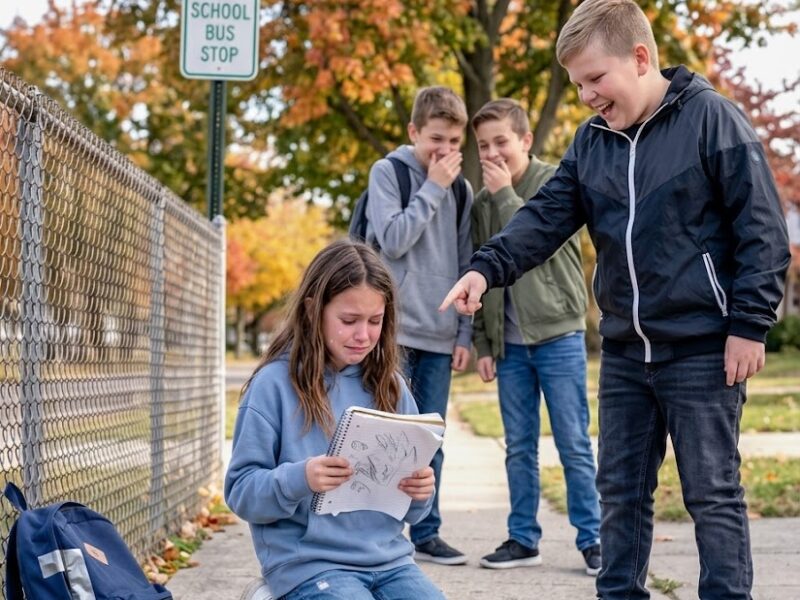
“My uncle is a biker,” she cried. The bully laughed—until 50 Hells Angels parked in the driveway.
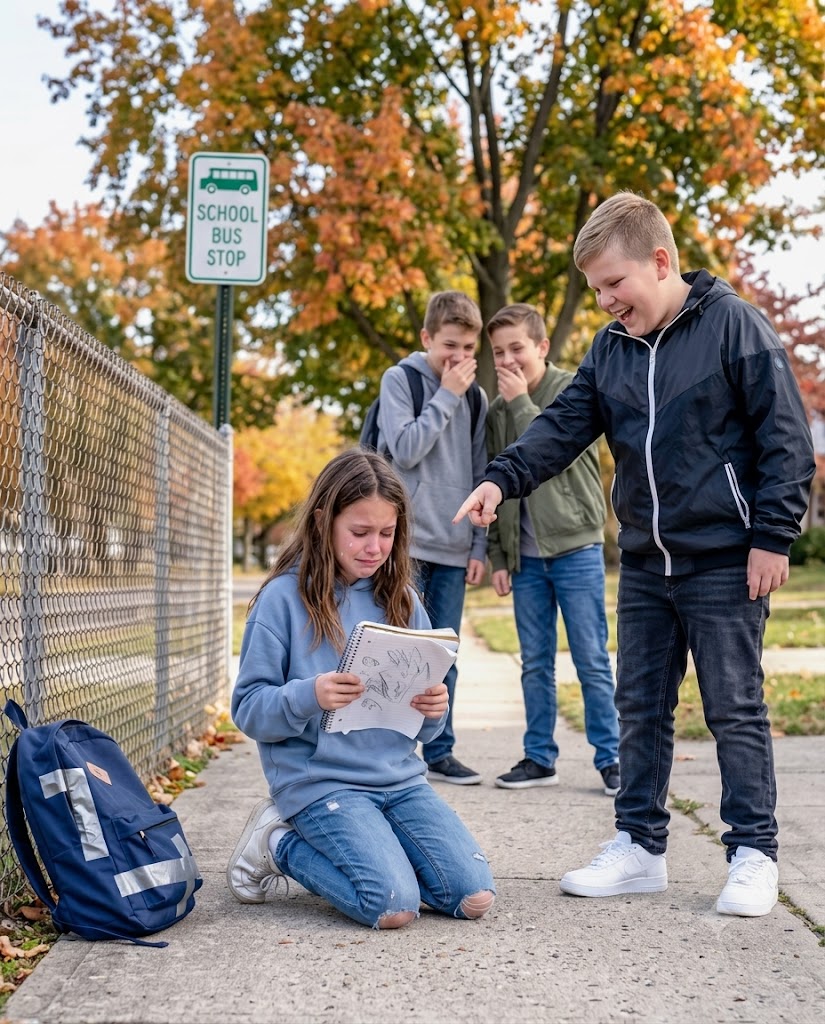
The middle school bus drop-off on Oakidge Lane always smelled like diesel exhaust and damp pine needles.
It was October, the kind of cold that slipped beneath thin cotton jackets and stayed in your bones until dinner.
Khloe adjusted the straps of her backpack.
One buckle was held together with silver duct tape her mother had carefully trimmed with kitchen shears three weeks ago.
It held, but it looked exactly like what it was—a repair made by a woman who had to choose between paying the heating bill or buying a new twenty-dollar bag from Target.
“Hey, Salvation Army.”
Khloe didn’t turn around.
She kept her eyes fixed on the cracked sidewalk, counting the weeds growing up through the concrete fissures.
One. Two. Three.
A hand caught the handle of her backpack and yanked backward.
The sudden stop took the air out of her chest.
She stumbled, her sneakers sliding on a patch of wet gravel before her knees slammed into the curb.
The denim of her jeans—hand-me-downs from an older cousin—shredded instantly.
The sting was sharp, hot, and immediately followed by the warm trickle of blood running down her shin.
Chase Barrett stood over her.
He was twelve, fifty pounds heavier than her, and wore a brand-new windbreaker that swished with every arrogant movement he made.
His father, Dan Barrett, owned half the commercial zoning properties on the east side of town.
Chase carried himself with the careless, heavy assurance of a boy who had never been told no by an adult who mattered.
Two other boys leaned against the chain-link fence behind him, hands shoved deep into their pockets, grinning with the vacant, bored cruelty of suburban kids who had nothing better to do between three o’clock and dinner.
“You dropped your junk, Khloe,” Chase said.
He nudged her notebook with the toe of his trail-running shoe.
It had slid out of her bag when she hit the ground.
The cover was decorated with ballpoint pen sketches of horses and poorly proportioned dogs.
“Leave it alone, Chase,” she said.
Her voice didn’t sound like she wanted it to.
It cracked on the second word, thin and fragile.
Chase stepped on the notebook.
He didn’t stomp on it.
He just placed his full weight on the cardboard cover and ground the tread of his sole into the paper until the spine snapped with a dull pop.
“My dad says your mom missed two months of rent on the duplex,” Chase said casually, shifting his weight.
“He told my mom you guys are getting evicted before Thanksgiving. You going to live in a tent by the interstate? Maybe you can build a fire out of your ugly shoes.”
The other two boys snickered.
A handful of younger kids lingering near the corner looked over, then quickly dropped their eyes and hurried away.
Nobody interfered on Oakidge Lane.
The Barretts donated the field lights to the high school football stadium.
They paid for the police department’s annual charity breakfast.
In a town built on quiet favors and property values, Dan Barrett’s kid was immune to the standard rules of playground justice.
Khloe pushed herself up off the curb.
Her palms were scraped raw with tiny gray pebbles embedded in the skin.
She felt the hot, tight humiliation swelling in her throat—that physical weight that makes ten-year-olds feel like they are going to suffocate right there in the open air.
She hated Chase, but more than that, she hated the absolute certainty in his face.
He knew she had nobody to call.
Her mother worked doubles at the dialysis center until nine every night just to keep the lights on.
The school counselor just handed out laminated pamphlets about conflict resolution that always ended with both kids apologizing.
“You shut up about my mom,” Khloe said, wiping her nose with the back of her dirty wrist.
Chase leaned in close.
He smelled like sour grape gum and expensive laundry detergent.
“Or what? You going to tell your dad? Oh, wait—”
He took off for Arizona five years ago.
Something inside Khloe’s chest finally snapped.
It wasn’t bravery.
It was pure blind desperation—an animal cornered against a chain-link fence, throwing out the only sharp edge it possessed, regardless of whether it would actually cut.
“My uncle is a biker,” she spat, her voice shaking so hard her teeth clicked together.
“He’ll come here. He’ll make you sorry.”
For a second, the bus stop went quiet.
The wind blew a few dead oak leaves across the asphalt, scratching against the road.
Then Chase threw his head back and laughed.
It was a loud, braying sound that echoed off the siding of the nearby houses.
“A biker!” Chase wiped a fake tear from his eye, looking back at his friends who were already chuckling.
“What, like a fat loser on a moped? My dad knows the chief of police, idiot. If some trashy, greasy biker comes anywhere near my house, my dad will have him thrown in county jail before he can even take his helmet off.”
Chase stepped forward, crowding her back against the fence until the wire diamond grid dug into her shoulder blades.
“Tell him to come,” Chase whispered, his grin cold and flat.
“We live at the end of Elmhurst Drive—the big brick house with the iron gates. Tell your uncle to bring his little bicycle. My dad’s security cameras need a laugh.”
He turned and walked away, kicking her ruined notebook into the gutter as he left.
His friends trailed behind him, their high-top sneakers scuffing rhythmically against the pavement.
Khloe stood alone by the curb for a long time.
Her knee was throbbing, the blood drying into a dark, stiff crust on her torn jeans.
She picked up the notebook from the wet leaves in the gutter, tried to press the broken spine flat, and realized some of the pages were torn completely through.
She didn’t cry on the walk home.
Crying took energy she didn’t have.
Instead, she walked with her head down, counting the cracks in the sidewalk all the way to the faded blue duplex at the bottom of the hill.
The duplex was quiet.
It was always quiet between four and eight.
The heat was turned down to sixty to save gas, making the air inside feel heavier and colder than the wind outside.
Khloe dropped her backpack by the front door, kicked off her shoes, and went straight to the small bathroom off the kitchen.
She sat on the edge of the yellowed fiberglass bathtub and used a damp washcloth to clean the gravel out of her palms.
Every time a pebble came loose from the torn skin, she hissed through her teeth.
She looked at her reflection in the medicine cabinet mirror.
Her eyes were red-rimmed, her dark hair tangled from the wind.
She looked small.
She looked exactly like the kind of girl whose notebook you could throw in the gutter without ever facing a single consequence.
She walked into the kitchen and stared at the landline phone mounted to the wall beside the refrigerator.
Below the phone, pinned to the corkboard by a red thumbtack, was a small, creased business card.
It wasn’t white anymore.
Years of cooking grease and sunlight had turned it the color of an old bone.
Printed in simple bold black block letters, it read: Mitch Callahan, “Custom Hydraulics and Machine Repair.”
There was a local phone number written beneath it.
And in the bottom corner, small enough that you wouldn’t notice it unless you looked closely, was a tiny red skull with a winged motorcycle wheel behind it.
Uncle Mitch was her mother’s older brother.
Khloe hadn’t seen him in fourteen months—not since her ninth birthday, when he had pulled up to the curb on a machine that sounded like an earthquake, handed her a twenty-dollar bill wrapped in a clean red bandana, and left before her mother got home from the clinic.
Her mother didn’t hate Mitch, but she feared the world he belonged to.
“Your uncle chose a very hard road, Khloe,” she had explained once while washing dishes.
“And the men he rides with don’t play by the rules normal people need to survive.”
Khloe knew what the red patch meant.
She had seen the documentaries on television—the dramatic voiceovers talking about outlaws, federal indictments, and territory wars.
She knew normal people crossed the street when men wearing the death’s head walked out of a bar.
She pulled the kitchen stool over, stood on it, and lifted the heavy receiver off the hook.
Her fingers trembled as she punched in the seven digits from the creased card.
The phone rang four times.
Each ring sounded louder than the last in the empty kitchen.
She was just about to hang up, terrified that she had made a terrible mistake, when the line clicked open.
There was no polite greeting.
Instead, a blast of background noise flooded through the earpiece—the sharp, rhythmic crack of pool balls colliding, the low rumbling bass of an old jukebox playing Waylon Jennings, and the horse laughter of several men shouting over the music.
“Speak!” a voice growled into the phone.
It wasn’t Uncle Mitch.
The voice sounded like gravel being turned over with a rusty shovel.
“Is—is Mitch there?” Khloe asked.
Her voice barely carried over the jukebox on the other end.
“Who’s asking?”
“Khloe. I’m his niece. Sarah’s kid.”
A pause.
The man on the other end didn’t say, “Hold on.”
He just turned his head away from the receiver and bellowed across the room, loud enough to make Khloe pull the plastic handset away from her ear.
“Brick phone! Some kid saying she’s Sarah’s girl.”
There was a shuffling sound, the clinking of glass against wood, and heavy footsteps approaching.
Then the phone shifted hands and the heavy breathing of a large man filled the line.
Khloe—Mitch Callahan’s voice was deep, slow, and flat.
It didn’t sound like a TV character.
It sounded tired, grounded, and completely devoid of urgency.
“Hi, Uncle Mitch,” she said.
“Your mom okay? She at the hospital?”
“No, she’s at work. She’s fine. Why are you calling the shop, kiddo?”
Khloe looked down at her knees.
The washcloth had left wet pink smudges on the torn edges of her jeans.
She tried to organize the story in her head—to explain about Dan Barrett, the commercial zoning, the field lights at the stadium, and how Chase wore shoes that cost more than her mother’s weekly groceries.
But when she opened her mouth, none of the complicated stuff came out.
“A boy pushed me down at the bus stop,” she said.
A single tear finally spilled over her lower lid and dropped onto the linoleum floor.
“He tore my jeans up and he stomped on my drawing book until it broke.”
On the other end of the line, the jukebox music seemed to fade into the background, though Khloe knew it was just Mitch pressing the receiver closer to his ear.
“You need a doctor?” Mitch asked.
There was no anger in his tone yet.
Just assessment.
“No. Just scraped my knees.”
“Did you tell the school?”
“They don’t care,” Khloe said, wiping her cheek with her shoulder.
“His name is Chase Barrett. His dad owns half the town. He said if we don’t pay rent, we’re going to live in a tent by the highway.”
And she hesitated, feeling the flush of heat rise in her face again.
“And what, Khloe?”
“He told me I was garbage. I told him my uncle was a biker and that you’d make him stop.”
Silence hung on the line for three long seconds.
Someone in the background of the clubhouse shouted about a missed break on the pool table.
“What did the boy say to that?” Mitch asked quietly.
“He laughed,” Khloe whispered.
“He said you were just a fat loser on a bicycle. He said his dad knows the police chief and that if you ever came to his house, they’d throw you in jail before you could get your helmet off. He told me to tell you where he lives.”
Another long silence.
Khloe could hear the faint, rhythmic sound of Mitch scratching his beard—a dry rasping noise against the receiver mouthpiece.
“Where’s he live, kiddo?” Mitch asked.
His voice hadn’t raised half an octave.
It was as calm as if he were asking for the time of day.
“Elmhurst Drive,” she said.
“The big brick house at the dead end with the black iron gates.”
“Okay, Uncle Mitch.”
Panic suddenly fluttered in her chest.
The reality of what she was doing started to sink in.
“Please don’t hurt him. He’s just a kid. If you hit a kid, the police really will put you in jail, and Mom will be so mad at me.”
A low, dry chuckle rumbled down the telephone line.
It wasn’t a mean sound, but it wasn’t warm, either.
It was the laugh of a man who had spent thirty years living in a world where violence was a tool, not a tantrum.
“We don’t touch kids, Khloe,” Mitch said gently.
“That ain’t our business. And your mom’s got enough on her plate without dealing with cops.”
“Then what are you going to do?”
“Nothing you need to worry about. Go wash your knees with soap. Put some antibacterial salve on them if your mom’s got any in the cabinet. Tell your mom I said hello when she gets home.”
“Uncle Mitch—”
“Go on now, kiddo. Do your homework.”
The line clicked dead.
A dial tone hummed steadily in Khloe’s ear.
She slowly hung up the phone and stepped down from the kitchen stool.
She stood in the dim room, the silence of the duplex rushing back in around her, heavier than before.
She felt a sickening wave of disappointment wash over her.
Nothing you need to worry about.
It was adult-speak for I’m not doing anything.
Mitch wasn’t coming.
He was thirty miles away in a smoky bar with his friends, drinking beer and talking about motorcycles.
Why would he ride all the way out to a suburban neighborhood just because his niece got pushed into the dirt?
Chase was right.
Nobody cared about the kids on Oakidge Lane.
The world belonged to men like Dan Barrett, who lived behind black iron gates and paid off the rules with signed checks.
Khloe went to her bedroom, climbed under her thin polyester comforter fully clothed, and stared at the water stain on the ceiling until the shadows in the room turned entirely black.
Thursday afternoon on Elmhurst Drive smelled of cut fescue and expensive cedar mulch.
It was a street designed for quiet.
The houses sat back from the road on two-acre lots, shielded from the rest of the world by neatly manicured private hedges and wrought-iron fencing.
Speed limits were strictly twenty miles per hour, enforced by speed bumps that homeowners association fees had paid to install.
Dan Barrett stood in his paved circular driveway, polishing the side mirror of his imported SUV with a microfiber towel.
Chase sat on the stone steps leading up to the front portico, scrolling through his phone while his father talked at him about an upcoming trip to a lakeside cabin.
At 4:15, the birds stopped singing in the oak trees.
It didn’t begin as a sound.
It began as a vibration in the soles of Dan Barrett’s loafers.
A low, sub-audible tremor hummed through the asphalt, rattling the loose change in the console of his SUV.
Chase looked up from his screen, frowning as the decorative glass lanterns on the stone porch pillars began to buzz faintly against their metal frames.
Then came the noise.
It was a heavy, thudding thunder—mechanical and relentless—rolling up the hill from the main thoroughfare.
It didn’t sound like traffic.
It sounded like an armored column moving through a war zone.
Down at the corner where Elmhurst Drive met the parkway, two motorcyclists turned onto the residential street.
They rode side by side, their front wheels aligned with military precision.
Behind them came four more, then eight, then twenty.
Within ninety seconds, the pristine suburban street was completely filled with iron, rubber, and chrome.
Fifty Harley-Davidsons moved at a crawling, deliberate pace down the asphalt.
There was no revving, no grandstanding, no erratic swerving.
That was what made it terrifying.
It was an orderly, slow-motion invasion.
The riders sat upright, wearing heavy leather cuts over denim jackets or dark hoodies.
On the back of every vest was the same distinct embroidery—the curved red and white rockers, the skull with the winged helmet.
The column reached the dead end of Elmhurst Drive and flowed into a wide formation, entirely blocking the Barrett family’s driveway, their mailbox, and the street in front of their gates.
One by one, the riders kicked their kickstands down.
One by one, the heavy V-twin engines sputtered and died.
The silence that followed was suffocating.
The only sounds left were the ticking of cooling exhaust pipes and the heavy metallic clink of boot heels settling onto the pavement.
The smell of unburned high-octane fuel and hot oil drifted over the manicured lawn, completely masking the scent of cedar mulch.
Dan Barrett dropped his microfiber towel.
His face, usually flushed with the ruddy confidence of a man who played eighteen holes of golf every Saturday, drained to the color of wet chalk.
He instinctively took two hurried steps backward toward his front steps, putting his body partially in front of Chase, who had scrambled to his feet, his phone gripped tightly in a shaking hand.
“What is this?” Dan yelled.
His voice sounded thin and hollow in the open air, lacking its usual boardroom authority.
“Private property! You’re obstructing a residential roadway! I’m calling Chief Miller right now!”
None of the fifty riders answered him.
Nobody reached for a weapon.
Nobody yelled back.
They simply stood by their machines, their faces hidden behind dark sunglasses or thick graying beards, staring straight ahead through the iron front gate.
From the center of the pack, a single rider stepped forward.
He was six-foot-two, broad-shouldered, carrying forty extra pounds of middle-aged weight around his midsection under a faded black canvas jacket.
His beard was trimmed short, salt and pepper, and his left cheek bore a thin, jagged scar that ran from his cheekbone down to the jawline.
He walked up to the black iron gate, stopped two inches from the metal bars, and rested his calloused hands on the ornamental spears at the top.
“Dan Barrett?” the man asked.
His tone was conversational, quiet, and rough.
Dan pulled his cell phone from his pocket, his thumb fumbling violently over the screen.
“You have sixty seconds to clear this street before every squad car in the township is parked on your tails. I know who you people are. You don’t intimidate me.”
The man at the gate didn’t blink.
He slowly reached into his jacket pocket.
Dan flinched, stepping back onto the first stone stair and pushing Chase behind him.
Instead of a weapon, the biker pulled out a battered spiral-bound drawing notebook with a broken cardboard spine.
He held it up through the bars of the gate.
“My name is Mitch,” he said smoothly.
“I’m Sarah Callahan’s brother. I believe your boy left this in the gutter yesterday afternoon.”
Dan Barrett blinked, looking from the ruined notebook in Mitch’s massive hand to the fifty men standing silently in the street behind him.
The threat didn’t compute.
He had expected extortion, a turf dispute, or a robbery—not schoolyard lost and found.
“What?” Dan stammered, lowering his phone slightly.
“Your boy,” Mitch repeated, pointing a heavy, grease-stained finger toward Chase, who was trying to shrink into the shadows of the portico door.
“Chase? That his name?”
Chase didn’t answer.
He was staring at the red and white patch on Mitch’s chest, his breathing shallow and rapid.
The reality of the world had just crashed through his front yard, and it didn’t care about his father’s bank account.
“Look here,” Dan said, trying to muster his outrage, though his voice shook noticeably on the vowels.
“If kids had a scuffle at the bus stop, that is a matter for the school administration. You bringing a gang to my home is a federal offense. I can have you all indicted for harassment.”
Mitch let out a soft, dry sigh.
He tossed the broken notebook over the top of the iron gate.
It landed on the slate walkway with a dull flap, right at Dan Barrett’s expensive leather loafers.
“We ain’t here to break your windows, Dan,” Mitch said.
He leaned his weight forward against the iron bars.
The metal creaked slightly under his mass.
“And we ain’t here to hurt a kid. I told my niece we don’t handle children. But you see, your boy told her something yesterday. He told her she was garbage. He told her you were going to put her and my sister out on the street before Thanksgiving and that I was just a fat loser on a bicycle who’d end up in a cell if I ever showed my face on your block.”
Mitch gestured with one hand toward the fifty motorcycles parked wheel-to-heel across the cul-de-sac.
“I just wanted the boy to see the bicycles,” Mitch said softly.
“I wanted him to understand that the world is a lot bigger and a whole lot harder than this nice brick driveway you built for him.”
Up and down the street, curtains were twitching in upstairs windows.
Neighbors were peering through blinds, nobody daring to step outside or intervene.
Chief Miller hadn’t arrived.
No sirens echoed in the distance.
The police station was four miles away, and even if a cruiser turned onto Elmhurst Drive right now, two local patrolmen wouldn’t dare get out of their car to move fifty Hells Angels off a public street without state backup.
Dan looked down at the notebook at his feet, then back up at Mitch.
The realization hit him with the weight of an anvil.
His money was a paper shield.
Right here, on this afternoon, all the zoning boards and country club memberships in the state couldn’t remove these men from his pavement until they decided to leave.
“What do you want?” Dan asked.
The bluster was entirely gone.
He just sounded tired and frightened.
Mitch shifted his gaze past the father, locking eyes directly with Chase.
The twelve-year-old boy froze, his back pressed hard against the heavy oak front door of his house.
“My sister works fourteen hours a day saving people’s kidneys at the clinic,” Mitch said, his voice dropping an octave, carrying clearly across the quiet lawn.
“She doesn’t ask for favors. She pays her bills when she can, and she raises a good kid. If I ever hear that your boy touched my niece again—if I hear he so much as looks at her shoes or mentions her clothes or says one word about where she lives—I won’t come back with fifty bikes.”
Mitch smiled.
It wasn’t a friendly expression.
It showed a crooked lower tooth.
“I’ll just come back by myself, Mitch. And I’ll sit on your porch until you get home from the golf course, Dan. And we’ll talk about respect between men. You understand me?”
Dan swallowed hard.
His throat bobbed.
He didn’t look at his phone.
He looked at the jagged scar on Mitch’s cheek and nodded slowly.
“I understand.”
“Pick up the book, kid,” Mitch said to Chase.
Chase hesitated, looking at his father for permission or protection.
Dan didn’t move.
Slowly, trembling so badly his knees buckled slightly, Chase walked down the slate steps, knelt on the driveway, and picked up the muddy, broken notebook.
“You buy her a new one,” Mitch said.
“Hard cover with the thick paper. You hand it to her on Monday morning, and you say you’re sorry. If she tells me you didn’t—well, you know what my bicycle sounds like now.”
Mitch turned his back on the iron gate.
He didn’t check to see if Dan was calling the cops.
He didn’t hurry.
He walked back to his motorcycle, swung his heavy booted leg over the saddle, and turned the ignition switch.
Fifty engines roared to life at once—a deafening blast of combustion that shook the autumn leaves from the oak trees overhead.
Slowly, in the same disciplined two-by-two formation that had brought them in, the column turned around in the wide cul-de-sac and rolled back down Elmhurst Drive, leaving nothing behind but a lingering haze of exhaust and the heavy, profound silence of a shattered illusion.
Monday morning at the Oakidge Lane bus stop was cold and crisp.
Khloe stood by the curb, her hands shoved deep into her coat pockets.
Her knees still stung slightly under her jeans, but the scabs were healing.
Down the street, Chase Barrett walked toward the corner.
He wasn’t wearing his windbreaker with the swishing sleeves.
He wore a plain gray hoodie pulled low over his forehead.
He didn’t walk with his friends.
He walked alone, his eyes glued to the sidewalk.
As he reached the bus stop, he stopped three feet away from Khloe.
He didn’t look her in the eye.
With a shaking hand, he reached into his backpack and pulled out a brand-new, thick sketchbook bound in black leatherette, along with a twelve-pack of professional drawing pencils.
He held them out toward her.
“I’m sorry about your book,” Chase muttered to the asphalt.
“And sorry about your leg.”
Khloe looked at the expensive sketchbook, then up at Chase’s pale, quiet face.
She reached out and took the book.
It felt heavy and solid in her hands.
“Okay,” Khloe said simply.
Chase stepped back, walking to the far end of the bus shelter, keeping ten feet of clear space between himself and everyone else.
He didn’t speak another word until the yellow bus pulled up to the curb.
Khloe climbed the steps of the bus, clutching the sketchbook to her chest.
She took a seat by the window, looked out at the sky over the neighborhood, and felt the warm, quiet certainty that no matter how worn her backpack was, she would never have to count the sidewalk weeds again.
Some debts aren’t paid with money.
They’re settled with respect.









