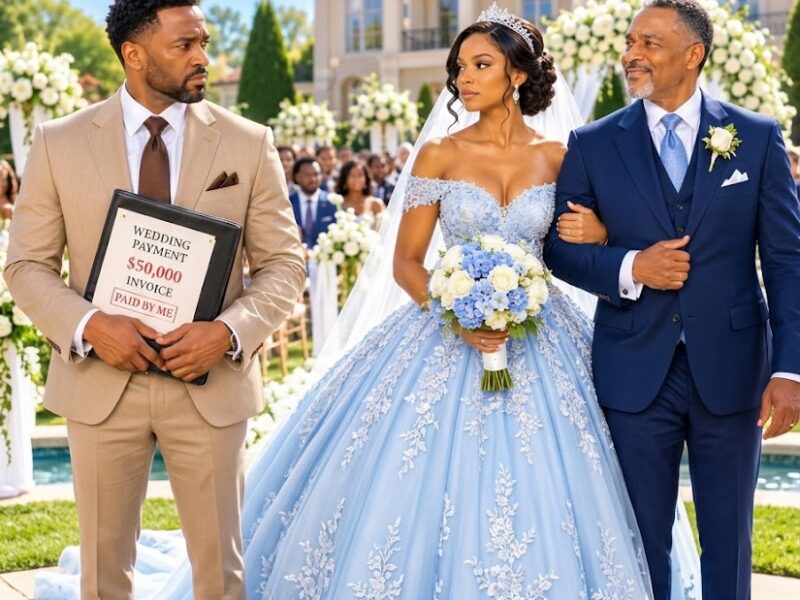
My Stepdaughter Invited Her “Real Dad” to Walk Her Down the Aisle—After I Paid for Her Wedding, I Quietly Pulled Every Dollar
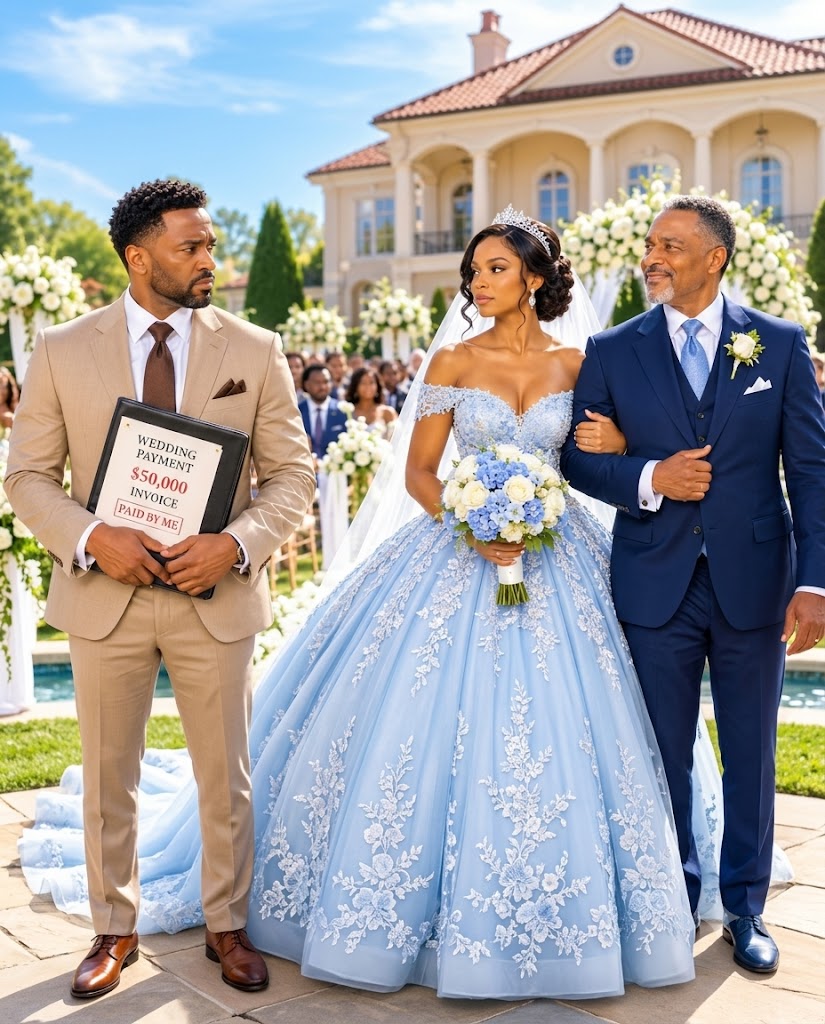
The first call came at 7:42 on a Tuesday morning, and I let it go to voicemail because I was on a job site with a nail gun in my hand and a subfloor that wasn’t going to level itself. By the time I climbed back into my truck, there were four more calls from the same number, plus a text in all caps that said, “URGENT—CALL ME BACK.” The number belonged to a wedding planner named Denise, a woman with a voice like a car alarm and a clipboard full of my money.
I’d been paying her invoices for three months, ever since my daughter Savannah got engaged to a good kid named Logan. The venue alone was a fortune—some restored plantation house on the water outside Charleston where the grass was always green and the chandeliers cost more than my first house. The catering was going to run more than what I paid for my second truck. But I didn’t care, because that’s what fathers do, and for twenty-one years, Savannah had been my daughter in every way that mattered.
She came into my life when she was six, standing behind her mother’s leg in a kitchen that smelled like pot roast, staring at me like I was a door-to-door salesman. Victoria—her mother, my wife—had told me she was shy. Savannah crossed her arms and asked me what my favorite cartoon was, which I later learned was a test.
I passed, apparently, because by the end of dinner she was talking nonstop about school and her teacher and the boy who ate glue. When I started showing up to her soccer games and dance recitals and parent-teacher conferences, I didn’t do it because I had to. I did it because that little girl had chosen me, the same way her mother had, and I wasn’t going to let either of them down.
The wedding planner, Denise, called again while I was sitting in the parking lot of a hardware store, and this time I answered.
“Mr. Caldwell,” she said, and I could hear the panic in her voice, “there has to be some kind of misunderstanding.”
“What misunderstanding?”
“The final payments—the venue, the caterer, the florist—they’ve all been canceled. The wedding is in six days.”
“That’s correct.”
There was a pause on the other end, the kind of pause that happens when someone is trying to figure out if they heard you right.
“But you’ve committed to this wedding,” she said, as if commitment were a contract I couldn’t break. As if I hadn’t been breaking my back for twenty-one years for a child who had recently decided I was just the stepfather.
“No,” I said. “I committed to my daughter. But my daughter has a real father now. Call him.”
I hung up before she could argue, and then I sat in the truck for a long time, staring at the dashboard. The sun was coming up over the harbor, and the city was waking up in that quiet way it does, the sidewalks filling with people walking dogs and jogging and drinking coffee from paper cups. It was the kind of morning that made you feel like everything was going to be okay, which was ironic, because everything was not okay.
The truth was, I had started to wonder who I was paying for. It wasn’t just the wedding. It was everything that had come before it—the private schools and the summer programs and the car and the college tuition and the first apartment. I had never kept score, because keeping score isn’t what fathers do. But something had shifted when Marcus Reed showed up, and I couldn’t ignore it anymore.
Marcus was Savannah’s biological father. He had walked away when she was barely a year old, no phone calls, no birthday cards, no child support, nothing. He was a ghost, and ghosts don’t pay for braces or sit in hospital chairs for three nights when a nine-year-old has the flu. Ghosts don’t teach a sixteen-year-old how to drive or listen to her cry until three in the morning after her first heartbreak. I had done all of that, and I had been happy to do it, because Savannah was my daughter.
But then, three months before the wedding, Marcus reappeared.
He found Savannah on social media, of all things, and she was excited. She was hopeful. She was convinced that he had changed, that he had spent twenty years regretting the way he had left, that he was coming back to make things right. I wanted to believe it, too, because I loved her and I wanted her to have everything she wanted. So when she told us she was meeting him for lunch, I said, “Just be careful,” and I meant it.
Within weeks, something shifted.
She started talking about Marcus constantly—how he remembered this, how he thought that, how he was going to walk her down the aisle. I heard her say it one evening when she was talking to one of her bridesmaids, and I wasn’t supposed to be listening, but I was.
“Marcus is going to walk me down the aisle,” she said.
The bridesmaid asked the obvious question. “What about Ethan?”
There was a pause, and then Savannah sighed. “I love Ethan. But Marcus is my real father.”
Real father. Three words. Three simple words that erased twenty years of sacrifice in a single breath.
I stood in the hallway outside the room and felt something inside me crack. I had been there for every school concert, every soccer game, every graduation. I had paid for private school and college and a car and an apartment. I had held her when she cried, and I had cheered when she succeeded. But none of that mattered, because Marcus had DNA, and I had a stepfather title that apparently didn’t mean anything.
I didn’t confront her that night. I waited until the next morning, when she came over to finalize some wedding details. She was cheerful and happy, completely unaware of what she had said, and I asked her the question I already knew the answer to.
“Who’s walking you down the aisle?”
She looked at me, then looked away, then looked back. “Marcus.”
“Why?”
“Because he’s my father.”
“He disappeared for twenty years.”
“I know.”
“He missed every birthday.”
“I know.”
“He wasn’t there when you were sick or when you graduated or when you needed him.”
“I know.” Her eyes dropped to the floor. “But he’s still my real father.”
I wanted to yell. I wanted to argue. I wanted to remind her of every single thing I had done for her, every dollar I had spent, every night I had sat in a hospital chair or a parking lot or a school auditorium. But instead, I simply nodded.
“If that’s what you want.”
She looked relieved. She hugged me and said, “Thank you for understanding,” and then she left. I sat at the kitchen table for a long time, staring at the same four walls I had stared at for twenty years, and I realized that the little girl who used to call me her hero was now a woman who didn’t know the difference between a father by blood and a father by sacrifice.
Over the following weeks, things got worse. Marcus was given the father-daughter dance. Marcus was given a speech at the rehearsal dinner. Marcus was listed prominently in the wedding program, while my name was nowhere to be found. Then came the family photo schedule, and it became impossible to ignore what was happening. Marcus was in almost every major photo. I was in almost none.
The financial side of the wedding continued to grow. The venue cost a fortune. The catering was luxury. The flowers were designer. Every week another invoice arrived, and every week I paid it, because Ethan always pays, and Ethan always shows up, and Ethan always sacrifices. But something inside me had started changing. Pain has a way of creating clarity, and one evening, sitting alone in my office with invoices covering my desk and a framed photograph of Savannah’s college graduation nearby, I asked myself a question.
If I’m only the stepdad now, why am I still carrying the responsibilities of a father?
The answer was simple. I shouldn’t be.
A week before the wedding, I made a series of phone calls. The venue. The caterer. The florist. The photographer. The band. The transportation company. I canceled every payment, effective immediately. No future invoices. No future obligations. No exceptions.
The wedding planner called within an hour. The venue called next. Then the caterer. Then the florist. My phone wouldn’t stop ringing, but I ignored every call, because for the first time in twenty years, I wasn’t rescuing anyone.
At 1:04 p.m. the next day, Savannah called. I answered immediately, because I knew the conversation was coming and I wanted to have it.
“Dad,” she said, then caught herself. “Ethan.”
That correction hurt more than the word “stepdad” ever had. She had called me Dad for twenty years, and now she was correcting herself because she had decided that word belonged to someone else.
“What is it, Savannah?”
“What is going on? The venue says the remaining balance hasn’t been paid. The caterer says you’re no longer responsible. The florist says the same thing. Why would you do this?”
“Why would I pay for a wedding where I’m treated like a guest?”
Silence. Long, heavy silence. Then, “This isn’t about money.”
“No. It’s about respect.”
“You’re trying to punish me.”
“No, Savannah. This is responsibility.”
“What does that even mean?”
“It means your real father can pay.”
She was quiet for a long time. Then she whispered, “You know he can’t afford that.”
And there it was. The truth everyone knew but nobody wanted to admit. Marcus Reed couldn’t pay for any of it. Not the venue, not the flowers, not the catering, not the photographer, nothing. Because despite all his speeches about fatherhood, he hadn’t actually prepared to be one.
The call ended badly. She cried. I stayed calm. Neither of us changed our position. And for the first time in twenty years, I let her experience the consequences of her own choices.
By that evening, the family drama had become impossible to contain. Victoria stormed into my office, furious.
“Have you completely lost your mind?”
“No.”
“Then explain this.” She threw a stack of invoices onto my desk. The numbers were staggering—more than $100,000 in unpaid balances. “Our daughter’s wedding is falling apart.”
“Then Marcus should help.”
She closed her eyes, and for a moment I thought she might scream. But instead she sat down, and something in her expression changed. Beneath the anger, she looked exhausted.
“Why are you doing this?”
“Because nobody cares what this feels like for me.”
Her eyes filled with tears. “Ethan—”
“Twenty years, Victoria. Twenty years of showing up. Twenty years of sacrifices. Twenty years of loving her like she was my own. And now I’m supposed to fund this celebration while another man takes the credit.”
She lowered her head. For the first time since Marcus returned, she had no argument. Only silence.
Meanwhile, Marcus was becoming increasingly loud. He called me directly the next day, and I almost didn’t answer. Almost. But curiosity won.
“Ethan,” he said, his voice carrying the kind of arrogance that only comes when someone believes they’re winning. “We need to talk.”
“No, we don’t.”
“This isn’t helping Savannah.”
“Interesting. You disappear for twenty years and suddenly you’re an expert on helping Savannah.”
“You need to stop acting emotionally.”
That word nearly made me choke. The man who abandoned his daughter was calling me emotional.
“How much have you contributed to the wedding, Marcus?”
Silence.
“How much?”
More silence. Then, “That’s not the point.”
I smiled. Actually smiled. Because his response told me everything. Zero. The answer was zero. Not a dollar, not a penny, not one single contribution. Yet somehow he had become the hero, the father, the honored guest, the man receiving all the praise.
I ended the call shortly afterward, because there was nothing left to discuss.
The following days became absolute chaos. Guests started hearing rumors. Family members started taking sides. Social media posts appeared. Relatives called constantly. Everyone wanted details, everyone wanted answers. Some supported Savannah. Some supported me. Some blamed Marcus. Others blamed Victoria. The wedding was no longer a celebration. It had become a battlefield, and the truth was slowly emerging.
Marcus wasn’t interested in rebuilding a relationship. He was interested in recognition, attention, validation—the title of father, but not the responsibilities. Never the responsibilities.
Three nights before the wedding, Savannah met Marcus privately. I wasn’t there, but later Victoria told me exactly what happened. Savannah had finally asked him the question she should have asked weeks earlier.
“Can you help save the wedding?”
Simple question. Reasonable question. The response? A list of excuses. Investments tied up. Unexpected expenses. Bad timing. Future opportunities. Promises. More promises. And even more promises. But no money. No solutions. No action.
For the first time, Savannah saw him clearly. Not as the fantasy she had created. Not as the father she had imagined. As the man he actually was. A man full of words and empty of responsibility.
The next day she called me. I didn’t answer. Then she called again, and again, and again. Seven missed calls, three voice messages, multiple texts. I ignored them all, because for the first time in twenty years, I wasn’t rushing in to save her.
That night, around 10:30, there was a knock at my front door. I opened it and froze.
Standing on the porch was Savannah. Her makeup was ruined, her eyes were swollen, and tears were running down her face. She looked nothing like the confident bride from a few weeks earlier. She looked like a little girl again. The same little girl who used to run into my arms whenever life hurt.
For several seconds, neither of us spoke. Then she whispered something I never expected to hear.
“Dad.”
And before I could respond, she broke down completely.
I stepped aside. “Come inside.”
She walked into the house slowly, quietly, like someone carrying the weight of the world on her shoulders. We sat across from each other at the kitchen table, the same table where I had helped her with homework, the same table where we had celebrated birthdays, the same table where we had planned college applications. Years of memories surrounded us, yet the silence felt heavier than anything I had ever experienced.
Finally, Savannah spoke. “I was wrong.”
I said nothing.
She wiped her eyes. “I thought I knew what I was doing.”
I remained silent, because for once, I needed her to say everything. Not for me, for herself.
“When Marcus came back, I was excited. I spent my whole life wondering why he left. I kept imagining what it would be like if he came back. And when he finally did, I wanted everything to be perfect. I convinced myself I could get back everything I missed. But you can’t recover twenty years in three months.”
“No,” I replied quietly. “You can’t.”
She nodded. Then she looked directly at me. For the first time in weeks, maybe months, she actually looked at me. And what I saw in her eyes wasn’t pride. It wasn’t stubbornness. It was regret. Deep regret.
“I hurt you.”
“Yes.”
Fresh tears appeared. “I know.”
“You didn’t just hurt me, Savannah. You erased me.”
The words landed hard. I could see it, but they were true, so I continued. “I never expected praise. I never expected recognition. I never expected repayment. Nothing. But I expected respect.”
“I know.”
I leaned forward. “This was never about walking you down the aisle.”
She looked surprised. “It wasn’t?”
“No. It was about what your decision represented. When you chose Marcus, you weren’t just choosing who would escort you. You were telling me that everything I sacrificed mattered less than biology.”
The kitchen became completely silent. Because there was no argument against that. No defense. No explanation. Just truth. And truth can be painful.
After several moments, Savannah whispered, “I’m sorry.”
I believed her. Not because of the words, because of the way she said them. There was no manipulation. No excuses. No blame. Just genuine remorse.
Then she said something unexpected. “Marcus isn’t who I thought he was.”
“No.”
“He kept making promises. Every time there was a problem, he had another excuse.” She laughed sadly. “You know what finally opened my eyes?”
“What?”
“When I asked him to help save the wedding. He couldn’t. He never intended to.”
And there it was. The realization. The painful truth. Marcus loved the title, but not the responsibility. He wanted the applause, not the sacrifice. The spotlight, not the work. The credit, not the commitment. The exact opposite of fatherhood.
A few minutes later, Savannah asked the question she had come to ask, the question hanging between us all night.
“Will you come to the wedding?”
I looked at her, really looked at her. Part of me wanted to say no. Part of me wanted to protect myself. Part of me wanted to walk away. But another part remembered every school play, every birthday, every graduation, every moment.
“I’ll come.”
She immediately started crying again. Then she stood up and hugged me, the same way she used to when she was little. For the first time in months, it felt genuine.
The wedding day arrived, and Charleston was beautiful. Blue skies, warm sunshine, a gentle breeze rolling in from the harbor. Guests filled the venue. Everyone knew there had been drama. Nobody knew how things would end. The atmosphere was tense. Whispers spread through the crowd. People exchanged nervous glances, waiting, watching, wondering.
Then the ceremony began. Music started playing. Everyone stood. The doors opened, and Savannah appeared. She looked incredible. But what happened next shocked every person in attendance.
Because she wasn’t walking. She was standing still. Alone.
The entire room became silent, confused. Even the officiant looked uncertain. Then Savannah turned toward the guests. She took a microphone and began speaking. Her voice trembled, but she kept going.
“I need to say something before this ceremony continues.”
The room became completely silent.
“I owe someone an apology.”
My stomach tightened. She looked directly at me. Across hundreds of guests, across the entire venue, right at me.
“For years, I believed being a father was about blood.”
People exchanged glances. Nobody moved. Nobody spoke.
“I was wrong.”
I saw Marcus sitting several rows away. His expression immediately changed. Savannah kept speaking.
“My biological father gave me life. But another man gave me everything else.”
The room was completely silent now. Many guests were already crying, including Victoria. Then Savannah said the words I’ll never forget.
“The man who taught me how to ride a bike, the man who helped me with homework, the man who paid for school, the man who sat beside hospital beds, the man who showed up every single day. That’s my father.”
I felt my throat tighten. Years of emotions crashed into me at once. Then Savannah stepped off the platform and started walking toward me. The entire room watched. Nobody breathed. Nobody moved.
She stopped directly in front of me. Tears streamed down her face. Then she held out her hand.
“Dad. Will you walk me down the aisle?”
At that moment, I wasn’t angry. I wasn’t hurt. I wasn’t thinking about money, or Marcus, or the wedding. I was thinking about the little girl who once told me I was always there. And maybe, just maybe, she finally understood why.
I stood, took her hand, and together we walked toward the altar. The room erupted into applause. Guests stood. Many were openly crying. Even Logan looked emotional. As for Marcus, he quietly left before the ceremony ended. Nobody stopped him. Nobody followed him. For once, there was no spotlight waiting for him. Only consequences.
The ceremony was beautiful. The reception was unforgettable. And for the first time in months, our family felt whole again. Not because everything was perfect, because truth had finally won. And sometimes that’s enough.
Today, Savannah and Logan are happily married. Victoria and I are stronger than ever. And Savannah never calls me her stepfather. Not anymore. She introduces me the same way every single time. With a smile. With pride. With certainty.
“This is my dad.”
And honestly, that’s all I ever wanted.









