My stepdaughter chose her “real dad” for her graduation—so I stopped paying her college tuition. Then she called me crying.
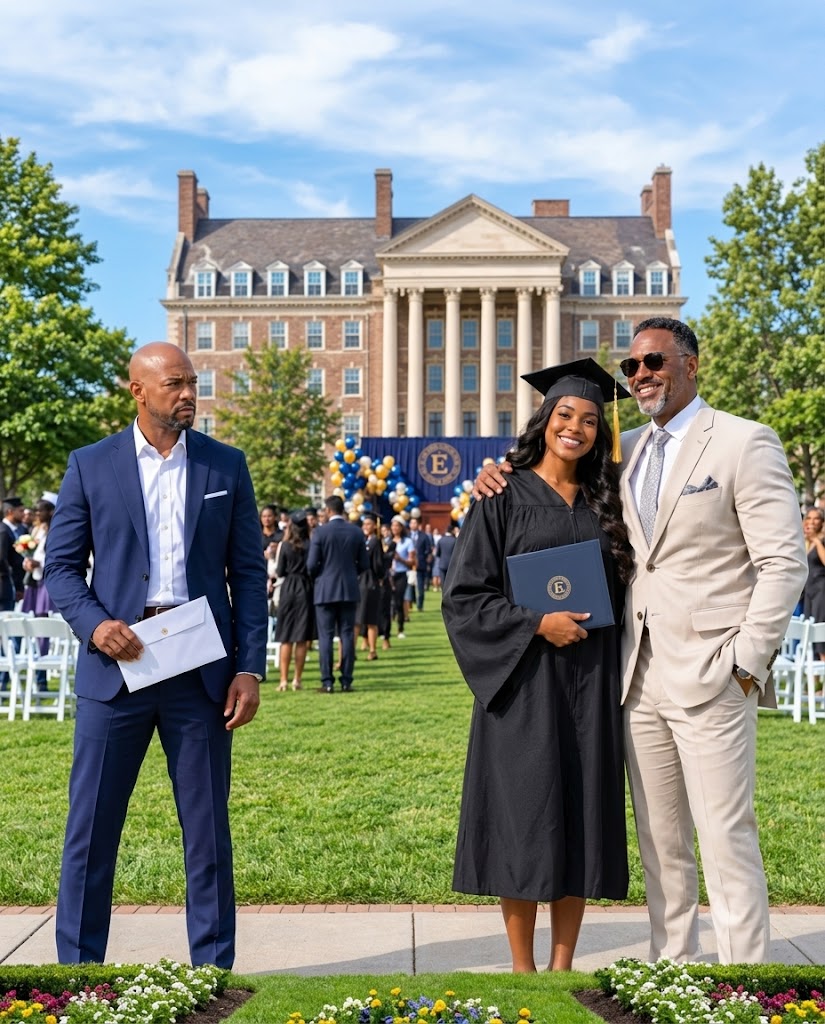
“Can you move? I want my real dad in the picture.”
The words hit me square in the chest on the sunlit lawn of Hartwell University, surrounded by blue and gold balloons and the low murmur of proud families.
I had paid every tuition bill for four years.
I had driven four hours when she called crying that she wanted to quit.
I had sat twelve rows behind the reserved section while her biological father took the family seat.
And now, on the day I had imagined since she was eight years old, she was asking me to step out of the frame.
“Your real dad?” I asked.
“Please don’t start,” Maya said, her voice tight.
“You’re my stepfather. He’s my father.”
I looked at the white envelope in my hand—the final tuition payment I had carried in my jacket like a promise.
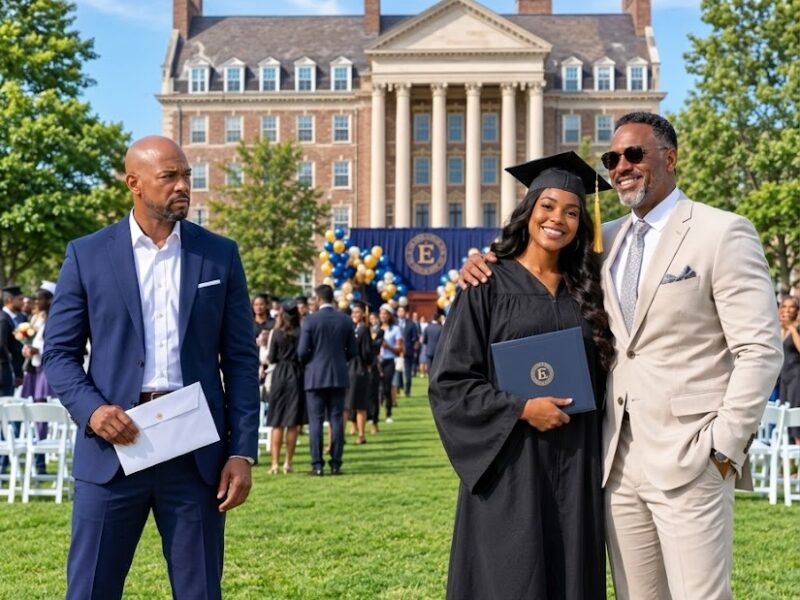
Then I looked at Terrence, standing beside her in his beige suit and sunglasses, his arm already curling around her shoulders.
“After I raised you and paid for everything?”
“I never asked you to replace him.”
“So I’m just the man who paid the bills?”
She didn’t answer right away.
“I didn’t say that,” she finally said. “I just want this picture with my dad.”
Something inside me went very quiet.
“I understand,” I said. “Then maybe it’s time he handles the remaining tuition.”
Her face changed.
“Wait—what do you mean?”
“I decided this morning that I won’t be making the next payment.”
“You’re serious?”
“Completely.”
She stared at me, and for a moment I saw the eight-year-old girl on my work boots, asking me to be her dad for one night.
Then her expression hardened.
“But there’s something else you should know,” she said.
“What?”
“You can stop paying if you want. Money was the only reason you ever mattered here anyway.”
The words landed like a slap.
Before I could respond, I said the thing I had been holding back for weeks.
“Before you take that picture, ask your dad why he came back into your life right after he learned I had changed my will.”
Terrence went still.
Maya’s eyes moved from me to him.
And the silence that followed was louder than any applause.
—
The first time Maya called me dad, she was eight years old.
And technically, she wasn’t talking to me.
It was a Friday evening in October, and her elementary school had organized a father-daughter dance. For two weeks, Maya had talked about almost nothing else.
Her biological father, Terrence, had promised he would be there.
She wore a little blue dress her mother, Nicole, had spent half the afternoon fixing. Every time headlights crossed the living room window, Maya jumped up.
“Is that him?”
“No, baby,” Nicole would say. “Not yet.”
Seven o’clock came. Then seven-fifteen. Then seven-thirty.
Terrence stopped answering his phone.
I was still in my work clothes when I found Maya sitting on the bottom stair, staring at her silver shoes.
“He said he’d come, Marcus.”
I sat beside her.
“I know.”
“Maybe something happened.”
“Maybe.”
I refused to tell her what I suspected. A child shouldn’t have to carry an adult’s disappointment before she’s old enough to understand it.
She looked at the clock. The dance had already started.
Then she looked at me.
“Marcus?”
“Yeah?”
“Can you be my dad tonight?”
For a second, I couldn’t speak.
I had been with her mother for almost two years. I helped with homework and made pancakes on Saturdays, but I had never tried to become her father. That title wasn’t mine to take.
So I crouched in front of her.
“I can be whatever you need me to be tonight.”
Her little hand slipped into mine.
“Then hurry. We’re late.”
Twenty minutes later, I walked into that school gym in work boots.
Maya didn’t care.
During the slow dance, she stood on my shoes. Halfway through, she looked up.
“Dad, you’re going too fast.”
Then she froze. Her eyes widened.
“Sorry, I didn’t mean—”
“Hey,” I smiled. “You want me to slow down or not?”
A tiny smile returned.
“Yeah.”
“Then that’s all you had to say.”
She wrapped her arms around me again.
Neither of us mentioned what she’d called me.
The next morning, she called me dad again. This time, she didn’t apologize.
—
Before I tell you how she went from asking me to be her dad to saying I wasn’t her father, answer this.
What makes a real parent? Blood or the person who stays?
Tell me below and subscribe.
—
Her graduation changed everything I believed about family.
Nicole and I married the following spring, but a marriage certificate wasn’t what made Maya my daughter. It was ordinary days.
I picked her up from school. I helped with homework. I sat beside her when she was sick, taught her to drive, and waited outside her bedroom with ice cream after her first heartbreak.
I wasn’t perfect, but I was there.
Terrence remained around the edges of her life. He would call often for a week, then vanish for months. He sent gifts and made promises, but too many important seats stayed empty.
I never used that against him.
Once, after he missed her academic award ceremony, Maya asked, “Why don’t you hate him?”
“Because loving you isn’t a competition,” I told her.
I meant it.
Years later, I would wonder whether being so careful not to compete had stopped me from seeing what was coming.
When college application season arrived, our dining room table disappeared beneath brochures. Maya wanted Hartwell University. She had wanted it since sophomore year.
The problem was the cost.
When the acceptance email arrived, Maya came flying downstairs with her laptop.
“I got in!”
Nicole screamed. Maya screamed.
Then she jumped into my arms.
Later that night, I found her alone at the kitchen table staring at the tuition estimate.
“What happened to the celebration?”
She closed the laptop.
“It’s too expensive.”
“We’ll figure it out.”
“No, Dad. I can go somewhere cheaper. I don’t want you and Mom spending all that on me.”
I pulled out the chair opposite her.
“Is Hartwell where you want to go?”
“Yes.”
“Did you earn your place?”
“Yes.”
“Then listen to me. As long as you do your part, you will never have to walk away from your future because of money.”
Her eyes filled.
“You don’t have to do that.”
“I know.”
“That’s a lot of money.”
“I know that, too.”
She came around the table and hugged me.
“I don’t know what I’d do without you, Dad.”
I kissed the top of her head.
“You’re never going to have to find out.”
For three years, she worked hard and kept me close. I paid all costs.
Then, during her senior year, Terrence came back.
Really came back.
Not birthday-text Terrence. Not promise-and-disappear Terrence. He called constantly, took Maya to expensive restaurants, bought gifts, and posted photographs of them together.
When Maya said they were rebuilding their relationship, I hugged her.
Later, Nicole asked if I was really okay with it.
“If he’s serious this time, I’m not standing in the way. She deserves every person who’s willing to genuinely love her.”
At first, I believed he was.
Then small things changed.
Maya stopped calling me before exams. When I asked about graduation, her answers became vague. Around her college friends, Terrence became “my dad.” Somehow, I became “my stepdad.”
Sometimes, she simply called me Marcus.
I noticed.
I told myself not to notice.
One night, my phone lit up beside the bed. Maya had posted a graduation photo. She was standing beside Terrence, his arm around her shoulders. The caption read, “Four years of hard work. Can’t wait to make my dad proud.”
I stared at those words longer than I should have.
The next morning, Nicole found me drinking coffee alone.
“You saw it.”
I nodded.
“Talk to her.”
“About what?”
“Being happy her father came back.”
“You know that’s not what I mean.”
I forced a smile.
“She deserves to be happy.”
But three days before graduation, I opened the desk drawer looking for the final tuition paperwork and found Maya’s graduation packet.
Two reserved family passes were clipped to the front. The first had Nicole’s name. The second had Terrence’s.
Mine wasn’t there.
I called Maya. She answered on the fourth ring.
“Hey, Marcus.”
Not dad. Marcus.
“Can I ask you something?”
“Sure.”
“I’m looking at your graduation packet. Why does Terrence have the second family pass?”
Silence.
“I was going to explain.”
“Then explain.”
She exhaled.
“Dad wants the family seat.”
I looked down at the name printed beneath Family Reserved.
“And what am I?”
“Marcus.”
“Please don’t make this difficult.”
“I’m asking you a question.”
“You can still come.”
Something tightened in my chest.
She continued. “You just won’t be sitting with us.”
I didn’t argue. I didn’t remind her who had attended every parent weekend. I didn’t mention the final tuition statement sitting six inches from my hand.
I simply said, “Okay.”
After we hung up, I opened the drawer again. Inside was a large white envelope containing the paperwork for the final payment I had promised to make—a payment of $32,000 that would clear her entire senior-year balance.
For fourteen years, I had never questioned whether Maya was my daughter.
That night, for the first time, I wondered if I had completely misunderstood who she believed I was.
—
Graduation morning should have felt like a victory.
For four years, I had imagined Maya crossing that stage. When I woke before my alarm, I told myself one reserved seat would not ruin the day.
Nicole was already awake.
“You’re still going?” she asked.
“Of course I’m going.”
She studied me.
“Marcus, about the seating—”
“Today is about Maya.”
I dressed carefully, then opened my desk drawer. The white envelope was still there, holding the documents for Maya’s final tuition payment.
I slipped it inside my jacket.
I had made her a promise.
Hartwell’s campus glowed beneath the afternoon sun. Blue and gold balloons framed the stage. White chairs covered the lawn, and families carried flowers and cameras.
Then I saw Maya.
She stood beneath an oak tree in her black gown and cap. For one second, I saw the eight-year-old girl in silver shoes standing on mine.
“There’s our girl,” Nicole whispered.
Maya saw us.
“Mom!”
She hurried over and hugged Nicole, then turned to me.
“You look nice, Marcus.”
Marcus again.
I smiled.
“You owe me a graduation picture.”
“We’ll take plenty.”
I handed her flowers.
“Congratulations, kiddo.”
“Thank you.”
Then a black sedan stopped nearby. Maya looked past me.
“Dad!”
She ran toward Terrence.
He stepped out in a beige suit and sunglasses and opened his arms.
“There’s my graduate.”
He put an arm around her.
“I always knew my baby would make me proud.”
I remembered the nights Maya called me over assignments and the four-hour drive when she wanted to quit.
I swallowed it.
Maya deserved a happy day.
Nicole sat beside Terrence in the reserved section. I sat twelve rows behind them.
When Maya’s name was announced, I stood up.
“Maya Bennett.”
She crossed the stage smiling. I clapped until my palms stung.
Terrence stood, too.
“That’s my daughter.”
A woman beside him smiled.
“You must be one proud father.”
“The proudest,” he said.
Afterward, Maya posed with classmates, Nicole, then Terrence.
I waited.
One photograph became five. A photographer called, “Dad, get closer to your daughter.”
Terrence wrapped an arm around her.
Nicole touched my arm.
“Go get in one.”
“I’ll wait.”
“You shouldn’t have to.”
Before I answered, Maya waved.
“Mom, come here.”
Nicole joined them. The three posed together.
Then Nicole looked at me.
“Marcus, come on.”
I stepped forward.
Maya’s smile faded.
“Actually, can you give us a minute?”
I stopped.
Nicole frowned.
“Maya.”
“I just want one with Mom and Dad first.”
I looked at her.
“Mom and Dad?”
“You know what I mean.”
“No, I’m not sure I do.”
Her voice dropped.
“Please don’t make this awkward.”
“I’m not trying to.”
“I want this picture with my real dad.”
There it was. Not biological dad. My real dad.
“Your real dad?” I asked.
“Marcus, please.”
Nicole stepped closer. “Watch how you’re talking to him.”
“Mom, I’m not doing anything.”
I raised a hand. “Let her speak.”
I looked at Maya.
“What are you trying to tell me?”
“That he’s my father.”
“I never said he wasn’t.”
“And you’re my stepfather.”
The word landed harder than I expected.
“I know what the paperwork says.”
“Then why are we doing this?”
“Because until recently, I thought we both understood paperwork wasn’t what made us family.”
She glanced toward her friends, embarrassed.
“Can we not do this here?”
“You stopped me from joining a family picture. Where should we do it?”
Terrence finally spoke.
“Man, it’s her day. Let her have the picture she wants.”
I turned to him.
“I’m talking to my daughter.”
Maya’s expression hardened.
“See? That’s what I mean.”
“What?”
“You keep calling me your daughter like you have something to prove.”
“I’ve called you my daughter since you were eight.”
“Well, things are different now.”
Nicole whispered, “Maya, stop.”
Maya shook her head.
“You really need to accept that paying for things never made you my father.”
Everything around me disappeared.
I saw an eight-year-old asking me to be her dad.
Then an eighteen-year-old hugging me in our kitchen.
My hand moved inside my jacket and touched the envelope.
“Is that what you think I was doing?” I asked.
“What?”
“Paying for things so I could be your father.”
“I didn’t say that.”
“You just did.”
She crossed her arms.
“Money doesn’t change biology.”
“I agree.”
That surprised her.
“Terrence is your biological father. I never asked you to choose between us.”
“Then why are you hurt?”
“I’m not hurt because you want him in the picture.”
I looked at the space beside her.
“I’m hurt because you decided I needed to be out of it.”
Guilt crossed her face.
Then Terrence said, “Let’s just take the photo.”
Something inside me became calm.
I removed the white envelope.
Maya looked at it.
“What’s that?”
“The final tuition payment.”
Her eyes dropped to it.
I nodded slowly.
“You’re right, Maya. Money doesn’t make a man your father. So I’m going to stop confusing the two.”
“What does that mean?”
“It means Terrence can handle the remaining tuition.”
She stared at me, then laughed once.
“Seriously?”
“Completely.”
“Because of a picture?”
“No.”
“Because I called him my real dad?”
“No.”
“Then what?”
“Because you just told me exactly how you see me.”
Her voice sharpened. “You promised to pay.”
“I promised the girl I raised that she would never have to leave school because of money.”
Her mouth opened.
“But I won’t be reduced to a bank account while pretending that’s a family relationship.”
Terrence laughed under his breath. “This is petty.”
“Then it shouldn’t be a problem.”
His smile disappeared.
“What’s that supposed to mean?”
“You’re her real dad. There’s a balance left. Handle it.”
Maya looked stunned.
“You can’t decide this today.”
“I already decided this morning.”
Her face changed. “You canceled it?”
“I stopped the payment.”
“Dad.”
She caught herself. She had called me dad. I heard it. So did Terrence.
Maya shook her head. “You’re proving my point. You think money gives you control.”
“No. Walking away from the money is me giving up control. You can’t buy your way into being somebody’s father.”
“You’re right.”
She blinked.
Then I looked at Terrence. His confidence had changed. His jaw was tight now, the same way it had been three weeks earlier when he realized I knew something he thought was hidden.
“There’s something you should know before you take that picture,” I said.
Terrence interrupted. “Maya, ignore him. Today is your day.”
Nicole looked between us. “Marcus, what are you talking about?”
I had kept quiet because I wanted proof before saying anything. Now I had it.
Maya stepped closer. “What do you know?”
I looked at the girl I had raised, then at the man she had chosen to stand beside her.
“Before you take that picture, ask your dad why he came back into your life right after he learned I had changed my will.”
Terrence went completely still.
Maya’s eyes moved from me to him.
“Dad?”
For the first time that afternoon, Terrence had nothing to say.
—
For several seconds, none of us moved.
Maya turned to Terrence.
“What is he talking about?”
Terrence adjusted his sunglasses.
“Nothing. Marcus is upset.”
“I asked you a question.”
“Maya, today isn’t the time.”
Her face changed.
“Then there is something.”
Nicole looked at me. “Marcus?”
I lowered the white envelope.
“Six months ago, Nicole and I updated our estate plan.”
Maya frowned. “Your will?”
“Yes.”
“Why would Dad know about your will?”
“That’s what I’ve been waiting for him to answer.”
Terrence scoffed. “I don’t know anything about your finances.”
“Then you won’t mind if I explain.”
He went quiet.
I faced Maya.
“Years ago, I included you in my estate. If something happened to me, you would have the same financial security I’d give a biological child.”
Her eyes widened. “You never told me.”
“You weren’t supposed to plan your life around money you might never receive.”
Maya looked at Terrence. “How did he hear about it?”
“My accountant has a brother named Calvin. Calvin knows Terrence. At a charity dinner last winter, my accountant mentioned that I had updated my estate. No amounts, no private details, but Calvin knew I’d raised you.”
Terrence shook his head. “That proves nothing.”
“No, by itself it doesn’t.”
I took out my phone.
“Three weeks later, you suddenly started rebuilding your relationship with Maya. Coincidence? That’s what I wanted to believe. Then Calvin contacted me two weeks ago because he felt guilty about a message you sent him.”
Terrence’s jaw tightened.
Maya whispered, “What message?”
I hated what came next. Whatever Maya had said to me, I still remembered the little girl waiting by a window for this man.
“Maya, you may not want to hear this here.”
“No, finish it.”
I opened the screenshot.
Terrence asked Calvin, “If Marcus put Maya in the will, are we talking enough for her to be set for life?”
Maya’s diploma folder lowered.
Terrence removed his sunglasses.
“Maya, listen to me.”
“You asked that?”
“It wasn’t like that.”
“Yes or no?”
He hesitated.
“Yes.”
Maya stepped backward.
Terrence spoke quickly. “I asked one question. That doesn’t mean I came back because of money.”
“Then why did you come back three weeks later?”
“Because hearing about your future made me realize how much of your life I’d missed.”
“So the money had nothing to do with it?”
His hesitation answered first.
“I was curious.”
“About my inheritance?”
“Partly, but once we started spending time together, none of that mattered. I wanted my daughter back.”
Maya stared at him, struggling between the father she had wanted and the truth standing in front of her.
Terrence sighed. “This is ridiculous.”
Maya turned to him. “Leave.”
His eyebrows rose. “What?”
“I need to think.”
“Maya, please.”
For the first time that day, she stepped away from him.
Terrence stared at me. “This is what you wanted.”
“No. If I wanted this, I would have shown her your message two weeks ago.”
He put his sunglasses back on.
“Call me when you’re ready to hear my side,” he told Maya.
She didn’t answer.
After he disappeared into the crowd, Maya wiped away a tear.
“Is that why you changed your will?”
“No.”
“Then what did you change?”
Nicole and I exchanged a glance.
There was another part of the story.
“Maya,” Nicole said softly, “Marcus didn’t put you in his will six months ago. He updated the documents six months ago. You’ve been included for years.”
“How many?”
“Since you were eleven,” I said.
Her lips parted. “Eleven? You and Mom had barely been married two years.”
“I know.”
“Why?”
“Because by then, I already knew what you were to me.”
She looked down.
I thought Nicole would stop there. She didn’t.
“There’s something else she deserves to know.”
“Nicole.”
“No, Marcus. Not after today.”
Maya looked between us. “What?”
Nicole took her hand.
“When you were fifteen, you were supposed to spend that summer with Terrence. He canceled because his company transferred him. That wasn’t true.”
Maya looked at me.
Nicole continued. “Terrence was in serious financial trouble. He was behind on rent, support payments, and other bills. He was about to lose his apartment.”
“What does that have to do with Marcus?”
“Marcus paid what Terrence owed.”
Maya went still. “You gave him money?”
“I helped him get stable.”
“Why? Because he was your father.”
“That makes no sense.”
“It did to me.”
“After all the times he disappointed me, you helped him?”
“I wasn’t helping him for him. I was helping him for you.”
Her eyes filled.
Nicole said, “Marcus made Terrence promise never to tell you. He didn’t want you growing up believing your biological father only stayed in your life because your stepfather rescued him.”
Maya covered her mouth.
Then she frowned. “That summer, Terrence suddenly started calling me every day.”
I nodded.
“And he bought me that laptop.”
I said nothing.
Her eyes locked on mine.
“No, tell me you didn’t.”
I couldn’t.
“The money came from me.”
She backed away. “That laptop was from Dad.”
“I know.”
“He gave me a card saying he would always make sure I had what I needed. I remember.”
“You paid for it and let him take the credit.”
“Yes.”
“Why?”
“Because you were fifteen. You didn’t need another reason to believe your father didn’t care.”
She shook her head. “All these years, whenever somebody said he never did anything for me, that laptop was what I remembered.”
“I know.”
“And you never corrected me.”
“No.”
Nicole’s eyes filled. “That wasn’t the only time.”
I turned. “Nicole.”
Maya looked up. “What do you mean?”
“Your sixteenth birthday trip. The money Terrence said he contributed. Marcus covered it.”
Maya stared at me.
“The ticket Dad used to come to my high school graduation?”
I looked away.
Her voice dropped. “You paid for that, too.”
I nodded.
She pressed both hands against her temples.
“So every time I thought he had finally chosen me—”
“No,” I interrupted. “Don’t do that to yourself. Whatever his failures were, his feelings belong to him. I only made sure money wasn’t the reason he stayed away.”
“But he let me believe it was all him.”
I had no answer.
Maya bent down and picked up her diploma folder.
“I need to talk to him.”
Nicole reached for her. “Not while you’re this upset.”
“Yes. Now.”
Her phone vibrated.
Terrence.
She stared at the screen.
Then her expression changed.
“What?” Nicole asked.
Maya didn’t answer. She turned the phone toward us.
Terrence had apparently meant to send the message to someone else. It read: “Graduation blew up. Marcus told her about the will. I need to know if she’s still getting her share before I waste any more time fixing this.”
Maya read it twice.
The color drained from her face.
Seconds later, Terrence deleted it and sent another message.
“Sorry, wrong person.”
Too late. Maya had already seen it.
She slowly raised her eyes to me, and for the first time that day, she didn’t call Terrence her real dad.
—
Maya stared at Terrence’s message until the screen dimmed.
“Before I waste any more time fixing this,” she whispered.
Nicole reached for her, but Maya stepped away.
“No. I need to hear him say it.”
She called Terrence. He answered immediately.
“Baby, that message wasn’t meant for—”
“For me?”
Silence.
“Who was it meant for, Dad?”
“Maya, you’re emotional.”
“Answer me.”
“It was private.”
“About my inheritance.”
Terrence exhaled. “You’re twisting this.”
“I’m reading your words. Did you come back because you thought I was getting Marcus’s money?”
“No.”
“Then why did you ask if I was still getting my share before you wasted more time on me?”
He didn’t answer.
Maya’s voice cracked. “Where were you when I waited for you at my recital? Where were you on my fourteenth birthday? When I got into Hartwell? When I almost dropped out?”
“I made mistakes.”
“Marcus drove four hours because I called him crying. You didn’t even know.”
“Nobody told me.”
“You could have called.”
That silenced him.
“I was ashamed,” Terrence said.
“Then I heard about the will. Money got my attention.”
Maya closed her eyes.
“But seeing you again changed something. I did want my daughter back.”
“Then why send that message?”
Another silence.
“Because I’m still not the man I keep pretending to be.”
Maya ended the call.
For several seconds, she just stood there. Then she faced me.
“Did you stop the tuition because you knew all this?”
“No.”
“Then why?”
“Because of what you said.”
“So this is punishment?”
“No.”
“It feels like it.”
“I understand.”
“Then pay it.”
Nicole whispered, “Maya.”
I shook my head. “No.”
She stared at me. “I didn’t stop paying because you love Terrence. I didn’t stop because you wanted a photograph with him. He’s your biological father. You have every right to love him.”
“Then why?”
“Because you looked at fourteen years of our relationship and reduced them to a checkbook, then expected the checkbook to stay open.”
Her eyes dropped.
“I promised to support my daughter. I never promised to finance someone who tells me I’m only useful when a bill arrives.”
“That’s not what I meant.”
“It’s what you said.”
“I was angry.”
“Words spoken in anger still belong to us.”
She looked away.
For years, I had hidden every uncomfortable truth and fixed problems before Maya saw them. Maybe that had taught her the wrong lesson.
“I owe you an apology, too.”
She looked up. “For what?”
“For making everything look easy. Every time something broke, I fixed it before you saw it. Maybe I taught you I’d always be there, no matter how I was treated.”
“I didn’t know.”
“I know.”
She looked at the envelope. “What am I supposed to do now?”
“Talk to Hartwell. Ask about a payment plan. Get a job. We’ll help you understand the options.”
“But you won’t pay it.”
“Not the way I planned to.”
She nodded.
—
The weeks after graduation were uncomfortable.
Maya arranged a payment plan with Hartwell and accepted a paid internship.
Terrence called repeatedly. Six days later, Maya agreed to meet him at a coffee shop and asked me to drive her. Forty minutes later, she returned to the car with red eyes.
“How’d it go?”
“He apologized.”
I waited.
“He admitted hearing about the inheritance pushed him to call. He thought if I had money someday, being close to me might help him, too.”
“I’m sorry.”
“But he said he really did start caring about our relationship.”
“Both things can be true.”
She looked at me. “How can you say that?”
“I don’t need him to be a monster for what he did to be wrong.”
“I’m not ready to forgive him.”
“You don’t have to decide today.”
Then she looked at me. “Are you ready to forgive me?”
I took a breath.
“I love you.”
“That’s not the same question.”
She nodded, and I drove us home.
—
Three nights later, I was washing dishes when Maya entered the kitchen holding something behind her back.
“Can we talk?”
“Sure.”
She placed an old photograph on the counter.
It was from the father-daughter dance. Eight-year-old Maya stood on my work boots, her arms around my waist.
“I found it in Mom’s photo box.”
I smiled. “I remember those boots.”
“You looked terrible. I’d come straight from work.”
“I know.”
Her smile disappeared.
“I remember waiting for him. I remember thinking nobody wanted to dance with the girl whose father didn’t come.”
“Maya.”
“Please let me finish.”
I turned off the faucet.
“You came anyway. You always came. And at graduation, I made the person who always came stand outside the family picture.”
Her voice trembled.
“I wanted Terrence to feel important, and I thought the easiest way was to make you less important.”
I said nothing.
“I was cruel. And the worst part wasn’t the tuition. It was saying paying for things never made you my father—like money was all you’d given me.”
She pushed the photograph toward me.
“You gave me every ordinary Tuesday, every awful night, every time I needed somebody. You taught me to drive. You stayed when I was sick. You listened when I was impossible. You showed up.”
She wiped her face.
“I’m sorry, Dad.”
The word landed differently now. Not because I needed the title, but because she finally understood it.
“I don’t expect you to pay the tuition,” she continued. “And I don’t expect to be in your will. I just don’t want the ugliest thing I ever said to you to be the last true thing between us.”
I looked at her.
“You want to know what I changed in the will?”
She hesitated. “Only if you want to tell me.”
“I didn’t remove you.”
Her eyes widened.
“I changed the structure. What I leave you someday will belong to you. Nobody else gets to treat your future like an opportunity.”
“Even after graduation?”
“The papers were signed before graduation. But after what I said, I considered changing them again.”
She lowered her eyes.
“I haven’t. Why? Because boundaries aren’t revenge.”
She cried.
Eventually I opened my arms, and she stepped into them.
—
Healing wasn’t instant.
Maya kept her payment plan and worked all summer. Near the end, I matched some of what she earned because she had begun taking responsibility.
Terrence remained in her life, too—carefully and at a distance. I never asked her to choose. There should never have been a competition.
Months later, Maya framed the old dance photograph and gave it to me.
On the back she had written: “Thank you for showing up.”
I keep it on my desk.
Sometimes I look at that little girl on my boots and remember the woman who asked me to step out of her graduation picture.
If the child you raised said money never made you their parent, would you keep paying—or do what I did?
Tell me in the comments. I know not everyone will agree.
And if this story made you think about what family means, subscribe for more.
Years ago, Maya asked me to be her dad for one night.
Fourteen years later, we finally understood what that meant.
Blood can name a father. Showing up makes a dad.









