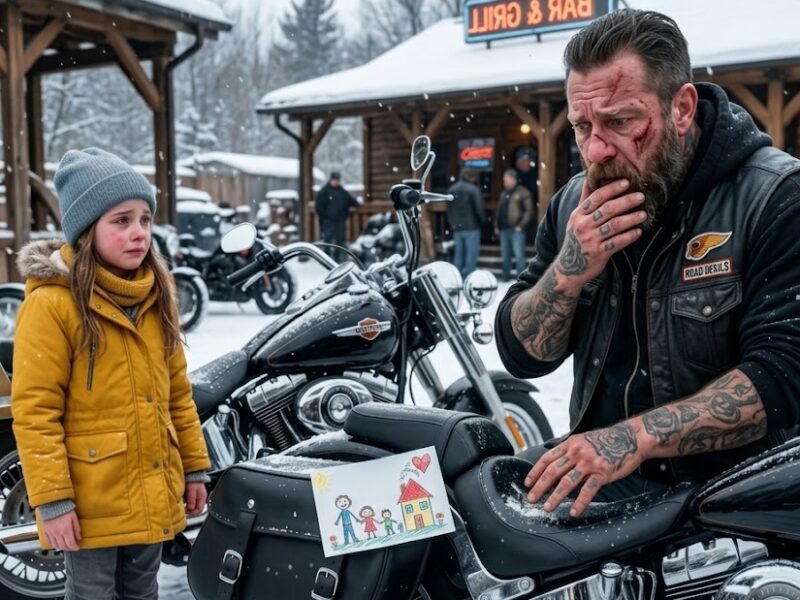
# My Sister’s in That Truck! Boy Grabs Biker’s Arm at Gas Station, Their Chase Stunned the Entire State — ## Part 1 — The August sun beat down on the Love’s Travel Stop just outside Valdosta, Georgia, with the kind of relentless heat that made asphalt shimmer like water and turned chrome into torture. Dominic “Duke” Hartley stood beside his Road King filling the tank while his brothers from the Iron Guardians MC stretched their legs after two hours of riding. They were five bikes strong that Saturday afternoon—Duke, Razor, Smokey, Bear, and a younger prospect named Axel—making their annual run from Atlanta to the coast for a veterans charity event. Duke was forty-eight, a former Army Ranger with gray threading through his dark beard and scars that mapped a life lived hard but lived right. The Iron Guardians had been riding together for twelve years, known throughout Georgia as the club that showed up when disaster struck, that raised money for children’s hospitals, that treated their patches with the kind of honor that made other clubs nod with respect. Even law enforcement grudgingly acknowledged they were the good ones. Duke was screwing his gas cap back on when he felt it—small fingers digging into his forearm with surprising strength, nails actually breaking skin through desperation. He spun to find a boy, maybe nine years old, African-American with close-cropped hair and eyes that were red-rimmed and wild with panic. The kid was breathing in gasps, his Star Wars T-shirt soaked with sweat that couldn’t all be from the heat, his worn sneakers scuffed like he’d been running. “My sister’s in that truck!” the boy shouted, his voice cracking with desperation as he pointed toward the exit where an eighteen-wheeler—white cab, unmarked trailer—was merging onto I-75 northbound. “Please, you have to catch them. They took her. They took Zoe, and nobody believes me.” Duke’s training kicked in before his conscious mind caught up. He scanned the truck—Georgia plates, nothing unusual about the rig itself—but there was something in the way it had been parked at the far edge of the lot, away from other trucks. Something in the way it had pulled out with such hurried purpose. “Razor,” Duke’s voice carried the command that had once moved soldiers under fire. “That white Kenworth pulling out. Something’s wrong. Get the plates.” Razor was already moving, pulling out his phone, zooming in on the truck before it disappeared from view. The boy was still gripping Duke’s arm, tears streaming now, words tumbling out in a torrent of terror. “We were in the bathroom, me and Zoe, and this man came in. He grabbed her. He had a cloth. She went all limp. And I tried to stop him, but he pushed me down. And he put her in that truck. I saw the back. There were other girls in there. I saw them. They looked scared. And I ran to tell the people inside. But they said I was lying. They said kids make up stories. But I’m not lying. I swear I’m not lying.” Duke knelt down, bringing himself to the boy’s eye level, his hands firm on small shoulders. “What’s your name, son?” “Marcus. Marcus Webb. My sister is Zoe Webb. She’s seven. She’s wearing a purple shirt with a unicorn. She has braids with purple beads. You have to believe me. Please. Nobody believes me.” Behind Duke, his brothers had formed a protective semicircle, their presence drawing attention from other travelers who were starting to notice the commotion. Bear, the club’s sergeant-at-arms and the largest of them at six-foot-five and two hundred eighty pounds of solid muscle, was already on his phone. “Calling Georgia State Patrol,” he said quietly, giving them the plates and description. Duke studied Marcus’s face and saw no deception, no confusion—just pure terrified certainty. He’d interrogated enough people in his military career to know the difference between a story and the truth. And this kid was telling the truth. “Marcus, where are your parents?” “My mom’s at work in Atlanta. We were supposed to ride the bus to our aunt’s house in Tallahassee, but we missed it. So we were waiting for the next one. That’s why we were here. I have to call my mom, but my phone died. And the people inside won’t let me use their phone. They think I’m making trouble.” Duke pulled out his own phone, handed it to Marcus. “Call your mom. Tell her what happened and tell her you’re with the Iron Guardians MC. That we’re going to get your sister back. And that she needs to meet us at the Georgia State Patrol Post in Valdosta.” He stood, his mind already working through logistics, probabilities, the cold mathematics of pursuit. That truck had maybe a three-minute head start, was probably doing seventy on the interstate, which meant it was already five or six miles ahead. Highway Patrol would respond, but they were scattered thin across hundreds of miles of interstate. And in trafficking situations, minutes mattered. Victims got moved to secondary locations, got transported across state lines, disappeared into networks that were designed to make people vanish. Duke looked at his brothers and saw his own calculation reflected in their faces. They all knew what they were about to do was technically vigilantism, was probably illegal in a dozen different ways, and could end with them in significant trouble with law enforcement. But they also knew that sometimes the right thing and the legal thing weren’t the same thing. And that they joined this club to be the kind of men who acted when action was needed. “Mount up,” Duke said quietly. “We’re going after that truck.” Smoky, the club’s voice of reason and a former state trooper himself, stepped forward. “Duke, if we do this wrong, if we interfere with an active investigation, or if this kid is wrong—” “He’s not wrong,” Duke interrupted. “Look at him, Smoke. That’s not a kid who’s confused. That’s a kid who saw something terrible and is begging anyone who’ll listen to help his sister. We sit here debating protocol while that truck puts miles between us. And by the time Highway Patrol gets their act together, those girls are gone.” He turned to Marcus, who was crying into the phone, trying to explain to his mother what had happened, his voice breaking with frustration as she apparently wasn’t understanding or wasn’t believing. Duke gently took the phone back. “Mrs. Webb, this is Dominic Hartley. I’m with the Iron Guardians Motorcycle Club, and I’m here with your son, Marcus. I need you to listen very carefully. Marcus just witnessed what he believes was an abduction of his sister. We’ve called Highway Patrol, but we’re also going to pursue the vehicle he identified while we wait for official response. I need you to trust me when I tell you that we will not let anything happen to your son, and we will do everything in our power to get your daughter back. Do you understand?” The woman on the other end was sobbing, her words barely coherent, but she managed to say yes, managed to say please, managed to say her baby girl’s name like a prayer. Duke handed the phone back to Marcus. “Stay on with your mom. We’re going to put you with someone safe here while we go after that truck.” But Marcus shook his head violently, stepping back. “No. I’m coming with you. I saw the truck. I can identify it. And if Zoe sees me, she’ll know help is coming. She’ll know I didn’t leave her.” “Son, it’s too dangerous.” “I don’t care.” Marcus’s voice carried across the parking lot. “That’s my sister. She’s seven years old and she’s scared and I’m the one who’s supposed to protect her because I’m her big brother and I already failed once. I’m not failing again.” Duke saw something in that moment that made his decision. He saw himself at nine years old watching his own younger sister get hurt by their father’s fists. Feeling that same crushing helplessness. That same desperate need to protect. He’d spent his whole adult life trying to make up for the times he couldn’t protect her before she died at sixteen from wounds that weren’t all physical. “Razor, Marcus rides with you. Axel, you stay here. Coordinate with Highway Patrol when they arrive. Give them our heading and tell them we’re maintaining visual contact only, no engagement.” He looked at Marcus. “You do exactly what Razor tells you. You hold on tight and you trust us. Understood?” Marcus nodded, and seconds later he was strapped into Razor’s backseat, a spare helmet that was far too large wobbling on his small head. Five Harleys roared to life with a sound like thunder, and they peeled out of that gas station doing things that were absolutely illegal and absolutely necessary. Duke took point, his Road King’s engine screaming as he pushed eighty, then ninety, weaving through traffic on I-75 north. Bear was on the phone with Highway Patrol, feeding them real-time updates. Smoky was running the truck’s plates through connections he still had from his trooper days. And Marcus, small arms wrapped around Razor’s waist, was scanning the highway ahead with an intensity that no nine-year-old should have to possess. — ## Part 2 — They’d been riding maybe eight minutes when Marcus’s voice came through Razor’s helmet comm, shrill with recognition. “There, that’s it. White truck, see it? That’s the one.” Duke spotted it—three cars ahead in the right lane, that white Kenworth cab with the unmarked trailer, maintaining steady highway speed like it had nothing to hide. His gut told him that was intentional, that whoever was driving knew the first rule of smuggling was to never attract attention, to blend in with the thousands of other trucks on American highways. Duke’s phone buzzed. A text from Bear: “Plates registered to shell company. Smoky’s contacts say it’s flagged in trafficking database, but no active warrants. GHP says units responding, but twenty minutes out.” Twenty minutes might as well be forever. Duke made his decision and accelerated, the Iron Guardians forming up around him. They weren’t going to stop the truck—that would be kidnapping, assault, a dozen felonies that would land them in prison. But they were going to make damn sure that truck didn’t disappear, didn’t exit onto some country road, didn’t make it to whatever secondary location was planned. They were going to be a visible, undeniable presence that forced the driver’s hand. Duke pulled alongside the cab, matching speed, making eye contact with the driver. A white male, maybe forty, with the kind of face that was aggressively forgettable. The man’s expression flickered when he saw the motorcycle club formation around his truck. Saw five bikers who weren’t backing off. Saw the way they’d essentially boxed him in. Bear pulled up on the trailer side. Smoky dropped back to prevent rear escape. And Razor stayed centered with Marcus, who was pointing at the truck and shouting, though his words were lost in wind and engine noise. The truck driver’s face shifted from annoyance to calculation to something that looked like panic. And that’s when Duke knew, with absolute certainty, that Marcus had been right. The driver’s hand reached for something—phone, radio, weapon, Duke couldn’t tell. And then the truck suddenly swerved left, trying to force Duke off the road. Duke’s Ranger training saved his life. He braked hard, dropped back, narrowly avoiding the trailer’s rear wheels. The truck accelerated, pushing eighty-five now, and the chase was on. They screamed up I-75 at speeds that made other vehicles blur, the Iron Guardians maintaining formation, their engines howling. Duke could see the driver on his phone now, clearly calling for instructions, for help, for something. Behind them, the wail of sirens. Finally—Georgia Highway Patrol, multiple units converging. The truck driver must have heard them too, because he made a desperate move, cutting across three lanes toward an exit. Duke followed, the whole formation staying tight. They hit the exit at seventy, the bikes leaning into curves that would have been suicidal at sane speeds. The truck’s trailer fishtailed as the driver pushed too hard. They were on a rural highway now—farmland on both sides—and ahead Duke could see the truck’s brake lights flashing. The driver was going to try to stop. Maybe destroy evidence, maybe scatter and run. But he didn’t account for the fact that five motorcycles could stop a lot faster than an eighteen-wheeler. The Iron Guardians formed a barrier across the road. And when the truck screeched to a halt fifty feet away, they were already off their bikes, using them as cover. Bear on the phone, giving Highway Patrol their exact location. The truck’s door opened and the driver jumped down, his hands raised in surrender, but his eyes were scanning for escape routes. “On the ground, hands behind your head. Do it now.” Duke’s command voice carried all the authority of his Ranger days. The man hesitated, and Bear took three massive strides forward, his sheer size making further resistance pointless. The driver dropped. Behind them, four Georgia State Patrol cruisers roared up, officers emerging with weapons drawn. And for a terrifying second, Duke thought they might be treated as threats, as another danger to manage. But the lead trooper—a woman with sergeant stripes and gray hair—took in the scene with experienced eyes. Saw five bikers maintaining defensive positions. Saw a man on the ground who looked guilty as hell. Saw a small boy climbing off a motorcycle and running toward the truck trailer screaming his sister’s name. “Someone open that trailer,” the sergeant commanded. “Now.” Bear had bolt cutters from his saddlebag—tools of the trade for bikers who sometimes had to deal with chains and locks in emergency situations. He cut through the padlock and pulled open the trailer doors. And what they found inside made even these hardened men’s stomachs turn. Six girls, ages approximately seven to fifteen, zip-tied and gagged, sitting on the floor of a trailer that had been modified with basic ventilation but nothing else. And there, in the front corner, was a little girl in a purple unicorn shirt with braids and purple beads. The moment she saw Marcus, her eyes went wide with recognition and relief. The sergeant was already calling for EMTs, for FBI, for the specialized units that dealt with human trafficking. Troopers were reading the driver his rights while securing the scene. And Duke stood there watching Marcus hug his sister while both of them sobbed. Watching the other five girls being freed and covered with emergency blankets. And he felt something crack open in his chest. Grief for his own sister he’d never been able to save. And gratitude that today, right now, they’d saved these girls. The sergeant approached Duke, her expression unreadable. “That was the most reckless, dangerous, technically illegal chase I’ve seen in twenty years on this job.” Duke nodded, accepting whatever was coming. But then her face softened. “It was also the bravest damn thing I’ve seen in just as long. Those girls would have been gone in another hour, moved to a different vehicle, scattered across three states. Your club just broke open a trafficking network we’ve been chasing for two years.” She extended her hand. “Thank you.” Duke shook it, his voice rough. “Thank Marcus. He’s the one who saw, who knew, who refused to let it go.” — ## Part 3 — Over the next three hours, as FBI agents arrived and EMTs checked each girl, and Marcus’s mother drove down from Atlanta crying so hard she could barely speak, the full picture emerged. The truck driver was part of a network that moved victims from Florida up through Georgia to buyers in Tennessee and Kentucky. The girls had been grabbed from various locations—parks, bus stops, one even from her own front yard—over the past week. Marcus and Zoe had been waiting at that gas station for their bus, and when Zoe went to use the restroom, the trafficker saw his opportunity. He hadn’t counted on Zoe’s brother following them, seeing everything, and refusing to let the adults’ dismissiveness stop him from saving his sister. By evening, the story had hit every news outlet in the state. “Motorcycle Club Saves Six Girls in Highway Chase” dominated headlines, and suddenly the Iron Guardians’ phone was ringing non-stop. Other clubs calling to offer support. Citizens wanting to donate to their veterans charity. Law enforcement agencies requesting they help with community outreach. But Duke didn’t care about any of that. What mattered was watching Marcus hold Zoe’s hand in the back of an ambulance while their mother held them both. Watching the other five girls be reunited with their families who’d been frantically searching. Watching the FBI agent tell him that the intelligence gathered from this bust would help recover dozens more victims. That night, at their hotel in Valdosta, with the charity ride postponed by mutual agreement, Duke sat with Marcus on the curb outside while the boy’s mother and sister slept inside. “You did good today, kid,” Duke said quietly. “You saw something wrong and you didn’t stop until someone listened.” Marcus was tracing patterns on the pavement with his finger. “Everyone thought I was lying. The people at the gas station, they looked at me like I was making trouble. Like I was just some kid with too much imagination.” “I know that feeling,” Duke said. “But you kept trying. That’s courage. Not being fearless, but being scared to death and doing the right thing anyway.” He pulled off his Iron Guardians vest—the one he’d worn for twelve years, the one that bore patches from every major ride and charity event and moment that mattered. He held it out to Marcus. “This is too big for you now, but you hold on to it. When you’re older, if you want to ride with us, you’ll have a place. Because today, you embodied everything this club stands for. Protecting the vulnerable, standing up when it’s easier to look away. Being the kind of man who takes action when action is needed.” Marcus took the vest with reverence, holding it like the precious thing it was. “I just wanted my sister back.” “And because of you, five other families got their daughters back too.” — ## Part 4 — Three months later, Duke stood in a community center in Atlanta watching Marcus accept an award from the Georgia State Patrol for his role in breaking up the trafficking network. The boy wore a suit that was clearly borrowed and shoes that were definitely too big. But he stood tall at that podium and told his story. Told how nobody believed him until someone finally did. Told how his sister was in therapy now but was going to be okay. Told how the other five girls were all home and healing. Zoe sat in the front row with her mother, wearing a new purple shirt with a unicorn, her braids redone with purple beads. And when Marcus looked at her, she smiled at him with the kind of love and trust that only siblings share. The Iron Guardians sat in the back row—five men in leather who’d done nothing more than believe a nine-year-old boy and then refused to let him down. They didn’t want recognition or awards or media attention. They wanted to ride, to serve, to be the kind of men who showed up when others needed them. After the ceremony, Marcus ran over to them, still wearing that too-big vest over his suit, and Duke knelt down to his level. “You keeping that safe?” “Every day,” Marcus promised. “I keep it in my room where I can see it. It reminds me that someone believed me.” “Always trust what you see with your own eyes,” Duke said. “Even when the whole world tells you you’re wrong. If you know you’re seeing truth, you stand on it. You understand?” Marcus nodded, and then he hugged Duke with the fierce gratitude of a child who’d been saved by a stranger who’d become something more. — ## Part 5 — The story of Marcus Webb and the Iron Guardians became legend in Georgia. A tale told in truck stops and police stations and motorcycle clubs across the state. It became a training case study at the FBI Academy for how civilian intervention could break major cases. It became a reminder to 911 dispatchers and gas station attendants and adults everywhere to listen when children report something wrong. Because sometimes they’re seeing things adults have learned to ignore. Marcus grew up knowing that his voice mattered. That his observations had value. That he’d saved his sister and five other girls because he refused to be silenced. Zoe grew up knowing her brother loved her enough to grab a stranger’s arm and demand help. Knowing that sometimes heroes don’t look like what movies tell you they should look like. And Duke rode on year after year with his brothers beside him, carrying in his heart the knowledge that his own sister’s death hadn’t been for nothing. That he’d spent his life since then trying to be the protector he couldn’t be for her. And that one August afternoon at a Georgia gas station, he’d finally gotten it right. The Iron Guardians still do that charity ride every year. Still raise money for veterans and children’s hospitals. Still show up when disaster strikes. But they added something new to their mission statement: “We listen when others ignore. We act when others hesitate. We protect the vulnerable because that’s what honor demands.” And in the front pocket of Duke’s vest, tucked beside his own club patch, is a school photo of a little girl in a purple unicorn shirt with braids and purple beads. A reminder that sometimes the most important rides aren’t the ones to the coast or the mountains, but the ones that start when a nine-year-old boy grabs your arm and says, “My sister’s in that truck.” And you choose to believe him. — ## Part 6: The Ripple Effect — Six months after the rescue, the FBI contacted Duke with news that would change everything. The driver they’d caught had been a low-level courier, but the intelligence gathered from his phone and the truck’s GPS had led to something much bigger. A network spanning four states. Twenty-three arrests. And forty-one children recovered—children who’d been taken from playgrounds, bus stops, and front yards over the past three years. Duke sat in his living room in Atlanta, staring at the email on his phone, and felt tears he hadn’t shed in years roll down his cheeks. Forty-one children. Forty-one families. Because a nine-year-old boy refused to be ignored. Because five bikers refused to look away. He called Marcus that night. “Hey, kid. You remember what I told you about courage?” “Yeah. Being scared and doing the right thing anyway.” “Well, I wanted you to know something. Because of what you did that day—because you grabbed my arm and wouldn’t let go—forty-one other kids are home with their families tonight.” There was a long silence on the phone. Then, in a small voice: “Really?” “Really. You didn’t just save your sister. You saved all of them.” Marcus was quiet for another moment, and Duke could hear him sniffling. “I’m glad I didn’t stop when they didn’t believe me.” “Me too, kid. Me too.” — ## Part 7: The Second Annual Ride — The Iron Guardians’ charity ride had become something bigger than they’d ever imagined. What had started as five bikes heading to the coast for a veterans event had transformed into a three-day rally with hundreds of riders from clubs across the Southeast. They called it the “Guardian Run”—a charity ride that raised money for children’s hospitals and trafficking survivor programs. And every year, at the starting point in Atlanta, a small ceremony was held. Marcus stood at the front of the crowd at the second annual ride, now ten years old, wearing his too-big vest over a new T-shirt that said “Believe Kids.” Zoe stood beside him, holding his hand. Their mother stood behind them, watching her children with tears in her eyes. Duke handed Marcus the microphone. “Say what you want to say, kid.” Marcus looked out at the sea of leather and chrome and faces. “I just wanted to tell everyone that you don’t have to be big to do something important. You don’t have to be a grown-up to be brave. You just have to see something wrong and not stop until someone listens.” He paused, looking down at his sister. “I almost stopped. When the people at the gas station didn’t believe me, I almost gave up. But then I saw Duke and his friends, and I thought—maybe they’ll believe me. Maybe someone will help.” He looked up at the crowd. “And they did. So if there’s anyone out there who feels like nobody’s listening—don’t stop. Keep finding people who will. There are good people out there. Sometimes they just look a little scary.” The crowd erupted in applause, and Duke put his hand on Marcus’s shoulder, his eyes glistening. — ## Part 8: The Wall of Names — Years passed. Marcus graduated from high school and went to college, studying criminal justice. Zoe went to therapy and got better, eventually becoming a counselor herself, helping other children who’d experienced trauma. The Iron Guardians continued their work, growing older but never slowing down. And in the lobby of the Georgia Bureau of Investigation headquarters, a wall was dedicated to civilian heroes who’d helped break major cases. At the center of that wall, in a place of honor, was a photograph of a nine-year-old boy pointing at a truck. Below it, a plaque: “Marcus Webb. Because he spoke, forty-one children came home. Because someone listened, a network was dismantled. Because one person believed, countless lives were saved.” Duke visited that wall once a year, on the anniversary of the chase. He’d stand there, looking at the photograph of Marcus, remembering that day at the gas station. Remembering the desperation in the boy’s eyes. Remembering the way his small fingers had dug into Duke’s arm. Remembering the moment he’d decided to believe. And he’d think about his own sister—the one he couldn’t save—and he’d whisper, “This one’s for you.” — ## Part 9: The Legacy Continues — When Duke was sixty-two, he finally hung up his helmet. His hands weren’t as steady as they used to be, and his eyes weren’t as sharp. But he still rode—just slower, and always at the back of the pack, watching over the younger members. Marcus was twenty-four now, a rookie police officer in Atlanta. He’d married his college girlfriend and was expecting his first child. And when he’d graduated from the police academy, Duke had been there, front row, wearing his Iron Guardians vest with pride. “You know,” Marcus had said at the ceremony, “I never would have become a cop if it wasn’t for that day at the gas station. I want to be the kind of person who believes kids when they say something’s wrong.” Duke had just nodded, too choked up to speak. The club had changed over the years. New members, new missions, new challenges. But the core remained the same. They listened when others ignored. They acted when others hesitated. They protected the vulnerable. And they never, ever stopped believing. — ## Part 10: Full Circle — On a sweltering August afternoon, twenty years after the rescue that had made him famous, Marcus Webb found himself at a gas station outside Valdosta. He was off-duty, driving his family down to Florida for a vacation. His daughter, Zoe—named after the sister he’d saved—was playing on the sidewalk while his wife filled the tank. And then he heard it. A small voice, desperate and scared. “Help! Please, someone help! My friend’s in that car!” Marcus spun. A little boy, maybe seven years old, was running toward him, tears streaming down his face. “That car, the blue one! My friend got in but she didn’t want to and there was a man and she was crying!” Marcus looked at the blue sedan pulling out of the parking lot. Looked at the terrified child beside him. And he made a decision. He pulled out his phone and called 911, giving them the description and plates. Then he knelt down to the boy’s level. “I believe you,” he said. “And I’m going to help you. What’s your name?” “Tyler.” “Okay, Tyler. Tell me everything you saw.” — Two hours later, a blue sedan was pulled over on I-75. A child was recovered, safe. A suspect was arrested. And Marcus Webb stood in a gas station parking lot, holding his own daughter in his arms, thinking about how one moment of belief could change everything. He called Duke that night. “Hey, old man. I wanted to tell you something.” “What’s up, kid?” “A kid grabbed my arm today at a gas station. Told me his friend was in trouble. And I believed him.” Silence on the line. Then, a voice rough with emotion: “Good job, Marcus. Good job.” “I learned from the best.” — ## Part 11: The Final Chapter — Duke Hartley died peacefully in his sleep at seventy-eight years old. His funeral was attended by hundreds—bikers, police officers, FBI agents, and a family named Webb who sat in the front row. Marcus gave the eulogy. He talked about the day a nine-year-old boy grabbed a stranger’s arm. He talked about the chase that had changed his life. He talked about the man who’d believed him when everyone else didn’t. And then he walked to the coffin and placed something inside. An Iron Guardians vest. The one Duke had given him twenty years ago. The one Marcus had worn every year to the Guardian Run. The one that had reminded him, every single day, that heroes don’t always wear badges. Sometimes they wear leather and ride to the sound of thunder. — The Iron Guardians continued on. New leaders, new members, same mission. The Guardian Run grew bigger every year. The wall of names at GBI headquarters got more names. And the story of Marcus Webb and Duke Hartley became legend—passed down from generation to generation of bikers and cops and children who needed to know that their voices mattered. Because sometimes the most unlikely heroes are exactly who someone needs when every second counts. Because sometimes all it takes is one person willing to listen. Because sometimes—just sometimes—a nine-year-old boy grabbing your arm at a gas station can change the world. — *Tell us in the comments: What would you have done in that gas station parking lot? Would you have believed Marcus when everyone else dismissed him? Would you have had the courage to chase that truck knowing the risks?* *Your answer might surprise you.* *But stories like this remind us that everyday heroes are everywhere, and sometimes the only thing standing between tragedy and rescue is one person willing to listen, to believe, and to act when every second counts.*
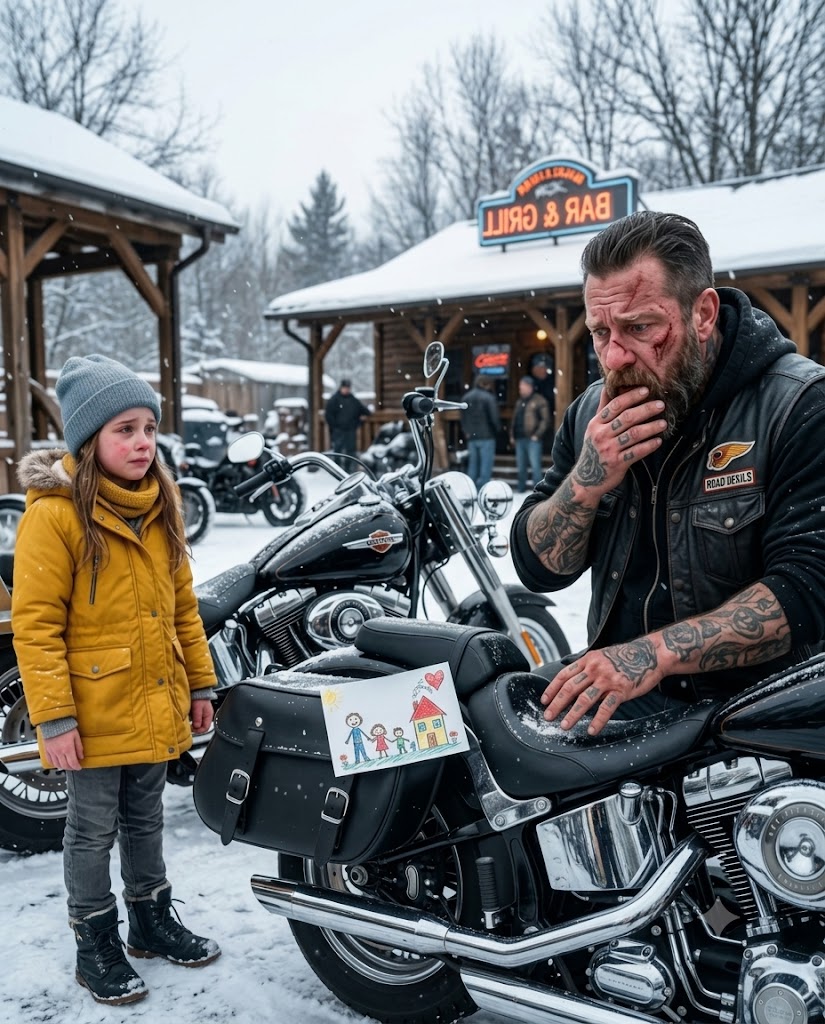
The November rain had turned the streets of Millbrook into rivers of gray when Jake Axe Morrison pulled his Harley into the parking lot of St. Catherine’s Children’s Home, killing the engine and letting the sudden silence wash over him like a cold wave.
He was forty-two years old, a former Marine with scars that mapped a life of hard choices and harder consequences, and he’d been making this monthly run with the Iron Brotherhood MC for three years now—bringing donations, spending time with kids who had nobody, trying to pay forward the kindness that strangers had shown him when he’d been just another angry kid aging out of the foster system with nothing but rage and a duffel bag.
The Brotherhood parked their bikes in a neat row, chrome gleaming despite the dreary weather, and as Jake swung his leg over the seat, he noticed something that made him pause.
A piece of paper tucked carefully under his bike’s mirror, protected from the rain by a plastic sandwich bag, secured with a rubber band that looked like it had come from a child’s craft supplies.
His thick fingers, scarred from years of mechanic work and bar fights he’d rather forget, carefully removed the makeshift package, and when he pulled out the drawing inside, something in his chest tightened in a way that had nothing to do with the cold.
The drawing was clearly a child’s work done in crayon on construction paper that had been folded and refolded so many times the creases were wearing thin.
It showed a little girl with dark hair standing beside a massive motorcycle, and next to her was a figure that could only be a biker—broad shoulders, vest clearly marked, arms covered in what looked like tattoos rendered in black and blue crayon.
But it was the details that made Jake’s hands start to shake.
The little girl in the drawing was holding the biker’s hand, and above them, drawn in careful purple crayon, were stars.
Not random stars, but a specific constellation that Jake recognized immediately because he had it tattooed on his left forearm—the only ink on his body that meant something beyond brotherhood or battle.
Ursa Major, the Great Bear.
His mother had shown it to him when he was five years old, two weeks before she died in a car accident that left him alone in a world that didn’t particularly care about one more orphaned kid.
She told him that bears were protectors, that they were fierce and loyal, and that whenever he felt alone, he should look up and find those stars and remember that someone was always watching over him.
Jake had that constellation tattooed on his arm after his first tour in Afghanistan, a reminder of the only person who’d ever loved him unconditionally, and he’d never told anyone what it meant.
Had never explained it to the kids at St. Catherine’s.
Had certainly never mentioned it during the Brotherhood’s visits.
So how did this child know?
How did she know to draw those specific stars above a biker and a little girl holding hands?
His fellow riders were already heading inside, their leather vests dark with rain, their voices calling back to him to hurry up, but Jake couldn’t move.
He stared at the drawing, at the careful way the child had colored inside the lines, at the smile she’d given the little girl in the picture—a smile that suggested hope, that suggested safety, that suggested she believed this biker could be someone who protected rather than threatened.
In the bottom corner, in handwriting that was clearly still being learned, were the words: *For the bear man, please don’t forget me. Lily.*
Jake felt his throat constrict, felt tears he hadn’t cried in twenty years burning behind his eyes, because he knew exactly who Lily was.
She was eight years old, had been at St. Catherine’s for six months after being removed from a home situation that the social workers wouldn’t discuss in detail but that had left her silent and withdrawn—a ghost of a child who watched everything but participated in nothing.
Jake had noticed her on his very first visit, had seen how she stood apart from the other kids, how she flinched when adults moved too quickly, how she seemed to be constantly calculating escape routes and exit strategies like a tiny soldier in a war zone only she could see.
He’d tried talking to her once, had knelt down to her level and asked her name, and she’d looked at him with eyes that were far too old for her face and then walked away without a word.
After that, he’d respected her distance but had always been aware of her presence, had noticed how she watched him when she thought he wasn’t looking, had seen her fingers tracing the outline of his forearm tattoo from across the room during a craft session three weeks ago.
The drawing in his hands wasn’t just a picture.
It was a message, a plea, a child’s desperate attempt to communicate something she couldn’t say out loud.
Jake’s mind raced through the implications.
St. Catherine’s was a temporary placement facility, which meant kids didn’t stay long—they either got reunified with family, placed in foster homes, or in rare cases, adopted.
Lily had been there six months, which was approaching the limit, and Jake had overheard the director mention something about a placement coming through, about Lily finally getting a permanent home.
But this drawing, this carefully protected message left specifically for him, suggested that Lily didn’t want that placement—that she was asking him, specifically him, the bear man, not to forget her, not to let her disappear into whatever situation was waiting.
Jake’s hands clenched around the paper, and he made a decision that would either be the best thing he had ever done or the most complicated mistake of his life.
—
He strode toward the entrance of St. Catherine’s, his boots leaving wet prints on the linoleum as he pushed through the double doors, and the director—a woman named Margaret Sullivan, who’d been running this place for twenty years and had seen every kind of adult walk through those doors—took one look at his face and knew something had shifted.
“I need to talk to you about Lily,” Jake said without preamble, and Margaret’s expression became guarded, professional—the look of someone who’d heard too many promises from well-meaning people who disappeared when reality got complicated.
“I need to know what her placement situation is, and I need to know if there’s any way I could be considered as a foster parent.”
The words hung in the air like a challenge, and Margaret gestured for him to follow her to her office—past the common room where the other Brotherhood members were already setting up for the afternoon’s activities, past the curious stares of children who’d learned not to get too attached to any adult who showed temporary interest.
In Margaret’s cramped office with its filing cabinets and faded motivational posters, Jake laid the drawing on her desk and explained what it meant.
Explained about his mother and the constellation and how Lily had somehow known, had somehow seen something in him that made her believe he could be her protector.
Margaret listened, her experienced eyes moving from Jake’s scarred hands to his tattooed forearms to his face, which was showing more vulnerability than he’d probably revealed in decades.
And when he finished, she sighed deeply.
“Lily is scheduled to go to a foster home in two weeks,” Margaret said quietly. “It’s a couple in their fifties, experienced foster parents, clean background checks, good references. On paper, it’s a good placement.”
She paused, choosing her words carefully.
“But Lily has been through three foster homes before she came here. The first two returned her because they said she was too difficult—which is code for traumatized in ways they weren’t equipped to handle. The third home…”
She paused again, and Jake saw anger flash in her eyes.
“We removed her from that home because of concerns about the foster father’s behavior. Nothing we could prove in court, but enough red flags that we acted immediately. Since then, Lily doesn’t trust easily. Doesn’t attach to anyone. Doesn’t believe that adults are safe.”
Margaret picked up the drawing, studied it with the careful attention of someone who understood that children’s art often contained truths they couldn’t voice.
“This drawing suggests she trusts you, Jake. In six months, I haven’t seen her voluntarily approach a single adult, and yet she left this for you, protected it from the rain, asked you not to forget her. That’s significant.”
She looked at him directly, her gaze searching.
“But fostering isn’t about weekly visits and donations. It’s about midnight nightmares and therapy appointments and school meetings and dealing with behaviors that come from trauma you can’t fix with good intentions. Are you really prepared for that? Because if you start this process and then back out, it will confirm every terrible thing Lily believes about adults and trust.”
Jake felt the weight of that truth, felt the magnitude of what he was considering.
But when he looked down at the drawing again—at the little girl holding the biker’s hand, at those carefully drawn stars that represented protection and memory and someone watching over you—he knew with absolute certainty that he couldn’t walk away.
“I’m prepared,” he said, his voice rough but steady. “I know I’m not the obvious choice. I’m a single guy. I work at a garage. I ride with a motorcycle club. I’ve got a past that includes bar fights and PTSD from two tours overseas. But I’ve also got stability now. I own my house outright. I’ve been sober for eight years. I’ve done the therapy and the work to deal with my demons.”
He paused, his jaw clenching.
“And more than that, I understand what it’s like to be the kid nobody wants. To age through the system, watching other kids get families while you get moved from placement to placement until you’re eighteen and they kick you out with a bus ticket and good luck.”
His voice dropped, became something raw and honest.
“I won’t let Lily become that statistic. If she’s asking me not to forget her, then I won’t. I’ll do whatever it takes—background checks, home studies, parenting classes, whatever hoops I need to jump through. Just tell me how to make this happen.”
Margaret studied him for a long moment, and something in her expression softened.
She’d been doing this work long enough to recognize the difference between someone who wanted to feel good about themselves by saving a child and someone who genuinely understood the commitment they were making.
Jake Morrison, with his leather and tattoos and military bearing, wasn’t the foster parent she would have predicted for Lily.
But maybe that was exactly why it might work.
“The process takes time,” Margaret said, pulling out forms and folders. “Background checks, fingerprinting, home study, training classes. Normally, it takes three to six months to complete everything. But given that Lily has already formed an attachment to you, and given my concerns about rushing her into another placement…”
She paused, making a decision that bent several rules but honored a deeper principle.
“I can accelerate some steps and delay her current placement while we evaluate you as an alternative. It’s irregular, but I have discretion in cases where I believe it’s in the child’s best interest.”
She handed Jake a stack of paperwork that looked daunting.
“Start with these.”
And then she waited until he looked up from the forms.
“And Jake—don’t tell Lily yet. Don’t give her hope until we know this is going to happen. She’s had too many disappointments already.”
Jake nodded, understanding the wisdom even as part of him wanted to run out to the common room and tell Lily right now that he’d received her message, that he wasn’t going to forget her, that he was going to fight to become her family.
But Margaret was right.
Hope could be cruel when it was premature, and Lily deserved better than another broken promise from another adult who ultimately let her down.
—
Over the next three weeks, Jake threw himself into the foster parent approval process with the same intensity he brought to military operations and motorcycle repairs.
He filled out forms that asked about every aspect of his life, submitted to background checks that examined everything from his credit history to his military service records, opened his home to a social worker named Patricia who walked through every room taking notes and asking questions about safety and stability.
He attended parenting classes on Tuesdays and Thursdays, sitting in a room with mostly couples and other single parents, learning about trauma-informed care and attachment disorders and how to handle behaviors that came from places of pain rather than defiance.
His Brotherhood brothers rallied around him in ways that surprised even Jake.
Bull and Reaper showed up to help him childproof his house, installing cabinet locks and outlet covers and smoke detectors in every room.
Chains organized a fundraiser at the clubhouse, raising money for bedroom furniture and clothes and all the things a little girl would need.
When Patricia, the social worker, came for her final home visit and saw the bedroom the Brotherhood had helped Jake prepare—painted soft lavender at the suggestion of Margaret, furnished with a sturdy bed and dresser, decorated with stars that glowed in the dark on the ceiling, with books and art supplies and a stuffed bear sitting on the pillow—her professional composure cracked and she smiled genuinely for the first time.
“You’re going to be approved,” Patricia told him.
And Jake felt something in his chest that he hadn’t felt since before his mother died.
The possibility of family.
Of belonging to someone and having someone belong to him.
—
The official approval came through on a Friday afternoon, and Margaret called Jake immediately.
“You’re cleared as a foster parent. I’m recommending immediate placement of Lily in your home starting tomorrow.”
Her voice carried both relief and caution.
“This is a trial period, Jake. There will be regular check-ins, therapy requirements, court reviews, and it’s going to be hard. Lily’s trauma runs deep, and you’ll face challenges you can’t anticipate. But I believe this is her best chance.”
That evening, Jake sat in Lily’s soon-to-be bedroom, holding the drawing she’d left on his motorcycle, and felt the weight of what was coming—the responsibility, the commitment, the certainty that his life was about to change in ways he couldn’t fully predict.
But when he looked at those carefully drawn stars, at the little girl holding the biker’s hand, at the plea not to be forgotten, he felt something stronger than fear.
He felt purpose.
—
The next morning, Jake returned to St. Catherine’s, and Margaret brought Lily to her office.
The small girl with dark hair and too-old eyes looked confused and wary when she saw Jake sitting there.
Margaret knelt down to Lily’s level.
“Lily, do you remember the drawing you left for Jake? The one with the stars?”
Lily’s eyes widened, and she glanced at Jake with an expression that mixed hope with terror—the look of someone who’d reached out and was now afraid of being rejected.
Jake pulled the drawing from his jacket pocket, carefully unfolded it, and held it so Lily could see.
“I got your message,” he said softly, his gruff voice gentler than anyone had ever heard it. “You asked me not to forget you. I want you to know that I didn’t forget, and I never will. Those stars you drew—they’re very special to me. My mom showed them to me when I was little. Told me that bears are protectors. You called me the bear man. And you were right.”
He took a breath, knowing this next part was crucial.
“Lily, I talked to Miss Margaret. And if you want, you can come live with me. Not just for a visit—for real. For as long as you need. I know I’m not what most people expect for a family, but I promise I’ll keep you safe. I’ll never hurt you, and I’ll never forget you.”
Tears were streaming down Lily’s face, and for the first time since she’d arrived at St. Catherine’s six months ago, she spoke.
Her voice was barely a whisper, but it was there.
“You want me? Really want me?”
Jake felt his own tears threatening and didn’t bother to hide them.
“Yeah, kid. I really want you.”
Lily crossed the small space between them in three running steps and threw her arms around Jake’s neck, and he held her while she sobbed against his leather vest—years of abandonment and fear and desperate hope pouring out in waves that shook her small frame.
Margaret watched with tears in her own eyes, knowing she was witnessing something rare and precious.
The moment when a child who’d given up on adults and a man who’d given up on family both discovered that maybe, just maybe, they could save each other.
—
The first months were exactly as hard as Margaret had warned.
Lily had nightmares that left her screaming, and Jake, exhausted, had panic attacks when she raised her voice even slightly. She tested boundaries constantly to see if he’d send her back like everyone else had.
But Jake showed up every single day—patient when she broke things, gentle when she lashed out, present when she finally started talking about the things that had happened before St. Catherine’s.
The Brotherhood became her uncles, teaching her about motorcycles and loyalty, showing her that tough exteriors could contain fierce protective love.
Therapy sessions twice a week helped Lily process trauma while teaching Jake how to parent a child whose trust had been shattered so many times.
And slowly, gradually, like stars becoming visible as the sky darkens, Lily began to heal.
She started sleeping through the night.
She smiled more often.
She called Jake *dad* for the first time four months after moving in, and Jake had to excuse himself to the garage, where he sat on his workbench and cried like he hadn’t cried since he was five years old.
—
A year after that drawing appeared on his motorcycle, Jake stood in a courtroom with Lily beside him, his Brotherhood filling the benches behind them, and a judge finalized the adoption that made them legally what they had already become in every way that mattered.
Family.
The story of the biker and the orphan girl spread through Millbrook like wildfire—not as a fairy tale, but as proof that family could be built from the most unlikely materials.
That healing happened in unexpected places.
That sometimes the people society dismissed as dangerous were exactly who someone needed to feel safe.
Jake kept that original drawing in a frame above Lily’s bed, a reminder of the moment when one brave little girl had reached out to someone who looked like he might understand what it meant to need protecting.
And that person had proven her faith wasn’t misplaced.
On clear nights, Jake and Lily would sit on his Harley in the driveway and look up at the stars, finding Ursa Major together.
And Jake would tell her the story his mother had told him about bears being protectors, about always having someone watching over you.
And Lily, who’d learned that family wasn’t about biology or fairy tales but about showing up every day and choosing each other again and again, would point to those stars and say:
“That’s us, Dad. The great bear and the little bear. We’re a constellation.”
And Jake—this former Marine with his scars and his leather and his refusal to forget—would hold his daughter close and know with absolute certainty that the best decision he’d ever made started with a child’s drawing tucked under his motorcycle mirror on a rainy November day.
A silent plea that he’d heard loud enough to change both their lives forever.
—
The years that followed weren’t without their challenges.
Lily’s trauma didn’t disappear overnight, and there were setbacks—bad days when she retreated into silence, nights when the nightmares returned with a vengeance, moments when she tested Jake’s commitment with behaviors designed to push him away.
But Jake never wavered.
He showed up for every therapy session, every parent-teacher conference, every school play and soccer game. He learned to recognize the signs of an impending panic attack and how to help her through it. He learned that sometimes the best thing he could do was simply sit beside her in silence, letting her know she wasn’t alone.
When Lily was twelve, she came home from school in tears because some kids had made fun of her for having a “biker dad” who looked like a criminal.
Jake listened, then asked her a question.
“Do you want me to change? Start wearing suits, cut my hair, sell the bike?”
Lily looked at him with fierce indignation.
“No! You’re my dad. You’re the bear man. You protect me. Those kids don’t know anything.”
Jake smiled and pulled her into a hug.
“Then that’s all that matters, kid. The people who matter will see past the leather and the tattoos. And the ones who don’t—well, they’re not worth your tears.”
When Lily was fifteen, she came to Jake with a request.
“I want to get a tattoo. Ursa Major, like yours. On my wrist.”
Jake was quiet for a long moment.
“You know what that constellation means to me. What it means to us.”
Lily nodded.
“That’s why I want it. So I’ll always remember that someone’s watching over me. So I’ll always remember that I’m not alone.”
Jake took her to the same tattoo artist who’d done his ink, and he held her hand while the needle worked, and when it was done, they looked at the matching constellations on their arms—his on his forearm, hers on her wrist—and both of them cried a little.
Not from pain.
From gratitude.
—
When Lily was eighteen, she graduated from high school with honors and got accepted to a university three hours away.
Jake was proud and terrified in equal measure.
The night before she left, they sat on the Harley in the driveway one last time, looking up at the stars.
“I’m scared,” Lily admitted. “What if I can’t do it? What if I fail?”
Jake put his arm around her shoulders.
“You’re the strongest person I know, kid. You survived things that would have broken most adults. You fought your way back from trauma and fear and abandonment. You’re not going to fail.”
Lily leaned her head against his shoulder.
“What if I get lonely?”
“Then you call me. Any time, day or night. I’ll answer. That’s what family does.”
She was quiet for a moment.
“I love you, Dad.”
“I love you too, Lily. More than anything.”
And when she drove away the next morning, Jake stood in the driveway and watched until her car disappeared from sight.
Then he went inside, looked at the framed drawing above what had been her bed, and let himself cry.
Not from sadness.
From pride.
From love.
From the overwhelming certainty that the best decision he’d ever made had started with a child’s drawing tucked under his motorcycle mirror on a rainy November day.
—
Lily thrived at university.
She studied psychology, determined to help children who’d been through what she’d been through. She volunteered at a local children’s home, becoming for other kids what Jake had become for her.
And on clear nights, she’d look up at the stars and find Ursa Major, and she’d remember the man who’d saved her, the man who’d proved that family wasn’t about blood but about choice.
When she graduated with her master’s degree in social work, Jake was in the front row, tears streaming down his face, the proudest father in the world.
And when she walked across the stage to receive her diploma, she looked out into the crowd, found his face, and mouthed the words:
*Thank you, bear man.*
—
The drawing still hung in Jake’s house, a reminder of the moment everything changed.
And every time he looked at it, he remembered the little girl who’d been brave enough to reach out, to ask for what she needed, to believe that someone could be her protector.
He remembered the fear and the hope and the desperate plea written in a child’s handwriting: *Please don’t forget me.*
He hadn’t forgotten.
He never would.
And in the end, that was the whole story—the story of a biker and an orphan, a man and a child, two people who found each other in the most unlikely of circumstances and chose to become a family.
Not because they shared blood.
But because they shared something stronger.
They shared a constellation.
The great bear and the little bear.
Together, always, watching over each other.
A family built from crayon and construction paper and a plea written in purple ink.
A family that started with a drawing tucked under a motorcycle mirror on a rainy November day.
A family that would last forever.









