My Mother Forced Me to Kneel in the Rain—Then the Helicopter Carrying My Company’s Logo Landed Outside
Part 1
Neil, if you have any respect left for this family, stay on your knees.
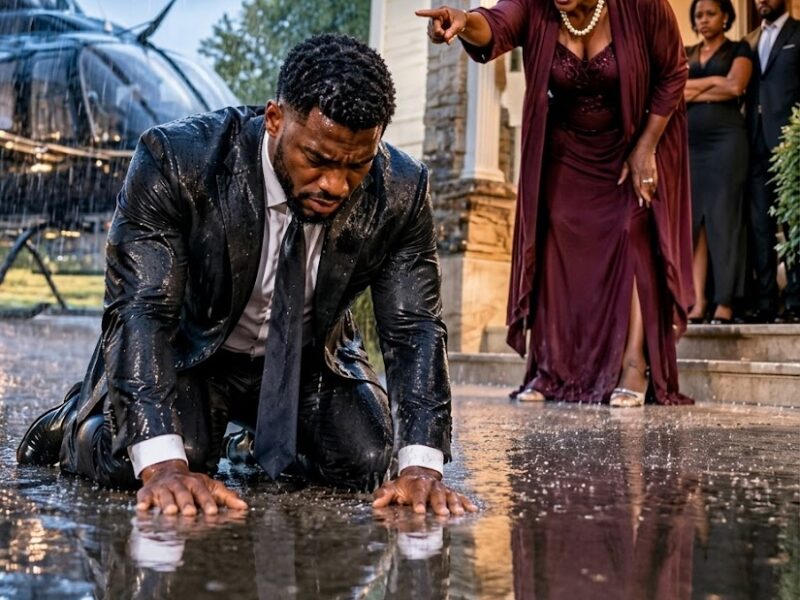
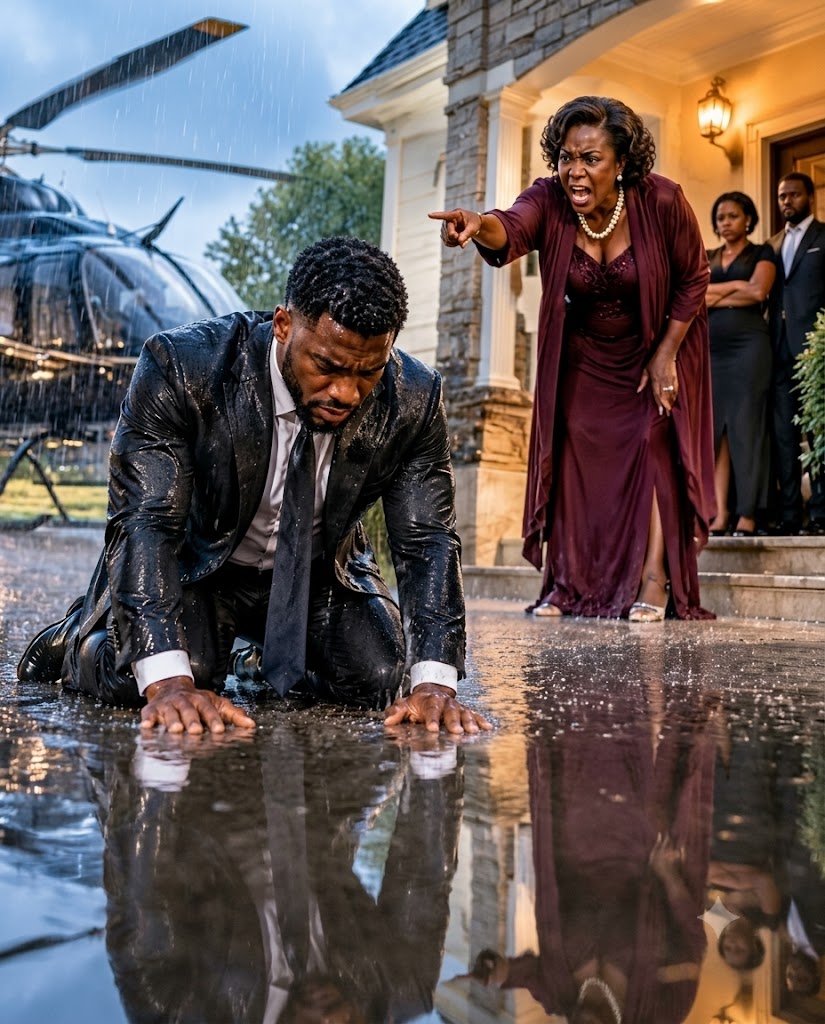
The words hung in the cold spring air like frost, suspended between the maple trees and the wet paving stones of my mother’s backyard in Bellweather, Maryland. Eleven members of my family watched. My aunt Cheryl’s hand flew to her mouth. My cousin Marcus looked at his shoes. Caleb, my younger brother, stood frozen with an expression I had never seen on his face before—something between horror and uncertainty, as if he had just realized the train he had been riding for years had no brakes.
Mr. Mercer, your aircraft is ready, sir.
That came thirteen minutes later. Thirteen minutes of cold rain soaking through my field jacket, dripping from my hair, spreading mud from my boots across my mother’s pristine patio. Thirteen minutes of silence so heavy it felt like a physical weight pressing down on my shoulders.
My mother had ordered me onto my knees in front of eleven members of my family, so I knelt. I didn’t defend myself. I didn’t tell her where I was going afterward. I didn’t mention that less than fifteen minutes away, an aircraft was waiting for me at a private landing zone off Redstone Road. I simply kept my eyes forward as the first cold drops began falling through the trees.
Thirteen minutes later, the low thunder of twin rotors rolled over the neighborhood. A matte black helicopter descended beyond the rear property line, settling into a cleared field beside the private road that ran behind my mother’s house.
The pilot came through the side gate wearing a charcoal flight jacket with Mercer Aviation Services embroidered near the collar. He stopped near the patio, his eyes sweeping across the frozen tableau of my family without expression.
Mr. Mercer. Every face turned toward him. Your aircraft is ready, sir.
I rose, wiped the mud from my trousers, and walked away.
What happened two hours later when my mother and brother entered the gala that helicopter was carrying me to was the moment fifteen years of silence finally became impossible to maintain.
Lauren called while I was driving north on Interstate 83, thirty-five minutes from my mother’s house in Bellweather. She had served as my executive director at Mercer Urban Holdings for almost eight years, and she had developed a communication style I valued more than almost anything else in my professional life. Concise, exact, and never padded with information I already possessed.
Final count is 326, she said. Governor’s office confirmed. Both pension delegations are in. The Toronto group landed twenty minutes ago. Flight crew will be at the Redstone pickup point by 6:50.
Good.
Press wants another five minutes with you before the stage remarks.
No.
I assumed. The family office delegation from Denver confirmed.
Anything else?
The pilot said he can hold if dinner runs long.
He won’t have to.
There was a short pause. You sound tired.
I had a morning.
You want me to ask?
No.
Then I won’t.
That was Lauren. I ended the call and placed the phone beside me on the leather seat of the black Suburban.
The Redstone pickup location was less than five minutes from my mother’s neighborhood. I had designed the schedule carefully. Arrive around 5:30, stay a little over an hour, leave by 6:40, board at 6:50, land downtown shortly after 7:20, change jackets, review introductions, be on stage at 8:20.
It was the kind of schedule I had lived by for most of my adult life. What I had not scheduled was humiliation.
Then again, family had never been particularly compatible with schedules.
Before I explain the backyard, I need to explain Mercer Urban Holdings. Because without that part, the rest of the evening sounds like some elaborate performance I arranged for revenge.
It wasn’t.
Fifteen years earlier, when I was twenty-eight, I bought a half-empty industrial distribution property outside Richmond, Virginia. The building had been abandoned by a regional logistics company and written off by nearly every major real estate firm that reviewed it. The roof leaked. Half the loading bays were unusable. The surrounding neighborhood had been declining for more than a decade. Banks disliked it. Institutional investors ignored it.
I saw something else.
I had spent four years studying manufacturing relocation, freight corridors, municipal redevelopment incentives, and the slow return of specialized industrial work to secondary American cities. My theory was simple. Everyone wanted glamorous downtown towers. Everyone wanted coastal technology campuses. Very few serious investors were paying attention to the neglected infrastructure that made those glamorous places function. Warehouses, freight terminals, utility corridors, light manufacturing parks, regional data infrastructure, cold storage, distribution land—the ugly buildings, the overlooked ones.
I borrowed nearly everything I could. I convinced two former clients to invest. I used my own savings. I signed personally against debt that should have terrified me more than it did.
The Richmond property became profitable in twenty-six months. I refinanced it, bought another facility outside Louisville, then another outside Columbus, then a distressed freight yard in Oklahoma City, then a manufacturing campus outside Milwaukee. Eventually, the structure became Mercer Urban Holdings.
The name Mercer was my family name. There was no branding committee behind it, no sentimental story. I simply used the name I had been born with.
By the time I was forty-three, Mercer Urban Holdings controlled or managed an infrastructure and commercial property portfolio connected to more than $612 billion in institutional capital. We operated in nineteen states. Our investors included retirement systems, insurance groups, endowments, sovereign investment funds, and family offices. Our name appeared regularly in financial trade publications. We employed nearly four thousand people directly and supported tens of thousands more through operating partners.
My family knew almost none of this.
They knew I worked in properties. That was the phrase my mother used. Nathan works in properties. My brother Caleb usually described it as me buying warehouses for rich people. Technically, neither statement was completely false.
Years earlier, I had attempted to explain. I was thirty. It happened during Thanksgiving at the same house where I would eventually kneel in the rain. My father was still alive then. We were sitting around the kitchen after most of the relatives had left. I told my parents that the company was growing faster than expected. I said we had closed another acquisition and that I was starting to believe the model could become national.
My mother, Ellen, had been a public school administrator for thirty-two years. She valued stability, predictability, pensions, credentials, job titles that could be explained in one sentence. She frowned at me over a mug of tea.
All this borrowing to buy empty buildings sounds dangerous.
It’s structured debt.
It’s still debt.
Yes, you’re always talking like risk becomes safe if you use enough complicated words.
My father smiled slightly, but he didn’t intervene.
Caleb did. He was twenty-seven then, married, already expecting his first child.
You know what? I don’t get it.
I looked at him.
You’re almost thirty-one. No wife, no kids. You’re here at some point. What exactly are you building all this for?
The company?
That’s not what I mean.
I know.
He looked at my mother. She said nothing.
Caleb continued. A building doesn’t show up at your funeral.
I remember staring at him. Not because the sentence devastated me, because it revealed something. They thought I was drifting. They thought I was substituting work for a life I had failed to create. They thought whatever I was doing was temporary, speculative, probably unstable.
And most importantly, I understood that explaining it harder would not change anything.
So I stopped.
I never announced another acquisition at family dinner. Never told them when our first institutional fund crossed $10 billion. Never mentioned the Wall Street profile. Never told them when we opened offices in Chicago, Phoenix, Dallas, Atlanta, and Toronto.
I answered questions accurately but narrowly.
How’s work?
Busy.
You still doing real estate?
Yes.
Still traveling all the time?
Pretty much.
That became our language.
Part of me told myself I was protecting the relationship from conversations that went nowhere. Another part, if I’m being precise, was waiting. Waiting for the company to become too real to dismiss. Waiting until I never had to persuade them.
That night was supposed to be that moment. Not with my family—with the world.
Mercer Urban Holdings was officially unveiling its new headquarters at Calder Exchange, a fifty-two-story redevelopment in downtown Baltimore that had taken nearly four years to complete. We had purchased the tower during a debt restructuring, renovated it, rebuilt the public concourse, added office space, retail floors, conference facilities, and a new headquarters campus occupying the upper fifteen stories.
That evening was our formal opening. Clients were coming. Public officials were coming. Financial media were coming. Partners from across the country were coming.
For the first time, I was scheduled to appear publicly not as a managing director, investment chairman, or anonymous institutional buyer. I was being introduced as founder and chief executive of Mercer Urban Holdings.
And before all of that, I was going to eat dinner with my mother.
The Bellweather house had belonged to my parents for thirty-four years. Two stories, white siding, dark shutters, large maple near the driveway, backyard sloping toward an old pasture that had gradually become surrounded by expensive homes. My father had died six years earlier. Ellen still lived there alone. She refused every suggestion that she move.
When I pulled into the driveway, I saw five cars and immediately knew this was not the quiet meal she had described.
Through the side gate, I could hear voices. My aunt Cheryl was there, two cousins, Caleb and his wife, their oldest daughter, my uncle Raymond, several family friends. Eleven people total.
I should probably say that the previous five months had been especially bad between me and my family. I had missed Caleb’s fifteenth anniversary dinner because I was in Frankfurt renegotiating a refinancing package involving several European lenders. I missed Ellen’s birthday lunch because of an emergency involving a municipal bond partner in Detroit. Three months before that, I left a Christmas gathering early when a major utility issue shut down part of one of our industrial campuses.
Every absence had an explanation. The problem with explanations is that enough of them eventually sound like excuses to people who do not believe the thing causing them.
That morning, I had been at a redevelopment site outside Harrisburg. One of our older distribution campuses was being converted into a mixed manufacturing and data infrastructure facility. The subcontractor responsible for a section of the foundation work had fallen nearly seven weeks behind. I wanted to see it myself.
The site had experienced several days of heavy rain. Walking it meant mud, concrete dust, standing water, boots covered in orange clay. My field jacket had picked up a streak of insulation adhesive near the sleeve.
I had planned to change at the office. Then two meetings ran long. Then traffic backed up on I-83, so I drove directly to Bellweather.
Caleb noticed the boots the moment I entered the yard.
Jesus, Nathan.
I looked down. What?
You seriously came here like that?
I came from Harrisburg.
So, a site inspection.
He shook his head. Of course.
I ignored the tone and leaned down to hug my niece. She smiled and asked whether I had seen the photos from her college acceptance. I said I had. I told her I was proud of her.
Then Ellen came toward me.
At first, I expected the usual greeting. Instead, she stopped three feet away and looked at my clothing. Her expression changed.
You couldn’t change?
I didn’t have time.
You knew this dinner was happening.
I did.
And you came dressed like you were cleaning out a basement.
I’m sorry about the boots. I can leave them by the gate.
That isn’t the point.
I knew from her tone that there was already a point and that we were simply approaching it.
What is the point?
The point is that you do this every time.
Do what?
Arrive however you want. Leave whenever you want. Miss things. Show up late, then say work like it’s a magic word. Everybody else has to accept.
I’m not asking anybody to accept anything.
You never ask. That’s part of the problem.
The yard had gone quieter. Caleb stood behind her. I looked toward the table and saw relatives pretending not to stare.
I lowered my voice. Mom, if you want to talk, we can talk inside.
No.
Why not?
Because every time I try to talk to you privately, you become calm and reasonable until I start feeling ridiculous for being angry.
I stared at her. That’s not something I do intentionally.
You don’t do anything intentionally, Nathan. Things just happen around you. Weddings get missed. Birthdays get missed. Your father spends his final month asking whether you’re flying in. And somehow that becomes another scheduling problem.
That one landed differently.
I looked at her. I was here before Dad died for three days. I came back twice for three days. I was managing a restructuring involving twelve thousand employees.
And your father was dying.
Both things were true. That was the difficulty.
My father had died during the most dangerous financial period Mercer Urban Holdings had ever faced. A credit freeze had threatened several portfolio companies simultaneously. If I had disappeared for weeks, payrolls could have failed. Projects could have collapsed. People far beyond me could have lost jobs.
I had flown home. I had sat beside my father. I had flown back. I had returned. I had taken calls from the hospital parking lot. I had hated every second of it.
But the version my mother carried was simpler. Her son had worked while his father died.
I began explaining. There were twelve thousand people whose employment depended on—
Stop.
She raised her hand.
I stopped.
Caleb stepped forward. This is what you always do. You turn everything into numbers.
I was answering her.
No, you were making yourself the victim.
I didn’t say anything about being a victim.
You don’t have to. You stand there acting like everybody else is irrational.
My aunt said quietly, Maybe everyone should cool down.
Ellen ignored her. You missed Caleb’s wedding rehearsal.
I was in Seoul.
You missed his restaurant opening.
A lender moved a closing.
You left Thanksgiving after forty minutes.
There was a fire at a property in St. Louis.
There is always something.
Yes. My answer came out sharper than I intended because what I do has consequences when I’m not there.
The silence changed. Ellen’s face tightened.
And we don’t.
That isn’t what I said.
It’s what you mean.
No.
You think whatever business you’re doing is more important than everyone in this yard.
I have never said that.
You don’t have to.
She looked down again. At the mud, at the boots, at the field jacket. Then she said something I had not heard from her since childhood.
Animal.
The word was soft, almost disbelieving.
You come into my home covered in dirt. After treating everyone here like they are appointments you can cancel—and you stand there telling me how important your work is.
I felt something settle inside me. Not anger exactly—something colder, a recognition that the conversation had crossed into territory where defending myself would become another form of participation.
Ellen pointed toward the wet paving stones.
If you have any respect left for this family, get down there.
I thought I had misheard her. What?
Kneel, she said.
Mom. Caleb’s voice was sharp.
She did not look at him. You heard me.
Nobody moved.
I looked around the yard. My niece looked horrified. My aunt’s hand covered her mouth. Caleb appeared suddenly uncertain about the entire direction of the confrontation.
I looked at my mother.
And then I knelt.
I want to explain that decision because I have been asked about it many times since.
I did not kneel because my mother had authority over me. I was forty-three years old. I did not kneel because I believed I deserved humiliation. I didn’t. And I did not kneel because I lacked the ability to walk away. There were security professionals within fifteen minutes of me. A helicopter crew was preparing for my arrival. Three hundred twenty-six invited guests were waiting for me downtown.
I knelt because I had spent half my adult life negotiating with people under pressure, and I had learned something useful. Escalation often reveals more when you refuse to compete with it.
I also knelt because some part of me wanted the moment to complete itself. I wanted to know how far this version of us would go.
Two minutes later, rain began.
Not dramatic rain. No thunder, no cinematic downpour. Just cold spring rain falling steadily enough to darken the stone and soak through my jacket.
Nobody went inside. Nobody brought an umbrella.
I watched droplets gather along the iron edge of the patio table. I watched mud spread slowly from my boots across the stone beneath me.
I thought about Calder Exchange. I thought about my speech. I thought about the aircraft schedule. I thought about Lauren saying the pilot could hold.
Then I thought about the obvious thing.
I could end all of this with one sentence.
I could say, I have to leave in ten minutes because a helicopter is taking me to the opening of my company’s new headquarters.
That sentence would change the physical situation immediately. Caleb would stop talking. My mother would ask questions. Someone would assume I was exaggerating. Someone else would pull out a phone.
The humiliation would end.
But would anything underneath it change?
I doubted it. Because the argument was not about mud. It was not about clothes. It was not even about missed dinners. It was about a family story that had hardened around me.
Nathan does not care. Nathan chose work over people. Nathan is always chasing some vague real estate thing. Nathan missed the life everyone else built.
And I had allowed that story to remain because correcting it repeatedly had seemed more exhausting than living beside it.
Five minutes passed. Then eight.
Caleb finally said, This is ridiculous.
I said nothing.
Ellen stood with her arms crossed. At ten minutes, she said, Get up.
I stayed where I was.
Nathan.
I did not move.
You can stand.
I looked toward the side gate.
Then the sound came.
At first, no one knew what it was. A low pulsing vibration rolled across the pasture. The glasses on the outdoor table trembled faintly. My niece looked toward the sky. Caleb frowned.
Rotor noise deepened rapidly, beating the air with enough pressure that loose napkins lifted from the table. The helicopter appeared beyond the trees. Matte black, twin-engine, Mercer Aviation Services markings near the tail. It descended into the open field beyond the property fence, the pilot maneuvering with the precision of someone who had rehearsed the landing site twice that week.
Nobody spoke.
A minute later, the side gate opened.
Captain Aaron Vale stepped into the yard. I knew him well enough to recognize that he understood immediately he had arrived during something strange and had decided professionally not to acknowledge it.
Mr. Mercer. Your aircraft is ready, sir.
I stood. Mud coated both knees. Water ran from my jacket cuffs. I brushed my trousers once.
Ellen stared at the pilot. Caleb stared at me.
I walked toward the gate.
Ellen said my name.
I paused but did not turn. What?
She hesitated. Where are you going?
Downtown.
For what?
I have an event.
Then I left.
The helicopter lifted at 6:58. From the air, Bellweather looked quiet. Orderly lawns, curving roads, backyard lights turning on one by one. As the evening darkened, I could see my mother’s street for less than thirty seconds. Then we banked southeast.
My phone started vibrating almost immediately. Caleb. I ignored the first call. The second. The third came four minutes later.
I answered. What?
There was no greeting. Whose helicopter is that?
Mine.
Silence. Then a short laugh. Not amusement. Disbelief.
You hired a helicopter.
No.
What does that mean?
It means what I said.
Nathan. There was Mercer written on it.
Yes.
Mercer. What?
Mercer Aviation Services.
Another silence. Is that your company?
Part of it.
Part of what?
I looked out at the landscape below us. Caleb, I’m landing soon. I have to prepare for an event.
What event?
I’ll talk to you later.
Wait—
I ended the call.
Calder Exchange had a rooftop landing platform attached to a neighboring conference structure. Lauren was waiting when I arrived. She looked at my trousers, then my jacket, then my face. She said nothing for approximately three seconds.
That bad? Family dinner?
I guessed.
She held out a garment bag. Suit jacket, shirt, trousers.
You brought trousers.
I work for you.
That wasn’t my question.
It was the correct decision.
She handed me a tablet. Your remarks. Governor’s deputy chief of staff has been moved to table four. The Toronto pension chair wants thirty seconds with you before the program. Bloomberg crew asked again.
No. Still assumed.
We stepped into the elevator. The tower descended around us in bands of glass and steel.
Calder Exchange had once been called the Rutherford Financial Center. When Mercer purchased it, nearly forty percent of the space was empty. The previous owner had defaulted on a debt package large enough to frighten most buyers. We saw opportunity.
Four years later, it contained our headquarters, public retail space, two financial technology firms, an engineering company, three international tenants, and a conference center overlooking the harbor. That evening, Mercer Urban Holdings was projected across the upper facade in white letters visible from blocks away.
The atrium had been transformed. Circular tables, standing areas, press platforms, projection walls showing fifteen years of acquisitions, maps of freight corridors, before-and-after redevelopment footage, photographs of facilities that had once been abandoned and now employed thousands.
The room was already full. Three hundred twenty-six guests. Mayors, investment managers, labor representatives, infrastructure advisers, bank executives, pension trustees, operating partners. People I had negotiated with for years. People I had fought with. People who had trusted me before the results existed.
At 7:56, Lauren found me in the VIP reception.
There’s something you need to know.
What?
Two people arrived through a secondary invitation.
I looked at her. Who?
Your mother and your brother.
For a moment, I thought I had misunderstood.
How?
One of your brother’s restaurant investors knows Daniel Kerr from the Mid-Atlantic Development Council. Kerr forwarded an extra pair of invitations because he thought your brother might want to make commercial contacts.
I almost laughed. They didn’t know.
No. They still don’t. I don’t think so.
What happened?
When they checked in, they said Mercer was their last name, too. One of the associates asked if they were related to Nathan Mercer.
I waited.
Your brother said yes. And the associate told him you were occupied before the program and they could wait in the outer reception area.
What did Caleb say?
Mostly questions.
My mother?
Lauren glanced toward the doors. Nothing.
I knew Ellen well enough to understand that silence.
What are they doing now?
Your brother has been reading everything he can see. And your mother—she’s standing near the exterior glass. Looking at the building.
I understood. From the outer reception, the projection on the opposite facade was visible through several stories of glass. Mercer Urban Holdings. Our family name. Fifty-two stories above a city where my mother had spent fifteen years believing I purchased random buildings for wealthy clients.
Keep them there until after the speech.
You sure?
Yes.
What do you want staff to tell them?
The truth. I’m working.
Lauren gave me a small nod and disappeared.
I was introduced at 8:22. The lights shifted. The screen behind me showed the first Richmond warehouse—not the restored version, the original one. Broken windows, rust, water stains, empty loading bays. I had chosen the photograph deliberately.
I walked onto the stage. The applause settled.
Fifteen years ago, I began, almost everyone who saw this building saw a mistake.
The next image showed the restored property.
They weren’t irrational. The roof failed. The tenant had left. The neighborhood was contracting. The financing was ugly. Every spreadsheet told a reasonable person to walk away.
The screen changed again.
What those spreadsheets did not measure was what happened if the freight corridor returned. If local incentives aligned with manufacturing demand. And if patient capital was willing to remain after the easy money left.
I spoke for twelve minutes about overlooked cities, about industrial infrastructure, about communities investors described as declining long after the people living in them had begun rebuilding. About discipline. About being willing to see value before consensus permits you to call it value.
Then the portfolio total appeared behind me.
$612 billion in assets managed or advised.
No theatrics. No dramatic pause. Just the number.
When I finished, the applause lasted longer than I expected.
At 8:47, Lauren approached. Your brother understands.
How can you tell?
He asked an associate whether the $612 billion refers to your company.
I rubbed the side of my face. What did she say?
She explained assets under management. And then he sat down.
I almost smiled. And Ellen? Still standing. Still looking outside.
She moved.
Where?
Lauren nodded toward the glass partition.
I could see them.
Caleb stood near a digital display showing the history of the company. He looked smaller somehow—not physically, just stripped of the certainty he had worn in the backyard. Ellen stood a few feet away. She was looking up toward the illuminated name outside.
For one strange second, I saw her as she had looked when I was sixteen. I had competed in a statewide debate final that year. My father could not attend because of work. Ellen drove three hours alone. I remember standing on stage afterward holding a trophy that felt absurdly large and seeing her in the audience. She had been crying. She tried to hide it. When I teased her afterward, she told me the room had been dry.
That expression had remained somewhere in my memory for almost three decades. Pride complicated by discomfort. Love unable to organize itself into language.
I saw it again through the glass.
Lauren opened the door. Caleb noticed me first. His eyes moved from my face to Lauren to the crowd behind me, then to the screen, then back to me.
Ellen turned.
Nobody spoke for several seconds.
Finally, I said, I have about forty minutes before the internal debrief. Do you want to sit somewhere?
Caleb stared toward the ceiling. This whole building—what about it? Is it yours?
Mercer Urban Holdings owns a controlling interest. So, yes.
Yes.
Lauren led us to a private conference room overlooking the atrium. Through the window, the projection was still visible. Mercer.
Caleb sat first. Ellen sat across from me. I took the chair at the end.
You don’t have to figure out what to say tonight, I told them.
Caleb looked at the table. That helicopter was really yours.
Yes.
You have aircraft.
We operate several.
For what?
Site visits, client travel, emergency logistics, whatever reduces wasted time.
He nodded slowly. Then he looked toward the atrium. $612 billion—that is capital managed, advised, or deployed through structures connected to the firm. It is not my personal money.
I know you looked like you were about to ask.
I was.
Despite everything, I almost laughed.
Caleb rubbed both hands over his face. How did I not know this?
You never asked very specific questions.
That’s not fair.
No.
He looked up. I waited.
After a moment, he lowered his eyes. No, it’s fair.
Ellen had said nothing. I looked at her. She looked back.
How long? she asked.
Fifteen years.
All of this?
Not at this scale. The Richmond building was first. Louisville came after, then Columbus. The first institutional fund launched twelve years ago.
And you never told us.
I considered the question. I did.
Her expression shifted. When?
Thanksgiving. I was thirty. Dad was alive. I said I thought the company could become national.
Ellen looked away.
I continued. You told me borrowing money for empty buildings sounded reckless. Caleb said I had no family because I was spending my life chasing work.
Caleb winced. I remember that.
So do I.
I was an idiot.
You were twenty-seven.
That doesn’t make it less idiotic.
No.
Ellen’s eyes returned to me. I thought you were taking commissions.
Sometimes we earned fees.
You said real estate.
I am in real estate.
Nathan, what did you want me to say? That I was building an institutional infrastructure platform? Yes. You would have told me it sounded like gambling with longer words.
Her mouth opened, then closed, because she remembered.
The room stayed quiet. Outside, applause erupted for something happening in the atrium.
Ellen looked toward the sound. I made you kneel.
Yes.
In front of everyone.
Yes.
In the rain.
Yes.
She lowered her head. I did not rescue her from the silence.
Eventually, she said, I don’t know what to do with that.
You could start by not pretending it didn’t happen.
I wouldn’t.
Good.
Her eyes filled, but she did not cry. I was angry.
I know.
I was angry before you arrived.
I know that, too.
I keep thinking about your father.
So do I.
He used to defend you.
I know.
He would say, Nathan is doing more than he tells us.
I stared at her. That was new.
When?
All the time.
I said nothing.
He said you were too private. He thought it was partly pride. He was probably right. He thought you wanted us to understand without having to explain.
That sentence reached somewhere. None of the others had.
I leaned back. Maybe.
Ellen looked through the conference room glass. Your father would have loved this building.
I think so.
He would have walked every floor.
Yes.
He would have asked annoying questions.
Hundreds.
For the first time that night, she smiled. It vanished quickly.
I owe you an apology.
Yes.
Her eyes met mine. The answer surprised her. Maybe she expected me to say she didn’t. Maybe she hoped I would make it easier.
I didn’t.
I owe you more than one.
Probably.
Caleb released something between a laugh and a sigh.
Ellen looked at him, then back at me. I’m sorry for tonight.
I nodded.
I’m sorry for what I called you.
I nodded again.
I’m sorry I used your father against you.
That one mattered. Thank you.
And I’m sorry that somewhere along the way I decided I understood your life without actually knowing anything about it.
I looked at her for a long time. That’s the part we should probably talk about later.
She nodded. Then after several seconds, she said quietly, I am proud of you.
There it was. The old expression finally translated.
I looked toward the window because looking directly at her suddenly felt harder. I know.
No. Her voice changed. You don’t.
I looked back.
I should have said it before there was a building with our name written across it.
Neither Caleb nor I moved.
I should have said it when you bought the first ugly warehouse. Even if I thought it was a terrible idea.
I smiled faintly. It was pretty ugly.
I’m serious.
I know.
I should have said it when you kept trying. After everyone thought you were wasting your life.
I nodded.
And I should never have made you believe that accomplishments were the price of being respected here.
I had no immediate answer. That was perhaps the first truly difficult silence of the night.
Caleb broke it. I’m sorry, too.
I looked at him. He stared at his hands.
I’ve spent years making jokes because I thought you stopped.
What?
I thought you looked down on me.
I never did.
I know that now.
Why would you think that?
He laughed without humor. Because you would show up, sit there calm, listen to all of us talk about the same things we always talk about, then disappear to some airport. That made you think I looked down on you.
It made me feel small.
I considered that. Caleb owned three restaurants. He employed more than one hundred people. He had built a stable marriage, raised two children. He had created a life I respected.
I told him that.
He shook his head. You never said it.
That seems to be a family tradition.
That finally made all three of us laugh. Not much, but enough.
We stayed in the room for thirty-seven minutes. Caleb asked how the first fund had been financed. Ellen wanted to know how many employees we had. She asked whether I knew them personally.
I told her obviously not all four thousand.
She frowned. I said I knew more than she would expect.
She asked whether I still visited the Richmond property.
Yes.
Why?
Because it reminds me what bad buildings look like before people decide they were obvious investments.
She smiled. That sounds like something your father would say.
When it was time for them to leave, I walked them through the main atrium. Several people stopped me. A pension trustee shook my hand. One of our operating executives introduced her husband. A city official thanked me for investment in his district.
Each interaction seemed to make Caleb more uncomfortable—not jealous, embarrassed, as if every handshake added another piece of evidence to something he wished he had understood earlier.
At the lobby doors, Ellen stopped. She looked through the glass at the letters high above us. Mercer Urban Holdings.
She stood there so long that people had to walk around her.
Finally, she said, Your father would have taken a picture of this from every possible angle.
Yes, he would have.
He would have printed them.
Definitely.
He would have made strangers look at them.
Unfortunately, yes.
She laughed. Then she touched my sleeve—not hugged me, not apologized again, just touched my sleeve. I’m going to think about tonight for a long time.
So am I.
I don’t expect you to forgive everything because I said sorry once.
Good.
She nodded. Then she and Caleb left.
Nine days later, a package arrived at Calder Exchange. It came through ordinary mail. No assistant, no courier, no message beforehand. The return address was my mother’s house.
Inside was a red wool scarf.
For several seconds, I did not recognize it. Then I did.
When I was seventeen, I had been selected for a regional academic competition in Pittsburgh. Our school bus broke down coming home. It was January, almost midnight. The replacement driver dropped several of us at the school parking lot where we waited for parents.
I had forgotten a proper coat because seventeen-year-old boys are sometimes committed to proving weather cannot affect them.
My mother arrived carrying a red scarf. She wrapped it around my neck before saying hello.
I complained that it looked ridiculous.
She told me I could look ridiculous or freeze.
I chose ridiculous.
I had not seen the scarf in twenty-five years.
There was no note in the package, no card, nothing written. Only the scarf.
Lauren stood at my office door while I held it. Everything okay?
Yes.
Family?
Yes.
She looked at the scarf. Good thing.
I think so.
She nodded and left.
I sat there for several minutes. The scarf smelled faintly of cedar from storage. I remembered that parking lot. I remembered my mother’s car idling under yellow lights. I remembered her turning the heater vents toward me. I remembered that she had driven almost an hour through snow without complaining once.
I thought about Bellweather, about the rain, about the command to kneel, about the word she used.
And I thought about how inconvenient human beings are when you need them to fit into a simple moral category.
The woman who humiliated me in front of my family was also the woman who crossed a county in a snowstorm because her teenage son was cold.
Neither version erased the other. Both were true.
That did not make forgiveness automatic. It made judgment more complicated.
There is a temptation after something like this to choose a satisfying interpretation. My family underestimated me. Then they discovered I was successful. Then they regretted everything. Justice.
That version is clean. It is also incomplete.
Because their mistake was not failing to understand my net worth. Their mistake was believing that not understanding my work gave them permission to define my character.
And my mistake was believing that because earlier explanations had failed, silence had no consequences.
It did.
I had turned privacy into armor. Eventually, armor becomes a wall. They filled the space behind that wall with assumptions. I let them.
That does not justify what happened in the yard. It does help explain how everyone arrived there.
For weeks after the gala, Ellen and I spoke carefully. Ten minutes at first, then twenty, sometimes about nothing significant. Weather, my niece’s college plans, a television show she thought I should watch. Then gradually harder things. My father’s final year. The trips I missed. The resentment she had accumulated. The resentment I had hidden because I preferred appearing unaffected.
One night, she asked me something that surprised me. Why didn’t you stand up when I told you to?
I did eventually.
You know what I mean.
I thought before answering. Because I wanted to know whether you would stop yourself.
There was silence.
Did I?
Not soon enough.
No.
She began crying. I almost changed the subject. Then I didn’t. I let her cry. That was new for both of us.
Caleb and I had a different repair. Less emotional, more awkward, more male perhaps, though I dislike excuses built around that word. He visited the Richmond property with me two months later. The first one, the ugly warehouse. We walked the loading floor while forklifts moved around us and technicians worked inside a newly expanded automation section.
He looked across the building. This was empty mostly. You bought this at twenty-eight?
Yes.
How terrified were you?
Very.
You never acted terrified.
I was trying to borrow money. Acting terrified is usually not helpful.
He laughed. Then he asked, Would you have come to my wedding if you could have?
Yes.
Really?
Yes.
Even though you were closing the Seoul deal?
I missed your rehearsal dinner. Not your wedding.
He stopped walking. You’re right. I know. I’ve been telling that wrong for years.
Yes.
He rubbed the back of his neck. Sorry.
Thank you.
That became part of our repair, too. Correcting stories. Not rewriting history into something comfortable. Correcting it—specific event by specific event. What happened? What did you think happened? What was actually true? What still hurt anyway?
Success did not solve that. Money did not solve it. The helicopter definitely did not solve it. Reality merely forced the conversation open. We still had to do the work afterward.
The red scarf hangs in the closet of my office now. I considered taking it home. Instead, I left it there. Sometimes before difficult meetings, I notice it—not as some symbol of triumph. As a reminder that people can misunderstand you deeply and still love you imperfectly. And that love, when it is real, does not excuse cruelty. It creates a reason to confront it.
I think about those thirteen minutes in the rain more often than I expected. Not because they were humiliating, although they were. Not because the helicopter arrival was satisfying, although for one brief and admittedly human second, it was.
I think about them because there was a version of that afternoon I could have prevented.
I could have entered the yard and said, I can stay for one hour. I’m opening the headquarters of Mercer Urban Holdings tonight. My aircraft leaves from Redstone at 6:50.
One sentence. Everything would have changed.
Caleb would have asked questions. My mother would have understood that the mud came from a property I controlled rather than some vague job she barely respected. Nobody would have told me to kneel.
Maybe.
But I didn’t say it. Partly because I was exhausted from explaining myself. Partly because fifteen years earlier, I had made a quiet promise to stop asking my family to believe in something they had already dismissed. I would build it. Then I would let it exist.
That strategy worked extraordinarily well in business. Families are not businesses. Silence compounds differently there.
Still, there are moments when explanation becomes useless. When people have already decided the meaning of your life before you enter the room. When every sentence you offer is translated through an opinion formed years earlier.
In those moments, reality sometimes has to arrive before understanding can.
Mine happened to arrive on rotor blades.
But the helicopter was never the point. The tower was never the point. The $612 billion was not the point either.
The point was what happened afterward. When there were no crowds, no projections, no pilots, no dramatic reveal. A mother mailed an old scarf without a note. A brother admitted he had been telling a story wrong for years. A son finally admitted that silence can become its own kind of dishonesty—and three people began the much less impressive work of learning one another again.
The scarf is still in my office. Mercer Urban Holdings is still written across Calder Exchange. My mother still lives in Bellweather. Caleb still makes jokes when conversations become uncomfortable. I still work too much.
None of us transformed into different people because of one night. That is not how real families work.
What changed was simpler. We stopped pretending our assumptions were facts.
And sometimes that is enough to begin.
If you have ever sat in a room while people who were supposed to know you best explained your own life back to you incorrectly, you understand why that matters. And if someone you know is building something quietly while the people around them have already decided what it means, remind them of this.
You do not always have to win the argument. Sometimes you keep building until the truth becomes too large for the argument to contain.
The scarf is in the closet. The name is still above the city.
And the work continues.









