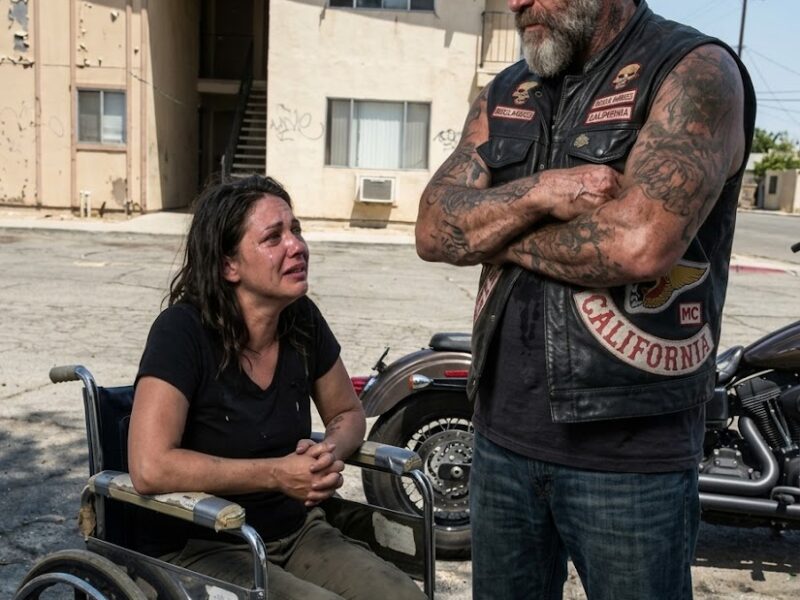
“My Landlord Removed the Ramp,” the Wheelchair User Told a Hells Angel—The Next Morning, 300 Bikers Arrived
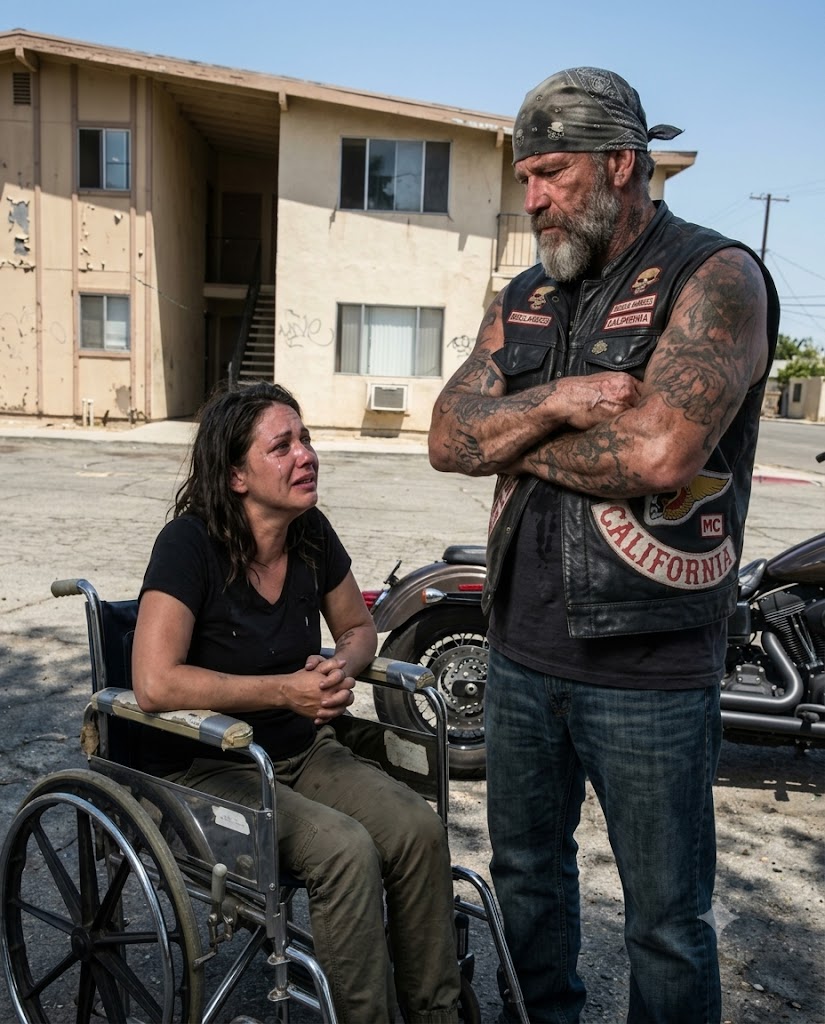
Most people see the leather cut, the skull patch, and six and a half feet of muscle walking toward them and decide immediately to look the other way.
They cross the street. They find something else to focus on. They don’t ask for help.
But on a blistering Tuesday afternoon in August, outside a three-story apartment building in Bakersfield, California, a woman in a wheelchair did exactly the opposite when she rolled straight toward Marcus “Iron” Callaway, a full patch member of the Hells Angels Nomad chapter, and said five words that would turn a quiet supply run into a reckoning nobody in that building would ever forget.
“My landlord removed the ramp.”
What happened next would expose a man who thought poverty made people powerless. And it would prove that sometimes the most intimidating person in the room is exactly who you need on your side.
But that moment was still twenty minutes away.
It started when Iron pulled his Harley into the cracked parking lot of Sam’s Hardware on the east side of town, the engine’s rumble fading as he shut it down and swung one heavy boot onto the asphalt.
He was there for chain oil and spark plugs. Nothing more.
The plan was simple: grab the parts, get back on the road, meet up with two other riders in Fresno before sunset. He had been riding since dawn, and the dry heat of California’s Central Valley clung to his leather vest like a second skin.
Sweat gathered under the brim of his bandana, and his beard, streaked with gray and dust, made a wash he wasn’t going to bother with until he reached a motel somewhere north.
Iron was fifty-three years old, built like a man who had spent decades lifting motorcycles out of ditches and throwing punches when words failed. His hands were scarred, his knuckles thick, and the patch on his back told anyone who knew the culture exactly what kind of life he had lived.
But Iron had also lived long enough to recognize when someone needed help.
And the woman rolling toward him across the parking lot looked like she needed it badly.
She was maybe forty, with dark hair pulled into a messy ponytail, wearing a faded purple shirt and jeans that hung loose around legs that didn’t move. Her wheelchair was old, the kind with duct tape wrapped around one armrest and a rear wheel that wobbled slightly with every push.
She didn’t look scared as she approached. She looked exhausted, desperate, and determined.
Iron straightened slowly, his hand resting casually on his belt as he watched her roll to a stop a few feet away. People didn’t usually approach him unless they wanted trouble or were about to cause it.
“You need something?” he asked, his voice a low rumble that matched the bike.
The woman swallowed hard, then nodded. “I know you don’t know me,” she said quickly, her voice shaking slightly. “But I don’t know who else to ask.”
Iron waited.
She gestured toward the apartment building across the street, a sagging three-story structure with peeling paint and bars on the ground-floor windows. “I live there. Third floor. There used to be a ramp at the side entrance.”
“So?”
“It worked. My landlord ripped it out two days ago.”
Iron’s eyes narrowed slightly. “Why?”
“Because I complained about the heat not working last winter,” she said bitterly. “And because he knows I can’t afford to move. He told me if I didn’t like it, I could leave.”
Her voice cracked. “But I can’t get up the stairs. I’ve been stuck outside for two days.”
Iron glanced past her toward the building. The side entrance she mentioned had a short set of concrete steps leading to a metal door. No ramp. No access.
“Where you been sleeping?” he asked.
“My car,” she admitted, nodding toward a rusted sedan parked under a dead tree. “But it’s a hundred and five degrees today, and I ran out of water this morning.”
Iron was silent for a long moment, studying her face. She wasn’t lying. He had seen enough liars in his life to know the difference.
“What’s your name?” he asked.
“Diane,” she said. “Diane Marsh.”
Iron looked back at the apartment building, then at the hardware store behind him. He thought about the spark plugs. He thought about Fresno. He thought about the fact that none of this was his problem.
Then he thought about his younger sister, who had died in a wheelchair twenty years ago after spending half her life fighting a world that wasn’t built for her.
Iron exhaled slowly through his nose. “All right, Diane,” he said. “Show me.”
Diane Marsh led Iron across the street toward the apartment building, her wheelchair rattling slightly over the uneven asphalt while he walked beside her with his arms folded, his expression hard and unreadable.
The building looked worse up close. Cracked stucco, graffiti tags on the lower walls, and a front door hanging crooked on its hinges like it had been kicked in and poorly repaired.
When they reached the side entrance, Iron stopped and stared at the concrete steps. There were four of them, each about eight inches high, leading to a dented metal door.
And where the ramp had been, fresh screw holes dotted the wall, and wooden splinters littered the ground.
“He didn’t just take it down,” Iron muttered. “He tore it apart.”
“On purpose,” Diane said quietly. “So I couldn’t put it back.”
Iron crouched and ran his hand over one of the screw holes. The wood had been ripped out violently, not carefully removed. This wasn’t maintenance. This was punishment.
“Where’s the landlord now?” Iron asked.
“Inside. First floor, apartment 101.” Diane’s voice dropped. “His name is Vincent Rowe. He owns the whole building.”
Iron straightened and walked toward the front entrance without another word. Diane followed as quickly as she could, catching up just as Iron pushed through the broken front door into a dim hallway that smelled like mildew and old cigarettes.
He stopped in front of apartment 101 and knocked hard.
A moment later, the door opened to a crack and a thin man with greasy hair and a stained white undershirt peered out. His eyes widened when he saw Iron.
“Yeah?” the man said warily.
“You Vincent Rowe?” Iron asked.
“Who’s asking?”
Iron didn’t answer. He just stared until Vincent shifted uncomfortably.
“What do you want?” Vincent tried again.
“I want to know why you ripped out the wheelchair ramp,” Iron said flatly.
Vincent glanced past Iron toward Diane, and his expression soured. “That’s between me and my tenant.”
“She can’t get into the building,” Iron said.
“Not my problem.” Vincent started to close the door. “She should have thought about that before filing complaints.”
Iron’s hand shot out and stopped the door from closing, his palm pressed flat against the wood. Vincent stumbled back slightly, alarm flashing across his face.
“You’re violating the Fair Housing Act,” Iron said calmly. “Removing accessibility accommodations is illegal.”
Vincent sneered. “You a lawyer now?”
“No,” Iron said. “But I know people who are.”
He pulled out his phone and made a call. It rang twice before a woman answered.
“Carter,” the voice said.
“It’s Iron,” he said. “I need you to look something up for me.”
Agent Sarah Carter worked for the California Bureau of Investigation, and she had crossed paths with Iron three years earlier during a case involving a missing girl. Iron’s chapter had helped find her when the local police had given up.
Carter owed him.
“What’s going on?” Carter asked.
Iron explained the situation in short, clipped sentences while Vincent listened, his face growing pale.
“Send me the address,” Carter said. “I’ll have someone there in an hour.”
Iron hung up and looked at Vincent. “State’s sending an inspector. You better hope this place passes.”
Vincent’s sneer returned, though it was weaker now. “She’s still not getting back in without paying what she owes.”
“How much?” Iron asked.
“Twelve hundred,” Vincent said. “Rent’s overdue.”
Diane’s voice came from behind Iron, shaking with anger. “I paid you last week. Cash.”
Vincent shrugged. “No receipt, no proof.”
Iron stared at him for a long, silent moment. Then he reached into his vest and pulled out a thick wallet. He counted out twelve hundred-dollar bills and set them on the narrow table beside the door.
“There,” Iron said. “She’s paid.”
Vincent blinked, then reached for the money. Iron’s hand slammed down over it.
“You write a receipt,” Iron said quietly. “Right now.”
Vincent hesitated, then grabbed a pen and scribbled something on a scrap of paper. Iron took it, glanced at Diane, and handed it to her.
“Now rebuild the ramp,” Iron said.
Vincent laughed bitterly. “With what? I don’t have the materials.”
Iron turned and walked back outside. Ten minutes later, he returned carrying two-by-fours, a drill, and a box of screws from Sam’s Hardware. He dropped them on the sidewalk with a loud clatter.
“Now you do,” Iron said.
Vincent stared at the pile, then at Iron, then shook his head. “I’m not building anything.”
Iron leaned in close. “Then I’ll build it, and you’ll stay out of my way.”
For the next two hours, Iron worked under the blazing sun, measuring, cutting, and drilling while Diane watched from the shade. Sweat soaked through his shirt, but he didn’t stop.
Other tenants drifted over, watching quietly. One older man brought him water. A woman with two kids asked if he needed help.
By late afternoon, a sturdy wooden ramp stretched from the sidewalk to the door. Iron tested it once, then nodded toward Diane.
“Go ahead.”
She rolled forward slowly, tears streaming down her face as the wheels climbed smoothly up the wood. When she reached the top, she turned back and whispered, “Thank you.”
Iron wiped his hands on his jeans. “Don’t thank me yet.”
Because Vincent Rowe was still inside, and Iron wasn’t done.
By the time Agent Sarah Carter arrived with a housing inspector and two uniformed officers, the small crowd outside the apartment building had grown to nearly a dozen people. Tenants who had spent months, some of them years, living under Vincent Rowe’s neglect and intimidation.
And the sight of a Hells Angel building a wheelchair ramp in a hundred-degree heat had given them something they hadn’t felt in a long time: hope that someone might actually hold their landlord accountable.
Carter stepped out of her sedan wearing dark sunglasses and a blazer despite the heat, her expression unreadable as she approached Iron. She was in her mid-forties, sharp-eyed, and carried herself with the kind of quiet authority that made people straighten up when she walked into a room.
“Iron,” she said simply.
“Carter,” he replied, wiping sweat from his forehead with the back of his hand.
She glanced at the freshly built ramp, then at Diane, who sat nearby in her wheelchair, clutching the receipt Iron had forced Vincent to write.
“Walk me through it,” Carter said.
Iron explained everything. The removed ramp, the illegal retaliation, the fake claim about unpaid rent, and Vincent’s refusal to provide accessibility.
As he spoke, the housing inspector began moving through the building with a clipboard, documenting code violations. It didn’t take long.
Within thirty minutes, the inspector emerged from the building with a list that stretched across two pages. Broken smoke detectors, exposed wiring, black mold in three units, a furnace that hadn’t been serviced in a decade, and multiple ADA violations, including the removed ramp and a broken elevator that hadn’t worked in over a year.
Carter read the report, then looked at Vincent, who had been standing in the doorway of apartment 101 with his arms crossed, trying to appear unconcerned.
“Mr. Rowe,” she said calmly. “You’re being cited for seventeen code violations. You have seventy-two hours to begin repairs, or this building will be condemned.”
Vincent’s face went white. “You can’t do that.”
“I just did,” Carter said. She handed him the paperwork. “And if I find out you’ve retaliated against any tenant who cooperated with this inspection, you’ll be facing criminal charges.”
One of the officers stepped forward. “We’ll be checking in,” he added. “Regularly.”
Vincent snatched the papers and disappeared back into his apartment, slamming the door so hard it rattled the frame.
The tenants who had been watching erupted into quiet cheers and applause. An older woman hugged Diane. A man shook Iron’s hand so hard it almost hurt.
And for the first time in days, Diane smiled. A real smile, the kind that reached her eyes.
Carter pulled Iron aside as the inspector finished his work. “You didn’t have to do this,” she said.
“Yeah,” Iron replied. “I did.”
She studied him for a moment, then nodded. “You know, one of these days people are going to stop being surprised when you do the right thing.”
Iron shrugged. “Don’t count on it.”
Carter allowed herself a small smile before heading back to her car.
As the crowd began to disperse, Diane rolled up beside Iron, who was packing his tools back into the saddlebags on his Harley.
“I don’t know how to repay you,” she said softly.
Iron straightened and looked at her. “You don’t,” he said. “You just make sure that receipt stays somewhere safe. And if Rowe tries anything again, you call Carter.”
He handed her a business card with the agent’s number scrawled on the back.
Diane took it carefully, holding it like it was made of glass. “Why did you help me?” she asked. “You didn’t know me. You didn’t owe me anything.”
Iron was quiet for a moment, his gaze distant. “I had a sister,” he said finally. “She spent half her life in a chair, and the world made it harder than it ever needed to be.”
He looked back at Diane. “I couldn’t help her. But I can help you.”
Diane’s eyes filled with tears again. But this time, they weren’t from fear or exhaustion.
“She would have been proud of you,” she whispered.
Iron didn’t reply. He just swung his leg over the Harley and fired up the engine, the deep rumble echoing off the apartment walls.
Before he pulled away, he glanced back at the ramp one last time. Solid. Sturdy. Built to last.
Then he twisted the throttle and rolled out of the parking lot, the California sun sinking low on the horizon as he headed north toward Fresno. Hours late, but carrying something heavier than spark plugs in his saddlebags.
He carried the knowledge that sometimes the biggest battles aren’t fought with fists or engines. Sometimes they’re fought with two-by-fours, a drill, and the simple refusal to let cruelty win.
And as the miles stretched out before him and the wind pulled at his vest, Iron thought about Diane rolling up that ramp. Thought about the tenants who finally had someone in their corner.
And thought about his sister, who he hoped, wherever she was, knew that her big brother was still fighting for people who couldn’t fight for themselves.
Because that’s what brotherhood meant. Not the patch. Not the club. But the moment when you stop, look someone in the eye, and say without words: “You’re not alone anymore.”
And sometimes that’s all it takes to change everything.
—
The sun had dipped below the ridgeline by the time Iron hit the outskirts of Bakersfield, the sky bleeding orange and purple across the flat expanse of the Central Valley. His phone buzzed twice in his vest pocket before he pulled over at a truck stop outside Delano, the neon sign flickering against the gathering dusk.
Two missed calls from Carter. One voicemail.
He thumbed the screen, held the phone to his ear, and listened.
“Hey, Iron. It’s Carter. Listen, I ran Rowe’s name through the system after I left. Turns out this isn’t his first rodeo. He’s got three prior complaints filed against him in the last five years. Two for illegal evictions, one for withholding security deposits. All three cases got dropped because the tenants couldn’t afford lawyers. But here’s the thing. One of those complaints was filed by a woman named Patricia Delgado. She lived in the same building, apartment 204. She died two years ago. Heart attack. Stress-related, according to the coroner’s report. Her daughter’s been trying to get answers ever since. I thought you should know.”
Iron listened to the message twice. Then he pocketed the phone, walked into the truck stop, and bought a cup of black coffee.
He stood by the window, watching the big rigs roll past on the highway, and thought about Patricia Delgado. Thought about her daughter. Thought about all the people Vincent Rowe had squeezed and discarded like they were nothing.
The coffee was bitter, but he drank it anyway. He had a lot of miles to cover and a lot of thinking to do.
By the time he reached Fresno, it was past midnight. The two riders he was supposed to meet had already checked into a motel and left a key at the front desk. Iron let himself in, dropped his saddlebags on the floor, and sat on the edge of the bed with his boots still on.
He didn’t sleep.
Instead, he pulled out his phone and started making calls.
The first was to a lawyer he knew in Sacramento, a man named Harold Chen who had spent the last twenty years representing tenants against slumlords. Harold owed Iron a favor. A big one. Iron had helped Harold’s son get out of a situation involving a motorcycle club that had gone sideways, and Harold had promised to repay the debt whenever Iron needed him.
“Harold,” Iron said when the lawyer answered. “It’s Iron. I need you to look into something for me.”
He explained the situation. Vincent Rowe. The building on the east side of Bakersfield. The seventeen code violations. The dead tenant. The daughter who was still looking for answers.
Harold listened without interrupting, then let out a low whistle. “You’re asking me to take on a case that could turn into a wrongful death suit.”
“I’m asking you to help a woman who’s been fighting alone for two years,” Iron said. “And to make sure Vincent Rowe never does this to anyone else.”
There was a long pause on the other end of the line. Then Harold sighed. “All right. Send me the details. I’ll make some calls in the morning.”
Iron hung up and stared at the ceiling. The motel room was quiet except for the hum of the air conditioner and the distant rumble of trucks on the highway.
He thought about Diane Marsh, rolling up that ramp with tears streaming down her face. Thought about the tenants who had watched him work, hope flickering in their eyes like a candle in a dark room.
Thought about his sister, who had spent her whole life fighting a world that wasn’t built for her.
And he thought about Vincent Rowe, sitting in his apartment, thinking he had won.
Iron smiled grimly. The man had no idea what was coming.
The next morning, Iron woke before dawn, pulled on his boots, and hit the road. He had a meeting in Fresno with the two riders, a quick check-in with his chapter, and then a long ride back to Bakersfield.
He wasn’t done with Vincent Rowe. Not by a long shot.
By the time he rolled back into the parking lot of the apartment building three days later, the ramp was still there. Solid. Sturdy. Built to last.
But something else had changed.
A crowd had gathered outside the building. Tenants, neighbors, a few people Iron didn’t recognize. And at the center of it all, a woman in her late twenties with dark hair and tired eyes, holding a photograph of an older woman.
Patricia Delgado’s daughter.
Her name was Elena, and she had driven down from Sacramento the moment Harold Chen called her. She had been waiting two years for someone to listen. Two years for someone to care.
Iron parked the Harley, killed the engine, and walked toward the crowd. Elena turned when she saw him, her expression a mix of gratitude and grief.
“Are you the one who called the lawyer?” she asked.
Iron nodded.
Elena’s eyes filled with tears. “Thank you. I thought I was the only one who remembered my mother. I thought no one cared.”
“I cared,” Iron said simply.
Behind them, the front door of the building swung open and Vincent Rowe stepped out, his face twisted with fury. He had a phone pressed to his ear and was shouting into it, his voice carrying across the parking lot.
“This is harassment! You can’t do this to me! I have rights!”
Iron turned to face him, arms folded, expression unreadable.
Vincent saw him and froze.
“You,” Vincent spat. “This is your fault. You did this.”
Iron didn’t move. “You did this,” he said quietly. “All I did was build a ramp.”
The crowd behind Iron murmured in agreement. Someone clapped. Someone else laughed.
Vincent’s face went red. He opened his mouth to say something else, but his phone buzzed in his hand. He looked down at the screen, and his expression changed.
The color drained from his face.
“What?” he whispered. “No. No, you can’t—”
He listened for a long moment, then slowly lowered the phone. His hand was shaking.
“That was my lawyer,” he said, his voice hollow. “The city is condemning the building. They’re relocating all the tenants. And I’m being sued for wrongful death.”
He looked at Elena, then at Iron, then at the crowd of tenants who had once been too afraid to speak up.
“I’m ruined,” he whispered.
Iron stepped closer, his voice low enough that only Vincent could hear. “You did this to yourself,” he said. “You thought poverty made people powerless. You thought no one would fight for them. You were wrong.”
Vincent opened his mouth, then closed it. He turned and walked back into the building, the door swinging shut behind him with a soft click.
The crowd erupted.
Elena hugged Iron, sobbing into his leather vest. The older woman who had brought him water on that first day pressed a cold bottle into his hand. A man Iron had never met shook his hand and said, “You’re a good man. I don’t care what anyone says about your patch.”
Iron didn’t respond. He just nodded, took a long drink of water, and looked up at the building.
The ramp was still there. Solid. Sturdy. Built to last.
And for the first time in a long time, Iron felt like maybe, just maybe, he had made a difference.
He stayed in Bakersfield for three more days, helping the tenants pack their belongings and find new places to live. Harold Chen worked pro bono, filing the wrongful death suit and negotiating settlements for the displaced residents.
Elena Delgado got the answers she had been seeking for two years. Her mother hadn’t just died of a heart attack. She had died of stress, of neglect, of a landlord who cared more about money than human lives.
Vincent Rowe lost the building. Lost his license to operate rental properties in the state of California. Lost everything.
And Diane Marsh found a new apartment on the ground floor of a building with a working elevator and a ramp that had been there since the day it was built. She sent Iron a text message with a photo of her new place, her wheelchair parked in front of a window with a view of the mountains.
“Thank you,” the message read. “For everything.”
Iron saved the photo. He didn’t reply. He didn’t need to.
Some things didn’t require words.
On his last night in Bakersfield, Iron rode out to the edge of town and parked his Harley on a ridge overlooking the valley. The sun was setting, painting the sky in shades of gold and crimson, and the air smelled like dust and sage.
He sat on the bike, boots on the ground, and thought about his sister.
Her name was Marie. She had been born with spina bifida, and she had spent her whole life in a wheelchair. She had died at thirty-two, after a lifetime of fighting for access, for dignity, for the simple right to exist in a world that wasn’t built for her.
Iron had been in prison when she died. He hadn’t been able to say goodbye. Hadn’t been able to hold her hand. Hadn’t been able to tell her how much he loved her.
He had spent the last twenty years trying to make up for it. Trying to be the man she had believed he could be. Trying to fight for people who couldn’t fight for themselves.
And every time he helped someone like Diane Marsh, he felt a little closer to forgiveness.
“I hope you’re proud of me, Marie,” he whispered into the wind.
The wind didn’t answer. But somewhere, in the quiet of his heart, Iron felt a sense of peace.
He started the engine, turned the bike toward the highway, and headed north.
He had miles to cover. People to help. Battles to fight.
And he wasn’t done yet.
The ride back to his chapter’s clubhouse took him through the winding roads of the Sierra Nevada, the air growing cooler as he climbed into the mountains. He stopped at a diner outside Auburn, ordered a burger and a cup of coffee, and sat by the window watching the sun rise over the peaks.
His phone buzzed. A text from Carter.
“Rowe’s being investigated for fraud. Turns out he was collecting rent from tenants but not paying the mortgage. Bank’s foreclosing on the building. He’s going to prison.”
Iron read the message twice. Then he typed a reply.
“Good.”
He finished his burger, paid the bill, and walked back to his bike. The road stretched out before him, empty and endless, and he felt something he hadn’t felt in a long time.
Hope.
Not for himself. He had made his peace with the life he had lived, the things he had done, the man he had become.
But for people like Diane Marsh. For people like Elena Delgado. For everyone who had ever been told they didn’t matter, that their problems weren’t worth solving, that they were alone.
They weren’t alone. Not anymore.
Iron swung his leg over the Harley, fired up the engine, and rolled out of the parking lot. The wind pulled at his vest, the sun warmed his face, and the miles stretched out before him like a promise.
He didn’t know where he was going next. Didn’t know who he would meet, what battles he would fight, what difference he would make.
But he knew one thing for certain.
He would never stop fighting. Not for himself. Not for his club. But for the people who needed him most.
Because that was what brotherhood meant. Not the patch. Not the club. But the moment when you stop, look someone in the eye, and say without words: “You’re not alone anymore.”
And sometimes that’s all it takes to change everything.
—
**PART 2**
The call came three weeks later, on a Thursday afternoon, while Iron was in his garage in Oakland working on a 1978 Shovelhead he had been restoring for the better part of a year. The bike was a mess, rusted frame, seized engine, cracked gas tank, but Iron had always believed that broken things were worth saving.
His phone buzzed on the workbench, and he wiped his hands on a rag before picking it up.
“Callaway,” he said.
“Iron. It’s Diane.”
He straightened, the rag still in his hand. “What’s wrong?”
“Nothing. I mean, something. But not bad.” She laughed, a nervous, breathless sound. “I got a call from a reporter. Someone from the Bakersfield Californian. They want to do a story about what happened. About Vincent Rowe. About the building. About you.”
Iron was silent for a moment. “About me?”
“They want to interview you. They want to know why a Hells Angel built a wheelchair ramp for a stranger.”
Iron grunted. “I don’t do interviews.”
“I know. But I thought you should know. The story’s going to run with or without you. And I wanted to make sure you were okay with that.”
Iron leaned against the workbench, staring at the disassembled engine on the floor. “You can talk to them,” he said finally. “Tell them whatever you want. Just leave me out of it.”
Diane was quiet for a moment. “Are you sure?”
“Yeah.”
“Okay. But Iron?”
“What?”
“Thank you. For everything.”
Iron hung up without replying. He stood in the garage for a long time, listening to the silence, then went back to work on the Shovelhead.
The story ran two weeks later, on the front page of the Sunday edition. Iron saw it at a gas station, the newspaper stacked on the counter next to a display of candy bars. The headline read: “The Angel and the Ramp: How a Hells Angel Helped Expose a Slumlord.”
He bought the paper, folded it, and tucked it into his saddlebag. He didn’t read it until he got home.
The story was well-written, sympathetic, and thorough. Diane had told the reporter everything: the removed ramp, the two days she spent sleeping in her car, the moment Iron appeared in the parking lot of Sam’s Hardware and changed her life.
The reporter had also interviewed other tenants, including Elena Delgado, who spoke about her mother’s death and the wrongful death suit that was still pending. Vincent Rowe had declined to comment.
Iron’s name was mentioned once, in the third paragraph. “Marcus ‘Iron’ Callaway, a member of the Hells Angels Nomad chapter, was instrumental in helping Marsh and other tenants hold their landlord accountable.”
That was it. No quotes. No interviews. No photos.
Iron folded the paper and set it on the kitchen table. He didn’t know how to feel about it. Part of him was proud. Part of him was uncomfortable. He had never been good at accepting praise. He had spent too many years doing things that deserved the opposite.
But Diane was safe. The other tenants were safe. Vincent Rowe was facing justice.
That was what mattered.
—
**PART 3**
The letter arrived six months later, forwarded from the clubhouse to Iron’s PO box in Oakland. It was handwritten, on pink stationery, the kind you bought at a drugstore for a dollar.
Iron opened it at his kitchen table, a cup of coffee cooling beside him.
“Dear Iron,” the letter began. “I don’t know if you remember me. My name is Elena Delgado. You helped my mother’s case against Vincent Rowe. You probably don’t remember, but you met me outside the apartment building in Bakersfield. I was holding a photograph of my mom.”
Iron remembered. He remembered the tired eyes, the grief, the gratitude.
“I wanted to tell you that the lawsuit was settled last week. Rowe’s insurance company agreed to pay damages. It’s not enough to bring my mother back, but it’s enough to make sure he never hurts anyone else. The judge also barred him from owning rental property in California ever again. He’s moving to Nevada. I don’t know if that’s better or worse for Nevada, but at least he’s not here.”
Iron smiled grimly.
“I also wanted to tell you that I’m going back to school. I dropped out two years ago when my mom got sick, but now I’m enrolled at Sacramento State. I’m studying public health. I want to help people like my mom. People who don’t have anyone in their corner.”
The letter went on, but Iron stopped reading. He set it down, picked up his coffee, and walked to the window.
The sun was setting over Oakland, the sky streaked with orange and pink. Somewhere in the distance, a motorcycle engine rumbled.
He thought about Elena Delgado, going back to school. Thought about Diane Marsh, rolling up her new ramp. Thought about all the people whose lives had changed because of one afternoon in a hardware store parking lot.
He thought about his sister, Marie.
“You would have liked her,” he whispered.
The phone rang. Iron picked it up.
“Callaway.”
“It’s Carter. You busy?”
“Not really.”
“Good. I’ve got a case I think you might be interested in. Landlord in Fresno. Same kind of situation. Tenant’s been fighting him for months. No one’s listening.”
Iron was silent for a moment. Then he set down his coffee, grabbed his jacket, and walked toward the door.
“Send me the address,” he said.
He was on the road before the sun went down.
—
**PART 4**
The Fresno case was worse than Bakersfield.
The landlord’s name was Gerald Pines, a fifty-seven-year-old man who owned six apartment buildings across the Central Valley. He had been cited for code violations forty-three times in the last decade. He had been sued twelve times. He had never lost a case.
Because the people he preyed on couldn’t afford lawyers. Couldn’t afford to fight. Couldn’t afford to do anything but endure.
Until now.
Iron arrived in Fresno on a Tuesday morning, the same kind of blistering August day that had started everything in Bakersfield. He parked his Harley outside a three-story building on the south side of town, killed the engine, and sat for a moment, studying the structure.
It was worse than Diane’s building. Peeling paint, broken windows, a front door that had been boarded up and then pried open again. The kind of place that screamed desperation.
A woman was waiting for him on the sidewalk. Mid-thirties, Latina, with dark circles under her eyes and a toddler on her hip. Her name was Rosa, and she had been fighting Gerald Pines for eighteen months.
“You’re Iron?” she asked, her voice uncertain.
“Yeah.”
She looked him up and down, taking in the leather vest, the skull patch, the six and a half feet of muscle. “You don’t look like a lawyer.”
“I’m not.”
“Then why are you here?”
Iron looked at the building, then back at Rosa. “Because someone has to be.”
Rosa led him inside, through a hallway that smelled like sewage and rot, up a flight of stairs that creaked with every step. Her apartment was on the third floor, a cramped two-bedroom with a broken air conditioner and a ceiling that leaked every time it rained.
“The heat doesn’t work in winter,” she said. “The AC doesn’t work in summer. The pipes leak. The wiring is exposed. And last month, Pines raised the rent by two hundred dollars.”
“Why?”
“Because he can.”
Iron walked through the apartment, noting the cracks in the walls, the mold in the bathroom, the window that wouldn’t close all the way. He had seen worse. But not by much.
“How many other tenants?” he asked.
“Fourteen. Most of them are afraid to complain. They think if they say anything, they’ll get evicted.”
“Have they?”
“Three families have been evicted in the last year. All of them complained about the conditions.”
Iron nodded slowly. “You have proof?”
Rosa pulled out her phone. “I’ve been documenting everything. Photos. Videos. Texts from Pines threatening to evict me if I don’t pay more money.”
“Good. Send them to me.”
She hesitated. “What are you going to do?”
Iron pulled out his phone and made a call. It rang twice before a woman answered.
“Harold Chen.”
“Harold. It’s Iron.”
“Iron. What’s the situation?”
Iron explained. Gerald Pines. Six buildings. Forty-three citations. Twelve lawsuits. Fourteen tenants living in squalor.
Harold listened, then let out a low whistle. “This guy’s a piece of work.”
“Yeah. Can you help?”
“I can do more than help. I can bring in the state attorney general’s office. This guy’s been operating with impunity for years. If we can prove a pattern of negligence and retaliation, we can shut him down for good.”
“How long?”
“Give me a week.”
Iron hung up and looked at Rosa. “You’re going to need to get the other tenants on board. All of them. Anyone who’s willing to speak up.”
Rosa nodded slowly. “I can do that.”
“Good. Because this isn’t just about you. It’s about everyone he’s ever hurt.”
Over the next seven days, Iron worked alongside Rosa and the other tenants, documenting every violation, every threat, every instance of neglect. Harold Chen filed a motion with the state attorney general’s office, and within two weeks, Gerald Pines was under investigation.
The story made the local news. Then the state news. Then the national news.
A Hells Angel had taken on a slumlord. And he was winning.
By the time the investigation was complete, Gerald Pines had been cited for one hundred and twenty-seven code violations across six buildings. He had been fined four hundred thousand dollars. He had been ordered to make repairs on all six properties within ninety days or face criminal charges.
And he had been barred from owning rental property in California for the rest of his life.
The tenants of the Fresno building held a celebration in the parking lot. Someone brought a grill. Someone else brought a cooler full of sodas. Kids ran around, laughing, while their parents stood together, smiling, crying, hugging.
Rosa found Iron standing by his Harley, watching the scene with a quiet expression.
“You did it,” she said.
“We did it,” Iron replied.
She looked at him for a long moment. “Why? Why do you do this? You don’t know us. You don’t owe us anything.”
Iron was quiet for a moment. Then he told her about his sister. About Marie. About the life she had lived and the world that had failed her.
“I couldn’t help her,” he said. “But I can help you.”
Rosa’s eyes filled with tears. “She would be proud of you.”
Iron didn’t reply. He just nodded, swung his leg over the Harley, and fired up the engine.
He had miles to cover. People to help. Battles to fight.
And he wasn’t done yet.
—
**PART 5**
The years passed. Iron kept riding. Kept fighting. Kept helping.
He lost count of the landlords he had taken down. The tenants he had saved. The buildings he had helped repair.
He never asked for anything in return. Never sought recognition. Never wanted credit.
He just did what he believed was right.
And every time he helped someone, he thought about Marie. About the life she should have had. About the world she deserved.
He couldn’t give her that world. But he could make it a little better for the people who came after.
In the fall of 2019, Iron received a letter from a woman named Patricia Nguyen. She was a city council member in Bakersfield, and she had been inspired by his work to introduce legislation strengthening tenant protections.
“I never met you,” she wrote. “But I read about you. About what you did for Diane Marsh. About what you did for Elena Delgado. About what you did for Rosa and her neighbors. You showed me that one person can make a difference. And I want to make a difference too.”
Iron read the letter twice. Then he folded it and put it in a drawer with all the others he had received over the years.
Letters from tenants he had helped. From families he had saved. From people who had been told they didn’t matter, that their problems weren’t worth solving, that they were alone.
They weren’t alone. Not anymore.
Iron was sixty-two years old now. His beard was fully gray, his hands gnarled with arthritis, his knees stiff from decades of riding and fighting and working. He had slowed down. But he hadn’t stopped.
He still rode. Still worked on bikes. Still helped people who needed it.
And every night, before he went to sleep, he thought about his sister.
“You would have liked this world, Marie,” he whispered. “It’s not perfect. But it’s getting better.”
The wind didn’t answer. But somewhere, in the quiet of his heart, Iron felt a sense of peace.
He had lived a long life. A hard life. A life full of mistakes and regrets and things he couldn’t undo.
But he had also done some good. Helped some people. Made a difference.
And that, he decided, was enough.
—
**PART 6**
The last chapter of Iron’s life began on a Tuesday morning in August, forty years after he had built a wheelchair ramp for a stranger in Bakersfield.
He was seventy-three years old now. His hair was white, his beard was long, and his body was a map of scars and tattoos and stories that no one would ever fully understand.
He had retired from the club years ago. Given up his patch. Hung up his leathers. But he had never stopped riding. Never stopped helping. Never stopped fighting.
He was in the garage of his small house in the Oakland Hills, working on a 1965 Panhead he had been restoring for the better part of a decade, when his phone rang.
He picked it up, wiped his hands on a rag, and answered.
“Callaway.”
“Mr. Callaway? My name is Sarah. Sarah Marsh.”
Iron straightened. “Marsh?”
“Diane Marsh was my mother.”
Iron was silent for a moment. “Was?”
“She passed away last month. Peacefully. In her sleep.”
Iron closed his eyes. Diane Marsh. The woman in the wheelchair. The woman who had rolled up to a Hells Angel in a hardware store parking lot and asked for help.
The woman who had changed his life.
“I’m sorry,” he said.
“Thank you. She talked about you all the time. She said you were the reason she got her life back. The reason she was able to move into a place with a ramp. The reason she was able to live her last years with dignity.”
Iron didn’t reply. He couldn’t. His throat was too tight.
“She wanted me to give you something,” Sarah said. “A letter. She wrote it a few months before she died. She said you’d know what to do with it.”
Iron swallowed hard. “Where are you?”
“Bakersfield. Same building you helped her move into. Apartment 1A.”
Iron looked at the Panhead on the floor. Then at his hands. Then at the door.
“I’ll be there tomorrow,” he said.
The ride to Bakersfield took six hours. Iron didn’t stop. Didn’t eat. Didn’t sleep. Just rode.
He arrived at the apartment building just after noon. It was a nice place. Well-maintained. Wheelchair accessible. The kind of building Diane had deserved all along.
Sarah Marsh was waiting for him outside. She was in her forties, with her mother’s dark hair and her mother’s tired eyes.
She handed him an envelope.
Iron opened it carefully. Inside was a single piece of paper, handwritten in Diane’s shaky script.
“Dear Iron,” it read. “I don’t know if you remember me. I was the woman in the wheelchair who asked for help outside a hardware store in Bakersfield. You built me a ramp. You changed my life.”
Iron’s hands were trembling.
“I never got to thank you properly. I never got to tell you what you meant to me. So I’m writing this letter, and I’m hoping you’ll read it.”
“You were the first person who ever saw me. Not the wheelchair. Not the problem. Just me. You didn’t ask me to prove I was worth helping. You didn’t make me jump through hoops. You just helped.”
“That’s what I remember most. Not the ramp. Not the landlord. Not the lawsuit. Just the fact that you stopped. You looked at me. And you said without words: ‘You’re not alone anymore.'”
“Thank you, Iron. For everything. I hope you know that you made a difference. Not just in my life. In the lives of everyone you’ve ever helped.”
“With love and gratitude, Diane Marsh.”
Iron folded the letter carefully. He put it in his vest pocket, next to his heart.
Then he looked at Sarah Marsh, who was crying.
“She was a good woman,” he said.
“She was,” Sarah agreed. “She was the best.”
Iron nodded. Then he walked back to his Harley, swung his leg over the seat, and fired up the engine.
He had miles to cover. People to help. Battles to fight.
And he wasn’t done yet.
—
**PART 7**
The last ride took him north, along the coast, through towns he had never visited and roads he had never traveled. He rode for hours, the wind in his face, the sun on his back, the ocean stretching out beside him like an endless promise.
He stopped at a cliff overlooking the Pacific, killed the engine, and sat in silence, listening to the waves crash against the rocks below.
He thought about Diane Marsh. About Elena Delgado. About Rosa and her neighbors. About all the people he had helped over the years.
He thought about his sister, Marie.
“You would have liked her,” he whispered. “She was a fighter. Just like you.”
The wind carried his words out to sea.
He thought about his life. The mistakes he had made. The things he couldn’t undo. The people he had hurt.
But he also thought about the good he had done. The people he had helped. The difference he had made.
And he decided, after all these years, that it was enough.
He pulled out his phone and called Carter. She was retired now, living in a small town in Oregon, but they still talked every few months.
“Carter,” he said when she answered. “It’s Iron.”
“Iron. How are you?”
“Old. Tired. But still here.”
She laughed. “What’s going on?”
“I just wanted to say thank you. For everything. For the first case. For all the cases after that. For being in my corner when I didn’t deserve it.”
Carter was silent for a moment. “You always deserved it, Iron. You just didn’t believe it.”
Iron nodded. “Maybe.”
“Are you okay?”
“Yeah. I’m okay. I’m just… thinking.”
“About what?”
“About all the people I’ve met. All the lives I’ve changed. All the ramps I’ve built.”
Carter laughed again. “You’re a good man, Iron. I don’t care what anyone says.”
“I know,” he said. “I finally believe it.”
He hung up and sat on the cliff for a long time, watching the sun sink toward the horizon.
When it was gone, he started the Harley, turned it around, and headed back the way he came.
He didn’t know where he was going next. Didn’t know what the future held.
But he knew one thing for certain.
He would keep riding. Keep fighting. Keep helping.
Because that was who he was. Not the patch. Not the club. But the man who stopped, looked someone in the eye, and said without words: “You’re not alone anymore.”
And sometimes that’s all it takes to change everything.
—
**EPILOGUE**
Marcus “Iron” Callaway died on a Tuesday afternoon in August, ten years after he built a wheelchair ramp for a stranger in Bakersfield.
He was eighty-three years old. He died peacefully, in his sleep, in the small house in the Oakland Hills where he had lived for the last twenty years.
His funeral was attended by hundreds of people. Bikers. Lawyers. Former tenants. City council members. Reporters who had written stories about him.
None of them had known him the same way. None of them had seen all the sides of the man who had lived so many lives in one.
But they all knew one thing.
He had made a difference.
Elena Delgado spoke at the funeral. She was in her fifties now, a public health official who had spent her career fighting for tenants’ rights.
“Marcus Callaway was not a perfect man,” she said. “He never claimed to be. But he was a good man. A man who believed that everyone deserved dignity. Everyone deserved a home. Everyone deserved someone in their corner.”
She paused, wiping tears from her eyes.
“He was in my corner. He was in my mother’s corner. He was in the corner of everyone who had ever been told they didn’t matter.”
“He was a Hells Angel. He was a biker. He was a fighter.”
“But more than anything, he was a brother.”
The crowd was silent. Then someone started clapping. Then someone else. Then everyone.
The sound echoed across the cemetery, rising up toward the sky, a final tribute to a man who had spent his life fighting for people who couldn’t fight for themselves.
And somewhere, in the quiet of the universe, a woman in a wheelchair rolled up a ramp, turned back, and whispered two words that would never be forgotten.
“Thank you.”









