
My Husband Fired Me Before the Entire Hotel Staff—Unaware My Signature Was on the Building’s Deed
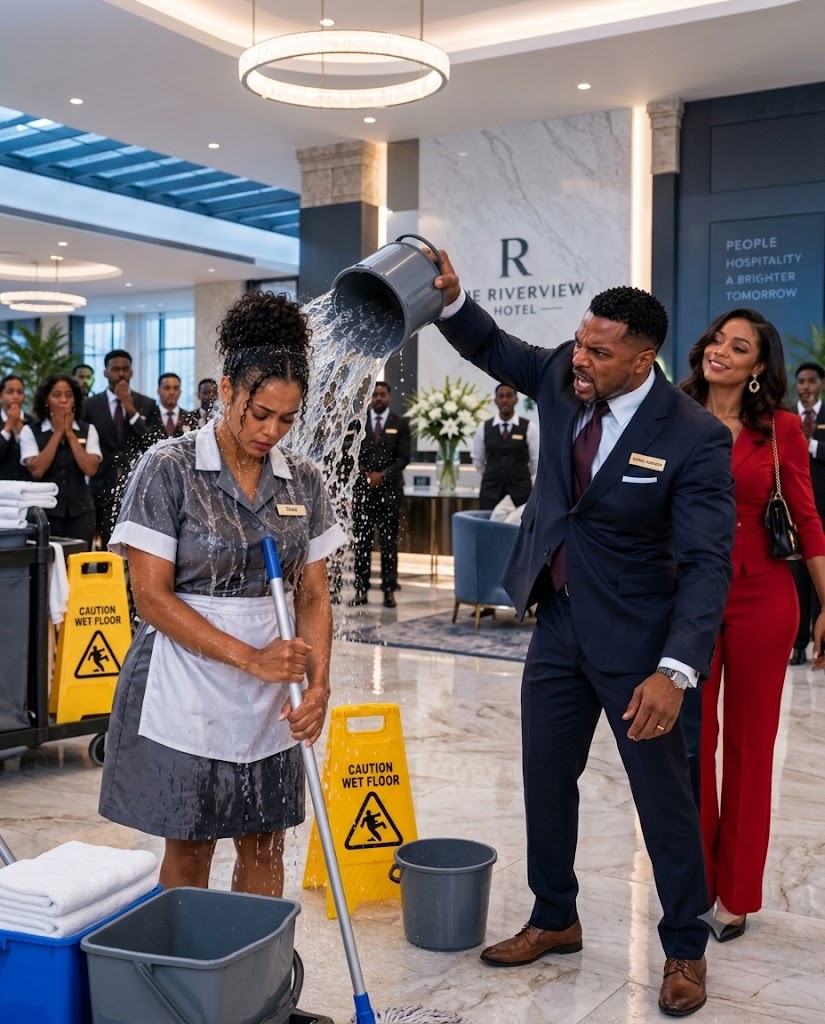
The bucket hit me square in the chest before I even saw his hand move. Dirty mop water, gray and cold, ran down the front of my uniform and pooled in my shoes while forty of my co-workers stood frozen in the marble lobby of the Riverview Hotel. My husband, Aaron, general manager of the flagship property, didn’t blink. “You are fired,” he said, loud enough for the front desk to hear. “Get out of my sight.”
Everyone in that room, listen up. Maya no longer works here. Effective now. Your job is to mop the floors. You don’t work in an office.
Then explain why my signature is on page four.
I want you to remember me standing there soaked, staff frozen around me, nobody moving to help. I want you to remember it, because in three weeks, in that exact same lobby, in front of nearly all of those same people, my husband was going to learn something about the woman he’d just humiliated that would end everything he thought he was building. He thought he was firing a housekeeper. He had no idea what he was actually doing.
If you’ve ever been underestimated by someone who thought they held all the power, stay with me. Subscribe so you don’t miss how this one ends. And tell me in the comments what city you’re watching from tonight.
My father used to say that a building tells you the truth about the people who run it, but only if you’re standing close enough to hear it. He didn’t mean that as a metaphor. He meant it literally, the way he meant most things, plainly and with the expectation that you’d actually do something about it. He built the Riverview from a single struggling property into six across three states, and by the time I was old enough to understand what that meant, he’d also become convinced of something most people in his position never bother to consider. Ownership without direct experience of the work is hollow.
He didn’t trust spreadsheets to tell him whether a hotel was a decent place to work. He trusted watching a manager talk to a housekeeper who had no idea who was standing nearby. I remember him taking me as a teenager on what he called walkthroughs that were really something closer to reconnaissance. Not announced visits with a general manager trailing behind him nervously, but quiet mornings where he’d park two blocks away and simply watch the loading dock, or sit in the lobby with a newspaper long enough to see how the front desk staff treated someone who clearly wasn’t checking in. He used to say that any company can perform decency for thirty minutes in front of an owner. The real test was what happened in the other twenty-three and a half hours.
Before he died, he asked me to do something most heirs never have to. He asked me to work inside the company anonymously, in ordinary roles, for a real stretch of time before I ever touched a single governance decision. Not as a formality, not as some symbolic gesture for a family trust document. He wanted me to actually know in my body what it felt like to be the person with no power in a room, because he said that was the only honest way to learn whether the culture underneath the Ady name was something he could be proud of, or something that had quietly rotted while he wasn’t looking.
I started in housekeeping at the Riverview six years ago. I was supposed to do it for eighteen months. I never stopped. I want to be honest about why.
It wasn’t only loyalty to my father’s wishes, though that mattered. Somewhere in the first year, I met Aaron. He was already the hotel’s rising operations manager back then. Sharp and confident, the kind of man who made you believe competence and decency were the same thing. We fell for each other slowly, the way people do when neither of them is performing for the other.
Except I was performing, in a sense, though not the way he’d have imagined. He fell in love with a housekeeper named Maya. He never knew the housekeeper also happened to be the person whose family trust would, on paper, eventually control every property he managed. I told myself for years that I’d tell him eventually. There was never a clean moment, and the longer it went, the more the silence stopped being about protecting a surprise and started being about something else entirely.
I wanted to know exactly what kind of man I’d married when he believed no one who mattered was watching him. Not because I doubted him. Because I loved him. And loving someone honestly means being willing to actually see them.
We married three years ago. I kept working the floor. He rose to general manager of the flagship property, the same one I mopped every single morning. Co-workers used to joke that I must be the only housekeeper in the state married to a GM, and I always just smiled and let them assume it meant nothing more than an unlikely office romance.
In those early years, Aaron was genuinely good at the job, or good enough that I never had reason to suspect otherwise. He knew the names of the housekeeping staff, which is rarer than it should be among hotel managers. He fought more than once for a budget increase to fix understaffing in the laundry department, back before whatever changed in him started changing. I used to think privately that my father would have approved of him, and there was a strange comfort in that, as though the two halves of my life, the disguised daughter and the ordinary wife, were quietly confirming the same thing about the man I’d chosen.
Something shifted gradually enough that I couldn’t point to a single day it started. Aaron grew more distant at home, more short with staff on the floor in ways that used to be out of character for him. He started taking meetings I wasn’t told about, in the specific way that isn’t lying exactly, just a slow narrowing of what he chose to share. I told myself it was the pressure of running a flagship property during a difficult stretch for the industry. I wanted very badly for that to be the whole explanation.
The first irregularity I noticed wasn’t dramatic. It was a staffing report six months ago that listed our housekeeping department as overstaffed relative to occupancy. A claim I knew, from literally being one of the bodies being counted, was false. I mentioned it to Aaron casually at first, the way a wife mentions something at dinner, not the way an owner’s representative flags a compliance issue. He told me the numbers came from corporate modeling, that I was reading a summary out of context, that I didn’t have the full picture.
I let it go. I told myself I was being paranoid, or worse, that I was letting six years in a housekeeping uniform make me suspicious of ordinary business language I simply didn’t understand.
It kept happening. A safety inspection report filed with a signature that looked enough like mine to pass a glance, attesting that housekeeping had signed off on reduced staffing minimums for the East Wing. A document I had never seen, let alone signed. I found it by accident, doing exactly the kind of ordinary floor-level work my father always said mattered most. Checking a supply closet inventory against a report that didn’t match what was actually on the shelves.
I sat with that discrepancy for two full days before I said anything to anyone. Turning it over, trying to find an innocent explanation that fit. I couldn’t find one. The signature was close enough to mine that it hadn’t been guessed at random. Someone had studied it.
Around the same time, a name started appearing in scheduling emails and vendor correspondence I wasn’t supposed to see but occasionally did, the way housekeeping sees everything if you’re paying attention. Ranata. I assumed at first she was simply the investment group’s representative on the sale Aaron had mentioned in passing. A routine transaction, he said. Corporate consolidation, nothing that would touch line staff. I didn’t yet know she was the reason he’d started staying late so often, or that consolidation was corporate language for eliminating most of the housekeeping department once the sale closed.
I confronted him with the forged safety report on a Tuesday. Not with accusations. With the actual document laid flat on our kitchen counter, my name printed at the bottom of a page I had never touched. He didn’t deny it convincingly. He told me to drop it. He told me, in the specific quietly cutting way he’d started speaking to me over the previous months, that it wasn’t my job to understand documents like that. I pushed a cart for a living, and he ran a hotel, and those were different jobs requiring different levels of trust.
I want to tell you that I already suspected by then what else was coming. I didn’t, not fully. I knew something in the marriage had gone cold. I didn’t yet understand that Aaron had already decided privately, weeks earlier, that he was leaving me for Ranata. That the sale wasn’t just corporate consolidation to him. It was the foundation of an entirely new life he’d already started building without telling me any of it.
The staff meeting where he fired me wasn’t really about the reports at all, though I didn’t understand that until much later. It was, I’ve since come to believe, the moment he’d been unconsciously building toward. A man who was already gone from his marriage, finally finding an acceptable public reason to act like it.
When the bucket hit me in front of nearly forty co-workers, when the water ran down my uniform and no one moved because no one knew whether moving would cost them their own job too, I understood something with total clarity that I hadn’t let myself understand in the weeks leading up to it. A man still invested in his marriage does not do this to his wife in public, in front of the people who both of them work with every day. This wasn’t really about the reports. This was Aaron ending the marriage the only way he apparently knew how to end anything. Publicly, decisively, and without ever having to be the one who said the actual words.
I stood there soaked and said nothing. I’ve thought a great deal since then about why I didn’t argue, didn’t cry, didn’t explain who I really was right there in that lobby with water still dripping off my uniform. The honest answer is that I understood, even in that moment, that the reveal deserved to happen somewhere the truth couldn’t be argued away. Not in a shouting match he could later frame however he wanted, but somewhere procedural, documented, undeniable. My father built our family’s governance structure to be exactly that kind of undeniable. I decided, standing there, to use it exactly as he’d intended.
I didn’t go home that night. I went to the office of Calvin Whitfield, our family trust’s attorney for over twenty years, a man who had known me since I was a teenager trailing my father through property walkthroughs. I told him everything. The falsified reports, the forged signature, the sale, the timeline. As far as I understood it, he didn’t waste time being outraged on my behalf, which I was grateful for. He simply opened a confidential audit under the trust’s authority, the kind of process that doesn’t require anyone’s permission or knowledge to begin, and told me the real danger wasn’t Aaron’s cruelty.
It was the calendar. The sale was scheduled to close in three weeks. Once it closed, the falsified records that proved the fraud would very likely be buried inside a transaction structure designed specifically to make them disappear.
Three weeks. That was the window. I spent it doing quiet, unglamorous work. The same kind of work I’d been doing on the floor for six years, just aimed differently now.
Calvin’s team pulled financial records, staffing histories, vendor communications, cross-referencing everything against what I already knew from having actually lived inside the building the entire time. I spent most evenings in Calvin’s conference room, going through documents at a folding table that felt a great deal less glamorous than anything Aaron probably imagined when he pictured what owning a hotel chain looked like. There were nights I sat there past midnight matching purchase orders against maintenance logs, feeling less like an heir asserting her rights and more like exactly what I’d spent six years becoming. Someone who paid close attention to details other people assumed didn’t matter.
I found more than once that the skills mattered more than the title ever could have. I knew what a real staffing schedule looked like because I’d lived inside a hundred of them. I knew which safety corners got cut first because I’d been the one occasionally asked to cut them.
Calvin, for his part, treated the entire process with a kind of careful procedural patience that I came to lean on more than I expected to. He reminded me more than once that the strength of the case wasn’t going to come from outrage. It was going to come from documents that couldn’t be argued with, timestamps that couldn’t be moved, and a governance structure my father had built specifically to survive exactly this kind of moment.
Your father didn’t build this trust to punish anyone, he told me one night, closing a folder. He built it so the truth would have somewhere solid to land.
There was one person who helped more than anyone else and who paid for it almost immediately. Desmond, the hotel’s maintenance supervisor, had noticed the same staffing irregularities I had, from his own angle. Work orders that didn’t match reported occupancy. Safety fixes that had been logged as complete but never actually performed. He’d mentioned his concerns to a mid-level manager weeks before I ever confronted Aaron directly. And when Aaron started suspecting there was a leak feeding information toward scrutiny he didn’t want, he moved to have Desmond terminated on a manufactured performance complaint.
I’d known Desmond for most of my six years on the floor. He was the kind of employee who fixed things quietly and never asked for credit. The sort of person my father’s old walkthroughs were specifically designed to notice and reward, if anyone had actually been looking. When word reached me, through a mutual contact who had no idea what I really was to any of it, that Desmond had been written up twice in a single week for infractions that didn’t match anything I’d ever seen from him in six years of working alongside him, I understood immediately what was actually happening. Aaron wasn’t disciplining a maintenance supervisor. He was trying to remove a witness before the walls closed in.
I found out the full details through Calvin’s audit team, who’d been quietly documenting the retaliation as part of the broader case. I made sure, through channels that didn’t reveal my involvement yet, that Desmond’s termination was administratively frozen, pending the outcome of an ongoing compliance review. He kept his job through those three weeks without ever knowing exactly why, or who had intervened. And there were nights I found a strange comfort in that. One person at least protected in real time, even while I couldn’t yet protect myself in the way that mattered most.
I didn’t go back to the hotel during that period. I couldn’t have, even if I’d wanted to. Aaron had made it clear, through the manner of the firing itself, that I wasn’t welcome on the property anymore. I watched instead from a distance, through Calvin’s updates as the sale moved toward its closing date, and through mutual acquaintances who had no idea what I actually was to any of this. I learned that Aaron had moved out of our house and into an apartment with Ranata within the first two weeks. I let myself feel the full weight of that when it reached me, sitting alone in a house that suddenly felt far too large, running my hand along a kitchen counter where I’d once laid out a forged report and asked him plainly to explain himself. I didn’t let it change the pace of the work.
There is a particular kind of grief that moves alongside determination rather than against it, and I let both exist in me at once. Some nights more of one than the other, without ever asking either to leave entirely.
The trust’s governing documents, drafted decades earlier by my father with a specificity that used to seem almost excessive to me and now felt like the most protective thing he’d ever done for me, required a mandatory ownership verification procedure at the formal closing of any sale involving a controlling property. A procedure that could not be waived, delayed, or structured around, regardless of who was in the room or how far along a deal had progressed. Aaron’s side and Ranata’s investors had no idea this requirement existed in a form that specifically named a living, active, controlling representative, because the trust had never previously needed to assert it during Aaron’s tenure. It had simply never come up until now. It never needed to.
The closing was scheduled for a Thursday morning in the same lobby where I had been fired three weeks earlier. The staging alone felt almost unbearably precise. The same marble floor, the same arrangement of white flowers on the reception desk, the same kind of bright upscale morning light I remembered from the day the water hit me. Aaron stood at the front of the room beside Ranata. Both of them composed, both of them clearly expecting a formality. Signatures, handshakes, the quiet satisfaction of a deal closing exactly as planned.
The investment group’s principals were seated to one side, folders open, pens ready. A cluster of hotel staff, the same staff who had watched me humiliated in that exact spot, stood near the back. Present because Aaron had wanted visible confirmation of a smooth transition for the new ownership group.
Calvin stood, opened a folder, and read the mandatory ownership verification aloud, exactly as the trust required. His voice even and unhurried, the way it had been every night in that conference room over the previous three weeks. He stated that the sale could not proceed to closing without confirming the presence and active authorization of the trust’s sole controlling representative. And then he said my name. Maya Ady Reed, controlling representative, Ady Family Trust, sole authorized signatory for the Riverview and its affiliated properties.
I want you to picture Aaron’s face in that exact second, because I’ve had it described to me more than once by people who were standing close enough to see it clearly. It wasn’t confusion at first. It was the specific sinking recognition of someone doing rapid, horrified arithmetic. Running back through six years of a marriage, a firing, a forged report with my name on it, and understanding all at once exactly whose name that really was.
Someone told me later that his hand actually went still on the table in front of him, mid-motion toward a pen he never picked up. Ranata’s reaction was faster and colder. She understood immediately what it meant for the deal, and her expression shifted from composed anticipation to something closer to calculation, already trying to determine how much of this was about to become public and how quickly she could distance herself from it.
I walked in from the side entrance as Calvin finished speaking, no longer in a housekeeping uniform, and I said nothing beyond confirming, for the record, that I was indeed the person named. Somewhere near the back of the room, I heard someone, I never found out who, say my name again quietly. The way you say something out loud specifically to make yourself believe it. I didn’t need to say anything else. The room did the rest of the work for me.
What followed wasn’t dramatic in the way people sometimes expect these things to be. It was procedural, which was exactly the point. The forged safety report, verified against Desmond’s documentation and the trust’s own audit, was enough on its own to trigger Aaron’s removal under the same governance authority that had employed him in the first place. Not my word against his, but a physical falsified document bearing a fraudulent signature.
He was terminated within the week. The sale voided in its entirety under the trust’s authority before a single additional signature could be collected. Ranata’s investment group withdrew from the deal within days once their own exposure to a fraud investigation became clear. I heard through channels that had nothing to do with me directly that several of the principals were furious with her specifically. She had vouched for the deal’s cleanliness personally, had structured much of the financing around a closing timeline that no longer existed, and now stood to answer for that in rooms far less forgiving than a hotel lobby. Her financial stake, which had been contingent entirely on that sale closing, collapsed in the same room where she’d once stood beside Aaron with such certainty, the two of them radiating the specific confidence of people who believed the story was already written in their favor.
Desmond was formally reinstated. Not quietly, but publicly, with a promotion to director of facilities across the flagship property and a direct line to the trust moving forward. The kind of real influence he’d never had reason to expect from a maintenance department that had for years been treated as beneath serious consideration. I made a point of telling him myself, in person, exactly what his documentation had meant to the case. He didn’t ask why I’d looked out for him during those three frozen weeks. I think, in his own quiet way, he’d already guessed more than he let on.
I didn’t call Aaron afterward. I didn’t need the satisfaction of hearing his voice try to explain himself. I let the governance process do exactly what my father built it to do. Speak plainly, without emotion, and without room for anyone to argue their way out of a forged document with a name on it that wasn’t theirs to use.
I think about my father’s insistence that I work the floor more than I expected I would, all these years later. He was right about almost everything he predicted, except for one thing. He thought the value of that disguise would be in understanding the business. What it actually gave me was something more specific. The ability to stand in a lobby soaked in dirty water, surrounded by people who had no idea who I really was, and feel underneath the humiliation something closer to clarity than despair.
I still work at the Riverview, though not in housekeeping anymore. And not, if I’m honest, out of any particular need to prove a point to the staff who once watched me get fired. I work there because I meant what I told my father years ago. That I wanted to understand the whole building, not just the version of it that gets shown to people who sign the checks. I know most of housekeeping by name now, the way I always did. Except they know mine too. Nobody has ever needed me to explain why that matters to me. I think most of them already understood, long before I did, exactly what kind of place they were hoping to work in.
I already knew exactly what I was worth. I had simply been waiting for the right room, at the right moment, to let everyone else find out.









