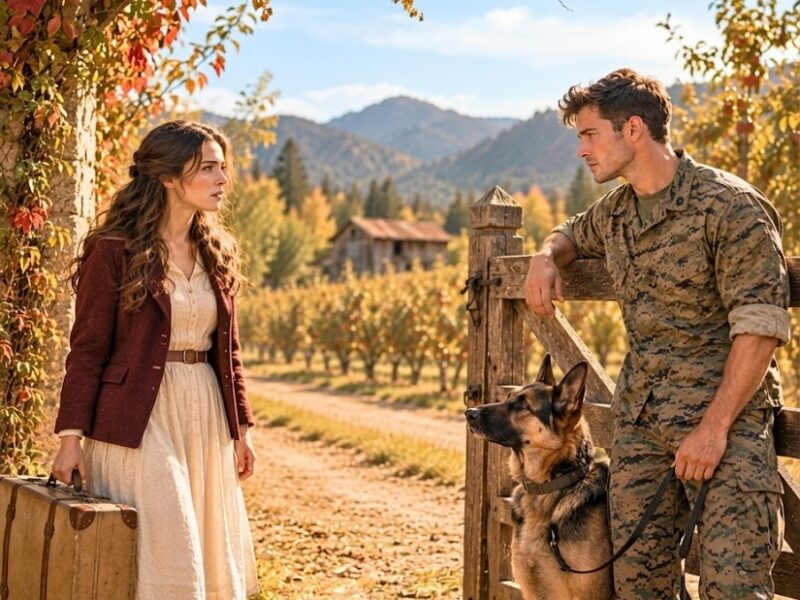
“My Father Offered You Our Orchard?” She Asked the Marine—Then He Revealed the Promise He Had Kept Secret
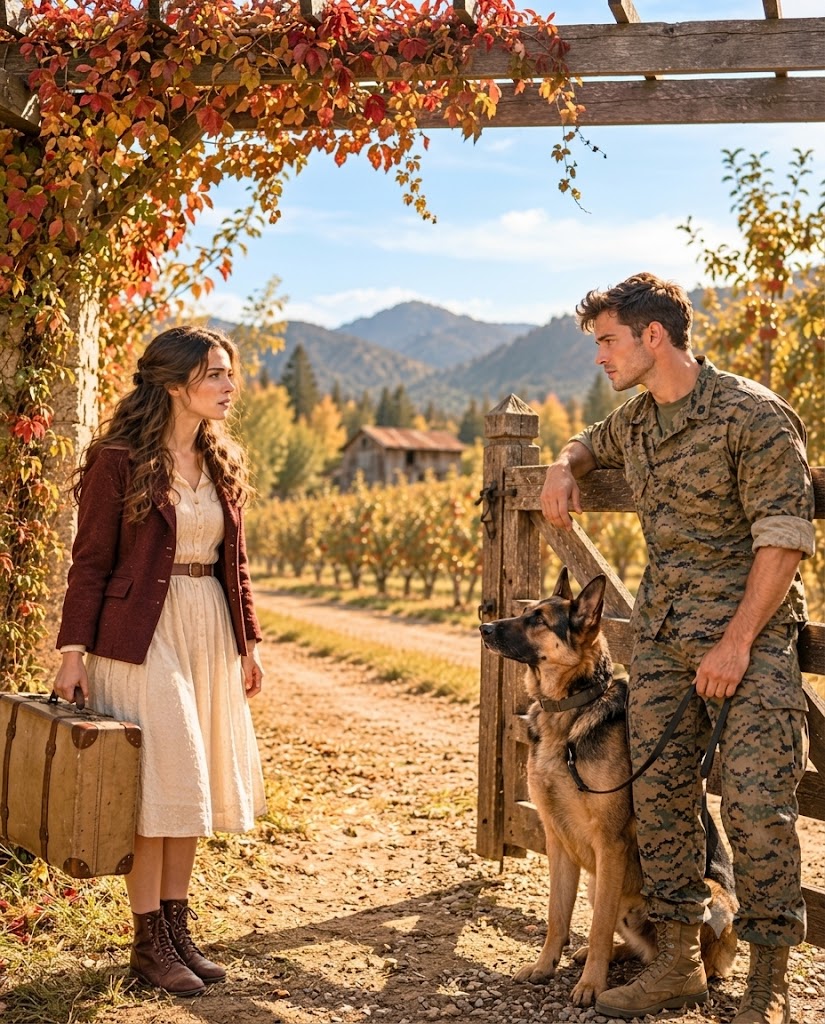
Part 1
The Marine came to Wanachi to sell his land and leave. Then his German Shepherd stopped at the edge of an apple orchard and refused to take another step. The young woman next door thought it meant nothing until her father looked toward an abandoned warehouse on the hill and later made the Marine an offer involving the orchard and her future. But what left her speechless wasn’t her father’s desperate proposal. It was the Marine’s answer.
And she had no idea that the ground his canine refused to cross was the first clue to a secret buried for nearly twenty years.
Late October had stripped the hills outside Wanachi, Washington, to copper grass and thinning apple leaves. A cold wind moved down from the higher slopes, carrying the dry sweetness of the season’s last fruit beneath a pale afternoon sky. Staff Sergeant Lachlan Reeve drove the old Dodge W250 slowly up the gravel lane, one hand resting high on the worn steering wheel. At thirty-two, the U.S. Marine stood a little over six feet with a lean, powerful build hardened by years of service.
Short dark brown hair, a clean-shaven, angular face, and gray-green eyes that rarely gave away more than he intended. He wore his Marine Corps camouflage uniform with the sleeves neat and boots dusted from the road. Service had taught him to notice exits, distances, and changes in silence before he noticed comfort. His late uncle’s house had always been the exception. No matter how long Lachlan had been gone, there had once been a porch light waiting here. Now the windows were dark.
He had come to settle the estate, sell the house and its twelve acres, then report to his new unit. Staying had never entered the plan.
Mako jumped down from the passenger side. The six-year-old black and tan German Shepherd K-9 was broad through the chest, dark across the saddle with alert, amber-brown eyes, and the controlled economy of an animal accustomed to working beside a Marine. Mako rarely wasted movement or noise. That was why later that afternoon, Lachlan noticed immediately when the dog stopped beside the southern fence.
Mako lowered his head. Two short sniffs, his ears shifted slightly backward. One forepaw moved toward a shallow strip of brittle grass, then stopped. Instead of crossing it, the German Shepherd stepped back.
Lachlan studied him. “All right,” he said quietly. He did not pull the leash.
Forty yards farther along, Mako did it again.
The growl of an ATV came from beyond the orchard. A woman brought it to a sharp stop beside the fence and climbed off. Eloan Hartley was twenty-eight, about five-foot-six, slender but strong from months of physical work, with fair skin touched by the cold, clear blue-gray eyes, and long chestnut-brown hair pulled loosely behind her head. Several strands escaped around a striking, finely shaped face. Grief had changed her more than farmwork had.
After her mother died, she had left an agricultural consulting career and returned home, bringing with her training in soil science and plant health and a habit of distrusting easy explanations.
“You’re over the Hartley line,” she said. Her gaze moved from Lachlan to Mako.
Lachlan glanced at the fence marker. “He isn’t. He was headed there. He stopped himself.”
Something in his calmness irritated her more than an argument would have. Then Lachlan pointed toward the dry strip. “He wouldn’t cross that.”
Eloan almost dismissed it. Instead, professional instinct made her crouch. She pressed gloved fingers into the soil, then looked uphill. One weakened tree became three. Three became a band. Yellowing leaves, dead shoot tips, undersized fruit, all following a rough line down the slope.
She slowly stood. For months, she had been looking at sick trees individually. Now she saw geometry.
Mako stopped at a second patch, repeating the same strange sequence. Eloan said nothing this time. She retrieved a narrow soil probe and sample bags from the ATV and collected soil from both locations.
When she returned to the farmhouse, Amos Hartley was sorting invoices at the kitchen table. At sixty-five, Eloan’s father was tall but slightly stooped with weather-darkened skin, thinning iron-gray hair, rough hands, and a lined face that had once seemed incapable of hiding anything from his daughter. Two failed seasons had made him quieter. He had become a man who studied bills before opening them, as though numbers might hurt less if approached carefully.
“The upper rows are weakening first,” Eloan said. “Not randomly. They’re forming bands downhill.”
Amos’s hand stopped. For less than a second, his eyes shifted through the window toward the old warehouse high on the northern slope. Eloan caught it.
“Dad, could be drainage.”
He lowered his eyes to the invoices.
Before she could press him, a dark SUV turned into the orchard drive. Conrad Wexler stepped out wearing a charcoal coat over an immaculate shirt. Forty-seven, tall and trim, he had carefully combed dark hair graying at the temples, a narrow, clean-shaven face, and the relaxed confidence of a man accustomed to being welcomed into rooms where money was discussed.
Around Wanachi, Conrad was known for remembering names, shaking hands without hurry, and buying struggling agricultural properties without ever appearing predatory. Wexler Agricultural Holdings had already acquired several nearby orchards, and its proposed packing and cold storage development would become far more valuable if the Hartley property joined the parcels surrounding it.
He carried another offer.
“We’re not selling,” Eloan said before Amos finished reading it.
Conrad showed no irritation. His eyes traveled past her toward the thinning rows. “Sometimes saving a family means knowing when to let the land go.”
Then he smiled politely, wished Amos well, and left.
After sunset, Lachlan found Eloan’s canvas tool bag where she had sampled near his fence. He carried it to the Hartley farmhouse. Amos invited him inside. The kitchen table was buried beneath loan notices, equipment invoices, and production records. Lachlan needed no agricultural degree to understand what he was seeing.
Amos rubbed both hands over his face. “Your uncle’s twelve acres are clear, aren’t they? No debt. If part of your ground and ours were managed together, it might buy us time.”
Lachlan remained standing.
Amos hesitated, embarrassment already entering his expression. “You’re unmarried. Eloan is too. I’m not saying tomorrow, but people build lives. Land stays together. Maybe someday this could all belong to one family.”
A floorboard sounded behind them. Eloan stood in the doorway. The color had drained from her face. The tool bag slipped slightly in her hand after Lachlan offered it to her, but she said nothing.
What hurt was not that Amos was desperate. She already knew that. It was hearing her own future spoken about like another parcel on a map.
Lachlan looked at her, then at Amos. He pushed the papers back across the table. “You can negotiate anything you own, Mr. Hartley.”
Amos’s jaw tightened.
Lachlan’s voice remained quiet. “But your daughter isn’t part of the acreage.”
Silence settled over the kitchen. Eloan stared at him. That afternoon, she had seen an unfamiliar Marine standing beside her fence and assumed he was another man arriving with intentions for Hartley land. Now he was the only man in the room refusing to claim anything from her.
Outside, Mako stood beneath the porch light, facing the dark orchard. Far beyond him, the old warehouse was barely visible against the northern ridge.
And for the first time, Eloan wondered whether the strangest thing she had seen that day was not what the German Shepherd had refused to cross, but why her father had looked toward that hill before she had ever mentioned it.
—
Morning came hard and bright over Hartley Orchard, frost silvering the grass between the rows, while the upper branches stood nearly bare against the blue Washington sky. By seven, Eloan had already decided she would not let the previous night become something her father could soften with silence.
Amos was pouring coffee when she entered the kitchen. He looked older than he had twelve hours earlier.
“I wasn’t giving you away,” he said before she could speak.
“That isn’t the point.”
“I was trying to keep this place alive.”
Eloan knew exactly what he meant. Her mother had helped plant some of the oldest rows, had kept harvest records in careful handwriting, had once said she hoped the orchard would outlive all of them. Since her death, Amos had clung to that sentence as if selling the land would mean losing his wife a second time.
Eloan understood the grief. She could not accept what he had done with it.
“You can call it a merger, a future, one family, whatever makes it easier to say. You still made a decision about my life without asking me.”
Amos stared into his coffee. For once, he had no answer.
Across the fence, Lachlan received a call from a broker before breakfast. The offer on his uncle’s property was better than he expected. Cash, quick closing, minimal contingencies. It was exactly the clean exit he had come to Wanachi wanting. He could sign, settle the estate, and leave before sentiment turned an old house into an obligation.
He looked through the kitchen window toward the southern field. One of the places Mako had refused to cross was unquestionably inside his property line.
Lachlan declined the offer. The broker sounded surprised. Lachlan gave him no explanation. He had spent too many years learning that what a man passed forward mattered as much as what he left behind. If something was wrong with those twelve acres, he would not hand the uncertainty to another family simply because the paperwork allowed him to.
Near noon, Eloan received the preliminary laboratory results. She read them twice. The pH was unremarkable. Salinity was elevated in one sample, but nowhere near enough to explain the damage. The nutrient profile offered no coherent pattern.
What stopped her was a flagged section near the bottom. Residues consistent with an older class of persistent agricultural compounds had appeared in both samples taken near Mako’s reaction points.
Eloan pulled twenty years of Hartley application records from a filing cabinet. Nothing matched.
She carried the report to Amos. “We never used these.”
His coffee cup paused halfway to his mouth. It was only a second, but she saw it.
“Dad.”
Amos set the cup down. “Your grandfather ran this place before computerized records. People used things differently.”
“Then these records go back farther than that.”
“Records aren’t perfect.”
Eloan watched him. Yesterday he had looked toward the warehouse. Today his first instinct was to explain away something she had not accused him of.
She folded the report. “Then I’ll find out what’s missing.”
—
That afternoon, she crossed to Lachlan’s property with sample bags, flags, a handheld GPS unit, and a field notebook. Lachlan gave her unrestricted permission to sample his acreage. Mako came with them, moving quietly ahead on a loose lead.
Eloan established a grid rather than following the dog. She took samples from apparently healthy soil, from damaged vegetation, and from areas where Mako showed no reaction. If there was a pattern, she wanted evidence strong enough to survive her own skepticism.
At the third flag section, Mako slowed, his head lowered. Two short sniffs, his ears shifted back. He stopped.
Lachlan opened his mouth.
“Wait, don’t move him.”
Eloan crouched several feet away and watched. Mako did not scratch. He did not bark or pull toward anything. He simply refused the next step.
Eloan marked the coordinates.
“What do you think he smells?” Lachlan asked.
“I don’t know.” She drove the probe into the ground. “And until I know, he isn’t evidence. He’s a reason to take another sample.”
For the first time that day, Lachlan smiled.
She collected material from Mako’s location, then control samples ten, twenty, and thirty feet away.
Over the next several days, additional results strengthened the pattern. The unusual residues appeared repeatedly near the suspect corridor and weakened outside it. Eloan still refused to trust her own conclusion alone. She contacted Dr. Marin Quill, a soil and plant health specialist associated with a Washington agricultural extension program.
Marin was fifty-three, compact and wiry with short ash-blonde hair, sun-freckled skin, rectangular glasses, and the blunt patience of someone who had spent decades telling worried growers that evidence mattered more than instinct. Years of investigating crop failures had made her especially suspicious of dramatic explanations.
She reviewed Eloan’s collection method, requested duplicate samples, and had several sent through an independent laboratory.
When she called back, her voice was measured. “I can’t tell you what’s causing the decline yet, but if you’re asking whether this behaves like an ordinary apple disease, my answer is no.”
That was enough for Eloan to change direction. Instead of studying only Hartley Orchard, she began tracing nearby properties acquired by Wexler Agricultural Holdings. Production records were incomplete, but former workers and county filings told a consistent story. Three of four orchards had experienced unexplained yield decline, root damage, or irregular tree loss before their owners sold.
One name kept appearing. Caleb Rusk.
Eloan found him in a small house west of town. Caleb was sixty-one, thick through the shoulders despite a slight limp, with a weathered square face, graying beard, and hands permanently roughened by orchard work. He had inherited his family’s trees, fought to save them, then sold after three failing seasons. Shame had made him defensive whenever anyone mentioned the property.
“I don’t own it anymore,” he told Eloan. “Whatever Wexler does with it isn’t my business.”
“I’m not asking why you sold.” That made him look at her. “I need to know when he first asked.”
Caleb disappeared into another room. When he returned, he carried a creased envelope. “I kept this because I hated myself for saying no the first time.”
Inside was Conrad Wexler’s original purchase offer. Eloan read the date, then read it again. Conrad had approached Caleb months before the orchard’s decline became severe enough to threaten the harvest, before neighboring growers had begun talking openly about the dying trees.
—
That evening, Eloan spread maps across the Hartley kitchen table. She marked Hartley Orchard, Lachlan’s property, the former Rusk Orchard, and the other parcels Conrad had acquired. Lachlan stood opposite her. Amos remained in the next room, unusually quiet. Mako lay near the porch door.
Lachlan studied the marks. “You think Wexler is killing the trees?”
“No.” The answer came immediately. Eloan placed one finger on the first property Conrad had bought, then moved it to the second and third. “I don’t have evidence he caused any of this.”
Her finger stopped over Hartley Orchard. The implication was worse precisely because she refused to exaggerate it.
“No,” she said quietly. “I think he knew they were going to.”
Neither of them spoke. Outside, Mako rose from the porch, ears lifting into the cold night. The German Shepherd stared beyond the orchard rows toward the dark northern slope. Eloan followed his gaze.
Somewhere above them, hidden in the darkness, stood the warehouse her father had looked toward before any laboratory had told them something was wrong.
—
November arrived with colder mornings and a thin white crust of frost beneath the apple trees. The harvest crews were gone now, leaving Hartley Orchard unnaturally quiet, while Eloan followed a problem that seemed to grow larger each time the data became clearer.
With permission from neighboring landowners, she expanded the survey beyond Hartley Orchard and Lachlan’s twelve acres. She collected root tissue from weakened and healthy trees, surface soil, and narrow cores at several depths. Marin independently reviewed selected samples and repeated portions of the analysis without knowing which locations Eloan considered suspicious. Eloan wanted the pattern to survive disagreement, not depend on her desire to find one.
By the end of the week, several possibilities had collapsed. Older trees were not consistently failing before younger ones. Damage did not radiate from infected trees the way many biological diseases would. Clay-heavy soils retained higher concentrations of the unexplained residues while better-drained sections often showed symptoms later.
Most unsettling were several cores where the deeper layers carried stronger signals than the soil near the surface.
Every eliminated explanation should have made the problem smaller. Instead, Eloan felt the opposite happening. The more ordinary causes disappeared, the harder it became to believe that Hartley Orchard was simply suffering from bad soil, bad weather, or the accumulated mistakes of an aging farm.
One cold morning, Eloan drove a marker into a patch near the lower edge of Lachlan’s property. “This should be one of the stronger points,” she said. Her model supported it. The slope, soil texture, and visible vegetation all fit.
Mako walked straight across it.
Eloan frowned. The six-year-old German Shepherd continued another twenty yards, then slowed. His head dropped. Two short sniffs. His ears shifted slightly backward. He stopped.
Lachlan said nothing.
Eloan looked from her marker to Mako. A month earlier, she would have trusted the model and dismissed the dog. Now, she pulled the marker from the ground and carried the sampling equipment toward him. She still sampled her original location as a control. Then she drove the corer beside the place Mako had refused to cross, separating the soil by depth before sealing each section individually.
Three days later, Marin called. “You need to look at the depth profile.”
The concentration increased below the surface. Not slightly. Enough to matter.
Eloan sat at her desk staring at the numbers. If someone had recently been spraying or deliberately applying something across the orchard, she would expect stronger contamination near the surface followed by downward movement. Instead, the soil was telling the opposite story. Whatever they were seeing had been there longer than the dying trees. Possibly much longer.
The discovery changed the work. Eloan stopped searching for a recent act and began reconstructing the land itself.
Lachlan helped without pretending to understand what she understood. When she explained clay retention, he listened. When she needed a fifty-pound corer carried uphill, he carried it. When an old fence blocked access to a sampling line, he repaired the damaged section after opening a passage, rather than leaving Amos another problem to solve.
That restraint surprised her. Men who wanted to impress her usually talked more. Lachlan seemed comfortable being useful without needing credit for it.
After nearly ten hours in the field one evening, they sat on the open tailgate of his faded Dodge W250, eating sandwiches wrapped in paper while Mako rested in the grass nearby. The orchard below them had gone dark except for one light in the Hartley kitchen.
“You really came here just to sell?” Eloan asked.
“That was the plan.”
“And now?”
Lachlan looked toward the house his uncle had left him. “Now I know enough not to sell yet.”
She understood the answer was about responsibility, not attachment.
For several minutes they ate in silence.
“My mother loved that orchard,” Eloan said finally. “My father still does.”
Lachlan waited. She appreciated that he did not fill the silence for her.
“Everyone assumes I’m afraid we’ll lose it.” She folded the sandwich paper between her fingers. “I’m not sure that’s the thing I’m most afraid of.”
“What is?”
Eloan hesitated. “That I’ll save it.” She gave a small, humorless laugh. “That I spend thirty years protecting something because they loved it. Then one morning, I’m fifty-eight and realize I never actually chose this life. I just inherited everyone else’s reasons.”
Lachlan looked out over the rows. “Then don’t let the orchard become another person choosing for you.”
He did not tell her to leave. He did not tell her to stay. Somehow that made the words harder to forget.
For Eloan, advice had too often arrived disguised as permission. Stay for your father. Leave for yourself. Fight because your mother would have wanted it. Lachlan had offered none of those answers. He had simply returned the decision to the one person everyone else seemed determined to make it for.
—
The next morning, Eloan returned to the maps. She marked every location where Mako had shown the same distinct behavior since Lachlan arrived. Five points.
She layered them over topographic contours, soil composition, damaged tree surveys, and drainage patterns. Then she stopped breathing for a second.
The points were not scattered. They formed a rough corridor descending from the higher northern ground.
Eloan leaned closer. Mako had never given her an answer. He could not tell her what was in the soil when it arrived or why it was there. But he had forced her to notice something her original model had missed.
She had been asking the wrong question. Not what is killing these trees. What happened uphill?
Eloan began digging through county property files, agricultural directories, archived business records, and old land use documents. Late that afternoon, one company name appeared repeatedly beside the warehouse on the northern slope. Wexler Crop Supply. The company had stored and distributed agricultural materials there nearly twenty years earlier. Its owner had been Conrad Wexler’s father.
Eloan carried the name home. Amos was standing at the sink when she said it.
“Have you ever heard of Wexler Crop Supply?”
He turned too quickly. “Where did you hear that name?”
Eloan went still. Not what is that? Not why are you asking? Where did you hear it?
Amos seemed to realize his mistake. “Everybody knew suppliers back then.”
But Eloan had already heard the fear beneath his answer.
That night, she kept searching. Near midnight, an archive site plan finally loaded on her screen. The old warehouse stood near the upper boundary. Access road, storage structure, loading area. Then she saw a small rectangular section behind the building. The faded label required her to enlarge the scan twice.
South disposal area.
Eloan stared at it. She pulled the later property transfer records. When the old company assets passed into successor holdings, environmental and operational files were included among the transferred records. Eventually, those records had gone to Conrad.
The warehouse was no longer merely something her father had looked toward. It had a history. And Conrad had inherited that history.
Eloan closed the laptop and crossed to the window. Beyond the black orchard, the northern ridge disappeared into the night. Then she looked toward her father’s bedroom door. For the first time since the investigation began, she was more afraid of what Amos knew than of what might be buried in the soil.
—
Rain came down the Wanachi hills before dawn, darkening the orchard soil and tracing thin streams between the rows. By breakfast, Eloan had printed the old site plan and placed it flat on the kitchen table in front of her father. Her finger rested on the faded rectangle behind the warehouse.
“South disposal area. Tell me what happened there.”
Amos did not ask where she had found it. That alone answered something. He lowered himself into a chair and stared at the map for a long time.
“Nearly twenty years earlier,” he said, “Wexler Crop Supply had used the warehouse for agricultural materials. One winter, a severe storm damaged part of the roof and storage area. Containers were compromised. Chemicals leaked into the ground behind the building.”
“How much?”
“I never knew.”
“Who cleaned it?”
“Wexler’s people. Contractors. They told us the affected soil had been removed and the site was remediated.”
“And you believed them.”
Amos looked at her. “We all did. For years, nothing obvious happened. The apples remained productive. Wells tested normally. Trees lived.”
Amos married certainty to time. If the land kept growing, then the company must have told the truth.
Then, roughly three years ago, heavy rains caused erosion along the upper slope. A local drainage project followed, redirecting runoff and stabilizing parts of the hillside. The modern planning maps no longer showed the old disposal area, so no one designing the work had reason to treat it as a buried environmental concern. The altered drainage changed how water moved through the slope.
Eloan understood before Amos finished. Repeated rain and snowmelt could have begun carrying old residues through deeper soil pathways downhill toward the orchards.
She stared at him. “When did Conrad first offer to buy this place?”
Amos looked away.
Her stomach tightened. “When?”
“Before the worst decline.”
The room seemed to shrink. “You knew.”
“No.” Amos stood abruptly. “I suspected. That’s different.”
“You looked at that warehouse the first day I told you the upper trees were failing. Because I remembered. And you said nothing.”
His face folded under something deeper than defensiveness. “Because if I was right, this land might be worth nothing. Your mother’s orchard. Everything we built. I thought if I kept working—”
“So you let me spend months trying to solve something you knew might have started up there.”
“I didn’t know.”
“You knew enough to be afraid.”
That was the sentence Amos could not answer.
Eloan walked outside before anger made her say something she could not take back. She crossed two rows of bare trees and stopped near the fence, breathing cold air that smelled of wet bark and soil.
Behind her, the farmhouse door opened. Lachlan stepped onto the porch. He started toward her, then stopped. He had seen enough to understand that concern could become another form of intrusion if a man insisted on delivering it.
Mako made a different choice.
The German Shepherd crossed the wet yard and approached Eloan without urgency. He stopped several feet away and sat. No paw against her leg. No whine, no demand to be touched. He simply remained there.
Eloan looked down at him. For weeks, she had watched Mako stop because something in the land made him unwilling to continue. This time, he had stopped because she had.
After a while, she reached down and rested her hand against the thick fur at his neck. Mako did not move closer.
Across the yard, Lachlan stayed where he was. For once, the dog was not helping her find something buried beneath the ground. He was only staying.
—
By afternoon, anger had become useful again. Eloan called Marin. Together, they searched development filings connected to Wexler Agricultural Holdings’ proposed packing and cold storage complex. Buried among planning references was the name of a private environmental consulting firm Conrad had retained after the drainage work.
Marin found the key reference first. “There was an assessment.”
Eloan leaned toward the screen. The available summary was cautious, technical, and devastating. It identified historical environmental concerns associated with the former Wexler Crop Supply property and warned that residual contamination near an old disposal area could migrate southward following changes in subsurface water movement. Further investigation had been recommended.
The report had been delivered to Wexler Agricultural Holdings. To Conrad.
Eloan checked the date against Caleb’s letter and the other purchase records. Within months of receiving the assessment, Conrad had begun approaching orchard owners. He had not created the old spill. Nothing they possessed showed that he had caused the contamination to move. But he had been warned about what might happen downhill, and he had said nothing.
Marin spread parcel maps across the table. Once the Wexler acquisitions were shaded, the business motive became visible. Conrad already controlled land on both sides of Hartley Orchard. Hartley was the missing link connecting his assembled properties to the road corridor needed for the planned packing and cold storage facility.
Eloan felt something colder than anger. He had not needed to kill the orchards. He only needed to wait until frightened owners became willing sellers.
Then Marin found the demolition permit.
The old warehouse had already been approved for removal. Work was scheduled to begin the following morning.
“If they disturb that ground,” Marin said, “we may still prove contamination, but reconstructing the original disposal area gets harder.”
Lachlan read the permit over Eloan’s shoulder. “Submit everything tonight. Let the agencies stop it.”
“I am submitting it.”
“Then don’t go up there tomorrow unless they tell you to.”
Eloan turned. His concern was obvious, but so was the mistake.
“You told my father I wasn’t something another man got to decide.”
Lachlan went still.
“That includes you.”
For a moment, neither spoke. Then Lachlan nodded. No defense, no explanation. “Then tell me what you need.”
The answer loosened something inside her that arguing never could.
They worked past midnight. Marin organized the laboratory and environmental findings. Amos, subdued by his confession, wrote a statement documenting what Wexler Crop Supply had told neighboring landowners after the old spill. Caleb forwarded a copy of Conrad’s dated purchase offer. Lachlan signed authorization granting investigators access to his acreage and sampling locations.
Eloan assembled the maps, timelines, soil results, and historical records into an emergency environmental review request.
At 1:43 a.m., she sent it.
No one slept much.
At first light, they drove toward the northern slope. The rain had stopped, leaving fog caught low between the hills. Before they reached the warehouse, Eloan heard diesel engines. Then she saw the excavator. Its steel bucket hung above the wet ground. A second machine waited near the loading area.
Conrad Wexler stood beside a dark sedan in a long charcoal coat. Next to him was a lean man in his fifties carrying a leather case, silver-haired, clean-shaven, and composed in the unmistakable manner of an attorney accustomed to letting documents speak before he did.
Conrad saw Eloan’s truck approaching. He did not look surprised.
The excavator engine continued to idle.
And Eloan realized that knowing the truth and reaching it in time were two very different things.
—
The fog had barely lifted from the northern slope when county and environmental vehicles turned onto the access road. The excavator remained running beside the old warehouse, its bucket suspended over wet ground, but no steel had broken into the disposal area yet.
Conrad Wexler watched the officials approach without visible alarm. His attorney stood beside him, leather case closed at his feet, while Eloan held the binder she had assembled through the night.
The attorney spoke first. An industrial accident from nearly twenty years ago, he argued, did not automatically establish liability for Wexler Agricultural Holdings. Historical maps were not proof of present contamination. And whatever unusual behavior a dog had displayed on neighboring property certainly could not establish an environmental case.
Eloan nodded. “I agree.”
The attorney paused.
“Mako isn’t evidence,” she said. “He never was.”
Conrad studied her, his expression tightening for the first time.
“I didn’t poison your orchard.”
“No,” Eloan said. “You just waited for it to die.”
Then she opened the binder.
She did not begin with Mako. She began with trees.
She showed the pattern of decline across age groups, the absence of disease-like transmission, the relationship between symptoms and soil structure, the stronger retention in clay-heavy zones, and the delayed damage in better-drained areas. Then came the depth profiles showing higher concentrations below the surface, followed by topographic maps tracing the affected corridor downhill.
Next came Wexler Crop Supply, the old warehouse, the south disposal area, Caleb’s dated purchase offer, the sequence of distressed orchards acquired after unexplained decline.
Only then did Eloan add the five locations where Mako had repeatedly stopped.
“These points didn’t prove anything,” she said. “They told me where my model might be wrong.”
She overlaid them with terrain, soil composition, and contamination data. The layers converged on a narrow section of Lachlan’s twelve acres immediately below the historical disposal zone.
An environmental officer asked where she would place a confirmatory core.
Eloan studied the map once more. Then she chose the location herself.
A portable coring rig was brought onto Lachlan’s property under his written authorization. While the drill worked downward, Mako stood quietly beside him. The six-year-old German Shepherd did not pull toward the machine or search the surrounding ground.
Eloan glanced at him once. No praise, no command. There was nothing left for him to find.
The core came up in sections. Below the natural soil profile was a layer that did not belong. A disturbed fill horizon with different texture and composition. Field screening justified immediate laboratory priority, and preliminary analysis showed the same persistent residues, increasing sharply with depth.
The demolition was suspended. The investigation expanded uphill.
Over the following days, official sampling reached the south disposal area. The conclusion was no longer theoretical. Contaminated material associated with the historical spill had not been fully removed.
But that finding alone did not establish what Conrad had known.
That came later.
Investigators obtained the complete private environmental assessment commissioned by Wexler Agricultural Holdings after the drainage changes. Unlike the summary Eloan and Marin had found, the full report identified the south disposal area, specifically warned that residual contamination could migrate southward through altered subsurface flow, and recommended further investigation before development.
Receipt records showed Conrad had received it.
He had not warned the orchard owners. Then he had begun buying their land.
The cold storage project was suspended. Previous Wexler acquisitions came under review. Former owners supplied letters, contracts, and timelines. Caleb was no longer the only man holding an old offer in a drawer.
No one dragged Conrad away in handcuffs beneath the apple trees. His collapse began more quietly, with dates, signatures, contracts, and time.
Hartley Orchard did not recover simply because the truth had been found. Several rows were removed. Other areas were taken out of production while remediation planning continued. Eloan and Marin mapped zones that could eventually be replanted and others that might require different crops or years of monitoring.
For the first time, Eloan could imagine the orchard surviving without imagining herself trapped inside it.
She chose to stay. Not for Amos, not for her mother’s memory, not because the land demanded repayment for everything her family had given it. She stayed because after being given the freedom to leave, she discovered she wanted the work.
Amos understood the difference. One evening, he found her reviewing remediation maps at the kitchen table.
“I made the same mistake twice,” he said.
Eloan looked up.
“When I was younger, I let a company tell me what was safe for my land because I wanted to believe them.” His eyes lowered. “Then I got old and frightened, and I thought I could tell my daughter what was safe for her future.”
His apology did not erase what happened, but Eloan accepted that he finally understood it.
Lachlan made his own decision. He kept the twelve acres rather than transferring unresolved environmental risk to another owner. But his leave ended, and the Marine Corps was still his life. He returned to duty instead of manufacturing a forever promise from a few intense weeks in Wanachi.
By early December, frost had hardened the orchard grass when the old Dodge W250 rolled up beside the Hartley gate. Lachlan stepped out in his Marine Corps camouflage uniform. Mako jumped down after him.
Eloan walked from the orchard to meet them.
“You can keep using my acreage for monitoring,” Lachlan told her. “Sampling, access, recovery work, whatever Marin needs.”
“Rent?”
“No.”
“A partnership?”
“No.” She studied him. “Conditions?”
“None.”
A small smile touched her face. Then she asked the question she had carried since the night her father put those papers on the kitchen table.
“Why did you never mention my father’s offer again?”
Lachlan looked at her. “Because he made it. You didn’t.”
He turned toward the Dodge.
Mako walked toward the gate, then stopped.
Eloan stopped, too. For weeks, she had learned to pay attention whenever the German Shepherd became still. She waited for his head to lower, for the two short sniffs, for his ears to shift backward.
None came.
Mako simply looked at her.
Then he crossed the line.
A few steps beyond the gate, he turned and looked back. At the beginning, Mako had refused to cross a boundary because something on the other side was wrong. Now he had crossed it. The rest was not his choice to make.
Eloan looked behind her at Hartley Orchard, the damaged rows, the empty spaces where trees had already been removed, and the land she had spent months fearing would become a life sentence.
Then she looked at Lachlan.
She stepped through the gate herself.
“The first time my father wanted me to cross this line, it was because he thought the orchard needed saving.” Her eyes moved briefly toward the rows behind her. “It doesn’t need a marriage to save it.”
Then she faced Lachlan. “And neither do I.”
He said nothing.
Eloan smiled. “I’m crossing because I want to.”
Lachlan did not promise to leave the Marine Corps. Eloan did not promise to leave Wanachi. He only held out his hand. She chose to take it.
Ahead of them, Mako turned toward the old Dodge. This time, no one needed him to find the way.
—
Sometimes God’s miracles do not arrive as thunder from the heavens or answers that suddenly make every problem disappear. Sometimes they come quietly. A loyal dog that refuses to take one more step. A stranger who chooses to listen instead of control. Or a truth buried beneath the ground, waiting for someone brave enough to uncover it.
Eloan learned that faith does not mean waiting for God to choose our path for us. Sometimes He simply places a light along the road and gives us the courage to take the next step ourselves.
In our own lives, we may face broken dreams, painful choices, or seasons when the road ahead seems impossible to understand. But perhaps some closed doors are protection. Some unexpected encounters are blessings. And some delays are guiding us toward something we cannot yet see.
If this story touched your heart, share it with someone who may need its message today. Tell us in the comments about a moment when an unexpected blessing changed your path. And subscribe to The Last Patrol for more stories of courage, loyalty, hope, and second chances.
May God bless you, protect your family, guide your steps, and bring a quiet miracle into your life when you need it.









