
Military daughter flew nine thousand miles to surprise her dad — Steve couldn’t say a SINGLE word
It was olive green, sun-bleached along the straps, scuffed at every corner, and heavier than it should have been for its size.
Not because of what was packed inside it, but because of what was taped to the inside flap.
A photograph, laminated and peeling at the edges, of a man holding a baby on a porch in Shreveport, Louisiana.
The man was laughing.
The baby was reaching for his face with both hands.
On the back of the photograph, in handwriting that had faded to a whisper, were six words.
Come home safe.
Love, your girl.
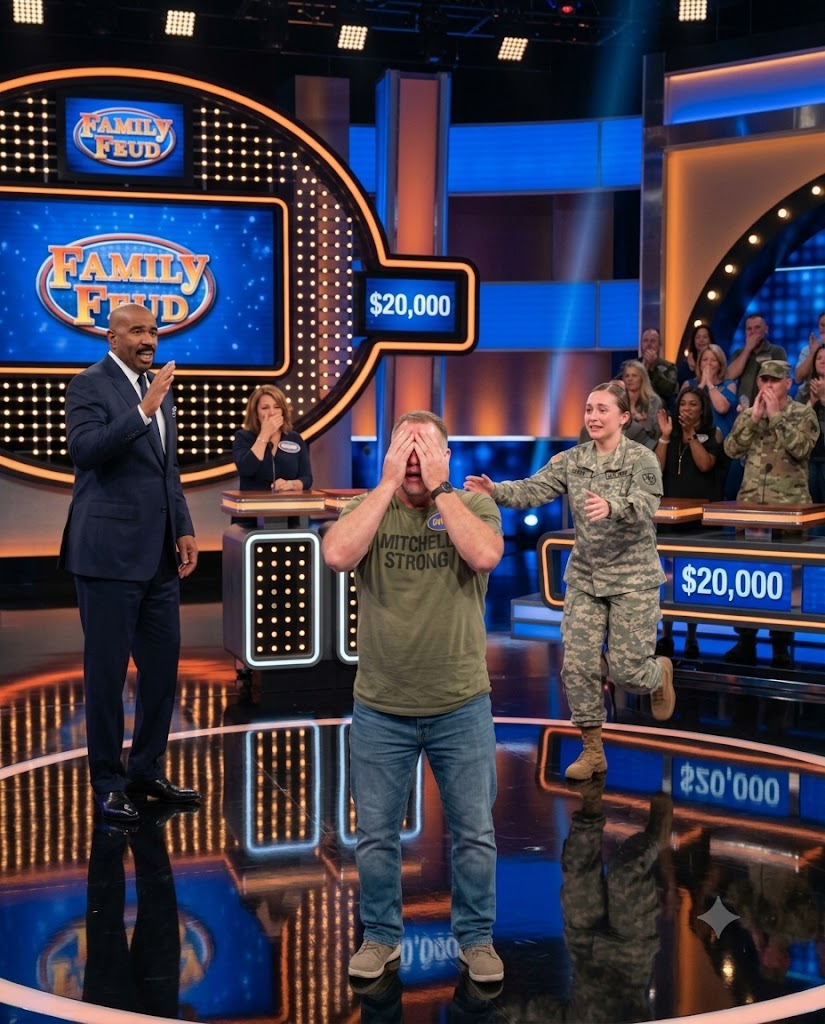
The man in the photograph was Sergeant First Class Robert “Bobby” Mitchell, 54 years old, a contestant on Family Feud, who was standing at the podium 30 feet away, answering questions about what people keep in their glove compartment, with no idea that the baby from that photograph, now a 26-year-old Army captain named Elise Mitchell, was sitting in chair 14 with that rucksack between her boots, having flown 9,412 miles from Bagram Airfield in Afghanistan to this studio without telling her father she was on the same continent.
When Steve Harvey found out what was about to happen, he couldn’t speak.
For the first and only time in his career, Steve Harvey opened his mouth and no words came out.
March 6th, 2020, a Friday afternoon in Atlanta.
The Mitchell family, Bobby, his wife Loretta, 52, his brother James, 50, his nephew Darius, 27, and his long-time friend and fellow veteran Clarence, 56, stood at the right podium in olive green t-shirts that Loretta had printed with Mitchell Strong across the front.
The competing family, the Bautista family from Jacksonville, Florida, Rosa Bautista, 58, her son Marco, 34, her daughter Isabella, 31, Marco’s wife Teresa, 33, and Rosa’s brother Ernesto, 55, stood at the left podium in bright orange.
During introductions, Steve asked Bobby about his service.
Bobby straightened his posture, a reflex so deep it was structural, and said he had served 28 years in the United States Army, retiring in 2018 as a sergeant first class.
Three deployments, two Bronze Stars, one Purple Heart from a mortar attack in Fallujah in 2006 that left shrapnel in his left knee and a limp he hid so well that most people never noticed it.
Steve shook his hand and said, “Thank you for your service.”
Bobby said what he always said, “Thank you for your support.”
Loretta squeezed his arm, and nobody in that studio, except Loretta, Cheryl the production coordinator, and the woman in chair 14, knew what was about to happen.
Bobby Mitchell had missed 11 of his daughter’s 26 birthdays.
He had missed her first steps.
He was in Kosovo.
He had missed her first word, “Daddy,” spoken to a photograph on the refrigerator while Bobby was in Iraq.
He had missed her middle school graduation, her first homecoming dance, and the afternoon she broke her arm falling off the monkey bars at Barksdale Elementary and screamed for her father in the emergency room while Loretta held her and said, “Daddy’s coming, baby. Daddy’s always coming.”
Bobby was in Kandahar.
He wasn’t coming.
He got the phone call 14 hours later on a satellite phone with a 3-second delay and heard his 8-year-old daughter’s voice, groggy from painkillers, say, “It’s okay, Daddy. I’m tough like you.”
Bobby hung up, walked behind a concrete barrier, and cried so hard that Clarence, who had been in his unit since 2001, found him and sat beside him without saying a word for 20 minutes.
The guilt of an absent military parent is a specific kind of corrosion.
It doesn’t attack in dramatic episodes.
It seeps.
Every missed recital, every phone call cut short by operational tempo, every birthday acknowledged by a scratchy satellite connection instead of a hug.
Each one deposits a thin layer of something that accumulates over years until the parent can no longer distinguish between pride in their service and shame about its cost.
Bobby carried both.
He was proud.
He was also hollowed out by the mathematics of absence.
11 birthdays, 4,200 bedtimes, three deployments averaging 14 months each, roughly 6 years of his daughter’s life spent on the other side of the world.
And that wasn’t even the part that made Steve cry.
When Elise was 17, she told Bobby she wanted to enlist.
Bobby was sitting in the living room of the house in Shreveport that he’d bought with his re-enlistment bonus in 2010.
Loretta was in the kitchen.
Elise stood in the doorway, tall, straight-backed, with her father’s jaw and her mother’s eyes, and said, “I want to serve.”
Bobby’s reaction was not what anyone expected.
He didn’t swell with pride.
He didn’t thank her.
His face went white, and his hands gripped the armrests of his recliner, and he said, “No.”
One word.
The same word with the same force that he used to issue orders to soldiers under fire.
Elise didn’t flinch.
She had inherited that, too.
They argued for 3 months.
Bobby forbade it.
Elise applied anyway.
Bobby stopped speaking to her for 2 weeks, the longest silence of their relationship.
Loretta mediated.
Clarence called Bobby and said, “Brother, you spent 28 years serving. You can’t tell her the thing you gave your life to isn’t worth her giving hers.”
Bobby knew Clarence was right.
He also knew what deployment felt like from the inside.
And the thought of his daughter experiencing it, the heat, the boredom, the sudden violence, the mortar rounds at 3:00 a.m., made his hands shake the way they shook when the VA therapist asked him to close his eyes and describe Fallujah.
Elise enlisted in June 2016.
She completed basic training at Fort Jackson.
She was commissioned as a second lieutenant through OCS in 2018.
She was deployed to Afghanistan in September.
Bobby drove her to the airport.
He hugged her at the gate.
He said, “Come home safe, Elise.”
She said, “I’m tough like you, Daddy.”
The same words she’d said at 8 years old with a broken arm.
Bobby made it to the parking garage before his legs gave out.
He sat on the concrete between two cars, and Loretta found him there 10 minutes later staring at nothing.
His phone clutched in his hand with his daughter’s flight number on the screen.
Bobby called Elise every Sunday at 7:00 p.m.
3:30 a.m. Monday in Afghanistan.
The calls lasted between 4 and 11 minutes, depending on signal strength.
They talked about nothing.
The weather in Shreveport, what Loretta cooked, whether the Saints were any good that year.
They avoided talking about what Elise’s days actually looked like because Bobby already knew and didn’t want confirmation.
And Elise already knew he knew and loved him enough to let the fiction stand.
Every call ended the same way.
Bobby said, “Come home safe.”
Elise said, “I’m tough like you, Daddy.”
It was their ritual.
It was the thread they held across 9,412 miles of distance.
Steve would later call what happened next the most important moment of his career.
The game went to fast money.
Bobby played first and scored 156.
Strong, fast, precise.
The answers of a man who had spent three decades making decisions under pressure.
Clarence went second and added 52, bringing the total to 208.
They won.
The $20,000 flashed on the board.
The Mitchell family erupted.
Bobby pumped his fist, a rare display of emotion from a man who kept everything locked behind 28 years of military composure.
Loretta was screaming.
James was pounding the podium.
Darius was jumping.
Steve walked over, grinning, ready to hand over the celebration.
Then Steve noticed Loretta.
Loretta wasn’t celebrating the money.
She was looking past Steve, past the cameras, toward the audience.
Her face held something that wasn’t surprise, but anticipation.
The expression of a woman who knows what’s coming and is watching the seconds count down.
Steve looked where Loretta was looking.
He saw a production assistant walking down the aisle toward row G.
He saw the assistant stop at chair 14.
He saw a young woman in army combat fatigues stand up.
He saw the rucksack.
Steve looked at Loretta.
Loretta nodded once.
“Bobby,” Steve said, “I need you to face the board.”
Bobby turned toward the board, confused.
Steve looked at the audience.
The young woman in fatigues was walking down the aisle toward the stage.
She was trying not to cry.
She was failing.
200 audience members realized what was happening at different speeds.
Some immediately, some when they saw the uniform, some when they saw the rucksack.
Some when they saw the photograph taped to the inside flap that the woman was now holding against her chest.
A wave of gasps moved through the audience like wind through grass.
Steve tried to speak.
He opened his mouth.
He looked at the woman climbing the three steps to the stage in combat boots.
At the father standing at the podium with his back turned.
At the 9,412 miles this woman had crossed to stand in this room.
And Steve Harvey, a man who had built a career on the power and precision of his voice, could not produce a single sound.
His mouth was open.
His eyes were full.
His hand was raised as if to gesture, but it just stayed there, suspended, useless.
The audience saw it.
The crew saw it.
Bobby, still facing the board, didn’t see it.
Loretta put her hand on Bobby’s shoulder.
“Turn around, baby,” she said.
Bobby turned.
Elise was standing 10 feet away, in uniform, rucksack on the floor beside her, photograph in her hand, 9,412 miles behind her, alive, whole, home.
The studio fell completely silent.
Bobby’s face went through a sequence that the camera on the left captured in devastating clarity.
Confusion, recognition, disbelief, verification, his eyes scanning the uniform, the rank insignia, the face, the jaw that was his jaw, and then, collapse.
Total, structural, full body collapse.
Not his knees, everything.
His hands flew to his face and his shoulders folded inward and his chest caved and a sound came out of Sergeant First Class Robert Mitchell that no one in that studio had ever heard a man make.
A sound that was somewhere between a sob and a roar.
The sound of 28 years of military composure detonating in a single second.
Elise ran the 10 feet.
She crashed into her father so hard they both staggered.
Bobby’s arms locked around her and he lifted her off the ground, shrapnel knee and all.
The limp he hid so well forgotten entirely.
And he held her the way he should have held her at 8 years old in the emergency room, at 13 at her graduation, at 17 in the doorway, at every moment he had missed.
He was saying her name, not once, not twice, over and over.
Elise.
Elise.
Elise.
The way a person says a word they have been whispering into a satellite phone every Sunday at 7:00 p.m. for 6 months and can now say directly into the ear of the person it belongs to.
Steve was still silent.
He was standing at center stage with tears streaming down his face, and his hand still raised in that frozen half gesture, and he could not speak.
25 years of television, thousands of episodes, millions of words, and for the first and only time, Steve Harvey had nothing.
A producer’s voice came through the earpiece on the podium.
Steve had already taken it out at some point, nobody remembered when, saying, “Steve, say something. We need a transition.”
Steve heard nothing.
He saw nothing except a father holding his daughter in combat boots on a game show stage.
Clarence broke first.
The man who had sat next to Bobby behind a concrete barrier in Kandahar, who had held silence for 20 minutes, walked to Bobby and Elise and put his arms around both of them and his forehead against Bobby’s back and shook.
James followed.
Darius followed.
Loretta was last.
She had been watching from the podium, letting Bobby have the moment the way she had let him have every moment for 28 years, because military wives learn to give time before they take it.
Then she walked over and wrapped her arms around her family and closed the circle.
But Steve wasn’t done.
He found his voice.
It came back in pieces, rough, broken, stripped of the polish that three decades of broadcasting had lacquered onto it.
“I’ve talked for a living for 25 years,” Steve said, “and just now, for the first time, I had nothing.”
Because some moments are too big for words.
He wiped his face with both hands.
“This young woman flew 9,412 miles. She coordinated with our production team. She sat in chair 14 for 2 hours watching her father play a game show, and she didn’t make a sound. 2 hours, because she wanted the moment to be his.”
Steve’s voice cracked.
“That’s not a surprise. That’s a sacrifice. That’s the same sacrifice her father made every time he got on a plane and left her behind.”
Steve looked at Bobby, still holding Elise, and said, “Let me tell you something, brother. I made God a promise. I said, ‘If you get me through the worst of it, and my worst was a car, a 1976 Ford Tempo, 3 years of nothing, I would spend my life helping people see what they couldn’t see on their own. You’ve been carrying guilt about every birthday you missed, every phone call you cut short, every time she broke her arm and you weren’t there.'”
Bobby’s eyes were locked on Steve’s.
“But look at what you built. Look at what’s standing in front of you. Your daughter didn’t enlist because she resented you. She enlisted because she wanted to understand you. She flew 9,412 miles because the man who missed 11 birthdays was worth every single mile. You didn’t fail her, Bobby. You showed her what service looks like. And she followed you.”
But Steve wasn’t done.
He turned to Elise.
“Captain Mitchell,” he said, and the use of her rank was deliberate.
A signal of respect that Bobby registered with a visible swelling of his chest.
“I need to ask you a question. Your father told you not to enlist. He fought you on it for 3 months. Why did you do it anyway?”
Elise straightened.
The soldier posture surfaced through the tears.
“Because he spent his whole life showing me that some things are bigger than yourself. And then he told me not to do the thing he spent his whole life doing. And I knew. I knew that the reason he said no wasn’t because he didn’t believe in service. It was because he loved me more than he loved the thing that gave his life meaning.”
She looked at Bobby.
“I enlisted because I wanted him to know that his sacrifice wasn’t wasted. That it didn’t just protect strangers, it built me.”
The studio fell completely silent.
Steve stepped to camera three.
“Everyone watching at home right now, there are military families in this country who carry an invisible weight every single day. The parent who leaves, the child who waits, the spouse who holds everything together in between. We thank them at parades, and we forget them at midnight when the house is quiet and the phone isn’t ringing. If you know a military family, call them. Not on Veterans Day, today, right now. Because the service doesn’t end when the uniform comes off. It lives in every missed birthday and every Sunday phone call and every 8-year-old who tells her daddy she’s tough so he won’t hear her cry.”
He announced the creation of the Mitchell Miles Foundation.
Seeded with $300,000 from the Steve Harvey Foundation dedicated to funding reunion travel for military families covering flights, lodging, and lost wages so that the distance between a deployed parent and a waiting child could be measured in hours instead of months.
Bobby and Elise were named co-chairs.
Steve looked at Bobby holding the photograph.
The one from the rucksack, the one taped to the inside flap for 9,000 miles.
Of a man laughing on a porch while a baby reached for his face.
He said five words that would be shared 298 million times.
She reached you across oceans.
The crew was shattered.
A camera operator was sitting on the floor with the camera still rolling pointed at the ceiling.
The sound engineer had muted his board because his own sobbing was bleeding into the mix.
Rosa Bautista crossed the stage.
Ernesto had served in the Marines for 12 years and Rosa knew the weight.
And took Loretta’s hands and said, “30 years of holding everything together. I see you, sister.”
Steve awarded both families the full $20,000.
He paid the Bautista’s share from his own pocket.
The clip was uploaded that evening.
Within 36 hours, 72 million views.
Within 1 month, 298 million across all platforms.
The hashtag 9412 miles trended in 63 countries for 16 days.
The longest any Family Feud hashtag had ever trended.
The Mitchell Miles Foundation received $28.4 million in its first 18 months and funded reunion travel for 4,700 military families across all branches of service.
The Department of Defense shared the clip on its official social media channels.
Three sitting members of Congress cited it in floor speeches about military family support.
Elise Mitchell completed her deployment and returned stateside permanently in August 2020.
Bobby drove to Fort Bragg to pick her up.
He stood at the arrival point for 3 hours before her bus was scheduled.
When she stepped off, he didn’t cry this time.
He just held her.
Loretta said later that it was the first time in 28 years she had seen Bobby hold someone without shaking.
In a 2022 interview with Anderson Cooper, Steve was asked about the moment he lost his voice on stage.
Steve laughed, a short, quiet laugh.
“Anderson, I have said millions of words on television, millions. And the moment I’m most proud of is the one where I said nothing. Because sometimes the best thing a man can do is shut up and let the moment be bigger than him.”
Anderson asked what Steve felt when Bobby turned around.
Steve said, “I felt what every parent feels when their child comes home. And I’ve never served. I’ve never deployed. But I know what it’s like to miss someone so much it changes the shape of your chest. And when that girl walked up those stairs in combat boots with that rucksack, I just knew. There were no words for it. There still aren’t.”
Today, Bobby Mitchell is 58.
He is retired.
He walks with a limp he no longer hides.
Elise is 30.
Stationed at Fort Liberty, North Carolina, 2 hours from Shreveport by plane.
They talk every Sunday at 7:00 p.m.
The calls last longer now.
30 minutes, sometimes 40.
They still end the same way.
Bobby says, “Come home safe.”
Elise says, “I’m tough like you, Daddy.”
The photograph from the rucksack, the man laughing, the baby reaching, hangs in Bobby’s living room, reframed, no longer taped to the inside of anything.
Below it, in a shadow box, sits a pair of captain’s bars and a folded American flag from Elise’s promotion ceremony.
And on the shelf beside it, olive green and sun-bleached and scuffed at every corner, the rucksack sits.
Empty now.
It carried what it needed to carry across 9,412 miles.
Its job is done.
A man stood on a game show stage with his back turned, and behind him, a woman in combat boots walked up three stairs carrying a photograph of a porch and a baby and a laugh from 26 years ago.
He turned around and the sound he made had no name.
Some reunions don’t need words.
Some reunions are the words.
The entire language of a family compressed into a single collision on a stage where the host couldn’t speak and didn’t need to.
The distance between a father and a daughter is not measured in miles.
It is measured in all the moments they missed and all the moments they refused to stop reaching for each other.
9,412 miles, one hug.
No distance at all.









