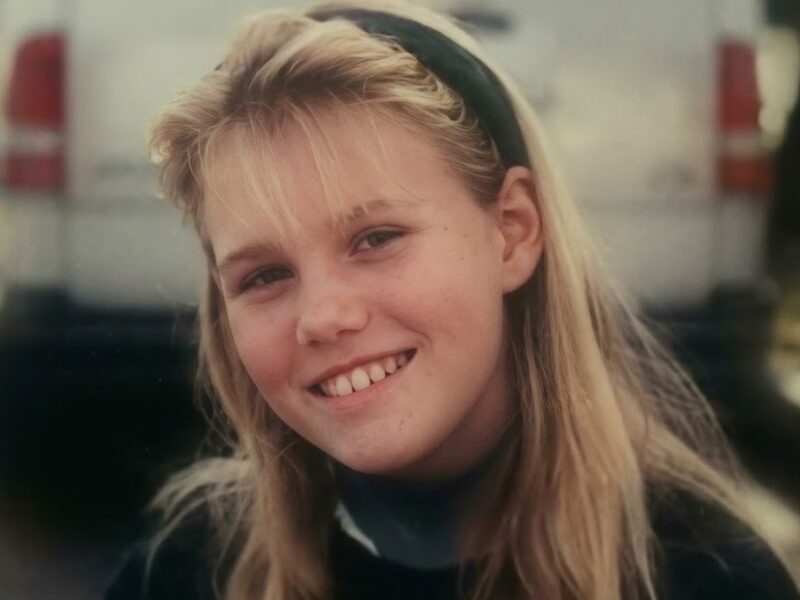
Jaycee Dugard Vanished in 1991—Officers Visited Her Captor’s Property 60 Times Without Finding Her
The morning air in Meyers, California, carried the sharp scent of Ponderosa pines and the quiet hum of a mountain community waking up. It was June 10, 1991, a Monday like any other, the kind of morning where danger felt like something that happened in other towns, to other families. A gray sedan slowed to a stop beside a school bus stop on Washoe and Boulevard, just a few dozen yards from a modest home where an 11-year-old girl named Jaycee Lee Dugard was walking toward her future.
Her stepfather, Carl Probyn, watched from the yard as Jaycee made the short walk she had made hundreds of times before. He saw the car stop. He saw a man step out. He saw the stun gun fire into his stepdaughter’s body, saw her pushed into the back seat, saw the sedan pull away in a matter of seconds. He jumped on his mountain bike and chased the vehicle up the hill, his lungs burning, his legs pumping, but the car crested the rise and vanished.
“There was a man and a woman,” Carl would later recall, his voice hollow with the memory. “In the passenger window I could see a black-haired woman.” He rode back down and told the neighbors to call 911.
Within the hour, police officers were at the home. The search that followed became the largest in El Dorado County history, thousands of volunteers fanning out across the region, search dogs moving through the pine forests, helicopters flying grids over the Sierra Nevada foothills. Flyers went up on every telephone pole, every storefront window, every community bulletin board within 100 miles. Tips came in by the thousands, reported sightings from across California and Nevada, every one logged, assigned, and followed up.
Not a single one led to the girl. No plate number. No clear description of the driver. No feature specific enough to separate one gray sedan from the millions registered in the state. The case went cold within weeks and stayed cold for 18 years.
But the man who took her was not hiding. He was living openly in Antioch, California, a suburb in the East Bay, under his own name, in a house he had occupied for years. His name was Phillip Craig Garrido. He was a convicted sex offender on federal parole, a man with a criminal record that should have made him one of the most closely watched people in the state. In 1977, he had been convicted of federal kidnapping and state sexual assault after abducting a 25-year-old woman named Katherine Callaway from a supermarket parking lot in South Lake Tahoe, handcuffing her, binding her, and driving her nearly 60 miles to a mini storage warehouse in Reno, Nevada, where he assaulted her for more than five hours. A police officer noticed a broken lock on the warehouse and investigated. That was the only reason she survived.
Garrido was sentenced to 50 years for kidnapping and 5 years to life for sexual assault. He served 11 years. In January 1988, the federal parole system released him. He was 37 years old. Katherine Callaway, now Katherine Hall, found out he was free. She contacted his parole agent directly and warned that the man was still dangerous and needed closer monitoring. The agent’s response was recorded in the file. He wrote that subjecting the parolee to electronic monitoring would be too much of a hassle based on the victim’s hysteria.
One sentence. The woman who had survived five hours in a warehouse was reduced to a word, and her warning was filed away. Three years later, the man took an 11-year-old girl from a bus stop less than an hour’s drive from where he had grabbed Hall.
The house on Walnut Avenue in Antioch looked like any other property on the block. A front house, a yard, nothing that would make a person driving by slow down. Behind the house was something else entirely. A tall fence lined with heavy tarps. Trees left to grow thick enough to block any view from the outside. Behind that cover, Garrido had built a network of tents and sheds connected and expanded over time, with no running water, no proper electricity, and no ventilation. One of the sheds was even soundproofed. The space was designed to hold a person without anyone knowing a person was there.
Jaycee was placed inside that compound on the day she was taken. She was 11 years old. She had no contact with anyone outside it. No phone, no school, no medical attention, no access to any part of the world beyond the tarps and fencing. The man and his wife, Nancy Garrido, were the only people she saw. The sexual assaults began immediately and continued for years.
In 1994, when Jaycee was 14, she gave birth to her first daughter inside the compound. There was no doctor, no hospital, no one with medical training present for a 14-year-old going into labor. Three years later, at 17, she delivered a second daughter under the same conditions. Both children were fathered by her captor. Neither one had a birth certificate or a medical record. As far as any system in the state of California was concerned, they did not exist.
The two girls grew up inside the compound. They never attended school. They never saw a doctor. They had never been inside a grocery store or ridden in a car on a public road the way other children had. Their mother was the only stable thing in their lives, and she had been a captive since before they were born.
Jaycee later described in her memoir what kept her from attempting to escape. It was not the fencing. It was not the physical threat. It was her children. Once her first daughter was born, every decision she made filtered through one calculation: What happens to them if this goes wrong? Garrido understood that. He had built a system around it. Total dependence, complete isolation, a closed world where he controlled the food, the space, the information, and the rules. He told Jaycee and the girls that the outside world was dangerous. He framed himself as their protector. Over the years, he folded religion into the structure, claiming a divine mission, positioning himself as a spiritual authority inside the compound the same way he controlled everything else. The girls called him their father. They called Jaycee their older sister. That was what he had told them, and they had never been given a reason or a reference point to question it.
For 18 years, three people lived behind a fence in a residential neighborhood in Antioch, California. Neighbors mowed their lawns on one side. Garrido walked in and out of the front house on the other. Mail was delivered. Trash was collected. The street functioned the way streets do. Nobody looked past the fence.
“You never know what people do behind closed doors,” one neighbor later told reporters. Another said, “I have six girls. I would die if something happened to them like that.” And yet, it was right across the street. Three doors down. Very scary.
The search for Jaycee Lee Dugard began within minutes of the 911 call on June 10, 1991. The El Dorado County Sheriff’s Office, the California Department of Justice, and the FBI Sacramento Field Office all deployed to the South Lake Tahoe area. Thousands of volunteers fanned out across the region. Search dogs moved through the pine forests around Meyers. Helicopters flew grids over the Sierra Nevada foothills. Flyers went up on every telephone pole, every storefront window, every community bulletin board within 100 miles. Tips came in by the thousands, reported sightings from across California and Nevada. Everyone was logged, assigned, and followed up. Not one led to the girl.
No plate number. No clear description of the driver. No feature specific enough to separate one gray sedan from the millions registered in the state. Carl Probyn had given investigators everything he could. The car, the man stepping out, the stun gun, his stepdaughter being pulled into the backseat. But because Carl was the last person to see Jaycee, and because he was the stepfather, the FBI turned its focus toward him almost immediately. He submitted to two polygraph examinations. He passed both. It did not matter. For years, he remained the primary suspect in his own stepdaughter’s disappearance. The suspicion followed him through the community, through his marriage, through his own front door. The man who had chased the car on his mountain bike spent the next 18 years carrying both the loss and the accusation.
“Damage that deep, it broke my marriage up,” Carl said. “I mean, you know, it’s like I’ve gone through hell. I’m a suspect.”
The investigation never extended west. It never reached the East Bay. It never touched Contra Costa County or the city of Antioch, 170 miles from where Jaycee was taken, where she had been living since the afternoon she disappeared. Within months, every actionable lead was exhausted. The case went cold.
Terry Probyn, Jaycee’s mother, refused to go cold with it. She tied pink ribbons to the trees near her home. She organized the printing and mailing of missing child posters. She held vigils. She cooperated with every media request that might put Jaycee’s face in front of someone who recognized her. “A piece of me is missing,” she told reporters. “Definitely. A piece of my heart. Feel like it’s been ripped. And I don’t feel like a complete person all the time because she’s not here.”
The case was featured on America’s Most Wanted. Tips came in. None of them held. For 10 years after the abduction, she took a week off work every Christmas and another week on the anniversary of the kidnapping. She spent those weeks at home crying. Not because she believed Jaycee was dead. Because she believed Jaycee was alive somewhere and nobody could tell her where.
The man who had taken her daughter was not hiding. He was living openly in Antioch under his own name in a house he had occupied for years. After his release in 1988, Garrido had been placed under federal parole supervision. In 1999, California’s Department of Corrections and Rehabilitation took over. From that point through August 2009, state parole officers conducted 60 visits to his home on Walnut Avenue. Sixty times an agent drove to the house, walked to the front door, spoke to the man inside, noted in the file that he was in compliance with his conditions, and left.
In all 60 visits, not a single officer checked the backyard. The man had been fitted with a GPS ankle bracelet designed to track his movements at all times. Over the years, the bracelet generated 335 alerts, signal losses, curfew violations, extended periods of time spent in the backyard behind the house. The data showed a clear and repeating pattern. He was spending hours in a part of his property that had no documented living space, no registered structure, no reason for a man on parole to be occupying it day after day. Three hundred and thirty-five times the system flagged it. Not once did anyone follow up.
The California Inspector General later determined that Garrido was properly supervised in only 12 of the 123 months the state was responsible for him. A failure rate of 90 percent. During at least one home visit, a parole officer saw a young girl at the property. Garrido told the officer she was his niece. The officer accepted the answer and moved on. His parole file contained no record of any children or dependents in the home.
In 2006, 15 years into Jaycee’s captivity, a neighbor called the Contra Costa County Sheriff’s Office and reported that children were living in tents in Garrido’s backyard. Children’s voices were coming from behind the covered area. A deputy went to the address. He spoke with Garrido at the front door. He did not enter the backyard. He left and filed a report noting no issues at the residence. The sheriff later admitted publicly that his department should have been more inquisitive and should have turned over a rock or two.
“This secret compound was so well concealed, law enforcement officers did not find it during searches of the property in 2006 and last July,” the sheriff said. “I offer my apologies to the victims and have accepted the responsibility for having missed an earlier opportunity to rescue Jaycee.”
In 2008, the parole agency conducted its own investigation after receiving reports of strange behavior. Investigators went to the house on Walnut Avenue. They questioned Garrido about his activities. Nobody checked the backyard. The compound stayed untouched. Jaycee and her two daughters remained unseen. That same year, Garrido complained to his parole officer about having to wear the GPS bracelet. He said he had not been in trouble with the law for 19 years. He had been holding a kidnapped girl and assaulting her for nearly the entire duration of those 19 years.
A month before the case finally broke, he signed paperwork promising he would not have contact with girls between the ages of 14 and 18. At the time he initialed those documents, he was living with two daughters he had fathered with the woman he had been holding captive since she was 11.
While the system checked its boxes and closed its files, Terry Probyn kept going. She told reporters years later that she never doubted for a single minute that she would see her daughter again. She had no evidence, no tips, no sign, just a certainty that lived deeper than anything the investigation had produced or failed to produce. Keeping that hope alive was what got her through the 18 years.
1991 became 2000. 2000 became 2005. Jaycee’s case faded from the news cycle. New families moved into Meyers. Kids who had stood at the same bus stop grew up and left town. The pink ribbons on the trees faded in the mountain weather. Terry replaced them. By the time 18 years had passed, most people who remembered the case assumed Jaycee was dead.
On August 24, 2009, the man who had taken her walked onto the campus of the University of California, Berkeley. He had two teenage girls with him. He told staff he wanted to hold a religious event for a group he called God’s Desire. The first person to meet with him was Lisa Campbell, manager of the campus police department’s special events unit. Campbell had worked law enforcement in Chicago and Los Angeles before coming to Berkeley. She had spent years reading people. Something about this man was wrong immediately.
His behavior was erratic. He was wearing a worn-out suit. He pulled out copies of a self-published book and said he could communicate with God. But it was the girls who raised the alarm. They were clean and neatly dressed, but pale, almost gray, like they had not spent much time outdoors. When Campbell asked them casual questions about their lives and schooling, their answers came back flat and rehearsed. One of the girls stared at her without blinking.
Campbell did not confront him. She scheduled a return meeting for the next afternoon and immediately reported what she had seen to campus police officer Allison Jacobs. Jacobs ran a background check. What came back changed everything. The man sitting across from Lisa Campbell’s desk was a registered sex offender on federal parole for kidnapping and sexual assault. He had been convicted in 1977, and his parole file listed no children. A convicted kidnapper and sex offender had walked onto a university campus with two girls nobody in the system knew existed.
On August 25, Garrido returned for his appointment. Jacobs sat in with Campbell. The two girls were with him again. The 15-year-old stood stiff, hands flat on her legs, eyes cast upward. The 11-year-old stared directly at Jacobs with pale blue eyes. Jacobs later said it was like the girl was looking into her soul. She described the whole scene as Little House on the Prairie meets a religious cult.
After the meeting, Jacobs picked up the phone and called Garrido’s parole officer directly. She told him about the two girls, the behavior, everything she and Campbell had observed over the two days. The parole officer confirmed what Jacobs already suspected. His file showed no children.
Two campus employees. Two days. No warrant. No DNA. No forensic technology. No special authority. They had looked at a man that 60 parole visits, 335 GPS alerts, a neighbor’s phone call, and an internal investigation had failed to see clearly, and they had decided that something was not right. Then they did what nobody in 18 years had done. They followed through.
The parole officer’s name was Edward Santos Jr. After Jacobs’ call, he summoned Garrido to the Concord parole office the next morning and ordered him to bring everyone living in his household. On August 26, 2009, Garrido arrived with four people: his wife, the two teenage girls, and a young woman he introduced as Alyssa, telling investigators she was his niece. Santos separated each person for individual questioning. Garrido was placed in one room, his wife in another, the young woman in a third. The two girls were kept apart from all of them.
Under questioning, Garrido’s story began to come apart. The details did not hold. The explanations shifted. And then, in that room in the Concord parole office, he confessed. He told investigators he had kidnapped an 11-year-old girl in 1991. He told them he had sexually assaulted her. He told them she had been living in his backyard ever since. His name was Phillip Craig Garrido. He was 58 years old. He had been a registered sex offender since 1977. His address had been on file with the state of California for over two decades. His ankle bracelet had been tracking his movements since it was fitted in 2008.
Sixty parole officers had stood at his front door. The system had his name, his record, his conviction, his address, and his GPS coordinates. It had everything except the willingness to walk 30 feet past the front door and look behind the fence.
In the next room, the young woman sitting across from investigators was not Alyssa. She was not his niece. She confirmed her real identity to authorities for the first time in 18 years. Her name was Jaycee Lee Dugard. She was 29 years old. The last time she had spoken that name to anyone outside the compound, she had been 11. Standing at a bus stop in Meyers, California, waiting for a ride to school.
That night, Jaycee and her two daughters were removed from the house on Walnut Avenue and taken to a secure location. The FBI arranged a phone call between Jaycee and her mother. Terry Probyn was in Southern California. She had not heard her daughter’s voice in 18 years, 2 months, and 16 days. Jaycee later described the call. She said she was crying so hard she could barely speak. She managed two words: “Come quick.” Terry told her daughter the only thing she had left to say: “I’m coming, baby. I’m coming.”
The next morning, Terry flew to northern California and met her daughter in person. She also met two granddaughters she never knew existed. Jaycee’s aunt, Tina Dugard, was at the reunion. She told the press the smile on her sister’s face was as wide as the ocean.
The most painful detail came after the reunion. During those 18 years, Jaycee had been held in Antioch, 170 miles from where she was taken. Less than a two-hour drive from her mother’s home. While Terry searched across California and Nevada, while she tied ribbons to trees and mailed posters and took weeks off work to cry, her daughter had been living behind a fence in a suburb in the East Bay.
Phillip and Nancy Garrido were arrested on August 26 at the Concord parole office. Phillip was charged with kidnapping and 13 counts of sexual assault. Nancy was charged with kidnapping and one count of sexual assault. Both initially pleaded not guilty. For nearly two years, the legal process moved through hearings, delays, and motions. In April 2011, both changed their pleas to guilty. The deal was structured to spare Jaycee and her daughters from having to testify.
“Citizens should be outraged that a predator like him was free to prey upon somebody else,” a prosecutor said. “Only this time, unfortunately, an 11-year-old child.”
On June 2, 2011, the sentencing hearing took place at El Dorado County Superior Court in Placerville, California. Jaycee was not in the courtroom. She had written a statement. Her mother read it aloud. “I choose not to be here today because I refuse to waste one more second of my life in your presence. Everything you did to me was wrong. I hated every single second of every single day for 18 years. You stole my life and the life of my family.” To Nancy Garrido, she wrote: “There is no God in this universe who accepts what you did. I hope both of you have as many sleepless nights as I have had.”
The woman standing in that courtroom reading those words was Terry Probyn. She was reading her daughter’s own words back to the people who had taken her because her daughter had decided she would not give them one more second.
Judge Douglas Finester called Phillip Garrido the poster child for a sex offender. He sentenced Phillip Garrido to 431 years to life in prison. Nancy Garrido received 36 years to life. Neither would ever be eligible for meaningful parole. The 431-year sentence guaranteed Phillip Garrido would die in a California prison.
After the sentencing, the question that remained was not about the Garridos. It was about the system that had let it happen. Jaycee sued the state of California. The state settled for $20 million, the largest payout in California history for parole system failures. It was not compensation. There is no dollar amount that compensates for 18 years. It was an admission. The system had failed in a way that was preventable, documented, and repeated dozens of times over nearly two decades.
In the years that followed, Jaycee did something no one had the right to expect of her. She rebuilt. She published A Stolen Life, a memoir that became a best seller. Not because it sensationalized what had been done to her, but because it told the truth about surviving something most people cannot imagine from the only perspective that matters: the one who lived it. She founded the JAYC Foundation, an organization supporting families recovering from abduction and trauma. She turned what had been taken from her into something that could help someone else, a choice nobody could make for her, a choice she made anyway. Her therapist later told the press that Jaycee was living remarkably well, that she was someone to be proud of.
On the morning of June 10, 1991, an 11-year-old girl walked up a hill in Meyers, California, toward a school bus stop a few dozen yards from her front door. Her stepfather watched from the yard. The walk took less than a minute. She never made it to the bus.
For 18 years, she lived behind a fence in a suburb 170 miles away. Sixty parole officers stood on the other side of that fence and never once looked past it. Three hundred and thirty-five alerts went off and nobody responded. A neighbor called and nobody checked. A victim warned the system and the system called it hysteria.
It took two women at a university who had never heard of Jaycee Lee Dugard, who had no file, no warrant, and no authority beyond their own judgment, to look at a man and two pale, quiet girls and decide that something was wrong. Then they picked up the phone.









