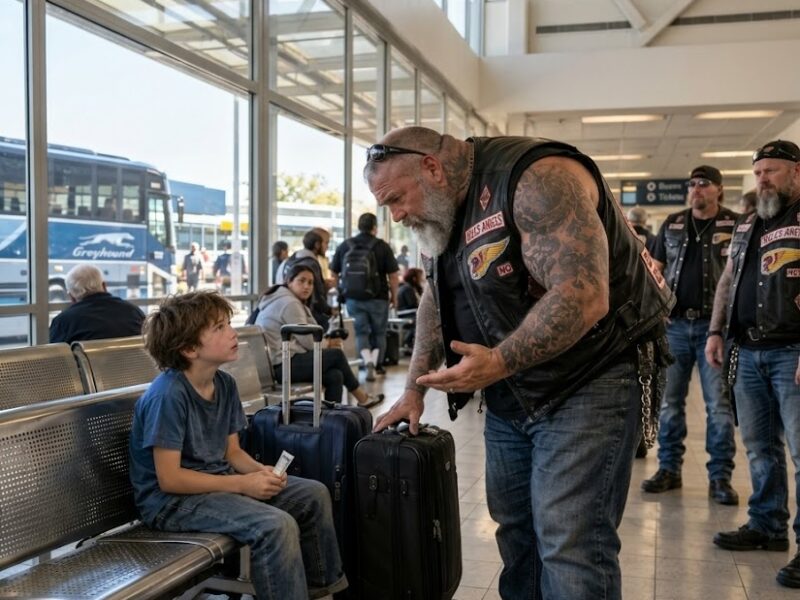
“I’ve Been Waiting Here Since Tuesday,” the Boy Told the Biker at the Bus Station
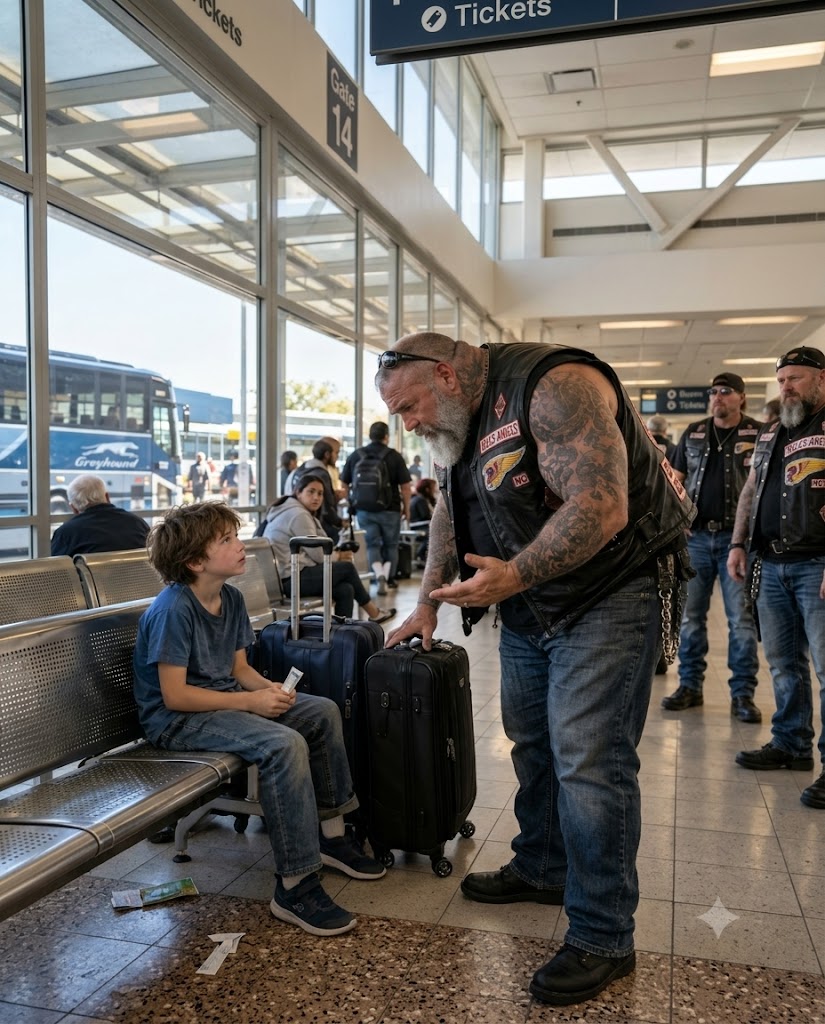
The wind was screaming against the glass when the boy looked up at the biker and said it.
Seven words, quiet, polite, terrifying.
“I’ve been waiting here since Tuesday.”
It was Friday. A dozen adults had walked past him. Four days under bright lights in a building full of people and not one of them had asked his name.
Scott Whitaker had a record, a leather jacket and a room full of phones pointed at his face. He knew exactly what would happen if he sat down beside that child.
He sat anyway.
But the boy was hiding something in his backpack. Something he had been told to show no one and in 40 minutes it would change everything.
The wind came across the Texas panhandle the way it always did in October. Flat and hard, carrying red dust and the sour smell of the feedlots east of town.
Scott Whitaker felt it shoving at his handlebars as he rolled down the off-ramp into Amarillo a little after 6:00 in the evening.
He was 46 years old, 6 ft 3 with a gray beard he kept trimmed close and a leather jacket that had survived 20 years of weather and two ex-girlfriends. Both forearms were covered in ink.
On the left, a Marine Corps eagle. On the right, a column of names and dates that he never explained to anyone.
He was on his way to Albuquerque for a charity ride that raised money for veterans families. And the radio had been promising a cold front by midnight.
A temperature drop of 30 degrees in 4 hours was nothing unusual out here, but it was enough to make a man on a motorcycle start looking for a roof.
A trucker he had met at a gas station in Oklahoma had told him about the Greyhound station downtown. “Cheap coffee,” he had said, “and the only warm waiting room in the city that stayed open all night.”
Inside, the air smelled of floor cleaner and burnt coffee. Rows of molded plastic chairs faced a ticket counter with a single clerk, a gray-haired man named Gary Mills, according to his name tag, who looked up, took in the beard and the leather and the tattoos, and looked down again at his crossword with visible effort.
A woman near the door pulled her purse onto her lap. A teenager in a hoodie sweatshirt stared at his phone. A man in a feed store cap watched Scott cross the room the way a person watches a dog he has not decided to trust.
Scott was used to it. He had been looked at that way since he was 19, and the look had only gotten heavier as the beard turned gray.
He bought a coffee from the counter, paid in cash, said thank you, and got no answer. Then he turned toward the far corner of the waiting room to find a seat away from everyone, which was his habit.
And he stopped.
There was a boy sitting beside the vending machine. He was small, maybe 9 years old, thin enough that his wrists looked like they might snap under the weight of the blue backpack in his lap.
His brown hair stuck up in the back where it had been slept on, and his jacket was a man’s size, the sleeves rolled three times at the cuffs. His sneakers were held together with silver duct tape.
He sat with his back straight and his feet not quite touching the floor, and he was watching the front door with the steady, exhausted attention of someone who had been watching it for a very long time.
He should have kept walking. A man who looked like Scott did not walk up to a child in a bus station. He knew exactly how that would appear, and he knew exactly who would be calling someone about it before he finished his coffee.
But he also knew something else, something older than the beard and the Marine Corps and everything since. He knew what it looked like when a kid was waiting for somebody who was not coming.
He sat down two chairs away, leaving an empty seat between them, and set his coffee on the armrest.
“Evening,” he said, keeping his voice low and easy.
The boy turned his head. His eyes were very blue and very tired with dark smudges under them that did not belong on a face that young. He studied Scott, the beard, the jacket, the ink, and Scott waited for the flinch.
It did not come. The boy looked at him for a long moment, then nodded once, the way a small adult might.
“Hi,” he said.
“You waiting on a bus?”
“No, sir.” The boy glanced at the door again. “I’m waiting on my grandpa. He’s coming to get me.”
“Yeah? When’s he due?”
The boy’s fingers tightened on the strap of his backpack. “He’s just late.”
Scott took a sip of coffee and let that sit. Outside, the wind rattled the glass of the front doors. Somewhere in the ceiling, a fluorescent tube buzzed and stuttered.
“How late?” he asked gently.
The boy was quiet for so long that Scott thought he might not answer. Then he said in a small, steady voice, the voice of a kid who had practiced saying it so he would not cry, “I’ve been waiting here since Tuesday.”
The words landed in the room like a dropped plate. The woman near the door glanced over. The teenager’s thumb stopped moving on his phone. Scott felt something cold move through his chest that had nothing to do with the coming weather.
It was Friday evening. He looked at the clock above the ticket counter to be sure. Friday, October 11th, 6:22 p.m.
“Tuesday?” Scott repeated carefully.
“Yes, sir.”
The boy reached into the pocket of his oversized jacket and pulled out a crumpled bus ticket stub, smoothing it against his knee as if it were a document of great importance. Scott leaned a little closer without moving his chair.
The stub read Tulsa to Amarillo and the date on it was 4 days old.
“I came on the bus by myself. My mom put me on it. She said Grandpa would be right here when I got off. And I got off and I sat down and he didn’t come so I stayed. She said not to move. She said if I moved he might not find me.”
“What’s your name, buddy?” Scott asked.
The boy blinked at him. Something moved across his face. Surprise, maybe, or the first small crack in something he had been holding together.
“Matthew,” he said slowly. “Matthew Pruitt.”
“Scott Whitaker.” He did not offer to shake hands. He just nodded the same way the boy had. “It’s good to meet you, Matthew.”
Matthew looked at him a moment longer. Then he said so quietly that Scott almost missed it, “Nobody’s asked me that yet.”
At the far side of the room, the man in the feed store cap had taken out his phone. He was holding it up at chest height, pointed directly at Scott, and he was not hiding it.
Scott did not look at the phone. He had learned a long time ago that looking at a camera only made people feel justified. He kept his eyes on the boy, his hands open on his knees where anyone could see them, and he spoke as if the room did not exist.
“Matthew, when’s the last time you ate something that wasn’t out of a machine?”
The boy considered the question with great seriousness. “Wednesday,” he said. “A lady gave me half a sandwich. She said it was too much for her.”
“And since then?”
Matthew nodded toward the vending machine at his shoulder. “I had $11. I’m trying to make it last.”
Eleven dollars. Four days.
Scott stood up slowly so the movement would not seem like a threat and walked to the vending machine. He fed a $10 bill into the slot and punched buttons until the machine delivered a bag of pretzels, two packs of peanut butter crackers, an apple juice, and a bottle of water.
Then he went to the coffee counter at the end of the room where a clerk was rinsing out a pot and asked what hot food they had.
“Nothing,” the clerk said, not unkindly. She was a woman in her 60s with silver glasses on a beaded chain and a name tag that read Loretta. “Kitchen closed at 4:00. I’ve got a microwave in the back and some frozen burritos.”
“I’ll take two.”
“For who?” she asked.
“For the kid by the vending machine.”
Her eyes went to the corner. Her face changed. The change started small, a tightening around the mouth, and spread until she looked like a person watching a car roll toward a cliff.
“How long has he been there?” she said.
“He says since Tuesday.”
“Gary,” she said in a voice that came out too quiet. Then louder, “Gary Mills.”
The man at the ticket counter looked up from his crossword. “Yeah?”
“Did you know there’s a child sitting in my waiting room?”
“The boy? Sure. He’s been waiting for his grandfather.” Gary shrugged, but his ears had gone pink. “He told me Tuesday morning. I figured somebody was coming. Day shift figured the same. Mikey on nights even brought him a blanket Wednesday. Nobody said anything was wrong.”
“Four days, Gary.”
“He didn’t say he needed anything.”
Scott took the burritos from the counter when the microwave beeped, wrapped them in napkins, and walked them back to Matthew without a word. He sat down in the same chair, two seats away, and set the food on the empty seat between them.
“Eat slowly,” he said. “Your stomach’s gotten used to nothing.”
Matthew stared at the burrito. Scott could see the argument happening inside him, hunger against everything he had been taught.
“Mr. Whittaker,” the boy said carefully, “my mom says I’m not supposed to take things from strangers.”
“Your mom’s right,” Scott said.
Matthew looked up, startled.
“She’s right,” Scott repeated. “That’s a good rule, and you keep following it. But you’ve been following it for 4 days without any food, and I’d bet my bike she’d tell you that eating is the exception. Here’s what we’ll do. I’m going to sit right here, and I’m not going to touch you or touch your bag. If you want to eat, eat. If you don’t, that’s fine, too, and I’ll keep sitting here anyway, okay?”
The boy took the burrito. He ate it in small, careful bites, as if it might be taken away, and halfway through he started to shake a little, the way a body does when it finally believes it is safe enough to feel how hungry it has been.
Scott pretended not to notice. He looked at the floor. He thought about a group home in Bakersfield many years ago, and a boy of eight who had sat in a hallway for 6 hours after a case worker forgot to come back for him. Nobody had asked that boy his name, either.
“Do you have a phone?” Scott asked eventually.
“Mom gave me her old one,” Matthew said. “It died on Tuesday night. I don’t have the charger. It’s in the kitchen back home.”
“Do you know grandpa’s number?”
“It’s on a paper in my bag.” Matthew’s hand tightened on the strap. “But mom said not to show it to anybody unless there was an emergency. Is this not an emergency?”
The boy’s chin trembled. “I didn’t think it was,” he said. “I thought it was just waiting.”
Scott had to look away for a second, out at the swirling dust, until his jaw stopped working. When he looked back, Loretta was standing at the end of the row holding a cup of hot chocolate in both hands. She set it on the arm of Matthew’s chair and did not meet his eyes.
“I’m so sorry, sweetheart,” she whispered. “I’m so sorry. I didn’t know.”
Matthew took the cup. “It’s okay,” he said politely. “Thank you.”
That politeness cut deeper than any accusation could have. Loretta straightened and her face changed again, but this time something harder was in it. She looked at Scott. Her eyes moved from the beard to the jacket to the tattoos, and Scott watched the old fear come in behind the guilt.
It was not malice. It was reflex. The reflex of a woman who had just discovered that she had failed a child and who needed desperately for the blame to belong to somebody else.
“Sir,” she said quietly. “Could I speak to you over here for a moment?”
“Ma’am, I’m happy to.”
“Not near the boy.”
Scott looked at Matthew. The boy was watching them over the rim of the cup, his blue eyes wide.
“I’ll be right back, buddy,” Scott said. “I’m not leaving. I promise.”
He followed Loretta toward the ticket counter. And by the time he reached it, he already knew what was going to happen. The man in the feed store cap had made a call. The woman with the purse was whispering to a stranger. Gary Mills had his hand resting on the telephone and he was staring at Scott with a look that Scott had seen too many times in too many towns.
“I just want to know,” Loretta said, her voice shaking slightly, “why a grown man who doesn’t know that child is buying him dinner and sitting beside him for half an hour.”
“Because nobody else was,” Scott said.
It was the truest thing he could have said. And it was exactly the wrong thing to say. Loretta flinched. Gary lifted the phone. And 40 seconds later, the front doors blew open on a gust of cold wind and two uniformed police officers stepped into the waiting room with their hands resting near their belts.
The taller one was in his 40s, broad in the shoulders, with a tight jaw, and a nameplate that read Dunham. His eyes found Scott immediately, as if the call had described him in advance.
“Sir,” Officer Ray Dunham said, his voice calm and flat, and it carried to every corner of the room. “I need you to put your hands where I can see them and step away from the counter.”
“Officer, I haven’t done anything.”
“Step away, please.”
From the corner of the room, a small, clear voice cut through the tension like a bell.
“He didn’t do anything,” Matthew said.
He had stood up. He was holding the cup of cocoa in both hands and it was trembling, but he did not sit back down. “He’s the only one who asked me my name.”
For a moment, nobody in the Amarillo bus station spoke. Officer Dunham looked at the boy, then at his partner, a younger man named Greg Hollis, who raised one eyebrow and shrugged slightly. The cold air rolling through the open door lifted the edge of the schedule posters on the wall.
Dunham did not take his hand off his belt. He did not need to. The posture alone said what the moment was. A large man with tattoos, a small child, a room full of witnesses who had already made up their minds.
“Son,” Dunham said more gently, “I need you to stay right there for me.”
“Yes, sir,” Matthew said and did not move.
Scott kept his hands visible. He had been in front of men with weapons before in places much further from home, and the lesson was always the same. Slow, quiet, and obvious.
“Officer Dunham, my name is Scott Whitaker. My license is in my back left pocket. My motorcycle is parked out front, and I’ve been in Amarillo for about 30 minutes. I’d like you to talk to the boy. He’s been here since Tuesday.”
“We’ll get to that.” Dunham nodded to Hollis. “Pat him down.”
The man in the feed store cap had not stopped filming. Dunham took the license and walked to the counter. Scott heard him call it in. He heard the pause, the murmur, the pause, and then Dunham’s voice shifted a degree colder.
“Copy that. Say again the date.”
When the officer returned, he was holding the license at an angle, like evidence. “You have a record, Mr. Whitaker.”
“I have a disorderly conduct charge from 2003, a bar in San Diego. I was 23. I paid the fine, and I haven’t had so much as a parking ticket since.”
“That’s a violent offense in my book.”
“It was a shoving match over a pool table, and I was drunk, and I’m not proud of it.” Scott kept his voice level. “I got sober 6 years ago. I have a coin in my left jacket pocket if you want to see it. I’m also a retired Marine, and I ride with a veterans charity. The head of the ride is a man named Walt Brant in Albuquerque, and he’ll vouch for me if you call him.”
“I’m sure he will.”
“Officer,” Scott said, and finally let a trace of urgency into his voice. “I’m not the problem here. There is a 9-year-old child in this room who’s been sitting alone for 4 days. Somebody should be asking where his family is.”
Dunham’s jaw tightened. For a second, Scott thought he saw something shift behind the officer’s eyes, a flicker of doubt, a hair’s width of discomfort. But the moment passed because behind Dunham, a woman had spoken loudly and clearly to the room at large.
“He was just sitting down there next to that child. I saw it. A man like that, I’m not saying anything, but come on.”
“Ma’am,” Hollis said, “we’ll handle this.”
“I’m just saying, if it was my kid—”
“It’s not your kid,” Loretta Haines said.
Everyone turned. The old woman stood behind the counter with both hands flat on the wood. Her glasses crooked, her face blotchy with something she was clearly fighting to keep inside.
“It isn’t your kid, and it isn’t mine either. And that’s the whole problem.” It wasn’t anybody’s. “That boy has been sleeping in a chair in my building since Tuesday morning, and I had seven people walk past him today, including me, and none of us asked him one single question. This man did it in 2 minutes.”
The room went very quiet.
“He bought that child a burrito,” she continued, and her voice cracked. “I’m the one who should be answering questions, not him.”
Dunham looked at her for a long moment. Then he looked at the boy in the corner, who was still standing, still holding the paper cup, still watching everything with those steady blue eyes. When he spoke again, the hardness had gone out of his voice, though not entirely.
“Mr. Whitaker, you’re free to sit down. Please stay in the building.”
“Yes, sir.”
“I’m going to talk to the boy. You can stay in my line of sight. If he gets scared, you step back.”
“Understood.”
He watched Dunham crouch down in front of Matthew. The officer was big and awkward at it, his knees cracking, but his voice was low and careful.
“Matthew, I’m Officer Dunham. I’m here to help you. Can you tell me about your grandpa?”
“His name’s Walter Pruitt,” Matthew said. “He lives on Hollis Lane. I mean, I think. Mom said it’s near a big water tower.”
“And you were supposed to meet him here?”
“Yes, sir, on Tuesday morning, but he didn’t come.”
Dunham glanced at Hollis. “Run the name.”
Hollis stepped away with his radio. Dunham stayed crouched. “Does your mom have a phone number I can call?”
“She’s in a place,” Matthew said, and his voice dropped. “A treatment place for her sickness. She said it was 30 days, and I couldn’t call her the first week, and she told me grandpa would take care of me. She said she’d be back before Thanksgiving.”
Treatment. The word hung in the air. Scott watched Dunham absorb it, and he watched the cold family history begin to assemble itself in the officer’s mind. A single mother, a sick day, a boy shipped across state lines to a grandfather who never came.
“Matthew,” Dunham said, “do you have anything with her information on it?”
The boy’s hand moved to his backpack, then it stopped. “She said not to show anybody,” he whispered. “Unless it was a real emergency.”
“I think this is one, son.”
“But what if you’re not who you say you are?”
It was a very good question. Dunham actually flinched. He looked at the badge on his own chest as if he was seeing it for the first time. And then in the silence, Matthew turned his head and he looked across the room directly at Scott.
“I’ll show him,” the boy said. “I’ll show Mr. Whitaker.”
“Matthew,” Dunham said, “I’m a police officer.”
“I know.” The boy’s voice was polite, small, and absolutely immovable. “But he’s the one who sat with me.”
Dunham rose slowly. His face was complicated. Scott stood too with his hands open at his sides and a terrible unexpected weight settled over him. He was a stranger with a record, a tattooed man with a motorcycle being asked to take a child’s last secret in front of a room full of people who wanted him to be guilty.
If he accepted, he would look like exactly what the phone cameras had already decided he was. If he refused, a frightened 9-year-old would be left alone with four more adults who had spent the last four days not asking questions.
He thought about the road. It was right outside, 40 ft away, humming on its kickstand under the dust-filled street light. Nobody would have blamed him for walking out and letting the professionals sort it out. It would have been the safest thing a man in his position could do.
He was tempted for exactly 3 seconds. Then he looked at Matthew’s shoes held together with silver tape and he walked across the room and sat down and he held out his hand.
The storm hit while Matthew was unzipping his backpack. It came in a roar, a long low wave of wind that rattled the station doors in their frames and flung a sheet of dust against the window so thick that the streetlights turned to brown smears.
The lights flickered. Somewhere a sign tore loose and clattered down the street. A baby began to cry near the ticket counter and Loretta Haines hurried over to the door to check the latch.
Matthew did not look up. He worked at a small inner pocket with his thin fingers, the zipper stuck halfway, and Scott stayed absolutely still on the edge of the chair, watching Dunham out of the corner of his eye. The officer had moved a step closer, and Hollis had finished his radio call and drifted over, too. They stood on either side, a loose and watchful half circle.
Nobody told Scott to back away. Somewhere in the last 10 minutes, the room had decided to let this happen, and Scott understood that it was not trust. It was exhaustion and the faint shared fear that they had all been wrong.
The zipper gave. Matthew drew out a folded sheet of notebook paper and a small laminated card, and he held them in both hands for a moment before extending them.
“I don’t know if it’s an emergency,” he said again, but this time it sounded like a question.
“It’s a good enough one,” Scott said gently and took them.
He did not read them first. He turned and held them out to Dunham so everyone could see. “Officer, I’d like you to be the one who looks at these.”
Dunham hesitated. Then he accepted the papers, and Scott saw the officer’s expression shift as he read.
The notebook page was a child’s writing, large and careful, in blue ink. Walter Pruitt, 1412 Hollis Lane, Amarillo. Grandpa’s phone, 806, and then a number.
Below it, in a different hand, an adult’s slanting script. Matthew, I love you. Be brave. I’ll see you before Thanksgiving. Do not go with anyone but Grandpa. If something goes wrong, show this to a police officer or a nurse.
And at the bottom, an emergency number for a treatment center in Tulsa, Oklahoma, and the name of a counselor, Ms. Patricia Yates.
Dunham read it through twice. Then he lowered it slowly and looked at Matthew. “Your mom told you to show a police officer,” he said quietly.
“Yes, sir.”
“Why didn’t you?”
The boy’s blue eyes filled. “Because,” he said, “I didn’t think it was bad enough. And you were all so busy.” He gestured vaguely at the waiting room, at the ticket counter, the clocks, the people. “I didn’t want to be a bother.”
Nobody spoke. Scott watched Officer Ray Dunham, a man who had worn a badge for 19 years, press his lips together hard and look at the ceiling. Hollis was already on the radio.
“Dispatch, I need a welfare check at 1412 Hollis Lane and a call to Northwest Texas Hospital. Run the name Walter Pruitt for any recent admissions.”
The answer came back in under 2 minutes, a crackle of static and a flat voice. Everyone in the waiting room leaned in to hear it.
“Walter Pruitt, age 72, admitted Monday night, stroke. He’s in the neurology unit on the fourth floor. A neighbor found him Tuesday morning.”
Tuesday morning. For a heartbeat, the entire building was silent except for the wind. Matthew had stepped off the bus at nearly the same moment an ambulance was pulling away from his grandfather’s house.
“He didn’t forget me,” Matthew said. His voice cracked on the word.
“Nobody—” Scott’s own voice was thick. “He didn’t forget you. He couldn’t come.”
The boy did not cry loudly. He cried the way he had done everything else for four days, quietly and politely, with his shoulders shaking and his hands pressed to his mouth. Scott did not touch him. He had made a promise. But he slid the cup of cocoa a little closer on the armrest, and he sat beside him, and after a moment, Matthew leaned sideways until his shoulder pressed against Scott’s arm, and Scott let him.
Across the room, Loretta Haynes had her hand over her face. The woman with the purse had gone pale. The man in the feed store cap, who had been filming for 20 minutes, had lowered his phone. He did not seem to know what to do with his hands.
Then the next piece fell into place because Dunham was a good officer under all of it, and he did what good officers do. He dialed the number on the card. The treatment center answered on the third ring.
Dunham identified himself and explained, in four careful sentences, what had happened. There was a long silence on the line. Then a woman’s voice, calm and clear, said, “Officer, I’m Patricia Yates. I run the intake program. Dana Pruitt is in my building, and she’s been counting the days. If you’ll hold, I’m going to bring her to the phone. Is Matthew there?”
“He’s here, Mom.” Dunham glanced at Scott, then at the boy, and did exactly that. “Please put the phone on speaker.”
The sound of footsteps came through the little speaker, a door opening, a murmur of voices, and then, ragged and breathless, a woman’s voice, thin with disbelief, “Matty?”
“Mom.”
Matthew was on his feet. He had the phone in both hands, pressed to his ear, and Dunham had gone entirely still.
“Mom, I waited. I did what you said. I waited right here. I didn’t move.”
“Oh, baby. Oh, my baby.” Dana Pruitt was weeping so hard that the words were barely shaped. “Where are you? Where’s Grandpa? I called and called. They told me I couldn’t call out again until Sunday and I thought— I thought he had you. I thought you were safe.”
“I’m at the bus station. I’m okay. A man bought me food. His name is Mr. Whitaker. He’s a Marine. He asked me my name.”
A pause. And then from the other end, a different note, careful and frightened. “Matty, who is this man?”
Scott felt every eye in the room turn toward him. The same eyes that had been aimed at him all evening. He met them one by one. He did not defend himself. He had said everything he had to say.
And across a thousand miles of static and a child’s trembling voice, a mother listened to a stranger for the first time.
“Mom,” Scott said, leaning slightly toward the phone, “my name is Scott Whitaker. Your son has been waiting here for 4 days and I want to tell you something. He kept every rule you gave him. He didn’t go with anyone. He waited, exactly like you said. And he did it with more courage than most grown men I served with. You raised a remarkable boy.”
On the other end of the line, Dana Pruitt broke completely.
The door banged open then on another surge of wind and a young woman in a gray coat with an ID badge clipped to her lapel hurried in, brushing dust off her shoulders.
“Officer Dunham, Denise Colby, Child Protective Services. I was told you have a minor here who needs immediate placement.”
Matthew’s head came up. “Placement?” he said. His face went white. “No, I have to wait. Grandpa is coming. I can’t go with anybody.”
“Honey,” Denise Colby said gently, kneeling. “I’m here to make sure you’re safe.”
“No.” The panic came all at once. The whole weight of 4 days, the strangers, the cold, the hunger. He backed away from her, bumped into Scott’s leg, and grabbed a handful of black leather in both fists. “I’m not going with her. I’m not going unless Mr. Whitaker comes. He’s the one who stayed. He’s the only one who stayed.”
The storm blew out around midnight, leaving a sky scrubbed clean, and a cold so sharp that the breath of every person leaving the Amarillo bus station hung in the air like smoke.
It took 3 hours to untangle everything. Denise Colby, to her credit, did not argue. She listened to Matthew, then to Dunham, then to Loretta Haynes, who gave a statement that was brutally honest about the station’s failure and left nothing out.
And at a quarter to 10, standing in the swirling dust outside the glass doors, she walked over to Scott with her clipboard under one arm.
“Mr. Whitaker, I’m not going to tell you this is regular procedure. It isn’t.”
“I understand.”
“But Matthew needs to see his grandfather tonight. The hospital has agreed to allow a brief visit with an officer present, and he has told me, three separate times, that he will go if you ride behind the cruiser.” She looked at him over the clipboard, steady and frank. “I checked your background with Officer Dunham. I called Mr. Brandt in Albuquerque. Everything you said holds up. So, here’s my condition. You follow us, you stay in the waiting area, and when Matthew is settled, you let me do my job.”
“That’s all I want,” Scott said and meant it.
On the fourth floor, the hallway smelled of antiseptic. A nurse named Brenda met them at the elevator with a quiet word to Denise, then led Matthew down the corridor toward a room at the end. Scott stopped in the waiting area, as promised, and lowered himself into a vinyl chair.
Dunham sat down across from him, took off his hat, and turned it slowly in his hands. “I walked in already knowing what I’d find,” he said at last. “19 years and I just did the thing I tell rookies never to do.”
“Everybody does it,” Scott said. “Asking is harder.”
Down the hall, a door opened. A nurse stepped out and beckoned and Scott stood. Dunham stood, too, and together they walked to the end of the corridor and stopped at the threshold.
Walter Pruitt lay in the hospital bed with a pale, sunken face and a white tube taped under his nose. The left side of his mouth drooped. He was a big man gone thin with a cap of white hair and hands like old work gloves, and those hands were wrapped around his grandson’s small ones.
Matthew sat on the edge of the mattress, perfectly upright, his backpack still on his shoulders.
“I’m sorry I was late,” Walter was saying. The words came slow and slurred, dragged out of him with great effort. “I’m sorry, Matty. I was coming. I swear I was coming.”
“It’s okay, Grandpa.”
“I was supposed to be there. I should have been there.”
“You were sick,” Matthew said with the grave, patient authority of a 9-year-old explaining something to a child. “And it’s not your fault. I waited, so it’s okay. That’s what waiting is for.”
The old man’s eyes filled. Scott felt his own throat close. He stood in the doorway and watched a stroke patient and a boy in an oversized jacket hold on to each other, and he thought of his own father, a man he had not seen since he was seven. He thought about a hallway in Bakersfield. He thought for the first time in decades that perhaps the boy in that hallway had finally been found.
Matthew turned and saw him. “Grandpa,” he said, “this is Mr. Whitaker. He’s the man.”
Walter lifted one trembling hand. “Thank you,” he managed, and the words were clumsy, but entirely clear. “Thank you for staying with my boy.”
Scott crossed the room and took the old man’s hand. “Sir,” he said, “it was the easiest thing I’ve ever done.”
The video went up on Saturday morning. The man in the feed store cap, whose name turned out to be Carl Ostrander, had posted it with a caption that blamed Scott. Within 6 hours, it had 200,000 views, and the comments were not what Carl expected.
Someone had spliced in Loretta’s speech from the counter. Someone else had posted the line, “He’s the only one who asked me my name.”
By Saturday night, a local reporter had interviewed Loretta, who stood in front of the bus station and said, without flinching, “I failed that child. We all did. The man with the tattoos was the only one who didn’t.”
By Monday, the town of Amarillo had changed its mind. Denise Colby arranged a temporary placement with a licensed foster family a few blocks from the hospital, a retired school teacher named Marjorie Sutton and her husband, and she made sure Matthew could visit his grandfather every afternoon.
Scott had meant to leave on Saturday. He stayed for 11 days. Every afternoon, he found himself at the hospital sitting in the corner of Walter’s room while Matthew did homework on a rolling tray, and the old man dozed. Sometimes they talked. Sometimes they played checkers.
On the 30th day after Matthew’s arrival, a Greyhound bus pulled into the Amarillo station at exactly 9:40 on a bright, cold morning. The door hissed open. A thin, pale woman with short hair and a battered suitcase stepped down onto the pavement and stopped, looking for something.
Matthew was standing in the front of the waiting room in his new sneakers with Loretta Haynes on one side and Walter Pruitt on the other in a wheelchair, his hand steady on the armrest. Denise Colby stood a little way back, smiling. Officer Dunham was by the door, hat off.
And at the very back, leaning against the vending machine in the same worn leather jacket, was Scott Whitaker, who had ridden to Tulsa and back to bring Dana home and who had not planned to be there and who would not have missed it for anything.
“Mom!”
Dana Pruitt dropped her suitcase. Matthew hit her at a dead run and she caught him and held on, her face buried in his hair, her shoulders shaking. When she finally looked up, her eyes found Scott across the room. She did not say anything. She just put her hand on her heart.
Scott nodded. Then he turned and walked to the glass doors because there are some moments a man should not stand in the middle of.
Outside the sun was bright and the wind had finally dropped. His Harley sat at the curb, gleaming, patient.
“Mr. Whitaker!”
He stopped. Matthew had broken away from his mother and was running across the waiting room, his sneakers squeaking on the tile. He skidded to a halt in front of Scott and looked up with those steady blue eyes.
“Will you come back?”
“I’ve got a ride to finish in Albuquerque,” Scott said. “But after?”
Scott crouched until they were eye to eye. For a moment, he did not trust himself. Then he said the only thing that was true. “I’ll be back by Thanksgiving. I’m told there’s a dinner I might get invited to.”
Matthew grinned. It was the first full smile Scott had seen on his face, and it changed everything about it.
“You’re invited,” he said. “Mom says so. I already asked.”
He wrapped both arms around Scott’s neck. Scott held him gently, and over the boy’s shoulder, he saw the waiting room, the plastic chairs, the vending machine in the corner, and the ticket counter where for 4 days a dozen adults had looked the other way.
The truth was simple, and it had taken a child to say it. Nobody had failed Matthew Pruitt because of a bad person. They had failed him because of a hundred ordinary people, each certain that someone else would stop.
And the only man who had stopped was the one they had all been taught to fear.
Scott rode out of Amarillo that afternoon with the sun on his shoulders and a coffee cup still warm in his hand. He did not feel like a stranger anymore.









