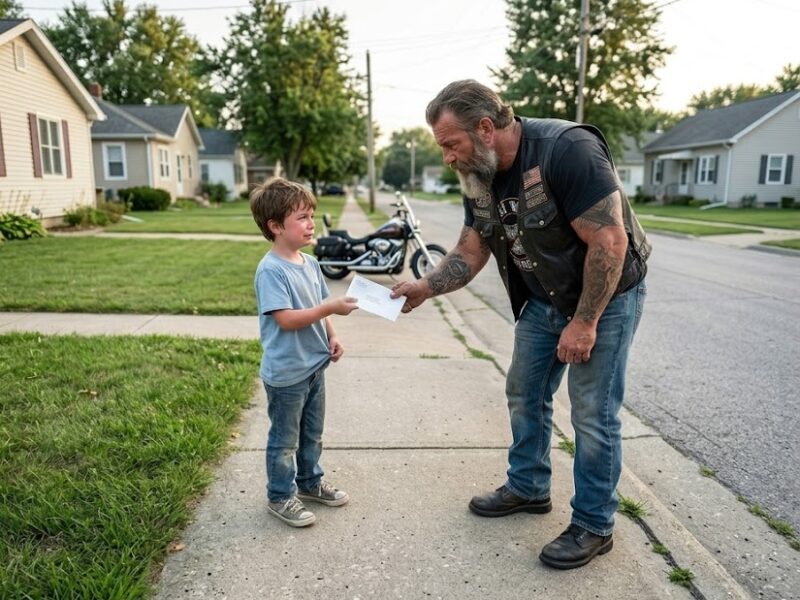
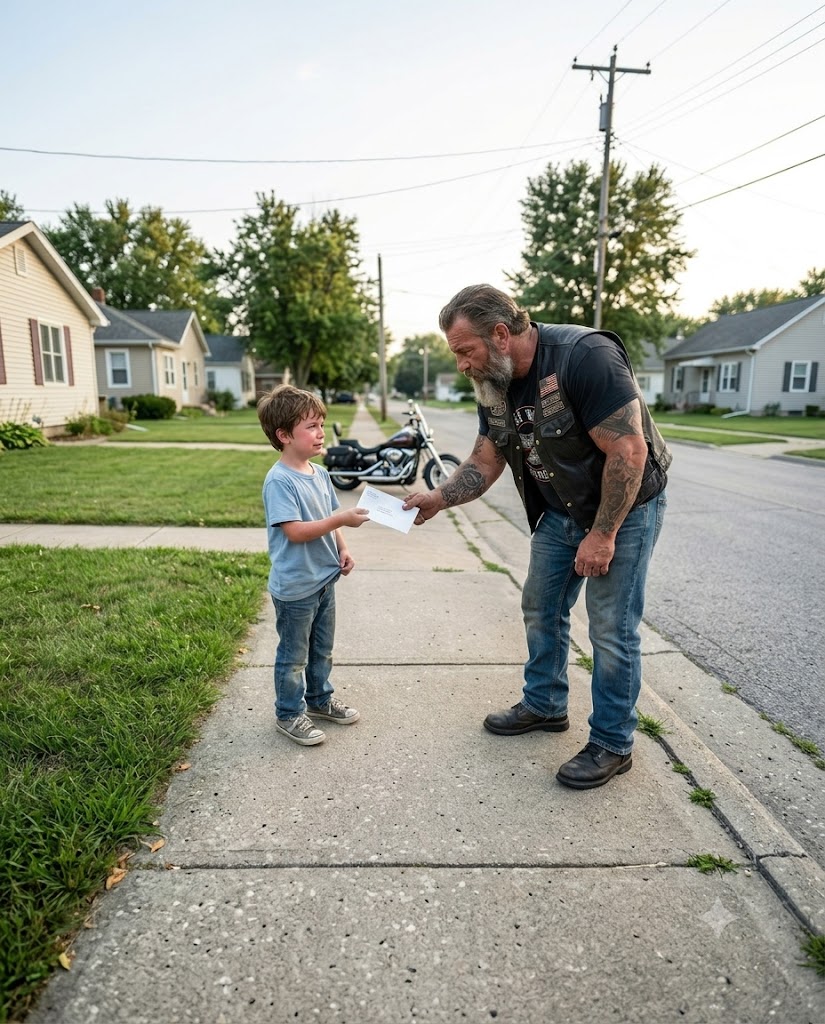
“I’ve been hiding this under my bed for six months,” the boy whispered, handing a biker a crumpled envelope. What was inside left the entire clubhouse silent.
Patrick Hollis was kneeling in a ditch with a dying man’s blood on his hands when the first cruiser’s lights hit the trees.
He had fourteen minutes of proof that he’d done nothing wrong.
He just didn’t know it existed.
Six months later, an eleven-year-old boy in a soaked gray hoodie crossed a highway in the rain carrying an envelope he had hidden under his bed and stopped six feet from the most hated man in town.
“Mr. Hollis,” he whispered.
“I know whose truck it was.”
But the name on that video belonged to the one man in Somerset who could take everything from the boy’s mother.
And somebody had already watched him cross the road.
Some silences have a sound.
In Prewitt’s Diner on a gray Saturday morning in October, the sound was forks going still.
Patrick Hollis felt it the moment he pulled open the glass door and the little brass bell above it gave its cheerful ring.
Conversation at the counter stopped halfway through a sentence.
A man in a feed store cap turned his shoulder.
In a corner booth, a woman slid her hand across the table and gathered her young son close, as if the floor had tilted and the boy might roll toward the door.
Patrick was fifty-two years old and six-foot-three, with a gray beard, a leather vest worn soft as an old glove, and tattoos on his forearms faded to the blue-gray of a winter lake.
He knew exactly what Somerset, Kentucky saw when it looked at him.
He had known for thirty years.
What he had never gotten used to was how the looking had changed in April.
He took the stool at the far end of the counter beside the napkin dispenser and waited.
Gus Prewitt, who had owned the diner since before Patrick opened his shop, stood at the grill with his back turned, flipping hash browns that did not need flipping.
One minute passed, then two.
The waitress, a young woman named Kayla, who had once saved him the last slice of coconut pie, studied the coffee pot as though it held instructions.
Finally, Gus spoke without turning around.
“We’re out of eggs, Patrick.”
Patrick looked at the plate of scrambled eggs sitting under the heat lamp three feet from his elbow.
Then he looked at the back of Gus’s neck, red and creased, a neck he had known for twenty years.
“Sure,” he said quietly.
“Thanks anyway, Gus.”
He laid a five-dollar bill beside the napkin dispenser.
Long ago, he had learned that leaving money made it harder for people to tell themselves he had stolen something.
The bell rang again as he stepped out, and the silence inside followed him onto the sidewalk and stayed there.
Everyone in town knew the story, or believed they did.
On a Friday evening in April, as the light was going, a thirty-nine-year-old lineman for the electric cooperative named Mark Whitaker had been driving home along Highway 80 when his pickup left the road at a curve and rolled down a steep embankment toward the creek.
Patrick, riding home from a parts run in Monticello, had been the first to arrive.
Deputy Brannock had been the second.
What Brannock found was a large bearded man in a leather vest kneeling in the ditch with blood on his hands, his shirt, and his face.
Brannock had not asked a single question before reaching for his handcuffs.
Patrick spent nine hours in an interview room that night.
No charges were ever filed, but in Pulaski County, a question without an answer becomes an answer all by itself.
By Monday, people were saying Hollis had run the man off the road.
By the funeral, nobody was saying anything to his face at all.
His shop sat a mile and a half east of town on Highway 80, a long metal building with a gravel lot and a sign in faded red letters that read Hollis Cycle and Welding.
On the morning after the funeral, someone had spray-painted a single word across the steel door: Killer.
Patrick painted over it twice.
On certain gray afternoons, the word still rose out of the paint, pale and stubborn, like a bruise coming back.
The customers from town stopped coming.
The ones who still came drove in from Monticello and Burnside, riders who cared more about a clean weld than a clean reputation.
They kept him open.
Walt Ferris, a retired mechanic and fellow army man who rode with the Lake Cumberland Veterans Riders, stopped by every Thursday with a bag of burgers and asked the same question.
“You could sell this place and start over somewhere else, you know?”
“And tell them they were right,” Patrick always answered.
“No.”
He kept one habit he never explained to anyone.
Every Sunday morning at seven, he rode out to a bend on Highway 80 where a white wooden cross leaned in the gravel.
He laid down fresh flowers, grocery store carnations, or whatever was blooming along his fence, and stood with his cap in his hands.
By four o’clock that Saturday afternoon, the rain had settled in.
The slow October kind that blankets the lake country and refuses to leave.
Patrick was under the lift of a 1998 Sportster when he noticed the boy.
He had noticed him before, a thin kid with a bicycle standing under the sagging tin roof of the produce stand across the highway, first once a week, then twice.
Patrick had assumed it was a dare.
He had never gone out to chase him off.
He didn’t have the heart.
Today, the boy was soaked through.
He wore a gray hoodie with sleeves that stopped well short of his wrists, and his brown hair was plastered across his forehead.
He stood for a long time at the edge of the road, his right arm pressed against his stomach, holding something under the sweatshirt.
A logging truck roared past and threw a sheet of spray over him.
He didn’t flinch.
Then he looked both ways, the way his mother had probably taught him, and crossed.
Patrick wiped his hands on a rag and stepped to the bay door.
The boy stopped six feet away, rain dripping from his chin.
Up close, his eyes were serious and unnervingly steady, the eyes of a child who had spent a very long time rehearsing.
And Patrick knew that face.
He had seen it once on the cover of a funeral program someone had dropped in the parking lot in April.
A younger version of the same face grinning around a missing front tooth, a baseball glove on one hand, a lineman’s easy smile standing beside him.
Patrick had picked the program up, smoothed it flat, and kept it in the drawer of his workbench ever since.
The boy pulled his hand out from under the hoodie.
In it was a brown padded envelope, creased and softened from being handled too many times, with a few words written across the front in pencil.
“Mr. Hollis,” he said.
His voice shook, but he did not look away.
“I’ve been hiding this under my bed for six months.”
Patrick’s heart did something slow and heavy in his chest.
“It’s about my dad,” the boy said.
Patrick did not take the envelope.
He had spent thirty years learning how things looked, and he knew how this would look to anyone driving past.
A bearded biker and a soaking wet eleven-year-old alone at his shop five miles from home.
He glanced at the highway.
A pickup rolled by, slowed a little, and kept going.
“Does your mother know you’re here?” he asked.
“No, sir.”
The boy swallowed.
“She’s working a double at the hospital. My aunt thinks I’m at the library.”
“What’s your name, son?”
“Ryan. Ryan Whitaker.”
“I know,” Patrick said, more gently than he had said anything in months.
I know who you are.
He dragged two folding chairs out of the bay and set them just inside the open door where the whole highway could see them.
Here’s what’s going to happen, he said.
We’re going to sit right here in plain sight where anybody driving by can see us.
I’m going to find you something dry.
And then I’m going to call your mother.
Please, Ryan said, and for the first time the steadiness broke.
Not yet.
If you call her first, she’ll come and take it and she’ll never let anybody see it.
You have to watch it first.
Patrick studied him.
Every sensible instinct he owned told him to pick up the phone.
But he had spent six months learning what it felt like to have a story decided for you before you were allowed to speak.
And he would not do that to a child holding the heaviest thing he had ever carried.
Thirty minutes, Patrick said.
I call her no later than that, whatever’s on there.
That’s the best I can do.
Patrick took a clean gray flannel shirt from his locker and Ryan pulled it on over the wet hoodie.
It hung to his knees.
From a drawer where he used to keep treats for the neighbors’ grandchildren who no longer waved when they passed, Patrick found a packet of cocoa and stirred it into hot water.
Ryan held the cup in both hands and did not drink.
Then the boy handed over the envelope.
Inside was a tiny memory card taped to an index card.
On the index card, in careful pencil capitals, someone had written: This is the video from my dad’s truck. You did not do it.
Patrick read it twice.
“Dad had cameras on his windshield,” Ryan said, the words coming fast now like water through a broken gate.
“One facing front and one facing back. Mom didn’t even know. Three weeks after the funeral, my uncle took me to Gentry’s Salvage to get dad’s things out of the truck. The cameras were gone from the glass, but the card was under the floor mat. I put it in my pocket, and I didn’t tell anybody.”
And you watched it.
Part of it.
Ryan stared into the cup.
Until the part where your headlight comes.
Then I couldn’t.
Patrick’s office was a cramped room off the shop floor with a metal desk and a laptop old enough to still have a card slot.
He sat down.
Ryan stood in the doorway.
“You can wait out there,” Patrick said.
“I’ve seen the first part,” Ryan said.
“I want to see your face when you see it.”
So Patrick pressed play.
The picture came up gray and grainy with a timestamp in the corner.
April 12th, 7:42 p.m.
There was no sound.
Through the windshield, Highway 80 unrolled in the dusk.
A curve opened ahead, then a pair of headlights swung around it, high and wide and on the wrong side of the road, and a white pickup truck suddenly filled the screen.
The picture jerked.
It spun, tumbled, went black, and came back crooked.
Patrick realized he had stopped breathing.
“Now the other one,” Ryan said quietly.
He leaned over and clicked a second file.
The rear camera.
The picture swung wildly, then steadied long enough to show the white pickup’s tail lights.
“Watch the lights.”
The white truck’s brake lights flared red.
They stayed lit for two full seconds, long enough that Patrick counted them as though the driver were deciding something.
Then they went dark, and the truck sped away around the curve.
For a single frame, the last of the daylight caught the chrome frame around its license plate, and the letters were sharp enough to read: Tate Motor Company, Somerset.
“Keep going,” Ryan whispered.
He dragged the slider through eleven minutes of dark empty road, and then a headlight came around the curve and stopped.
A man ran down the embankment.
The camera, tilted on its side with the truck, caught him through the cracked windshield.
A big man in a leather vest on his knees in the broken glass, reaching through a window to hold a hand that was not his own.
Patrick watched himself.
He watched his own lips move, the same few words over and over, though no sound came.
“I’ve got you. Stay with me. I’ve got you.”
For fourteen minutes he never moved.
Then red and blue light began to paint the trees.
When the file ended, Patrick found that his hands were flat on the desk and that he could not lift them.
“Why me?” he finally asked.
His voice came out rough.
“You could have taken this to anyone.”
“Because everybody in town already decided about you,” Ryan said.
“And you didn’t do it.”
He looked at the floor.
“I see you on Sundays at the cross. I watch from the creek bank. You take your hat off. You talk to him. One time I got close enough to hear. You said you were sorry you couldn’t do more. A person who did it wouldn’t say that, so I knew.”
“And the truck?”
“I know that truck,” Ryan said.
“It’s called Tate’s. He drives it to the Dairy Dip. The week after Dad’s funeral, it had a new front fender that didn’t match the rest. His dad owns the dealership and our house.”
He drew a shaky breath.
“Mr. Tate’s company owns our house. Mom pays rent to them. I told her one time that you didn’t do it and she said never to say your name in her house again. So I didn’t know who to tell. Everybody who would listen to a kid had already made up their mind about you.”
He lifted his eyes and they were wet, but steady again.
“So I picked the one person in town who’d already been punished for it.”
For a long moment, Patrick could not speak.
He thought about a boy of eleven carrying this alone under his mattress through summer and fall, weighing a whole town against two pencil-written sentences.
Then he took a thumb drive from the desk drawer and copied both files onto it.
“Never hand over the only copy of anything,” he said, mostly to himself.
He slid the drive into the inside pocket of his vest and tucked the original card back into its envelope.
He looked at the clock.
Twenty-nine minutes had gone by.
“I’m going to call your mother now, Ryan.”
Patrick called the hospital and asked for Denise Whitaker.
A tired voice came on the line.
“Denise Whitaker?”
“Mrs. Whitaker, this is Patrick Hollis.”
The silence on the other end was total.
Then came a clatter, the sound of a phone hitting a hard floor, and a voice somewhere in the background calling for someone to help her.
Patrick raised his voice, hoping she was still listening.
“Your son is safe. He’s here at my shop. He’s dry and he’s fine. Come as fast as you like. I’ll be standing outside where you can see me.”
Eleven minutes later, tires screamed onto the gravel.
The car door was open before the engine stopped.
Denise Whitaker came across the gravel in hospital scrubs, her dark blonde hair coming loose from its clip.
She was thirty-eight and looked a great deal older.
Patrick stood in the rain at the edge of the lot as he had promised, with his hands out where she could see them.
She did not look at him at first.
She went straight to Ryan, who had come out of the bay door in a gray flannel shirt that hung to his knees, and she pulled him against her so hard he gasped.
Then she lifted her head and her eyes found Patrick over her son’s shoulder.
“I told you at the funeral,” she said, and her voice shook with something that was not quite rage and not quite fear.
“I told you what I’d do if I ever saw you near my family again.”
“Yes, Mom,” Patrick said.
“You did.”
“Mom.”
Ryan pulled back far enough to look up at her.
“Mom, you have to watch it.”
“We’re going home right now, Ryan Michael Whitaker.”
“Dad’s in it.”
Denise went completely still.
“Please,” Ryan said.
“I took it from the truck. I’ve been hiding it under my bed. Mr. Hollis didn’t do anything, Mom. He didn’t do anything. Please just watch.”
Patrick said nothing.
Anything he said would sound like a man defending himself.
And he had done enough of that to last a lifetime.
He waited, rain running down his beard, while a woman made the hardest decision of her life in five heartbeats.
“Show me,” she said.
He took her to the office and left the door open.
He did not stay.
He and Ryan stood together beneath the overhang of the bay door while the rain came down.
And for twenty-six minutes, neither of them spoke.
Through the open office door, Patrick could see the pale blue glow of the screen on her face.
He saw her hand fly to her mouth.
He saw her shoulders fold.
At one point, she made a sound he would remember for the rest of his life.
And Ryan, beside him, reached out without looking and took hold of the hem of Patrick’s vest.
When she finally came out, her face was wrecked and very quiet.
She sat down on an overturned bucket by the workbench as if her legs had decided for her.
“Fourteen minutes,” she said.
“Yes, Mom.”
“You didn’t move.”
“No, Mom.”
“He asked me not to let go.”
Denise looked up.
“Did he say anything?”
Patrick had rehearsed this moment for six months.
On the road at sixty miles an hour, in the shop at midnight, at the foot of a white cross.
He had never once gotten it right.
The deputy had ordered him to stay away from the family.
And Denise had screamed the same thing at the funeral.
So the words had stayed locked up in him like a letter he was forbidden to mail.
“Mom, I don’t know if you want your son to hear it.”
She reached out and put her hand on Ryan’s shoulder.
Tell us both.
Patrick took off his cap and held it in front of him.
He said, “Tell Ryan I’m sorry I’m going to miss Saturday.”
His voice cracked and he let it.
Tell him to keep his back elbow up.
For a second, nobody moved.
Then Ryan made a small, strange sound, half laugh and half sob.
He had been supposed to start at second base that Saturday for the first time.
For three weeks, his father had stood in the backyard every evening, tossing him pitches and saying the same four words until Ryan was sick of hearing them.
Denise pulled her son into her arms and Patrick turned and walked to the far end of the bay because there are things a man should not watch.
The cruiser came up the drive with its lights flashing but its siren off.
Mrs. Dunlap, who lived a quarter mile down the highway, had seen the boy walk into the shop, then Denise’s car flying after him, and she had called the sheriff’s office.
Deputy Neil Brannock stepped out with one hand resting on his belt, his eyes moving across the scene and landing exactly where he had decided to look.
“Step away from them, Hollis.”
“Neil.”
Denise rose from the bucket.
“Neil, it’s not what you think.”
“Denise, you’re upset.”
Brannock’s voice carried the practiced softness of a man speaking to a grieving woman.
“Let’s get you and the boy in the car.”
“I’m not upset.”
“I’m telling you I was wrong.”
She held out the envelope.
“We were all wrong. It’s on this card.”
Mark’s truck had cameras.
Brannock took the envelope, then he looked at Patrick and something in his face closed like a gate.
“So, let me understand this,” he said.
“A man with a barroom assault on his record, a man who was found with a dead man’s blood on him, and who has had six months to think about it, happens to produce a grieving child with a story that clears him.”
“Watch it, Deputy,” Patrick said quietly.
All fourteen minutes.
I’ll log it as evidence.
And you stay away from this family until I say otherwise.
Brannock slid the envelope into his shirt pocket.
Understood?
Patrick looked at the ground.
Yes, sir.
He watched the cruiser disappear toward town.
Beside him, Ryan had gone gray.
He took it, the boy said.
He’s going to lose it.
Maybe.
Patrick put a hand into his vest and felt the hard little rectangle of the thumb drive against his ribs.
But he didn’t take the only one.
Denise drove her son home at dusk with a long look back through the rear window.
Patrick stood alone in the empty lot and dialed a number he had carried in his wallet since April, written on the back of a card.
Detective Lorraine Shaw of the Kentucky State Police answered on the second ring.
This is Patrick Hollis.
You told me to call if I remembered anything.
Mr. Hollis.
She waited.
Do you remember something?
No, ma’am.
Something found me.
When he finished explaining, she was silent for a moment.
Where will you be at seven tomorrow morning?
Where I am every Sunday.
A white cross on Highway 80.
I’ll find you there.
Don’t give that file to anyone else.
And Mr. Hollis, in April I wasn’t able to tell you that you weren’t my suspect.
I’m sorry for that.
It was nearly dark when a pearl white Ford Expedition rolled into the lot and stopped with its headlights on him.
The man who stepped out wore a quarter-zip pullover the color of oatmeal, a Rotary pin on the chest, and the easy smile of someone who had never been refused a table anywhere in Pulaski County.
Patrick Hollis, said Gordon Tate.
I hope you’ll forgive me dropping by unannounced.
I know how folks around here have treated you.
It’s a disgrace, and I’ve been meaning to do something about it.
Tate reached into his pocket and drew out a bank envelope, thick and white.
I sit on the chamber board.
I can have Gus Prewitt pouring your coffee by Monday morning, and my fleet service sent to your shop by Tuesday.
All it takes is a little understanding.
A grieving boy found something that belongs to his daddy’s grief.
Grief makes things look like other things.
The envelope hung in the air between them.
For six months, Patrick had wanted exactly one thing: a cup of coffee handed across a counter by someone who didn’t flinch.
Now, a man was holding it out, wrapped in white paper.
His hand began to rise.
His hand rose, and it pressed the envelope flat against Gordon Tate’s quarter-zip pullover.
“No,” Patrick said.
Tate’s smile did not move, but the warmth went out of it, like a porch light being switched off.
“You’re making a mistake, Hollis. This is a town with a long memory.”
“I know.”
Patrick kept his hand where it was.
“I’ve been on the receiving end of it for six months. That’s how I know what a memory is worth when it’s wrong.”
“Walk carefully,” Tate said.
He took the envelope back, got into his Expedition, and drove away.
Patrick stood in the empty lot until the tail lights had shrunk to red points on the highway.
Then he took out his phone and called Walt Ferris.
“I need a favor,” he said.
“I need some of the boys.”
Within the hour, four motorcycles rolled into the lot with their headlights low.
Walt came first in his old army field jacket, and he did not ask a single question.
He parked his Road King facing the highway, shut off the engine, and sat on it in the rain with a thermos between his knees.
The others did the same.
They stayed there through the night, five men and women in leather and rain gear, not talking, forming a line of dark shapes between the shop and the road.
It was the first time in six months that anyone had stood with Patrick Hollis where the whole highway could see.
At six forty-five the next morning, the rain had stopped and a thin gold light was coming up through the mist over the lake.
Patrick wheeled out his bike.
Behind him, five engines turned over one after another, a low unhurried rumble that rolled across the fields.
He rode out to Highway 80, to the bend where the white cross leaned in the gravel with the Veterans Riders in a loose line behind him.
He had expected to be alone with the flowers, as always.
He had not expected the gray state police sedan already parked on the shoulder or Denise Whitaker standing by the cross with her arm around her son’s shoulders.
Ryan had told her where to find him.
He had not expected the third vehicle at all.
Deputy Neil Brannock’s cruiser pulled in behind the sedan as the engines died.
Brannock climbed out slowly.
He wasn’t wearing his hat.
His uniform was rumpled and his eyes had the raw look of a man who had not slept.
In his right hand, he held a clear evidence bag and inside it lay a brown padded envelope.
Nobody spoke.
Detective Shaw, a lean gray-haired woman in a windbreaker, watched the deputy with the patience of someone who had seen a lot of men arrive at the truth late.
Brannock walked to the cross, stopped in front of Patrick, and held out the bag.
“I took it home last night,” he said.
His voice was hoarse.
“I decided before I ever put it in the machine that it was going to be nothing, a boy’s mistake, something you’d put together.”
He swallowed.
“On the way back to town, I called Gordon Tate. He’s been good to this department for years and I thought he ought to know. I told him the Whitaker boy had brought Hollis an envelope. That’s all I said.”
Shaw’s head turned.
“Then he called me back at nine and asked what was on the video,” Brannock said.
“I never said a word about a video, Detective.”
He looked at the pavement.
“I sat in my driveway for an hour with that in my hand. Then I watched it. All fourteen minutes. I watched you kneel in that glass, Hollis. I’ve been a deputy for twenty-two years, and I put handcuffs on you without asking you a single thing because of how you looked. I decided before I knew. I’ve been deciding about people like that my whole life, and I never once got caught.”
He turned to Shaw and handed her the bag.
“Chain of custody’s logged, and I’ll give you a statement on the call.”
“Thank you, Deputy,” Shaw said evenly.
Brannock turned back to Patrick.
His mouth worked.
“I don’t have the words for what I owe you.”
“Not me,” Patrick said.
He tipped his head toward Denise and Ryan.
“They’re the ones who lost something. Start there.”
Brannock looked at the boy, and then he did something Patrick would think about long afterward.
He took off his badge cap, which he’d been carrying under his arm, and he held it in both hands in front of him the way a man stands at a grave.
“I’m sorry, son,” he said.
“I’m sorry about your father, and I’m sorry I got in your way.”
Ryan studied him for a long moment with that unnervingly steady gaze.
“Okay,” he said.
It was not forgiveness.
It was a door left open an inch.
Denise stepped toward Patrick.
“I screamed at you at his funeral.”
“Yes, ma’am. I’d take it back if you’ll let me.”
“There’s nothing to take back,” Patrick said.
“You were grieving, and somebody handed you a name. That’s all it ever takes.”
He knelt and laid the carnations at the foot of the cross.
Ryan knelt beside him and set a scuffed baseball next to them, and for a moment nobody said anything at all.
Detective Shaw cleared her throat gently.
“Mr. Hollis, Mrs. Whitaker, the state police lab found white paint on the driver’s side of Mark Whitaker’s pickup in April. It was consistent with a full-size Ford truck. Your motorcycle is black, Mr. Hollis.”
She almost smiled.
“I couldn’t say that out loud, and I couldn’t say whose truck it was. I needed a face on a white pickup, and a boy found me one. We pulled records Saturday night. Tate Motor Company’s body shop did an unscheduled repair on a white F-250 two days after the crash. It was logged as fleet maintenance. No customer name, but a part-time employee remembered the truck.”
She patted the evidence bag.
“This ties it all together.”
When? Denise asked.
A judge will sign tonight.
We move at eight tomorrow morning.
Monday morning dawned clear and cold.
By eight, a line of vehicles had pulled up along Highway 27 in front of Tate Motor Company’s glass showroom.
Detective Shaw led the way up the walk with four troopers behind her.
Deputy Neil Brannock walked beside her at his own request.
Traffic slowed along the highway.
Pickup trucks stopped.
By the time the troopers came out of the back bay, a quiet crowd had gathered on the sidewalk, curious and then stunned.
Gus Prewitt was among them, still in his white apron, having come three blocks on foot from the diner when the first siren sounded.
Colt Tate was brought out in handcuffs, twenty-six years old, his face blank with the kind of disbelief that comes from never having been told no.
Behind him, troopers wheeled out a white F-250 with a mismatched front fender.
And standing in the showroom doorway in his oatmeal pullover, Gordon Tate was shouting.
“This is insane! You’re taking the word of a biker and a child!”
Brannock turned to face him.
The whole sidewalk heard the deputy’s answer because it was said quietly.
“No, Gordon. I’m taking Mark Whitaker’s.”
The crowd went silent.
Then at the back, Gus Prewitt slowly took off his cap, and he did not look away.
By Wednesday, the whole county was telling a new story, and it was in just as much of a hurry as the old one had been.
The local paper ran the arrest on the front page, above the fold.
Colt Tate was charged with reckless homicide and leaving the scene of a fatal accident.
Gordon Tate was charged with tampering with physical evidence and hindering prosecution, the repaired fender having been found bent and primed at the back of a storage barn.
The state police pulled the dealership’s repair records, and the same unremarkable ticket numbers appeared again and again, the way a stain does when you hold cloth up to the light.
Deputy Brannock gave a full statement, accepted a formal reprimand without argument, and wrote a letter to the editor under his own name.
It ran four paragraphs and used the word sorry twice.
Patrick read none of it.
He was under the lift of the Sportster finishing the carburetor when the shop phone rang.
Hollis Cycle and Welding.
Patrick?
The voice was rough and hesitant.
It’s Gus Prewitt.
Patrick set down his wrench.
I’d like you to come by tomorrow morning, Gus said, if you’re willing.
I understand if you aren’t.
He almost said no.
Then he thought of a boy crossing a highway in the rain.
At seven the next morning, the little brass bell rang its cheerful ring, and every fork in Prewitt’s Diner went still.
But it was a different kind of stillness.
It was the sound of a room waiting to be brave.
Patrick walked to the stool at the end of the counter.
Gus came around from behind the grill wiping his hands on his apron.
His face red and creased and older than it had been in October.
In front of the whole diner, he reached under the counter and set down a clean white mug.
“The eggs are in,” Gus said.
His voice was not steady.
“I lied to you, Patrick. I lied to you for six months, and I’d been lying to myself longer than that. I told myself I was just staying out of it. That’s not what I was doing.”
“Coffee’s fine, Gus,” Patrick said gently.
Kayla filled the mug.
Her hand trembled, and she did not look away.
In the corner booth, the woman who had pulled her young son close in October slid out and crossed the room.
The boy was beside her.
“I told him to stay away from you,” she said, and her voice was small.
“I’d like to tell him I was wrong.”
Patrick looked at the boy, who was about seven, and watched him with enormous curious eyes.
“Tell him to look people in the face before he decides about them,” Patrick said.
“That’s all anybody wants, to be looked at twice.”
The woman nodded.
Her eyes were wet.
There were no speeches.
Nobody applauded.
The town did what small towns do when they are ashamed and decent in equal parts.
It carried out plates, it refilled cups, and it let one tall bearded man eat a plate of scrambled eggs in peace.
Patrick drank his coffee slowly.
It was only coffee, and it was the best he had ever tasted.
By the end of that week, trucks began pulling into his gravel lot.
First one, then three, then a line.
The man in the feed store cap, who had turned his shoulder in the diner, brought in a lawn tractor with a bent axle and stood beside it awkwardly, saying nothing until Patrick said, “Let’s take a look.”
Mrs. Dunlap, who had called the sheriff that Saturday, came by with a pound cake, and she did not leave until she had looked Patrick in the eye and told him she was sorry.
Denise’s house, as it turned out, was never in danger.
The bank officer who took over the Tate rental accounts wrote to every tenant that their leases would continue unchanged.
The thing Ryan had been so afraid of, the loss that had kept him quiet all summer and fall, turned out to be much smaller than the silence he had kept to avoid it.
“I should have said something sooner,” he told Patrick one afternoon, sitting on an overturned bucket in the shop, swinging his legs.
“Son, you said it exactly when you could.”
Patrick handed him a wrench.
“Most people never do.”
Then he opened the drawer of his workbench and took out a folded paper soft at the creases from six months of being handled.
It was the funeral program.
“I picked this up in the parking lot in April,” he said.
“I never knew whether it was mine to keep.”
Ryan smoothed it flat across his knee.
His father grinned up at him from the cover, one arm around a younger boy with a missing front tooth.
He looked at it for a long time.
“Can I keep it?”
“It was always yours.”
Ryan folded it carefully and slid it into the pocket of his hoodie, the way he had once carried an envelope.
On the last Saturday of October, under a high blue windless sky, the fall league baseball field behind the recreation center smelled of cut grass and popcorn.
Ryan Whitaker, eleven years old, stood in the on-deck circle in a uniform two sizes too big, taking slow practice swings with a borrowed bat.
Along the outfield fence, a line of motorcycles stood parked in a row with their engines off.
Walt Ferris sat on the first one.
Beside the fence, with his cap in his hands, stood Patrick Hollis, alone, exactly where a man stands when he’s not sure he’s allowed to come closer.
Patrick.
Denise was sitting at the end of the first bleacher row.
She patted the metal bench beside her.
The parents on either side of her, a man in a feed store cap and a woman who had once turned her shoulder in a diner, shifted over without being asked, and a plain gray space opened up in the bleachers.
Patrick stood there for a moment.
Then he walked over and sat down.
In the top of the third inning, Ryan stepped up to the plate.
The pitcher wound up.
Ryan’s back elbow lifted a half inch, exactly the way a man had taught him in a backyard every evening for three weeks in April.
The bat cracked like a rifle shot.
The ball sailed over the shortstop’s head and rolled all the way to the fence.
Ryan flew around first base, and at the bag for a single sweeping moment, he looked up.
He didn’t look at the scoreboard, or the crowd, or his mother.
He looked at the gap in the bleachers, at the big bearded man sitting in the middle of it, and he grinned around a front tooth that had finally grown back.
Patrick Hollis lifted his cap from his knee and held it up.
Behind the fence, Walt Ferris and the Veterans Riders, who had kept their engines silent all afternoon, rose from their bikes and took off their caps.
What the envelope had held in the end was fourteen minutes of video.
What the boy had handed him was something harder to carry and harder to give.
A chance for a town to look twice.
Some silences have a sound.
That Saturday, the only sound was a bat and a crowd rising to its feet.
And a man who had spent six months being unseen, finally, finally seen.









