
It was New Year’s Eve. Every restaurant in town was packed. A group of Hells Angels walked from door to door, looking for a table — and every single place turned them away. Then a poor single mom, sitting alone with her kids at a tiny diner, looked up and waved them over.
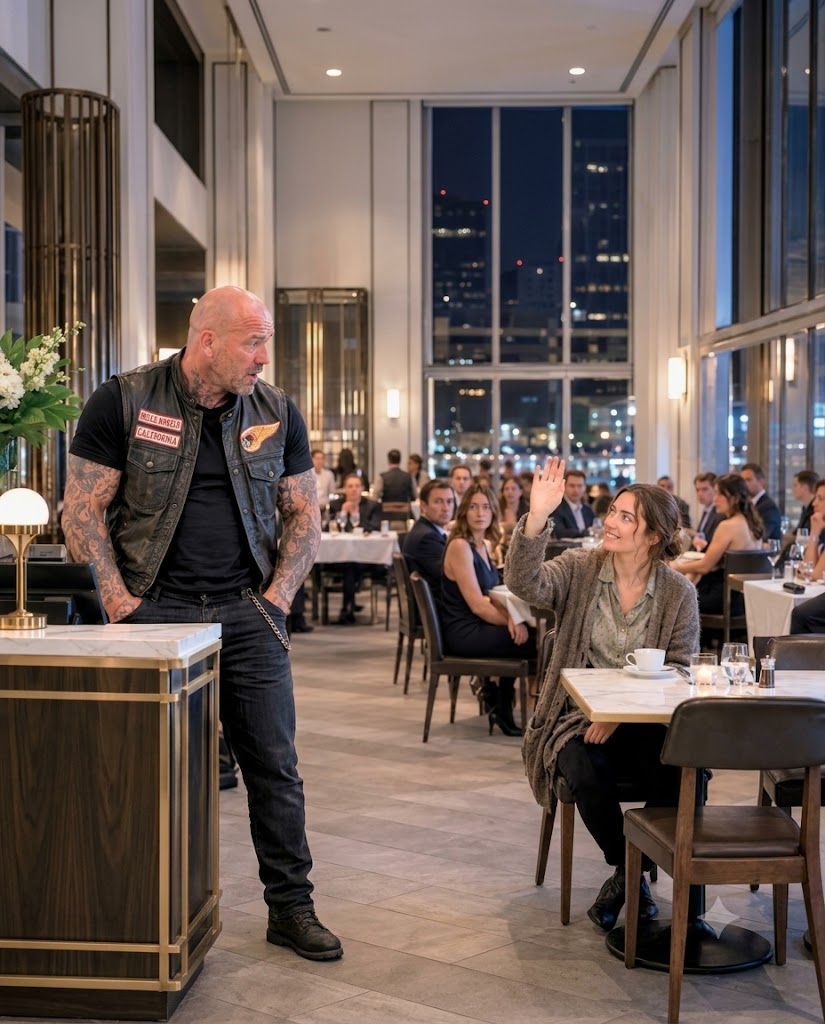
A boot kicked the diner door open and let the cold roar in.
Four men filled the doorway, leather cut stiff with road salt, knuckles scarred, faces burned red by eighty miles of winter wind.
Behind them, a dog padded in on silent paws and sat.
The hostess looked up and her smile died.
She counted the patches. She counted the scars.
Then she said the words that would have ended most nights.
“Every table’s full. Come back another time.”
But half those booths sat empty and everybody in that room could see it.
Nobody said a word.
The biggest of the four, a gray-bearded man they called Deacon, didn’t argue.
He just turned to go.
That was when a tired waitress with an empty tip jar lifted her hand and waved them over.
What happened before midnight left that whole diner in tears.
Stay with me on this one.
Her name was Mara Keane and she’d been on her feet since six that morning, twenty-six years old.
A little girl at home named Lily, six years old, waiting up with the old woman next door.
Mara worked the Ponderosa Diner out on the edge of Flagstaff, the kind of place that stayed open when nothing else would because the owner was cheap and the highway never slept.
It was New Year’s Eve, 1998, and the whole town had somewhere better to be.
Everybody else got the holiday off.
Mara got the double shift because the double shift was the only way the rent got paid.
Her coat was too thin for that mountain cold.
The heel on her left shoe was worn down to nothing, and she’d learned to stand with her weight on the other foot so nobody would see her list to one side by the end of a night.
Her tip jar had maybe four dollars in it because the people who came in on a night like that were the people with nowhere else to go and those people didn’t tip.
She wasn’t bitter about it.
That’s the thing to understand about Mara.
She didn’t have the energy left to be bitter.
There’d been a husband once, gone now, gone the way men like that go, without a forwarding address and without a dime.
She’d stopped waiting for anybody to ride in and fix it.
She just had the energy to keep moving one table to the next, counting down the hours until she could lie down next to her daughter and sleep for four hours before it all started again.
Now, the man running the floor that night was the assistant manager, a stiff little guy named Dale.
Dale cared about two things.
The register coming out right and what he called the atmosphere.
Dale believed the Ponderosa was one bad crowd away from being a nice place.
It was not a nice place.
The vinyl was cracked, the coffee was burnt, and the sign out front had been missing its P for three years.
But Dale had his dreams, and his dreams did not include four Hells Angels tracking road salt across his floor.
So when that door opened and those four men filled it, Dale was already shaking his head.
He nudged the hostess.
He muttered something.
And the hostess, a nervous kid barely out of high school, said the line Dale wanted her to say.
“Every table’s full.”
The four men stood there a second.
The oldest one, the one they called Deacon, had a gray beard and eyes that had seen a lot of closed doors.
Roy Callaway was his name, though hardly anybody used it anymore.
He’d been riding forty years.
He’d buried friends.
He’d done time, years of it, in a place that teaches a man exactly how little the world thinks he’s worth.
And somewhere along the way, he’d stopped expecting the world to be kind to men who looked like him.
So he didn’t argue.
He gave a small nod like a man who’d heard it all before, and he turned to leave.
The other three turned with him.
There was Tiny, who was anything but, a mountain of a man with hands like catcher’s mitts.
There was Preacher, lean and quiet, with a cross tattooed on his throat and a way of watching a room like he was counting the exits.
And there was Cole, the young one, maybe twenty-five, still knew enough to feel the insult and go red about it, his jaw tight, a word already halfway up his throat before Deacon put a hand on his chest.
Easy, that hand said.
We’ve been here before. We’ll be here again.
And by the door, sitting exactly where Deacon had told him to sit, was the German Shepherd, Gunner.
Big, dark, still as a statue, watching everything.
Deacon never went anywhere without that dog.
There’s a reason for that, and we’ll get to it.
They’d ridden a long way that night.
Up from Phoenix, through the high country into cold that bit straight through leather.
They were tired. They were hungry.
All they wanted was a hot meal before the last cold push home.
And they were about to walk back out into it empty.
That’s when Mara sat down her coffee pot.
She’d watched the whole thing.
She’d seen the hostess look at the scars.
She’d seen Dale’s little head shake.
And she’d seen the empty booths same as everyone else.
She knew that waving those men over could cost her.
Dale would have something to say about it.
But Mara Keane had spent her whole life being the person nobody made room for.
She knew the burn of standing in a doorway waiting to be told there was no space.
And she could not stand there and watch it happen to somebody else.
So she lifted her hand and she waved.
Four big men stopped in the doorway and looked at her.
Mara’s heart was going hard, but she kept her voice steady.
“Corner booths open,” she said. “Give me one second and it’s all yours.”
And then she did something that made Deacon’s eyes narrow.
She walked over to that booth herself and with her own two hands she cleared the dirty dishes somebody should have bussed an hour ago and she wiped it down and she stood back and said, “There you go. Sit anywhere you like.”
For a second, nobody moved.
Then Deacon walked over slow and lowered himself into that booth with a grunt, and the other three followed.
The dog stayed by the door watching.
And across the room, Dale folded his arms and stared at Mara with a look that said, this isn’t over.
She knew it wasn’t.
But she poured four coffees and carried them over anyway, hot and black.
And she set them down and said, “That’s on the house. Warm up a minute.”
And Deacon looked up at her.
Really looked, the way old men look when they’re reading a story written in small print.
He saw the thin coat.
He saw the worn shoe and the way she stood a little crooked to keep off it.
He’d already seen the tip jar with its four lonely dollars, and he recognized something because Deacon knew that look.
He’d worn it himself a long time ago.
It was the look of somebody carrying far too much all by themselves and smiling anyway so nobody would ask.
“What’s your name?” he asked her.
“Mara,” she said.
He nodded.
“Roy,” he said. “But everybody calls me Deacon.”
And then he said, “Thank you, Mara.”
Said it plain. Said it like it meant something.
And for a reason she couldn’t have explained, Mara’s throat went tight and she had to turn away quick and go check on a table that wasn’t there.
Now, here’s where the night started to turn.
The four of them ordered like men who hadn’t eaten all day because they hadn’t.
Burgers, chili, eggs, the big breakfast plates, stacks of toast, more coffee.
Mara kept the cups full.
And every time she came by, Deacon asked her a question.
Easy ones.
How long you been working here?
Cold enough out there for you?
You got family waiting on you tonight?
And little by little, without quite meaning to, Mara told him.
She told him about Lily, six years old, home with the neighbor, probably asleep by now with her shoes still on because she hated taking them off.
Said bare feet made her feel like she couldn’t run.
Deacon laughed at that. A real laugh, low in his chest.
“Smart kid,” he said. “Keep your boots on. You never know.”
And Mara told him when he asked why she was working New Year’s Eve that double shifts paid time and a half.
And time and a half was the difference between making rent and not.
She didn’t say it to complain.
She said it the way you mentioned the weather, just a fact of the life she had.
Deacon listened to all of it.
He didn’t say much.
But Tiny went quiet and Preacher stopped eating for a second, and young Cole stared at his plate like something had gotten to him.
These were not soft men.
Every one of them had put somebody in the hospital at least once.
But every one of them had a mother or a sister or a kid somewhere.
And every one of them knew exactly what Mara was and wasn’t saying.
They knew what it cost to carry a child through a winter on a waitress’s feet.
Some of them had been that child.
And then Dale came over.
He came over while Mara was back in the kitchen, so she didn’t see the start of it.
He stood at the end of that booth with his arms crossed and told those four men in his careful little voice that the Ponderosa was a family establishment, that maybe they’d be more comfortable somewhere else, that he didn’t want any trouble.
He said the word trouble like he was doing them a favor by warning them.
Deacon set down his fork.
He looked up at Dale slow and said, “We’re not trouble, friend. We’re four cold men eating breakfast. We’ll pay for every bite and we’ll leave a clean table. That’s all.”
Dale didn’t like that answer.
Dale wanted them gone because gone was tidy and Dale liked tidy.
He opened his mouth to say more.
And that’s when Mara came out of the kitchen with four plates balanced up her arm and she saw Dale standing over her table and she heard the tail end of it and something in her just broke loose.
Not loud. Mara never got loud.
But she set those plates down careful, one by one.
And she turned to Dale and said, “These are my customers, Dale, and they’ve done nothing wrong. And if you’ve got a problem with how I’m running my section, you can take it up with me after my shift.”
The whole diner went quiet.
Dale’s face went red and white at the same time, and he leaned in close, close enough that only she and the men at that booth could hear, and he said the thing that was the real turning point of the whole night.
He said, “You know what? I don’t need to take it up after your shift. Consider this your notice. Clean out your locker when you’re done.”
He fired her on New Year’s Eve for clearing a table.
Mara didn’t cry.
She wanted to, but she didn’t.
She just stood there a second and she nodded like she’d half expected it because when you’ve been let down enough, you stop being surprised by it.
And she said, “Okay, Dale.”
And she turned around and went back to work because there were plates to carry and coffee to pour and the night wasn’t over no matter what Dale said.
The four men watched her go.
Nobody said anything, but Deacon’s jaw was working under that gray beard, and his eyes had gone flat and cold as the mountain outside.
The men finished their meal in silence.
They cleaned their plates, and near eleven, they got up.
Deacon left a stack of bills on the table, more than the meal cost, and the four of them pulled their coats tight and walked out into the dark with the dog at their heels.
The bell over the door jingled.
And then they were gone, taillights swallowed up by the parking lot and the snow coming down soft under the lights.
Mara watched them go from behind the register.
She thought, well, at least somebody was kind tonight.
At least somebody said thank you and meant it.
She looked at the stack of bills they’d left and started to count it.
And that was going to be the whole story.
Four rough men who turned out gentle, a small kindness on a hard night.
The end.
The diner emptied out over the next half hour.
Dale went back to the office to do the count.
The hostess clocked out.
By twenty to midnight, it was just Mara and the cook in the back and the hum of the coolers and the snow falling outside.
She sat down at the counter finally for the first time in hours.
She slipped off her bad shoe and rubbed her foot.
She poured herself a cup of coffee.
She let herself breathe.
The hard part was over.
She’d lost the job, sure, but she’d find another.
She always did.
For one quiet minute, she just sat there in the warm, empty diner and let the night be over.
It was not over.
The door banged open.
The cold came in a second time, but it wasn’t four bikers now.
It was two young men she’d never seen, hoods up, moving fast and wrong, and the one in front had a gun in his hand, and he was already swinging it toward her face and screaming at her to get on the ground.
And just like that, the whole story changed.
This wasn’t about a table anymore.
It wasn’t about a job or a thin coat or an empty tip jar.
It was about whether Mara Keane lived to see her daughter in the morning.
“Get on the ground!” the gunman screamed again.
His hand was shaking.
That’s the thing people don’t understand about a man with a gun.
The steady ones are dangerous.
The shaking ones are worse because a shaking hand doesn’t decide.
It just goes off.
The second man vaulted the counter and started yanking at the register, cursing, screaming at Mara for the key.
Dale came out of the back office at the noise and froze dead in the hallway, white as paper, hands up.
And here’s what Mara did.
With a gun six inches from her face, with her whole body screaming to drop and curl up and disappear, she thought about Lily.
She thought, if I die here, my daughter has nobody.
No father, no grandparents, nobody in the whole world but a tired old neighbor who couldn’t keep her.
And that thought made her hands move.
Slow, careful.
She reached for the register key on its coiled cord and she said in a voice that barely shook, “Okay, okay, I’m getting it. Nobody has to get hurt.”
Good. That’s the right thing to say.
Keep the shaking hand calm.
Give them what they want.
Live.
She almost had the drawer open.
And then Dale, poor scared Dale, did the stupidest thing a scared man can do.
He bolted.
He turned to run for the back door.
And the gunman spun toward the movement and his shaking finger tightened.
And in that half a second, everything in that diner was about to go very, very wrong.
That’s when the window by the door exploded inward.
Now, before I tell you what came through that window, let me ask you something.
If you’ve ever had somebody show up for you when the whole world had already written you off, you know exactly how Mara felt in the next sixty seconds.
If you’re feeling this one, do me a favor and hit that subscribe button because stories like Mara’s are the only ones I tell and I want you right here for the rest of it.
All right, back to that window.
What came through?
It was seventy pounds of German Shepherd moving like a dark blur.
Gunner.
He’d been outside the whole time because the four men had never left.
Here’s what Mara found out later.
Deacon had ridden two hundred yards down the road and then he’d stopped.
He’d sat on his bike in the falling snow and he’d thought about that waitress losing her job for being kind to him and he could not do it.
He could not ride home.
Forty years of riding away from closed doors and this one he could not ride away from.
So he turned the bikes around, all four of them, and they’d rolled back into the lot with the engines off, coasting quiet, because Deacon had an idea about doing something good for Mara before he left for good.
He’d been halfway through telling the others what he meant to do when two men on foot hurried past them toward the lit-up diner with their hoods up and their hands in their pockets.
Deacon had seen a hundred men move like that.
He knew the walk of a man working up his nerve to do something he couldn’t take back.
And Gunner had seen them, too.
The dog had gone stiff.
A low sound had started in his chest.
And when the first scream came from inside, Deacon had said one word.
“Gunner, go.”
And that dog had crossed that parking lot like a shot and gone straight through the window.
He hit the gunman center mass and took him off his feet.
The gun went off, but it went into the ceiling.
A crack like the whole building splitting and plaster rained down.
Gunner had the man’s gun arm in his jaws and seventy pounds of him pinning the man to the floor.
And that gun was skittering away across the tile.
And the man was screaming a different kind of scream.
Now, the kind men make when they’ve suddenly found something scarier than themselves.
And right behind the dog came the door.
Tiny hit it so hard it tore half off the hinges.
Then Deacon, then Preacher and Cole.
Four big men filling that doorway again, but nobody was telling them there wasn’t a table this time.
The second robber, the one behind the counter, grabbed for Mara.
He got an arm around her neck and started dragging her backward, yelling that he’d hurt her, waving a knife he’d pulled from his belt.
And for one awful second, the whole room stopped because now they had her.
Now there was a blade at Mara Keane’s throat and four men who couldn’t cross the floor fast enough to stop it.
Deacon raised his hands slow.
“Easy,” he said in a voice like gravel. “Easy, now. You don’t want to do this, son.”
The man screamed that he’d cut her.
Deacon kept coming one slow step at a time, hands open.
“I believe you,” Deacon said. “I believe you’ll do it. So let’s you and me talk about how you walk out of here instead. All you got to do is let go of her. Nobody here wants to watch a kid grow up without her mother.”
“She’s got a little girl,” Deacon said. “Six years old, sitting up right now with her boots on, waiting for her mama to come home. You want to be the reason she waits all night? You don’t. I can see it. You don’t.”
Something in that landed.
Maybe the man had a mother.
Maybe he had a kid of his own.
Or maybe it was just that Tiny had drifted around to his blind side, and Gunner had left the first robber groaning on the floor and turned those dark eyes on the second one and started walking stiff-legged toward him, head low.
A sound coming out of that dog that would freeze your blood.
The man looked at the dog.
He looked at the four bikers.
He looked at the door that wasn’t there anymore.
And his nerve just went.
The knife clattered to the floor, and he shoved Mara away and bolted for the broken window.
And Tiny caught him by the collar in midair like a man grabbing a cat.
And that was the end of that.
It was over in less than a minute.
The first robber was pinned under Gunner.
The second was folded up in Tiny’s grip.
The guns and the knife were kicked into a corner, and Mara was on the floor by the counter, shaking, alive.
Both hands pressed to her throat where the blade had been, staring up at four strangers who had come back for her when they had absolutely no reason to.
Deacon knelt down in front of her slow so his knees cracked.
He didn’t touch her.
He just got down to her level and said, “You’re all right. You’re all right, Mara. It’s done. They can’t hurt you now.”
And Mara looked at that gray-bearded man she’d shared a pot of coffee with an hour ago.
The man the hostess wouldn’t seat.
The man she’d lost her job to be kind to.
And she started to cry.
Not from fear, from the other thing.
From the thing that happens when you’ve carried it all alone for so long and somebody finally, finally helps you carry it.
Preacher was already on the diner phone with the police.
Cole had a boot on the first robber’s back.
Dale had come creeping out of the hallway, gray-faced, and now he was standing there useless, staring at the men he tried to throw out, understanding maybe for the first time what kind of men they actually were.
The police came.
The two robbers went out in handcuffs, one of them limping, both of them a lot more scared than when they’d come in.
The officers took statements.
One of the older cops crouched down to scratch Gunner behind the ears and said, “This dog ought to get a medal.”
And Deacon said, “He’s had a few.”
And through all of it, the four bikers stayed.
They didn’t duck out before the law showed up, the way men with their records had every reason to.
They stayed because Mara was still shaking.
And you don’t leave somebody shaking.
Somewhere in the middle of all that, the clock on the diner wall rolled over.
Midnight. 1999.
Somewhere out in the town, fireworks went off, little muffled pops under the falling snow.
And in that broken-up diner with plaster on the floor, four Hells Angels and one worn-out waitress and one hero dog stood together and watched a new year come in.
“Happy New Year, Mara,” Deacon said quiet.
She laughed, wet and broken and real.
“Happy New Year,” she said back.
Now, here is the part the premise promised you.
Here is what those men did before that night was through.
While the police were still riding up the last of it, Deacon pulled his three brothers aside over by the busted window.
They put their heads together and then every one of them reached into a pocket.
Mara didn’t see it.
She was giving her statement, answering questions, holding a cup of coffee somebody had pressed into her hands to stop them shaking.
She didn’t see the men counting out bills by the window.
She didn’t see Deacon fold the money into a paper diner napkin, thick, and write something on the outside with a stub of pencil Preacher carried.
And she didn’t see the four of them one by one quietly lift the plates they’d eaten off of, the plates still sitting on that corner booth nobody had cleared in all the chaos, and slide something underneath each one.
Then they got ready to go for real this time.
Deacon came over to Mara at the counter.
He said, “You did good tonight. Braver than most men I know.”
She shook her head, said she hadn’t done anything, said they were the brave ones, and he stopped her.
“No,” he said. “You waved us over when nobody else in this town would give us the time of day. Everything that happened after that happened because you were kind to four strangers who looked like trouble. Don’t you ever let anybody tell you kindness doesn’t matter. It’s the only thing that ever has.”
He whistled for Gunner.
The dog came and leaned against Mara’s leg one last time, warm and solid, and she buried her hand in his fur and whispered, “Thank you,” into his ear like he could understand it.
And maybe he could.
Then the four men walked out through the hole where the door used to be into the snow.
And a minute later, she heard the engines fire up, four of them rough and loud, and then fading, fading, gone down the dark highway toward home.
Mara finished out the night.
There wasn’t much choice.
She helped tape plastic over the broken window.
She swept up the plaster.
Dale didn’t say one word to her the whole time.
Couldn’t even look at her.
And somewhere around two in the morning, as she was pulling on her thin coat to finally go home, he cleared his throat and said, “Mara, about earlier, forget what I said. You’ve still got your job.”
She just looked at him.
“You know what?” she said. “I’ll think about it.”
And she walked out into the cold feeling, for the first time in a long time, like a woman who had choices.
She was so tired she forgot all about the corner booth.
It was the cook who found it the next morning cleaning up for the breakfast shift.
He went to clear that back booth, lifted the first plate, and stopped.
He lifted the second, the third, the fourth.
And then he called Mara, who was home asleep with Lily curled up against her, and he said, “You need to come down here. You need to see this.”
Under each of those four plates was money, real money, folded flat.
And under the plate where Deacon had sat was the napkin, thick with bills, and written across the front in rough pencil letters were the words: For Mara and Lily. So you don’t have to do it alone.
Inside that napkin, and under those four plates, was a little over four thousand dollars.
Four cold, hungry men who’d ridden a long way home had emptied their pockets for a waitress they’d known for two hours.
But the money wasn’t even the part that made Mara sit down right there on the diner floor and cry until she couldn’t breathe.
It was the note.
Because the note told her the one thing she had never once let herself believe.
That she didn’t have to carry it all by herself.
That somebody had seen her, really seen her, and decided she was worth coming back for.
Mara used some of that money to catch up the rent.
She used some to buy Lily winter boots and herself a real coat, a warm one, the first warm coat she’d owned in years.
And she kept that napkin.
She smoothed it out flat, and she kept it.
And years later, it was still folded in the drawer by her bed, soft as cloth from being read so many times.
She did go back to the Ponderosa, but not for Dale.
A few months later, the place came up for sale, the owner finally done with it.
And Mara, with a little help and a lot of nerve, found a way to take it over herself.
First thing she did was clear out Dale.
Second thing she did was hang a sign by the door that said, “All are welcome here. No exceptions.”
And she meant every word of it.
Bikers, drifters, the lonely, the broke, the folks nobody else would seat.
There was always a table at Mara’s place.
Always.
And every New Year’s Eve, four motorcycles rolled into that lot.
Deacon and Tiny and Preacher and young Cole, who wasn’t so young anymore, and a German Shepherd named Gunner, gray in the muzzle now, slower on his feet, but still the first one through the door.
Mara never charged them a dime.
She’d have fought you over it.
Their corner booth was reserved all night every year.
A little hand-lettered card on the table that said, “This one’s taken.”
And Lily grew up calling four Hells Angels her uncles and that old dog the best friend she ever had.
Gunner passed on a few winters later, the way good dogs do, too soon.
They buried him out behind the diner under a pine with a flat stone that just said Gunner.
Came back because that was the whole thing, wasn’t it?
That was the reason none of them ever forgot that night.
On the one night the world shut its doors on them, a tired woman waved them in.
And when her turn came to need somebody, they came back.
A dog went through a window and four outcasts went through a door for a single mom who had nothing left to give but kindness and gave it anyway.
Years later, folks would ask Deacon why.
Why’d you turn the bikes around?
Why’d you go back?
And that old man would get quiet and he’d look off down whatever road he was on and he’d say the same thing every time.
“Because somebody finally made room for us,” he’d say. “And when somebody makes room for you, when the whole world won’t, you don’t forget it. You spend the rest of your life trying to make room for somebody else.”
A door opened on a cold night.
The warmth got in and it never left.









