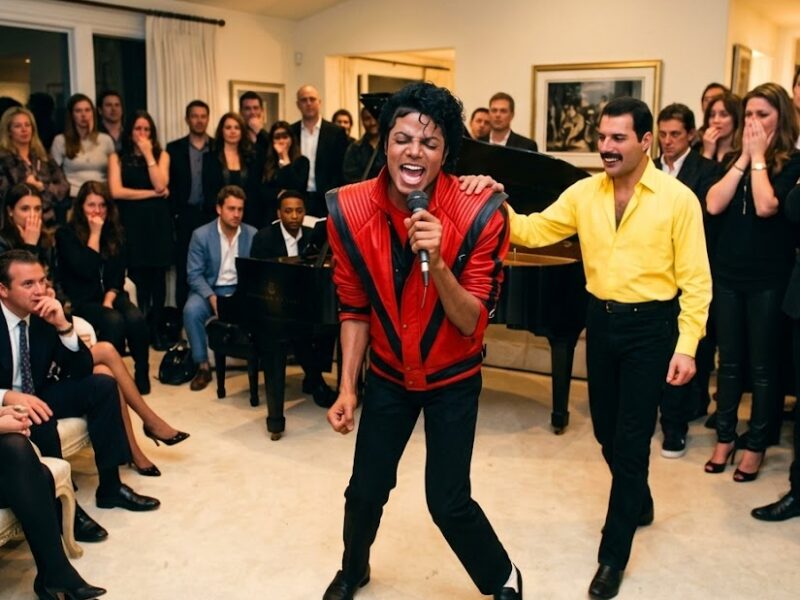
Imagine Michael Jackson Singing a Queen Song at a Private Party—Freddie Mercury’s Reaction Silenced the Room
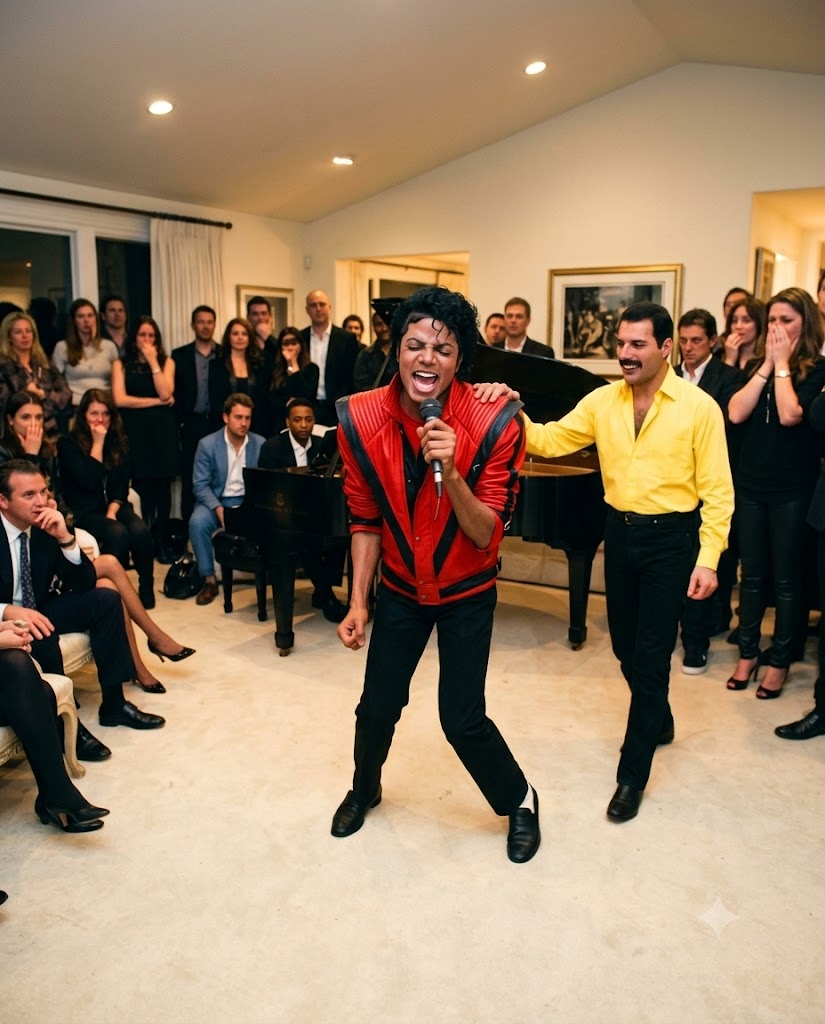
Beverly Hills, California. Late evening, March 1984, 10:40 p.m.
The private estate sat tucked into the hills like a secret the city had agreed to keep.
No press. No cameras. Just 35 people who actually mattered to each other rather than to the tabloids.
Michael Jackson had just swept the Grammys a few weeks earlier — eight wins for Thriller, the biggest night any artist had ever had at that ceremony.
His close friend, a producer with ties to half the industry, decided the moment called for something quieter than another red carpet event.
So here they were. Musicians. Close friends. A handful of record executives who’d earned their invitations through actual friendship rather than business.
Michael was 25. Freddie Mercury was 37, in town for a few weeks between Queen recording sessions.
Quincy Jones stood near the bar. A scattering of session musicians milled around. A couple of actors. The vibe was relaxed, warm.
Everyone was drinking wine except Michael, who sipped ginger ale and sat mostly quiet in a corner, watching, laughing at the right moments.
He was careful the way he always was in rooms full of adults he half idolized and half feared disappointing.
There was a grand piano in the living room. A Steinway somebody had shipped in specifically for the party because you didn’t throw a gathering like this without one.
Freddie found his way to it fairly early in the evening, the way he always did at parties — drawn to a keyboard the way other people are drawn to a bar.
He wasn’t performing exactly. Just playing loose, casual, half a verse of one song bleeding into the chorus of another.
The way musicians do when they’re relaxed and among friends and nobody’s filming.
He played a little bit of “Love of My Life.” A little bit of “You’re My Best Friend.”
The room drifted toward him, the way rooms always drifted toward Freddie at a piano.
People gathering without quite deciding to, drinks in hand, humming along.
Michael sat in the corner watching. He hadn’t said much all night.
Just observing the way he did in most rooms he wasn’t performing in, soaking up everything happening around him with that quiet, careful attention people who knew him well had learned to recognize.
11:15 p.m.
Freddie finished a loose run through “Somebody to Love.” The room applauded. Somebody called out for another one.
Freddie laughed, waved a hand. “I’ve been playing these songs for a decade, darlings. Somebody else should have a go.”
He looked around the room, scanning faces, and landed on Michael sitting quiet in his corner.
“Michael, you play piano, don’t you? Come up here.”
Michael shook his head slightly, that shy half smile crossing his face. “I’m good right here.”
“Come on now,” Freddie said, grinning, already enjoying himself. “You’ve got that whole album full of songs. You can carry a tune or two. Surely you can manage something of mine.”
The room laughed. A few people started encouraging Michael, gentle pressure building the way it does at parties when everyone senses a good moment brewing.
Quincy Jones, standing near the bar, raised his glass toward Michael with a knowing grin. “Go on, Michael. Freddie Mercury is asking you to play Queen.”
Michael stood reluctant, smoothing down his jacket, and walked slowly to the piano.
Freddie slid off the bench, stepping aside with a theatrical little bow, gesturing grandly at the keys. “All yours.”
Michael sat down, looked at the keys for a second, then up at Freddie. “Any requests?”
Freddie considered it playful, tapping a finger against his chin. “Bohemian Rhapsody, of course. But you can’t have the whole band. Piano only.”
The room laughed. It was a challenge, a friendly one, the kind you throw at somebody you already suspect is more capable than they’re letting on.
Michael nodded slowly. “Okay. But I’m changing it.”
Freddie raised an eyebrow, delighted. “Changing it? That’s rather a lot of song to be changing, darling. Six minutes, three movements, an entire opera in the middle. You sure about that?”
“I can and I will,” Michael said. Quiet but sure.
Freddie grinned wide, settling onto the arm of a nearby chair to watch. Genuinely curious now. This was going to be interesting.
Nobody in that room expected what came next.
Michael placed his hands on the keys. Didn’t warm up. Didn’t test the sound.
Didn’t do any of the small nervous rituals people expected from somebody about to attempt Freddie Mercury’s most famous song in front of Freddie Mercury himself.
He just started.
The opening notes were recognizable. That unmistakable aching ballad melody Freddie had written years earlier in a flat in London.
The one that opened one of the most ambitious songs ever put on a record.
But it wasn’t Queen’s version. It wasn’t the layered operatic production everybody had heard a thousand times on the radio.
It was something else entirely.
The first 30 seconds. The melody was there, unmistakably Freddie’s melody, but the chords underneath it had shifted.
Softer. Rounder. Gospel voicings.
The kind of chord movement you’d hear from a choir director working a room into a slow, building fervor, rather than a rock band building toward a guitar solo.
Thirty to sixty seconds in, Michael started singing.
His voice, soft, almost breathless at first, carried none of Freddie’s theatrical grandeur.
It sounded intimate. Wounded. Like somebody confessing something in a quiet room rather than performing an opera for a stadium.
He sang the opening lines, the words Freddie had written about a boy who’d killed a man and couldn’t take it back.
But the delivery had transformed entirely, turned inward, turned personal.
The room went quiet.
Sixty to ninety seconds. Michael shifted the arrangement further.
What had been a rock ballad became something closer to a spiritual. The kind of slow, mournful hymn you’d hear from a church choir working through grief on a Sunday morning.
The kind of chords Freddie, raised on opera and Elton John records in England, had never once reached for in his own writing.
But Michael had grown up surrounded by them.
His mother was a devout Jehovah’s Witness. Sunday meetings, hymns, the particular cadence of gospel harmony had been threaded through his entire childhood, whether the world ever heard it in his pop records or not.
He was translating Freddie’s British rock opera into something that sounded like it had come straight out of a small storefront church on the South Side of Chicago.
Ninety seconds in, Freddie, sitting three feet away on the arm of that chair, had his hand pressed against his mouth.
His eyes were wet. Not crying yet, but close. Something visibly shifting behind them.
Quincy Jones, standing against the wall near the bar, had stopped moving entirely.
Just watching Michael’s hands move across the keys like he was witnessing something he hadn’t expected to see that night or possibly ever.
Two minutes in, Michael added something that wasn’t in the original at all.
A bridge entirely improvised, his fingers moving across the keys like he was reaching for something just beyond the song itself.
The melody Freddie had written, the chords Michael had absorbed his whole childhood in church pews, the space between arena rock and gospel collapsing into a single unbroken sound.
It wasn’t a cover. It wasn’t a tribute act doing an impression.
It was recognition.
Michael was showing everyone in that room that Freddie’s spiritual wrestling — the guilt, the confession, the desperate plea for mercy buried underneath all that operatic bombast — and the spiritual wrestling that built Black American gospel music were reaching for the exact same thing.
Different accents. Different traditions. Same ache underneath.
One of the session musicians sitting near the fireplace, a keyboard player who’d worked with everybody from Stevie Wonder to the Rolling Stones, later said he’d stopped breathing somewhere around that bridge.
He’d heard thousands of piano players in his career. He said he’d never heard anybody do what Michael did in that moment.
Take a song that famous, that beloved, that specific, and completely rebuild its foundation without losing a single ounce of what made the original matter.
Three minutes in, Michael brought the melody back around, the familiar line everybody in that room had heard a hundred times on the radio.
But now it sounded like something you’d hear at a funeral for somebody you’d loved deeply.
Which in a strange way that nobody in that room could have predicted that night, it eventually would be.
Three and a half minutes in, Freddie’s composure had fully cracked.
He wasn’t hiding it anymore. Tears sitting openly on his face, his hands still pressed against his mouth like he was trying to physically hold something in.
Michael kept playing, eyes closed now, completely lost in whatever he was building.
The operatic middle section of the song, the part everybody remembered from the record as layered vocal harmonies and thunderous production, reduced instead to just his voice and two hands on the keys.
He didn’t try to recreate the wall of sound Queen had built in the studio.
He replaced it with space. With silence between phrases. With the kind of restraint that made every note land harder because there was nothing else competing for your attention.
Four minutes in, Michael pushed into the section everybody knew was coming.
The frantic, tumbling wordplay. “Galileo, Galileo.” The mock-operatic chaos of the original recording.
But instead of speeding up into that chaos, Michael slowed it down even further.
Turned it into something closer to a call and response, the kind you’d hear in a Black church when the choir director starts trading lines with the congregation, building toward something.
Freddie stood up from the arm of the chair, unable to sit still anymore, moving a few steps closer to the piano without seeming to realize he was doing it.
Four and a half minutes in, Michael brought the whole thing to its climax.
The section of the song everybody remembered as Freddie’s voice tearing itself open over crashing guitars.
Michael built it instead into a single sustained note held with a vibrato that made the piano itself seem to shudder.
His voice cracking on purpose, letting the imperfection sit there exposed rather than smoothing it over the way a lesser performer would have instinctively done.
He held the note. Five seconds. Ten seconds.
The room, already dead silent, seemed to lean forward collectively, waiting.
Fifteen seconds. And somewhere behind Freddie, somebody let out an audible gasp.
Then Michael released it. Slow. Careful.
Let the note descend back down into the final resolving chords, the ones Freddie had written to close out one of the strangest, most ambitious six minutes ever put on a pop record.
Except now they sounded less like the end of a rock opera and more like the closing chord of a hymn.
A major seventh with an added ninth hanging in the air. Church. Resolution. Peace.
He let it fade completely. Didn’t rush it. Let the sound die away on its own.
Natural. Unforced. Then silence.
Nobody moved. Nobody applauded.
The 35 people in that room stood frozen. Some with hands over their mouths. Some with tears openly on their faces.
Some simply staring at Michael like they’d witnessed something they didn’t yet have the words to describe.
Freddie Mercury was crying openly now, his face wet, his shoulders shaking slightly, making no effort at all to hide it.
Quincy Jones had his hand pressed flat against his chest, standing perfectly still.
Nobody had thought to record any of it.
Later, one of the guests would say, “Some moments you don’t capture. You just live them, and then you spend the rest of your life trying to describe something words were never built to hold.”
Michael sat at the piano, hands still resting on the keys, head slightly bowed.
Waiting. Not for applause. Just waiting for the room to remember how to breathe again.
Thirty seconds passed. Nobody spoke.
Finally, Freddie moved.
He walked slowly toward the piano, his face still wet, not bothering to wipe it away.
He put his hand on Michael’s shoulder.
“That’s my song,” Freddie said, his voice thick. “But that’s not how I wrote it.”
Michael looked up at him, uncertain for a second, like he was bracing for something.
Freddie’s voice broke slightly. “That’s how it was always meant to sound. I just didn’t have the tradition in me to find it.”
Michael stood. The two of them embraced right there in the middle of the living room in front of everybody.
Freddie whispered something in his ear. Nobody else in the room heard exactly what.
Later, when asked what he’d said, Freddie would only ever say, “That’s between me and Michael.”
The party continued after that. Quieter now. More reverent.
The loud laughter from earlier in the evening replaced by something softer, more thoughtful.
People talking in smaller clusters, glancing over occasionally at the piano like it had become something almost sacred.
Around midnight, Freddie and Michael found their way out to the back terrace, just the two of them.
The lights of Los Angeles spread out below the hillside. Stars overhead. The low hum of the party still audible behind them through the open doors.
Freddie lit a cigarette, his hands trembling slightly.
“Michael,” he said, “how did you know to do that? The gospel chords, the whole arrangement, turning it into a hymn.”
Michael thought about it for a moment before answering, careful the way he always was with his words.
“Because that’s what you were searching for,” Michael said quietly. “When you wrote it. All that guilt. All that pleading. Asking to be forgiven. Asking if it’s too late. That’s a prayer, Freddie. It’s just dressed up in rock opera. I grew up around that same prayer, just in a different building with a different choir. Every song is a prayer if you strip it down far enough.”
Freddie took a long drag, exhaled slowly into the night air.
“You never even met me before tonight. Not properly. How could you possibly understand what I was reaching for when I wrote that?”
Michael looked out at the city lights. “I listened. Not to the production. Not to the guitar solo everybody remembers. To what was underneath it. What you were actually trying to say when nobody else was in the room with you.”
Freddie nodded slowly, wiped at his face with the back of his hand.
“You know,” he said, “people think this business is about performance. About the show, the costumes, the spectacle. And it is. God knows it is. Half my life has been spectacle. But that — what you just did in there — that wasn’t spectacle. That was something else entirely.”
He paused, taking another drag.
“I’ve spent my whole life giving people the biggest show I could build. Bigger stages. Bigger productions. More layers. More drama. Sometimes I wonder if I buried the actual song underneath all of it somewhere along the way. Tonight, you found it again. Found the thing I was actually trying to say and handed it back to me. Stripped down to almost nothing. And somehow it hit harder than anything I’ve ever heard from a full orchestra.”
Michael was quiet for a moment. “I think sometimes the biggest thing you can do for a song is get out of its way.”
Freddie laughed softly, a broken, genuine sound. “That’s a very wise thing to say for somebody your age.”
“I had good teachers,” Michael said.
They sat together on that terrace for a long while, the party murmuring softly behind them, neither one saying much else.
Just two of the most famous voices on the planet sitting quietly together under the same sky, having just shared something neither of them would ever fully be able to explain to anybody who hadn’t been in that room.
November 24, 1991. Freddie Mercury died at his home in London.
AIDS complications announced to the world only one day before his death.
The news landed like a shock wave across an industry that had genuinely believed — or wanted to believe — that he had more time.
Michael Jackson released a statement that week.
“I met Freddie many times over the years, and I’ll always be grateful for every one of those moments. But there’s one night I’ll never forget. A private party in Los Angeles, spring of 1984. He dared me to play one of his songs, Bohemian Rhapsody, at the piano. No band. Nothing but the keys. What I played wasn’t meant to compete with what he built. It was a translation. I took his song, this incredible piece of music he wrote from somewhere so personal, so searching, and I put it in a language I understood — the gospel music I grew up hearing in church. I think I found the prayer that was always underneath his song, dressed in a tradition he’d never worn before, but one I believe he understood completely the moment he heard it. When I finished, Freddie was crying. He told me that was how the song was always meant to sound. He just didn’t have the tradition in him to find it himself. I’ve thought about that every single day since I heard he was gone. Freddie showed the world that a song could hold opera and rock and pure vulnerability all at once. That night, I think I showed him that his search for something bigger than himself — that ache in his music — it belongs to everybody who’s ever looked for God in a room full of strangers. That’s what genius does. It doesn’t stay in one place. It reaches across every tradition looking for the truth underneath. And when it finds it, it hands it back to you like a gift you didn’t know you were missing. Rest in peace, Freddie. I hope wherever you are, the music never stops.”
In 1994, three years after Freddie’s death, Michael sat for a documentary interview about the history of collaboration in popular music.
The interviewer asked him, “What’s the most memorable performance you’ve ever been part of?”
Michael thought for a long time before answering.
“Playing Bohemian Rhapsody at a piano for Freddie Mercury in 1984. Just 35 people in the room. No cameras. No recording. Just me at a piano, turning his song into something I’d grown up hearing in church.”
“Why was that so memorable to you?”
“Because I wasn’t trying to impress anybody,” Michael said. “I was trying to understand something. Freddie wrote that song when he was wrestling with guilt, with mercy, with something bigger than himself. I took that wrestling and I translated it into the tradition I knew. Gospel music. The same hunger for something beyond ourselves, just expressed in a completely different way. When I finished, everybody in that room understood something. That music was never really about genre or style or who wrote what first. It’s about the human need to reach for something larger than we are.”
“Did you ever tell Freddie what that night meant to you?”
Michael nodded slowly, a small private smile crossing his face. “I did. That night out on the terrace. Just the two of us.”
“What did you say to him?”
Michael’s smile stayed. “That’s between me and Freddie.”
In 1998, Quincy Jones published a memoir covering decades in the industry.
One chapter, tucked in among stories about Thriller sessions and studio breakthroughs, was titled simply: “The Night Michael Made Freddie Cry.”
An excerpt from that chapter read:
“I was at that party in Beverly Hills. Somebody had put together this intimate gathering after the Grammys. Just friends. No press. And Freddie Mercury was there, in town between Queen sessions. He ended up at the piano, the way Freddie always did at any party with a piano in the room, playing bits and pieces of his own songs, loose and relaxed. At some point, he pulled Michael up to the piano, half joking, daring him to play something of his. I didn’t expect much of anything to come of it. Honestly, I figured Michael would play a few bars, everybody would laugh, and the party would keep moving. Instead, Michael completely rebuilt Bohemian Rhapsody in front of us. Took this massive, ambitious six-minute rock opera and turned it into something that sounded like it belonged in a small Baptist church on a Sunday morning. Gospel chords. That falsetto of his that could break your heart in half a second. All the drama and spectacle of the original stripped down to something so quiet and so honest it stopped every single person in that room cold. When he finished, Freddie was crying. I was crying. I’d worked with Michael for years by that point, produced records with him, watched him grow from a kid into the biggest star on the planet, and I still wasn’t prepared for what he did at that piano. Later, I asked him why he changed the arrangement so completely instead of just playing it straight, the way anybody else would have out of respect for the original. He told me, ‘Because the song was already perfect the way Freddie wrote it. I couldn’t improve on it. But I could show it from a place he’d never been able to see it from before. Give it back to him in a language that came from somewhere different, but was reaching for the exact same thing.’ That’s what Michael did that night. He didn’t try to compete with Freddie Mercury. He expanded him. Showed everybody in that room that a song written in a London studio by a man raised on opera and glam rock could live just as easily inside a gospel tradition thousands of miles and a completely different history away, as long as you understood what the song was actually trying to say underneath all of it. That night in Beverly Hills, Michael proved that the truest tribute you can pay to somebody’s art isn’t imitating it. It’s transforming it. And in doing so, showing the artist something about their own work they never fully saw themselves.”
In 2001, Brian May, Queen’s guitarist, was asked in an interview about his favorite musical memories connected to Freddie.
“There are so many,” Brian said. “Live Aid, obviously. The writing sessions for A Night at the Opera. Watching him command a stadium like nobody else on earth could. But one of the ones that sticks with me the most — and I wasn’t even in the room for this one — Freddie told me about it himself. Not long after it happened. He said he’d been at a party in Los Angeles and Michael Jackson had played Bohemian Rhapsody at the piano. Just him. No band. Completely reworked as this gospel hymn. Freddie said it was the first time he’d ever heard somebody understand the actual spiritual core of that song rather than just the drama and the production around it. He told me, ‘Brian, I wrote that song asking for mercy. Asking if it was too late for forgiveness. Michael heard that underneath everything else, and he handed it back to me stripped down to just that. I’ll never forget it.’ Freddie wasn’t a man who was easily moved by other people’s performances. He’d heard everybody. Worked with everybody. Seen every kind of talent this business has to offer. But that story, the way he told it to me, I could tell it had genuinely shaken something loose in him. I think about that sometimes. That there was a night when the biggest showman rock music ever produced sat quietly and let another artist show him something new about his own work.”
In 2004, 20 years after that party, a documentary about the history of gospel music’s influence on popular culture aired, featuring interviews with musicians who’d witnessed the crossover between traditions firsthand.
Michael, by then rarely giving lengthy interviews, agreed to a short sit-down specifically because of the subject matter.
“People forget,” Michael said in that interview, “that almost every voice you love in American music came out of a church somewhere. Doesn’t matter if they ended up singing pop, rock, soul. Doesn’t matter. Somewhere back there’s a choir. A piano. Somebody’s grandmother singing something true in a small room. Freddie’s music came from a completely different tradition. Opera. Glam. British rock and roll. But underneath all of that, he was asking the same questions gospel music has always asked. Am I forgiven? Is there something bigger than me? Is there mercy for what I’ve done? That night at the piano, I wasn’t trying to prove anything to him. I was trying to show him that his song already belonged to a tradition he’d never been introduced to. And when he heard it, I think he recognized his own voice in it. Just wearing different clothes.”
The interviewer asked if that moment had changed how Michael thought about his own music afterward.
“It changed how I thought about honesty,” Michael said. “Freddie built these enormous theatrical productions, and underneath every single one of them was something real. Something he needed to say. I think that night taught me that no matter how big the show gets, no matter how much production you wrap around a song, if there’s nothing true underneath it, none of it matters. And if there is something true underneath it, you can strip everything else away and it’ll still hit just as hard. Maybe harder.”
In 2009, following Michael’s own death that June, a wave of tributes and retrospectives poured out across the industry.
Musicians and collaborators from every era of his career shared memories, both public and deeply private.
Among them, a short statement from Roger Taylor, Queen’s drummer, surfaced in a music magazine’s memorial piece.
“Freddie told me about a night in 1984,” Roger said. “Michael Jackson playing Bohemian Rhapsody at a party, turning it into this gospel hymn that apparently reduced half the room to tears. Freddie included. I never heard it myself. Wasn’t there. But Freddie talked about it more than once over the years. He said it was one of the only times another artist had made him hear his own song as if for the first time. Coming from Freddie, who genuinely believed he understood every note he’d ever written better than anybody else possibly could, that was about as high a compliment as he was capable of giving. I think about that now. Both of them gone. Both taken far too young. Two of the most singular voices this business ever produced. Sitting at the same piano for one night, finding something together that neither one of them could have found completely alone. That’s a rare thing. I’m glad it happened, even if I never got to witness it myself.”
The 35 people who were in that Beverly Hills living room in March 1984 carry that memory with them still, decades later.
No recording exists anywhere. No video. No audio.
Just 35 witnesses to a moment where Michael Jackson took Freddie Mercury’s search for mercy and forgiveness and translated it into a language Freddie had never spoken himself, but understood completely the instant he heard it.
When people who were there are asked what happened that night, they almost all say some version of the same thing.
You had to be there.
And they did. Because some music is meant to stay exactly in the room where it was born. Sacred. Unrepeatable. Complete in itself.
In the years following both Michael’s and Freddie’s deaths, musicians who’d been present at that party occasionally referenced the night, always carefully, rarely in full detail.
More often just a quiet acknowledgment that something profound had happened. Something that resisted being fully explained, no matter how many times somebody tried.
A journalist once asked Quincy Jones in one of his final extended interviews what the greatest live musical moment he’d ever witnessed in person was.
Quincy didn’t hesitate. “Michael Jackson playing Bohemian Rhapsody for Freddie Mercury in 1984. But I’m not going to describe it to you in any more detail than I already have in my book. Some things lose something in the retelling. You needed to be standing in that room.”
“Why can’t you describe it fully?” the journalist pressed.
“Because words weren’t built for that particular moment,” Quincy said. “It exists somewhere beyond them. That’s what made it so rare in the first place.”
In 2018, a music historian working on a book about the intersections between gospel tradition and mainstream pop reached out to several people who’d been at that party, hoping to piece together a fuller account of what had actually happened that night beyond the fragments that had circulated for years in interviews and memoirs.
One of the session musicians who’d been present, by then well into his 70s, agreed to speak on the record for the first time.
“I’ve told that story maybe a handful of times in almost 40 years,” he said. “Not because it’s a secret exactly. More because I’ve never felt like I could do it justice. I’ve played piano professionally my entire adult life. Worked with legends. Heard incredible musicianship more times than I could count. And I still think about those four minutes more than almost anything else I’ve witnessed in this business. What got me wasn’t just the technical skill, though God knows that was extraordinary in itself. It was the fact that Michael understood something about that song that even Freddie, the man who wrote it, hadn’t fully articulated to himself. Michael found the prayer buried underneath the opera, and he handed it back to Freddie so gently, so completely, that there was nothing left to do in that room except cry. I think that’s the mark of real genius. Not just executing something difficult. Understanding something true about another person’s work. Something they themselves might not have fully seen. And finding a way to show it to them without ego, without trying to outdo them, just trying to honor what was already there.”
In 2022, a retrospective television special about the golden era of American pop music included a segment specifically dedicated to reconstructing, as best anybody could, the events of that Beverly Hills party.
Using interviews collected over decades from those who’d been present, along with commentary from music historians, the segment attempted to explain to a new generation why that unrecorded, unreproduced moment had become such an enduring piece of music folklore.
“What made that night significant,” one historian explained on camera, “wasn’t the fact that two of the biggest stars in the world happened to be in the same room, though certainly that helped the story travel. What made it remarkable was the resolution underneath the performance itself. Michael Jackson took an incredibly personal piece of music, something Freddie Mercury had poured years of internal struggle into, and rather than simply performing it as a tribute, he found a way to translate its emotional core into an entirely different musical tradition. One built on centuries of its own spiritual searching. And in doing that, he didn’t diminish Freddie’s work. He revealed something inside it that even its own author hadn’t fully seen.”
The segment closed with a brief audio recreation — not of the actual performance, since none existed, but of a pianist attempting to approximate the described arrangement based on secondhand accounts from those who’d been there.
Even that pale approximation, disclaimed clearly as an artistic interpretation rather than a genuine recording, left the show’s studio audience visibly moved.
For those who study the relationship between gospel tradition and mainstream American pop music, that night in 1984 occasionally gets cited as one of the clearest examples of how deeply that tradition runs underneath even the most unlikely corners of popular culture.
“You can trace almost every major vocalist in American music back to a church somewhere,” one gospel music historian noted in a later academic paper, touching briefly on the incident. “It doesn’t matter whether they ended up singing rock and roll, opera-inspired glam, or pure pop. Somewhere back there is a choir. A piano. A tradition of turning pain and hope into sound. What happened at that piano in 1984 is one of the purest examples of that thread being pulled taut in front of witnesses. And everybody in that room feeling exactly what was happening, even if they couldn’t have explained the musical theory behind it.”
For Michael, that night became something he referenced quietly, rarely, always with the same careful respect, whenever conversations turned toward the deeper purpose behind his own artistry beyond the choreography and the record sales and the spectacle the public had come to associate with him.
“People think what I do is about the show,” he said in one of his final extended interviews, given in the early 2000s. “The dancing. The production. All of it. And there’s nothing wrong with any of that. I’ve spent my whole life trying to give people something they’ll never forget when they walk out of a stadium. But every now and then, you get a night like the one I had with Freddie, where you remember the actual reason you started singing in the first place. It wasn’t for the fame. It wasn’t for the charts. It was because there was something inside me trying to get out. And singing was the only language I ever fully trusted to carry it.”
For those who knew Freddie personally, the memory of that night seemed to linger even longer, carried quietly by the people closest to him for the rest of his life.
A friend who’d remained close to Freddie until his final years recalled a conversation they’d had not long before his death.
“He told me once, near the end, that whenever things got difficult, whenever the illness made everything feel impossibly heavy, he’d think about that piano in Los Angeles. Think about standing there listening to Michael play his own song back to him in a way he’d never imagined it could sound. He said it reminded him that the songs he’d written, all of them, belonged to something bigger than just him. Bigger than Queen. Bigger than any single performance. That memory meant a great deal to him. Far more than most people would probably guess.”
There’s something particular about a moment like that one.
Something that happens when two artists, each of them already among the most famous people alive, each of them carrying enormous, carefully constructed public identities, find themselves in a quiet room with nothing but a piano and permission to be completely honest with each other.
Freddie Mercury dared Michael Jackson to play one of his songs that night, half in jest, expecting maybe a playful, respectful run through the melody before the party moved on to something else.
He didn’t expect Michael to reach into the deepest, most vulnerable core of a song Freddie had written about guilt and mercy and the desperate hope for forgiveness, and hand it back to him translated into an entirely different musical language.
One built out of a tradition Freddie had never lived inside but understood the moment he heard it.
And when Michael accepted that dare, when he sat down at that piano and let 35 strangers and one of the most famous men in the world hear something he’d carried inside himself his entire life, he gave everyone in that room something far more valuable than a clever cover of a beloved song.
He gave them proof that the deepest truths inside any piece of music don’t belong to any single tradition, any single genre, any single artist’s history.
They belong to whoever’s honest enough to go looking for them.
That’s what happened on a spring night in 1984 in a private home in Beverly Hills.
Not a competition. Not a stunt.
Just one dare. One piano.
And four minutes that took a song already considered one of the greatest ever written and somehow, impossibly, made it feel brand new to the very man who wrote it.
The night Michael Jackson sang a Queen song at a private party, and Freddie Mercury — the man who built that song out of nothing but his own aching search for grace — sat there and wept because for the first time, he finally heard exactly what he’d been trying to say all along.









