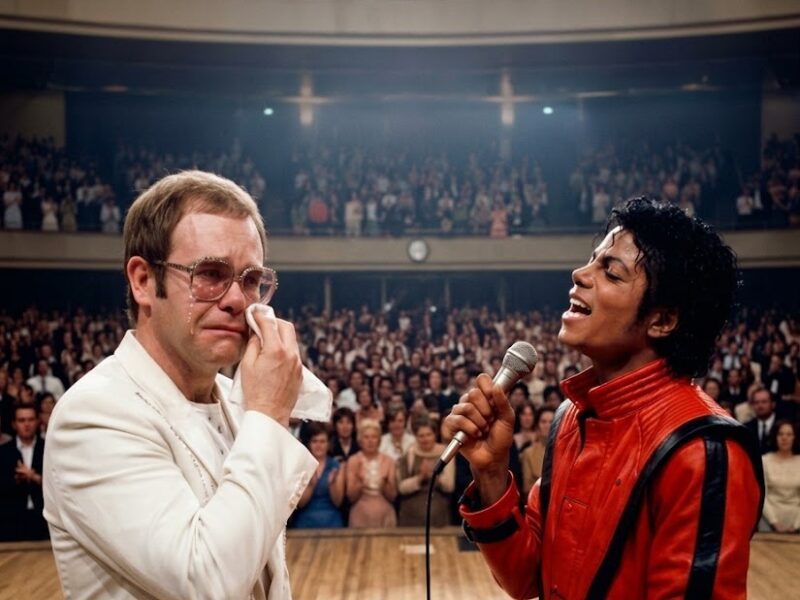
Imagine Elton John Daring Michael Jackson to Sing Gospel Live—Minutes Later, Elton Was in Tears
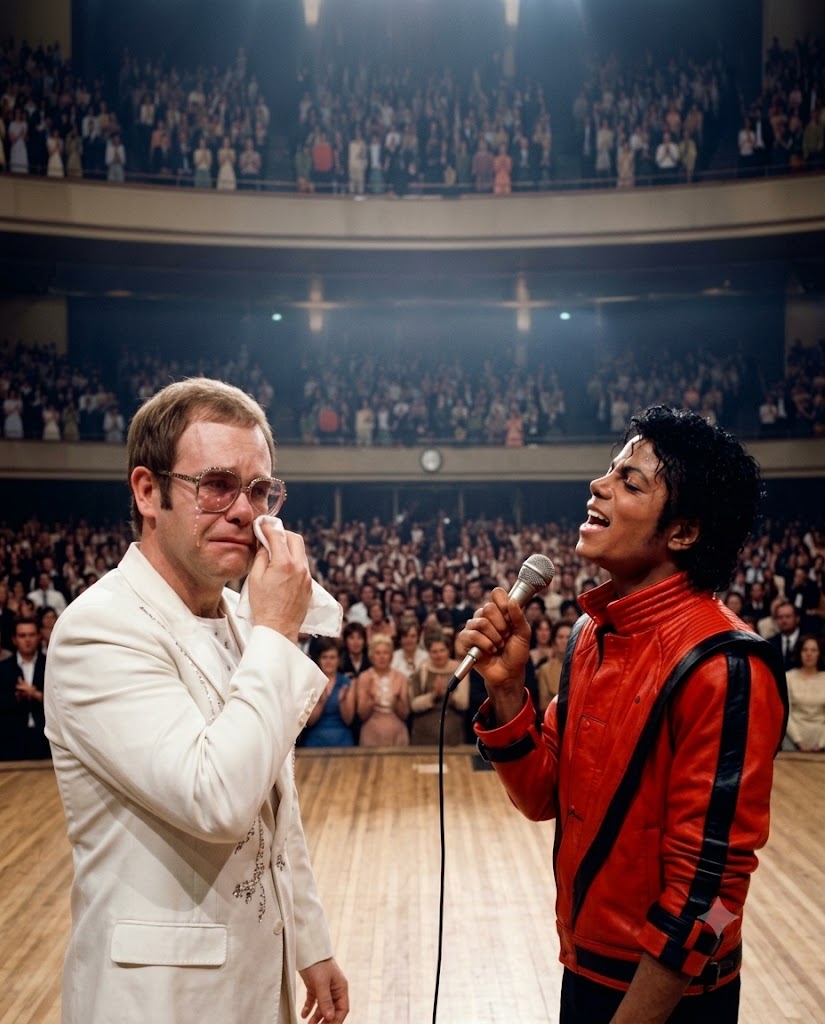
June 1981, the Universal Amphitheater, Los Angeles. Elton John was deep into a stretch of shows that had turned into something more than a tour.
More like a slow climb back toward himself after a few years that had nearly buried him. But that particular night wasn’t just another stop on the road.
It was a benefit concert for a children’s hospital charity. And the bill that night read like something nobody thought would ever actually happen on one stage.
Michael Jackson was there, too. 22 years old, off-the-wall, still selling strong, already the biggest solo star to come out of a family act in the history of the business, but still a couple years off from the kind of fame that would turn him into the single most talked about human being on the planet.
He’d been asked to do two songs before Elton closed the night. A favor to the organizers, a chance to sing for a crowd a little different from what he was used to.
He said yes, almost before they finished asking. Neither one of them knew what was about to happen once the lights came up.
If you already love Michael Jackson or Elton John, hit that subscribe button right now because this story is one for the books. Michael got to the venue around 4 that afternoon.
Quiet, careful, moving through the hallways the way he always moved, like he was trying not to take up more space than absolutely necessary, even though he was already one of the biggest names in the building. He greeted every crew member he passed, remembered names if he’d heard them once, asked soft questions about people’s families, thanked the soundman twice for something that hadn’t even needed thanking.
He wasn’t nervous exactly. He was careful.
Sharing a bill with Elton John, even for two songs, was the kind of thing he still had to remind himself was actually happening and not something he dreamed up. He’d grown up listening to Elton’s records the way a lot of kids his age had.
And there was something about finally being in the same building as that voice that made him feel younger than 22. He had his set picked out, two upbeat numbers off the new record, something to get the crowd on their feet before Elton came out and did what Elton always did.
He’d rehearse the whole thing, quiet in the car on the way over, tapping the rhythm out against his knee, going through the choreography in his head one more time, even though his body already knew it cold. What he didn’t know was that Elton had a different idea for how that night was going to go.
Elton arrived a little after 6, quieter than his usual entrance. Just a couple guys from his team trailing behind him, sunglasses on, even though the sun had already dipped low enough that he didn’t really need them anymore.
He’d had a rough stretch of years by that point, the kind that didn’t always show up in the reviews, but sat heavy on a person anyway. The drinking had gotten bad for a while.
The whole machine around him, the outfits, the glasses, the enormous stage shows had started to feel less like fun and more like something he was hiding behind. And there were nights, more of them lately, where he sat alone before a show and thought about where all of it had started before any of the noise.
Gospel and soul music had been the first thing that ever really got into him. Not the outrageous costumes, not the piano smashing, not the headlines, just a boy in Pinner outside London sitting close to a radio, hearing American voices coming through the static that sounded like they were reaching for something bigger than the room they were recorded in.
His mother hadn’t been an easy woman to love, not always. And his childhood hadn’t been the warm thing people sometimes assumed a famous person’s must have been.
But there had been a stretch of years, a few quiet Sunday mornings at his grandmother’s house, where somebody would put a record on, one of those old American gospel sides, and for a few minutes, the house would go still in a way it almost never did otherwise. He hadn’t sung anything close to that kind of music on a stage in years.
Not really. Not from someplace honest.
The persona had gotten so big, it had started swallowing the parts of him that used to reach for that stuff in the first place. He found out Michael Jackson was opening for him that night and smiled for the first time all day.
“He any good?” one of his guys asked, half joking, the way people did when they hadn’t quite caught up yet to how big Michael was about to become. Elton just looked at him.
“Son, you’ve got a lot to learn. This next part right here is where the whole night turns, so stay with me.”
The show started at 8. The amphitheater was packed tight.
5,000 people dressed up for a Saturday night, buzzing with that particular electricity a crowd carries when they know they’re about to see something big, even if they don’t fully know what yet. Michael came out first to warm applause.
The kind you give somebody you’ve heard great things about, but haven’t quite decided on for yourself. He opened with a fast, bright number off the new record, and by the second chorus, the whole front section was on its feet without really meaning to be.
Hands moving because his voice and his body had that effect on a room, whether people planned on giving into it or not. By the time he finished his second song, the applause had turned real, the kind that surprises even the band standing behind him.
He was walking off stage, sweat already shining under the lights, grinning that soft, shy grin of his. When a stage hand caught his arm, Elton wants you to stick around, he said.
Says, “Don’t go far.” Michael blinked.
Stick around for what? The stage hand just shrugged and hurried off, the way stage hands do when they know more than they’re saying.
Michael stood in the wings a second, a towel around his neck, heart beating a little harder than it had all night. He didn’t have the first idea what was coming.
He just knew something was. Elton came out to the kind of roar that shakes a building.
The costume that night was somewhere between spectacular and absurd. Feathers catching the stage light, glasses the size of dinner plates, and he moved across that stage like the whole room belonged to him, which it did.
He opened with two of his biggest numbers. The crowd screaming through every line.
And by the third song, the whole amphitheater was on its feet and staying there. Then, right in the middle of the set, right when nobody expected it, he stopped the band with a raised hand.
The room went quiet fast. “I want to bring somebody back out here,” Elton said into the mic.
That clipped, warm English accent carrying easy over the crowd. “A young man already sang for you tonight, and I’ve got a feeling most of you weren’t paying nearly close enough attention. Michael Jackson, come on back out here.
Michael’s stomach dropped clean to the floor. He walked out slow, that soft smile back in place, even though his mind was racing a mile a minute, trying to figure out what in the world was about to happen.
The crowd clapped him out, warmer this time, curious now, too. Elton waited till he got close, then leaned toward the mic again, that little glint in his eye that anybody who knew him would have recognized as trouble brewing.
“Now, Mr. Jackson here,” Elton said. He sang two real fine songs for you tonight.
Real fine. But I happen to know something about him nobody in this room knows yet.
Michael raised an eyebrow, half smiling, half nervous. Now what would that be, Mr. John?
I heard Elton said that before Motown, before any of them radio hits, this young man grew up in a house where Sunday meetings meant more than any recording session ever would. Singing hymns with his family before the whole world ever knew his name.
The audience murmured, curious now, leaning forward in their seats. Michael felt his face go warm.
“That’s true enough. So, here’s what I’m thinking,” Elton said, turning to face him full on now.
The whole crowd watching the two of them like a tennis match. “I’m going to dare you right here, right now, in front of all these good people. I dare you to sing us a gospel song, not one of your radio songs, the real thing, the way you sang it before anybody was paying you a dime for it.”
The room went dead silent. Every eye in the place, swinging between Elton and Michael, waiting.
If you’re already hooked, this is a real good time to hit that subscribe button. Michael stood there a second, the towel still around his neck, suddenly feeling heavy on his shoulders.
This wasn’t the plan. He’d come to sing two upbeat numbers and get off stage before Elton John swallowed the whole night the way Elton always did.
Singing gospel, singing something that personal, that raw, in the middle of a Los Angeles amphitheater. That was a whole different animal.
“Mr. John,” he said, laughing a little to buy himself time. “I don’t believe that’s exactly what these good folks paid to hear tonight.
I believe it’s exactly what they paid to hear,” Elton said, no laughing in his voice now. “Dead serious, whether they know it yet or not,”
Michael looked out at the crowd, 5,000 faces waiting. He looked back at Elton, and something in his eyes gave him pause.
There wasn’t a lick of showmanship in that look. It was something else.
Something almost like he needed this more than the crowd did. What song you got in mind?
Michael asked. Quiet. Just between the two of them, though the mic caught every word.
Whatever they sang at your house on a Sunday morning, Elton said. Whatever you sang before any of this was a business.
Michael’s throat tightened up on him without warning. He thought of his mother, Katherine, humming hymns while she ironed shirts in that small house in Gary.
The record player low in the background even when nobody was really listening to it, just letting it fill the room. He thought of the whole family crowded into a Kingdom Hall on Sunday mornings before Motown, before any of it.
His brothers’ voices around him, nobody caring how loud or how crowded it got because the music filled up whatever space was left. “All right,” Michael said.
“Quiet, and the whole room seemed to lean in closer to hear it.” “All right, Mr. John, you asked for it.”
He turned toward the band. I don’t think I need you for this one.
Just let me do this alone if that’s all right. The band leader nodded and the stage went quieter than it had been all night.
Just the low hum of 5,000 people holding their breath. Michael closed his eyes for a second and when he opened them, something in his face had changed.
The performer’s polish was gone. What was left underneath was something a whole lot more real.
He started singing Amazing Grace. Keep watching because what happens over the next few minutes is the whole reason this story is still talked about decades later.
His voice came out different than it had on the first two songs. Not polished, not performance ready, something rougher around the edges, something that cracked a little on the high notes and didn’t try to hide it.
He wasn’t singing to entertain anybody anymore. He was singing to something further back, something older than the stage he was standing on.
By the second verse, you could hear a pin drop in that amphitheater. 5,000 people who’d come to watch a pop concert.
And every single one of them sat there frozen, listening to a 22-year-old kid sing about a wretch like him, being saved, like he was talking straight to God, and nobody else in the building existed. Elton stood off to the side of the stage, and something was happening to his face that his crew hadn’t seen in years.
His jaw was tight, his eyes were shining under the stage lights in a way that had nothing to do with sweat. Michael kept singing, his voice climbing now, stronger, the crack in it turning into something like conviction instead of weakness.
He sang about grace so amazing it could save a wretch like him, about being lost and then found, blind and then seeing, and every word landed on that crowd like a stone dropped in still water. He got to the last verse and without planning it, without even really deciding to, he looked over at Elton standing there in the wings, and what he saw stopped him cold for half a second.
Elton John, the biggest name in the room, a man who’d filled stadiums and broken records most artists could only dream about, was standing there with tears running down his face, not even trying to wipe them away. Michael kept singing anyway. Some part of him understood that stopping now would break something more than the song.
He finished the last line. Let the final note hang in the air a second, then went quiet.
Nobody clapped right away. The whole amphitheater just sat there in that ringing silence you only get when something real has happened in front of you and you’re not sure yet if you’re allowed to make noise about it.
Then Elton started walking toward him slow across that stage and the crowd finally broke into applause, but it wasn’t concert applause. It was something quieter, more careful, like they knew they were watching something they weren’t supposed to interrupt too loud.
If you’re feeling this story right along with me, go ahead and hit that like button. Elton reached him and just stood there a second, not saying anything, wiping at his face with the back of his hand like a man who wasn’t used to crying in front of 5,000 strangers and didn’t quite know the proper way to do it.
Elton Michael said quiet just for him, though the mic still caught it. “You all right?”
He nodded, though it took him a second to trust his own voice. “My grand used to sing that,” he finally said.
“Not exactly like that, but close. Sunday mornings before any of this, before I even knew what I wanted to be. I haven’t heard anybody sing it like they meant it that deep in a long, long time.
I’m sorry, Michael said. And he meant it plain and simple.
No performance in it at all. Don’t be sorry, Elton said, shaking his head slow.
That’s the best thing that’s happened to me on a stage in a long, long while. The crowd was still quiet, watching this whole thing unfold, like they were witnessing something none of them had tickets for.
You dared me, Michael said, a little smile creeping back onto his face now, trying to ease the weight a bit. I didn’t know you’d be the one crying over it.
Elton laughed, wet and a little broken, wiping his face again. Neither did I, honestly.
He turned to the crowd, still holding the mic loose in one hand. Ladies and gentlemen, I don’t know if you understand what you just heard, but that right there, that’s the real thing.
That isn’t any of this. He gestured around at the lights, the band, the whole glittering setup behind him.
That’s church. That’s home.
That’s where every single one of us came from before anybody put a spotlight on us. The room finally let itself applaud proper, loud, and long people rising out of their seats.
This next part is the reason folks still bring this story up whenever the subject comes up. Elton turned back to Michael.
Can I ask you something? Go on.
Would you sing one more with me? Not you alone this time.
Both of us. Michael’s eyebrows went up.
You and me. Right here.
Right here. Elton said, “I haven’t sung anything close to gospel in front of a crowd like this in years. Feels like maybe tonight’s the night to change that.
But I don’t think I can do it alone. I think I need you standing next to me for it.”
Michael looked at him a long second, reading something behind those tired eyes that told him this wasn’t a bit wasn’t some rockstar showmanship dressed up as sincerity. This was a man asking for something he genuinely needed.
All right, he said softly. What are we singing?
Border song, Elton said. Not the version everybody knows.
The bridge of it. That gospel piece in the middle.
That’s where the real heart of it always lived. Even if nobody ever slows down long enough to hear it properly.
My grand loved that section more than anything I ever wrote. Michael nodded slow.
Then let’s sing it for her. The band, sensing the moment without needing to be told twice, came in soft behind them.
Just Elton at the piano and a little organ underneath. Nothing flashy, giving the two of them room to breathe.
Elton started the first line, and his voice came out shaky at first. Thin in a way nobody in that room had ever heard from him before.
He wasn’t the showman right then. He was a boy sitting close to a radio, reaching for something he’d forgotten he still wanted.
Michael came in on the harmony, his voice wrapping around Elton’s like he’d been singing with him his whole life instead of 20 minutes. Where Elton’s voice wavered, Michael’s steadied.
Where it cracked, Michael’s held firm underneath, carrying him through it the same way he used to carry a harmony line for his brothers back when their voices gave out mid song. By the second verse, something had shifted in Elton.
His voice grew stronger, surer, like the singing itself was stitching something back together that had been torn open a long, long time ago. The whole amphitheater was standing now, not clapping, just standing.
Tears running down more faces than just Elton’s. 5,000 strangers watching two of the biggest voices in music sing something quiet and true, like it was the only thing either one of them had ever really wanted to do.
They reached the final section together. Elton turning to look at Michael right as they hit the highest note.
Both of them holding it together, neither one backing off. Two voices doing what neither one could quite manage alone.
If this story is giving you chills, that’s your sign to hit subscribe before we keep going. The song ended and for a long moment nobody in that room made a sound.
Then the applause came, but it wasn’t the kind you give a hit song. It was the kind you give something sacred, something you know you were lucky to witness and won’t ever see again quite the same way.
Elton stood there, chest heaving a little, tears still wet on his face, and he didn’t bother hiding them anymore. “Thank you,” he said into the mic, voice thick.
“Thank you for that.” He turned to Michael and pulled him into a hug right there on stage, arms wrapped tight, and Michael felt him shaking a little against his shoulder.
“You brought something back to me tonight,” Elton said quiet, just for his ears, though a few folks in the front row swore later they’d caught it, too. “First time in years, I felt like I was sitting in my grand’s front room again.”
Michael held on to him a second longer. “Whatever’s been hard for you lately, whatever this business does to a person, I think she’d be proud of you tonight.
I know that much for sure.” Elton nodded against his shoulder, unable to say much else right then.
They separated after a moment, and Elton wiped his face one more time with the back of his sleeve, laughing a little at himself now, embarrassed, but not ashamed. “Well,” he said to the crowd, voice steadier now, “I believe Mr.
Jackson here just showed every one of us something we needed reminding of. Doesn’t matter how big the stage gets.
Doesn’t matter how many feathers they put on you. The real stuff, the stuff that matters.
That’s still just a voice and a memory and somebody willing to be honest enough to sing it out loud. The crowd roared its approval, and Elton turned back to Michael, that easy grin returning to his face now, though something behind his eyes had softened in a way that would stay there the rest of the night.
“You’ve got a seat at my piano anytime you want it,” Elton said. “I mean that.
I might just take you up on it,” Michael said, grinning back. Stick around because what happened after the show is a story in itself.
Backstage after the concert wrapped, Elton found Michael in the hallway near the dressing rooms, still in his stage clothes, a towel around his neck, waiting on his people to bring the car around. “Got a minute?” Elton asked.
“For you?” “Always.”
They sat down together on a couple of folding chairs somebody had left out. Away from the noise of the crew breaking down equipment, away from the small crowd of handlers who were used to keeping people at a respectful distance from both of them whenever they needed a breather.
“I don’t know if you understand what you did up there tonight,” Elton said, still a little raw around the edges. “I’ve been performing for years, huge shows, big crowds, all of it.
And somewhere in there, I think I forgot what any of it was even for. Forgot why I started playing piano in the first place.”
“Tonight reminded you?” Michael asked gentle. “Tonight reminded me,” Elton said.
My grand used to tell me the same voice that can make you famous can also make you forget who you really are if you let it. I think I let it somewhere along the way.
Been a rough stretch of years if I’m honest with you. The drink mostly feeling like the whole persona had gotten so big I couldn’t find myself underneath it anymore.
Michael reached over and put his hand on his arm. Mr. John, I’ve been singing since I was old enough to stand up straight and I’ll tell you something my mother always told me.
She said, “The gift isn’t yours to keep. It’s yours to give away.
Every time you sing something real, something honest, you’re giving a piece of that gift back to whoever’s listening. Tonight, you gave it back to 5,000 people who needed it a whole lot more than they probably knew walking in that door.” Elton sat with that a moment, nodding slow.
“That’s real wisdom coming from somebody your age.” “I had a good teacher,” Michael said, smiling.
“A whole family full of them, actually. If this story is teaching you something already, don’t forget to hit that like button.
They sat quiet together a while longer. The noise of the crew packing up equipment fading into the background.
Just two singers from two different worlds who’d found the exact same thing waiting underneath all that fame and all those lights. You know, Elton said eventually, “I think that’s the first time I’ve cried in front of an audience in years.
Not since I was a much younger man, back before any of this got so big. Never once let myself do it on stage.
Too worried about what it would mean. Somebody seeing me like that.
Sometimes it takes the right song, Michael said. And sometimes it takes somebody standing next to you who isn’t afraid to sing it with you.
Elton looked at him a long moment. You’re going to be something else, Michael Jackson.
Something this business hasn’t seen before. I can feel it standing right here.
Well, Michael said, a small shy laugh escaping him. Well just have to wait and see about that, won’t we?
Can I ask you something? Michael said, “Of course.
Was tonight the first time in a while you’ve thought about your grand that close? Or does it come around a lot?
That feeling? Elton considered the question seriously, more than a casual answer would have needed.
More than I let on if I’m honest. Losing her took something out of me I never quite got back.
And this whole life I built. The fame, the noise.
Some days I think I built it partly to drown out how much that loss still sits in me. Tonight it just came right back up sitting there next to you.
I understand that better than you’d probably guess. Michael said, “This business, it gives you the whole world and asks you to forget what you actually needed before any of it showed up.
I think that’s part of why gospel still gets me the way it does. It doesn’t care about any of the noise, just cares if you mean it.”
Elton nodded slow, something shifting behind his own eyes now, a recognition passing between the two of them that neither one had expected walking into that hallway. If this story is moving you, please subscribe before we continue.
Can I ask you something, too? Elton said, “Go ahead.
Was it hard growing up the way you did, performing before you were even old enough to understand what fame was going to cost you?” Michael was quiet a moment, considering the question with more weight than a casual answer would have required.
“Harder than most people know,” he said finally. “I’ve been on a stage since I was 5 years old.
My father pushed us hard, real hard. Rehearsals until our hands hurt until our voices gave out some nights.
I never really got the kind of childhood other kids get to have. Fame doesn’t fix what’s missing in a person.
Sometimes it just gives the missing part a bigger stage to show up on. I’m sorry, Elton said quiet.
Don’t be sorry, Michael said. I’m working through it best I can.
Got my music. Got a few people around me who genuinely care even if some days it doesn’t feel like enough.
But I tell you that so you know. Whatever you’re carrying, whatever this whole business has thrown at you over the years, you’re not the only one who’s ever struggled with it.
Plenty of us have walked some version of that road. They sat quiet together for a moment, the last of the crews voices fading down the hallway, the building slowly emptying out around them.
Before Elton left that night, he gave Michael a number to reach him. Told him to ring any time, whether it was about music or just needing somebody who understood what this strange business could do to a person from the inside out.
I mean it, he said. This industry chews people up plenty.
Good to have somebody who understands, somebody you can call when it gets to be too much. Michael held on to that number like something precious.
I’ll remember that. Thank you for tonight, for all of it.
Thank you, Elton said, standing, adjusting his glasses. For reminding me why I fell in love with music in the first place.
Been a while since a show felt like that one did tonight. I needed that more than I realized walking in here.
That night at the Universal Amphitheater never got officially recorded for release. No album, no single, just a handful of grainy audience recordings that circulated quietly for years among collectors who knew what they had.
But everybody who was in that room carried it with them the rest of their lives, telling the story to anybody who’d listen about the night Elton John dared Michael Jackson to sing gospel and ended up crying in front of 5,000 strangers because a young man from Gary, Indiana, reminded him exactly who he used to be before any of it got so loud. If this story left an impact on you, please hit that like button before we finish. Years later, when reporters asked Michael about that night, he never told it like gossip, never dressed it up bigger than it already was.
“That’s one of my favorite nights I ever had on any stage anywhere,” Michael said once. Not because it was Elton, though certainly that was something, but because for a few minutes up there, we weren’t celebrities.
We were just two people remembering what music felt like before anybody was watching, singing the only way we knew how. Honest.
And when Elton was asked about it decades later in a separate interview, he kept his answer short in the way he often did with things that had actually mattered to him. “There are nights that change how you think about your whole career.” Elton said, “That one changed mine.”
Michael reminded me standing right there on that stage that you can build the biggest show in the world and still lose track of the reason you ever wanted to sing at all. Doesn’t matter how many feathers you’re wearing or how big the room gets. Somebody’s got to be brave enough to cut through all of it and just sing something true.
That night, he was the brave one. I was just lucky enough to be standing close enough to catch it.
Word of what happened that night traveled fast, even without a proper recording to back it up. Musicians who weren’t even there started talking about it within days, hearing it secondhand from crew members, from other performers who’d been backstage, from anybody lucky enough to have witnessed it directly.
A young backup singer who’d been part of Elton’s band that night, gave an interview years later, and she still got emotional talking about it. I’ve played behind a lot of big names in my career, she said.
But I’ve never seen anything like what happened between those two. It wasn’t a performance.
You could tell the second Michael opened his mouth that this wasn’t about hitting the right notes or looking good under the lights. This was somebody reaching back into his own life and pulling something out for everybody to see.
And watching Elton standing there in the wings crying like that that broke something open in the whole room. I don’t think anybody who was there that night ever forgot it.
One of the sound engineers who ran the board that evening said something similar in a magazine piece years afterward. “I’ve mixed thousands of shows,” he said.
“Thousands, and I can tell you most nights you’re just doing your job, keeping the levels right, making sure nothing clips. That night when Michael started singing Amazing Grace, I had to stop and just listen.
Forgot I was even working. That’s not something that happens to me.
Not ever. But it happened that night.
If this story is teaching you something real about music and honesty, hit that like button before we continue. Michael referenced that evening a handful of times over the years.
Always careful, always brief, the way he tended to talk about the things that mattered to him most. In an interview years later, a journalist asked him about moments in his career that had changed him personally rather than professionally.
There was a night early on, Michael said, opening for Elton John at a benefit show. Something happened between us on that stage that I don’t really have words for even now.
He dared me to sing something real, something that had nothing to do with what I was there to promote, and I ended up singing Amazing Grace in front of thousands of people. Hadn’t sung anything like that in public since I was a little boy sitting in a Kingdom Hall.
“What did that experience teach you?” the journalist asked. Michael thought about the question for a long moment before answering.
That no matter how big the show gets, he said, “No matter how many people are watching, no matter how much money’s riding on every second of it, the truest thing you can ever give an audience is just yourself, not the version of you that’s rehearsed and lit and dressed for the cameras. The version that remembers where you came from.”
Elton asked me for that version that night, and I gave it to him, and I think it changed something in both of us. Elton, for his part, brought up the story periodically over the decades, always with the same warmth, the same careful respect for what had actually happened rather than what people wanted the story to become.
In an interview conducted years after Michael’s passing in 2009, a reporter asked him directly about that night, hoping he’d share something the public hadn’t heard before. “I don’t tell that story to make myself look good,” Elton said, his voice noticeably softer than his usual quick, sharp delivery.
I tell it because it was real and because Michael was real that night in a way people didn’t always get to see later in his life once everything got so complicated, so scrutinized. Everybody thinks they know somebody like that from the magazines, from the headlines, from all that noise that follows a person their whole career.
But the young man I saw standing on that stage crying his way through Amazing Grace because I dared him to, that was about as true a version of him as I ever got to witness. I feel lucky I saw it.
The reporter asked if he’d kept in touch with Michael over the years. Here and there, Elton said, “Never as much as I would have liked, if I’m honest.”
His life got complicated in ways I don’t think either of us could have predicted that night. But every time we did speak, even years later, he’d bring that show up.
Ask me if I remembered it the way he did. Told me once, it stuck with him whenever things got hard for him later on.
That means something to me. That’s not nothing.
If this story about honesty, grief, and music moved you, please subscribe before we continue. Over the years, that particular evening became something of a quiet legend among people who followed both Michael’s and Elton’s careers closely.
Music historians occasionally referenced it in retrospectives, always noting the same thing. That in an industry built on spectacle, on bigger stages and louder productions and more elaborate shows every single year, one of the most powerful moments either artist ever produced happened with nothing but a single voice unaccompanied and later two voices and a simple piano.
What made that night significant? One music writer noted in a piece looking back at both careers wasn’t the size of the crowd or the fame of the two people on that stage. It was the willingness of both of them to strip everything away.
Michael could have sung something safe, something from the record he was there to promote. Instead, he sang something that cost him something to sing.
And Elton, a man whose entire public identity was built around spectacle, excess, and outrageous showmanship, let himself be seen falling apart in front of thousands of people. That kind of vulnerability doesn’t happen by accident.
It happens because somebody creates a space safe enough for it to happen in. Some who study the history of American gospel music also took note of that evening, pointing to it as an example of how deeply that tradition runs underneath so much of popular music.
No matter how far removed the surface sound might seem, and how it reaches across an ocean, too, all the way to a boy in England sitting close to a radio decades earlier. You can trace almost every major vocalist in popular music back to a church or a family gathering somewhere. One gospel historian said in a documentary that touched briefly on the incident.
Doesn’t matter if they became a pop icon, a rock legend, a soul singer. Somewhere back there is a hymn, a choir, a mother, or a grandmother singing something simple and true.
What happened on that stage in 1981 is a perfect example of that thread getting pulled and everybody in the room feeling it pull whether they understood exactly what they were feeling or not. For Michael, that night became something he referenced whenever he talked about the deeper purpose behind his own music beyond the choreography and the record sales and the spectacle the public would eventually come to associate almost entirely with him.
People think all I do is the show, he said in a later interview. The dancing, the production, all of it.
And there’s nothing wrong with any of that. I’ve spent a good part of my life trying to give people something they’ll never forget when they walk out of an arena.
But every now and then, you get a night like the one I had with Elton where you remember the real reason any of us started singing in the first place. It wasn’t for the fame. It wasn’t for the charts.
It was because there was something inside us that needed to come out. And singing was the only way we ever fully trusted to carry it.
For Elton, the memory seemed to linger even longer, surfacing in interviews and conversations with people close to him at unexpected moments, always tied to the same handful of details. The song, the tears, he couldn’t stop.
The way Michael’s voice had held steady underneath his when his own started to shake. A close friend of Elton’s, speaking in a later interview, recalled a conversation they’d had years after that night.
He told me once that whenever things got really hard for him, whenever the pressure or the old habits started creeping back in, he’d think about that stage in 1981. Think about standing next to Michael Jackson. Both of them just singing something true.
He said it reminded him that underneath everything, underneath all the feathers and the fame and the excess, he was still just a boy who fell in love with music, sitting close to a radio in Pinner. That memory meant a lot to him, more than most people would probably guess.
If this story left an impact on you, please hit that like button before we finish. There’s something particular about a moment like that one.
Something that happens when two people who’ve spent their entire careers being watched, being judged, being turned into symbols bigger than themselves suddenly find a space where none of that matters anymore. Where it’s just two voices and an old song and whatever memory that song happens to carry.
Elton John dared Michael Jackson to sing gospel that night. Not because he wanted to embarrass him, not because he wanted to prove a point about authenticity versus spectacle, but because somewhere in his own life, he’d learned that the realest thing a singer can offer an audience is the truth of where they came from.
And when Michael accepted that dare, when he stood there and let himself sing something honest in front of thousands of strangers, he gave everyone in that room something far more valuable than a perfectly executed performance. He gave them a glimpse of the boy before the fame, the kid who sang in a small Kingdom Hall next to people he loved before the whole world started watching his every move.
That’s the story that got told and retold in the years that followed. Not because it involved two of the biggest names in music history, though certainly that helped it spread, but because it reminded everybody who heard it of something simple and true.
That no matter how big you get, no matter how far you travel from where you started, there’s always a song somewhere in you that can bring you right back home. If this story taught you something about music, memory, and honesty, make sure you’re subscribed.
Hit that like button. Share this with someone who needs to hear it.
That’s what happened on a June night in 1981 at the Universal Amphitheater in Los Angeles. Not a scandal, not a feud, just two artists, one dare, and a song old enough to remember exactly who both of them really were underneath all the fame.
The night Elton John dared Michael Jackson to sing gospel and minutes later found himself standing next to him in tears watching one of the biggest stars in the world become just for a few minutes a young man remembering his family’s voices singing the only way he knew how. Honest.









