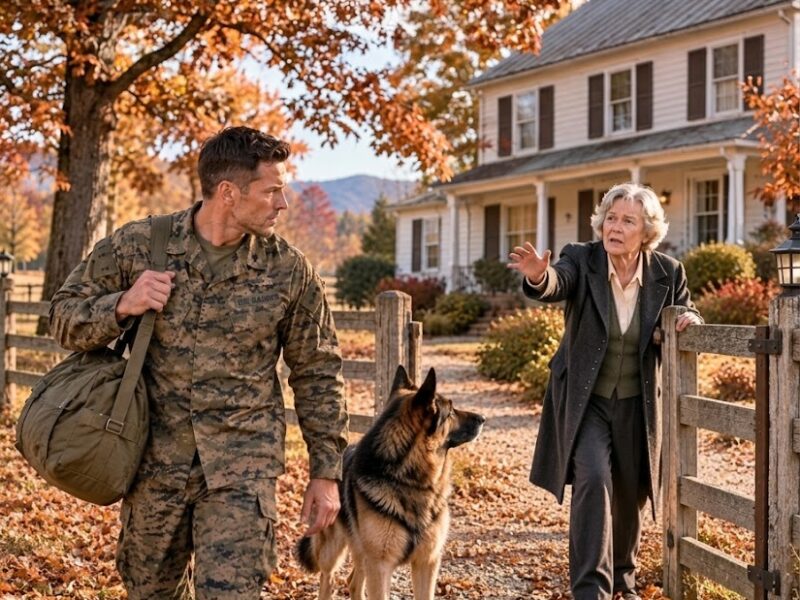
“I’m Not Asking You to Stay—Just Be My Son for One Week,” the Elderly Woman Begged a Marine
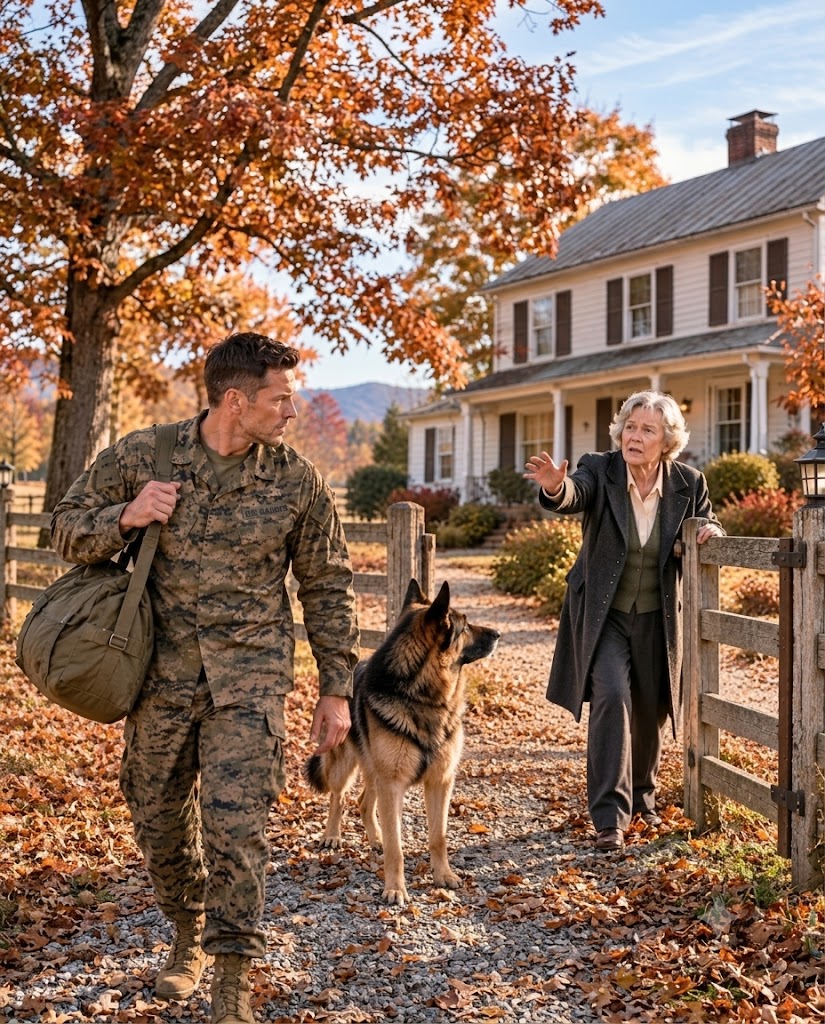
Late October lay cool and windless over the countryside outside Staunton, Virginia.
Maples burned red and copper along the narrow roads, while the Blue Ridge faded beneath a pale afternoon sky, and fallen leaves gathered against old fences.
Gunnery Sergeant Elias Trent had been driving for nearly five hours when Bishop began shifting restlessly in the back seat.
At forty-two, Elias was an even six feet tall, lean and rangy with a long weathered face, deep-set brown eyes, a nose bent slightly left from an old break, and dark hair clipped close enough to expose the gray spreading above both ears.
He had not shaved that morning, leaving a rough shadow along his jaw that made him look more tired than he felt.
Ten days of leave stood between him and his return to Quantico.
Yet he had planned almost none of them.
Elias was courteous with strangers, dependable with Marines under his responsibility, and uncomfortable whenever kindness required him to explain himself.
Years of service had taught him how to enter unfamiliar places with a purpose.
Leave was harder.
Without orders, he tended to keep moving.
Bishop understood movement.
The seven-year-old German Shepherd, a retired military working dog Elias had adopted after the dog’s final service assignment, had a dark sable coat, black mask, muscular chest, calm brown eyes, and a small triangular nick along the edge of his left ear.
A faint frosting of gray showed beneath his chin.
Bishop had spent most of his life learning discipline.
But retirement had made him curious about ordinary things.
Roadside grass, drifting leaves, unfamiliar fence posts, the smell of cold soil.
When Elias pulled onto a gravel shoulder and opened the door, Bishop climbed out with a low stretch and immediately began investigating the edge of a quiet country lane.
They walked for several minutes before Bishop stopped panting beside him.
Elias reached for the water bottle clipped to his bag and found it empty.
“That’s on me.”
Bishop looked up without sympathy.
A white farmhouse stood beyond a wooden gate farther along the lane.
It was old but cared for, with clean porch boards, trimmed shrubs, clear windows, and neatly stacked firewood.
Elias disliked bothering strangers, but Bishop’s tongue was hanging farther out now.
He stopped outside the gate.
“Afternoon, ma’am.”
The woman on the porch looked up.
Miriam Holloway was seventy-seven, slender and upright, her body smaller than it had once been without appearing fragile.
Short silver hair curved neatly beneath her ears, framing a pale face lightly freckled with age, and dark brown eyes that remained alert and direct.
She wore charcoal trousers, a cream blouse beneath a moss-green wool vest, and black walking shoes.
Widowhood had taught Miriam to manage things herself rather than wait for someone to notice what needed doing.
She regarded Elias cautiously, but not fearfully.
“Afternoon.”
“Sorry to bother you. Could I trouble you for some water for my dog?”
Her eyes moved to Bishop.
“What’s his name?”
“Bishop.”
Miriam disappeared inside and returned with a metal bowl and a glass of water.
She opened the gate herself.
Bishop drank until the bowl was nearly empty, then stepped back and settled naturally against Elias’s left leg.
Miriam froze.
For one strange moment, the present seemed to leave her face.
Elias followed her gaze to Bishop.
“Ma’am?”
She blinked.
“You’re a Marine.”
It wasn’t quite a question.
“Yes, ma’am.”
“Still serving?”
“Yes.”
“And you’re traveling alone?”
Elias glanced at Bishop.
“Depends who you ask.”
That earned the smallest smile.
Miriam studied him another second.
“Anyone waiting for you during your leave? Wife? Children?”
The question landed closer than she could have known.
Elias had become skilled at answering personal questions with as few words as possible.
“No, ma’am.”
He drank the water, thanked her, and handed back the glass.
“Come on, Bishop.”
They had walked perhaps twenty paces when Miriam called after him.
“Marine.”
Elias turned.
She stood inside the open gate, one hand gripping its top rail.
“I need to ask you something.”
He waited.
Miriam seemed suddenly angry with herself for having called him back.
Twenty-one years of waiting had taught her patience, but not courage for what she was about to say.
“I’m not asking you to stay,” she swallowed.
“Just give me one week. Let me pretend you’re my son until next Sunday. Then you and your dog can leave.”
Elias stared at her.
“Ma’am, I can’t pretend to be somebody I’m not.”
“God, no.”
Her voice sharpened immediately.
“I had one Luke.”
The name softened everything that followed.
Miriam went inside and returned with an old photograph.
A young Marine stood beside a German Shepherd wearing a working harness.
The dog’s name, she told Elias, had been Havoc.
The Marine was her only son, Luke Holloway.
Seeing Bishop beside Elias had brought the photograph back to her with painful clarity.
“Luke left twenty-one years ago,” Miriam said.
Elias looked from the photograph to her.
“No contact.”
She shook her head.
“No phone calls, no letters, no return.”
A week earlier, however, a local VFW post had contacted Miriam after an inventory of stored property uncovered an old foot locker Luke had deliberately left with the post before disappearing.
The contact information attached to it had long been outdated.
Only now had they traced it back to Miriam.
“I haven’t opened it,” she said.
Elias frowned.
“Why not?”
“Because it isn’t the thing I’m afraid to open.”
She looked toward the farmhouse.
Her husband, Thomas Holloway, Luke’s father, had died nine years earlier.
Miriam described him simply: a solid, broad-handed man who had spent most of his life believing promises mattered precisely when keeping them hurt.
Before his death, Thomas had made Miriam agree that Luke’s forty-fifth birthday would be the end of their vigil.
If their son had not returned by then, she would finally open the sealed letter Luke had left behind and stop giving the rest of her life to the possibility of footsteps at the gate.
“Next Sunday,” Miriam said quietly.
“Luke turns forty-five.”
Elias finally understood the week.
Not completely, but enough.
“You want me here because of the letter?”
“I want someone here because I’m tired of being brave in an empty house.”
There was no self-pity in the sentence, which made it harder to dismiss.
Elias looked down the road.
He had enough leave remaining.
That wasn’t the problem.
The problem was that this woman had accidentally asked for the one thing he avoided giving strangers: a place in his time.
Bishop leaned lightly against his leg.
Elias exhaled.
“I’ll come back tomorrow morning.”
Miriam’s expression did not brighten.
Instead, something inside it loosened.
“That’s one day more than I had five minutes ago.”
Elias nodded and walked away.
At the road, he looked back once.
Miriam remained beside the open gate, holding Luke’s photograph against her chest, watching neither him nor Bishop now, but the empty stretch of lane beyond them.
Elias had promised only tomorrow morning.
Miriam had asked for only one week, and neither of them yet knew what seven days could do to a grief that had been given twenty-one years to learn how to survive.
—
Monday morning came colder than Sunday, with thin frost silvering the grass outside Miriam Holloway’s farmhouse and low clouds hanging over the Shenandoah Valley.
By eight-thirty, the sound of tires on gravel reached the kitchen.
Elias had kept his promise.
Bishop jumped down from the truck first, dark sable coat catching the weak morning light, while Elias followed, carrying two coffees.
He had shaved, but otherwise looked much as he had the day before.
Close-clipped hair, plain dark jacket over a gray shirt, jeans, boots.
Miriam noticed the absence of luggage immediately.
“You’re not staying here.”
It sounded more like confirmation than disappointment.
“Found a motel outside town.”
“Good.”
Elias raised an eyebrow.
Miriam opened the door wider.
“I asked for a son for a week, Marine. Not a house guest.”
Inside, she set three rules before accepting the coffee.
First, she would never call him Luke.
Second, Elias would never be expected to tell anyone he was her son or family.
Third, he was not to open Luke’s sealed letter for her, no matter what happened before Sunday.
“That last one wasn’t on my list of plans.”
“It is now.”
Elias studied her.
“You always make rules before breakfast?”
“Only when strangers agree to unusual arrangements at my gate.”
Something almost comfortable passed between them, then disappeared when Miriam picked up her coat.
The VFW facility sat twenty minutes away in a low brick building beside an American flag snapping in the cold.
A volunteer brought out the foot locker on a wheeled cart.
It was olive drab, scuffed along the corners, with faded shipping marks and “HOLLOWAY” stenciled across one side.
Miriam stopped several feet from it.
For twenty-one years, Luke had existed mostly as absence.
Seeing his name printed on something solid made that absence suddenly occupy space.
Elias did not touch her.
He simply waited.
The paperwork explained how the locker had survived.
Luke had deliberately left it at the old post shortly before departing Virginia, taking only a duffel bag with him.
When that post later closed, unclaimed property was transferred into storage.
It moved again during another consolidation, while Luke’s old contact information became useless.
Only a recent inventory and a volunteer willing to chase aging records had connected the name Holloway to Miriam.
Back at the farmhouse, Elias placed the locker on the dining room floor.
Miriam knelt beside it.
“You want me outside?”
“No.”
She opened it herself.
There was nothing dramatic inside.
Folded civilian shirts, an old shaving kit, photographs curled at their edges, service papers, a paperback swollen from humidity, a wristwatch that had stopped at 6:14 sometime in the unknowable past.
Miriam touched each object with the caution of someone handling evidence from a life she had once known intimately.
Then she found a small metal tag.
“Havoc.”
Her thumb covered the engraved name.
Elias saw her jaw tighten.
“He came home with Luke for a while.”
Havoc, Miriam explained, had been a German Shepherd who served alongside Luke before eventually becoming part of his life after the uniform came off.
The dog had given Luke something people could not: company without questions.
On bad nights, Havoc slept against Luke’s bedroom door.
When crowds became too much, Luke walked him for miles.
When Luke stopped answering friends, he still talked to Havoc.
Then the dog became ill.
He died a few months before Luke left.
“Bishop lay nearby, head resting between his paws.”
“After Havoc,” she continued, “Luke got quieter. I thought grief needed time.”
Elias looked at the tag in her palm.
“Sometimes time just gives silence more room.”
Miriam looked at him, but he offered nothing further.
Beneath several papers, they found a travel receipt issued on the date Luke had disappeared.
Destination: Bozeman, Montana.
Miriam stared at it.
“He told us he was going west.”
“So you knew about Montana?”
“No. Just west. For twenty-one years, West had been an enormous place. Now it had a city.”
Another folded paper carried only a name and an old telephone number.
Raymond Keane.
Miriam recognized it immediately.
“He served with Luke.”
The number no longer worked, but an updated address was easy enough to obtain locally.
By early afternoon, they were standing outside a modest brick house on the other side of Staunton.
Raymond Keane answered after the second knock.
At seventy-three, Raymond was thick through the torso despite age, with large hands, a flattened nose, close-cropped white hair, and a neatly trimmed mustache the color of steel wool.
His left knee had stiffened enough to give him a slight hitch when he walked.
He possessed the guarded courtesy of a man who had spent decades keeping private things private.
His expression changed when he saw Miriam.
Then he noticed the paper in Elias’s hand.
“Where’d you find that?”
“In Luke’s foot locker,” Miriam said.
Raymond’s face lost color.
They sat in his living room.
Bishop remained beside Elias while Miriam placed the Bozeman receipt on the coffee table.
“Did you know he went there?”
Raymond looked at the receipt for a long time.
“He didn’t.”
Miriam’s fingers tightened.
“What?”
“I drove him to the station.”
The room became very quiet.
Raymond explained that Luke had called him because he did not want Thomas or Miriam taking him.
Luke had one duffel bag.
He had purchased passage toward Montana.
Raymond watched him stand near the departure area, but Luke never boarded.
“He came back to my truck before it left,” Raymond said.
Miriam stared at him.
“What did he say?”
“Drive.”
“Where?”
Raymond swallowed.
“Back here.”
Miriam stood so quickly her chair scraped the floor.
“No, Miriam. No, he never came home.”
“I didn’t say he went inside.”
Raymond’s voice cracked for the first time.
Twenty-one years earlier, after dark, he had driven Luke back to the road opposite the Holloway farmhouse.
Luke asked him to stop beneath the trees where the truck would be difficult to see.
Then Luke got out.
For nearly an hour, he stood across the road.
The kitchen light was on.
Miriam’s silhouette passed the window several times.
Luke watched.
He never crossed the road.
He never touched the gate.
Raymond had finally gone to stand beside him.
“I asked what the hell we were doing there.”
Raymond’s eyes had grown wet.
“He said, ‘If I go in, I’ll become the man my father wants me to be again.'”
Miriam lowered herself slowly back into the chair.
“You knew.”
Raymond looked at the floor.
“He made me promise. For twenty-one years. I thought he’d call you when he was ready.”
And when he didn’t, Raymond had no defense for that.
He explained that Luke eventually climbed back into the truck and asked to be taken into Staunton.
Raymond dropped him near the center of town.
Luke took his duffel bag, thanked him, and disappeared down the sidewalk.
“Where did he go?”
“I don’t know.”
“Did you ever see him again?”
“No.”
Miriam’s voice fell almost to a whisper.
“Did he tell you what was in the letter he left me?”
Raymond looked up, genuinely confused.
“What letter?”
That answer hurt differently because Miriam believed him.
Outside, the afternoon had darkened.
Elias walked beside her toward the truck, but did not reach for her arm.
Miriam stopped before opening the passenger door.
For twenty-one years, she had believed her son had left home and kept going.
Montana had been painful.
Distance was understandable.
But Luke had come back.
He had stood close enough to see his mother moving behind the kitchen window.
Miriam looked toward the direction of the farmhouse, though it was miles away.
“My son came home.”
Elias said nothing.
Her eyes filled, but she refused to let the tears fall.
“He came all the way back,” she whispered.
Then she looked at Elias.
“And he still didn’t come through the gate.”
—
Tuesday came beneath a low ceiling of gray cloud, and the fields beyond Miriam’s farmhouse looked stripped of color.
The gate stood where it always had, ordinary wood and iron, though neither Miriam nor Elias could look at it quite the same way anymore.
Miriam did not speak about Raymond during breakfast.
She did not need to.
Every time she crossed the kitchen, she could see through the window to the road where Luke had stood twenty-one years earlier.
She tried to picture him there, grown, wounded in ways she had not understood, close enough to see her moving through this very room.
For years, she had protected herself with distance.
Montana, the West, somewhere beyond reach.
Now distance had collapsed to a road, a gate, and perhaps sixty yards between a son and his mother.
By Wednesday, Elias finally asked the question Miriam had been avoiding.
“What was he like before he left?”
Miriam looked toward Bishop, sleeping near the kitchen doorway.
“Different from the boy we sent away.”
Luke had come home from the Marines leaner than before, with dark hair kept shorter than civilian life required, and hazel eyes that seemed to check rooms before settling on faces.
He was not violent, Miriam insisted, nor cruel, nor incapable of affection.
He still laughed sometimes.
He helped neighbors without being asked.
But sleep became unreliable.
A slammed truck door could stiffen his entire body.
In restaurants, he chose seats facing entrances.
Crowded stores exhausted him, and there were nights when Miriam found him awake at three in the morning with Havoc beside him.
Havoc never demanded an explanation.
After the German Shepherd died, the silence around Luke deepened.
Thomas Holloway had not understood it.
Miriam crossed to a framed photograph on the sideboard.
Thomas had been a large man, nearly six-two in his younger years, with thick forearms, sandy hair that turned white early, a square face, and blue eyes that made him look stern even when amused.
He had worked with his hands most of his life and believed love was demonstrated through reliability: bills paid, roofs kept sound, promises honored.
He adored Luke.
He also came from a generation of men who knew how to carry pain better than how to name it.
“He was proud of Luke,” Miriam said.
“Maybe too proud of the version he understood.”
Thomas would find Luke awake before dawn and tell him, “You survived. You’re home. That’s what matters.”
“He meant, ‘You’re safe now,'” Miriam said.
“Luke heard, ‘You survived, so what right do you have to still be hurting?'”
Elias said nothing.
The final argument happened in the kitchen.
Luke told Thomas he needed to leave Virginia because he no longer knew who he was when everyone around him remembered who he had been.
Thomas accused him of running away.
Luke answered that maybe running was the only thing he still knew how to do.
The next morning he left.
Miriam opened the kitchen desk drawer.
Inside lay the envelope.
Its paper had yellowed slightly.
Across the front in Luke’s handwriting were five words: “Mom, when you’re ready.”
“I found it that afternoon,” Miriam said.
“You never opened it.”
“No.”
Thomas knew about the envelope, but Luke had addressed it to Miriam, and Thomas never asked her to break that boundary.
Years passed.
Every birthday, Miriam told herself she would open it next year.
Every Christmas she imagined Luke might arrive before she had to.
Thomas eventually stopped telling her she should read it.
Nine years ago, when his health was failing, they finally chose an ending together.
Luke’s forty-fifth birthday.
If their son had not returned by then, Miriam would open the letter.
By Thursday, Elias understood why Thomas had chosen a date instead of simply telling his wife to stop waiting.
A deadline allowed hope to remain hope for a little longer.
That evening, Elias’s phone rang while they sat on the porch.
He answered before the second ring.
“Wrong number.”
Miriam noticed.
On Friday morning, it happened again.
A delivery notification sounded while Elias was pouring coffee, and his hand went toward the phone almost before the sound registered.
“You always do that?” Miriam asked.
“Do what?”
“Answer the world like it’s an emergency.”
Elias stared at the screen.
For once, Miriam waited him out.
“My brother’s name was Caleb.”
It was the first time Elias had offered something personal without being asked twice.
Caleb Trent had been four years younger than Elias, shorter and more compactly built, with unruly dark hair, warm brown eyes, and the kind of easy smile Elias had never learned to imitate.
Where Elias measured words, Caleb spent them generously.
He worked with engines, remembered birthdays, called people simply because he had thought of them, and possessed an irritating talent for making strangers feel like old friends.
Thirteen years earlier, while Elias was on duty overseas, Caleb called him three times.
Elias could not answer.
A few hours later, Caleb died in a car accident.
Miriam’s face tightened.
“You think if you’d answered—”
“No.”
The answer was firm.
“The calls didn’t cause the accident. I couldn’t have reached him. I couldn’t have changed what happened.”
“Then what stayed with you?”
Elias looked at his phone.
“I don’t know what he wanted.”
That was the wound.
Not an imagined rescue.
Not guilt built on impossible arithmetic.
A missing sentence.
Maybe Caleb wanted advice.
Maybe he wanted to tell a joke.
Maybe he had bad news.
Maybe there had been no importance at all.
Elias would never know.
“After that,” he said, “I stopped putting my phone on silent.”
Miriam looked toward the kitchen, toward the drawer.
She possessed words from Luke that she could read and would not.
Elias had lost words from Caleb that he would have given almost anything to hear.
Neither of them mentioned the symmetry.
They did not have to.
Friday evening settled cold around the farmhouse.
Bishop slept near Elias’s chair while Miriam opened the kitchen drawer and lifted Luke’s envelope.
She held it for nearly a minute.
Elias watched her thumb move beneath the sealed edge.
Then she returned it to the drawer.
“Sunday.”
Elias frowned.
“That’s two days away.”
“I can count.”
“You’ve waited twenty-one years.”
“Yes.”
“So why are two more days important?”
Miriam closed the drawer.
For several seconds, she looked not old, but simply tired.
“Because if I open it tonight, I can still tell myself I had two more days before I had to know.”
Elias had no answer.
Then Miriam looked around the kitchen: the table where Thomas once drank coffee, the window where Luke had seen her silhouette, the chair that had remained empty through thousands of meals.
And Elias finally understood.
She was afraid of whatever Luke had written.
But that was not the deepest fear.
For twenty-one years, Miriam had known exactly what tomorrow required of her: wait.
If she opened the letter, Sunday might end that obligation.
And for the first time since Luke disappeared, Miriam Holloway would have to wake on Monday morning and discover who she was when waiting was no longer the reason to get out of bed.
—
Saturday dawned clear and brittle over Staunton, the first hard frost whitening the fields and turning every fallen leaf rigid at the edges.
By seven, sunlight had reached the farmhouse gate, but neither Miriam nor Elias mentioned that only one day remained.
Raymond Keane arrived shortly after breakfast.
He did not come inside.
He stood on the porch in a brown canvas jacket, his white hair uncovered despite the cold.
One large hand closed around something small.
The confidence Elias had seen in him earlier in the week was gone.
Raymond looked like a man returning something he had carried far longer than intended.
“I should have given you this before,” he told Miriam.
He opened his palm.
A military dog tag rested there.
“Holloway, Luke.”
Miriam did not immediately take it.
“Where did you get that?”
The night I drove him back, Raymond explained, Luke had removed the tag while sitting in his truck after they left the road across from the farmhouse.
He had turned it over between his fingers for several minutes before handing it to Raymond.
Luke had said he needed time when he was neither Marine Holloway nor Thomas Holloway’s son.
Just Luke.
“Why didn’t you tell me this two days ago?” Miriam asked.
Raymond looked ashamed.
“Because every truth I’ve brought you this week has hurt you.”
“And you thought another day would make this one kinder?”
“No.”
At least he did not insult her with an excuse.
Miriam finally accepted the tag.
Raymond left soon afterward.
Elias watched her remain on the porch, the small rectangle of metal hidden inside her closed hand.
“Luke didn’t hate you,” Elias said.
“I know he didn’t hate his father.”
“I know that, too.”
“Then maybe what he was trying to get away from wasn’t either of you.”
Miriam turned.
“Careful, Marine.”
Elias should have stopped.
Instead, the thought that had been forming since Raymond’s revelation finally found words.
“Maybe Luke had returned because part of him wanted home. Maybe he had remained outside because home also represented expectations he could no longer carry. And perhaps Miriam’s twenty-one years of waiting had slowly changed from love into protection against the answer she feared most.”
“Maybe you weren’t waiting for Luke anymore,” Elias said.
“Maybe you were waiting because not knowing was easier than finding out why he didn’t come through that gate.”
The silence afterward was absolute.
Miriam did not slap him.
She did not shout.
Her face changed in a way anger alone could not explain.
Elias saw hurt first, then something harder: dignity pulling itself around the wound.
She walked to the front door and opened it.
“You had no right to make my son simple just because my grief is complicated.”
Elias felt the accuracy of the rebuke before he could defend himself.
“Miriam—”
“You should go.”
He looked at her.
She did not take it back.
So he called Bishop, walked through the gate, and left.
No dramatic rain followed him.
No engine failed.
Bishop did not refuse to climb into the truck or turn back toward the farmhouse.
The German Shepherd settled into the rear seat, and Elias drove to his motel, carrying the uncomfortable knowledge that sometimes leaving when asked was the only respectful thing left to do.
At 1:47 Sunday morning, Elias’s phone rang.
He came awake instantly, his hand closed around it before his eyes fully focused.
Unknown number.
“Hello?”
A recorded voice began offering information about an account he did not have.
Elias disconnected.
The motel room went silent.
He sat on the edge of the bed, phone in his hand, Bishop watching from the floor.
Thirteen years.
Every ring answered, every late-night notification checked.
Every unknown number granted a fraction of hope before reason could stop it.
Caleb was dead.
Elias knew that.
He had always known.
Yet some part of him had lived as if the missing fourth call might still arrive and finally tell him what the first three had been about.
He had accused Miriam of hiding inside uncertainty.
Elias stared at the dark screen.
He had simply chosen a different hiding place.
—
Sunday morning arrived cold and bright.
At the farmhouse, Miriam dressed carefully, placed Luke’s unopened letter inside her coat, and carried two folding chairs across the field behind the house.
An old oak stood near the far boundary.
Beneath it rested a simple granite marker bearing Thomas Holloway’s name.
There was no marker for Luke.
Miriam placed one chair beside Thomas’s grave, then another.
The second chair was not for her missing son.
She had understood that much sometime before dawn.
Luke did not need a symbolic seat.
He had occupied enough space in her life without being present.
The chair was for someone living, someone who could sit beside her while she kept the promise Thomas had asked of her.
Miriam waited.
Nine o’clock passed, then ten.
She had told Elias to leave.
He owed her nothing.
She reminded herself of that whenever the leaves moved.
At last, she reached into her coat and touched the envelope.
“Mom, when you’re ready.”
Perhaps readiness had never been a feeling.
Perhaps it was simply the moment when there were no more days left to borrow.
A sound came through the leaves.
Miriam looked up.
Bishop emerged first between the trees.
The dark sable German Shepherd walked calmly toward the oak, his breath faintly visible in the cold.
He stopped several feet from Miriam.
Elias appeared behind him.
He wore the same dark jacket, hands empty, expression uncertain in a way Miriam had not seen all week.
Neither spoke for several seconds.
Then Elias looked at the empty chair.
“I owe you an apology.”
Miriam’s fingers remained around the envelope.
“Yes.”
He almost smiled.
“I tried to turn something I didn’t understand into something I could explain.”
“Yes.”
“I’m still not sure I understand it.”
“You don’t have to.”
Elias looked toward Thomas’s marker, then back at her.
“I’m not your son.”
Miriam’s expression softened.
“I know.”
The words carried no disappointment.
That mattered.
Elias glanced once more at the empty chair.
“Still need somebody to sit there?”
Miriam looked at him for a long moment.
Yesterday she had believed his greatest mistake was thinking he understood her grief.
Now she realized her own mistake would be requiring him to.
He did not need to become Luke to remain.
She did not need to become Caleb to matter to him.
“Yes.”
Elias walked forward.
Bishop settled in the leaves between them.
Elias lowered himself into the second chair beside Miriam beneath the oak.
He did not ask for the letter.
He did not tell her it was time.
He simply sat there while the Sunday sun moved slowly through bare branches, and the envelope rested unopened in Miriam’s hands.
For twenty-one years, Miriam had waited for one man to come back.
That morning, another man had, not because she had called him, not because he owed her anything, because this time he had chosen to return.
—
Sunday sunlight filtered thinly through the old oak, warming nothing.
Miriam sat beside Thomas’s grave with Luke’s letter resting across both palms while Elias occupied the second chair and Bishop lay quietly between them among the dry leaves.
For twenty-one years the envelope had contained every possibility Miriam could imagine.
An apology, an accusation, a goodbye, an explanation terrible enough to justify silence.
As long as the paper remained sealed, none of those possibilities had to become truth.
Now her thumb rested beneath the edge.
She held the envelope toward Elias.
“You read it.”
He did not take it.
“Please.”
“That letter isn’t mine.”
“I don’t know if I can.”
Elias looked at the five handwritten words on the front.
“Mom, when you’re ready.”
“He wrote your name on it, Miriam.”
She lowered her hand.
For a moment, she resented him for refusing.
Then she understood that accepting the envelope would have been easier for Elias and worse for her.
All week he had been learning not to occupy Luke’s place.
Reading Luke’s final known words to his mother would have crossed the one boundary that mattered most.
Miriam slid a finger beneath the seal.
The sound of paper tearing was almost disappointingly small.
She unfolded the letter.
Luke’s handwriting leaned slightly to the right, familiar enough that Miriam’s breath caught before she reached the first sentence.
She read silently at first.
Luke did not blame her.
He did not blame Thomas.
He wrote that coming home from the Marines had been stranger than leaving.
Everyone around him saw a Marine who had survived and returned safely.
Neighbors shook his hand.
Thomas looked at him with pride.
Miriam watched him as if simply having him beneath her roof meant the hardest part was over.
But Luke did not know who the man inside civilian clothes was anymore.
He wrote about waking before dawn with his heart already racing, about entering crowded rooms and immediately searching for exits, about missing the clarity of being needed for something he understood.
Havoc had made those months bearable because the German Shepherd required no version of Luke except the one standing beside him.
Then Havoc died.
Luke wrote that grief did not create what was wrong inside him, but it removed the one living thing around which he had still known how to organize his days.
Miriam stopped reading.
“I thought he was grieving the dog.”
“He was,” Elias said.
“I thought that was all.”
Elias did not rescue her from the thought.
After a while, she continued.
Luke wrote that Thomas had loved him well, even when they failed to understand each other.
His father’s words had sometimes hurt, but Luke knew they came from a man who believed survival itself was a victory.
Luke simply could not explain that being alive and knowing how to live were different things.
Then Miriam reached the line that made her cover her mouth.
She read it aloud.
“If I find my way back, I want to come through that gate because I chose home, not because I was afraid to leave it.”
The gate.
Twenty-one years earlier, Luke had stood across from it.
Now Miriam understood something Raymond could never have told her.
Luke had not remained outside because there was no love inside the farmhouse.
He had remained outside because he feared walking through it before he knew whether returning was a choice or another surrender of himself.
There were only a few lines left.
Luke promised he would write when he was ready.
Then came the final sentence.
Miriam’s voice broke as she read it.
“Until then, Mom, please don’t make waiting for me your life.”
There was no second letter, no later explanation, no answer hidden beneath the foot locker lining, no final destination that transformed twenty-one years into a mystery Elias could solve.
Only silence after that page.
Miriam folded the letter carefully.
“I didn’t listen to him.”
Elias looked toward Thomas’s marker.
“You loved him.”
“That’s not the same thing.”
“No.”
The honesty hurt, but it did not wound her.
Miriam looked across the field toward the farmhouse gate.
“Do you think he’s alive?”
Elias could have offered hope.
He could have offered probability.
Both would have been guesses.
“I don’t know.”
She nodded.
For the first time, those words did not feel like a sentence.
They were simply the truth.
Elias’s phone began vibrating in his pocket.
Unknown number.
He took it out.
For thirteen years, uncertainty had trained his hand to answer before thought could interfere.
This time, he watched the screen until the second vibration.
Then he declined the call.
Miriam said nothing.
Elias opened the settings and switched the phone to silent.
He stared at the small symbol on the screen.
Caleb would not call a fourth time.
Accepting that did not erase his brother.
It only meant Elias no longer had to spend every ringing moment waiting for the impossible to explain the past.
He put the phone away.
—
On Monday morning, Elias loaded his bag into the truck for Quantico.
Miriam walked with him and Bishop to the gate carrying the same metal bowl she had used the previous Sunday.
Bishop drank.
“Long drive,” Miriam said.
“Yes, ma’am.”
“Better go then.”
Elias waited almost unconsciously for another question.
Will you come back?
It never came.
Miriam scratched Bishop gently beneath the chin, then stepped aside.
Elias climbed into the truck.
When he pulled away, he checked the mirror.
Miriam remained beside the gate.
She did not call after him.
—
Three months passed.
Winter stripped the remaining color from the Shenandoah Valley.
One January morning, Miriam was carrying firewood toward the porch when she heard something at the gate.
She turned.
A dark sable German Shepherd stood outside it.
A small nick visible along his left ear.
Miriam stopped.
Bishop’s tail moved once.
Behind him stood Elias Trent.
His close-clipped hair showed a little more gray beneath the winter light.
In his hands were two paper cups of coffee.
Miriam walked toward them without hurrying.
“Dog thirsty again?”
Elias looked down at Bishop.
“Something like that.”
For a moment, none of them moved.
Then Miriam opened the gate.
She did not ask how long Elias was staying.
He did not offer a promise.
Bishop crossed first.
Elias followed.
Miriam closed the gate behind them.
Twenty-one years earlier, one man had stood outside it because he needed to discover whether home could ever become his choice.
Now another man had crossed it for exactly that reason.
And Miriam at last understood the difference between waiting for someone to return and leaving the gate open for someone who chose to.
—
Maybe the miracle in this story was never that Luke would suddenly walk back through the gate.
Maybe the miracle was that after twenty-one years, Miriam finally found the strength to stop standing there waiting.
Sometimes God does not answer our prayers in the way we expect.
Sometimes he does not return what we lost or explain every silence.
Instead, he sends someone unexpected to sit beside us when the empty chair feels unbearable, reminding us that life can still hold love after loss.
Many of us are waiting for something.
A phone call, an apology, an answer, a person to return, or a wound to finally make sense.
But faith is not always about receiving the answer.
Sometimes faith means trusting God enough to keep living while the answer remains unknown.
Perhaps the miracle is not behind the gate we keep watching.
Perhaps it is already standing beside us, waiting for us to notice.
If this story touched your heart, share it with someone who may need this message today.
Tell us in the comments what you are learning to let go of and subscribe for more stories about faith, loyalty, kindness, and second chances.
May God bless you, protect your family, comfort every heart carrying an unanswered prayer, and give you the courage to recognize the doors he is opening in your life.
Amen.









