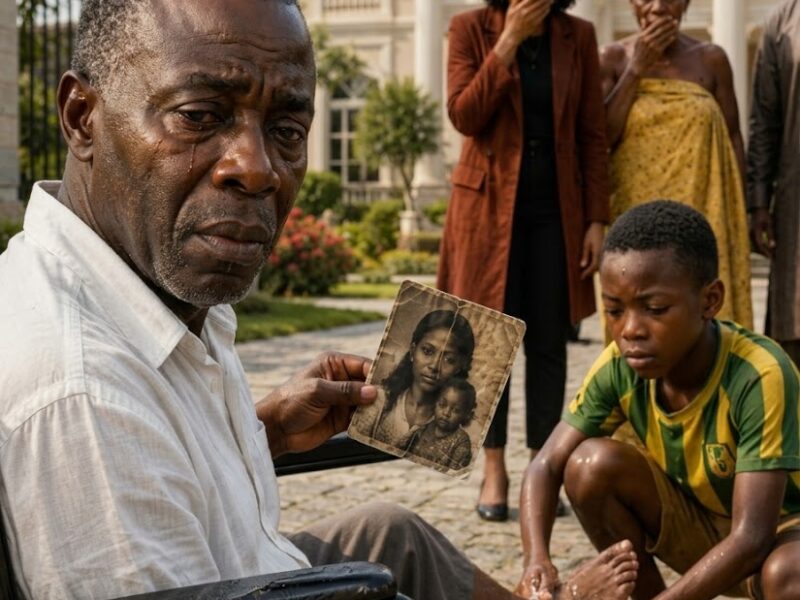
“I’ll Wash Your Feet and You’ll Walk,” a Poor Boy Told the Paralyzed Billionaire. The Board Panicked
You think just because you have money, you can do anything you want.
You are wrong.
You will pay for this.
>> Stop.
You don’t understand.
The world called Kojo a thief and shoved him back out into the rain.
And thirty seconds later, he climbed the wall of a billionaire’s estate anyway.
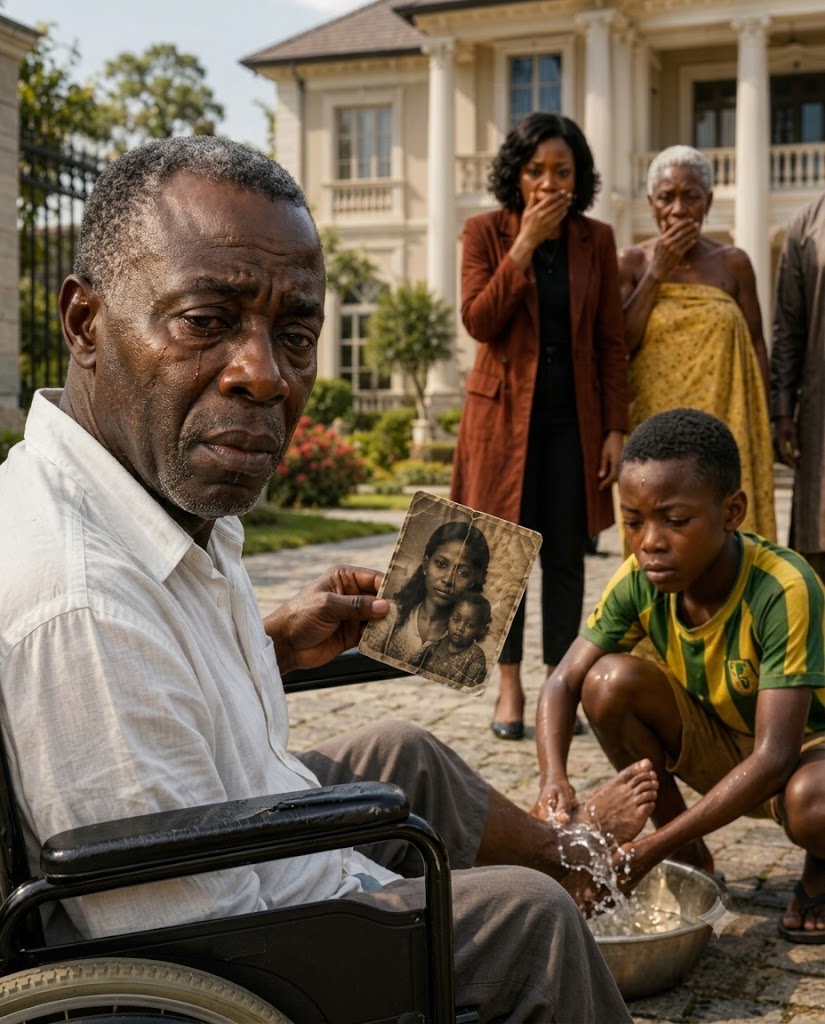
One wet afternoon in the hills above Accra, a paralyzed man named Julius Owusu Ansah laughed out loud when a barefoot boy dropped over his back fence carrying an old brass basin and said, without blinking, that he had come to wash the man’s feet so the man could walk again.
>> Snorts.
It should have been the end of the story.
Then Julius saw the photograph folded inside the basin and the laugh died in his throat.
Rain moved across the terrace garden in slow gray sheets.
It darkened the stone paths and pooled in the low corners of the lawn.
And it turned the surface of the swimming pool into something dull and metallic, the color of a coin left out in the weather.
Julius sat under the covered veranda in a wheelchair he had learned to hate, watching the water take the rain and give nothing back.
Three years earlier, he had been the most talked-about man in American business, the founder of Sankofa Nexus, the mobile money and solar company that had put electricity and a bank account into villages that had never had either.
His face had been on magazine covers from New York to Los Angeles.
Investors had flown in from London and Lagos to sit across a table from him and beg.
Now he spent his afternoons watching rain and feeling nothing.
Below his waist, the light aircraft had gone down over Lake Volta on a clear morning that turned violent in eleven minutes.
The crash had taken the use of his legs.
It had also taken his wife, who had lasted two years before she stopped being able to watch him disappear.
And most of his son.
And the future he had once assumed was his by right.
Specialists had flown him to Johannesburg and Frankfurt.
Every one of them arrived at the same word.
Permanent.
No recovery.
No second chance.
At first he had fought it.
Then he had prayed about it.
Eventually he had done neither, which was its own kind of quiet.
Somewhere near the gate a buzzer sounded.
A security vehicle rolled along the drive, tires hissing on wet gravel, and then everything was ordinary again.
Until it wasn’t.
Movement caught his eye at the rear wall near the old flame tree, and Julius frowned.
For a moment he thought the rain was playing tricks.
Then a small shape came over the top of the wall, hung for a second by its fingers, and dropped down onto the grass.
A child.
He could not have been more than eleven.
He wore a football jersey two seasons out of date, khaki shorts patched at one knee, and rubber sandals gone gray with age.
In one hand he carried a battered brass basin.
In the other, a folded white cloth held against his chest to keep it dry.
The boy landed lightly, steadied himself, and looked around the vast garden the way a person looks at something he has only ever seen from the outside of a fence.
Then he saw Julius.
He did not run.
He did not freeze.
He smiled, a calm and unhurried smile, the kind most grown men lose somewhere along the way, and started walking straight toward the veranda.
Julius’s hand drifted to the call button on the arm of his chair.
Two words to security and the boy would be gone.
His thumb rested on the button.
He did not press it.
Something about the way the child moved stopped him.
Some absence of fear that did not fit the situation at all.
The boy reached the edge of the veranda, out of the rain at last, and set the basin down on the stone with both hands.
Carefully, the way you set down something that matters.
Water dripped from the hem of his shorts.
He looked up, straight into Julius’s eyes, and did not look away.
“My name is Kojo Mensa,” he said.
His English was careful and school-taught, threaded with Twi.
Julius stared.
“Do your parents know you are here?”
The boy ignored the question entirely.
He unfolded the white cloth, laid it flat across his own knees, and then, without asking, knelt down on the wet stone.
Julius’s frown deepened.
“What are you doing?”
Kojo took a slow breath.
For a strange moment, the rain itself seemed to go quiet, the whole hillside holding still.
Then he said it, softly, as if it were the most reasonable thing in the world.
“I am going to wash your feet. And then you will walk.”
Silence.
One second, two, and then Julius laughed.
It was not a cruel laugh, and it was not a happy one.
It was the laugh of a man hearing something impossible, and it echoed under the veranda roof and out into the rain.
Kojo did not laugh.
He did not even smile.
He simply waited, kneeling, patient as stone.
Julius shook his head.
“Boy, you have no idea who you are talking to.”
Kojo looked at him steadily.
“I know exactly who I am talking to. You are Mr. Julius Owusu Ansah. Most people know that. You are lonely,” the boy said.
The laugh left Julius’s face.
“You stopped believing people the day they told you it could get better.”
“My grandfather said that happens to men who used to be strong.”
Something cold and unfamiliar moved through Julius’s chest.
“Who told you all this?”
“My grandfather.”
“Your grandfather knows me?”
Kojo looked down at the basin.
“Not exactly.”
The rain came harder, drumming on the roof.
Thunder rolled out past the ridge.
Julius studied the child on his stone floor.
Not dangerous.
Not calculating.
Just a very poor boy with a very old basin kneeling there with the certainty of someone holding a secret.
“Kojo,” Julius said carefully, “how did you get in here?”
“I climbed the wall.”
“Why?”
“Because I needed to find you.”
Security still had not come and part of Julius noted it and set it aside.
He had not pressed the button.
He kept not pressing it.
Kojo reached into the basin.
“You do not believe me.”
It was not a question.
“No,” Julius admitted.
“I know.”
“Then why are you here?”
“Because my grandfather said some people stop healing long before their body does.”
Julius leaned back.
His jaw tightened.
Three years of physiotherapists.
Three years of strangers telling him to keep a positive attitude.
He was tired in a way sleep did not touch.
“You should go home,” he said.
Instead of leaving, Kojo lifted something from the basin.
A photograph.
Old, its edges soft with handling.
The color faded to the browns of another decade.
Julius glanced at it the way you glance at anything a child holds up.
Then he stopped breathing.
The photograph slipped from Kojo’s fingers and landed face up on the wet stone.
The man in it was younger by twenty years, standing in front of a small clinic with a hand-painted sign, laughing, healthy, standing on his own two legs.
The man in it was him.
“Where,” Julius said, and his voice came out thin, “did you get that?”
Kojo picked the photograph up and wiped a drop of water from it with his thumb.
“My grandfather kept it.”
Julius’s heart was going fast now, faster than it had in years.
He remembered that day.
A fundraiser for a rural clinic outside Pando back when Sankofa Nexus was three people and a borrowed office.
Almost no photographs had been taken.
Almost no one alive would still have one.
“Who was your grandfather?”
“His name was Nana Kwabena Osei.”
The name landed somewhere far back in Julius’s memory.
Not close enough to place, but close enough to ache.
Kojo set the photograph back inside the basin, then stood.
Rain tapped the roof.
He smiled again, not because he had won anything, but as if he were sure this was only the beginning.
“I will come back tomorrow,” he said.
“Why?” Julius asked.
The boy glanced at the basin, then back at the man in the chair.
“Because my grandfather spent eleven years waiting for me to be old enough to find you.”
And before Julius could ask a single one of the questions crowding his throat, Kojo picked up his basin, turned, and walked back into the rain, leaving a billionaire alone under a gray Accra sky with one impossible thought turning over and over.
How had a barefoot boy from the wrong side of Accra ended up carrying a photograph the world had forgotten?
That night Julius did not sleep.
Rain kept tapping the tall windows long after the house went dark.
The photograph sat on the desk in his study under the small pool of light from a reading lamp, and he had looked at it more times than he could count.
Who was Kwabena Osei?
Why keep that photograph for over a decade?
And why send a boy now, after all this time?
His legs lay still beneath the blanket.
Three years since Frankfurt.
Three years since the last specialist used the word permanent as if it were a door closing.
And a boy with a basin had cracked that certainty in under ten minutes.
The next morning came in clean and bright, the way mornings do in the hills after rain.
Gardeners moved along the hedges.
Staff talk drifted through the house.
Everything looked normal except the man at the breakfast table who kept glancing toward the back wall.
He caught himself and was annoyed.
He was not waiting for anyone.
Certainly not for a boy who climbed walls and made promises no one could keep.
And yet when noon came and went and the wall stayed empty, something in him tightened that felt uncomfortably like disappointment.
Across the city, life ran to a different rhythm.
Nima had a music of its own, tro-tro horns and the slap of dominoes and the sizzle of plantain and oil at the corner of every lane.
Gutters ran gray.
Corrugated roofs threw back the heat.
This was Kojo’s world.
He lived in two rented rooms above a seamstress in a building where the stairwell smelled of kerosene and the one bulb on the landing had not worked in a year.
And still, the boy moved through it carrying more gentleness than most people carried through mansions.
He climbed the stairs that morning with two nylon bags of groceries.
One was his.
The other belonged to Auntie Comfort, who was seventy-nine and lived alone and whose knees no longer forgave the stairs.
No one paid him.
No one asked him to.
He simply did it.
When she opened her door and saw him, she smiled the way old women smile at something that reminds them the world is not entirely broken.
“You did not have to do this again.”
“I know, but I wanted to.”
She shook her head.
“Your grandfather would be proud.”
For half a second something crossed the boy’s face and then was gone.
Six months since the funeral.
He carried his grandfather everywhere now.
Most of all, in the old notebook zipped into the front of his school bag.
The notebook was falling apart, the covers soft as cloth, some pages stained brown at the edges.
Inside were notes and small drawings and half stories Nana Kwabena Osei had collected across a lifetime of tending to people the hospitals had finished with.
Most grown men who saw it called it superstition.
>> To Kojo, it was the most valuable thing he owned.
He walked down to the community kitchen behind the Presbyterian church where volunteers dished out rice and stew to anyone who came.
And the moment he stepped in, two of the cooks smiled.
Not because he mattered, but because he helped, always without being asked.
“Morning, Kojo,” called Mr. Boateng from behind the pots.
“Wipe the tables for me.”
The boy was already reaching for the cloth.
At the far end of the room, a young man sat alone in a torn jacket.
His shoes held together with wire.
And most people stepped around him without seeing him.
Kojo did not.
He carried over an extra bowl of stew.
“For you.”
The man looked up, surprised.
“Thank you.”
Kojo shrugged.
“My grandfather said nobody should eat alone.”
The man lowered his eyes, and for a moment looked as if he might weep.
That happened often around Kojo.
People felt seen when no one else had bothered to look.
Not everyone loved him for it.
Outside afterward, reading the notebook on the church step, he heard the older boys before he saw them.
“There goes the little healer,” one said, and another laughed.
“Still trying to fix people with river water.”
The words were old and worn, and they still found the soft place.
He kept his eyes on the page.
One of them jabbed a finger at the notebook.
“You really think that old book knows more than the doctors at Ridgecrest?”
He said nothing.
They tired of it and drifted off.
Their laughter trailed down the lane.
He turned to a page written in his grandfather’s slanted hand.
The ink gone pale, but the words clear.
Some wounds live in the body.
Some live in the heart.
And if you heal only one, the other keeps bleeding.
That was Nana Kwabena exactly.
The old man had never claimed to work miracles.
He had only ever listened and cared, and sometimes that turned out to be the same thing.
He turned another page, and this one was different.
A photograph had once been taped there.
You could still see four little squares of yellowed tape.
Beneath the empty space, his grandfather had written a name.
Julius Owusu Ansah.
Kojo traced the letters.
He remembered finding this page after the funeral, sorting through the old man’s things.
Most pages described patients and neighbors.
This one had dates and questions, and one line pressed hard into the paper.
If anything ever happens to him, find him.
He had not understood it, not until the evening he saw that same face on a neighbor’s television, a report about the Great Sankofa Nexus and its founder who no longer appeared in public.
The moment he recognized the face, he knew.
So he would.
It was as simple as that to an eleven-year-old, and maybe that simplicity was its own kind of courage.
Miles away, Julius sat under the veranda again.
He checked his watch.
He looked at the wall.
And then at last, a small shape in a faded jersey came over the top of it, basin in hand, walking toward him with the same fearless calm.
And this time Julius understood something that unsettled him more than anything the boy had said the day before.
He was glad the child had come back.
He simply did not yet know why.
And neither of them knew that inside the old man’s notebook lay a fact that could unmake everything Julius believed about the morning his plane fell out of the sky.
This time the guards saw him.
Two started across the lawn before Kojo was halfway to the house.
“Sir, the boy is back.”
Julius looked up from the financial report lying unread on his lap.
For a moment, he considered the simple thing, the logical thing, the thing the old Julius would have done without a flicker of thought.
Instead, he surprised himself.
“Let him through.”
The guards traded a glance.
“Sir?”
“You heard me.”
They stopped.
Kojo kept walking, the basin swinging gently at his side, and reached the veranda and smiled.
“Good afternoon, Mr. Owusu Ansah.”
“You came back.”
“You sound surprised.”
“I am.”
The boy set the basin down.
“I said I would.”
Something about that plain certainty made Julius shake his head.
Grown men broke their word.
Business partners broke their word.
Friends had vanished the moment his life became difficult.
This child treated it like something you could hold in your hand.
Kojo sat on the edge of the veranda.
For a while, neither spoke.
“What exactly did your grandfather tell you about me?” Julius finally asked.
Kojo considered it.
“Not much.”
“Then why did he keep my photograph?”
“Because he said one day you would need help.”
Julius laughed softly, and it came out more bitter than he meant.
“Looks like he was right.”
Kojo tilted his head.
“You are sad.”
Julius looked out at the garden.
“No.”
“Yes, you are.”
The bluntness caught him off guard.
Children were usually afraid of him.
>> Employees certainly were.
No one just looked him in the eye and told him the truth.
No one except this boy.
“You are very sure of yourself for a small boy.”
“My grandfather said people get angry when someone tells them the truth.”
That almost made him smile.
Almost.
Kojo opened the basin.
Inside were folded cloths, a small cork bottle, a twist of dried leaves, the photograph, and the notebook.
Julius’s eyes went to the notebook.
“You carry that everywhere.”
The boy pulled it closer.
“Yes.”
“What if you lose it?”
“I will not.”
There was something fierce and protective in the way he said it, and Julius recognized it because he used to feel exactly that way about certain things before the lake, before everything came apart.
The memory pulled at him, and he let it.
The aircraft coming back from a site inspection near Kapando, routine.
Then the weather turned fast and mean, and the next thing he clearly remembered was a hospital ceiling, and a doctor’s careful voice explaining that his spine had taken a blow it would not come back from.
His wife, Abena, had not left because she stopped loving him.
She left because she could not keep watching the man she married go out like a lamp, room by room.
His son, Kwesi, had blamed everyone, and now weeks went by without a call.
Only the money stayed.
Money filled the rooms and paid the specialists, and could do nothing at all about the silence, and there was a great deal of silence.
“What are you thinking about?” Kojo said.
Julius blinked.
He had drifted.
“Nothing.”
“My grandfather said people only look like that when they are remembering something that hurts.”
Julius looked at the boy.
“You know, for someone who is eleven, you talk like you are ninety.”
Kojo grinned.
“My grandfather talked enough for two people. Some of it stuck.”
And that, unexpectedly, pulled a real chuckle out of Julius, the first in longer than he wanted to admit.
The boy’s eyes brightened.
“There it is.”
“There is what?”
“You forgot how to do it.”
“I did not.”
“You did.”
Again the certainty, again the honesty, and strangely he did not mind.
A voice cut across the veranda.
“Father.”
Kwesi Owusu Ansah stood at the door, tall, in a suit that cost more than the building Kojo lived in, an expensive watch and an expensive frown.
His face went hard the instant he saw the boy.
“What is he doing here?”
Kojo lowered his eyes.
He had seen that look many times, the look that decided about him before it learned his name.
>> He is visiting,” Julius said.
“He is trespassing.”
Kwesi came closer, his gaze moving from the basin to the notebook to the boy himself.
“What do you want? Money?”
“No.”
“Attention?”
“No.”
“Then why are you here?”
Kojo looked up at him, steady.
“To help your father.”
Kwesi laughed, short and without warmth.
“Help him?”
He turned to Julius.
“Dad, this is absurd.”
Julius said nothing, and the nothing surprised Kwesi, because the old Julius would already have agreed.
Instead, the man in the chair watched and waited and listened.
Kojo stood.
His small frame looked smaller beside the tailored suit, and still he did not shrink.
“My grandfather said everyone needs help sometimes.”
“My father has the best doctors on the continent.”
“Maybe. But he is still sad.”
The words landed harder than the boy intended.
For a moment something like guilt flickered over Kwesi’s face, and then pride pushed it down.
“You are a child. You know nothing about our lives.”
“No. Then stop pretending you do.”
It was not the cruelest thing a person could say.
It was enough.
Enough to make Kojo look at the floor.
“Dad, this has to stop.”
Julius’s voice came out with an edge that had built companies.
“Leave it alone.”
Kwesi stared.
“What?”
“I said leave it alone.”
For the first time in a long time, the son stepped back.
Kojo quietly reached for his basin.
“I should go.”
“No,” Julius said.
The boy hesitated.
Kwesi shook his head, turned, and walked back into the house.
Kojo sat back down slowly.
His smile was gone.
“Do not mind him,” Julius said.
“It is all right.”
It is.
The boy shrugged.
“I am used to it.”
And that answer hurt Julius more than he expected because an eleven-year-old should never say those words about being dismissed.
And yet the boy said it the way you report the weather.
Julius looked out over the garden and for the first time in years something in him shifted, only slightly.
He knew what it was to become invisible.
Not in the same way, but close enough.
The light dropped lower and turned gold.
Kojo opened the notebook to check something and a loose sheet of paper slipped free and drifted down unnoticed by them both and came to rest half under the wheel of Julius’s chair.
On that page was a name, a doctor’s name, connected to the very night Julius’s world ended.
The next afternoon the sky was clean and hot, the rain a memory.
Kojo came over the wall as he always did.
When he reached the veranda he found the man already there watching the wall.
And Julius looked away too quickly.
As if he did not want to be caught waiting.
Kojo noticed.
He always noticed.
“You were waiting.”
“I was not.”
“You were.”
Julius sighed.
“You enjoy being right.”
“Only when I am right.”
And that earned a reluctant real smile.
Today the boy moved with purpose.
He unfolded the white cloth.
“My grandfather called this waking up sleeping feet.”
He took small cloth bundles from the basin, then a jar of coarse gray salt, then the twist of dried herbs and the smell of them rose into the warm air, green and sharp and strangely familiar.
He poured warm water from a thermos into the basin and set the herbs to steep and steam curled up.
“Where did you learn all this?”
“My grandfather. He started teaching me when I was five.”
“And you remember it.”
“The important parts.”
There was no boast in it, only fact.
He rolled up the cuffs of Julius’s trousers and looked at the still unresponsive legs.
Three years.
No one had touched them outside a clinic in three years.
“Can I?” Kojo asked, and something about being asked, being treated as a man and not a case, made Julius nod.
The boy removed his shoes and socks, gently, without a trace of pity, and lowered the man’s feet into the warm herb water.
The heat spread up through skin that had felt cut off from the world, and Julius closed his eyes.
It was not dramatic.
It was not a miracle.
It was pleasant, and pleasant had become rare.
Kojo began to wash, slowly, not like a nurse and not like a therapist, but like someone caring for another person.
No rush, no performance, no expectation.
“Do you miss her?” the boy asked.
Julius opened his eyes.
The question went straight in.
He knew who she meant.
“Yes.”
It came before he could stop it.
Kojo nodded.
“My grandfather said missing someone is proof they mattered.”
Julius swallowed against something in his throat.
“Your grandfather was a wise man.”
“He would have liked you.”
“He never met me.”
“He knew enough.”
Then Kojo pressed his thumb into the sole of Julius’s foot, moved it, pressed another spot.
“Does this hurt?”
“No.”
“This?”
“No.”
He pressed higher, along the arch, and Julius frowned because for the briefest instant, so small it might have been nothing, there was a spark, like the static snap off a wool blanket, gone before he could name it.
But there.
His eyes widened.
Kojo went still.
“What?”
Julius looked down at his own foot, and his heart began to knock against his ribs.
“Do that again.”
The boy pressed the same spot once, twice, three times.
A faint prickling, barely there, but real.
Three years of nothing, then this.
Not movement, not recovery, just a whisper, but enough to make a man question everything.
Kojo’s eyes lit up.
“You felt something.”
Julius said nothing.
His mind was racing.
“My grandfather said sleeping things wake up slowly,” the boy offered.
And for the first time Julius did not dismiss the phrase because for the first time he wanted it to be true.
Footsteps.
Auntie Ajoa, the housekeeper who had run this house for two decades, stopped at the veranda door and took in the basin, the herbs, the boy kneeling at her employer’s bare feet.
“And what exactly is happening here?”
Kojo scrambled up.
“He is helping,” Julius said.
Ajoa blinked.
That was not the answer she expected.
She looked the boy over, the old jersey, the gray sandals, the falling-apart notebook, and to her credit, she did not sneer, though she plainly did not understand.
“Shall I call security, sir?”
“No.”
It came fast and it surprised her.
“Very well, sir.”
She left, but not without one long backward look.
When the door closed, Kojo sat again.
“You trust me?”
Julius considered the word trust, a dangerous word, one he had retired years ago.
“I do not know.”
Kojo nodded.
“That is all right.”
“Why?”
“Because trust grows.”
Simple.
Always simple.
The session ended near sunset.
Kojo dried the man’s feet with the white cloth and packed his things.
And as he lifted the basin, Julius saw the folded sheet of paper on the ground where it had lain since the day before, half under his wheel.
He bent, worked it loose, and unfolded it.
At the top in the old man’s hand was a name.
Dr. Solomon Bediako.
The name hit him like a hand on the back of the neck.
His first neurologist.
The man who had stood at the foot of his hospital bed and delivered the verdict.
Why would Kwabena Osei have written down that name years ago with three hard question marks beside it and one line underneath pressed deep into the paper.
This diagnosis does not fit.
Julius stared at it and a chill went through him despite the heat because for the first time in three years, he was not wondering whether he could walk again.
He was wondering whether someone had lied to him.
Julius was awake before dawn, alone in his study.
On the desk lay the old page beside three years of medical records, hundreds of appointments, thousands of pages, and one name repeating through all of it.
Dr. Solomon Bediako.
A soft knock.
“Come in.”
His lawyer, Mr. Tetteh, stepped inside.
A man who had worked for him fifteen years and who noticed trouble before it arrived.
Tetteh took one look at the page on the desk and something crossed his face.
A flicker, gone in an instant, but Julius had not built an empire by missing flickers.
“You recognize it.”
“It is nothing.”
“Your face says otherwise.”
“Where did you get this?”
“A friend.”
A week ago, he would have called the boy a trespasser.
Now the word friend came out on its own.
Tetteh set the page down.
“Does this have anything to do with that boy?”
The room went quiet and the quiet was answer enough.
“Julius, this needs to stop.”
“He asked one question.”
“A boy asked one question in three years that no one else thought to ask.”
Tetteh changed tack.
“People are talking. The board, the investors. There is a video.”
He turned his phone around.
Someone on the ground staff had filmed the boy washing Julius’s feet, thirty seconds of it, and the internet had done the rest.
A billionaire in a wheelchair, a barefoot child kneeling with a basin, herbs, water, six hundred thousand views and climbing, and comments that mocked Julius and mocked the boy and mocked them both.
The headlines were worse.
Sankofa founder abandons doctors for street healer.
Has Julius Owusu Ansah lost his mind?
Anger rose in him, not because they were laughing at him, but because they were laughing at Kojo, a boy who had never asked for a single thing.
“This is becoming a problem,” Tetteh said.
“For whom?”
“For everyone.”
>> And that answer told Julius everything.
This was not about protecting him.
It was about protecting the picture people preferred, a powerful man who had accepted his defeats quietly, rather than one who had started asking uncomfortable questions in a very quiet house.
Across the city, Kojo had no idea any of it was happening.
Near closing at the community kitchen, Mr. Boateng handed him a phone with a troubled look.
Kojo watched himself on the little screen, watched the comments scroll.
Little con artist.
Using a kid for clout.
His smile faded.
Mr. Boateng regretted it at once.
“I am sorry.”
Kojo handed the phone back.
“It is all right.”
It was not, and they both knew it.
“People can be cruel,” the old man finally said.
“My grandfather said people are usually afraid of what they do not understand.”
“Your grandfather sounds like a wise man.”
“He was.”
The boy’s voice caught just slightly, just enough.
He stood and gathered the basin.
“It is time.”
Despite the video, despite all of it, he was still going.
Because helping the man had never once been about being seen.
Julius saw the change in the boy the moment Kojo came over the wall.
That evening, the smaller smile, the lower shoulders.
“What happened?”
“Nothing.”
Julius held up his phone.
“I saw the video.”
That stopped the boy.
He sat down.
“They think I am lying.”
“I know.”
“They think I want money.”
Julius’s jaw tightened.
“I know.”
Kojo looked at the ground, and for the first time since they had met, he looked like exactly what he was, a small boy carrying far more than his share.
“They laughed at my grandfather, too,” he said quietly, “when he helped people. Some of them called him a fraud.”
And that struck Julius because he suddenly understood that being doubted and dismissed was not new to this child.
It was the water he swam in, and still he kept helping.
>> The veranda door banged open.
Kwesi, phone in hand, fury on his face.
“Dad, this has gone far enough. Do you have any idea what is happening? Our share price dropped almost four percent today.”
Julius looked at his son.
“That is what worries you?”
“Of course it worries me. The board is worried. The whole market thinks you have lost control.”
Kojo lowered his eyes, and Kwesi somehow got angrier for it.
“I should go,” the boy said, standing.
“No,” Julius said, and there was a force in it Kwesi had not heard in three years, the voice that had once filled boardrooms.
“Sit down.”
The boy hesitated, then obeyed.
“You are choosing him over your own family,” Kwesi said.
Julius held his gaze.
“No. I am choosing kindness over fear.”
Silence complete.
Kwesi looked stunned, and so did Kojo.
Then the son turned and walked out, and the door slammed, and the sound rolled out across the darkening lawn.
Before he left, Kojo set the white cloth beside the man’s chair.
“You forgot this.”
“No, I brought it for you.”
“Why?”
“Because everyone needs something clean to hold when the world gets dirty.”
The answer stayed with Julius long after the boy was gone.
That same night, while the whole city was busy laughing at a boy with a basin, no one noticed something far more important.
In an office tower on the ring road, a man was quietly deleting files connected to Dr. Solomon Bediako.
Someone was tidying up old records.
Someone was afraid, and fear only shows itself when the truth is getting close.
The next days changed the shape of Julius’s mornings.
He stopped watching the rain and started reading.
Every file he opened raised another question.
Records were missing.
Notes had vanished.
Several digital entries had been edited months after his diagnosis, long after any doctor should have touched them.
The deeper he went, the more resistance he met.
Tetteh grew evasive.
Board members became hard to reach.
Bediako’s clinic said certain files could no longer be located, lost, misfiled, unavailable.
The excuses sounded rehearsed, and a man who had negotiated with governments knew the sound of a rehearsed excuse.
One afternoon, Kojo arrived to find the study buried in paper, folders, and printouts, and notes spread across every surface.
He stepped inside and stared.
“What happened here?”
Julius looked up, his eyes tired but sharp in a way they had not been in years.
“I am trying to find out whether I have been lied to.”
The words hung between them.
Then Kojo saw a medical chart lying open at the edge of the desk.
Scans and diagrams and something on it stopped him cold.
He grabbed the notebook, flipped pages fast until he found it, and laid it beside the chart.
A hand-drawn sketch, old and faded, and nearly identical to the scan.
His heart began to race.
“What is it?” Julius asked.
Kojo pointed.
“My grandfather called this a sleeping river.”
“A what?”
“A sleeping river,” he said.
“Sometimes a nerve looks dead even when it is not dead. Sometimes the road it takes goes underground where you cannot see it. And if the doctor stopped looking too soon, they miss what is still alive.”
The room fell silent.
Julius stared, his pulse climbing, because Kwabena Osei’s words stopped sounding like folk wisdom and started sounding like a warning written years in advance, pointing at the exact doctor now appearing in every gap in his records.
Julius reached for the phone.
“I am getting a second opinion.”
And Kojo smiled, a real one, the first in days.
It lasted only seconds.
“You are doing what?”
Kwesi again, in the doorway, a tablet in hand, patience gone.
He crossed to the desk, pointed at the boy.
“You are making medical decisions based on a notebook.”
“It is more than that.”
“No, it is not.”
His voice cracked around the room.
Kojo felt the old sting.
Then Julius spoke, slowly, deliberately, the way he used to close a deal.
“You know what is interesting? For three years, nobody questioned the diagnosis. Not one person. Not one. Then a boy asked one question, and suddenly everyone wants him to stop asking.”
Kwesi did not answer, because somewhere under his anger he knew his father was right.
Three days later, Julius sat in the waiting room of one of the most respected neurology clinics in West Africa, rain tapping the glass, a folder of old scans and copied notebook pages in his lap.
Across from him sat Kojo, basin at his feet, notebook under his arm, small in the enormous room and completely unafraid.
“You nervous?” Julius asked.
“A little.”
“Me, too.”
That surprised the boy.
“Billionaires get nervous more often than you would think.”
A door opened, and a woman in her early fifties stepped out, confident, warm-eyed.
“Mr. Owusu Ansah, I am Dr. Efua Sarpong.”
The second opinion had finally arrived.
Inside, she read the file in silence, flipping pages, her expression growing more serious with each one.
“What made you seek another evaluation?”
Julius glanced at Kojo and the doctor followed his gaze and her face softened.
“You can tell me.”
So he told her everything.
The notebook, the photograph, the spark in his foot, the edited records, the missing files, the name that would not stop appearing.
She listened without once interrupting or dismissing him.
Then she asked a single question.
“May I see the original scans?”
They came up on the wall screen, black and white and gray, patterns only a specialist truly reads.
She studied them.
Minutes passed.
Then she leaned closer, frowned, leaned closer still and pulled up a newer set beside them for comparison.
Her eyes widened just slightly, a reaction most people would have missed.
Julius did not.
“What is it?”
She turned to him.
“Mr. Owusu Ansah, there is something here I do not understand. I need to run more tests because some of what I am seeing does not match your original diagnosis.”
The rest of the day blurred into reflex tests and sensitivity measurements and neurological evaluations.
Each result adding another layer of confusion.
By evening she called only Julius into her office and closed the door.
The injury was real, she said.
You were seriously hurt.
He nodded.
“But,” she said, and the word hung in the air.
“But what?”
She slid several images across the desk.
“Based on everything I have reviewed, I do not believe your recovery potential was ever zero. There were signs, small ones, rare ones, but signs.”
His breathing slowed and nearly stopped.
For three years every specialist had said the same thing.
Impossible.
Permanent.
Finished.
Now one doctor had taken it apart with a single sentence.
“How small a chance,” he managed.
“No one can say. But it was not zero.”
Three years.
Three years stolen by two words.
What would have happened if therapy had started differently?
She did not answer, and the silence answered for her.
He came out of the office a different shape than he went in.
>> Kojo stood at once.
“What happened?”
For several seconds Julius could not speak.
Then he whispered it.
“You were right. You and your grandfather.”
And for the first time since the lake, tears stood in his eyes.
Not tears of defeat, but something he had almost forgotten the name of.
He put a trembling hand over the boy’s small one.
The door was never all the way closed.
That night the truth stopped being an accident and started being a crime.
A private investigator Julius had quietly hired delivered a file.
Dozens of pages, internal emails, financial records, and one devastating thread.
Dr. Solomon Bediako had for the last four years been a paid consultant to the Meridian Trust.
A holding vehicle that had steadily bought up shares in Sankofa Nexus.
A vehicle whose largest single beneficiary was a man Julius trusted with the running of his company.
Bernard Fori, deputy chairman.
His late wife’s cousin.
The man who ran board meetings while Julius sat at home in the rain.
Julius read it twice, then a third time.
The company’s charter contained an incapacity clause.
Common enough, drafted by lawyers years ago.
If the founder were medically certified permanently incapable of leading, control of his voting shares would pass to a trust administered by the board until succession could be arranged.
Permanently incapable.
The exact phrase.
And the doctor who had certified it permanent had been on Bernard’s payroll the entire time.
This had never been about an insurer saving money on a claim.
This had been a slow, patient theft of an entire company.
And the price of it had been three years of a man’s life.
He did not sleep.
Somewhere past two in the morning, he found the last document in the file, a thin one, older than the rest.
A note in the hospital’s own logbook dated eleven days after the crash in a careful hand.
An orderly had flagged an inconsistency between the neurologist’s dictated report and the scan stored in the imaging system and had requested a review.
The request had been denied and the orderly reassigned.
The name in the logbook was Kwabena Osei.
The old man had seen it.
Three years ago, working the night shift at Ridgecrest to make rent, he had seen the seam in the lie and pulled at it, and powerful men had quietly cut the thread and sent him back to Nima.
But he had written it down.
He had always written it down.
And he had spent the rest of his life waiting for a boy to grow old enough to carry it up a hill.
What came next did not happen the way it happens in films.
There was no single dramatic phone call.
Julius did something colder and more patient.
He copied everything three times, to three different lawyers in two countries, and then he did what Bernard had never expected a broken man to do.
He called an emergency board meeting and invited the one thing self-righteous men cannot survive.
Witnesses.
On the morning of the meeting, the boardroom on the fourteenth floor was full, directors and counsel, and two people from the exchange’s compliance office, who had been sent a copy of the file the night before by a source no one could trace.
Bernard Fori sat at the head of the table, calm, certain, a man who had spent three years being right.
“I called this meeting,” he began smoothly, “because the founder’s recent conduct raises serious governance concerns. It gives me no pleasure. We have a duty to protect this company and its standard of leadership.”
There it was, the whole vocabulary of the self-righteous, duty and standards, and the great regret of doing the necessary cruel thing.
Then the door opened and Julius came in.
Not in the wheelchair.
On two forearm crutches, slowly, one careful step at a time, a physiotherapist a pace behind him, and Dr. Efua Sarpong beside her.
The room went silent the way a room goes silent when the story it had agreed to believe walks in and refuses to be true.
Bernard’s calm slipped just for a second, and in that second Julius saw everything.
“Sit, Bernard,” Julius said.
“You called this meeting to certify me incapable. Let us talk about certificates.”
He laid the file on the table.
He did not raise his voice once.
He let the paper speak.
The Meridian Trust, the consultancy payments to Bediako of two hundred eleven thousand dollars a year.
The edited scans, timestamped at 10:47 on a night the founder was sedated.
The logbook entry in a dead orderly’s hand.
One by one the pieces went down on the table like cards.
And the beautiful, terrible thing was that it was Bernard’s own process that convicted him.
His own meticulous minutes.
His own signed authorizations.
His own paper trail built to look like good governance.
He did not break the way villains break in stories.
He got louder.
He said the payments were consulting fees, entirely proper.
He said the incapacity clause was there to protect shareholders.
He said he had acted within the rules at every step, and he said it again and again, gripping the edge of the table.
And the more he insisted on the rules, the more the rules closed around his throat, because everything he was proud of was written down and signed.
He was not sorry.
Men like him are never sorry that they did it.
They are only sorry that it stopped working.
“You would have let me sit in that chair for the rest of my life,” Julius said quietly, and it was not a question.
Bernard’s mouth opened and closed, and no rule came out.
And then the room did what rooms do when one brave voice makes space for others.
A junior nurse named Ama Adarti stood up at the back where the compliance officers had asked her to wait.
Her hands shook and her voice shook and she said she had been on shift the night the imaging file was altered.
That she had seen who came and went.
That she had said nothing for three years because her mother’s treatment was paid by this company and she was afraid.
And that she was more afraid now of never having said it.
Then the imaging technician who had been quietly transferred to a rural post spoke over a video link and confirmed the timestamps.
Then one of the directors, an old man who had signed things he should have questioned, pushed back his chair and said he would be resigning and cooperating fully and that he was ashamed it had taken a child and a basin to make him look.
Three of them.
The old man had written it in the notebook years before.
The exact number it takes.
Some lies only fall when three people who were afraid decide to be brave in the same room.
The morning after the story broke and this time no one was laughing at a boy.
The exchange suspended trading pending review.
Bernard Fori was removed and referred for prosecution.
Dr. Solomon Bediako lost his license within the year and would spend a long time explaining two hundred eleven thousand dollars a year to people who were not impressed by his standing.
The Meridian Trust unwound.
And through all of it Julius found to his own surprise that he cared less and less about the verdict because the thing he had actually gotten back could not be entered into any ledger.
The therapy did not become a miracle.
It became work.
It became mornings that hurt and afternoons he wanted to quit.
Months of a leg that would not answer and then one Tuesday answered.
A twitch became a flicker.
A flicker became a wobble.
A wobble became a step and the step became two and two became a slow, ugly, glorious walk across a rehabilitation room while a physiotherapist cried and Dr. Sarpong laughed and Kojo very nearly knocked him over with the force of his hug.
And every single afternoon without fail the boy came over the wall with his basin because some things do not change even when everything else does.
Kwesi changed, too, slower than his father’s legs and more honestly.
He came to the study one evening and sat and stared into his coffee for a long time before he said, “I was wrong about him.”
Julius waited.
“I thought he was taking advantage of you. I think he saved you.”
Julius looked toward the dark garden.
“He did.”
Neither of them said anything else.
Some truths speak for themselves and then just as everything was steadying Kojo disappeared.
The first day Julius was not worried.
The second was stranger.
By the fourth worry had become fear and he set his whole apparatus of drivers and contacts loose across the city and the answer when it came hollowed him out.
The building above the seamstress in Nima had been condemned after an inspection found the foundations unsafe and the tenants scattered, some to relatives, some to nowhere.
An eleven-year-old with no parents and no grandfather had been placed in a state-run children’s home on the edge of the city.
Nobody had told Julius.
Nobody had known to.
The boy had never mentioned it once.
Not while washing a rich man’s feet, not while carrying a dead man’s warning up a hill, not once.
Julius went himself.
The home was clean and safe and cold in a particular way of places people end up when the world stops offering them choices.
A social worker led him down a hallway hung with the children’s drawings.
And there, by a window at the end of a common room, sat Kojo, basin at his feet, notebook in his lap, watching the sun go down over Accra.
And the sight broke something in Julius.
Because for the first time since he had met him, the boy looked small.
Not brave, not certain, just small.
A child caring far too much.
Kojo looked up and saw him and smiled the same smile.
“Mr. Owusu Ansah.”
Julius swallowed.
“Hello, Kojo. What are you doing here?”
And the only possible answer came out easily.
“I came looking for you.”
And for the first time since his grandfather died, the boy’s eyes filled.
And this time he could not blink it away.
“Why did you not tell me?” Julius asked.
Kojo looked at the notebook.
“I did not want you to worry. You were busy. The doctors, the lawyers, the newspaper people. You had important things.”
And Julius closed his eyes because for years he had been surrounded by people who wanted things.
And the one person who had requested nothing except quietly into a shelter had gone quietly into a shelter rather than add himself to the list.
On the little table beside the boy were papers Kojo tried to cover.
And Julius gently took them.
Rent arrears in a dead man’s name.
Utility notices.
A clinic bill from the grandfather’s last illness.
And beneath them, page after page in a careful child’s hand, a schedule.
Every therapy session, every exercise, every small observation.
And at the top of every page, one name.
Julius Owusu Ansah.
Not one line mentioned money.
Not one.
Only notes about helping a stranger stand.
“Why did you keep doing all this?” Julius asked.
And the boy looked genuinely puzzled, as if the answer were the plainest thing in the world.
“Because you needed help.”
That simple.
That honest.
That impossible to buy.
The social worker returned to say visiting hours were ending, and Julius should have left.
And instead, he looked at the boy and asked, “Would you like to come back tomorrow? For therapy. For anything.”
Kojo laughed, wet and surprised, the first laugh all evening.
“I have missed my coach,” Julius said, and even the social worker smiled.
As he turned to go, the boy stopped him.
“Mr. Owusu Ansah, you know what my grandfather used to say?”
“What?”
“People do not always need someone to save them. Sometimes, they just need someone who does not leave.”
The words followed Julius all the way up the hill, and did not let him sleep.
The next morning, he called his lawyers, and then his son.
And when Kwesi read the file on the desk, he looked up in something close to shock.
“Dad, I am serious. You have already decided?”
“Yes.”
And Kwesi, to his own surprise, smiled.
“About time. I think you have been us family for weeks.”
The change did not arrive in a grand gesture in a ballroom.
It arrived in a small government office three weeks later, in the smell of floor polish and old paper, with a magistrate reading glasses low on her nose, and a social worker signing where the tabs were stuck.
And Kwesi, in a plain shirt, and Auntie Ajoa dabbing her eyes and pretending it was the air conditioning.
Kojo did not fully understand what the papers meant until Julius explained it twice.
And even then, the boy kept looking at the man in the chair as if the floor of his life had quietly changed shape beneath him.
Guardianship, a home, a name on a form that said someone would not leave.
When it was done, Kojo did not cheer.
He simply put his hand into Julius’s the way he had that first evening in the clinic, and neither of them said anything because some truths speak for themselves.
The years did what years do.
The condemned building came down, and something better went up in its place, funded quietly.
No plaque with Julius’s name on it because he asked for it that way.
>> One wing of the estate became a center for rehabilitation and transport and support for children from families the hospitals had finished with, and the waiting list grew long, and families came from Accra, and then from Kumasi, and then from farther.
Above the entrance, a small brass plate carried three words and a name, the Kwabena Osei Center, and beneath it in the old man’s own slanted hand, copied from a page in a falling-apart notebook, a single line.
A sleeping river is not a dead one.
Kojo stayed exactly himself.
The house did not change him, >> and the school fees did not change him, and the attention certainly did not because his grandfather’s lessons ran too deep to be washed out by comfort.
He still went down to the community kitchen most afternoons.
He still carried Auntie Comfort’s groceries up the stairs of her new building until the day her knees stopped needing the help for good.
He still carried the notebook everywhere.
Nearly ten years after a barefoot boy came over a wall, the sky over a university courtyard stretched an endless cloudless blue, and among the graduates in their gowns stood a young man who was no longer small.
When his name was called, a man stood up first in the front row, without crutches now, slowly but on his own two legs, and after him, a woman who had once been a frightened junior nurse, and a housekeeper, and a brother, and two dozen children from a center on a hillside, until the whole row was standing.
Afterward, Julius handed him a wrapped package, and inside was the notebook, its cover restored and protected but unmistakably the same.
And on the first page, in Julius’s hand, a line the young man read twice before he could see the rest of the world again.
You washed my feet, but you taught an old man how to walk.
And under it, one word.
Family.
Some years after that, on an ordinary bright afternoon, a boy of eight sat in a wheelchair by a window at the Kwabena Osei Center, scared and certain his life was over, wearing the exact expression a billionaire once wore in the rain.
A young physiotherapist came in quietly, carrying something under his arm, and set an old brass basin down on the floor with both hands, carefully, the way you’d set down something that matters.
He knelt.
He unfolded a clean white cloth, and outside the window, on the hill, the light lay gold across the garden, >> and the water in the fountain kept moving, the way water does, going where you cannot always see it.
If a story like this one moved something in you, do this old man in the chair a small kindness.
Subscribe, and stay a while because there is always another one waiting, and the next one might be about someone exactly like you.









