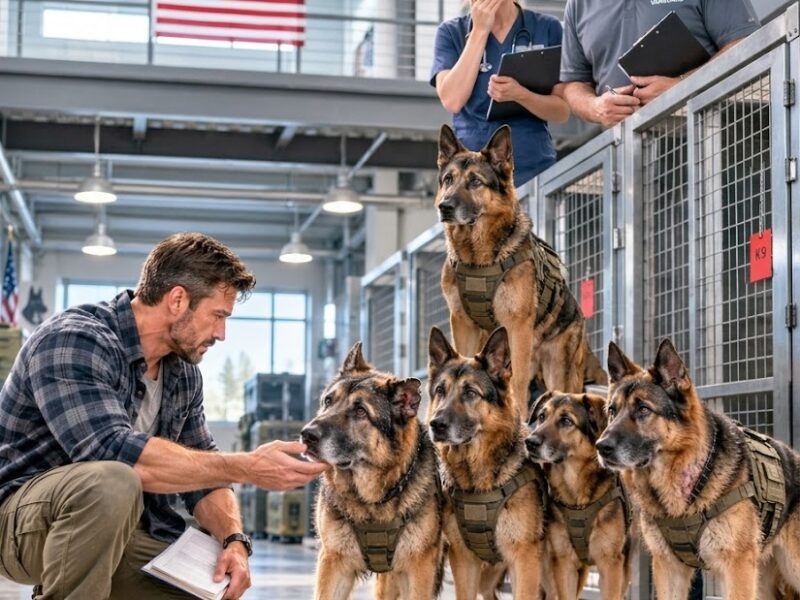
“I’ll Take Every One of These Retired K9s,” the Navy SEAL Declared—The Shelter Staff Thought He Was Crazy Until They Discovered His Unbelievable Plan
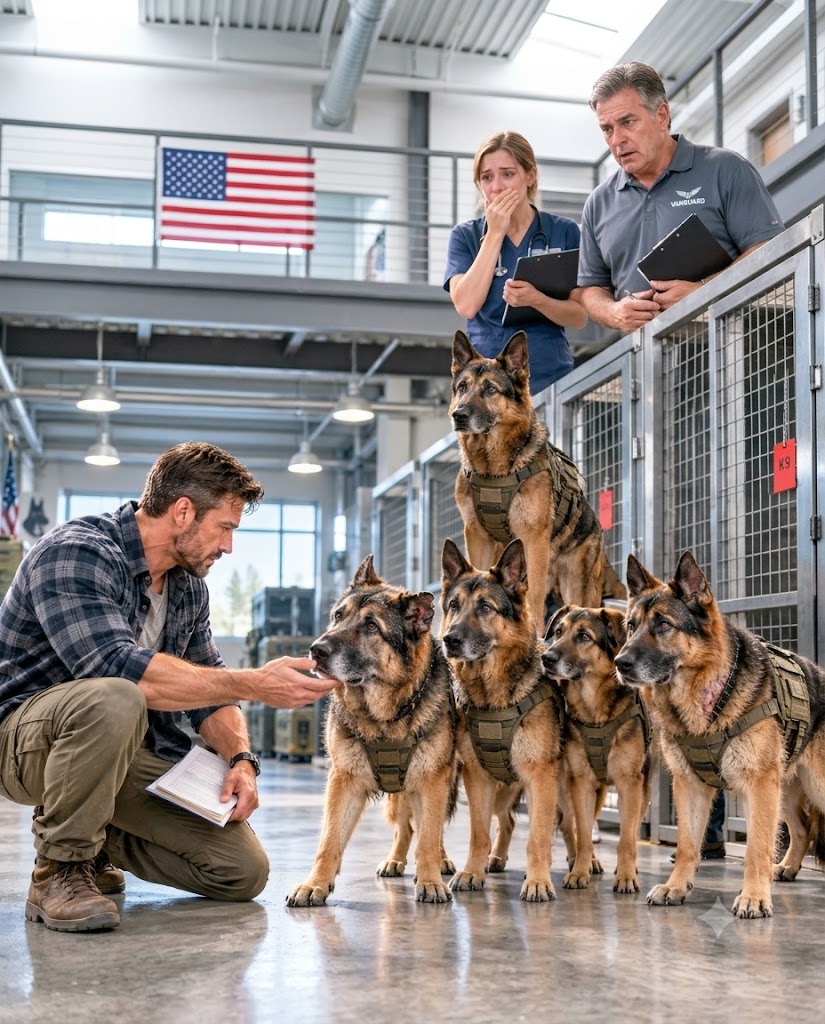
The fluorescent lights inside the intake office of Vanguard Defense Kennels buzzed with a cold, sterile hum that set retired Navy SEAL Senior Chief Luke Donovan’s teeth on edge.
Located six miles west of Joint Base San Antonio–Lackland in Texas, the private subcontractor was paid to process, evaluate, and transition decommissioned military working dogs returning from overseas deployments.
On paper, the facility boasted climate-controlled runs and behavioral rehabilitation specialists.
In reality, it smelled of industrial bleach, wet concrete, and quiet desperation.
Luke stood at the reinforced glass counter, his broad shoulders stiff beneath a faded flannel shirt.
A jagged shrapnel scar ran from the corner of his left jawline down into his collar—a permanent souvenir from his final deployment with SEAL Team Five out of Naval Amphibious Base Coronado.
He tapped his weathered knuckles against the stainless steel counter and stared at the facility’s administrative director, Philip Montgomery.
Montgomery didn’t look up from his dual-monitor computer setup.
He wore a pressed slate-gray polo embroidered with the Vanguard logo and a gold Tissot watch that caught the harsh ceiling glare every time his fingers clicked the mouse.
“I told you on the phone Tuesday, Mr. Donovan,” Montgomery said, his voice oiled with practiced bureaucratic boredom.
“Multi-purpose canine Brix, tattoo identification number K9-T884, failed his civilian temperament assessment yesterday afternoon.
Once a dog is classified code red for hyper-aggression, federal liability protocols prohibit public adoption.
The paperwork is already signed.”
“Brix isn’t aggressive. He’s grieving,” Luke said, his voice low and gravel-rough.
“His handler, Petty Officer First Class Danny Miller, was my best friend.
When Danny took a sniper round in northern Syria eight months ago, Brix laid across his chest for forty minutes under live fire until the medevac dustoff touched down.
You don’t put a Silver Star dog in a freezer because he growled at a kid in a lab coat.”
Montgomery sighed, leaning back in his leather ergonomic chair and steepling his fingers.
“Sentimental stories look great on television, Chief Donovan, but Vanguard operates under strict insurance mandates.
If a seventy-five-pound German Shepherd with a bite force of 240 pounds per square inch snaps at a mail carrier in suburbia, my company gets sued for millions.
Brix is eleven years old.
He has hip dysplasia, shrapnel fragments in his left shoulder, and severe acoustic triggers.
Putting him down at 4:00 today is the humane, fiscally responsible choice.”
Before Luke could reach across the counter, the heavy steel door behind the front desk clicked open.
A young veterinary technician in navy blue scrubs, her name tag reading Dr. Rachel Whitman, stepped out carrying a stainless steel clipboard.
Her eyes were red-rimmed, and when she saw Luke’s trident lapel pin, she hesitated, glancing nervously at Montgomery.
“Dr. Whitman,” Montgomery snapped, “have the back kennels been cleared for the 4:00 sedation?”
“They’re prepped, Mr. Montgomery,” Rachel said quietly.
Then, defying her boss’s glare, she looked directly at Luke.
“It’s not just Brix, sir. There are four of them in corridor C—all German Shepherds, all combat veterans transferred from the same overseas contracting unit last week.
He didn’t even let me run the seventy-two-hour decompression protocol before failing them.”
“That is enough, Rachel,” Montgomery barked, standing up so fast his chair slammed into the drywall.
“You are paid to administer sodium pentobarbital and sign the disposal manifests, not to audit company policy.”
Luke didn’t raise his voice.
Years of operating in the dark had taught him that quiet men were far more dangerous than loud ones.
“Show me corridor C,” he said.
“That area is restricted to authorized personnel,” Montgomery replied, stepping toward the security buzzer.
Luke pulled a laminated folder from his canvas jacket and laid it flat on the counter.
“This is an observational clearance letter, signed by Rear Admiral Thomas Caldwell at Naval Special Warfare Command, authorizing me to inspect the welfare of any canine asset previously attached to our task force.
Touch that panic button, Philip, and I’ll have the Department of Defense Inspector General auditing your billing records before breakfast tomorrow.”
Montgomery froze, the color draining from his cheeks.
Slowly, he lowered his hand.
“Five minutes,” he muttered. “Then you leave the premises.”
Rachel pushed the heavy security door open and led Luke down a narrow concrete hallway where the air grew noticeably colder.
At the end of the corridor sat four galvanized steel holding cages—the red-tag row reserved for dogs scheduled for termination.
Luke stopped in front of the first cage.
Sitting in the shadows was Brix, a massive sable German Shepherd with a gray-frosted muzzle and a notched left ear.
The moment Luke knelt and pressed his knuckles against the chain-link mesh, the dog’s ears swiveled forward.
Brix let out a low, trembling whine, limped to the front of the cage, and pressed his scarred forehead against Luke’s fingers.
In the second cage sat Sarge, a black-and-tan shepherd missing three toes on his right hind paw from an improvised explosive device in Mosul, staring blankly at the concrete wall.
In the third was Freya, a lean, fierce-eyed female whose ribs showed through her dull coat, pacing in tight, frantic circles.
And in the fourth cage lay Gunner, an older shepherd whose throat bore a thick surgical scar—a dog whose vocal cords had been damaged by smoke inhalation during an embassy extraction, leaving him unable to bark.
Four battle-scarred warriors, discarded in three-by-four wire boxes, waiting for a syringe.
Montgomery’s polished leather shoes echoed down the hallway as he caught up to them, checking his watch.
“Three minutes left, Donovan.
As you can see, these animals are completely burned out.
Keeping four geriatric high-risk shepherds in isolation runs costs my facility four hundred dollars a day in specialized handling fees.
The contract payout for decommissioned dogs is a flat fee, whether we rehome them for six months or euthanize them on day one.”
There it was.
Not public safety, not humane care—cold, unadorned profit margins.
Luke stood up slowly, his eyes locked onto the four red plastic tags clipped to the cage doors.
He reached into his back pocket, pulled out his leather checkbook and his farm registration papers for his twenty-acre property in Boerne, Texas, and turned to face the director.
“I will take all these retired canine dogs,” Luke said, his voice ringing off the concrete walls.
“Every single one of them. Right now.”
Montgomery let out a sharp, derisive laugh.
“Are you out of your mind? One man cannot handle four red-tagged combat shepherds simultaneously.
They haven’t been socialized together.
They’ll tear each other apart before you hit Interstate 10, or they’ll tear your throat out while you sleep.”
“My ranch has a ten-foot perimeter fence, six indoor-outdoor steel runs, and zero neighbors for two miles,” Luke replied evenly.
“Under the Military Working Dog Retirement Act, a qualified former handler with documented tactical experience has first right of refusal prior to euthanasia.
Dr. Whitman, how much is the standard administrative transfer fee per dog?”
“Zero dollars for military rescues,” Rachel said immediately, her eyes shining with sudden hope.
“Just your signature on the liability release forms.”
Montgomery stepped forward, his face flushing a deep, ugly crimson.
“Wait just a minute. Those four dogs came in on a special private manifest from Doha.
Their medical files aren’t even fully digitized yet.”
“Then print the raw intake sheets,” Luke cut in, stepping inches from Montgomery’s chest until the smaller man backed up against the wall.
“Because in ten minutes, I’m backing my Ford F-350 up to that loading bay.
And if all four of these dogs aren’t walking out into the Texas sunshine with me, the next phone call I make won’t be to the Navy.
It’ll be to every local news station in San Antonio with Dr. Whitman’s testimony on how Vanguard pockets federal rehab money by killing healthy war dogs.”
For ten agonizing seconds, nobody breathed.
Inside the cages, Brix rose to his feet, standing shoulder to shoulder against the wire beside Sarge, Freya, and Gunner.
Four pairs of amber eyes fixed dead on Philip Montgomery.
Montgomery swallowed hard, his jaw twitching.
“Draw up the release papers, Rachel,” he hissed.
“Let the SEAL take them.
When they maul him to pieces in a week, it won’t be on Vanguard’s insurance.”
By the time Luke turned his heavy-duty pickup truck off the main highway onto the gravel road leading to his ranch in Boerne, the Texas sun was bleeding orange across the Hill Country horizon.
He had fitted the bed of the truck with four secured aluminum Vari-Kennels borrowed from Dr. Whitman, who had slipped him her personal cell phone number before he left the loading dock.
“Watch your back, Senior Chief,” Rachel had whispered while helping him lift Sarge into the truck.
“After you signed the release forms, I saw Montgomery on his encrypted satellite phone in the server room.
He wasn’t calling corporate headquarters.
He looked terrified—like someone had just put a gun to his head.”
Luke kept those words turning over in his mind as he unlocked the heavy iron gates of his property.
Since retiring from the Teams two years ago after Danny’s death, the ranch had been too quiet, too big—a place where a man could drown in his own memories if he didn’t keep his hands busy.
Now, as he opened the kennel doors inside his converted barn—which he had spent the afternoon outfitting with thick orthopedic mats, stainless steel water buckets, and soft amber lighting—the silence was gone.
Instead of the bloodbath Montgomery had predicted, the four German Shepherds stepped out onto the concrete floor with the disciplined, silent spacing of a four-man fire team clearing a room.
Brix took point, sniffing the perimeter of the barn before giving a low, raspy chuff.
Immediately, Freya stopped pacing and dropped her haunches beside a hay bale.
Sarge limped over to the water trough, and Silent Gunner pressed his scarred flank against Luke’s knee, looking up with fierce, unwavering devotion.
“They weren’t feral at all,” Luke murmured, dropping to one knee to run his hand over Gunner’s neck.
“You boys were trained as a pack unit, weren’t you?”
That didn’t make sense.
Standard military doctrine assigned one handler per dog.
Multi-dog pack deployments were almost exclusively used by specialized black-ops private security details operating off the books.
Luke brought out four bowls of warm bone broth mixed with high-protein kibble.
While the dogs ate slowly, he decided to remove the heavy, stiff tactical agitation collars they had arrived in—thick two-inch nylon collars made by Ray Allen Manufacturing, fitted with heavy-duty Cobra buckles.
He unbuckled Sarge’s, Freya’s, and Gunner’s collars without issue, replacing them with soft leather house collars.
When he reached for Brix’s collar, however, the big sable shepherd flinched.
Not in anger, but cautiously nudging his nose against the underside of the nylon band.
Luke frowned, weighing the collar in his palm.
It felt heavier than standard two-ply ballistic nylon should.
He walked over to his workbench, switched on his bench lamp, and ran his thumb along the inside seam where the D-ring was reinforced.
The stitching didn’t match.
Someone had cut open the inner neoprene padding after the collar left the factory and re-sewed it using olive-drab braided fishing line.
Luke picked up a utility knife, slid the steel blade carefully beneath the green thread, and sliced the seam open.
Tucked inside the foam lining, wrapped in three layers of waterproof Parafilm to mask any metallic scent or electronic emission, were two objects.
The first was a military-grade microSD card encased in titanium housing.
The second was a small, surgically removed microchip capsule stained with dried blood, bearing an encrypted serial prefix Luke recognized instantly from his years in Joint Special Operations Command: DARPA-PROJ-77.
Before Luke could reach for his Toughbook laptop to read the card, all four German Shepherds froze simultaneously.
Brix abandoned his food bowl, his hackles rising along his spine like a row of needles.
Freya and Sarge flanked the barn’s double doors in a crouched ambush stance, while Gunner glided silently toward the dark window facing the quarter-mile gravel driveway.
His lips curled back to reveal two inches of gleaming white fangs.
Not a single dog barked.
They were executing a silent perimeter alert.
Luke reached up and killed the overhead barn light, plunging the room into darkness.
Moving to the window beside Gunner, he peered through the wooden slats toward his front gate.
Two black Chevrolet Suburbans with blacked-out headlights were rolling slowly up his private road, their tires crunching over the limestone gravel.
They had cut through the heavy padlock on his front gate with hydraulic bolt cutters.
As the lead SUV came to a halt fifty yards from the barn, the passenger door opened and Philip Montgomery stepped out alongside three men wearing night-vision goggles, plate carriers, and suppressed carbines.
Montgomery wasn’t here because of a clerical error, and those four retired K9s hadn’t been scheduled for euthanasia to save four hundred dollars a day.
They were witnesses, and the men who owned them had just come to finish the job.
Luke didn’t waste a second reaching for a phone.
Out here in the limestone hollows of Kendall County, sheriff’s deputies were twenty minutes away on a good night, and the four men spreading out in a tactical fan across his pasture weren’t local burglars.
They moved with the fluid center-axis re-lock discipline of Tier One private military contractors.
Luke slipped the titanium microSD card and the bloodied microchip into the zippered chest pocket of his flannel shirt.
Moving by memory in the pitch-black barn, he unlocked the concealed steel locker bolted behind the tack room door, pulling out a suppressed Heckler & Koch MP5 submachine gun—legally registered from his instructor days—along with three thirty-round magazines and a pair of white-phosphorus night-vision monoculars.
When he stepped back into the main aisle of the barn, the four German Shepherds were still holding their silent perimeter positions.
Not a whimper, not a scrape of a claw against the concrete.
Luke crouched down between Brix and Freya.
He didn’t know the exact verbal command codes their previous unit had used, so he fell back on the universal silent hand-and-touch signals used by special-operations handlers in night raids.
He tapped two fingers twice against Brix’s left shoulder blade.
“Hold and cover.”
Then he swept his palm low toward the side hayloft exit.
Brix’s ears flattened into combat mode.
The eleven-year-old shepherd gave a single, almost imperceptible nod of his massive head.
Next to him, three-legged Sarge shifted his weight onto his muscular front shoulders, his amber eyes glowing faintly in the dark, while Gunner and Freya glided like twin shadows behind the heavy cedar stalls.
Outside, fifty yards from the barn doors, a voice amplified by a low-decibel directional megaphone cut through the night air.
It was Philip Montgomery.
“Donovan, we know you’re inside the barn. Listen to me very carefully.
The men with me work for Aegis Global Solutions.
There was a customs quarantine breach on the cargo flight from Doha.
One of those four dogs is carrying a classified bio-tracking transponder that belongs to the Defense Department.
Walk out with your hands over your head and leave the dogs inside, and nobody gets hurt.”
Luke peered through a knothole in the cedar planking, flipping down his night-vision monocular.
In the crisp green-and-white glow of the lens, he saw Montgomery cowering behind the open armored door of the lead Suburban.
Meanwhile, three contractors in Ops-Core helmets were advancing silently toward the barn.
Two moved up the center driveway with suppressed Daniel Defense rifles aimed at the main sliding doors, and a third flanked left through the tall Johnson grass toward the side tack room.
“Leave the dogs inside and nobody gets hurt.”
Luke knew exactly what that meant.
The moment he stepped out, they would put two subsonic rounds into his chest, lock the barn doors, and burn the structure to the ground—blaming the fire on faulty rural wiring and calling it a tragic veteran suicide.
“Not in my house,” Luke whispered.
The contractor flanking left—a heavyset operator wearing a balaclava—reached the side door of the barn first.
He tested the brass handle, found it unlocked, and eased the wooden door open six inches, sweeping his infrared laser across the empty feed room.
Satisfied that Luke was pinned at the front windows, the contractor stepped fully across the threshold, raising his rifle.
Luke clicked his tongue twice against the roof of his mouth.
From the darkness behind the grain bins, Gunner launched himself into the air.
Because the dog’s vocal cords had been severed years ago, there was no warning growl, no bark to trigger the gunmen’s reflexes—only seventy-eight pounds of bone and muscle flying out of the dark like a guided missile.
Gunner’s jaws clamped down with bone-crushing force onto the contractor’s right forearm, right over the wrist tendons holding the rifle.
The man let out a muffled scream as his carbine clattered to the concrete floor.
Before he could reach for his sidearm with his left hand, Freya erupted from beneath the workbench, locking her teeth into the back of his knee joint and yanking sideways.
The two-hundred-pound mercenary crashed face-first onto the barn floor.
Within three seconds, Luke was over him, driving a heavy boot between the man’s shoulder blades, stripping his Glock 19 and radio, and cinching two heavy-duty zip ties around his wrists.
“Charlie Two, report,” a voice crackled over the man’s earpiece.
“Caleb, check in.”
Luke didn’t answer the radio.
Instead, he pulled the pin on a military-grade smoke canister from the downed operator’s vest and lobbed it out the front hayloft window, right between the two remaining gunmen advancing up the gravel driveway.
As thick white-phosphorus smoke billowed across the yard, blinding the contractors’ thermal and night-vision optics, the two men panicked and opened fire on the barn’s main doors—thwip, thwip, thwip—splintering the old oak planks with suppressed 5.56 rounds.
Luke hit the side pasture gate release and whistled once—a sharp, rising two-tone note Danny Miller used to call Havoc.
Brix and Sarge shot out of the side barn door beneath the cover of the rolling smoke cloud.
Sarge may have been missing three toes on his right hind paw, and Brix may have had shrapnel in his shoulder, but the moment the scent of gunpowder hit their nostrils, ten years of age vanished.
They weren’t neglected kennel dogs anymore.
They were apex predators defending their handler.
“Left flank, behind the smoke!” one of the gunmen yelled, spinning his rifle toward the rustling live-oak brush.
He was half a second too slow.
Brix burst through the gray haze, leaping four feet off the ground to slam both front paws into the gunman’s chest plate, knocking the wind completely out of him.
As the man hit the limestone gravel, Brix stood directly over his throat, teeth bared an inch from his jugular, emitting a deep, chest-rattling growl that froze the contractor solid.
Thirty feet away, the third gunman tried to sprint back toward the idling Suburbans, raising his rifle to shoot Brix from behind.
Before his finger could tighten on the trigger, three-legged Sarge hit him low at full sprint, driving his heavy skull into the man’s shin.
The contractor stumbled into the gravel ditch, and Luke stepped out from the tree line, firing two non-lethal subsonic rounds into the dirt an inch from the man’s helmet.
“Drop the weapon, or I let the dogs finish supper!” Luke roared.
The contractor threw his rifle into the grass and raised both hands.
Back by the vehicles, Philip Montgomery didn’t wait to help his hired muscle.
Screaming in panic, the kennel director jumped into the driver’s seat of the lead Suburban, threw the heavy SUV into reverse, and slammed his foot on the accelerator—only to hear the sickening crunch of steel as his rear bumper slammed straight into an unmarked black Ford F-250 pickup truck that had just pulled silently across his narrow driveway, blocking the exit gate.
The pickup’s high beams flashed on, flooding the pasture with blinding white light.
Behind it, two Kendall County Sheriff’s cruisers lit up the night sky with red-and-blue strobes.
The driver’s door of the black F-250 swung open.
Out stepped Dr. Rachel Whitman, holding a shotgun in one hand, alongside a tall, silver-haired man wearing a suit jacket over a tactical vest—Special Agent David Keller of the Defense Criminal Investigative Service, DCIS.
Montgomery slumped over the steering wheel, his face buried in his hands, as sheriff’s deputies yanked his door open and dragged him onto the gravel in handcuffs.
An hour later, the floodlights of the crime-scene unit illuminated the front pasture of Luke’s ranch while paramedics treated the bite wounds of the three Aegis Global contractors under armed guard.
Inside the farmhouse kitchen, the atmosphere was quiet.
Brix, Sarge, Freya, and Gunner lay curled on thick wool blankets beside the warmth of the brick hearth.
Dr. Rachel Whitman knelt beside them, gently cleaning a superficial wood-splinter scrape on Brix’s foreleg while feeding Sarge strips of roasted chicken from her hand.
At the oak dining table, Special Agent Keller slid the titanium microSD card into a secure government card reader connected to Luke’s laptop.
“Dr. Whitman called my field office in Austin ten minutes after you drove away from Vanguard Kennels,” Keller explained to Luke, his face grim as decryption lines scrolled across the screen.
“For the past six months, my task force has been investigating a black-budget subcontractor called Aegis Global Solutions.
That’s the unit your friend, Petty Officer Danny Miller, and his dog, Brix, were temporarily attached to in northern Syria right before Danny was killed.”
Luke’s knuckles turned white against the edge of the table.
“The official Navy report said Danny’s outpost was hit by a stray mortar and insurgent snipers.”
“Bull,” Keller said quietly.
“The official report was a lie fabricated by Aegis directors.”
The decryption finished, and three folders popped up on the screen: video files, financial wire transfers, and GPS logs.
Keller clicked the first video.
The grainy helmet-cam footage had been recorded by Danny Miller himself eight months ago inside a warehouse near the Iraqi-Syrian border.
On the screen, men wearing Aegis Global patches were loading crates of American-made anti-tank missiles and night-vision optics onto unmarked civilian flatbed trucks—selling Pentagon weapons directly to local militia commanders for millions in untraceable bearer bonds.
In the corner of the frame, Danny’s voice could be heard whispering into his mic.
“They realized my team stumbled onto the shipment logs.
They jammed our satellite comms and called in coordinates on our own position.
If I don’t make it out of this valley, I’m sewing the master drive and the tracker chip from the stolen crates into Brix’s collar.
Nobody searches a dead man’s dog on the medevac flight.”
Luke stared at the screen, his throat tightening until he could barely breathe.
At the very end of the clip, Danny turned the camera lens briefly toward the four German Shepherds huddled beside him behind a concrete blast wall—Brix, Sarge, Freya, and Gunner.
“Bring them home, Brix,” Danny whispered on the recording, rubbing the sable shepherd’s scarred ear as distant gunfire echoed outside the warehouse.
“Find Luke. He’ll know what to do.”
The screen went black.
“Dear God,” Rachel whispered from the floor, tears slipping down her cheeks as she wrapped her arms around Brix’s neck.
“He just didn’t realize Danny had hidden the drive inside the dog’s collar until last week,” Agent Keller said, closing the laptop carefully.
“When a mid-level clerk audited the missing serial numbers from the Syrian depot, they tracked the four dogs from the overseas holding facility in Doha directly to Vanguard Kennels in San Antonio.
Montgomery was paid two hundred fifty thousand dollars to mark all four dogs code red for immediate euthanasia and cremate their remains—along with their gear—before anyone could inspect them.”
Keller stood up and extended his hand to Luke.
“If you hadn’t walked into that kennel at 3:30 this afternoon and refused to leave without all four of those dogs, Senior Chief, Danny Miller’s murderers would have walked away billionaires and four American heroes would be ashes right now.”
Six months later, the federal trial in San Antonio made national headlines.
Philip Montgomery pleaded guilty to federal conspiracy and obstruction charges in exchange for a twelve-year prison sentence, while six top executives at Aegis Global Solutions were indicted for treason, arms trafficking, and the murder of Petty Officer First Class Danny Miller.
With the whistleblower reward and restitution funds seized from Vanguard Kennels, Luke Donovan bought the neighboring eighty acres of Hill Country land.
Together with Dr. Rachel Whitman—who resigned from corporate veterinary medicine for good—he founded the Miller Brix K9 Sanctuary, a permanent retirement ranch dedicated exclusively to red-tagged, scarred, and forgotten military working dogs that no one else would take.
And every evening at sunset, when Luke walked the fence line beneath the sprawling Texas live oaks, he never walked alone.
Flanked by Sarge, Freya, Silent Gunner, and old Brix trotting proudly at his left knee, the retired SEAL and his four discarded war dogs finally had the peace they had earned.
Loyalty doesn’t end when the uniform comes off, and no hero—two-legged or four-legged—should ever be left behind.
Which of these four brave German Shepherds touched your heart the most—Brix, Sarge, Freya, or Silent Gunner?
Let us know in the comments below.
If you believe our retired military K9s deserve a loving home after serving their country, please hit that like button, share this story with a fellow dog lover, and subscribe to our channel for more incredible stories of courage and loyalty.









