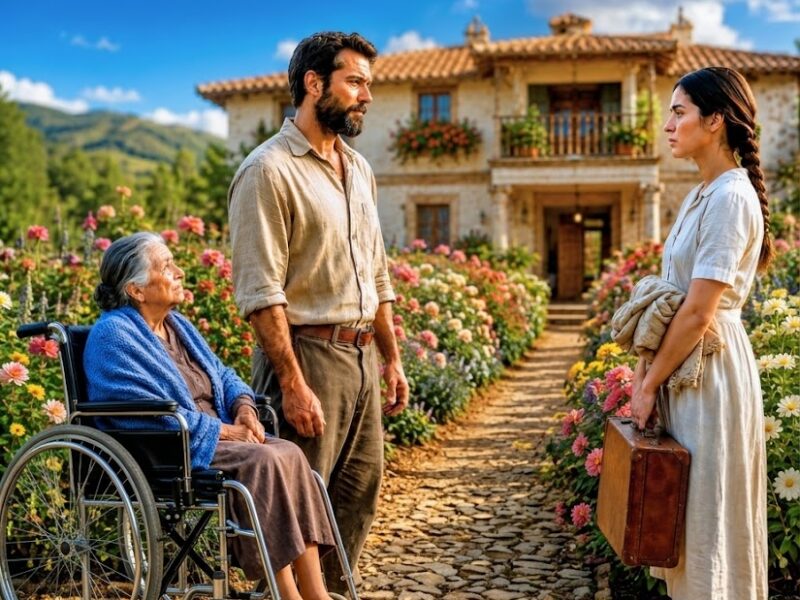
“If you let me stay, I’ll take care of your mother…” the young woman begged. But the farmer noticed the suitcase.
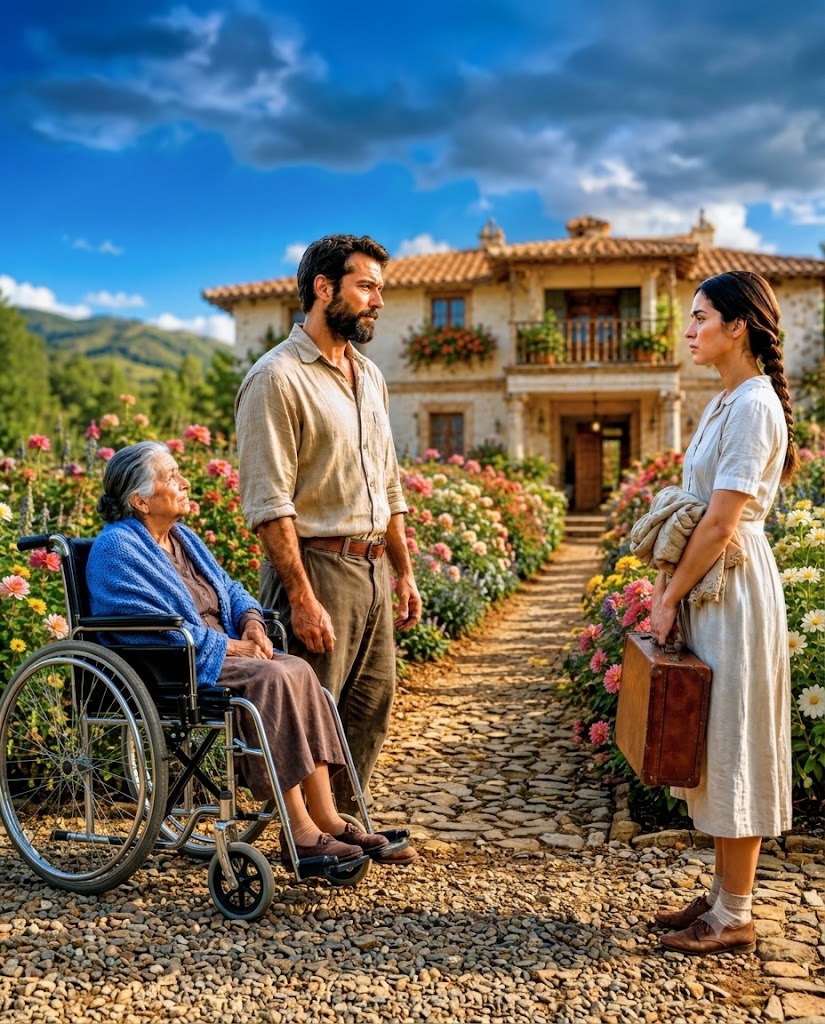
The sun over the Serra Gaúcha fell like a hammer on the back of her neck, and the sweat ran down her forehead, gluing strands of hair to a face burned by the road. Her dress, once light-colored, had a hem stained with dirt, and her worn sandals showed she had walked far more than a body can bear.
In one hand, an old suitcase of cracked leather. On the other arm, a bundle of clothes pressed against her chest, as if her whole life were stored inside. She stood at the crooked wooden gate, and when she finally spoke, her voice came out hoarse, dragged by the dust of the highway.
“If you let me stay, I’ll take care of your mother and I’ll make the food. I don’t want a salary, mister. Just a roof and a plate. Please.”
Mateus Bianquin stopped beating the hay, wiped his face on the dirty sleeve of his shirt, and measured the woman from top to bottom, without hurry, the way of a man who had been disappointed too many times to trust a stranger. He didn’t look first at her eyes. He looked at the suitcase.
That suitcase pressed against her body said more than any word. It said that something lived there that she was afraid of losing or of letting go. “Where did you come from?” he asked, his voice low and dry like the dirt of the yard.
The young woman didn’t answer. She lowered her eyes, gripped the suitcase tighter, and in that silence, the farmer understood, without needing another word, that this woman was running from something. He knew well the silence of those who carry too much weight. He had lived in it for four years.
Before continuing this story, tell me in the comments what city you’re watching from. I love knowing how far the Serra Gaúcha can reach. Which corner of Brazil these stories end up in. Leave your mark now. Come with me, because what happened on that farm nobody expected.
Mateus looked again at the scattered hay, at the patched barn, at the stone house peeling in the background, with the dry grapevines dragging along the trellis like tired arms. Everything on that property was begging for help, and he could barely handle himself. He took care of his 81-year-old mother alone, trapped in a wheelchair since the stroke. He owed the bank, he owed the cooperative, he even owed himself some peace. There was no way to support another mouth. There was no heart for it. His heart had dried up along with the vines.
“I can’t, miss,” he said, turning his back. “There’s not even enough here for me. Go on your way before it gets dark, because the mountain road at night is no place for anyone.”
She didn’t move. She stood there planted at the gate, her chest rising and falling fast. And when he was already leaving, he heard her voice break into a thread. “I have nowhere to go. If you send me away, I don’t know what I’ll do.”
That was when another voice cut the air. A thin voice, old, but firm as a fig tree root, coming from the wooden porch, where the wheelchair rested in the shade. “Mateus, let the girl in.”
He stopped, closed his eyes for an instant, like a man who already knew he was going to lose that argument before it even began. “Mom, you don’t even know who this person is.”
“I know enough,” answered Dona Assunta, her light, stubborn eyes shining under white eyebrows. “I know that nobody walks in this sun, with a face like that, by choice. You don’t send anyone back to the road in this heat, son. Not in this house. Your grandmother wouldn’t have. Your mother won’t.”
Mateus breathed deep. The air smelled of cracked earth, old manure, and the distant sweetness of the few grapes that still insisted on ripening at the back of the vineyard. He looked again at the young woman, at the suitcase, at the tired feet inside the broken sandals.
“One night,” he said at last, reluctantly. “Eat, sleep, and tomorrow morning you go on your way. That’s it.”
The young woman brought her hand to her mouth and shook her head, the relief almost knocking her over right there. “Thank you,” she whispered. “Thank you, mister. I work. You’ll see that I work.”
“What’s your name?” asked Dona Assunta from the chair.
The girl hesitated for just an instant. An instant so small that only an attentive old woman would notice. “Lucia,” she answered.
And Dona Assunta, who was 81 years old and had already buried a husband, brothers, and half her friends, noticed right away that that name had been born there at the gate, tailor-made to hide another one. But she said nothing. She only smiled a tiny smile, the kind that keeps a secret, and pointed her chin toward the inside of the house. “Come in, Lucia. You must be dying of thirst.”
And so it was, on a scorching late afternoon in February, that a woman without a past entered the Bianchin farm, carrying a suitcase that nobody knew what it held, and an old woman in a wheelchair was the only one on that first day to see that the whole house was about to change.
The Bianchin farm woke before the sun. It had been that way for generations, since Mateus’s great-grandfather had arrived from Italy with one hand in front and the other behind, and planted the first grapevine in that rocky ground. But what had once been a waking of life, of voices, of pots, of people, had turned into a waking of ghosts.
Mateus got up in the dark, put water on for chimarrão, and drank it alone, silent, looking out the window at the darkness that little by little was lightening over the hills. The gourd passed only through his hands. There was no one to share it with.
Then came the hardest part of the day, the part nobody saw. He entered his mother’s room still before dawn and began the silent ritual of caring for a body that no longer obeyed. He changed her, cleaned her, lifted Dona Assunta from the bed to the chair with all the care those thick farmer’s arms could manage. He did it without a word of complaint, but also without a word of tenderness, like a man serving a sentence, not like a man exercising love.
And Dona Assunta, who felt everything, stayed quiet. She knew her son loved her. She just didn’t know anymore how that love had come to look so much like a heavy duty.
On that first morning, when Mateus pushed open the kitchen door, still rubbing his eyes, he stopped at the threshold. The wood stove was already lit. There was coffee made, the warm smell filling the room. And the old wooden table, always covered with dust and overdue bills, was clean, with a checkered tablecloth he hadn’t seen since Rosa was alive.
Lucia was facing away, stirring a pot, her hair tied in a hurried bun. “Good morning,” she said without turning. “I didn’t know if you liked polenta in the morning. I found some cornmeal left in the pantry. I hope you don’t mind.”
Mateus didn’t answer right away. There was something about that scene. The fire lit, the smell of food, the tablecloth on the table that squeezed his chest in a way he hadn’t felt in a long time. It hurt. It hurt because it reminded him. And he had spent four years doing everything to not remember.
“You don’t need to do this,” he murmured, sitting heavy in the chair.
“Yes, I do,” she answered, turning with the plate in her hand. “That was the deal. You gave me a roof. I make the food.”
The deal, he wanted to say, was one night only. But he didn’t say it. He ate the polenta in silence, and it was good. It was too good.
It was in the care of Dona Assunta, though, that the strangest thing happened that morning. Lucia asked permission and entered the old woman’s room to help. Mateus, who stayed watching through the crack of the door with a distrust he himself couldn’t explain, saw something that left him without ground under his feet.
The girl knew. She knew exactly how to lift a weakened body without hurting it. She knew how to support the nape, turn the hip, distribute the weight. She knew how to talk while she did it, to distract from the pain and the shame. She knew how to check the skin on the back with her fingers, searching for the sores that appear in those who spend too long lying down.
That was not the way of a housewife. That was trained hands, the hands of someone who had already cared for many sick people, many people at the edge of the end.
“Where did you learn that?” he asked later in the hallway, his voice harder than he intended.
Lucia froze, lowered her eyes. “I learned by caring,” she said. And that was all she said.
Mateus didn’t insist, but he stored it away, as he stored everything. The day on the farm followed the rhythm of always, that slow and heavy rhythm of the countryside, measured by the sun and not by the clock. After coffee, Mateus went to the vineyard to pretend there was still something to save.
He ran his hand over the dry branches, pulled weeds, turned the hard earth baked by so much sun, and with each gesture his body remembered his father, his grandfather, all the Bianchin hands that had done that same thing before him, when the farm was pride and not shame. Now it was only stubbornness. He worked because he didn’t know how to do anything else, because stopping meant sitting down and thinking. And thinking was the thing he feared most in the world.
Inside, Lucia discovered the house little by little, like someone entering a dark room and recognizing the furniture by touch. She found in a stuck drawer a dish towel embroidered with initials that weren’t hers and that she intuited belonged to a dead woman. She found empty canning jars, stacked in the pantry, covered in cobwebs, waiting. She found at the back of a cabinet a box of photographs that nobody had opened in years. And she didn’t open it either, because she understood, without anyone telling her, that inside lived the woman whose absence haunted every corner of that house.
At noon, the mountain sun fell straight down and the gravel of the yard was too hot to walk on barefoot. Lucia took a plate of food to Mateus in the barn because he didn’t come in for lunch. He made a point of eating alone, leaning against a hay bale, chewing slowly and looking at nothing. She left the plate beside him without a word, and he thanked her with a grunt, but ate everything. And when she came back for the plate, he had cleaned even the sauce with a piece of bread.
In the late afternoon, when the heat loosened, Lucia sat Dona Assunta on the porch and the two of them peeled potatoes for dinner, in the comfortable silence of two women who know how to work without talking. The mountain sky changed color slowly, from the hard blue of midday to the soft orange of late afternoon. And the birds began their noisy six o’clock meeting in the branches of the fig tree. It smelled of earth finally cooling, of wood smoke from some distant stove, of the tired sweetness of the few ripe grapes. Smells of the mountains, smells of a place that, despite everything, still knew how to be beautiful.
“Do you have children?” asked Dona Assunta suddenly, without taking her eyes off the potato.
Lucia’s knife stopped in the air. Just an instant. “No.” She lied softly. “I don’t have anyone, Dona Assunta.”
The old woman didn’t look at her, but her crooked fingers squeezed the potato in her hand a little tighter, and she changed the subject, with the delicacy of someone who understands that some doors are not pushed open, you wait for them to open on their own.
“Well, this house here used to have a lot of people,” said Assunta. “In my father-in-law’s time, at harvest, there would be forty people cutting grapes, singing, eating at that long table that today only gathers dust. There was music, there were children running everywhere. We stomped the grapes with our feet, you know? In a wooden vat, everyone together, the must rising up to the knee.”
She laughed, a laugh wet with longing. “Then the world got small. The children went away to the city, one by one. My husband died, and Mateus, Mateus lost Rosa and lost himself along with her. Today we’re only the two of us. This house too big for so few people.”
Lucia listened and, without realizing it, began to understand that she had fallen not into just any house, but into a house in mourning, a mourning so old and so deep that it had become the furniture of the place itself.
That night, lying in the dark of the room he had once shared with Rosa, Mateus kept thinking about the woman sleeping in the back room, about the suitcase she kept under the bed even while sleeping, and about how, for the first time in four years, the house had smelled of food all day. He didn’t like feeling that. Feeling was dangerous. Feeling opened the door to losing again. And he had already lost everything a man can lose.
Outside, the moon beat on the dry vines, and one of them, the oldest, the one in the middle of the vineyard, had, without anyone noticing, a single green shoot stubbornly trying to be born on the twisted branch, as if the earth too were tired of dying.
One week turned into two, two turned into a month. Nobody spoke of Lucia leaving, and nobody spoke of Lucia staying. She was simply there every day as if she had always been. And the farm, which was only silence and dust, began to gain the noises of living people.
But it was with Dona Assunta that the change became most beautiful to see. The old woman spent her days in the chair, leaning against the window, looking at the world outside, like someone watching an old movie she knows by heart. After the stroke, the children and grandchildren who lived in the city had been thinning out their visits. First by week, then by month, then almost never. Mateus took care of her body with dedication, but he had no more words to give. The two lived in the same house, like two castaways on separate islands, seeing each other from afar, unable to cross the water that separated them.
Lucia crossed that water on an ordinary afternoon. “Dona Assunta,” she said, stopping in front of the chair. “How long has it been since you left this room?”
The old woman shrugged with the half of her body that still obeyed. “Why go out? To see the same dying vine?”
“To feel the sun,” answered Lucia. “It’s good for the body, and even better for the soul.”
And before the old woman could protest, the girl unlocked the chair and pushed it with care out of the house, down the improvised ramp that Mateus had built years before. She took Dona Assunta to the middle of the yard, under the big fig tree, from where you could see the whole valley descending in green curves to the horizon, the neighbors’ vineyards shining in the afternoon sun.
Dona Assunta was silent for a long time, then her eyes filled with water. “It’s been months since I’ve seen the valley,” she whispered. “I thought I’d never see it again.”
Lucia crouched beside the chair and took the old woman’s crooked hand between hers. “You’ll see it every day now,” she promised. “Every blessed day, if you want.”
And it was there under that fig tree that the two of them began to talk for real. Dona Assunta told of her parents’ Italy, of the dances of her youth, of the husband who died young, of the children who grew up and went away. Lucia listened with an attention the old woman hadn’t received from anyone in years. Because the girl didn’t listen out of politeness, she listened because, deep down, she too was starving for people. Two solitudes that met and, without planning it, decided to keep each other company.
Mateus watched from afar, from the barn, with the scythe stopped in his hand, and when that afternoon he heard a sound he hadn’t heard in too long, his mother’s laughter, loud and clean, cutting the mountain air, he had to lean against the barn wall. His throat tightened. It had been four years since that house had laughed. He had even forgotten the sound.
That same week, however, the first strange thing happened. It was late afternoon. Lucia was in the yard hanging clothes on the line when a silver car with an out-of-town plate slowed down on the dirt road in front of the farm. It didn’t stop, it only slowed, like someone looking for an address or looking for someone.
Mateus, who was nearby, didn’t pay much attention at first, but he saw Lucia. He saw the girl drop the clothes on the ground. He saw her shrink behind the hanging sheet, her whole body trembling, her breath held, her eyes glued to that car, like someone watching her own death pass by.
Only when the car disappeared around the curve, raising dust, did she breathe again. And when she realized Mateus was watching her, she hurried to pick up the clothes from the ground, her face pale, pretending it was nothing.
But it was something. He knew it was something. That night he didn’t ask, not yet, but he stayed awake late, looking at the ceiling, putting the pieces together. The suitcase she never let go of. The name chosen in a hurry. The hands trained in caring for the sick. The terror of that car. There was a whole story hidden there, and he was beginning to understand that it was a story of fear, the kind of fear that makes a woman walk until her body can’t take any more, in scorching heat, looking for any roof far enough away.
And for the first time in four years, Mateus Bianchin felt the urge to protect someone. The urge frightened him more than any silver car.
The green shoot on the middle vine became a branch, the branch a leaf, the leaf two. And the Bianchin farm slowly began to come back from the dead. It was Lucia who started working on the vineyard. One morning, Mateus found her on her knees in the dirt, among the dry vines, digging around the roots with her own hands.
“Don’t waste your time with that,” he said. “Those vines are done. Three years they haven’t given anything worth anything.”
“Done?” she answered without stopping digging. “They’re thirsty. The dirt down here is hard as stone. Water doesn’t get down. If you loosen the soil and water right at the foot, there’s still salvation in a lot of them. A person I knew taught me. She said a plant is like a person. When it looks dead, many times it’s just waiting for someone to care.”
Mateus stood still, looking at that woman with her hands in the dirt, talking about saving what he had already given up for lost. And something inside him, hard as that ground, also cracked a little to let the water down.
In the following weeks, the house changed smell. Lucia made preserves, cucumber, onion, wild radicchio, filling the jars she gathered from the pantry, lining them up on the shelf like little treasures. She resurrected the recipe for a tomato sauce that Dona Assunta dictated from memory from her chair, correcting the garlic point and the basil hour. She made bread. The smell of bread baking in the wood oven spread through the whole property. And it was a smell that pulled you into the house, a smell of home that Mateus had buried along with his wife.
Dona Assunta became the heart of the kitchen again, from the chair leaning against the table. She commanded everything, sent Lucia to fetch the bay leaf from the yard, taught the secret of letting the bread dough rest, covered with a cloth on the edge of the warm stove, told the story of which aunt brought it from Italy. The girl listened to everything, wrote everything down in an old notebook, and, without realizing it, was giving back to that old woman something the stroke had taken. The feeling of being useful, of mattering, of still having something to teach the world. It was the strongest medicine Dona Assunta took, and it didn’t come in a pharmacy bottle.
Mateus noticed. He noticed everything from afar, in his quiet way. He noticed that his mother talked all day now. She, who had been almost mute after the illness. He noticed that the house had begun to have a schedule again, the coffee hour, the bread hour, the afternoon chimarrão hour. And he noticed, mainly, that he himself had begun to invent excuses to pass closer to the kitchen. He went to fetch a tool he didn’t need. He came to drink water he wasn’t thirsty for. He stood at the doorframe, pretending to look at the weather outside, just to hear a little more of Lucia’s voice singing softly while she kneaded the dough.
And it was in that time, without either of them noticing the exact moment it began, that another thing was sprouting between Mateus and Lucia, slowly, like the vine. It wasn’t anything spoken, it was small gestures. It was the chimarrão gourd that he, one morning, without thinking much, extended to her, the first time in four years he shared the gourd with someone. She took it, drank, returned it, and neither of them commented on what that meant, but both felt it.
It was his hand that touched her hand by accident, when the two of them pushed Dona Assunta’s chair together down the ramp, and neither of them pulled away too quickly. It was the way he began to wait at the end of the afternoon for her voice humming in the kitchen, and how the day seemed wrong when she was quiet.
One Saturday afternoon, Mateus appeared in the kitchen and, a little awkwardly, held out to Lucia a handful of wildflowers, yellow daisies and some little purple flowers that grew loose at the edge of the vineyard. He didn’t say they were for her, he only said, flustered, looking at the floor, “I thought they’d look nice in that vase on the table. The house was needing it.” And he left quickly, before she could answer.
Lucia stood with the flowers in her hand, her heart giving a jump she thought she would never feel again, and put them in the vase with a care that said everything neither of them had the courage to speak. At dinner that night, nobody commented on the flowers, but Dona Assunta, from the other side of the table, looked from one to the other with that little smile of someone who has lived long enough to read what young people think they’re hiding.
After coffee, when her son went out to lock the barn, the old woman pulled Lucia by the sleeve. “Lucia,” she said softly. “It’s been four years since that man brought flowers into this house. The last time he brought them was to put on top of a coffin.”
She squeezed the girl’s hand. “I don’t know where you came from and I’m not going to ask, but whoever sent you here sent you at the right time.”
Lucia didn’t know what to say. She only squeezed back the old woman’s crooked hand and felt her eyes burn.
One night, after Dona Assunta was already asleep, the two of them stayed on the porch, looking at the dark valley dotted with the distant lights of the other farms. They stayed a long time without speaking. It was Mateus who broke the silence, and he himself was surprised by what came out.
“My wife’s name was Rosa,” he said, his eyes lost in the dark. “It’s been four years since she left. It was fast. One of those illnesses nobody expects. In one month she was planting flowers in the garden. In the next…” He stopped, swallowed. “I wasn’t home when it happened. I had gone to the city to take care of some bank business. I arrived too late. And since that day I can’t stop thinking that if I had stayed, if I hadn’t cared so much about money…”
“You’re not to blame,” said Lucia softly.
“Everybody says that.” He gave a bitter smile. “But nobody can convince me.”
Lucia stayed quiet for a while, then said, choosing each word. “Sometimes we carry a guilt that isn’t ours, mister. We carry it because it’s easier to hate ourselves than to accept that some things simply happen without us being able to do anything.”
She looked at her own hands. “I know what I’m talking about.”
He turned his face to her. And in that instant, on the dark porch, with the valley breathing below them, there was a silence different from all the others. A full silence, a silence in which the two solitudes recognized each other and for a second almost touched.
But Lucia got up. “It’s late,” she said, her voice a little trembling. “Tomorrow there’s a lot to do.”
She started inside, but stopped at the door and, without turning around, asked: “Mister, if one day someone comes here looking to know who works on this farm, if some paper or some question comes, can you not say my name? Can you say there’s nobody here?”
Her voice was a thread. “I promise I didn’t do anything wrong. I promise on my soul. I promise on everything sacred. But I need to not exist for a while. Just that. I need to not exist.”
And she went in, leaving Mateus alone on the porch, his heart beating hard and a certainty growing in his chest. Whatever that woman was running from, he was no longer going to let it reach her, even if he had to rise from his own grave of guilt to stop it.
The silver car came back on a Wednesday, late afternoon. This time it stopped. Lucia was in the barn, separating the canning jars to take to the parish fair, when she heard the sound of the motor dying in front of the gate.
She didn’t need to see. Her body knew before her head. The jars trembled in her hand. One of them slipped and shattered on the cement floor. And she stood paralyzed, leaning against the wall, her heart racing like that of a cornered animal.
Mateus was in the yard when the man got out of the car. He was tall, dressed too well for that dirt road, city shoes covering themselves with dust. He had a gentle way in his voice and a hardness in his eyes that didn’t match each other. And Mateus, who had spent his life reading cattle and people, knew right away that this was the man from Lucia’s fear.
“Good afternoon,” said the stranger with an educated smile. “Sorry to bother you. I’m looking for a person, a woman. She ran away from home a few months ago and the family is desperate. People have been saying they saw a young woman who looks like her around these parts, working on a farm.”
He took a photo from his pocket and held it out. “This one here. Her name is Helena. We just want to know she’s okay. You know how it is. We worry about the ones we love.”
Mateus took the photo. It was Lucia, younger, her hair different, a smile on her face he had never seen there. A smile from before, from when fear didn’t yet live in her. He looked at the photo for a long time, and from the back of the barn, without the man seeing, Lucia’s terrified eyes met Mateus’s over the stranger’s shoulder, begging in silence.
Mateus returned the photo. “I don’t know her,” he said, his voice flat as stone. “Only me and my old mother live here. There’s no woman working on this farm. You were misinformed.”
The stranger’s smile faltered. His eyes wandered over the yard, over the clothesline with women’s clothes swaying in the wind, over the checkered tablecloth visible through the kitchen window. He knew. Mateus knew he knew.
“Is that so?” said the man slowly. “Because I was guaranteed it was here.” He took a step toward the house. “Could I take a little look? Just to be sure. Your mother, she wouldn’t mind if…”
“She would mind.” Mateus stepped in front of him, his whole body closing the path, the broad shoulders of a man who had spent his life carrying weight. He didn’t raise his voice, he didn’t need to. “You’re on my land without me inviting you. I already answered what I had to answer. Now it’s best you take that car and go back where you came from. Before it gets dark, the mountain road at night is no place for city people.”
The two men stared at each other, and the city man, despite all his money and all the gentle rage in his eyes, realized that there he was not going to pass. Not that day. He put the photo back in his pocket, adjusted his jacket, and the educated smile returned colder. “All right,” he said. “Sorry for the inconvenience. But I’ll be back. I always end up finding what I’m looking for.”
And he looked at the house one more time, lingering, before getting in the car and disappearing around the curve. When the dust settled, Lucia came out of the barn. She was crying, but it was a dry cry, contained, the cry of someone who learned to cry without making noise.
She stopped in front of Mateus and, for a while, neither of them spoke. “I’m leaving tonight,” she said at last, her voice firm despite the tears. “I’ll pack my things and go. I can’t bring this into your house, mister. You have your mother to take care of.”
“If he comes back and…”
“Sit,” he said. “Sit, Lucia. Or whatever your name is. Sit here and tell me everything from the beginning, because I just lied to a man looking into his eyes, and I have the right to know who I lied for.”
She sat on the porch step, pressed her hands together, and, in a low voice, began to tell. She told that her real name was Helena, that she had married young, in love, to a man who seemed like the whole world and who, with time, turned into a cage. She told how the control began small, almost affectionate, and grew until she could no longer go out, no longer see her family, no longer be a person.
She told it without details, because some details are not told, but with a truth so naked that Mateus felt his own stomach turn. She told that she endured years because she had hope, and that the hope had a name, a daughter, a little girl.
Here her voice broke completely. “She was everything,” Lucia whispered. “She was born sick, her little heart wasn’t strong, and I spent her whole life caring for her, learning from the doctors, from the nurses, learning to turn her, to clean her, to give medicine at the right time, to hold her when she ran out of air.”
She looked at her own hands, those trained hands that had impressed Mateus weeks before. “This is where I learned, mister. Caring for her. She lived three years, three years and four months. And when she left, I had nothing left to keep me tied to that man, nothing but fear.”
She got up, went to the back room, and returned with the suitcase. That old suitcase of cracked leather that she never let go of. She opened it in front of him there on the porch step, and Mateus, who had imagined money, jewels, who knows what, saw that a woman in flight saves, when she can only save one thing, some crumpled documents that proved who she was, a birth certificate, and wrapped in an embroidered cloth, a few photographs of a little girl with big eyes and a tiny knitted bootie, blue, kept as if it were made of gold.
“This is all I have of my whole life,” said Helena. “This is what I carry. It’s not money, mister. It’s the proof that I existed, that she existed, that I was a mother once.”
Mateus looked at that blue bootie in the palm of her hand, and the man who had dried up inside four years before, the man who hadn’t cried since Rosa’s burial, felt the tears rise without asking permission, because he knew that. He knew losing. He knew carrying the absence of someone in his pocket for the rest of his life.
He closed the suitcase carefully, with a gentleness his thick hands didn’t seem capable of, and returned it to her. “You’re not leaving,” he said. His voice came out hoarse, but it left no room for discussion. “That man can come back as many times as he wants. He’s not taking you. Not from here. Not while I’m standing.”
He breathed deep. “I spent four years hiding from life because I was afraid of losing again. But I discovered something these past weeks, Helena. I discovered it with you, with my mother laughing again, with that vine stubbornly sprouting. I discovered that hiding from life isn’t staying safe, it’s just dying slowly. And I’m tired of dying slowly.”
Helena looked at him and, for the first time since the gate, she didn’t look like someone begging for help. She looked like someone who, at last, had found a safe place to rest her weight.
“We’re not going to do this hidden in the dark,” continued Mateus. And he already had a plan forming in his hard head. “We’re going to do it right, in the light. Tomorrow morning we go to town, to the police station, to talk to the prosecutor’s office, to the priest, to whoever is needed. You’re not running from a crime, Helena. You’re running from a man who did you harm. And there is law for that. There are people who protect.”
“We’re going to do everything properly, with papers, with witnesses, with the whole community knowing. Because a man like that only has strength while the victim is alone and hidden. The day he has to face a whole town, he shrinks. I know the type.”
A thin, stubborn old voice made itself heard. Dona Assunta was awake. She had heard everything. “Let him come,” said the old woman, her eyes shining with an old fury. “Let him come mess with my house. He’ll see what’s good for a cough.”
And despite everything, despite the fear, the three of them laughed. A small, tired laugh, but true. The laugh of people who had finally decided to stop running.
The next morning, very early, the three of them went down the mountain toward town. Mateus driving the old pickup, Helena in the middle with the suitcase on her lap, Dona Assunta in the back, propped up with pillows, insisting on going along, because “this story is the whole family’s now and nobody leaves me at home.”
What happened that day and in the days that followed, Helena would never forget, because she, who had spent months believing she was alone in the world, discovered she was not. She discovered that kindness, when it begins, has a habit of spreading.
At the police station, a middle-aged clerk, the kind who has seen too much pain to get used to it, sat beside Helena, held her hand, and made her understand that the law existed precisely for people like her, that there was a protective order, that there was a process, that there was a path. She was patient, she was human, she wrote everything down, forwarded everything, and at the end said a sentence Helena kept forever: “You’re not asking anyone a favor. You’re exercising a right. Never be ashamed of that again.”
At the parish, the priest, a fat, noisy Italian who had known the Bianchins since Mateus’s baptism, didn’t ask too many questions. He did what a good priest does. He opened the door, spoke with a lawyer from the diocese who helped women in at-risk situations for free. He spoke with the ladies of the pastoral group, who in two days organized a network nobody had asked for.
One brought clothes, another brought food, another offered her house in town in case Helena needed to disappear for a few days. Another simply showed up at the farm to keep her company, so that she would never again be alone when the men were in the field.
And the mountain community, that small community of Italian surnames, where gossip ran wild, did what Mateus predicted it would do. It closed ranks. Because one thing is a city man intimidating a woman alone and hidden. Another thing entirely is him having to pass through a road where every farm knows his car, every neighbor wrote down his plate, and every family decided that that girl from the Bianchin farm was, from then on, one of theirs.
The neighbor from the corner property, who had a twenty-year-old grudge against Mateus over a badly divided fence, showed up at the gate one day without warning. He got down from the tractor, cleared his throat, and said without looking anyone directly in the face: “I heard about the story. If that silver car shows up again, just ring the old chapel bell. I hear it from here and I’ll come right away with all the boys.”
And he left without waiting for thanks, in the rough way of mountain men, who do good embarrassed to be seen doing it. Twenty years of grudge melted in one sentence. Because there are times when the community remembers it is stronger together than apart.
The ladies of the pastoral group created a rotation without anyone asking. Dona Ivone came on Mondays, brought cornmeal cake, and spent the whole morning chatting with Dona Assunta. Dona Teresa, also a widow, appeared on Wednesdays and taught Lucia to make colonial cheese the old way. Another brought flower seedlings, another a free-range chicken left over. None of them spoke of charity, because it wasn’t charity, it was community. It was the way those people found to say “You are not alone” without needing words.
The silver man came back one more time, a few weeks later, but this time, when his car appeared around the curve, he didn’t find a woman alone and trembling. He found Mateus’s pickup parked across the entrance. He found two neighbors who happened to be there drinking chimarrão. He found an official paper, the protective order that Mateus held out through the window with the calm of a man who no longer had fear, and he found mainly a truth that men of that type only understand when it’s too late: that their power depends on the dark, and that there, on that mountain, all the lights had been turned on.
He left and never came back. But the Bianchin farm didn’t go back to being only what it was. It had become something else. The old wine cellar in the basement, closed for years, was reopened. It was Helena’s idea, really. She had a hand for preserves and for food, and Dona Assunta had in her head the family recipes nobody made anymore, and Mateus had the vines that, miracle by miracle, care by care, were producing again.
On weekends, they began to receive people. First the neighbors. Then people from the city who heard about Dona Assunta’s polenta and Helena’s sauce and Mateus’s new wine. The bank debt, which had suffocated the farm for years, didn’t disappear in a magic stroke. Nobody showed up with a suitcase of money. It was paid the way real things get resolved. Installment by installment, Sunday by Sunday, with the sweat of three people who decided to work together and a community that decided to show up.
It was slow, it was hard, but it was theirs. And every time Mateus paid another installment at the cooperative, he felt something he hadn’t felt in a long time. Pride. The pride of someone who wasn’t saved, who saved himself.
And in the middle of all that, the love that had sprouted slowly on the porch like a vine had finally ripened. It no longer needed to hide. Helena and Mateus worked side by side in the cellar, like people who already belonged to each other. They understood each other with a glance across the full table, shared the last task of the night and the first chimarrão of the dawn. Dona Assunta watched it all from her chair in the corner of the cellar, with the smile of someone who had orchestrated it from the first instant. From the gate, from the “Let the girl in, Mateus.”
“You took your time, son,” she said to him one night, softly, when the two of them were alone closing the cellar. “But you arrived. Better late than a whole sad life.”
Autumn arrived on the mountain painting the vineyards red and gold. That year’s harvest was the best in a decade. The vines Helena had resurrected with her own hands gave abundant, sweet grapes. And the wine that came from them was, according to the Italian priest who understood the subject, wine of people who had returned to hope.
On a Sunday of sun and mild air, the Bianchin farm filled up as it hadn’t filled since the great-grandfather’s time. There was a long table under the fig tree, there was steaming polenta on the board, there was roasted chicken, radicchio, colonial cheese, fresh bread, and new wine. There was an accordion playing the old waltzes that Dona Assunta hummed from her chair, moving her feet to the rhythm with the half of her body that still danced.
There were the neighbors, the ladies of the pastoral group, the fat priest already red-faced from the second glass, and there was, in the middle of everything, Helena, who had once arrived there dusty and nameless, and who now laughed loudly, her face full of sun, surrounded by people who called her theirs.
It was at the end of the afternoon, when the light turned golden and soft over the valley, that Mateus asked for silence, tapping his knife slowly on the glass. He was not a man of speeches, everybody knew. So when he stood up, a little awkward, twisting his cap in his hands, the whole table went quiet, curious.
“I don’t know how to talk pretty,” he began. His voice a little trembling. “Who knows how to talk pretty here is my mother, and she’s spoken for me my whole life.” They laughed. “But there’s one thing I need to say in front of everyone, because I spent too long saying the important things only to myself, in the dark, and look how that turned out.”
He turned to Helena. She was sitting, the napkin forgotten in her lap, her eyes already filling with water, because women always know before. “Helena,” said Mateus, “you arrived at my gate on a scorching day, all sweaty, with a suitcase pressed to your chest, begging for a roof, and I almost sent you away. Almost. If it weren’t for my mother, I would have committed the biggest mistake of my life.”
He breathed. “I was dead inside, girl. I had been dead for four years and didn’t even know it. You arrived and lit the light in this house again. You brought food, you brought laughter, you brought my mother back to life, and you brought me back too, without me even noticing.”
Dona Assunta, from her chair, was already crying without hiding it, the handkerchief squeezed in her crooked hand. Mateus put his hand in his pocket and took out an old velvet box, worn. Inside was a thin gold ring, worn by time.
“This ring was my grandmother’s,” he said, “my mother’s mother. My mother kept it her whole life. She kept it even after Rosa was gone, when everyone thought I would die alone on this mountain. And do you know what my mother told me when I asked her for the ring yesterday?”
He looked at Dona Assunta, his voice failing. “She said: ‘I was saving it for when you came back to life, son. And you came back.'”
The whole table was silent. Even the accordion had stopped. Mateus straightened up. He didn’t kneel, because a mountain man doesn’t kneel easily and because his knees were no longer for kneeling, but he bent in front of her, his eyes in her eyes, and held out the little box.
“I know you were married once, and that marriage for you tastes like a cage. So I’m not offering you a cage, Helena. I’m offering you a gate that’s always open. You can leave whenever you want, and the door of this house will never lock for you again, nor for anyone. But I would be the happiest man on the mountain if you chose to stay. Not because you need to. Because you want to. Will you marry me?”
Helena didn’t answer with words. She couldn’t. She stood up, took the bearded, sunburned face of that man between her two hands, the same hands that had once carried a sick daughter, that had carried a suitcase down the highway, that had dug the hard earth to save a dead vine. And she nodded yes, yes, a thousand times yes.
While the tears fell and the whole table exploded in a roar of celebration, and the accordion came back louder, and the fat priest raised his glass, and Dona Assunta, in the middle of all that noise of happiness, looked at the orange sky of the mountain and whispered a thank you to whoever might be listening up there.
The season turned, and the Bianchin farm, which had once been only silence and dust, learned to be a home again.
On a hot afternoon the following summer, almost a year after that first day, Helena was in the yard under the fig tree, slowly pushing Dona Assunta’s chair to catch the late afternoon sun, as she did every day, because she had promised and she kept her promises. The vines behind them were heavy with green grapes, promising another abundant harvest. From the cellar came the smell of bread and the sound of Mateus fixing something, humming softly a song he didn’t even know he knew.
It was Helena who saw it first. Far away, on the dusty curve of the dirt road, a figure was walking slowly, a tired shape, bent under the weight of a bundle, feet dragging in the dust in the way of someone who had already walked far more than a body can bear.
Helena stopped the chair, brought her hand to her forehead to shield her eyes from the sun, and looked for a long time at that person slowly approaching the gate. And her heart recognized it before her eyes did. Recognized the exhaustion, recognized the fear, recognized the shrunken hope of someone knocking on the last door in the world, not knowing if they will find a no or a home.
“Dona Assunta,” said Helena softly, her voice choked, “someone is coming.”
The old woman squinted her light eyes toward the road, then looked at Helena, and the two understood each other without a word, the way only those who have been on both sides of a gate understand each other. Helena locked the chair in the shade, adjusted the shawl on the old woman’s shoulders, and began to walk.
She went down the yard slowly, with the golden sun beating on her back, toward that exhausted figure who now stopped, insecure, outside the crooked wooden fence, without courage to enter, without strength to continue, eyes lowered, waiting to be sent away as so many people had always sent her away.
Helena reached the gate. The same gate. And she opened it.
“You can come in,” she said, in the softest and firmest voice in the world. “There’s room here. There will always be room here. Come, come in, it’s too hot to stay out in this sun. There’s fresh water and food in the kitchen, and nobody, nobody will ever send you away again.”
And while she led the exhausted stranger inside, along the dirt path lined with the flowers she herself had planted, with Dona Assunta smiling under the fig tree and Mateus coming out of the cellar, wiping his hands on his apron to see who was arriving, Helena understood at once everything that had happened there.
She understood that kindness is not paid back, kindness is passed on. That that old woman in the wheelchair, who on a scorching sunny day said “Let the girl in,” had, without knowing it, lit a current that now she, Helena, passed forward, and that would pass again and again, because no gesture of kindness, however small it seems, is lost in the world.
It only waits, patient as a vine in the dry season, for the right moment to sprout again in someone else. The sun set slowly over the Serra Gaúcha, gilding the vineyards and the stone house, and the Bianchin farm welcomed one more tired soul, as it would always do from then on for the rest of its days. Because a house is only truly a home when its gate knows how to say: come in.
Gratitude. That is the word that stayed from this story. If it also stayed in your chest, write gratitude down here in the comments. I want to read every one of you.
And tell me one thing, which is the question this story left me with. What was the time when a stranger opened a door for you when you most needed it? It could have been a ride, a plate of food, a word at the right time, a roof on a difficult day. That person who appeared out of nowhere and welcomed you when the whole world seemed to have turned its face away from you.
Write it down here, tell us. I want to read every testimony of kindness you have to share, because that is what makes me believe the world can still be fixed. Before you go, let me know what city, what corner of Brazil you followed Helena, Mateus, and Dona Assunta from. From north to south, everyone is welcome on this porch of ours.
These stories exist for only one reason, to remind us that kindness still lives in the hearts of ordinary people and that every small gesture can save an entire life. If you believe that too, leave your like, share this story with that person who needs to hear today that hope is still worth it. And subscribe to the channel so you don’t miss the next one. There’s always a new gate waiting to open around here.
Stay with God and until the next story. May your gate, wherever you are, always know how to say: come in.









