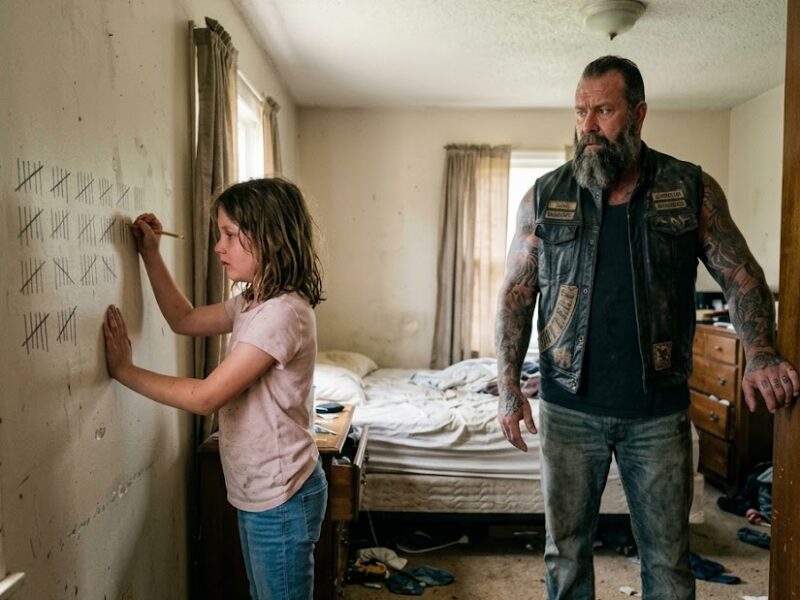
“I scratched a mark on the wall every day he was gone,” the girl whispered—then showed the biker her bedroom wall.
The sleet was coming sideways when the twelfth man through the gate stopped walking.
Mark Holloway sat frozen on his motorcycle, one numb hand clenched around a phone. Seventy miles behind him, an eight-year-old girl lay awake in a stranger’s bed, a bent paperclip in her fist, counting days on a wall she could no longer reach. Four hundred and seventeen of them.
And the man standing in the orange light was the reason for every single one.
He was staring past Mark now at the dark road, measuring how fast he could disappear. Mark had one photograph and one sentence to stop him. He wasn’t sure either would be enough.
The first thing Mark noticed about the Gray House on Troy Street was how quiet it was.
It was not a peaceful quiet. It was the kind that settles into a home where a child has learned not to ask for things. It was the first Saturday of November in East Dayton, and a cold rain had been falling since dawn.
Mark parked his Harley at the curb behind two other bikes and a church van, pulled off his gloves, and flexed fingers that ached more every winter. He was fifty-four years old. His beard had gone mostly gray, a pale scar cut through his left eyebrow, and his leather jacket had been broken in so long it fit him like a second skin.
Twenty-six years of hauling freight across the country had left him with a bad back, a quiet house, and not much else.
The Miami Valley Riders Club ran a repair program on the first weekend of every month, fixing gutters, porch steps, and furnaces for seniors who could not afford a contractor. Mark had joined three years ago for one simple reason.
Saturdays alone in his own kitchen were louder than any interstate he had ever driven.
Walt Brennan, the club president, met him on the porch with a clipboard and a thermos. Walt was sixty-eight, built like a mailbox, and had never once been in a hurry.
“Ruth Puit, seventy-one,” he said, reading from the page. “Furnace is short-cycling, back door sticks, and there’s a window upstairs that won’t latch. She’s got a granddaughter living with her. Go easy. The kid’s not much of a talker.”
Mark spent the morning in the basement with the furnace, a flashlight in his teeth, and a dead flame sensor in his palm. Ruth Puit sat at the top of the stairs in a kitchen chair, an oxygen tube looped over her ears, and watched him like a woman who’d been disappointed by helpful people before.
She was thin and sharp-eyed, with silver hair pinned back tight.
The girl appeared around noon. She stood in the basement doorway in a gray sweatshirt three sizes too big, the sleeves swallowing her hands, her light brown hair pulled into two braids that did not match. Freckles dusted her nose. Her green eyes studied Mark’s tools, his beard, his scar, and then settled on his face with a patience no eight-year-old should have.
“That’s Ashley,” Ruth called down. “Ashley Whitaker. She doesn’t bite.”
“Neither do I,” Mark said gravely.
The corner of her mouth moved just barely, and then went flat again, as if smiling were something she had been told to save.
By two o’clock, the furnace was roaring and the back door swung true. Mark climbed the narrow staircase to the second floor to look at the window. The hallway smelled of old carpet and lavender soap. At the end of it, a door stood open, and Ashley stood beside it, waiting.
Her bedroom was small and tidy, a twin bed with a faded quilt, a shelf of library books arranged by height, a window with a cracked latch, which Mark fixed in about four minutes with a new catch and two screws. He tested it twice. It clicked shut like a promise.
“Do you want to see something?” Ashley asked from the doorway.
Mark did not know much about children anymore. His own daughter was twenty-nine and had not spoken to him in nine years, but he remembered one rule. Answer honestly and never guess what they want.
“Sure,” he said.
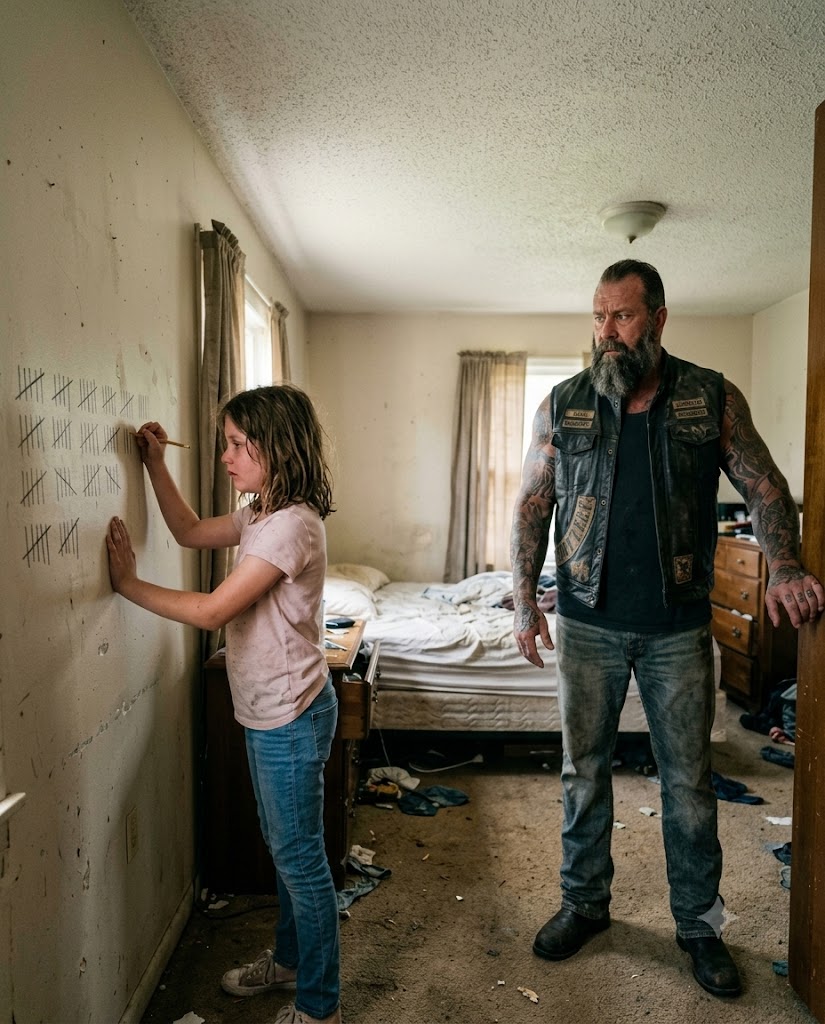
Ashley dragged the small bed away from the wall, its legs squealing on the floorboards. Behind it, scratched into the old plaster just above the baseboard, were rows of tiny marks, hundreds of them. Each group was four straight lines crossed by a fifth, the way a prisoner might count, the rows running side by side like fence posts along a country road.
Some were deep and angry. Others were light and careful. The newest ones were so fresh that the plaster dust still clung to them.
Mark crouched, knees popping, and could not find a single word.
“I scratched a mark on the wall every day he was gone,” Ashley said. She held up a bent silver paperclip, the tip worn flat. “Grandma doesn’t know. She hardly comes upstairs.”
“Who is he?” Mark asked quietly.
“My dad.” She said it the way other children said their own names. “His name is Curtis Whitaker. He told me he would be back before the first snow. That was last year.”
Mark’s eyes moved over the wall again, and this time he started counting without meaning to. He gave up at the third row. The number did not matter. What mattered was the care in every line, the discipline of a child who had decided that if she could not stop time from passing, she could at least refuse to let it pass unnoticed.
“How many?” he asked.
“Four hundred thirteen,” Ashley said. “Four fourteen tonight.” She looked at the window he had just fixed, at the gray sky pressing against the glass. “The weatherman says it might snow this week.”
Mark understood then. A year ago the first snow had come and gone without her father. Now another one was on its way, and she was giving him one last chance to keep his word.
Downstairs, a kitchen chair scraped. Ruth’s voice drifted up, thin and breathless. “Ashley, everything all right?”
Ashley looked at Mark. It was not a plea. It was a test. He had been shown something precious, and now the question was what kind of man he would turn out to be.
“Everything’s fine, Mrs. Puit,” Mark called back. “Window’s fixed.” Then, softer, to the girl: “Your secret’s safe with me.”
He helped her push the bed back against the wall. Neither of them said anything else, but as he reached the top of the stairs, her small voice followed him.
“Mr. Mark, do you think he knows how many it is?”
Mark gripped the railing. Four hundred thirteen days. For a moment, he was not in a stranger’s hallway at all. He was in a truck cab somewhere in Nebraska twenty years ago, telling himself the miles would be worth it, that his own daughter would understand.
“I don’t know, kiddo,” he said, and his voice came out rough. “But somebody should find out.”
Ruth Puit did not offer him coffee. She offered him the truth, which Mark soon learned was harder to swallow.
He found her in the kitchen, hands wrapped around a mug she never drank from, the oxygen machine humming beside her chair. Rain tapped the window over the sink. On the refrigerator, a child’s drawing of a house with a yellow sun had curled at the corners.
“I need to ask about Ashley’s father,” Mark said. “I’m sorry. It’s not my business.”
Ruth’s mouth tightened. “She showed you the wall.”
Mark hesitated, remembering his promise. Ruth saw it and almost smiled. “Relax, Mr. Holloway. I’ve known since last Christmas. I climb those stairs on my good days, when she’s at school. I sit on that bed and count the new ones.” Her voice cracked and she steadied it. “I never told her it would be like taking away the only clock she’s got.”
“Where is he?” Mark asked.
“If I knew that, I would drive there myself and bring him back by the collar.” Ruth let out a breath that rattled. “Curtis Whitaker married my daughter Lynn eleven years ago. He was a good husband. Worked second shift at a machine plant out by the airport. Coached Ashley’s T-ball team. Then Lynn got sick. Ovarian cancer. She was gone in nineteen months. Ashley was six.”
She turned the mug a quarter turn on the table. “After the funeral, he stopped sleeping. Then he started drinking. The plant laid him off that spring. And by summer, he was losing whole days. Fourteen months ago, he got pulled over on Wayne Avenue at two in the morning with Ashley’s booster seat empty in the back, thank heaven, and a blood alcohol level twice the limit.”
“What happened then?”
“The judge gave him a choice. Treatment or jail. He sat right where you’re sitting and swore on his wife’s grave he’d finish it. He packed Ashley’s clothes himself. He told her he’d be back before the first snow.” Ruth’s thumbnail scraped at the rim of the mug. “The program was in Chillicothe. Six months residential. He finished it. I’ll give him that. A counselor called to tell me. Then he went quiet.”
“Quiet how?”
“No calls, no letters. Just a money order in the mail on the first of every month. Two hundred dollars, no note, no return address.” She pulled open a drawer beside her and set a rubber-banded stack of paper stubs on the table. “Eight months of them. I cash every one and I hate myself a little each time. He sends money like it’s a ransom and he’s the one being held.”
Mark turned the top stub over. A pharmacy chain. A Columbus address stamped in blue ink. The next one, a grocery store, also Columbus. The third, another grocery store, different street. Whoever bought them had moved through the same city month after month, careful as a man who did not want to be found, and could not stop leaving a trail.
“Columbus is an hour away,” Ruth said, watching him read. “Seventy miles of interstate, and he can’t spare a Saturday. That’s what I tell myself when I’m angry. When I’m tired, I tell myself something worse.”
“What’s the worst thing?”
“That he’s decided she’s better off without him.” Ruth looked up and her eyes were wet and furious. “I don’t tell her that. I tell her he’s working. I tell her everything takes time. But Mr. Holloway, I’m seventy-one with lungs like wet paper. I don’t have the time to wait for a man who can’t pick up a phone.”
She leaned forward. “So don’t you walk in here and make that child any promises. People have been making her promises for fourteen months.” Her voice dropped. “Ashley stopped singing the week of the funeral. She used to sing in the bath so loud the neighbors could hear. Now she does her homework at the kitchen table and waits for the mail carrier at the window every afternoon. Four o’clock. The mail carrier has never once had a letter for her.”
Mark nodded slowly. He did not argue. He had spent a lifetime making promises from the cab of a truck, and he knew exactly how much they weighed when they were not kept.
“Yes, ma’am,” he said. “Could I take a photo of those stubs?”
Ruth studied him for a long moment. “Why?”
Mark could have said he was a retired trucker with nothing better to do on weekends. Instead, he told her the truth. “Because I have a daughter I haven’t spoken to in nine years. I know what being gone looks like from the leaving side. I’d like to see it from the coming home side once.”
Ruth said nothing, but she nodded once and pushed the stack of stubs an inch across the table toward him.
Mark photographed each stub front and back while Ruth watched the rain. Every one was written in the same cramped handwriting, and every one had the memo line left blank, as if the sender had wanted to say something and could not find the nerve.
Out on the porch, the rain had thinned to a mist. Walt Brennan was loading ladders into the church van. Mark showed him the photographs on his phone and told him everything, and Walt listened the way he always did, chewing the inside of his cheek.
“You know you can’t just go knocking on doors in Columbus,” Walt said. “Man’s got a right to stay lost.”
“I know.”
“And you know this isn’t your fight.”
“I know that, too.” Mark rubbed his scar, an old habit. “Walt, you ever see something you can’t unsee?”
Walt sighed long and slow. “Those residential programs usually keep an alumni line. They won’t give out a name, but they’ll pass along a message to any graduate who signed the consent form.” He tapped the clipboard against his palm. “Long shot.”
“I’ll take a long shot.”
When Mark swung a leg over his bike, the front door of the Gray House creaked open. Ashley stood on the threshold in her enormous sweatshirt, braids damp from the mist, holding the screen door with both hands.
“Are you going to find him?” she called.
Every sensible thought in Mark’s head lined up to answer. Don’t promise. Say you’ll try. Say anything but yes. Behind her in the dim hallway, he could see Ruth leaning on the wall, shaking her head just slightly, begging him with her eyes.
But he thought of four hundred thirteen scratches in old plaster, and of the phone number he had never dialed, and of a daughter who had stopped waiting for him long ago.
“Yes,” Mark said. “I’m going to find him.”
Ashley did not smile. She did not run to him or thank him. She simply nodded, the way a person nods when a debt has been acknowledged, and let the screen door fall shut.
Mark started his engine. He had given his word to a child, and for the first time in years, the sound of the Harley felt less like running away and more like going somewhere.
But as he pulled onto Troy Street, he did not yet know that the clock Ashley had been counting was almost out of time.
For three days, Mark Holloway learned how easy it is for a grown man to disappear.
On Sunday, he called the recovery program in Chillicothe and reached a recording. On Monday, he reached a human being, a social worker named Dana Whitmore, who spoke in the careful voice of someone who had been burned by good intentions. She could not confirm that Curtis Whitaker had ever walked through her doors, but she took Mark’s name, his number, and a short message, and promised to post it on the alumni board.
The message was short. Your daughter is still counting. Please call.
On Monday afternoon, he wrote to Columbus with a photograph of Curtis that Ruth had pressed on him, folded inside his jacket. A lean man with dark blond hair and a crooked grin. One arm around a laughing woman, the other around a small girl in a batting helmet. Mark worked through the stores printed on the money order stubs, holding the photograph out to cashiers and pharmacists who gave it a glance and a shrug. Nobody remembered a quiet man buying a money order on the first of the month.
He came home at dusk with a sore back, a cold fist of discouragement in his chest, and no answers. The Harley’s engine ticked as it cooled in his driveway. Inside, his house was exactly as silent as he had left it.
On the kitchen table sat a framed photograph he had dug out of a drawer the night before. A nine-year-old girl in a Halloween costume, grinning with a missing front tooth. His daughter, Hannah.
He didn’t call her. He picked up the phone, held it, and put it down again, because he had learned in nine years that silence was safer than hearing her say she was busy.
On Tuesday afternoon, an ambulance sat in front of the Gray House on Troy Street with its lights turning silently in the drizzle.
Mark had come to report that he had nothing to report. He killed the engine and ran. Paramedics were guiding a stretcher down the porch steps. Ruth lay under a blanket with an oxygen mask over her face, her lips the color of ash.
A step behind them, Ashley stood on the porch in her gray sweatshirt, holding the cordless phone against her chest with both hands. She was not crying. That was the worst part.
“I called 911 like Grandma showed me,” she told him in the flat voice of someone reciting a fire drill. “She said she couldn’t breathe. I stayed on the line the whole time.”
“You did everything right,” Mark said, and knelt in front of her so their eyes were level. “Everything.”
Ruth caught his sleeve as the paramedics lifted her toward the ambulance. She could barely speak. “Don’t let them take her.”
Then the doors closed and the sirens swallowed the rest.
Within the hour, a county case worker named Patricia Doyle pulled up in a gray sedan. She was forty-five, with reading glasses on a chain and the tired kind eyes of a woman who had stood on a thousand porches like this one. She spoke to Mark gently, but she did not bend.
“Mrs. Puit is Ashley’s only guardian on record,” she said. “The father signed temporary papers fourteen months ago, but nobody has been able to reach him. With Mrs. Puit in the hospital and no other relatives, I have to place Ashley in emergency foster care tonight.”
“I can take her,” Mark said. The words were out before he could weigh them.
Patricia’s expression did not change, which was somehow worse than pity. “Mr. Holloway, you’re a stranger to this child, and I can’t hand her to a man she met four days ago, no matter how good his intentions are. There’s a hearing Thursday morning. If the father can be found before then and he’s willing and fit, I can ask the court to move quickly. If not—” She let the sentence hang.
Ashley packed her own bag. Mark watched through the open bedroom door as she folded three sweatshirts, a toothbrush, two library books, and the bent paperclip into a school backpack with hands that did not shake. She did not look at the wall. She did not need to.
At the door, she paused and looked back at the bed. “Mr. Mark,” she said, “take a picture of the wall in case he needs proof.”
Mark slid the bed aside one last time and photographed the marks row by row until his own hands were shaking.
At the sedan, she stopped and looked up at him. “Did you find him?”
“Not yet,” Mark said. It was the hardest thing he had ever admitted to anyone. “But I haven’t stopped.”
“Okay,” Ashley said. She said it the way Ruth must have taught her, evenly, so that no one could tell how much it cost. Then she climbed into the back seat and the door closed.
As the sedan pulled away, Mark saw her lean toward the window. The cold had fogged the glass, and with one small finger, she drew something in the mist. Four short lines, then a fifth slashing across them. Then she started a new group.
By nine o’clock that night, Mark was sitting in the parking garage at Miami Valley Hospital with the engine off and his forehead against the handlebars. Ruth was in intensive care, sedated, her pneumonia worse than anyone had expected. Nobody would let him in. He was not family.
A cold, familiar voice whispered that this was the moment to leave. He could ride home, put the photograph of Hannah back in the drawer, and let the county and the courts do what they were built to do. He had been leaving his entire life. He was very good at it.
Boots scuffed on concrete. Walt Brennan lowered himself onto a low concrete barrier beside the bike, breathing hard from the stairs, a paper cup of coffee in each fist. He handed one over without a word.
“Heard what happened,” Walt said at last. “You thinking of folding?”
“She’s right. You know the grandmother?” Mark stared at the coffee. “I’m a fifty-four-year-old stranger with a bad back and a motorcycle. I made a promise to a little girl I can’t keep.”
“Can’t or haven’t yet?” Walt asked. “Those are two different animals, Mark. I’ve known you thirty years. You’ve walked away from a lot of things. But I never saw you start something you cared about until Saturday.”
Mark’s phone buzzed against his thigh. He almost ignored it. An unfamiliar number with a Columbus area code lit the screen. He answered, and for a moment heard only breathing, and behind it the faint beep of a forklift backing up.
“Who is this?”
The man’s voice was rough and low, a voice that sounded as if it had been sanded down by shame. “The counselor said somebody left a message. She said it was about my daughter.”
Mark stood up so fast the coffee spilled across his boots. Every speech he had prepared fell away. “My name is Mark Holloway,” he said. “Ruth Puit is in intensive care at Miami Valley Hospital. Ashley is sitting in a stranger’s house tonight because nobody could find you. She’s been scratching a mark on her bedroom wall every day since you left. Four hundred seventeen of them.” He drew a breath. “Mr. Whitaker, the county hearing is Thursday morning. You have until then.”
The line went dead. Mark stood in the cold concrete garage with the phone pressed to his ear, listening to nothing, and felt the last four days collapse into a single awful second.
“He hang up?” Walt asked.
“Maybe.” But Mark was already redialing. On the fourth ring, a gruff man answered.
“Alum Creek Freight dock office.”
“I’m looking for Curtis Whitaker. It’s a family emergency.”
A long pause, a clatter in the background. “Whitaker just walked out to the dock looking like the floor was moving. Shift ends at twelve thirty. Employee gate’s on the east side.”
The line clicked.
Walt did not argue. He peeled off his own padded jacket, pulled a spare helmet from the saddlebag of his bike, and pressed both into Mark’s arms. “Temperatures dropping. Radio says sleet by midnight.” He looked at the helmet, then at Mark. “In case you bring somebody back.”
The ride east on Interstate 70 was seventy miles of black asphalt and rising wind. Past Springfield, the rain turned to slush that rattled on Mark’s visor like thrown gravel. His fingers went numb inside his gloves, the road signs blurred. He kept his eyes on the white line and his mind on the one image he could not shake: a small hand drawing tally marks on a fogged window.
Alum Creek Drive on the south side of Columbus was a canyon of warehouses and idling trailers under orange sodium light. Steam rose from the loading docks. Mark found the east gate at ten past midnight, parked in the shadow of a chain-link fence, and killed the engine.
The silence rang. Sleet ticked against the metal of the gas tank. He waited.
At twelve thirty, the gate rattled open and tired men in reflective vests began to trickle out, lunch bags swinging, collars turned up against the weather. Mark searched every face.
The twelfth man stopped walking.
He was leaner than the man in the photograph, with the hollow cheeks of someone who had been rationing his own life. Dark blond hair stuck out beneath a gray work cap. He wore a faded canvas jacket over his vest. For a long second, Curtis Whitaker simply stood in the sleet, looking at the stranger beside the motorcycle, and Mark watched him decide whether to run.
“You shouldn’t have come here,” Curtis said. His voice was steady, but his hands were not.
“Probably not,” Mark agreed. “But you hung up before I could tell you the rest.”
“There is no rest.” Curtis pulled his cap lower. “Ruth’s sick. Ashley’s with the county. I heard you. What do you want me to do—walk in there with a hundred and twelve dollars and a rented room and tell a judge I’m fit to raise a child?” He dug into his pocket and held up a worn bronze coin. “Four hundred seventeen days sober. That’s what I’ve got. That’s all I’ve got.”
“She isn’t counting your money,” Mark said. “Look.” He held out his phone.
On the screen, in the harsh glow of the sodium lights, was the photograph he had taken Tuesday afternoon. A gray plaster wall, rows upon rows of tiny scratched lines, each fifth line slashed across the four before it.
Curtis took the phone. For a moment he did not understand what he was looking at. Then Mark saw the exact instant it hit him. His lips moved, silently counting the first row. Then the second. His knees gave out and he sat down hard on the wet curb, the phone clutched in both hands, the sleet landing on his bare hair where his cap had fallen.
“She did that.” His voice cracked down the middle. “With what?”
“A paper clip. Every night behind her bed, where she thought nobody could see.”
Mark lowered himself onto the curb beside him, his bad back protesting. “She told me you said you’d be home before the first snow. She’s been watching the weather report.”
Curtis laughed, a broken, wet sound. “I sat outside that house in April. Took two buses to Dayton and sat at the bus stop across the street for two hours. Saw her come out for the mail in a coat that was too small. She’d grown. I didn’t know she’d grown.” He wiped his face with the heel of his hand. “I couldn’t make my legs move. I told myself I’d come back when I had a real apartment, a real paycheck, a real reason for her to believe me. I didn’t want to show up with empty hands. I’d already broken the promise once.”
“Empty hands?” Mark repeated. He shook his head slowly. “Son, I drove a truck for twenty-six years. I told myself the same thing every mile. I’ll go home when I’ve made enough, when I’ve got something to show her. My daughter is twenty-nine now. I haven’t heard her voice in nine years.” He looked at the coin in Curtis’s fist. “She wasn’t counting my paychecks either. I found that out too late.”
“What if I fail again?” Curtis whispered. “What if I show up and I’m not enough?”
“Then she watches you fail and get back up,” Mark said. “A kid can live through a father who stumbles. What she can’t live through is a father who’s only a number on a wall.” He nodded toward the phone. “You don’t have to be perfect, Curtis. You have to be there.”
Curtis closed his eyes. “Ruth. Is she going to make it?”
“She’s in intensive care. Pneumonia. The doctors say she’s a fighter. Lynn used to say her mother could outlast a hurricane.”
“She never forgave me. She was right not to.”
“Maybe,” Mark said. “But she let your daughter keep her counting for a year and never took it away. That’s not a woman who gave up on you.”
For a long time there was only the hiss of sleet on asphalt and the distant roar of the interstate. Curtis stared at the phone. He stared at the coin. Then he closed his fist around it and stood swaying like a man who had set down something heavy and was not sure his arms still worked.
“My shift’s over,” he said hoarsely. “I’ve got nothing in that room worth taking.” He looked at Mark. “Is it too late?”
“Not yet,” Mark said. He rose, shrugged off Walt’s padded jacket, unstrapped the spare helmet from the back of the bike, and held them out. “But the clock’s running, and it’s seventy miles to Dayton.”
They rode west into the weather. Two men on one motorcycle, the sleet slowly thinning, and then somewhere near Springfield going soft and white.
Mark felt Curtis go rigid behind him. Then he felt him shaking. It took him a moment to understand that Curtis was laughing and crying both at once.
“It’s snowing!” Curtis shouted over the wind, his voice muffled by Walt’s helmet. “Mark, it’s snowing!”
“I know,” Mark shouted back. “You told her before the first snow. That was last year. So you’re right on time for this one.” He opened the throttle. “Hold on.”
Ahead, through the curtain of falling snow, the lights of Dayton rose out of the dark. In a stranger’s house across town, an eight-year-old girl was asleep with a paperclip under her pillow, not knowing that her father was riding toward her through the first snow of the year.
Curtis had not stopped shaking since Springfield, and it was not the cold.
At two in the morning, with snow still falling, they reached Miami Valley Hospital and found Walt waiting under the awning, hands jammed in his armpits, wearing only a flannel shirt. He had lent Mark his jacket hours ago and was not about to mention it. He took one look at Curtis, nodded once, and said nothing.
A night nurse let Curtis into the intensive care unit as family. Mark stayed in the hallway on a vinyl chair and watched through the glass as a thin, shaking man approached the bed of the woman who had every right to despise him. He did not hear what was said. He saw Curtis kneel. He saw Ruth’s hand, spotted and frail, rise from the blanket and settle on the back of his head.
At seven that morning, Patricia Doyle arrived with two cups of coffee and a clipboard. She listened to Curtis for twenty minutes in a quiet waiting room. She read the discharge letter from the Chillicothe program, which he had carried folded in his wallet for eight months, then stepped into the corridor to make two phone calls.
When she came back, she took off her glasses and let them hang on their chain. “I can’t give her back to you today,” she said. “You understand there’s a process. Home study, background check, a court order. It will take time.” She paused. “But I can take you to see her this morning, supervised. And I can tell the judge on Thursday that you came here before anyone made you.”
The foster home was a tidy brick ranch in Kettering. Snow hushed the street. A foster mother in a quilted robe opened the door, took one look at the man on her porch, and stepped aside without a word.
Ashley sat alone at the kitchen table in her gray sweatshirt, a bowl of cereal going soft in front of her. She had not slept. Mark could tell by the shadows under her eyes. Her braids had come undone.
When she looked up and saw the man in the doorway, she did not scream or cry or run. She went completely still.
Curtis stopped three steps inside the kitchen as if the floor might not hold him. His mouth opened. Nothing came out.
“You’re late,” Ashley said.
It was exactly the sentence a small, furious, heartbroken girl should have said. Curtis flinched as if she had struck him, and then slowly he went to his knees on the linoleum so that his face was level with hers.
“I know,” he said. His voice broke on the second word. “I know I am. I’m four hundred eighteen days late, Ash. And I’m so sorry. I’m sorry I was scared. I’m sorry I stayed away. I should have come home the first day I could.”
“Four eighteen,” Ashley said, her chin trembling. “I didn’t get to do today’s yet.” She swallowed. “Are you staying?” she asked. “Because if you’re not going to stay, you should say it now. Grandma says it’s better to know.”
Curtis looked at Patricia, who stood by the refrigerator with her eyes carefully on the floor. He looked at Mark, who gave him nothing, because nothing was his to give. Then he looked back at his daughter, and Mark saw him choose the truth over the easy thing.
“I can’t promise you forever, Ash. I’ve made promises I couldn’t keep, and I won’t do it again. Here’s what I can promise.” He wiped his eyes. “I will be here today. And tomorrow I’ll be here again. One day at a time, the same way you’ve been counting. As long as it takes for you to believe me.”
Ashley studied him for a long time with her mother’s patient green eyes. Then she slid off the chair, crossed the kitchen in three small steps, and walked into his arms.
She did not say anything. She did not have to. He held her as though he had been underwater for fourteen months and had finally broken the surface.
Over her shoulder, Ashley’s eyes found Mark in the doorway.
“You found him,” she said, muffled against her father’s jacket.
“He found himself,” Mark said, and his own voice was not steady. “I just gave him a ride.”
The next weeks did not go the way movies go. Nobody drove off into the sunset.
On Thursday morning, a juvenile court judge in a plain wood-paneled courtroom heard Patricia Doyle’s report, read the letter from Chillicothe, and ordered Ashley placed with her father at the Troy Street house under county supervision, on the condition that he attend his recovery meetings and keep his job. Curtis nodded to every word like a man accepting a gift he did not believe he deserved.
The Miami Valley Riders did the rest. Walt called a friend who ran a truck repair garage off Wilmington Pike and got Curtis a day-shift job with health insurance. Eleven bikers showed up in the snow on a Saturday to haul his belongings from a Columbus rooming house into the back of a church van. Nobody asked for thanks. Ruth, home from the hospital by then, gave them pie anyway.
On the first Sunday in December, Mark was invited to dinner. After the pot roast, Ashley took his hand and led him upstairs.
Curtis was already there, sitting cross-legged on the floor of the small bedroom. The bed had been pulled away from the wall. The marks were exactly as Mark remembered them, hundreds of tiny silver scratches in the lamplight.
“We wanted you to see,” Ashley said. She held up the bent paperclip, its tip worn to nothing. “I decided something.”
She knelt beside the last row and drew one final line, long and steady, beneath the whole wall, the way a student draws a line under a finished page. Beside it, in small, careful letters, she scratched three words.
He came home.
“Grandma says we could paint over it now,” she said, sitting back on her heels. “But I don’t want to. It’s the only place that remembers how long I waited.”
“Then we won’t,” Curtis said. His arm was around her shoulders. “We’ll leave it exactly where it is. Every time I start to think I’m too tired or too ashamed, I’ll come up here and count.”
On the refrigerator downstairs, Mark noticed later, a new calendar hung beside the old drawing of the house with the yellow sun. Every square since that Wednesday held a small gold star. Ashley was still counting, but now she was counting days she got to keep.
Mark rode home that night through light, drifting snow. His house was as quiet as ever. But on the kitchen table, the framed photograph of a nine-year-old girl in a Halloween costume sat where he had left it, and this time he did not put it away.
He picked up the phone. His thumb hovered over the number for a long moment. Then he pressed it, and when the voicemail beep sounded, he spoke before he could lose his nerve.
“Hannah, it’s your dad. I’m not calling to ask you for anything. I just wanted you to know that I’ve been counting, too. Nine years, one month, and some days. I’m sorry for every one of them. If you ever want to hear the rest, I’ll be here.”
He set the phone down and waited, which was something he was learning to do.
Three days later, a text message lit up the screen. Four words: Got your message. Coffee?
Mark read it twice, then a third time. Outside the kitchen window, snow kept falling, soft and patient. And for the first time in his life, Mark understood that waiting was never the hard part.
The hard part was being the one who finally showed up.









